How the Central Bank of Russia Fined the Rotenbergs
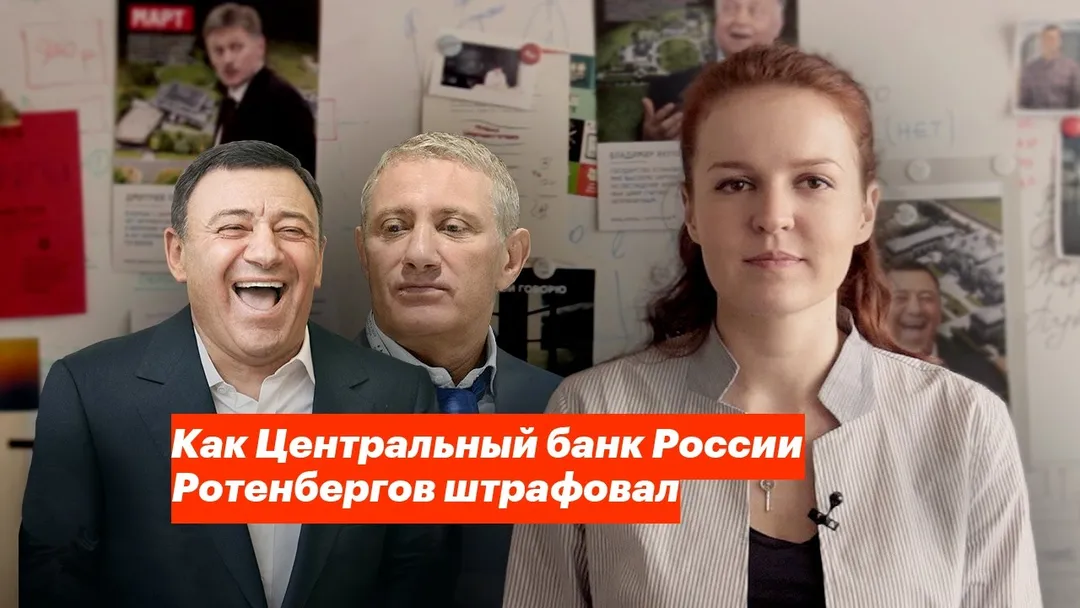
Hi, my name is Kira Yarmysh, and now
I’m going to tell you an amazing story.
Imagine this situation: your home
has been robbed, but you absolutely
couldn’t care less. Meanwhile, your neighbors are terribly
upset: they run outside and try
to catch the thieves. And you, meanwhile, thoughtfully
look out the window and do absolutely nothing.
take no action.
Sounds strange, right? But that is exactly what
recently happened in our country. Arkady
and Boris Rotenberg, Putin’s cronies and
closest friends, are graduates of
a physical education institute. They have created nothing
and have no particular talents, yet
they still receive, without any competitive bidding,
multibillion-dollar state contracts.
That includes the bridge to Crimea and the Power of
Siberia gas pipeline, as well as numerous Olympic
facilities. We at FBK (the Anti-Corruption Foundation) have repeatedly
talked about them, including showing their
homes outside Moscow. Here, take another look
at what they look like. Now let me move
directly to the story. In 2015,
a major scandal broke out involving
Deutsche Bank, Germany’s largest bank.
It was accused of lacking effective
anti-money-laundering procedures and of shortcomings
in its reporting. It turned out that Deutsche
Bank had been used for several years
to secretly move money out of Russia.
How did it work? Simultaneously,
two identical trades were executed. They
are also called mirror trades. In Moscow,
securities were bought for rubles, and in
London they were immediately sold for
dollars. Money in the morning, chairs in the afternoon; afternoon
money, chairs in the evening; evening money, night
chairs; night money, morning chairs; morning—well,
everything’s clear. Clear. But can it be chairs in the morning and
money in the afternoon?
[music]
Over several years, Deutsche Bank
carried out several thousand such transactions
worth $10 billion.
There was no economic sense whatsoever in these
trades. Often they even turned out
to be loss-making for the client, and their only
purpose was to secretly take rubles out of
Russia, convert them into dollars, and then
place those dollars into offshore accounts where
they would be impossible to trace.
So where was the money? Who do you think those
very Deutsche Bank clients laundering
money this way were? That’s right—the
Rotenbergs. After being placed under sanctions, they
ran into difficulties moving
money abroad, so they used
this very scheme: mirror trades.
The trades were made in small amounts, and the bank
didn’t notice them for a long time. But there were so many
of these trades that eventually
the U.S. Department of Justice finally became
interested, because one of Deutsche Bank’s branches
is located there as well. And that’s when
the scandal erupted. And now comes
the best part of the story.
The investigation went on for many months and
ended in January of this year. In the end,
the bank had to pay fines as follows:
to the United States, $425 million;
to the United Kingdom, $204 million.
But Russia’s Central Bank also
fined Deutsche Bank—and you will never
guess the amount: 300,000 rubles (about $5,000 at the time).
Just think about it:
$10 billion was secretly taken out of Russia,
no taxes were paid on it,
and in effect our country was robbed
of an enormous sum. But
the Central Bank assessed the damage at 300,000
rubles. The United States and the United Kingdom, which
were not the ones being robbed in this case,
demanded $630 million in penalties
because the bank failed to scrutinize
its transactions carefully enough and allowed capital
to be moved out of Russia. And we, the injured
party, have no complaints either against the bank
or against the Rotenbergs. Please, dear friends,
go on robbing us—we don’t object at all.
I’d like to finish with this
wonderful quote from Putin: “We will also need
to prepare, as has been done in other countries,
our own national plan
for combating money laundering,
tax evasion, and de-offshorization.”
So this is what our national anti-money-laundering plan looks like in the end:
a bank involved in laundering money
gets fined by us
a laughable amount, and the Rotenbergs are handed
yet another government contract without
any competition. Why does this happen?
The explanation is very simple. Here it is
right on your screens: Putin is patting
his best friend Boris Rotenberg on the head.
For 17 years, power in this country has been
held by a gang of people bound together.
They are not going to stop one another
from stealing, and they are not going to punish themselves.
They will do nothing for the good of the country,
because their only goal is
their own well-being. If you are not
okay with that, if it outrages you, then you have the power
to change it. Alexei Navalny will be
running in the 2018 presidential election.
He needs your signatures to support
the campaign. You can add your
signature here and thereby make your contribution to
the fight against corruption. Subscribe to
our channel—this is where the truth is told.
