Navalny at 20:18. Broadcast #015. Putin’s Rule Comes of Age, Matilda, Khodorkovsky, and Udaltsov
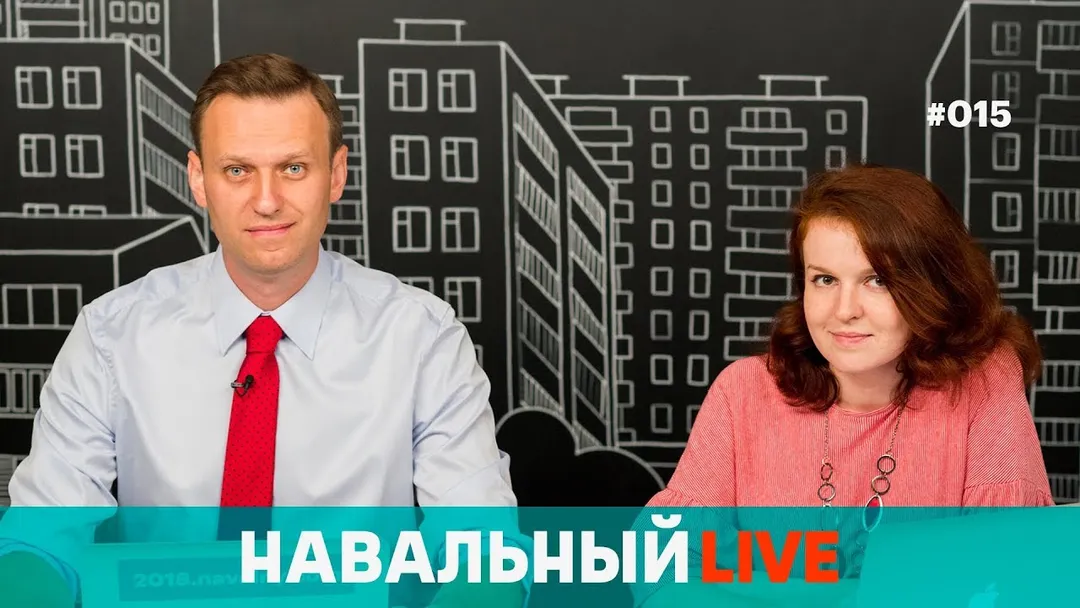
[music]
Good evening. In Moscow it's 8:18 p.m. That means
that Alexei Navalny is here in the Navalny Live studio.
Navalny. I'm always here on Thursdays
if I'm not in court, not in a special detention center,
and nothing has changed. Who's this girl? What
are you doing on my broadcast? This is my broadcast, my
views, my likes. My name is Kira, and I am
your secretary. So now I'm here. Yes,
actually, we wanted to reveal right away
one of my darkest secrets. Journalists
quite often ask me,
"Alexei, what are you afraid of?" And the assumption is
that I'll answer, "I'm afraid of a sudden
attack," or that I'm afraid of something like that. But the truth
is—and everyone in our office knows it well—
that I am terribly afraid of
live broadcasts. And in particular, this
live broadcast—more precisely, this specific
live broadcast. Everyone knows perfectly well
that when Thursday comes around, it means
Navalny spends the whole morning walking around the office
whining, "My God, I have to host the broadcast again today, I'm
terrified." So I, uh, invited
Kira, who claimed that she isn't at all
afraid of live broadcasts—it's just
a camera. Alexei was so terribly afraid—really.
Today he talked about it so much
and prepared so seriously that even you
started to get scared. So now we're all afraid that Kira
is going to mess everything up today. So be sure
to write in the comments what you think of her.
We'll kick her out if necessary.
For the rest of the broadcast, Kira will
help me with the questions. If something
happens to me and I start saying
the same thing over and over again—which does
happen to me, as you know—she'll kick me
under the table. And, very importantly,
since she is my press secretary,
the press secretary of the Anti-Corruption Foundation,
thanks to Kira, we'll have
a segment called
—I forgot the name of the segment—the segment
is called "The Question Navalny Doesn't Want
to Answer."
For all the journalists who ask me
questions all week, I
bring them to Alexei, but Alexei doesn't always
feel like commenting. But finally,
today he will comment, and there'll be
no way out. She'll simply ask the very
most important questions that journalists ask me,
in exactly the wording
they use, and there'll be
no escape—I will answer them. And our
first news item that we want to discuss
is, of course, the celebration that took place across
the entire Russian Federation, because on August 9,
that is, just yesterday, 18 years ago,
Vladimir Putin came to power. He was
appointed acting
prime minister of Russia—or rather, he was
appointed prime minister, and then became
acting president. And that was how
this 18-year
ascent began. And yesterday, a child who
was born on that very day turned 18
years old. In other words, entire generations
have grown up under Putin. How old are you? I'm
27 now, and back then I was nine. So
your entire conscious life has passed
under Putin. A Putin child, in that
sense—a child of the Putin generation.
That's really true. Let's recall
a few seconds of video showing how it happened, how
he was appointed, what all the citizens of
Russia saw.
He will be able
to unite around himself those who
in the 21st century
are destined
to renew
Great Russia.
This is the secretary
of the Security Council,
director
of the FSB (Russia's Federal Security Service),
of Russia, Vladimir
Vladimirovich Putin.
"...who are destined to renew Great Russia." Well,
there you have it—he's been "renewing" it for 18 years now. And this is a very
important video. I think it's important to
show it, because now Putin
builds his ideology on a kind of
contrast with the Yeltsin years. We
can see it. But who appointed him? He was
appointed by Yeltsin, appointed by the
Yeltsin family. He was appointed in order to
serve the interests of the Yeltsin family. So I don't
know—do you feel any contradiction between
the Yeltsin era and the Putin era? Or
do you not remember the Yeltsin years at all?
I mean, I think I remember the moment when
my parents were deciding to vote for him.
That's about the only political memory from
my early childhood connected with
politics. And after that, I already remember the moment
when he was leaving.
On New Year's Eve itself. Kira has just now
partly formulated the explanation, the answer
to a question journalists also often ask me:
why have young people now come out
to protest rallies? Well, that's why—
because all their lives they have seen
only Putin. And all these stories about
the "cursed '90s" or the Soviet Union
or how little we had back then—
I don't know, in the 1980s we sat down at
the New Year's table and had nothing, whereas
now everything is abundant—I have bored Kira
with stories like that several times. But
she can't even understand what it's about. Right. And
my children can't understand it either, and even people
who are older—if a person is 30, that
means Putin came to power when they were
12. Even for a 30-year-old...
a person for his entire conscious life. He
has lived under Putin all his life, and he's somewhat
tired of it. Besides, in recent years they
have obviously seen the economic situation
deteriorate; put simply, they just see
their wages going down, right? Yes, of course, and they
are absolutely not buying all these stories
about how things are better now than in the 1990s
they want things to be better than in
the neighboring country; they want things to be
better than yesterday, but instead something is happening that
makes life worse and worse, every
year. So young people, people of the new
generation, people of Putin's generation, they
will protest because they are simply
fed up. Will you protest? Of course. I
saw how you—yes, somehow you didn't end up in
police custody during the rally. And yes, there were
some extremist episodes in your
biography too.
Well, speaking of 18 years of Putin, and
in connection with today's and yesterday's
events, we have actually seen very clearly
seen it.
What is it based on? The only thing,
the only thing Putin can rely on now,
is no longer the standard of living—not for a long time now,
not even high oil prices, but
exclusively, simply, the jailing of people
who are dissatisfied with something, including
people who, well, haven't even done
anything that could in any way be interpreted as
any kind of resistance to the regime.
Of course, at the start of our program we cannot avoid
touching on two topics. First of all, this is
the verdict that was handed down
yesterday, right?
regarding the rally on the 26th.
Andrei Kosykh was sentenced to 4 years—
or rather, 4 and a half years
of imprisonment in a penal colony for
taking part in the rally on the 26th. He is accused
of having attacked a police officer, uh,
and the photograph in the case file on which
the whole case is based is just some kind of
dark silhouette. It's obvious that no one
attacked anyone; we did not, in general, see any beaten
police officers. We basically did not observe
any genuinely beaten
police officers there who could
say that they had suffered harm to their
health. We did not see any. These are
completely fabricated cases. And one more
verdict was handed down just today, uh, right?
In court—I know, I'm saying Dmitry Kretsky
Dmitry Kretsky's case has been sent to court, but I mean
the verdict that was delivered just
today. It was the verdict in the so-
called Army of the Will of the People case.
Yes. Well, everything is clear there with Alexander
Sokolov,
who was sentenced to 3.5 years. It's not
entirely clear with the others, to be honest,
the other members.
It's not clear to me at all. So let's—if
it's clear, maybe it will be clear to the viewers too,
at least a little, so
there are strange views. Some people consider my
views strange; some consider your
views strange—for example, your
views on music or partly on
literature seem rather
strange to me. But if I become president, I am not
going to put you in prison for that for four years.
These people who today received
various prison terms—the journalist Sokolov
got three and a half years, Parfyonov four years,
Kirill Barabash three years, and the group's leader
Yury Mukhin got a 3.5-year suspended sentence. What
exactly was their crime? If you
just type into YouTube right now "Army
of the Will of the People" or "referendum for
responsible government," you will see directly
—I wrote it down, yes—they stated that
they wanted a referendum and had even drafted
a bill under which there would be
accountability for the highest elected
state officials—the president and deputies
if they did their jobs poorly. I mean,
it's all logical: people simply wanted to hold
a referendum if they were doing a bad job. For
example, if, uh, your performance on
this broadcast today were to get
nothing but dislikes—well, at least
it would be hard, hard to separate whether
people were actually criticizing themselves or
criticizing me.
You say "dislikes" because you're mixing things up
or on purpose? I already said just now
"without likes" because deliberately, yes, with all
due respect.
So anyway, returning to the
serious subject: these people came forward simply with the idea
of direct democracy. They said: we want
to hold a referendum, we want to evaluate
this government. If the government is evaluated
well, we reward it. This was explicitly
written down. If we evaluate the government poorly, we
punish them—not shoot them, not hang them,
not do something horrible to them. Well,
there should be some system of penalties within
the law. And all these people, for
simply sending out press releases,
—I was called by the defense side
as a witness in this case. Well, because I
know people from this group, uh, and I have long
followed their activities. For the most part, their
activities, with all due respect, mainly
consisted of the fact that they
sent out press releases about their
bill, and these press releases were read
and deleted, and now they have been sent to prison for
3 to 4 years for that. Let's listen to what
Sokolov said—not even in his final statement,
but after the verdict was delivered, uh. Do we have
that clip?
that the idea of a referendum in Russia
and in essence, the full weight of the law will begin to be used against us.
a petty crime involving obstruction
a referendum, as you can see
thank you for your work
please throw it in here
please
for conversations
people were accused of creating
an extremist community, practically
a terrorist group, simply because
they said, “Let’s hold a referendum and
we’ll evaluate this government.” What
happens in Switzerland, for example, what
happens in a large number of countries, what
the Russian authorities themselves introduced when
for example
they began using the Russian Public Initiative system
where 100,000 people can
vote there on something
or assess something, and the
Active Citizen system under Sergei Sobyanin is
exactly about that. Of course, we know
that everything there is rigged and falsified, but
in essence it’s exactly the same thing, a kind of
direct voting system, a referendum.
So now let’s jail Sobyanin and this whole
group under the same article
as Sokolov. Uh, I don’t know, Sokolov is
also an excellent investigative journalist.
Did you ever work with him, did you
ever speak with him? I didn’t. I remember he did
an investigation into the Vostochny Cosmodrome
there was some major, really good
investigation, but I never personally
interacted with him, unfortunately. But he
really was great. I also, with him—with
him specifically, from that group—
he was the only one I didn’t know, uh,
he was an excellent journalist—probably still is
an excellent journalist, just a journalist
who is sitting in prison, and this is completely
uh, a completely vile, disgusting
story. I understand perfectly well that in every
one of our broadcasts, unfortunately, we talk about
some criminal case, and it is
revolting, it’s disgusting, it’s
lawlessness has already become somehow
almost banal to use the word ‘lawlessness,’ because
people call every case lawlessness. But here
it’s simply
random people being imprisoned. For what? So that
these 18 years of Putin, uh, well
so to speak, would continue further. That’s
the only thing holding it all together. It’s,
unfortunately, uh, unfortunately, horrible,
monstrous, and
this concerns not only
such political cases; it concerns
the criminal justice system in Russia as a whole. This
week some striking statistics were
published—yes, in *Vedomosti* (a Russian business newspaper), if
I remember correctly, *Vedomosti* published
statistics on the number of acquittals
in Russia. And it would seem they couldn’t
possibly get any lower, because everyone kept
joking endlessly that in Russia only 0.4%
of verdicts are acquittals—0.43%, which is
lower than under Stalin, but apparently there was still
room to go down, and now it’s 0.36%, as
you can see on the screen right now, percent
acquittal rate. But the most interesting thing there
is which cases have lower—or rather higher—
acquittal rates. If you wanted to know
what crime to commit so that
your chances of acquittal would be higher,
well, obviously—if you know the answer to that question
you need to—don’t look here, don’t look here,
please
corruption crimes. It seems to me
people should be acquitted more often for them in our
country.
That’s right—in fact, really,
the acquittal probabilities are all very
low across all types of crimes. That’s how
the system works: it just imprisons everyone.
Once you end up there, you’ll almost
certainly be jailed. But several times
less
the probability—if you, uh, are put on trial there—
of being imprisoned is lower
for abuse of official position
and exceeding official authority.
For abuse of official position,
the acquittal rate is 2.1%; for exceeding official
authority, 1.6%. So there, several
times more often, as we can see—still low, but
several times more frequent
some measure of justice, the chance of
acquittal, goes to those people charged with
the crimes under which officials are usually tried
rather than for bribes, because here people are
actually prosecuted for bribery fairly rarely. It’s a complicated
offense structure, whereas exceeding official
authority—But if you, Kira, decided
Interesting, weren’t you supposed to be given
the same little note as me?
Actually, here’s the takeaway: if someone wants
to commit a serious crime,
a crime with a high probability of
acquittal, then what they need to do is
falsify elections, they need to
rig elections. What do we have there,
eight, almost nine percent—8.7–8.9%
chance that you’ll be acquitted
if you falsify elections. That is,
that’s the kind of crime toward which
the authorities are most lenient. But I
think it’s fairly
obvious why: because in 100
percent of cases, the authorities are the ones who
organize it, and probably imprison these people
if they falsify things in favor of some other
side. And guess under which article
there are no acquittals at all, with a 0%
chance of acquittal if you suddenly
find yourself charged under the infamous Article 282
the extremism article under which
Sokolov and all the others have now been imprisoned, under which
these criminal cases are being opened.
against our campaign headquarters, where in general
they persecute people and fabricate cases against
political activists. Article 282 (Russia’s law on incitement of hatred or extremism) — if
you are charged under it and the case makes it to court, you are
saved 100%. That’s how this
system works. But what I actually want
to say to you, Kira, is something very interesting.
First of all, don’t commit a crime,
because given where you work,
you have no chance of being among that 8% of acquittals. Even
if you start rigging elections.
But besides the fact that this system has
a repression-based— is that even a word?
Repression-based, repressive — sorry,
a repressive machine, yes, uh—
it also grotesquely distorts
the law enforcement system, the police.
Police officers simply understand that they do not need
to prove anything in court. Yes, you don’t have to
prepare proper case materials, because
there is no adversarial process in court. You can put together
some case file, send it over, and you will still
get the person imprisoned, the person will still
be convicted. That means there is no need
to work. The Investigative Committee doesn’t
work, the police don’t work at night,
don’t work — well, just imagine that you are
an investigator.
I think about this a lot when I’m at your
court hearings. I recently told Alexei
that three years ago I sincerely thought that
something here might change, that in the end
some kind of
sudden event might happen that would somehow
change the outcome of the case. Well, at least
a little bit — like in the movies: an acquittal, a witness
suddenly says, “You know what, no, I
changed my mind.”
Those same police officers who
come there, stand up, start
— at your last hearing, the police officers, well,
seriously, he was fumbling with some papers, he
was nervous, as if he had forgotten a lesson
he hadn’t learned. I mean, usually they — well, they
absolutely do not need to do anything, that’s
true. And still, the rewritten
reports — they brought in ten people, and their
reports all said the same thing. Was it in
Volkov’s case or Rubanov’s, when there was
that case where they were in the courthouse corridor
rewriting them? I was sitting there then. What
was that? Well, and the same thing happened now
when your report was signed
by the police officer who, at that very
moment — formally, when he supposedly signed it —
was in Volkova’s courtroom giving
testimony. They literally rewrite reports in the corridors.
So in principle, in the kind of courts
we’ve seen in films, and that will exist in the
beautiful future, this would be
inadmissible evidence altogether. Any
judge would throw it out immediately. And in an adversarial
process, in a jury trial, this would be
completely impossible, because jurors, well,
obviously, would never find
a person guilty on the basis of such
evidence. It would all fall apart. But in
a Russian court, it works. By the way,
that is one of the reasons why, uh,
the Russian state
so persistently removes jury trials from
so many areas, because
the percentages — actually, with juries, by the way,
there
it’s 30–40%, precisely because the police do poor work.
Well then, uh, let’s probably
move on — you’re rubbing your hands — to the question
I don’t want to answer.
Well, I mean, maybe I do want to, I just haven’t yet
answered it anywhere before on the air of this
program. Tell us, uh, what were you
being pressed about this week? Well, obviously
they asked about Khodorkovsky first, and then
today about Udaltsov, so about
Khodorkovsky — what were they asking? Let’s put it in the
harshest possible terms for
me. About Udaltsov, uh, they quoted him to me,
a quote that went as follows:
We probably have it — please play it.
“And when that same Ilya Ponomaryov was running around on
that day saying that we needed to break
through the police cordon, I found it
strange, and I wondered why he was doing
that, when Alexei Navalny, the day before
that rally, had suggested not going to Bolotnaya (Bolotnaya Square in Moscow, site of major protests)
but instead heading toward the Udarnik cinema/theater.”
End quote. Yes, basically it’s simple:
comment on it. And right now I also see
that we’re getting a huge number of
questions: will you cooperate with
Udaltsov, will you be on friendly terms, will you
create something together? Alexei, please comment
on the statement. Who are they asking about — Udaltsov
or Khodorkovsky?”
Well, today it’s really about Udaltsov, because
of what happened today.
Let’s start from the beginning. I’m sitting at work in the morning,
and after a while Kira comes to me
— my phone is exploding: “Udaltsov,
press conference,” everyone’s asking. So I
went to look at what was going on there.
The press conference — I click on Rost...
Show me the photo. Ah, there it is,
it’s on the screen. I see Udaltsov, and I
honestly, without any reservations, say: I’m very glad
he’s free. I’m glad to see him. He is
without question a political prisoner. The case
against him was absolutely fabricated.
I’m happy that Sergei has finally been released,
especially since he served the full term without
any reductions, without any of those special arrangements. Well,
and who do I see standing next to him? You saw it
in the video — nodding along, standing there like
his handler.
At the press conference, clearly orchestrating everything.
Some familiar woman. Where had I seen her
before? Maybe we have a little...
A video featuring her—let's watch it.
Let's watch that too.
Mr. Navalny deceived people—that's where we started.
We started with the fact that he deceived the people
who follow him.
And we also saw this wonderful
person—what's her name?
Volkova, who for some reason goes around everywhere and
says that she is my former lawyer.
She's a strange woman who, for all anyone knows,
appeared out of nowhere, probably in 2012,
and started introducing herself as—what does that even mean—
speaking from the position of a lawyer. You've probably
seen her in REN TV reports (a Russian pro-Kremlin television channel), where she also
talks about me and what she called me. We
even had some video where Navalny was called
a political pedophile, a political
pedophile—meaning Navalny is a political
pedophile. And most of all—then there appeared
a photograph of this person on screen right now.
The director of our foundation, Roman
Rubanov, who was jailed for 10 days,
was jailed because this very same
Violetta Volkova, who today
was running Udaltsov's press conference,
showed up at a rally where he was
the legal coordinator, and then in an
interview she said, "I was just passing by, I saw
the stage was empty, so I went up and started
speaking." And when Rubanov said,
"Why is some—well, I don't want her
speaking. I'm the official filer for the rally, I'm its
organizer," and tried to turn off the sound, the
police came up to him and arrested him, and
they took him away—he was detained and
jailed for 10 days. He served 10 days
because of this wonderful
woman. So, uh, despite all that,
while I understand how hard it has been for Sergei,
these four and a half years, and the kind of
difficult circumstances he found himself in, still, to me
it's strange to watch the group of
allies he now has—this
is very disappointing to me. Well, I
hope that the man has just been released—what can
you expect from him? I understand that even if
you're locked up for 15 or 25 days, you're
basically isolated. Kira brings me
printouts,
news summaries of what's happened. But
when a person is actually in prison,
there's even less real information available about
what's going on. So let Sergei
get out, look around, understand what's happening
around him, and maybe be a bit more, uh,
careful, perhaps, in his choice of—well, I don't even
know what to call them—adviser, handler,
whatever. Unfortunately, it looks
like a handler. I've known Udaltsov for many years,
probably 15 years. It seems to me that he
will somehow be able
to break out of
this grip, this entanglement, uh, and from those whom
she, of course, represents.
Khodorkovsky? Yes, Khodorkovsky is in there too.
There's also that wonderful quote everyone is asking you
to comment on. I hope we'll
listen to it. Let's imagine that something
happened and Navalny was allowed to run in
the 2018 Russian presidential election,
and let's imagine that he wins. How would
you react? Would that make you feel
joy or fear? For me, it would cause
joy on the one hand, because I
believe any rotation of power is
a good thing. On the other hand, I would definitely
say: guys,
stock up for hard times,
because famine will begin—not famine, I mean in
a broader sense. No, it's just that we'll return to
a system of monopoly power that is unpleasant for everyone.
At the beginning of his path, Putin was
noticeably more liberal than he is today, but the path
that a
leader in our country travels
is always more or less the same. And that is exactly
why I believe we should frame the question not as
"Who instead of Putin?" but "What instead of Putin?" And that
is the position that, as of today,
a real transfer of power in
our country will take place, first,
within the next eight years, and second,
it will specifically be a change from a presidential
to a parliamentary, or parliamentary
republic. There will be no other kind of change.
So you're stocking up on, I don't know, suitcases
and hardtack just in case? No? All right, so they're
asking you to comment on that.
Simply put: okay, Mikhail Borisovich (Mikhail Khodorkovsky) has been talking about
me all week—let's talk about him.
Mikhail Borisovich, listen and take notes. But
first of all, as Khodorkovsky himself correctly said,
I watched his interview
with Yury Dud (a popular Russian interviewer)—an excellent interview.
I also watched his interview with Venediktov.
In that interview, he said, well,
"Guys, you're quoting only one of my
phrases." And in essence, in essence,
there's nothing bad there. I mean, I certainly
don't like, uh, the way it was presented,
which is exactly what he was talking about, because
he understands that journalists will
pull out only the phrase, "If Navalny
wins, stock up on hardtack or suitcases,"
but in essence he's simply saying that
we don't need to elect just a person—we need
to change the system. And that's fine, he
is saying the right thing, and I'm glad that
this is being discussed, because that is the purpose of
our election campaign. After all, this
is not an election campaign specifically for
me personally. It is an election campaign for
people who want change in Russia, and
of course change in Russia is impossible
unless we make the system such that
some person, some new person, will not be able
to usurp power again. And that requires the very
constitutional reform. In every
I talk about this in the interview.
It says
that what disappoints me about the position
of Mikhail Borisovich (a respectful way of referring to Mikhail Khodorkovsky) is this: why
doesn't he want to read our program? Why
do we keep coming back to this over and over?
A lot has already been said: we will reduce the presidential term to 4
years, we will eliminate
the possibility of serving more than 8 years, we will give
more powers to parliament, and everything
else—this is all a huge part of my
program, and a lot has been said about it. But again,
uh, well, the saddest thing in all this
is that Khodorkovsky—I think very highly of him,
he is a very smart person, very
good—but unfortunately he still
gravitates toward that traditional camp
of the Russian opposition that has led us
into the dead end we are now in.
The entire Russian opposition, broadly speaking,
is divided, for me, into two parts. Some
people do things, while others endlessly
discuss how exactly we are going to live
in some future Russia when Putin is gone.
And they say we absolutely must, right now,
think about what Russia will be like without
Putin. That's a valid conversation, it needs
to happen, it needs to be discussed—but we also need
to do something else. Say Putin is gone tomorrow—
who will be president then?
Let's say right now, this very moment, there's breaking news:
Putin has, uh, been taken to the moon; he's gone off into the wilderness
to chase pike and has decided to keep chasing them
for the rest of his life. Sorry, but
who will be president then, in this
system? They'll appoint someone—Sergei
Ivanov, Dmitry Medvedev, along with his
yachts and all that stuff. In other words, this
system will reproduce itself if we do not
fight it. So let's fight it.
Let's do something every day
to defeat this system, instead of
endlessly agonizing and talking about
how, well, yes...
Well, that's not action—it's an imitation
of activity that consists of
endless discussion and dividing up the skin
of a bear that hasn't been killed yet.
One more question. All right—then what, in your view,
should Khodorkovsky's activity ideally
look like, the activity of his organization?
Please make a note of this, so that when there are
headlines
like "Another scandal in the Russian opposition,"
it says Yarmysh started all this and
all that—well, okay, I'll answer your
question. First,
I absolutely do not share the view
of those people who write, "Look, he's already
been working for three years, we're disappointed, they
haven't done anything," because there was no reason
to have inflated expectations. I
have been involved in this kind of work for many
years, and I understand that you can't change everything
The people who expected that Khodorkovsky would come
and immediately build
some huge organization, really
make things happen, do this, do that—well, that's
nonsense, my friends. You can't just
show up and make it happen like that. You cannot
build, for example, a network-based organization
while being abroad. It's impossible.
You can't build a political party here
especially under conditions of repression. And in general,
he shouldn't be doing this. I told him myself
that he shouldn't try to organize a network
structure—it's impossible to organize one here.
And besides, I certainly did not
uh,
I certainly wasn't expecting extraordinary achievements in terms
of organizational work.
Khodorkovsky is a smart man.
But an ordinary, normal smart person
can't create some kind of super-structure,
because it's simply not possible.
And you can't say, "Ah, he was an oligarch or
a wealthy man, so he must possess
some kind of superpowers." No, he doesn't.
He's a smart, capable guy, but like
any Russian oligarch in the commodities sector, well,
basically none of them has any super-
mega-abilities. If, I don't know, you want
to dispute that, then name me
even one Russian
commodities oligarch—or even a non-commodities one—
who achieved something while operating in
a competitive environment in the West, built
some kind of business there. Where are they? Even
the best of them, uh, accomplished nothing there.
So there is no need
to expect that a wealthy person, coming into
politics, will suddenly change everything here,
set everything right, and do some
super impressive things we've been waiting for for a long time
but that never got done. And anyway, can you name
even one
wealthy person—oligarch or not,
businessman—whose move into politics in
Russia was successful? Not even one that
ended well—just one that, at least for a time,
didn't end badly, or was successful in principle.
Prokhorov? Or those people from Delovaya Rossiya (Business Russia, a Russian business association)?
The current Titov is a businessman too. Well,
nothing was accomplished there either, despite enormous resources.
So for now,
when Russian oligarchs, or simply
wealthy businessmen, run into
politics,
from Khodorkovsky to Usmanov, it generally doesn't
go very well. And there's a great
O. Henry story called *The Modern Village Entertainment*.
Have you read it?
Read it—it's easy to google.
It's called *The Modern Village
Entertainment*. It brilliantly describes the pattern
of interaction between a Russian oligarch and
various people who are trying to
providing political services, that's what this is about.
That's exactly what it's about—even Usmanov, yes, Usmanov,
rushed into politics and decided to say something to me there,
to answer me. But when he ran into
a competitive environment—well, YouTube,
It's great, you feel really confident
when you have Channel One (Russia's main state TV channel) or
the newspaper *Kommersant*, and you write something,
and people can only respond on Facebook. But
when you say it on YouTube, and on YouTube itself
someone answers you back, to a much broader
audience—well, what was his big achievement there?
His "achievement" was that he got played like
a child by some crooks. Who was it there—
Minaev, Krasovsky—who simply took
a huge amount of money and made him look
ridiculous. So I apologize for going on so
long. In general, there's no need to have
inflated expectations. But what disappoints
me is that in that same interview with Dud (Yury Dud, Russian journalist/interviewer),
Khodorkovsky was asked, "So what is
your coolest achievement over the last three years?"
and he says, "A website."
Well,
here we have
an impressive person with almost 100 percent
name recognition in Russia, with probably hundreds of
millions of dollars,
and an intelligent person, a good person,
who has a team—and the biggest
achievement is a website. Well, I have a website too.
Any person can make a website; for that
you basically need nothing at all. I want
Khodorkovsky to come out and say: I will build
a TV channel, I will build radio, I will make
an outstanding newspaper. I will help all these
journalists who otherwise won't be able to do anything.
I go to the section of his—well, this
project for defending political prisoners,
it's a great project. I was one of the people
who advised him to create this
project. At first, if you remember,
it was even called—maybe someone remembers—the project
of Navalny and Khodorkovsky. You remember, right?
We talked that through at the time. So yes,
good for him for doing it—it's better
than nothing. But there it says: currently we
are defending, what, eight people or seven, and
we have helped about 30 people, to whom
they gave 150,000 rubles each (about $1,600), but that's
great. Khodorkovsky helped me too, by the way,
once, with paying lawyers in
one of my cases. If not for him, I would have
been completely screwed there, because from
all sides there were criminal cases, lawyers,
and there was absolutely no way
for me to carry all that myself. But
that's not his scale—to defend seven people, and
it's not his scale to help 30 people.
He should come out and say: I am allocating 2
million dollars a year, and I will pay for
lawyers for all political prisoners
in Russia. There are many of them, but for sums like these—
amounts that are laughably small for him—
he can absolutely allocate them. And they should
select those lawyers through a competitive process.
Relatives can't afford to get to the prison colonies,
so he should say: from this money, I will pay
for tickets for all relatives who need
to travel somewhere—I don't know, to Norilsk,
to visit their imprisoned relatives held on political charges.
Mikhail Borisovich, I am absolutely certain,
I kind of want to tell you this directly—
someday we'll meet, and I'll gladly
discuss this with you in person. But for now,
speaking through the camera, I don't want to see
a tweet from Open Russia saying that we
are raising 40,000 rubles (about $430) for a fine and have already
collected 4,000. That's ridiculous. That's not
Khodorkovsky's scale; that's not the scale
of Open Russia. I want to see the kind of work
that you are capable of doing. You should
do what you know how to do. I don't know—
create some kind of think tank, gather
the best scholars, pay them, do the things
that we can't do. Make films
that millions of people will watch. Build
television. But here, as you can see, everything is
about a little cup—we think every time which
one. Oksana, the producer of our channel, asks
what color cup we should use today—
white or red—and so we
perform in front of a wall painted
with colored chalk because we can't
afford to install, like others do, a video
screen; we can't do a green screen and all
the rest. That is, we do a lot of things,
these broadcasts are watched by hundreds of thousands of people, but
Khodorkovsky could do it on a much bigger scale.
He could make a much stronger showing. But I hope he will.
I hope he will do something bigger. So, to sum up my long
and rather huge answer to
[music]
Mikhail Borisovich's statement: I'm glad that he
is discussing this. I understand that he
is constantly being asked about me. That probably
annoys him a little. But it's great
that he responds. Still, I hope he
moves out of the zone where there is endless
discussion of authoritarian me, and enters
the zone where something—why are you wagging your finger at me?—where something
interesting is actually happening.
One more question—
Wait, before the first question: I can see the chat
is exploding with questions about Kamikadze. What
happened to Kamikadze? As I understand it, this is
happening right now, live.
It seems to me he released a personal video,
and apparently they are opening
a criminal case over it. He said so himself.
He said so himself. People are asking, asking:
Have you seen Kamikadze's latest video? Could he
be imprisoned? Wouldn't you like to help him?
I haven't seen the latest video, but
of course, first of all, I'm sure he did not
make any video for which one would actually
need to imprison someone, and it's hard to make
such a video. But
Of course, we’ll provide whatever help we can.
Whatever help we’re able to provide. And I support him, and
his struggle, in general, for a normal
YouTube channel and in his political statements, I
of course support him, and I hope that
everything will be all right. There’s already
some kind of criminal case that’s been opened,
something unclear. Well, now
they’ll say it’s a criminal case for incitement to
suicide.
Anyway, we’ll sort it out. If he needs
help, we’ll try to provide that help.
Kamikadze is a decent person. You
were wagging your finger at me about something there. Yes, I
was wagging my finger because, well, your
well-known authoritarianism—authoritarianism
that everyone knows about.
I mean, this is an old story—that you’re
accused of being a leader in the cult-of-personality sense, a kind of Putin 2.0.
I really don’t know
how many years this has been going on, but just in
recently,
over roughly the last
year and a half, it’s become absolutely widespread—
the main theme is calling you Putin,
comparing you to him, promising that if you come
to power, we’ll get the same thing
we have now. Columns are being written about it, everyone is talking about it,
speaking out, and even Yury Dud (a well-known Russian journalist and interviewer) asked
Khodorkovsky whether he would put an equals sign
between you and Putin.
It seems to me that it’s become fashionable now—
suddenly one person said it, and everyone
picked it up as one of those trending topics. What’s going on?
Well, first of all, it seems to me
that this is still being discussed by a fairly narrow
Facebook crowd, which of course
is interesting—we read what’s happening there—
but it’s still a rather small
discussion. Second, answer me
please, in front of the whole audience: well,
am I really authoritarian?
No, no.
Please. And you know, several times
at FBK (Anti-Corruption Foundation) staff meetings, I asked,
everyone says no. As for whether I’m authoritarian—I
really think I’m not at all
authoritarian. My working style is, uh,
it seems to me, super democratic, and
that even leads many people
to call our work style—sorry for the expression—
sloppy. That’s already kind of
a negative thing; it shouldn’t be like that, uh,
but
we need to keep an eye on it.
We should judge it by actions and by policy programs,
by statements. Let me stress once again:
we have clearly laid it out—I believe
and I’ve said this repeatedly for many years—that
the super-presidential republic
that exists in Russia is not what we need. The president should
reduce his own powers. If I become
president, I will voluntarily reduce my
powers. We must reduce
the presidential term; we must return
certain powers to parliament; we must give
parliament the ability to conduct independent
investigations, including against the
president. We must free the mass
media. These are my programmatic
positions. No one can reproach me
by saying I’ve only just started saying this now.
I’ve been saying this my entire political life.
And
that, it seems to me, fully explains
what kind of president I want to be and what kind of
beautiful
Russia of the future there will be if I am ultimately
elected to this office. It seems to me that one of the
reasons why this is constantly
being harped on is that, again,
historically, the Russian opposition has
ended up in such a terrible situation because
it is very afraid of leadership, very
afraid of competition. Everything that existed in
the Russian opposition—any principles of
unity—comes down to round tables,
remember Committee 2008 (a Russian opposition coalition),
these are people who, in theory, are supposed to sit down somewhere
and endlessly
keep negotiating about something. That doesn’t work. I
support primaries.
I
am saying quite openly that I will take part in these
primaries and win them. Maybe at some point
I’ll lose them; maybe I would lose them now,
but I’m ready to run and I’ll fight
for victory. I don’t see anything
authoritarian in that. It seems to me that this is a normal
situation. How else are we supposed to choose
our candidate? And many people, they
are simply afraid of this competition, afraid of
these elections. So they want to
reduce political activity to
an endless round table and meeting.
And if you don’t want to spend your time on round tables
and meetings, and you say, “No, I’d rather,”
“guys, go to the city of Omsk now and”
“hold a meeting with volunteers,” they say,
“Right, so you’re the leader; all you want
is to stand on stage, show off, and
have power.” I even shared the airtime, actually.
You can see it right there, with the other person. Well, that’s just
how the work of a presidential
candidate is structured: he has to travel and speak,
and his surname has to be printed on the leaflets.
And if you don’t want that, well,
that just means you’re afraid, you’re not confident in
your own abilities, and you don’t want to take part in
the primaries. So I completely do not
agree with these accusations from that point of view.
Well, probably that’s not surprising. Few people
agree with accusations against themselves; Putin probably doesn’t agree with
the idea that he’s a totalitarian leader either. Well,
once again, guys, judge by actions. My
political biography is completely clear.
You can look at what I’m doing now,
what I was doing recently, who my family is, what I
was concerned with how I live and everything else, and
Well, just draw your conclusions based on
these cases. We've been answering this
question for so long. What else do we have in the next topics?
Still-offended Russia: a new turn
just a new episode in the series: some
villains keep insulting Russia. You
remember that in the last program I said
that this is the main political trend
and that we would constantly see some
strange things, inexplicable things, about
certain offended people demanding
some kind of retribution against someone
and that's exactly what's happening now, has happened
something remarkable—or rather, it's not just now
that it's been happening; for several months now this
film *Matilda*, which was made by
Did you watch the trailer? I specifically
watched as many as two trailers today while preparing. I
really, honestly, don't understand. I understand everything,
that Poklonskaya has an unhealthy
love for Nicholas II, so in principle she
got outraged, but I simply cannot understand
what exactly could have irritated her so
much. Does she think that he couldn't have
been in love? Or—well, in this trailer
it's a tsar who cheated on his wife and
who was in love with a ballerina, and that somehow
undermines his pure image
It's just so hard to
grasp. I mean, what here could possibly be
so subversive that people
could get this outraged over it? Why
Well, listen, it's like this: there sits
Poklonskaya, thinking, well listen, this is
a saint, a holy man. He only
had a peaceful demonstration shot down. He
only wrecked Russia. He only
did a whole bunch of terrible things
He only was
a monarch who wanted to remain
an absolute monarch in the 20th century. That's all
nonsense. But this—
a picture with a ballerina—that happened, and
look, here's the thing: the director, Uchitel, is
quite clearly pro-Putin in his outlook,
as a person.
and he's being attacked by other pro-Putin
figures. This week
the main thing that happened was that on the 8th
Kadyrov said that on the territory of Chechnya
there would be no screening, and on the 9th the authorities
of Dagestan said there would be no screening and
tried to request it too. So suddenly
out of nowhere, all Dagestanis decided
that they dearly love Nicholas II and they
want to ban this film.
Even if we try to guess right now,
well, who is it? Did Putin decide to ban
all this? No—the culture minister,
who is pro-Putin, is on *Matilda*'s side.
Poklonskaya is also pro-Putin, but against
*Matilda*. Kadyrov is pro-Putin too, and someone
has stirred up this whole offended reaction—100
thousand signatures have been collected there,
some petitions and all the rest. What's all this for?
And remember how on the previous broadcast I
said this would become the main
political driving force: someone is constantly
getting offended, and some people are constantly
demanding that something be banned. This is what
all politics will boil down to in the coming
years. All sorts of people will constantly
be trying to ban something, because by now it's become
pointless to try to ban me or
you—or really, we've already been banned from
all sides. Now they'll start trying to ban each other.
But, uh, what I wanted
to say, still on the subject of *Matilda*,
there is a reason to be offended, and Poklonskaya
does have a reason to be offended. I don't understand why
she isn't getting offended over Lenin, though. And so
they're writing petitions against the film,
against director Uchitel. Today
Poklonskaya said there should be
a criminal case opened for creating an
extremist organization against
the director of this film. But if you get on at
Avtozavodskaya metro station, on the green
line, and ride along this
green line, where do you arrive? At
Voykovskaya metro station, which is named after
Pyotr Voykov, who, as is well known,
was involved in the execution of Nicholas II—he gave the order for the shooting
and was one of the people who approved
the execution. There are various memoirs
which, admittedly, are rejected by many, about
how he supposedly almost personally stabbed
those children there.
But what is absolutely certain, documentarily,
is that he received something like 16
liters of sulfuric acid in order to
take those people who had been killed in that massacre
and then pour sulfuric acid over them, and
Poklonskaya doesn't notice that at all.
She doesn't notice it at all. Before the start of the
program—I'm about to fly into a rage here
because I—just do the same thing
I did: google right now "Voykov Street"
and you'll find
28 Voykov Streets in major Russian cities.
Where are you from—do you have one where you are?
In Rostov-on-Don, for example, there is a Voykov Street,
and that's not even counting streets called
Voykovsky, or Pyotr Voykov Street, or
something else. What's more, I'll say this—yes, I
am sure Natalia Poklonskaya will listen to
this broadcast, so: dear Natalia
Poklonskaya, in your native Crimea there are two
Voykov Streets, in Kerch and in Simferopol.
What's more, the Kerch Metallurgical
Plant is called Petrus—this was the party
nickname of Pyotr Voykov—and in Crimea you also have
a village called Voykovo, that is, after Voykov. In other words, a whole lot of
streets and a whole lot of localities are named in
honor of the man who killed your
beloved tsar and poured sulfuric acid over him, his family,
and his children. Why are you silent?
Then please go to your native
Crimea and hold a referendum there.
Rename streets there. Why don’t we
hear a single statement at all on this
topic? What hypocrisy, you have to admit.
It’s easier to open these cases, teacher,
by the prosecutor of Crimea.
And she swore allegiance to Ukraine; now she
has sworn allegiance to Russia, but in any case she is
the prosecutor of Crimea, she is a deputy from Crimea, but
if deputies from Crimea are demanding
that streets be renamed—well no, you don’t
want that. You want to ban
some film. It’s disgusting. It’s
disgusting, unfortunately, and well, this is
what is happening. It’s unclear how to
put a stop to it already. As you can see, even Putin’s
people can’t stop it.
Because the theme of an offended
Russia will keep
working constantly.
Now, on to something good for a change. Come on,
something good. We have, we have
good news, very rare good news: we
won a court case.
And that really is an obvious
impossibility, because it was a case about
honor and dignity, a defamation case
against me. I always lose cases like that
because some kind of pro-
Putin clientele, all those people,
sue me and demand that some of
our materials or statements be declared
untrue,
defamatory. And one Sergey
Anatolyevich Mikhailov
who, as the media report,
is the leader of the Solntsevo criminal
group, nicknamed Mikhas, also sued
me over our film *Chaika* and,
surprisingly, lost.
It’s a completely astonishing thing. I think
it has to do with the fact that he really did it
on his own initiative.
He filed it just to somehow
curry favor a little with all that
Kremlin crowd. Riding the wave of Usmanov
filing suit, he apparently felt
that he needed to sue Navalny, needed
to send some signal that I don’t like him either,
that I’ll join the fight against
him, squeeze a million rubles out of him (about $11,000), but
what happened was that he filed suit and everyone
remembered the film *Chaika* again; everyone rushed
to see what we had said in the film about it,
*Chaika*, and once again recalled and saw the facts that
our Prosecutor General is a gangster,
that his family are gangsters and thieves and
corrupt officials, and that deputy prosecutors general
set up companies together with
the wives of Tsapok gang members
who murdered children, and the effect was the opposite.
So, in order to end this more quickly,
they denied his claim.
So that’s how we won, but
the most astonishing thing, because of this trial,
is that the documents Mikhailov
brought to court show that
he was awarded by President Putin.
President Putin presented him with
a commemorative watch.
And the coolest part—what I liked even more
than the Putin part—is that we see that in
2009 he also received a certificate of honor
from the Minister of Internal Affairs,
Nurgaliyev.
Our lawyers dug this up, and they brought
all of this in. You understand, it’s fantastic: here is
a man whom all Russian media call
the leader of an organized criminal group,
the Solntsevo group; all foreign media call him that,
the Swiss prosecutor’s office called him that,
that’s how he appears in police files,
and yet they give him a certificate of honor.
And I’d be interested to see how
that happened. There stands Minister Nurgaliyev,
Nurgaliyev back then, in his uniform with stripes
and epaulettes, all gleaming, and he walks up to him and
I’m interested in only one thing: did he say to him,
“Dear Sergey Anatolyevich,” or “Dear
comrade”?
“I am awarding you this certificate of honor
for your contribution to... whatever it is you do.” And the same
goes for Putin’s administration, because Peskov
was lying, as we have now learned. It turned out
that when this was first discussed,
he said there had been no award ceremony.
But there was—there is already an official statement.
It turned out he lied to all of us, and
indeed they did present him with a certificate of honor,
they gave him a watch. For what merits, I wonder?
But we decided not to drop this story,
and we sent official letters both to the Interior Ministry and to
the presidential administration—official
letters, which they are obliged to answer.
We want them to confirm the authenticity of both this
certificate of honor and these
award watches with which our authorities
reward the wonderful Sergey
Anatolyevich, whom for some reason everyone
considers the leader of the Solntsevo
organized criminal group.
It will be very interesting to see what they
reply to us.
What else is on the agenda for us, Kir?
Today we also have
teachers—not the director Uchitel, but teachers.
This is actually extremely important news
that came out this week: the Levada
Center published the results of its
large survey of teachers, and it turned out
—well, a fairly obvious thing turned out. I think
even without the survey we all understood this,
it’s just that now we have actual figures
reflecting public opinion. So what
did they find? Please tell us.
What they found was that
the number of teachers satisfied with their work
By the end of 2016, it had sharply declined—
just think about it.
And the share of those dissatisfied with their salary increased,
while the share satisfied with their salary rose to 28 percent
to 34.
What matters here is the abrupt, almost sudden
drop in teachers’ satisfaction with their
work.
This is the most important point. We began
today’s broadcast by noting that
the Putin regime has turned 18—reached legal adulthood,
and that is a completely
fitting piece of news, because, well, that’s it—he has
already squeezed the entire country dry, to the bottom. He
can’t do anything anymore. There was a big
discussion about this last week,
or the week before, after an article in *Vedomosti* (a Russian business newspaper) about
how the presidential administration cannot
find an image of the future. So
Putin will run in the election, but they can’t
piece together any kind of vision for the future. But
how could they? What are they supposed to say?
Before, the vision of the future was clear. In 2005,
oil prices were rising, and they told people:
we’ll raise your salaries a little. That worked. In
2011–12, and then in 2014–15, it was: now we’re going to
go to war with everyone and seize something.
They seized something, but everyone only got poorer because of it. Basically,
the whole thing rested on repression and
on the fact that living standards were gradually
rising because the price of oil
was gradually rising. Then oil prices fell,
and the king was revealed to be naked. And this same Levada Center survey
also looked at teachers’ salaries, and we
learned that, uh, half of all teachers earn
less than
20,000 rubles (about $340 at the time).
Another 25% earn between 20,000 and 27,000 rubles (about $340–$460), and another
quarter earn more than 27,000 rubles, while the average
salary is
25,900—that is, 26,000 rubles (about $440). That still
sounds like a fairly decent figure,
but I personally know only one teacher—
my friend, about my age. She
works at a school in Tambov Region (in western Russia),
and she earns 11,500 rubles (about $195). At the same time,
part of that money is paid to her as a supplement
for being a young specialist, because, well,
to be completely honest, it’s 11,000—11,000
plus bonuses and extra payments.
That is, if she were not
a young specialist,
well...
That’s exactly why they jail people,
because what else can they say to teachers? Well, how
could job satisfaction possibly rise
if, among the top 25 percent
of the highest-paid teachers, we include people
who earn 27,000 rubles? That’s less
than 500 U.S. dollars. There you have it—a country
claiming global leadership,
extracting oil and selling oil for
trillions of dollars, which has
nuclear weapons, which gives various countries
billions of dollars left and right,
and yet to its highest-paid
teachers it can pay salaries of about $500,
at most $600. How is all this
even happening? And it’s obvious that, well, it cannot
work like this. It simply cannot. So,
please explain—your
teacher friend, does she talk about
politics, or do you not discuss it?
How she votes, I don’t know. But one thing is absolutely
certain: she will not vote for Putin.
So
no, in fact, they are all very
unhappy with the amount of reporting. And besides
their salaries and everything else, it’s not just that—
the entire education system seems
so
idiotic that they spend far more
time filling out stupid paperwork
instead of working with children. Have you
read Alexei Navalny’s platform? I have.
I’ve read the platforms. That’s exactly why, by the way,
this didn’t come out of nowhere.
I didn’t just make it up off the top of my head. In
2013, we were constantly
meeting with teachers. Even now I
still meet fairly often with teachers—
with teachers at meetings with volunteers—and
they too, by the way, cite salaries
well below 26,000 rubles, and all of them
complain that because of all the reporting, we are not
working with children—we are writing papers
that nobody reads. And since
2013, every one of my
platforms has included a point that I will implement:
I will free teachers
from this endless reporting. It is not
needed, it does not work, and in any case
it is falsified. It’s simply—yes, it’s
this endless paperwork flow that
nobody needs. Our task is to make sure
teachers work with children and with parents.
Let them use all that time
that they now spend on forms for the district education office and for
reporting. They keep an electronic gradebook,
and they keep a paper gradebook, and they also
do all sorts of other things—lesson guides,
endless materials, endless meetings—and
none of that is necessary. They should be teaching
children. And the practice of modern
education in European countries, in those
countries whose children achieve outstanding results
in various international
Olympiads, shows that teachers need to be left
alone, and that their salaries need to be
raised. And the Russian budget can
raise their salaries and stop
forcing them to do
stupid paperwork.
But I want to say, so as not to end
on such a gloomy note—I see we are already
coming close to the end—
that this situation with teachers is
catastrophic, and
It’s terrible for them, and it shows there.
There is a sharp rise in discontent. It
is good for running an election campaign.
These teachers who earn
11,000 rubles (about 11,000 RUB) are unhappy, but many of them
still, by the way, continue to vote for
Putin. Why? Because they all say,
“Well, if not Putin, then who?” It seems
there’s no one else. And for 18 years now
they’ve been told that there is no one else, but
there are others. In particular, there are other people
and there are ours as well. In this election campaign,
in this election campaign, we need to
take an active part, telling
teachers like these that there is another, completely
different world possible, and this is no
fairy tale. With the current budget, it is possible to
raise their salaries almost twofold.
This may not be a problem at all.
You could do it just like that, and remove
half of the excesses. There are candidates
who talk about this. So, my friends,
I urge all of you to take an active
part in the campaign. These people all across
the country, who are sitting there, who
are unhappy with their salaries, unhappy
with their situation, unhappy with their
principals, unhappy with their
bosses and governors—they are waiting until
someone comes to them and tells them
that such an alternative exists, that there is such a
candidate. They do not want to let him onto the ballot,
but all together we must, uh, make that
happen. That is why I am going into this election
—to help all these people. We are all going for one
choice, for that purpose, right.
And now, well, everyone in the comments
will write that I seated her next to me
so she could go after you.
Please, on the next live stream with me,
argue actively. Thank you very much to everyone who
watched this broadcast. Uh, in the description of this
video there are links to all our
social media pages, please
follow us—definitely follow us
and definitely subscribe to our channel.
They tell the truth here. Uh, next
Thursday, 2018, I’ll be here with Kira if
uh, she got good reviews, probably.
With Kira. If the reviews were bad,
then so that she can improve. See you
next Thursday.
[music]
