Navalny at 20:18. Broadcast #004, 11.05
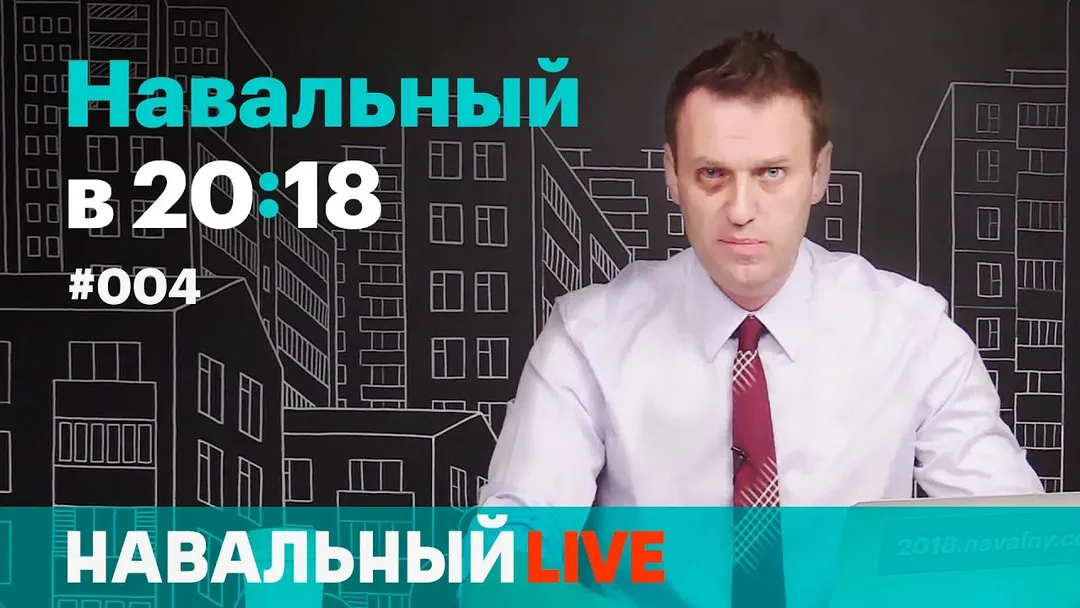
[music]
Hello, everyone. It’s 8:18 p.m. in Moscow. This
means that in our channel’s studio, live on
air, is Alexei Navalny.
My appearance today is more
traditional: no green egg, no
green face, sorry, no cool
eye patch. I hope this won’t
hurt our channel’s viewership too
much. On the other hand, I do
have a small black eye, although these
days a black eye isn’t exactly the kind of thing
that draws much attention on air.
I’m extremely
glad that I was able to go on air today
at the time I was supposed to
go on air. I made a special effort
to get back to Moscow on time. First of all, I want to
thank all of you once again
for all your support. Your words
of encouragement, doctors’ contacts, and everything
else you told me and wrote to me about.
Thank you very much. I’m very glad to have the chance
to answer questions on today’s broadcast,
especially since I’ve read an enormous
number of absurd stories about myself,
conspiracy theories about how exactly
I left the country, how
of course I wouldn’t return to Russia,
or wouldn’t be allowed back into Russia, or
something else. There were huge numbers of
headlines saying Navalny had left and
of course he wouldn’t come back. And when I
left, well, I knew everything about my own situation. I
was reading it all, but I knew what my plan was.
I knew I would have the operation and return
to Russia as soon as possible. And I
looked at all those headlines
spread by Kremlin-controlled media. And it was very
interesting to me, because, well,
in that way they were showing their
hopes. And their hope, of course, is tied
to the idea that people will leave Russia.
People who think critically about
what is happening. People who
look for independent views, people
who are ready to spread
independent opinions. People who
fight corruption, people who
want to go out to rallies and protests. Ideally,
they would all leave. After all, it’s impossible
to jail every one of them. So they were practically dreaming that
I’d go off to Barcelona, have the
operation, and then say: "You know,
I’ve realized, of course, it’s all so hard, they’re
throwing brilliant green antiseptic dye at me, and
there are threats from all sides." So I thought,
probably it would be best to stay somewhere
abroad. But of course not. This is my
country, and here I am, in fact,
an absolutely law-abiding citizen. I,
unlike the Kremlin, conduct myself entirely
within the law. I believe I am right in everything
I say. I tell the truth. And I do not
understand why I should leave. I do not
understand why, uh, anyone
thinks I might leave because I’m afraid of
them—people who break the law,
who steal our money, who
rig elections, who lie on the
news. They should be afraid of us. They
are afraid of us, in fact. So
I have no plans to leave, and never
have had any, and never will. Over the last five years, well,
look, in the last five years, for three years I didn’t
leave Moscow at all. For five years I was
banned from traveling abroad. For one of those years
I was under house arrest. So
the degree to which my freedom was restricted
has varied quite a bit. Right now I have
an international passport; maybe tomorrow
they’ll take it away from me. But that cannot in any way
affect my views, my
goals, or my attitude toward the current
government, or my determination, my
desire to change this country for the better.
So no, uh, I will not leave, and I think
all those guys who are making life difficult for us here
should be the ones to leave. Russia does not belong
to Alisher Burkhanovich Usmanov, who has once again
made the list of
London billionaires. It does not
belong to Timchenko, a citizen of Finland,
it does not belong to citizen
Putin; it belongs to us, and I am here
on far clearer
legal and moral grounds than
all of them. That’s why I came back and, uh,
quite normally, by the way,
crossed the border. There were absolutely no problems
at all. It even seemed to me that the young woman
at border control was actually rather glad
to see me back. She said, "Oh, so it’s
you who’ve returned." I said, "Yes, that’s
right, everything’s fine."
So I never had any such plans.
And I hope none of you, none of
the normal people, my supporters of course,
seriously thought that I might
leave.
I received a huge number of questions
about whether I now have the right,
having gone to Spain for treatment,
to criticize officials for
going abroad for medical care. I just wanted
to begin the program with
that. There were a lot of snide
comments. People dug up some of my old
tweets where I said to one
official—yes, I see Kiselyov (a pro-Kremlin TV host) has come up—
why are you going to Israel? Yes,
and I criticized another one, some
Yumashev. I said he was going
abroad somewhere. And now they’ve pulled out those tweets
and are saying: "So, Navalny,
you went to Spain yourself, and now you
have no right—uh, no moral right
to criticize officials for the fact that they
travel abroad or get medical treatment abroad
or something else." What I want to say is
this: after
I went to Spain and had
surgery there, and saw how
Western medicine actually works with my own eyes
in a very direct, everyday
way, I’m not just going to criticize
officials — I’m going to tear into those
officials who support
Putin’s regime here, while going abroad for treatment
to foreign countries. Because I would like
every citizen of this country, every
single person, to have access to healthcare
at the level of, say,
Spain’s. I want everyone here
to be treated properly. And officials who
vote here for the budget, who
vote for this government,
which has been systematically destroying healthcare
all these years, while they themselves go
abroad somewhere — of course they should be
criticized, but that part is normal. Any
person wants what’s best for themselves and their
loved ones. And if they have the opportunity,
and they want to get treated, they go abroad.
Fine, let them go, if it so happens
that our healthcare system currently has
problems. But if at the same time, here at home,
you passionately insist that
everything is great here, if you’re a member of United
Russia (the ruling political party) and systematically reduce, year after year,
healthcare funding, well,
then of course you should be held accountable for that
— absolutely called out for it.
Sorry, but first and foremost
what needs to be criticized is hypocrisy, because
you go on television talking about how
dear citizens of Russia, we have such wonderful
healthcare, everything is so great here. Thank you
to Vladimir Vladimirovich Putin, and then tomorrow
you go to Israel for treatment. That’s where the
problem lies. Of course that deserves
criticism. Russia has
wonderful doctors, but overall
healthcare is, of course, in a
catastrophic state. Do you know
how much a doctor earns, for example, at
the eye disease center I went to?
14,000 rubles (about a modest monthly salary). You understand, a doctor may
have golden hands, may be a
brilliant physician — and there are people like that there,
a great many good doctors. By the
way, my Spanish professor,
who operated on me, knows
the people who treated me here. There is this
well-known ophthalmology dynasty,
the Kasparovs. And he said: "Yes, I know them
." He sent them his regards and said that
they treated me correctly here. But if
healthcare
is underfunded, if the supplies
are poor, if the medicines are not of the right
quality, if everything is falling apart, if
hospitals cannot properly pay for
utilities and municipal services, there will be no real healthcare here. And
so there’s no need for hypocrisy; what’s needed is to
work on the things that affect this
government, including putting pressure on it so
that it increases
healthcare funding to the
levels, to the standards that exist in
European countries. I was treated there in
a public clinic, actually. As a
foreigner I paid there, but it was, in
fact, a state clinic,
as far as I understood from them. Damn, it
looked like a museum. It just
didn’t look at all like any hospital I’d ever
been in. I’ve been in
different hospitals, including
private ones here in Moscow. And I’m
sure the same thing can and should
exist in Russia. And we have enough money
for it — they’re just cutting
that funding. Moscow officials, with
the city of Moscow’s two-trillion-ruble budget,
every year they cut
funding for both healthcare and
education. It’s the same with education.
That’s why I believe that,
without question, I still have the moral
right to criticize officials who
go abroad for treatment. I still
have the moral right to criticize
officials who send their
children abroad for
treatment. Because by
going there themselves or sending
their children there, they are doing
something good for themselves, but something very bad
for the rest of us here, because they support
the system that does not allow people to get
proper treatment. In general, the way
Russian healthcare is structured, we have
maybe half a percent of people, or
even 1 percent, who can
afford treatment abroad. You can
go to somewhere like Israel,
Switzerland, Spain — anywhere — and
pay for yourself there. That is just a
tiny number of people. There are also
another two or three percent of people
who have doctor acquaintances
or can pull strings (use personal connections)
or they simply got lucky and know
good doctors, and actually end up
receiving quality medical
care here in Russia itself. But
all the rest,
95 to 98 percent of people, receive medical
services that are simply
catastrophic — catastrophically
unsatisfactory. Simply
awful. And this is not some personal
fantasy of mine; it follows directly from, among other things,
life expectancy in
Russia. So yes, this needs to be criticized, it needs to be
to keep exposing the hypocrisy of all these
guys. Uh, yes, but what I regret is
that I can’t have a proper
operation here in Russia. I have to have
it in Spain. I want it to be possible
to have it done in Russia, but for now it can’t
be done here, so I’ll keep going there. Yes. A few more
questions that I’ve been asked. How did it
happen? Here’s a question from Gleb Likhachyov: tell us,
how did it happen that you were given a visa precisely
at the moment when there was an urgent
need to travel abroad? Could it
be that you really are a Kremlin agent after all? Well,
first of all, the Kremlin doesn’t issue visas. And, uh, I’ll
combine this with a question from Probki TV.
Why was Navalny given a foreign passport at exactly this time
when for five years he hadn’t been
given one? People, don’t read Telegram channels
with political analysis. Today, after I’d already
come back, they gave me some of
this nonsense to read, the stuff that’s been written.
Some articles by political
columnists. So, let me tell you how
it really happened. It’s all pretty
simple. So, on the second day my
treating ophthalmologist said that
things were bad and I needed to go
abroad, especially if it turned out I needed a
corneal
transplant. So, basically: somehow get yourself a
foreign passport. Well, how exactly
could I get a foreign passport?
No way. And yet, under the law—well, for five
years they really didn’t give me one. I, uh, I
read the law. It says in the law that
there is an emergency procedure for sick people.
It’s available to everyone—well, it’s available
to patients. You write a special
application, and within three days you get
a foreign passport. So I pursued two
routes. I had already been suing over the fact that
I’d been denied a foreign passport several
times. And my current case is before the
European Court of Human Rights.
So my lawyer filed a request with the
ECHR, asking it to issue an urgent order
to Russia to, uh, issue me a
foreign passport within three days. That was
move number one, so to speak. Move number two: I simply
sat down at this very, well, exactly this
computer and wrote an email to Mikhail
Fedotov, the human rights ombudsman,
saying: “Dear Mikhail Fedotov,
uh, here’s the situation: I need a foreign passport,
I’ve been illegally denied one, and I’ve lived with that for five years,
but now I need to travel
abroad because I need to have an
operation. Please put a stop to these
illegal actions and give me a
foreign passport.” Fedotov wrote back to me: “Well,
okay, write the same thing addressed to Vaino,
the head of the presidential administration.” I sent
the same letter to that same email address. Uh,
I don’t know what they did internally after that,
but in parallel, alongside all this, I
went to the regular, what’s it called,
multifunctional public services center. In a post I made
for you, I wrote that it was the FMS, the migration
service. That really was a mistake.
That’s not what it is. It’s now called the
multifunctional center of the Yuzhnoportovy District
nearest to my home.
I submitted all the documents there, after which the
next day they called me from that
multifunctional center and said:
“Come in and pick up your foreign passport.” I don’t
know what was going on behind the scenes. Whether
Fedotov helped me there, or Vaino helped me,
or whatever was happening internally—I
really did send an email to the
human rights ombudsman so that they would,
within an entirely
lawful procedure, without departing in any way from
the requirements of the law—on the contrary,
by complying with the law, uh, within
this procedure for issuing an emergency
medical passport—carry it out. And they did.
Uh, I got it and left. Well,
probably, probably—I don’t know—maybe
someone in the Kremlin
felt ashamed that they had splashed me with
brilliant green antiseptic. Though I doubt they felt
ashamed,
probably. Uh, well, maybe they
thought they didn’t want to bear
responsibility for me ending up
without an eye, or something like that. Again, whatever
was happening internally, I have no
idea. I doubt that anything
particularly extraordinary was happening, because
as I said, the procedure for issuing a
foreign passport for medical purposes
is laid out in the law, and I think it’s
not all that rare. It happens. So I
officially submitted my documents to the
multifunctional center and officially
received it. That’s the story. And all these
stories about the Kremlin being behind me, or behind
this side or that side—well, it’s all just
made up by people who need to
write a column. And you think there’s
some kind of elaborate conspiracy,
one side, two sides, some kind of
Kremlin towers (rival factions within the Kremlin), when in fact some guy is just sitting at home
thinking, “This idiot has to turn in
tomorrow’s column.” So he
sits there writing down his own political nonsense,
and then you go and read all of it.
Evgenia Parker: “A hospital in Russia is
a nightmare. My grandmother was recently in one; the walls are
crumbling, there’s no treatment. Vendors walk into
the rooms of seriously ill patients. Rudeness
from the staff is constant—just awful, in a
word. Well, that’s exactly how it is. It is. And no one
is going to fool us. You know, no matter how much, uh,
no matter how much officials tell us
that Russian healthcare is improving
or that it’s good
Russian healthcare, but we’ve been
in those hospitals ourselves, so we know
perfectly well what it’s like, and no one will ever
be able to convince us that this is normal. And we
know there are excellent doctors — there really are.
But if a doctor’s salary is
14,000 rubles, then they simply cannot work
properly. What they are doing is
surviving. What they are doing is
trying to earn extra money somewhere, to do
something else on the side. They cannot
focus either on research or on treating patients.
So yes, of course, you are absolutely
right. Alexei is asking me,
Alexander: "Will you respond to
reports by Kremlin media outlets that
are waging an information war against you?"
But they have been waging an information
war against me for quite a long time. Well, this is how I
answer them. We launched this channel. I don’t
know how many people will watch me.
I think quite a lot. I think this particular program
will have more viewers
than some Kremlin print
media outlet. Fewer than television, but
more than any print publication.
So I am answering them. And that is, in
a certain sense, what our confrontation
is all about. They lie about us
endlessly, and they lie endlessly about
the state of the country. We try
to spread the truth, so, well,
we respond as best we can. I also noticed,
I made a note of several topics for myself. There was something written about
medical treatment for officials, about a foreign passport,
whether I’ll come back, whether they’ll let me in or not. It seems to me
that I’ve answered all of those questions.
If I haven’t answered something, so that there are no complaints
that I somehow
left something unsaid about any ties I may have with
the Presidential Administration, write with the hashtag
Navalny 2018, and I
will answer. What do you say about Life? Today they
wrote a lot about your stay in a
luxury hotel. Well, I stayed in a hotel — where else
was I supposed to stay? Yes, I stayed in a decent
hotel in Barcelona. Yes, I stayed in one
in that sense. Life’s big exposé. Uh, I
found it very
funny. They wrote that I had gone to
Barcelona with my family and was, supposedly, spending
a glamorous summer vacation. I went to Barcelona
with my wife and with a doctor, an
ophthalmologist. She went with me — my attending
physician — and she helped me a great deal. She was actually present
during the operation itself. And my children were
very upset when they saw
those headlines, because today they were
actually off on some kind of
school trip around Moscow in raincoats together
with their class, reading articles about how
they were sunbathing in
Barcelona. And as for the church and politics, yes,
Sokolovsky. I was flying out today and watching
all those live broadcasts.
I said this on the previous program, and I’ll
repeat it now: of course, this is absolute
and utterly impossible
obscurantism. And I’ll repeat again that
the judge who brought criminal charges against Sokolovsky
is
a criminal herself. This is a textbook case of bringing
criminal charges against someone known
to be innocent. Sokolovsky could have said
whatever he wanted. I watched
some of his videos, and some
of them are fairly unpleasant. He speaks
very harshly. He is a militant atheist.
A kind of preaching militant atheist.
But the whole country was like that 30
years
ago. We live in a country where demolishing
churches and blowing up churches was considered a good
thing. We live in a country where all of us
were — well, not all of us, but at least people
my age and a bit younger —
Young Pioneers (the Soviet communist youth organization). Every summer I went
to visit my grandmother, and at school I would take
a little book from the atheist library and
try to prove to my grandmother that God did not exist. We
live in a country where, not so long ago — well,
there was this absolutely central
famous line attributed to Yuri Gagarin about how
he flew into space and didn’t see
God there. We live in a country where, until fairly
recently, even the rock opera
*Jesus Christ Superstar* was
banned for religious propaganda.
In other words, ours is fundamentally a society of atheists, and
militant atheists like Sokolovsky
were mainstream not that long ago. And now
this disgusting judge who
today gave him a suspended sentence, fortunately,
although, speaking as someone who has also received a suspended
sentence, I can say there is nothing
good about it. Many people think
that a suspended sentence means you were tried and then
just walked away. But you have to keep going
to report to the criminal supervision office. At any
moment your suspended sentence can
be turned into a real one. It is, in fact,
a genuinely serious punishment.
So anyway, this same judge studied law
in Soviet times, and she
took exams in so-called scientific atheism, she
took the history of the CPSU (Communist Party of the Soviet Union). In Yekaterinburg
the imperial family was executed. And not so
long ago — well, in Soviet
times — the people who executed
the imperial family wrote in their memoirs
arguing over who, exactly, pulled the trigger
first and who fired the bullet into the tsar’s forehead.
And that was considered completely normal. And then
suddenly everyone became so
devout — what can you do. These judges,
these CPSU members, our officials — all of them
are handing down monstrous sentences. This
phrase — that Sokolovsky is shaping public opinion —
that obscurantism and arbitrariness reign in Russia.
Well then, bring criminal charges against me too.
I also believe—and any normal person knows—that
arbitrariness reigns in Russia.
Arbitrariness.
the denial of the existence of the founders
of Christianity and the Prophet Muhammad. Yes,
that is what Sokolovsky is being accused of. And on that
basis he is being subjected to criminal
prosecution. But he is an atheist—that is
entirely his right. When I was 23, or 24,
I too was a militant atheist.
If someone started telling me
some proper and wise things
about religion, I behaved
in much the same way—I laughed, guffawed, and
mocked any sacred beliefs and any so-called
proofs
of existence, or proofs that
some miracles had happened. That is normal;
it is normal for a society to contain such
people. It is normal for society
to include aggressive
proselytizing atheists who spread
their atheist views. It is
also completely normal that there are believers
who do not like this. But,
excuse me, criminal
prosecution is something entirely
different. And I did not put up this picture for nothing,
because the situation with
Sokolovsky, aside from the fact that he has been
illegally subjected to criminal
prosecution, is also important because
the state demonstratively goes after people like him,
crushes them, and spends on them
all of its resources. Investigators,
prosecutors, judges—they kept him under
house arrest, and the penal service was also
watching him, some convoy was transporting him, and he was held in
pretrial detention (SIZO). And meanwhile,
in Vasilyeva's case, billions of rubles were
stolen.
Billions. Compare the public
danger posed by Sokolovsky, whom
nobody even knew, and by Vasilyeva. Well,
these are simply incomparable amounts of
social harm that were caused,
even if we assume that Sokolovsky
also caused some harm—they are absolutely
incomparable. And on top of all that,
besides,
instead of putting anyone on trial for real
crimes, they go chasing after people like
Sokolovsky. This is also a diversion of
state resources. This is all happening in
Yekaterinburg. It is a fairly
troubled city in terms of crime,
troubled in terms of legality and the
maintenance of public order. There are plenty of people there
to prosecute, plenty to deal with,
plenty to bring to criminal responsibility,
plenty of crimes there
to investigate. But that is not happening,
because 50 people, or 20 people,
are busy with this, and enormous
resources are being diverted to it. But in the Beautiful Russia of the Future,
we will certainly bring this judge to
criminal responsibility, together with the
prosecutors and everyone else who was
involved in this, because they are criminals.
They committed a crime against
Sokolovsky; they committed an abuse-of-office
crime against all of us, because
they spent their time—and taxpayers' money—
on all this nonsense. And of course,
we will put an end to
obscurantism. People often ask, "But why
did they go after him in particular?" You know,
I have a
theory. They do not like people who can
speak out loudly. Sokolovsky has,
I have not checked, but I think he has around
half a million channel subscribers, or even
more. Someone check, if you have
time—someone is prompting me. 300,000,
right? 300,000 channel subscribers.
Well, that is more than any newspaper.
That is why people like him are crushed, because
this government loves an information
monopoly. It
hates anyone who can
speak to large groups of people. And
it thinks: "How dare you? You are
forbidden to sit on Facebook and broadcast
something so that 10 people can hear you."
It is we, in our Komsomolskaya Pravda (a Russian newspaper)
or Argumenty i Fakty (a Russian newspaper), or on Channel One
or Yevgeny Kiselyov,
who are allowed to speak to large groups of
people. But you, Sokolovsky, are not allowed to,
and neither are you, Navalny."
That is exactly why they seized equipment from us here.
They are extremely sensitive
about precisely these things—when
people communicate with a broad audience.
So that was probably one of the
reasons for such a manic, if I may use
the word,
persecution. Alexander Khudich asks me:
"What are your thoughts on
Putin's latest initiatives to ban
assemblies, ban foreign payment
systems, and abolish anonymity on the
internet? Let's start with the ban on
assemblies. Let's begin there. It is an
astonishing thing. Do you know that Putin
issued a special decree under which, in
a number of major cities—really, in
almost all major cities—it will now be impossible
to submit
applications for rallies and have them approved through the
usual procedure. They must now be
cleared by the FSB (Russia's security service). The most astonishing
thing is that this has been done under
the pretext that rallies might interfere with
the Confederations Cup, the
warm-up event before
the FIFA World Cup. But the tournament itself
doesn’t start until the 17th, while the ban
was introduced on June 1. And the reason for that
is completely obvious. On June 12, 147 cities
had already announced that they wanted to take part in
anti-corruption rallies. And of course, right now
I’m seeing a huge
number of questions: does this change our
plans? Guys, let’s
think about it. Does it change our plans? Were we
granted approval for anything on March 26?
Of course they don’t want any
rallies. Just think about it, imagine
yourself in Putin’s place and ask yourself: would I want,
if I were Putin, stealing billions
of dollars, with all my friends having become
billionaires, would I want thousands, tens of thousands,
to come out into the streets of Moscow, St. Petersburg, Krasnodar, or
Vladivostok, or any other city,
carrying banners saying
“stop stealing, stop lying, and
stop stealing,” and shove in my face those
little ducks associated with Medvedev
or Roldugin’s cellos, and all those
yachts and palaces? People come out and
point to them, and they remember
healthcare, they remember
education, they remember their
salary, and they draw these simple
parallels between their low wages and
all those lavish palaces. So,
of course they don’t want that. These rallies
are the worst thing for them. Because
tens of thousands come out, maybe hundreds of thousands,
and millions know about it.
The whole city is buzzing because
people realize: wow, in our city
for the first time in decades, people
have taken to the streets, unauthorized,
to protest corruption. Polling
shows that all these rallies
are supported. So, simply put,
public opinion is changing. If
before, public opinion was like this:
“Yes, the stealing is terrible, but they’ve always
stolen, they always will steal, and
nothing can be changed, so we all stay silent,” then
now everyone sees that no,
we’re not staying silent, and it can be changed. The critical
mass is growing, and people can take to the streets and
put pressure on the authorities. And as in
normal countries, this will lead to
a reduction in corruption. And do they want to reduce
corruption? Of course not. That’s why
today, under the pretext of the FIFA World Cup,
tomorrow under the pretext of
some film festival, I don’t know,
the day after that a youth and
students’ festival, then a dog show,
then a flower festival, then a day of
jam or honey or who knows what else.
They
will never simply allow us to
just come along, guys, and hold a rally
against us.”
Does this change our plans? Obviously,
no. Has our attitude toward corruption
changed? No. Have we received more
answers to questions about corruption? No. But
do we see that we are right? Yes, we do. And this is
yet another confirmation that they are using
this kind of plain cheating and
petty fraud to try to
make it harder for us to hold rallies. Once again, we
are convinced that we are right. So on June 12,
Russia Day (a national holiday in Russia), regardless of
their decrees, we will of course hold
our own
rallies as we see fit. Peacefully.
We will submit applications. We will do everything possible
to make sure these rallies do not inconvenience anyone.
We will separate them from other official
events so that everything goes
smoothly and without problems. We hope
that the authorities will come to their senses and won’t
interfere with us, and that in accordance with the law
they will say: “Yes, people have the right to hold
a rally.” But if they say: “No,” then we
will hold them anyway, because we
want to defeat corruption, because we
want to live more prosperously, because we want to live
better, because we want to create that
very atmosphere of total intolerance toward
corruption that Peskov (Putin’s press secretary) talked about and
that Putin was recently told about at
his ridiculous meeting on
fighting corruption. But they hold
these meetings as a ritual, and then behind
closed doors they probably laugh: “Ha-ha,
well, Dimka (a familiar form of Dmitry, referring to Medvedev) got in a little jab there,”
by talking about, uh, an atmosphere of intolerance.”
But we take it seriously. We
know that there is a direct connection between
our wages and the level of corruption.
That is why we want to reduce corruption,
we want to raise wages. By June 12,
come out, and check the description. We
will post a link to all the groups now. 147
cities are already taking part. Look for your city.
If your city isn’t there, submit your city
and
join in. So, hello. They say internet anonymity
has been shut down—did you hear about the decree of May 9?
I haven’t heard
anything yet. I don’t think they’ve shut down
anonymity. I think they’re simply
continuing their blocking measures as before.
And they will
keep doing it. They view the internet
as a dangerous tool through which
undesirable
information is spread.
They saw the film *He Is Not Dimon to You* (Navalny’s anti-corruption documentary about Medvedev), and
they have one practical task. They
sit there thinking: how do we make sure
that no one can spread
links like that? So they are constantly
coming up with new ways to do it, and they will continue.
to make things up. It's a constant
strategy. What else are people writing to us about? Meduza
has already published a news item: "Navalny wrote to
the head of the presidential administration to
get a foreign passport." I condemn,
you, Meduza, for writing a story like that,
because you should have written the story
as it actually was: Navalny
emailed the Human Rights Commissioner
of the Russian Federation. And
that sounds completely different, you'll agree.
But really, I don't care. Whatever
headline they use for clickability
is nonsense. I'm absolutely right.
Do I have the right to get a foreign passport? Well,
of course I do. There are rulings by the European
Court, both on Bulgaria and on Russia. A member
of our Progress Party, Mikhail Benyash,
was in the same situation, won
at the ECHR, was issued a foreign passport, and I
will win this case too, and I will be given
a foreign passport. Well, I would write
a formal demand: I demand that I be issued a
foreign passport and that my rights not be violated. Well,
excuse me, then go ahead and run
headlines saying that all day long I write to
Prosecutor General Chaika or President Putin,
I write and complain about some
Rosneft issue. All day long, I—and all the lawyers
at the Anti-Corruption Foundation—they write to
various state bodies demanding
that the law
be enforced. And, uh, now I'm being asked—and
our social media department is giving me a stern look—
to promote
Instagram. "Alexei, more photos on
Instagram would be great." As I understand it,
you've just made up
a listener question, right, so that I would
mention Instagram. Anyway, there is
Instagram—subscribe. We want
to get more followers there,
because all the research shows
that, especially in the regions, it's a very
popular social network. I'm there as
Navalny 4 on
Instagram.
Ah, Juliette Makrotchan asks me:
"Alexei, will you be attending
future campaign office openings?" Of course,
yes, I will. The only thing is,
to my great, great regret,
this Far East tour—I
simply have to miss it for medical
reasons. The doctor told me, basically,
to take it easy for another week and not go
anywhere, because, well, they only just
stitched this thing onto my cornea, and I'd
better avoid any sudden
movements. So for the Far East
tour, Volkov is leaving tonight, along with
campaign staff. But of course I will be there later.
That's my job as a candidate. That's how a candidate
is supposed to run an election campaign:
travel around opening offices, meeting
people,
uh, answering their questions, answering
journalists' questions. That's what I do. That's how
an election campaign is supposed to be run.
I'm very sorry that I'm missing
Vladivostok. They've created complete chaos around our
campaign office there. And the local
governor is completely lawless. And,
by the way, it's interesting that the
lower a governor ranks in political stability,
the bigger the show he puts on around
our office. In regions that would seem
more problematic, like Tatarstan or
Bashkortostan, it's completely calm—nobody
bothers us there. But as soon as we arrive
in places with weak governors, like
Miklushevsky in the Far East, they
start running around trying to curry favor with Moscow and
detaining people. They jailed
the head of our office there for 15 days, and they also
intimidated another young woman and are causing problems with the
premises. But even so, we have lots of volunteers
there, and we are going to run a very active campaign
in the Russian Far East.
And the rally on the renovation program is on May 14.
I won't talk about it for long, because
every episode of Navalny Live
has been about these five-story apartment blocks by about
20 percent. I'll just say that everything
that has happened so far, including
over the past week, has once again shown us
that a major scam is being prepared.
What is happening is this:
Muscovites are being set up for the theft of budget funds.
And all other Russian citizens
are also being set up for the theft of budget funds
taken out of their regions
and brought to Moscow so they can be
carved up there.
If you live not in Moscow but in
any other city, even a city
with over a million residents, even in St. Petersburg or,
I don't know, in wealthy cities like Tyumen,
Khanty-Mansiysk, or absolutely any other
city—are they relocating people out of five-story apartment blocks there? No.
Maybe they're relocating people out of barracks where you live? No.
No. Are they even relocating people out of
unsafe buildings? No. People spend years running around and
shouting. They live in genuinely dangerous buildings
and say, "Relocate our building's residents,
do something, anything." But they are never
relocated. But in Moscow,
they've decided to use this as a pretext
to skim off an enormous amount of
money. As I understand it, on May 14,
official approval has already been granted. On
Sakharov Avenue at 2:00 p.m., there will be a rally about
this renovation program. So
please come. It's important—for those
who live in five-story apartment blocks, and for those who
actually want to achieve a proper demolition of their
five-story building, and for those who
want to be left alone. For all of them,
who have nothing to do with
the five-story apartment blocks, but are simply concerned about
how public funds are being handled. Those who
are sick of watching how
people are being deceived by these
online votes, come out, this is
important. It is both a Moscow issue and a nationwide
one. Artyom Azizov asks me what
will happen to the homes of corrupt officials that
will be confiscated by the state when
you come to power. What will be done with them?
Well, they will be transferred to the state budget, as
the law requires. Corrupt officials
stole our money. With that money they
built or bought real estate here and abroad,
uh, bought themselves yachts and
vineyards. All of it will be sold at
proper, honest auctions. The money
will go into the budget. From the budget, that
money will be spent the way it
is supposed to be spent from the budget. That is,
normally, honestly, and humanely. That
is exactly how the system should
work.
And Mikhail Pavlenko asks me, Alexei,
in one of your live broadcasts
you said that scientists should themselves
fight pseudoscience. But how, if the media
promote obscurantism and even give airtime to people
who have an interest in it, because there is
demand for it. That only makes the role of
scientists even more important. Well, who else is going to fight
obscurantism? Scientists have fought it before.
Educated people in the broadest
sense of the word. They can and must fight
obscurantism, and no one but them can
fight obscurantism. That is what it means to be
educated people. Maybe they were, well, somehow
luckier in life. They received a better
education than everyone else. They may
also be a little braver
than everyone else. That is why they must
fight, because if they do not,
then we will once again see the whole
country charging water from Alan Chumak (a Soviet-era TV faith healer)
or being treated by Kashpirovsky (a famous Soviet TV psychic healer) through
the television. Of course scientists must do this; it is
the mission of scientists to move society
upward along this spiral. So of course
the state has an interest in it.
Right now, the state is interested in
crushing absolutely everything. The state
is interested in us, uh,
going back politically and mentally
to somewhere like the 15th century, while still having as much money as
the 21st century. But
politically, we would be living in the 16th century.
A monarchy, an anointed ruler of God, and
everything
is supposedly fine. We must not agree to this,
and we must fight this obscurantism,
despite the fact that they will
promote it in every possible way.
And Cracken One asks me, Alexei:
"Good evening." Good evening. What
will you do under your rule with
crooked investigators who
break the law for a bonus? And what should
be done with crooked investigators
who break the law for a bonus? There is
no tricky answer to that question,
no especially clever answer,
or, you know, some original
answer, and there is no new
information I can give you: if
investigators break the law, they need to
go to prison, and we will put them there. People
who engage in this—well, I do not know exactly what
is meant specifically by crooked
investigators, but I take it to mean those
who fabricate criminal cases in order
to advance their careers or
improve their statistics—but they are criminals.
They are worse than those who steal
wallets from people on the subway, because
they are more dangerous to society. A thief
who steals wallets or slashes bags
is very dangerous. But an investigator who
fabricates criminal cases in the name of the state
may be the most dangerous
person in the country. He can destroy other people's lives,
he can send people to prison, he can
destroy a person, he can destroy
their family, their health, trample everything
they have. So of course people like that
will be sent to the defendants'
bench. I also wanted to say something about Rosnano.
The situation there is astonishing.
This morning we heard that
Milamed, who was accused of large-scale
embezzlement at Rosnano, had been released from
house arrest because his maximum
period of detention had expired. And the case, in
general, seems to be falling apart because
the prosecutor's office sent it back. And then, bang, by
evening the news came out that the case was after all
being sent to
court, uh, and the decision to send it back
for further investigation was revoked. In general, sending a case back
for further investigation is a classic
way of making a case collapse. Any lawyers here
know that perfectly well. Nevertheless,
in this particular situation it seems to me
that everything is still heading toward collapse, just in a more
elegant form. They cannot
after having themselves created a huge
stir and heavily publicized this Rosnano case. Everyone
knows perfectly well, the whole country knows, that
Rosnano does nothing useful. And I
know it, and I took part in debates with Chubais
and he told me a great many things.
And since those debates,
about two years have passed, and on every issue
we argued about, I turned out to be right.
I want to record a video about this.
There are no nanotechnologies there. There is only,
at best, wasteful spending, and at
worst, outright theft of money.
But we need to be clear that this is
Putin’s personal project. And Chubais,
a man who is deeply unpopular with the public,
is kept in power personally by Putin, who hands him
these tens of billions of rubles to manage
(hundreds of millions of dollars). That’s why I’m sure this case
will simply be buried in some
other, more inventive way.
They’ll send it to court now, or else
it will somehow come to nothing in court. In other words,
Milamed and the other people involved, I
don’t think they will suffer any serious
consequences, and certainly no
money will be returned, because,
well, in projects like this, people enjoy
immunity. From the very beginning it was clear there
would be a carve-up of public money here. Right
from the very start, when
Skolkovo (Russia’s state-backed innovation hub) existed only as an idea, when
it was being created, it was obvious that
there was nothing there except
embezzlement, because you cannot
create some ultra-advanced
industry, some branch of
technology, in one specific place. It
just doesn’t work that way. Industry as a whole has to be developed,
high technology has to be developing
across the board, and there has to be, in
general, a growing and developing
educational level for something
somewhere to really take off. But this idea that
you can just dump money into some
place, take a few gold coins,
bury them under a tree, bury them in the ground, and
nanotechnology will grow out of it — that’s not
how it works. And it was obvious that it wouldn’t
work, but they went ahead with it anyway.
It’s obvious why they did. They all, uh,
grew their own little golden
trees by burying a few
coins in the ground. And the beneficiaries of all this,
of course, will never allow any
criminal cases to go anywhere, and nothing there
will end the way it
should end.
I can’t deny myself the small
pleasure of bringing up here
Governor — or rather Vice Governor —
of St. Petersburg,
Albin. You remember, I recently
put out a video about Zenit
Arena, and I said there that Zenit
Arena cost 48 billion rubles (roughly $800 million). And its
pitch is absolutely substandard. And we
saw in the first match that, well,
nothing there really works. Exactly. None of it
matches a price tag of 48 billion rubles. And this
is a failure. This is a textbook example
of how this government cannot do
anything properly. They focused on
one project, poured as much money into it
as they wanted. It started, after all,
with a 6 billion ruble estimate for Zenit Arena, and ended
at forty-something billion. And what came of it? Nothing
good. What we got was a rather
mediocre stadium with problems. And
after that, Vice Governor Albin
wrote to me in a Facebook post and called me,
what was it he called me, a lying
good-for-nothing. And basically, in a million
letters, he wrote about how everything was wrong and how
the pitch was magnificent, the stadium wonderful, everyone
loved it. So apparently I’m this lying
person who only looks for the bad. And
of course, the whole point is to discredit
our dear, wonderful
president. So what was the latest
recent news? That Zenit
refused to play on the new pitch because of
the condition of the field. And this quote from
Zenit’s head coach is just priceless:
Luchescu: “There isn’t a single pitch like this in Ukraine.
Not even the bottom teams in the league
have a pitch like this. In 13 years I have never
seen anything like it. Not even in spring, when
the season is just beginning.” 48 billion rubles. 48 billion
rubles. The most expensive stadium on planet
Earth, built under the personal
supervision of Putin. And the governor was there,
standing around in a hard hat, and Miller from
Gazprom, and everyone was fussing over it. And what
do we get? The head coach of the team
the stadium was built for says
that in 13 years he has never seen such a
terrible pitch. In other words, they built the worst
pitch in Russia for a completely
unimaginable amount of money. So then,
Governor Albin, who I’m sure
will watch this broadcast — will you argue with us
this time too? You see, you can’t
keep deceiving people forever. While you were
building it, you could lie that
everything was fine, but sooner or later
the moment comes when footballers actually have to run
on the pitch. And the footballers
refuse. They say the pitch is very
bad. And that’s it — nothing will help you now,
not Dmitry
Kiselyov, not Channel One, not Channel Two,
not the St. Petersburg media, not anything
at all will help you, because you won’t be able
to make Zenit’s players run
on this very bad pitch.
That’s why I would very much like the St. Petersburg city administration
to apologize
to the Anti-Corruption Foundation, and acknowledge that
the data we published about
the real cost of Zenit Arena
was correct, and that perhaps the federal
government should hold
those responsible accountable — perhaps
remove this Albin from office,
perhaps even bring criminal
charges against him. Someone has to
be responsible. Even if it’s just a fall guy.
Fine, then find one — find at least
a scapegoat. Point your finger at
the person who is to blame for the fact that we
They built and built and built, and in the end they didn't...
they ended up with the worst pitch, worse than what even
the bottom-ranked teams have, according to Zenit's head
coach. Someone has to
be held accountable, but so far they're just keeping silent. Well,
I'm really looking forward to Albin (a Russian official) or someone
else showing their eloquence again and
writing me, you know, an open
letter. And Sabina Gasanova writes to Alexei.
Alexei, I really want to go to the rally, but
at my school they made us sign
a paper saying that if anyone is
involved in it, they will be immediately
expelled.
Sabina, those papers have no legal
force. In fact, they have
no practical effect at all. They're
just trying to scare you. No one can
expel you. They're just, well, with students,
stringing them along, trying to frighten them. They can't actually do
that. If there is such a paper,
take a photo of it, send it to us, and we
will sue your university, we
will take some other
steps as well. They're doing all this
because they understand that they cannot
stop people from coming, they cannot
prevent people's desire. So now
they've started
simply scaring not even the students themselves, but
their parents, saying, "We'll expel all of you,
we'll do something to you,
we'll make trouble for you." They can't do anything to anyone.
I believe that the real chances
of expulsions are, first of all, minimal.
Second, your best guarantee, your best
insurance, is this: photograph all of it,
record it and post it online. And you
will see, just as in all the cases that
have happened before,
they will immediately start denying everything.
They will start saying, "We were misunderstood,
of course we never said that we
would expel everyone." And then the person
who actually said it will, how to put it,
be described as having blurted out some nonsense, and that
no one authorized him, and so on, and so
forth. So, well, don't let yourself
be frightened by this kind of nonsense.
We will never defeat corruption if
we believe every bit of nonsense said by
some shady vice-rector of yours,
who is just as corrupt because
he sits there skimming money off public
procurement contracts. The hashtag for questions on Twitter is
Navalny2018. Send your questions.
And Leon says: "This stadium is damaging
Zenit's reputation. Zenit is the best club
in Russia." There are many different opinions
about which club is the best, but yes, without a doubt, this
stadium is damaging Zenit's reputation.
Zenit is a wonderful team and enjoys
enormous support across the country, especially
in St. Petersburg. It's really not
pleasant that Zenit's name
keeps being invoked in connection with this idiotic
stadium. Zenit is the main
victim here, so of course, well,
I do sympathize with Zenit's fans over
all of this.
And Vera Aronova asks: Alexei,
please comment on the situation with
the closure of some campaign offices and
the termination of lease agreements by landlords.
Wishing you a speedy recovery. Thank you
very much. We have no office closures. In not a single
region have we closed an office.
We have had situations where
some security officials or
bureaucrats came and pressured landlords, and
we were simply forced to move from one
premises to another.
Uh, in most regions this
does not happen. It happens, perhaps, in
10% of regions where, as I already said,
there are simply the most cowardly
governors trying to curry favor.
But we are not closing offices; we are moving
to different premises. Well, sometimes to
a worse place, and sometimes it's a shame to give up
a space. It was somewhere in the
central part of town, in a central
location. In Volgograd we had a great
office on the main street. Now
we have been forced to terminate the
lease, but we will find another place.
But in the end, what matters to us is not the premises
themselves. What matters to us are volunteers,
what matters to us is real work. And
the volunteers are there, the campaign coordinators are there,
the real work is there. We will keep doing it,
and no one can really throw us out
anywhere. If they force us out of
all our premises, then, well,
we will coordinate our activities without premises at all,
send out stickers,
leaflets. People will distribute them
themselves. Right now we have, uh, 102,
102,000 volunteers signed up, I think.
That is a huge force, and you can do all this even without
stickers, without, without premises, all of
this you will still do. You do all this
for free. You don't need any
offices. The most important thing is that we have
our idea and the fact that we are right. That is what we will
work with.
Ivaka666 says: "Tomorrow
Albin will write that the poor quality
is Alexei Navalny's fault." They will. In
fact, you're laughing, but that's more or less
what they will write. They'll write something like that.
These so-called liberals who ran the country
for many years have brought us to the point where now
we can't even build a stadium because
we don't have good engineers. Of
course, they won't mention
that Putin has been in power already
longer than Yeltsin and Gorbachev combined.
picked out. They still blame some people
from the 1990s, and they will keep doing
that. They will keep saying it, because
what else can they say? They’re not going to
say: "Here we are, our entire
Putin mafia from St. Petersburg, we’re
such incompetent crooks, we can’t
do anything, we can only steal."
And even when we steal a great deal, we
still can’t build a stadium or the most
important construction projects. Of course,
they won’t say that. They’ll look for
someone to blame. Who’s to blame? Well, the CIA
or someone like that, I don’t know—Obama. They’ll say:
"Because of the sanctions, we couldn’t
buy proper cement or
something else." Of course, they’ll shift the blame
from the guilty party onto
the innocent one. A small sports update.
Well, it just made
an impression on me.
I just went online when I was still
in Spain before my flight. And yesterday,
when Putin was playing in his hockey
Night League, I was absolutely struck by
the sheer scale of
the coverage. All right,
he’s into hockey, everyone knows that, this is
the Night League, they play, there are news reports about it,
some people are interested. But I actually
saw that Match TV, the state
sports channel, broadcast the entire match
in full during prime time. On every news program
they ran seven-minute segments about how
they were out there playing hockey
and how Putin scored eight goals. And this
was literally the top news story
in the country. A country where, well, an enormous
amount is happening, an enormous
number of
problems, an enormous number of
crimes, a low standard of living,
meager wages. 20% of people live
without sewerage.
Excuse me. And on the news they show
these seven-minute segments about this
little entertainment. And it really looks
like some kind of perversion. And when I was watching
this, I
remembered that I had recently been reading a scholarly
biography of Stalin, and it interestingly
describes how toward the end of his life
he had really lost his mind and, well, made
everyone entertain him with strange
pastimes. For example, he would
walk around with his guards all the time and carry
a tape measure with him, because he had
this game: "How many meters is it to that
tree?" And everyone had to say: "About
8 to 15." Then they would measure it with the tape, and
find out who had won. And everyone
understood that, well, he had simply lost
his mind and was busy with this nonsense, even though
he was supposed to be governing a gigantic country. But
no one could say it. And here it’s the
same thing. These people have simply lost
their minds.
They are busy entertaining
themselves. And it’s this absolute
little closed circle of crooks. In that same match
there were all my favorites: Arkady
Rotenberg, Roman Rotenberg, Boris
Rotenberg, Gennady Timchenko, all these
wonderful citizens of Finland and
Switzerland who, at the same time,
are Russia’s main state contractors
or the main sellers of Russian
oil. And they came up with this hockey
league. They entertain themselves, and a crowd of flunkies
runs around after them and starts filming it.
The lackeys of television say:
"Listen, this is so great,
so interesting, let’s broadcast it
live to the whole country in prime time."
And this madness of people who have been
in power for 18 years—it, well, it
takes over everything. It devours the whole country,
including simply because they do not
work.
They occupy themselves with these
little amusements of theirs and force all of us to be
drawn into them, and
they try to prove that this is normal,
that since the president is into
hockey, we should just broadcast
full matches live. Let’s
applaud him. He scored six goals and,
I don’t know, beat professional
hockey players. How wonderful, what a great man.
This is genuinely a sign
of madness. No exaggeration. We are
moving toward some kind of
leaders who gave speeches for 68
hours, or toward emperors who
set things on fire and appointed horses to the
senate, and all the rest. This is a typical
sign of madness that comes from a person
having sat in power for many years, and he
simply no longer understands anything, and there
are no people in his circle
who could say anything to him.
On the contrary, the only people around him are those who say:
"How great—come on, let’s
show you around the clock
playing
hockey." What will happen to the state corporations,
Dmitry Saikov asks me. They are, for the most part,
not needed. The overwhelming
majority of state corporations are basically
unnecessary. They are invented constructs
that exist solely
to enrich this elite. And
they are a mechanism for stealing money,
nothing more and nothing less.
Will you be at the opening of the campaign headquarters in Moscow?
Vika Klaus asks me. Will
volunteers receive emails with information about
the place and time? Will there be room for everyone?
thousands of registered volunteers? Well,
of course, I’ll be at the opening of the campaign headquarters in
Moscow. And to be honest, we do have
something of a problem finding a venue for
the headquarters in Moscow, because, well, from the experience of
other regions, we understand that
a lot of people will come, so we need a large
space, a big building, a large
venue. There probably really will be
thousands
of people. Most often, such large venues
belong to the state or
are under state control.
So when we come and say:
"We need a meeting with volunteers here for 4,000
people," they all get scared and say:
"Oh no, no, no, we’re afraid, get
approval from the mayor’s office or something." But
nevertheless, of course, we will find a venue
and we will hold meetings with volunteers.
It will be a working meeting,
a normal meeting, the way it should be done
during an election campaign. I very much
hope that many Moscow
volunteers—or at least those who
want to attend this event—
will come, and I’ll be able to
talk with them there. That’s important.
Gennady Koshelev asks me: "
Does Alexei think that if the salary
of a janitor from Kondopoga in some backwater,
Kondopoga, I think, actually
rises to the level of an engineer’s salary in Kazan
of 25,000 rubles (about $275), will that intensify the brain drain
from the country and the decline in the status of
intellectual labor? No, I don’t
think so. Apparently, uh, this refers to my, my
position that
we should invite fewer migrants here
and instead raise wages more, including
for janitors. That’s what I believe.
Just because an engineer in Kazan
earns 25,000 rubles (about $275). That is a disgraceful
situation, and of course the salary should
be higher, that does not mean a janitor
should earn 3,000 rubles (about $33). In other words, the low
salary of an engineer in Kazan
is not some kind of benchmark. Simply put,
an engineer in Kazan, a major
city of over a million people, how much should
an engineer earn? Well, he should earn,
probably, no less than
80,000–90,000 rubles (about $875–$985). That would be normal, in
a normal developed country, based on
the parameters of the budget, based on the parameters of
our economy. I’m not saying he
should earn, as in Western Europe,
3,000–4,000 euros there, but 80,000–90,000 rubles
is what he should be making. A janitor in that
backwater should also earn
a decent wage, because, uh, well,
what’s wrong with being a janitor? It’s a normal profession,
that doesn’t mean the person should be
some kind of, excuse me, homeless drifter and live
somewhere on the street or rent some
tiny corner. A janitor is a janitor, and he also
has a family; he also needs a separate
apartment. And the money—huge sums of money—that we
allocate to housing and utilities, they
are enough to provide a decent standard of living
for all housing and utilities workers, for everyone
working in this sector, including
janitors. "A Piece of Bread" asks me.
Great username. A Piece of Bread. Alexei,
when you become president, will
the archives on the Great Patriotic War
(the Soviet term for World War II on the Eastern Front) and the USSR as a whole be declassified? Well,
absolutely, yes. And it is disgraceful
that we still have closed
archives on the Great Patriotic War. We
still have archives closed on, say,
the 1920s. This
destroys historical scholarship. It does not
allow historical science to develop. It
prevents us from educating our citizens.
It prevents us from creating normal
school curricula. The fact that all of this
is classified, and that historians cannot
work with it, causes, I believe,
colossal damage to our
society. Alexei asks—Anton
Simovskikh: "Will you seek
a visa-free regime with Europe when
you become president?" Of course, yes.
Of course, yes. We should have
a normal visa-free regime with Europe.
Russia is close to European countries. In
fact, our standard of living is so low
because of our problems, including
because of corruption, including because
the same people have been in power for
many years now—18 years—but we are close to
European countries. Raise
the standard of living a little, and we’ll be fairly close
to a country like Spain. There is nothing there
that is so radically
different. We are, uh, unquestionably,
a European country. Unquestionably, the goal
is integration into Europe.
Ideally, even a leading position in Europe, but
and, of course, a visa-free regime with
European countries. We want it.
Russian citizens want a visa-free regime
with European countries, but a visa regime
with the countries of Central Asia is what we
should have; instead, we have exactly the opposite. Here, a citizen
of Uzbekistan can come here even without
an international passport, but a European foreigner cannot
enter here, and we cannot
travel there. So, of course, this is
an absolutely wrong system, and it needs to
be changed.
Syrna Baka asks me. I see, I see,
I see. They’re waving at me that I should
wrap up. Alexei, what can you
say about the Federation Council?
I still don’t understand what this body does.
Is it necessary, or who even sits there? Nobody
understands. And I don’t understand why we need the
Federation Council (the upper house of Russia’s parliament). But really, the
Federation Council isn’t needed by anyone. In its current
form, it is an absolutely pointless body,
where some louts sit around, collecting
large salaries, enjoying immunity,
free business trips, and big black
official cars, while providing
no benefit at all. But in the beautiful Russia
of the future, of course, we will reform
all these institutions in order to
give them real purpose and some
usefulness. Our program has come to
an end. Huge thanks to everyone who
watched me live.
Subscribe to our channel,
subscribe to all our social media
accounts, watch the programs on Navalny
Live. There are quite a lot of them. We had two
premieres this week.
We are fighting television, we are fighting
the zombie box (a derogatory Russian term for propaganda TV). We hope that with your
help, we are at least dealing it
painful blows with our
programs. Thank you very much. See you
next Thursday at
6 p.m.
[music]
