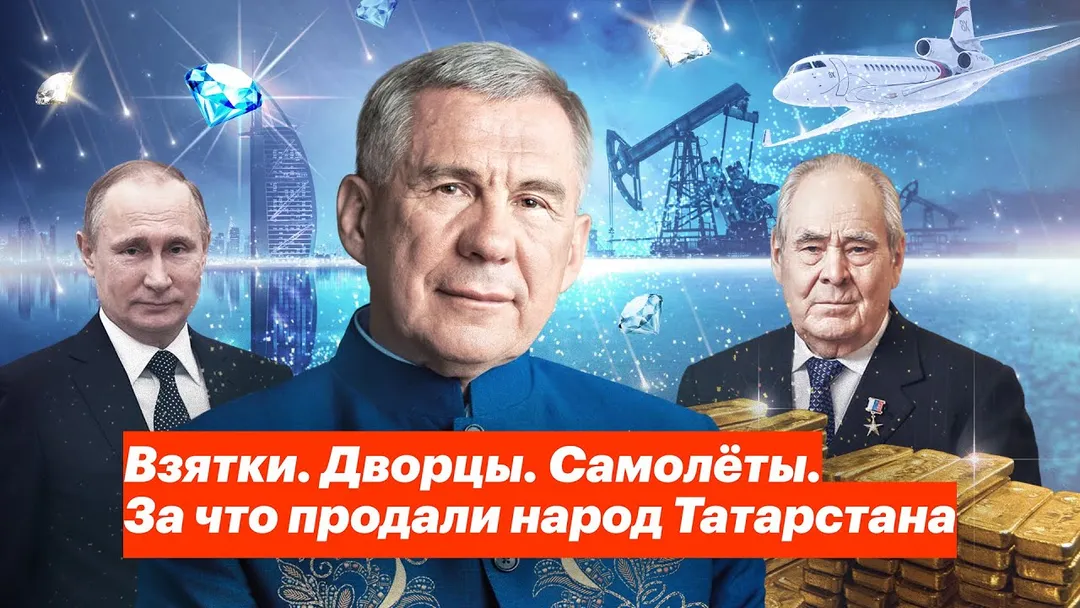
Bribes. Palaces. Airplanes. What the people of Tatarstan were sold out for
We are here with you in a place that, by right,
can be called one of the most
remarkable in Russia. Two peoples live here,
they speak two languages here,
and two religious
faiths coexist peacefully. We are in Kazan, one of the most
beautiful cities in Russia. Everyone who has been here
will agree with us: it really is
a very pleasant place. Well-kept squares,
gardens, parks, and the embankment—here took place
the World Cup; the FIFA World Cup was held here
in football (soccer).
It would seem that if everything is so good, then what
could be the problem? The problem is that behind
this beautiful outward facade
there is a gaping void. The people here
have been deceived and robbed, while the officials who
have seized everything here are ready to do
anything to stay in power.
[music]
[music]
[music]
Here, in this very spot, standing before the camera, there should
have been Alexei Navalny.
Kazan was supposed to be one of the
stops on our trip through Russia’s regions.
On August 20, Alexei was poisoned in Russia.
As we now know, with the military-grade nerve agent Novichok.
But at the time this video was recorded, Alexei
had been in a coma for two weeks, and we
are continuing what we started in his place.
Tatarstan is a place where a real
sultanate, khanate, kingdom—you can call it
whatever you like, but the essence does not change.
For 30 years—longer even than Putin and
Lukashenko—one clan has been in power,
one group of people who, at the expense of
their own people’s well-being, became
the richest people in the country, and perhaps in the world.
To understand how this happened, we
need to go back into the past.
[music]
“Take as much sovereignty as
you can swallow.” This phrase by Boris
Yeltsin, spoken here in Kazan,
is probably known and remembered by every Russian
over the age of 30.
He said it in 1990. In this way,
the future first president of the new
post-Soviet Russia was trying to preserve
a country that was falling apart,
to stop the “parade of sovereignties.”
The authorities in Moscow were taking unprecedented
steps to calm the rebellious regions, and
above all
Tatarstan: take what you want, be
as independent as you can be,
just do not leave the Russian Federation.
And how do you view this talk
about the autonomous republics? We
say: take the share of power yourselves,
take only as much as you yourselves can
handle. Tatarstan wanted sovereignty
and fought for it. The symbol and driving force
of that struggle was a local official from
the agricultural sector, the regional Communist Party secretary,
the future president and “babai,” that is,
the “grandfather” of Tatarstan, Mintimer Shaimiev.
Look at the front pages of the local
newspapers in 1991: “Mintimer Shaimiev,”
“The people and parliament of Tatarstan
bless you to defend sovereignty
and freedom for us all. The people of
Tatarstan are behind you.”
“Be courageous, wise, and incorruptible,”
Mintimer.” That same summer of 1991, Shaimiev
was elected president of the Republic of
Tatarstan.
And from that moment began the story of
what was probably the largest-scale usurpation
of power and the most shameless personal
enrichment. The election was uncontested,
meaning there were simply no other
candidates on the ballot.
Shaimiev won with 71
percent. And here is another interesting point: on
that same day, the whole country was also electing
the president of Russia, but at polling stations in
Tatarstan, those ballots simply were not
given to people. That is how Tatarstan chose its own
president.
And it ignored the Russian presidential election, and over
time the tension only increased. In
1992, Tatarstan held a
referendum on independence.
Sixty-one percent of residents voted
for sovereignty.
Half of all voters turned out.
Despite the fact that
Russia’s Constitutional Court declared
the referendum illegal, listen to what
Valery Zorkin said from the podium. To this
day, he remains the chairman
of the Constitutional Court and has just
once again backed Putin, but back in 1992
he was saying terrifying things: “We are on the edge of the abyss.
A Yugoslav scenario.”
“Stop. We are talking about a situation
that could multiply a hundredfold
the Yugoslav tragedy and all the other
hotbeds of civil war that we see
before us. I appeal to
the Supreme Soviet of Tatarstan, I appeal
to you, the people’s deputies: take every
possible measure. We are standing on the edge of the abyss.
Stop.” But the people had voted, and
under the pretext of this referendum,
Tatarstan refused to sign
the federal treaty with Moscow. Tatarstan
demanded special status and a separate
agreement. It was a truly fierce
political struggle. The local authorities
were defending the interests of their people. Besides
Tatarstan, the federal treaty with
Moscow was refused only by
Chechnya.
And
the standoff with the center continued.
For another two years, Shaimiev skillfully kept adding fuel
to the fire, scaring Moscow with Tatar
nationalism and maintaining the impression
that without him, the region would descend into
ethnic conflict. In Tatarstan,
its own constitution is in force,
formally taking precedence over other
laws; sovereignty was declared, and even
its own special
money appeared here—tokens like these, which could
be used for payment alongside rubles. On
the reverse side, right here, is
the answer to the question of what Tatarstan
was fighting so hard for,
or rather what Shaimiev personally was fighting for: oil. In 1994,
Moscow and Kazan signed the most
important treaty on the division of powers
and the mutual delegation
of authority.
It gave Tatarstan the exclusive right
to create its own system of state bodies,
form its own budget, have its own
citizenship, and even take part in
international relations. And most importantly,
it could control its land and resources.
It seemed like this was it—
the long-desired independence. The money was not going
to Moscow, as it did from other regions, but staying
here. Resources—land, mineral wealth, water, oil—
were, quote,
the exclusive heritage and property of the people of
Tatarstan. It sounded like victory—but not so fast.
In 1996, Shaimiev was re-elected
to a second presidential term.
Once again, there was no real alternative in the election, and an utterly
shameless 97 percent of the vote. When asked
whether he would run
again, Shaimiev sighed: why not? It was impossible to imagine
otherwise. Question: will you seek another term?
No, the constitution does not provide for it.
And if the president
violates the constitution, who would stop him? And in
2001, he ran again and
became president for a third time, and
then a fourth, in 2006—though this time without
any election at all, simply at the request of
Putin. Speaking of Putin, Shaimiev had
an excellent relationship with him almost
immediately.
When he first met Putin, then director of the
FSB (Russia’s security service), the two for some reason exchanged
wristwatches. More broadly, Shaimiev stood
at the origins of the United Russia party
and can be considered its father at the
regional level.
Later, he became one of its main patrons.
Shaimiev was Putin’s authorized representative in all
elections. The secret of their wonderful and
cloudless relationship was simple: between
Kazan and Moscow, another
unspoken agreement had been struck. One side—
Tatarstan—delivers sky-high
levels of support for Putin and United Russia,
truly sky-high, almost Chechnya-level (a reference to the republic’s unusually high official election results).
In Putin’s first presidential election,
he received 53 percent nationwide, but here
he got 69. In 2018,
it was 77 across the country, but 82 in Tatarstan—and so it has continued
to this day. In the most recent State Duma
elections, United Russia received
54 percent nationwide, but here in the republic
it got as much as 85. For Putin’s “term reset” (the constitutional change allowing him to run again), nationwide
78 percent voted in favor,
while in Tatarstan, just to be safe, it was over 83.
And the other side of the deal—Putin, that is—
lets the Tatarstan elites steal on a scale
that even the most brazen Moscow
United Russia officials could only dream of: stealing with impunity,
without oversight, in any amounts, and from
anything at all. And the main carte blanche was given to two
families: the beloved “grandfather” Babai (a respectful Tatar nickname for an elder) Shaimiev
and his successor, the current president,
Rustam Minnikhanov. Let’s finally
talk about him too. Here, among a dozen
Tatarstan leaders, we find
the main figure in our investigation.
Here he is: the president of Tatarstan, Rustam
Minnikhanov. Minnikhanov has held this
position for 10 years already, and now, on September 13,
he is planning to be elected to a third
term—that is, for another five years. Minnikhanov
became president in 2010 after
Shaimiev stepped down and
said he wanted to make way for younger
politicians. But did he really make way for younger—or at least
independent—politicians? It is hard to call Minnikhanov
independent. Minnikhanov says
he met Shaimiev back in childhood,
and literally grew up on the lap of the first
president of the republic. Then came
friendship with Shaimiev’s sons, work in
the Tatarstan government,
and finally the honorary transfer of power
in 2010. In short, he was a successor in every sense:
long known, loyal, and devoted.
Shaimiev calls Minnikhanov
a historic figure: “He is a historic
figure, a fateful one.”
And Minnikhanov replies that Shaimiev is an example
and a guide for the younger generation.
An idyll. The system that Shaimiev built in the mid-
1990s was picked up and
improved by Minnikhanov: super-rich elites,
and poor people who, on top of being
poor, are also constantly squeezed.
There is a thing here called
“self-taxation.” In a village or rural settlement,
a referendum is held: do you want,
say, this fence in
the park to be replaced? People vote yes in the referendum,
and then every resident of the village is charged
300, 500, or 1,000 rubles (roughly $3–$11) on a mandatory
basis, per person. And this despite the fact
that people already pay taxes, already pay
for housing and utilities, already pay their utility bills, and then someone
comes to them and says:
“Chip in some more.” Here, the
political field has been completely cleared out; there is almost no
There are no independent media here; lawlessness and
arbitrariness reign. The police here are known above all
for torturing, raping, and
killing people right inside their own precincts. In the
couple of days while we were recording this
video, our film crew was
chased.
Police officers who arrived on the scene threatened us,
confiscated our computers, phones,
and cameras—for some reason from us,
not from the attackers. Our lawyer,
a citizen of Belarus, was illegally
nearly deported from Russia.
I was fined 30,000 rubles (about $330), and
yes, just look: today we are being
subjected to
surveillance. They won’t let us
take a single step.
Why is this happening? Regimes like this are actually
very fragile and require
constant, nonstop protection.
Minnikhanov and United Russia understand that perfectly well.
On September 13, elections will be held—for
the president and for several city
councils, and even a by-election to the State Duma—and
what Tatarstan’s crooks fear most
is that something might go wrong for them in these elections.
So let’s scare them properly.
Vote for anyone except
Minnikhanov.
Sign up for Smart Voting, and
if you live in Kazan or Naberezhnye
Chelny
or Nizhnekamsk, we’ll send you the name
of the candidate you should
vote for in order to throw
United Russia members
out of the municipal council. You can
do that part, and we’ll do the other part
of the job. The point is that this investigation is
not just a story
about the incredible wealth of Tatarstan’s
officials. We caught the sitting
president of Tatarstan, Rustam
Minnikhanov, taking a bribe of nearly 3
billion rubles (about $33 million), and we demand
his immediate dismissal.
[music]
So, from the Kazan Kremlin, we’re heading
straight to the scene of the crime. With you is
Oleg Yemelyanov, head of Alexei Navalny’s Kazan headquarters.
Alexei Navalny.
Hi, Oleg. So, where are we going? We’re
going to
Ostrovsky Street, right in the city center, to see
a local landmark. It is
both the symbol and the operational center of Rustam Minnikhanov’s criminal
empire, which, as in all good detective stories,
is located
in the most obvious place—right behind me.
The building behind me is the Luciano hotel complex. It is
an elite, expensive hotel that has
a spa complex, a beauty salon, and
a restaurant. In Kazan, literally everyone knows it,
primarily because it
belongs to Minnikhanov’s wife, Gulsina
Akhatovna. And it is in this spa complex—
forgive the pun—
that the president’s family launders billions.
And the spa treatments have nothing to do with it.
The hotel business is only
a signboard, a front. In reality, behind all
these jars, massage rooms, and
pools lies a specially created
machine for taking bribes and
laundering money. This is what the family of the president of Tatarstan
lives on.
Federal news outlets first took notice of Minnikhanov’s wife,
Gulsina, probably in
2017, thanks to her financial disclosure.
According to the published data, she
earned 2.3 billion rubles in one year (about $38 million).
That is far more than, for example, the budget
of Nizhnekamsk. Naturally, everyone was stunned.
2.3 billion rubles—even the biggest
crooks in United Russia don’t dare
declare sums like that. At first there was no explanation
at all.
Then came a terse comment saying that
she had sold a stake in that very spa complex
we were standing by to some
unknown offshore company. A stake in a Kazan
spa complex for more than 2 billion rubles
doesn’t sound very convincing. So we
decided to look into it. We started digging and
were very surprised, because right on the
surface we found one of the
largest bribes we can remember—and, most interestingly,
one that is proven perfectly,
fully documented from start to finish.
The bribe—a stake in Gulsina Minnikhanova’s company—was
bought by the Cypriot offshore company Santero. We found it
and studied its annual reports for 2016.
Here is the line we need: it bought 49
percent—that is, not a controlling stake—of
Luciano for 2.2 billion rubles,
which is roughly equivalent to 33.5
million dollars. There it is in the
Cypriot document. And now the suspicious part begins.
Immediately after
buying these shares, the company
writes them down in value. To simplify it completely:
if you bought something for 100 rubles, then
in your accounting documents you should
record
it as 100 rubles too, not 200; otherwise it is
an overvalued asset. But instead of 33.5 million,
our offshore company bought a stake in the spa complex
owned by Minnikhanov’s family for $33 million,
yet on its balance sheet it listed it at only 6.5
million.
Theoretically, that could have happened
if, the day after the purchase,
a meteor had accidentally fallen on the spa complex and
completely destroyed it—then you could
write it down like that. But we
checked: no meteor fell. Which means
the deal was fictitious, not a market transaction. We
We kept reviewing the financial statements, and in
2018, believe it or not, the exact same thing happened
again.
Shockingly, Santerna contributed to Luciano’s charter capital
to the tune of $10 million, and at the same time did not
increase the ownership stake it held, and then
once again completely wrote down that
investment. In other words, they again spent
money on something absolutely unnecessary,
literally paying for thin air. So,
curious who this bungling
businessman is, the one who just throws
money around, practically stuffing it into
Minnikhanov’s pocket? The answer is right there in
the corporate registry.
The offshore through which the bribe was paid
is 100% owned by the Russian
oligarch Ruben Vardanyan. Vardanyan, one
of Russia’s richest men,
is known as the founder of the investment
firm Troika Dialog and as one of the ideological
driving forces behind Skolkovo and other
“innovation” projects. He presents himself as a super-
sophisticated investor, engaged in
philanthropy, and around the world
maintains a highly respectable image.
But that really is only an image,
apparently aimed at his foreign
colleagues and partners. In reality, he
quite recently paid 3 billion
rubles (about $40 million at the time) in a straightforward bribe to the president
of Tatarstan (a republic within Russia). Why Tatarstan?
A logical question. Vardanyan has had
close and long-standing ties
to Tatarstan. Since 2006, his
Troika Dialog and he himself have held large
stakes in KAMAZ, which, as is well known,
is based in Naberezhnye Chelny.
Vardanyan, together with Minnikhanov, sits on
the supervisory board of the Investment
and Venture Fund of the Republic of Tatarstan, and
by his own account, he is a big fan
of Tatarstan—and it shows. In total, Vardanyan
paid the Minnikhanovs $43.4 million.
Of that amount, he wrote off
or impaired $38.4 million. That is
the bribe—equivalent to nearly 3
billion rubles. After all, this is the 21st century;
the era of cash in suitcases—or
railcars, in our case—is over.
So to disguise this bribe, they
used the following scheme:
a pseudo-purchase of the spa complex—precisely
a pseudo-purchase. From the outside, it looks as though
Vardanyan’s offshore owns 49%
of this entire huge
hotel & spa complex—that is,
of a business that generates at least some
income.
But that is not the case. Luciano is registered as owning
only the building, while
the money is actually earned by entirely
different legal entities, and Vardanyan has nothing
to do with them.
We specifically went to have coffee at the
hotel restaurant to see
who collects the profits from this complex, and
the contents of the receipt surprised us.
It turned out that the money for services rendered
does not go to the companies of Nikonov and
Vardanyan, but to an entity called LLC Service Center, also
listed on Luciano’s website. This
company belongs to Venera Gafarova and the sister
of Minnikhanov’s wife. This is a very important
figure in our investigation. Venera Gafarova herself
is unlikely to be running a business in Kazan,
because she lives mainly in
Switzerland, where she looks after
her grandson, who studies at one of the most
expensive schools in the world.
Venera Gafarova’s husband, Harris Gafarov,
headed the pension fund
of Vysokogorsky District from 2002 to 2015,
and when his career as an official
ended, in 2017 he and his
wife bought themselves Maltese
passports. Here is the notice of their admission to
Maltese citizenship. It always seems to be this way with
United Russia party members: the pension fund is in Tatarstan,
but their retirement is in Switzerland or somewhere else
in Europe. We will mention Gafarova more than once
in this investigation,
because many of the Minnikhanov family’s assets
are registered in her name as a nominal owner.
But for now, we still have one more
unfinished matter near the famous
Luciano.
As someone from Kazan, I can tell you for sure that
everyone in Kazan has probably heard of the Minnikhanovs’ spa complex,
or at least knows about it. But when
you hear “spa complex” or “hotel,”
even if you have a very vivid
imagination, you still picture
just a hotel—maybe a building,
some infrastructure. But that is not our
case. Here, the Minnikhanovs own
an entire city block, and they are expanding right before
our eyes.
The largest building here is
the Luciano spa complex—more than 14,000
square meters (about 150,700 sq ft). Attached to it is a 10-
story hotel building and a conference hall.
The huge covered parking garage also
belongs to the Minnikhanov family. And this
residential building next door is also worth mentioning.
The Minnikhanovs own apartments here—not
just one, not two, not even five, but an entire
entrance section containing 22 apartments with a total
area of 2,178 square meters (about 23,440 sq ft). And here
is a new mega-development: a year ago, the wife
of Minnikhanov bought from former Kazan mayor
Kamil Iskhakov the land under the
Health Complex. Unlike Luciano,
this was a fairly affordable bathhouse complex with
a gym. The 12,000-square-meter plot
(about 129,200 sq ft) in the very center of the city
was sold to Minnikhanov’s wife for 165
million rubles, and three weeks later
after the purchase for Rustam Minnikhanov himself
revalued it at 560 million rubles
the old bathhouses were demolished, and in their place they are building
some kind of multifunctional center
so, we’ve dealt with the bribe from the oligarch Vardanyan, and
we’ve разобрали it, and so that you don’t think this is
some kind of fluke or mistake, I suggest we move straight
on to the next bribe. It’s not only
the big oligarchs who have to pay tribute
local businessmen keep up too
Minnikhanov’s system is set up so that
his small—and more often large—cut
he gets literally from everything and everyone
around him. Let’s figure out where the
president of Tatarstan, who has spent his entire
life in public service,
got a 1,600-square-meter house. We are in the very
heart of Kazan—you simply couldn’t find a more central location
to the right is the Kazanka River
a tributary of the Volga
right here is the embankment, a beautiful and
well-developed tourist area. Ahead is
the Kazan Kremlin
you can see the famous Kul Sharif Mosque. Here,
without exaggeration, stand the most expensive
houses in Kazan
but the very most expensive among these houses
is, of course, Minnikhanov’s
this luxurious house, with an area of almost
1,600 square meters, belongs to a company
owned by his wife
the mansion looks very modern, the kind of place
with terraces—you’d expect to see it somewhere in Switzerland
or Spain. Although the house is listed
in the asset declaration, the land under it
has been declared only partially. The plot’s area is
6,500 square meters
in total
to the right is another, smaller house, registered
directly in his wife’s name. There is also a boiler house and
greenhouses nearby. The total value of this complex
is very hard to estimate—nothing like it in
Kazan has ever been sold. Nevertheless,
we are sure it is worth no less
than 1 billion rubles
where could such money have come from in the
family of a public official?
Of course it couldn’t have—and it didn’t. The house
with an area of 1,579 square meters was acquired by Minnikhanova’s company
in an exchange with a local
businessman, Ravil Ziganshin—a businessman
former deputy, and contractor for Minnikhanov
in return, Minnikhanov had a non-residential basement
space here, which was exchanged for
this kind of house on the embankment
Is that luck? No, it’s a bribe
to the sitting president of the republic from
the region’s largest developer
but we’re not done yet with the luxurious
houses on the embankment. Let’s once again
look at Minnikhanov’s billion-ruble house
and at a neighboring plot. This house
to the left of Minnikhanov’s is registered to the daughter of
his sister
Leila Kadyrova. The house has an area of 575
square meters and was purchased in 2011
we estimate the value of this house at 200
million rubles. Kadyrova herself works
as an ordinary notary, by the way—you can
book an appointment and even request a home visit
from her
and now let’s look to the right, also directly
across the fence. No, this is not another palace
it is a mosque, and its story is very
interesting. I am now standing not far from
the house we flew over. It is so
close to the Kazan Kremlin that this whole
zone has a special protected status
as a UNESCO World Cultural Heritage site
and behind me you can see the mosque
in theory, construction is not allowed here, but this is just
yet another illustration of the fact that for the
Minnikhanov family, laws and rules do not
exist
this mosque, made of the whitest marble in the
world, was built quite recently. The construction was overseen by
the same Ravil
Ziganshin, who effectively gifted
the neighboring house to the Minnikhanov family. The mosque is named
in honor of Minnikhanov’s son, Irek
who died in a plane crash in 2013
the mosque is hardly open to the public
and clearly has a special
status. First, it is located
literally just across the fence from the Minnikhanovs’ house
and second, among its founders are
the president’s closest relatives
the 24-year-old’s
Irek Minnikhanov, who lived permanently
in Switzerland, was buried not here but in
the city center, on the Alley of Fame—a
memorial complex in Gorky Park where
well-known revolutionaries are buried,
as well as cultural figures and scientists. There had been no burials
there since 1957, but half a century later
Irek Minnikhanov’s grave appeared there
and
what is the main sign of a corrupt official
from United Russia (the ruling political party)? He cannot build himself
just one dacha—he needs more and more country houses
it is an endless process that defies
logic: more houses and more square
meters. We found the Minnikhanov family’s second house
20 kilometers (12.4 miles) from Kazan
in the village of Ilyino, a 40-minute drive from
downtown Kazan
before you is a 100-square-meter house belonging to Gulsina Minnikhanova
the wife of the president of Tatarstan. The house
is registered directly in her name. It’s a great spot
very pleasant, right by the water. But you’re probably
asking why we’re showing this to you—what’s the
point?
A house is a house, nothing special. The answer
is literally right before your eyes—there it is
it sits on more than 3 hectares (about 7.4 acres)
of Tatarstan land with access to
a helicopter landing pad, and this land is registered
not to Minnikhanova herself, but to a farm
his wife's sisters
the very one in whose name the restaurant is registered
Lucha and Venera Gafarova. Here is the main house
with access down to the water
its area is 1,380
square meters. To the right is a 770
square-meter pool building, and a little farther on
you can see a separate bathhouse and a greenhouse
and at the entrance to the property there is a checkpoint and
a guard house. We estimate this entire country estate at
500 million rubles
what is the main sign of a corrupt official
a United Russia party member? I think I've asked this before
wait, I'm asking on purpose, just to drive the point home
it is impossible to stop stealing
for a corrupt official, a bribe-taker
nothing will ever be enough. There is your
answer. But the famous
"Why do we need new officials? They'll come
and start stealing, while the old ones have at least
already stolen enough"—in principle
no, they will never steal enough, and the methods
will only become more and more sophisticated
more sophisticated. Dacha No. 3 of Minnikhanov
is located 30 kilometers (about 19 miles) from the center
of Kazan, on the picturesque bank of the Volga River
the story of this house is staggering in its brazenness. On
this site there used to be an old Soviet
children's camp, Volga. The camp needed
renovation and rebuilding, and the oil company
Tatneft volunteered to do it
but to understand the trick, you need
to look at the satellite images. The camp
used to be right here, in a very good spot, right
by the river, and it ended up
over here. Construction began on the waterfront plot
in 2011. At the opening
of the new camp, Minnikhanov said: "We have always
wanted to have a good youth center
and camp, but we always wanted to have one, and now
a youth center—and thanks to the oil
company Tatneft
that wish came true." It was his personal wish
that came true: Minnikhanov got yet another mega-
dacha
Right here, on the site of the stolen
children's camp, stands an elite
settlement, Borovoye Matyushino, which
is called Kazan's Rublyovka (an upscale suburb associated with Russia's elite). Here live
important bosses from Tatneft
but the largest and most luxurious house in the settlement
once again belongs to our old acquaintance, Rustam
Minnikhanov
this plot, with an area of 9,000
square meters, is registered to a company owned by his
wife. From above you can see a separate house for
the staff; its area is 308 square meters
while the main house has an area of 1,500
square meters, and next to
the artificial pond there is another
300-square-meter structure, something like a huge
summer veranda. We found the architectural
plans for this house
the luxury is astonishing: the house has its own
movie theater, a sauna complex with mosaics on
the walls, a fireplace hall, and of course its own
huge swimming pool. And in general, the interiors
are striking in their opulence. We estimate this entire
super-dacha at 1 billion
rubles
pulling away from the house, we turn our attention to
the helipad. Dear residents of Tatarstan
we have found out that this is your helipad
come and use it. This floating
platform was built by Tatneft and, according to
the documents, gifted to the Republic of Tatarstan
but by some curious coincidence
this gift for the republic
was placed not on the Kremlin Embankment
but right by President Minnikhanov's personal dacha
this piece of "public property" is inaccessible to an ordinary
person
and this story, by the way, is a perfect
illustration of the fact that Minnikhanov truly
considers Tatarstan his personal domain
he directly equates himself with the republic
state property
equals my property. And Tatneft is
quite literally the key mechanism of his enrichment. The
company has two parallel
functions: on the one hand, it extracts and
sells oil; on the other, it pays for Minnikhanov's personal
whims and desires
providing him with a lifestyle that
he officially has no money for. The best
example
is the private jet. We analyzed
Minnikhanov's movements around the world and
compared them with which aircraft were in
the same places at the same time. The only
match was a private Falcon 8X jet. In
November of last year, Minnikhanov visited
Bratislava
the plane we were tracking was there too. On February 2
of this year, the jet flew to
New York, where we also found Rustam
Minnikhanov, who was meeting with
American Tatars
on June 6, the plane flew to Altai, and
two days later, on Monday, the media reported
on a meeting between the president of Tatarstan and
the region's governor, Oleg Khorokhordin
on this same plane, Minnikhanov also flew
on what was clearly not a business trip to Abu Dhabi, to
watch the Formula 1 final
for New Year's, the Falcon was waiting for Minnikhanov in
the Maldives during his ten-day
vacation. Such an aircraft costs 3 billion
rubles
its upkeep is at least 200 million
rubles a year. It is a very expensive
luxury, and Minnikhanov personally, and even
the state budget, cannot
afford to pay for something like this. The aircraft alone
without maintenance costs as much as 10
city budgets of Dubna. And who pays for it?
We ordered an extract from the civil aviation register
to find out who the owner is
about this private jet and got an answer
As for Tatneft, it should be stated clearly and plainly:
one important thing: this is not some nice little
favor. It is a bribe. Tatneft is a company
that is publicly listed. Its shares are traded on the London
Stock Exchange, and substantial stakes
belong to major international
investors. And all these investors, instead of
receiving dividends,
are paying for Minnikhanov's New Year
flights to the Maldives.
By the way, speaking of New Year, there is a very funny
story about Minnikhanov's pettiness.
He has a 220-square-meter apartment in Dubai
— here it is in the declaration. It was registered in the name of
his son, who bought it when he was about
twenty years old, and then, when he
died, the apartment passed by inheritance to his
mother. So, Minnikhanov really likes
to celebrate New Year there.
But somehow you have to get to the United Arab Emirates,
and that is expensive, lots of people are traveling,
and so on. So every year in
the last days of December, around the
29th or 30th, Minnikhanov
would arrange an official working visit to Dubai for himself.
There you go: 2015, December 31 — work is in full swing.
2016, December 31 — a meeting with some
important representatives of the Emirates. It feels
as if the meeting is taking place at Minnikhanov's
home, or in the next room.
Here his nephew is spending his vacation
in exactly the same interior. Next, 2017
— once again, by an amazing coincidence,
work right before New Year suddenly came up
precisely in the Emirates. 2018 — the same
situation again. In other words, Minnikhanov
comes up with state business for himself on December 31
in Dubai, and then, well, how could he not
stay on for a couple of weeks? He is literally
squeezing everything he can out of
the Tatarstan budget and out of Tatneft, which
is supposedly a national asset.
They simply use it as a cash cow: to
build a helipad,
provide a dacha, provide a plane,
and for Minnikhanov's election campaign
Tatneft also provides the money. He has
this well-known campaign program
for neighborhood improvements called "Our Yard."
Minnikhanov flaunts it as his
main trump card, his big achievement. But who is really
paying for it? Tatneft. In order
to help its boss get re-elected,
they turned a public oil company into
their own personal wallet. When did Minnikhanov
start stealing?
We asked ourselves that question, and we are ready
to answer it: as soon as the opportunity arose,
even before he became
president — that is, back when he was serving as
prime minister, Minnikhanov began
to grow fabulously rich. In 2009, even before
all those stories about the spa salon, the wife
of Minnikhanov became the owner of a 175-
square-meter apartment in an upscale residential building on
Yakimanka in Moscow. One like that now costs
about 120 million rubles. His wife's income
that year was 8
million rubles. In 2011, Minnikhanov's 22-year-old
son bought, for 1 million euros,
two apartments in the same building in France.
Their total area was
322 square meters.
The apartments are located in a low-rise residential
complex 10 minutes from the border with
Switzerland. Where did a 22-year-old guy get
1 million euros for housing like that? Daddy gave it to him —
the newly elected president at the time.
Today those apartments are worth more:
at least 1.5 million euros, or 135
million rubles. They are registered in the name of
Minnikhanov's sister, Venera Gafarova. We do not know
in what year, but apparently
around the same time he became the
owner of a 220-square-meter apartment
in Dubai. From the photographs, we roughly
understand where it is located. Apartments like that
in Dubai also cost close to 1 million
dollars; we estimate its value at 70 million rubles.
Do you know where apartments are more expensive than in the sunny
Arab Emirates? On Red Square in Moscow.
There, property owned by the company Luciano
includes apartments worth 220 million
rubles.
They also have a garage there. In total, the residential
real estate we found belonging to the Minnikhanovs
comes to almost 3.5 billion
rubles. And that is only what was bought
by the president himself or by his wife. The sum is
certainly shocking.
But you know, the problem is not only in
the enormous amounts of money they invested
in real estate. The problem is in their lifestyle.
For several years we have been closely following both
Minnikhanov himself and his
relatives on social media, and the scale of it
shocks even us. It is not only Minnikhanov himself who flies on private
jets,
but everyone down to very young children.
During vacations, their social media is flooded
with photos from private aircraft,
diamonds, handbags costing 20,000 euros each,
and for some reason they are constantly photographing black
caviar. The children look as if they are growing up not in the family of a president,
but in the family of some super-rich
rapper.
You look at it and really understand:
these people have completely lost all sense of shame.
This is Venera Gafarova's grandson. How old is he here,
about 12? And this 12-year-old boy
is wearing two watches at the same time: on his left wrist,
a Hublot worth more than 1 million rubles, and
on his right wrist, a Breguet for about the same
price. Do you know why he needs two watches?
So he can have both Kazan time and
Swiss time at once.
And a schoolboy walks around with two and a half
millions of rubles on his wrist every day
Where does such brazen audacity come from?
Learning from the best, we examined
the watch collection of the president himself
I will never tire of repeating
that of a civil servant, not a businessman—and he has broken
all records, judging by the photographs
Minnikhanov is simply obsessed with watches. His
favorite brand is Patek Philippe. We
found an entire collection in his possession. Here are
some simpler ones for 3 million rubles, then
the same model in black for another 3 million
another Patek Philippe for 4 million rubles
or these classic ones for 5 million—
the same price as the ones from the official photo shoot—but
the most impressive Patek Philippe costs 19
million rubles—roughly three annual salaries
for Minnikhanov. That's already a lot, and we
haven't even gotten through half of it. This is
an Audemars Piguet for 9 million rubles, and
this is a Richard Mille, like Peskov's, only
slightly cheaper—20 million rubles. And here
a pensive Rustam Nurgaliyevich has put on
an even more luxurious watch—a tourbillon—and
one worth 26 million rubles for a photo shoot with
grandmothers who are war veterans. Minnikhanov deliberately
dressed especially modestly: on his wrist, a Vacheron
Constantin worth 5 million rubles
Here are a couple more models for the sake of completeness
of the collection. In total, we managed to find
12 watches in his possession
with a total value of 107 million rubles
An investigation into illicit enrichment
into Minnikhanov is like a renovation that
can never be finished
and can only be stopped. So
by an act of will, we are drawing a line under
the Minnikhanov story. But in Kazan
we will definitely come back to it again
[music]
We can't leave Kazan without
showing you this place. And if, in the case
when we were standing near the spa salon
linked to the Minnikhanovs, we had to talk
about front companies and secret business dealings, here
there are no secrets—at least
not now. Behind me is the office of the TAIF Group
of companies
the source of colossal enrichment. Shamil
will explain the history of this outfit, put
all the pieces together, and very clearly
demonstrate how Babai (a nickname for Mintimer Shaimiev) Shaimiev
deceived and robbed his own people. You
remember we showed you a coin with
an oil derrick on it
That very oil which was supposedly exclusively
the property of the Tatar people, all the natural resources
around which the entire battle
for sovereignty unfolded—all of it became a source
of enrichment not for Tatarstan, as promised, but
for Mintimer Shaimiev personally. In 1995,
the authorities of Tatarstan created the company TAIF
which was tasked with preparing the privatization
of the largest enterprises, with controlling stakes
held by the state
The republic contributed to its charter capital
stakes in the largest enterprises
of Tatarstan—Tatneft
Nizhnekamskneftekhim, and so on. TAIF
was given unique conditions
They paid no regional taxes
at all. The government also allowed them
to buy oil from Tatneft at
a fixed low price
and then export it at market prices
The profit created virtually out of thin air
was spent by TAIF on buying up
telecom operators, TV companies, factories
and building shopping centers
The list could go on forever. They
became a very rich company very
quickly. And then it turned out that TAIF was
no longer state-owned: the republic
had simply disappeared from the list of owners, and all
the wealth accumulated thanks to all these privileges
ended up in private hands
Whose hands those were remained hidden for a very long time; the ownership structure
was opaque. Several
years ago, because of court proceedings,
it became known that at least a quarter—
25 percent of TAIF—belongs to the children and
grandchildren of Mintimer Shaimiev
So that you understand the scale of the
wealth we're talking about: last year the
Shaimiev family became the third-richest
family in Russia
right after the Rotenbergs. Their fortune
was estimated at $3 billion, or
225 billion rubles
That's roughly Tatarstan's annual budget
How does the family of the first president spend this
money? Exactly as you'd expect: super-
elite real estate in Russia and
abroad
We are flying toward the estate of the younger son
of Mintimer Shaimiev
Radik, near the village of Obukhovo, 20 kilometers (about 12 miles)
from Kazan
The size of the plot impressed even us
478,000
square meters—roughly the size of two
Moscow Kremlins
And over here, screened by a small forest so it can't be seen
from the main house, are the garage
the utility building, and the staff house. The estate's infrastructure
is managed from
here. And of course, the main house
It may only be two stories, but its area is
a full 3,000 square meters. Around it are
perfectly trimmed lawns, trees, and
gardens. You might think that behind the house
there is a lake, but no—it is an artificial
pond with an area of 12,000 square meters
We estimate the value of this Shaimiev family estate at
2 billion rubles
[music]
Radik Shaimiev's daughter—that is, the granddaughter of
the first president of Tatarstan, Kamille
Shaimieva lives in London. In the incorporation
documents for a Cyprus offshore company, we
also found her home address. This apartment
is in this building, in the most expensive district
of London, worth 5.5
million pounds — that is, 550 million
rubles. But besides his granddaughter Kamilla, there are
other grandchildren too. They also need somewhere
to live. We are three kilometers
away from the dacha of Radik Shaimiev, which we
already showed you.
This is near the village of Bima. It was precisely
because of filming this dacha that the security guards launched
a chase on ATVs, and the police stole
all our equipment, just so you would not see
what is here.
So, we are pleased to present to you
the giant dacha
of Timur Airatovich Shaimiev, the 30-year-old
grandson of the first president of Tatarstan, and
this dacha is no less impressive than
his uncle’s dacha next door.
The total area of the property is almost 400,000
square meters.
The plot is so large that we have to
fly quite a distance just to
get the whole thing on camera. The entire property
is filled with artificial ponds and
canals. Construction here is now nearing completion.
The size and purpose
of many of the buildings are not yet known, but the area
of the main house we already know: 2,000
square meters. We estimate this
country residence at no less than 3
billion rubles.
In Tatarstan, many consider Mintimer
Shaimiev a national hero. He himself
says that people kiss his hands when they
meet him, that monuments are erected to him
during his lifetime. He retains his
position as an adviser
to the president and actively participates
in political life. The proposed constitutional amendments
are aimed at the comprehensive
strengthening of the Russian Federation.
And we suggest you look once again
simply at these two houses: 5 billion
rubles sunk into dachas — or rather, into these
palaces.
This is what it was all for:
the division of powers,
the nationalization of resources, the usurpation
of power, and these sky-high percentages for United
Russia — this is what it was all for. The money is,
of course, enormous. But if you think about it,
they did not sell
themselves all that dearly, really.
[music]
[music]
In 2010, when Minnikhanov had just become
president of Tatarstan for the first time,
a journalist asked him whether it was possible
to defeat corruption. He answered no and
said, and I quote: “Out of ten people, one
won’t take bribes.”
“Nine will. If they bring them, how can you not take them?”
And Minnikhanov has adhered to this principle
faithfully and devotedly. The very moment
unlimited power fell into his hands,
Minnikhanov began stealing — a lot.
Shamelessly, brazenly: dachas, apartments, watches,
aircraft, real estate abroad.
Minnikhanov personally has everything you could
possibly imagine, and it did not come
out of thin air. This is not some abstract
money. This is your money, people of Tatarstan.
These are your wages, your taxes, your
resources. In the end, you were deceived,
sold out. Thirty years ago, Shaimiev promised
you that all of Tatarstan’s wealth would be
yours. He deceived you. The wealth is his — first of all his.
Second, Minnikhanov’s. Third,
some other official’s,
who belongs to their clan. And every
new dacha, every new airplane of your
president is simply another
transaction in robbing you.
They will take away your right to choose, they will extract
tribute from you, and Minnikhanov will get, well, another
piece of real estate in Dubai. Power is not given by God,
by grandfathers and great-grandfathers, or by the “father of Tatarstan.”
There should not be such a thing in your country. Your president should
be a person to whom you matter more than
a trip to the Maldives on a private jet.
On September 13, do not vote for Minnikhanov.
Vote for anyone you want — just not for him.
If you are from Kazan, Nizhnekamsk, or
Naberezhnye Chelny,
take part in Smart Voting. All these
United Russia members in your local assemblies are accomplices, they are
participants in a gigantic operation to
loot Tatarstan.
Register on the Smart Voting website
and subscribe to our
channel.
This is where the truth is told.