Candidate ratings, the progress of the strike, kill whoever you want
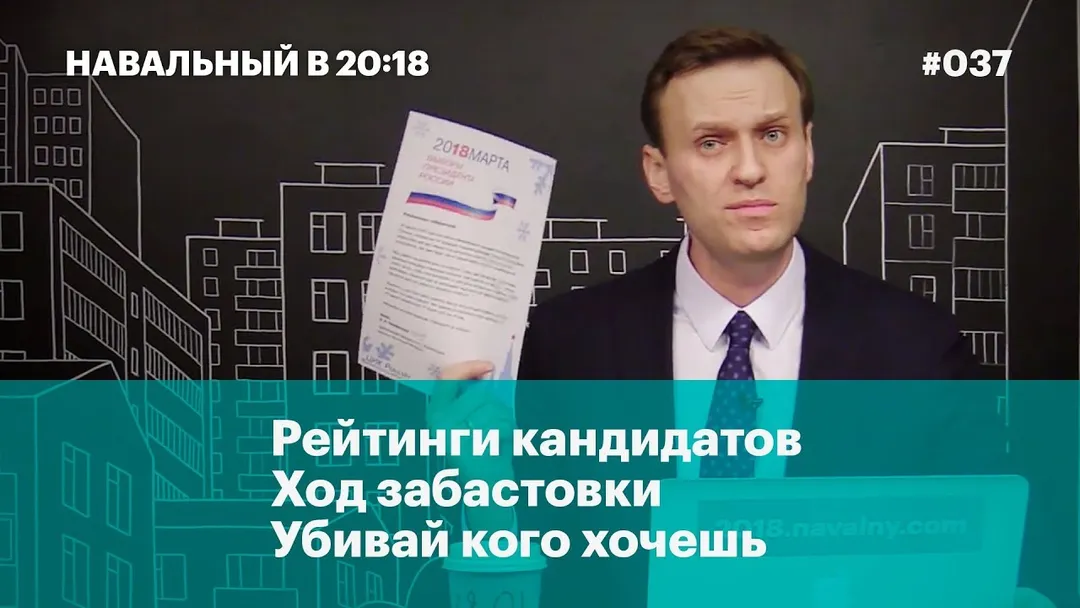
[music]
[music]
[music]
[music]
[music]
Hello everyone, Moscow 20:18, Alexei is in the studio.
Navalny, or the mastermind behind the Perm
massacre, as the Tsargrad TV channel called me this week.
We'll talk a bit more about that
a little later. What does
a happy person look like? Who is a happy
person, what do they look like? Look here:
I am completely happy, because happiness
is satisfaction with what you do.
We are carrying out our voters' strike,
and it's working, and that is very
cool. It really does make me
genuinely happy, and it makes
our entire штаб (campaign headquarters) happy too. Because what
happened this week? All
the political news this
week was about how these
authorities, in every possible way, are trying to drag
people to the polls. We also discussed
the naked dancing—not completely naked,
just slightly naked—students from Ulyanovsk.
Well done to them, they danced wonderfully. They
will probably also take part in
the voters' strike, judging by the fact that
they've already started being investigated for that dance by
the prosecutor's office. But apart from the nearly naked
students, all the news in one way or another
concerned new inventions: how exactly
to force people to vote. It has been announced that
at the same time as the election there will be
some kind of contests on
neighborhood improvement—like, come vote
not only to re-elect
Putin, but also to vote for some
little mushroom, what color it will be in your
courtyard, school referendums, and so on and
so forth. Of course, my favorite this
week is the proud city of Yekaterinburg, where it was
announced that people could ride the ice slides
for free if they were for the election and
for participating in the election, and if they said
the special password:
"I'm for the election." This is, of course, astonishing,
truly something else. I mean, it's very,
very cool—everything is working for us, and we
can see that the authorities have chosen this
interesting tactic. On the one hand, they are
now very actively fighting our
voters' strike; on the other hand,
they are probably not capable of
resisting the mass character of our movement,
because something remarkable has happened
with the January 28 protest. I'll start with that right away, because
that's the main thing we need
to talk about now. In the first days, when we announced
that there would be a protest, they told us
nothing would come of it. Then, when we
started submitting applications, we were told:
basically,
rejections everywhere, they started issuing rejections
all over. In Khabarovsk they even jailed our coordinator for 15
days just two
hours after he brought in the application,
simply because he had submitted it—they immediately
took him to court and locked him up for 15 days. But
now, apparently, the concept has changed, and I
don't know what exactly they decided there.
Some Kremlin analysts and political commentators
will explain it, perhaps. Maybe they don't want
images of mass
detentions or something like that on the eve of
the presidential election, because they realized
that people would come to the protest anyway.
protest.
They are now approving things for us on a massive scale, and
there are now more than 90
cities participating, and almost everywhere
the protests have been approved. They approved them in such
cities that our lawyers refuse
to believe it—in Sochi,
where for ages nothing has ever
been approved, and now we can go to a rally there.
In Sochi, in the wonderful venue; in
Rostov-on-Don too—that is, in cities
like these. In Kazan they approved
the protest—where usually they approve absolutely nothing.
It's completely astonishing. There are
a few
especially stubborn cities, though—Ufa,
Arkhangelsk,
Ryazan, Murmansk. But those rejections
that happened there were at the first stage. I
think maybe they will reconsider
and approve something for us there.
As for Moscow and St. Petersburg, as usual the authorities
are showing off. In Moscow we were told
that we should go to Shchukino. Our
answer is very simple: you might
be happy about that,
but how could we possibly agree to such
illegal actions? People have the
right to rally where they submitted
their notice under the notification procedure. Therefore
I can say absolutely clearly that in
Moscow, as in St. Petersburg, where the local authorities are also
apparently going to invent
something similar, the protest will take place in
full compliance with the law and with the notice filed.
That's our formula, so that they, you know, don't
arrest me right here from this studio for
calling for something. I am saying
that the protest will take place in
full compliance with the law. So,
guys, don't make any plans for January 28.
Take part. These will be approved
actions, and it's very important to come to them, because
the Kremlin aren't fools either—they think
General Frost will fight us on their behalf. January 28
in Russia is not exactly a warm
date, especially since in all the cities where we're
holding these protests—including Yakutsk—
it's not hard to imagine how many
degrees below zero it will be in Yakutsk, but
You still have to go—there is nothing more
important from a political point of view, that's
it. There is nothing—you can't write something
important, you can't say something important, you can't
do something important. No one can—
not me, not you—do anything more important
than physically being present at the rally on the 28th
01, because this is the main mechanism
for putting pressure on the authorities in every country, in
every city, at all times—the most
important, the main way to apply pressure, the most
important way to express discontent,
the most important way to mobilize people
around us. We are carrying out a voters' strike,
and as part of this strike we
are calling on everyone else not to participate,
to campaign against it, but to monitor
the elections.
So, from the point of view of achieving our
political goals,
there is nothing more important we can do.
In the description of this broadcast, find the link,
register, and go in your city
without fail. It looks like we'll quite
peacefully have a nice walk and, well,
tell them everything we wanted to say, see
each other, and disperse without any detentions.
But even if there were detentions,
or there will be, that's nothing—it absolutely does not
change anything. We have to go, otherwise nothing will
work out for us. At the same time, it's quite
clear from their strategy that they
are forced to approve these rallies for us,
to authorize them, because otherwise once again there will
be detentions and a dispersal, and across
the whole country. But we have simply felt
a sharp increase in pressure on all our
headquarters, and right now in St. Petersburg
as I understand it, the search is still continuing in
our office—already at the stage of seizing
materials. Some people simply came in
saying that a report had come in that
something was happening here,
something illegal, and as part of checking
that report they, well, threw everyone out of
the office except the coordinator. Right now they are
simply confiscating all the laptops,
printers, some personal belongings, leaflets—
well, basically everything they can take away. In other words,
they're robbing us—they've carried out a raid.
The St. Petersburg police carried out
a raid on our—so, here is a very short video from
our St. Petersburg office.
[music]
So, we've already had two searches, two
searches in Veliky Novgorod, a search in
Cheboksary,
yes, in Cheboksary, a search in Penza, and right now
a search in St. Petersburg, and we understand that they
are going to keep doing this again and again and again. It
all follows a very curious kind of pattern.
This is how it all happens:
the first thing they do when they come in is
start taping over the cameras. We
equipped all our offices with cameras so that
there would be some record. Here, you can see now
this video from Cheboksary: as soon as they
come in, some operative right here
in the corner—a guy in plain clothes, apparently
from Center E (Russia's anti-extremism police unit),
has adhesive tape ready, and with that tape he
walks around covering the camera. There, he spotted
another camera, goes, goes, goes, pretends
like he's just walking past,
and then—there, nothing is visible. And this is
the pattern all these searches follow. They are
absolutely illegal, of course. I mean, how
can you just come into someone's organization?
Imagine you work somewhere—
a legal entity,
not a private residence, your office—and some
police officers come in and say, listen, well,
we received a report that you have
extremist materials,
or that you have a Navalny leaflet. Your
competitor called and said, hey, they have
Navalny leaflets at such-and-such address.
They come in there and simply start confiscating
computers. What will happen to your business?
Well, naturally, your business will shut down
immediately. This is what is happening
in the country right now. This is what they
will tell us they are allowed to do by law. But
that raises the question: do we even need
such a law? Do we need this kind of police? Do we need
this kind of judicial system that permits
this? It's awful, and it is infuriating.
Of course we are suffering material losses.
Of course we will be asking you
to go to the Navalny 2018 website
to the donations section and send money again
so that we can continue all
this activity. But on the other hand,
it's actually great that all of this
works—even our little leaflet campaign, which
many people like
to laugh at because, you know, it seems to me
they think it's not real. But people are making
leaflets, posting them in the descriptions—
there is also a leaflet in the description of this broadcast.
You can print it out. And all of this
is not some fake campaigning—this is
real campaigning. Look, at the
Far Eastern University, in a dormitory,
students
were visited because there had been a report: these
students were distributing leaflets. By the way,
the students turned out to be solid people,
not the timid sort. They called
a lawyer at the headquarters and asked what to do.
The lawyer said: tell those
police officers to get lost. They did, were taken to the
station, and then released. What can they
do to these people? This is absolutely
legal activity. So
please keep doing it. And
now I'll show you a short clip
from a wonderful video that
One of the campaigners in Nizhny Novgorod filmed it.
About how he did it—let's
watch for 31 seconds.
And look at that pipe—what a huge pipe, calling out.
This is Lobachevsky... and here's the dorm.
Actually, this is Lobachevsky campus, and here is
the local landmark—here is the real
weapon of a campaigner.
For the voters' strike, of course,
we got truly enormous pleasure
today from the head of the Central
Election Commission, Ella Pamfilova, who really
really made our day when we saw
the special statement from the Central
Election Commission regarding this
leaflet.
They disliked it so much that they
actually put out a press release that
was then quoted by the state
news agency TASS, saying that there were some
terrible people—without mentioning me—and to that
I say: that's us, that's us, Ella Pamfilova, you know
it's us, following in your footsteps, who made
this especially sinister leaflet. And this is not our
leaflet—we confirm that. So, friends, in light
of the fact that the Central Election Commission disliked it so much,
the Central Election Commission
there's a separate link in the description of this
broadcast where you can download this leaflet. There
you'll find the leaflet as we made it. But we
sat down and thought: if a miracle happened,
if Ella Pamfilova stopped lying the way
she does every day, what would she
write in the leaflet? And we put together a
truthful one.
It says here, from Ella Pamfilova:
"Dear voters, on March 18
the reappointment of Vladimir
Putin will take place. Be sure to come. We
traditionally call this an election. Don't want
to go to the polling station? No need to worry—we'll have contests
and pastries.
That's excellent payment for
taking part in the performance. Please
come, spit on your future, and
do what the bosses tell you. This
is the real, true, genuine leaflet
from Ella Pamfilova. So print it out,
put it up in your building entrance, if it's torn down then put it up again.
We put it up, and it works. Enjoy
watching how it works. You'll see how
very soon the janitors will come running,
special workers from these
social agencies will run through apartment entrances and
around buildings, persuading people to go vote.
This is the reaction to our strike, and it's going
great—it could go even better
if you join in. Well,
basically, we're ready to tell
you how this election will end. That is, you
understand that it will not end with
Putin's reelection, but with Putin's reappointment.
That's what they invented it for. But today we
are already ready to tell you the details.
You don't need to wait until March 18
to know the election results.
I promised on the previous broadcast that
we had launched—would launch—our sociological
service, especially given that
the Levada Center, the last independent
sociological center, was banned from
publishing candidate ratings—indeed,
from publishing any election-related data at all.
So we launched our own service. It
will conduct one sociological survey
a week—either nationwide or a major regional one.
Our sociological service
has been operating since 2013, and we
have repeatedly proven that we make election forecasts
better than most
polling services. We absolutely
do not lie; we do everything according to methodology.
It makes no sense for us to lie. It's much
more important that you trust us, because
the sociological service operates on your money,
and so if you see that
the result does not match our forecast,
well, then stop giving it money.
That is why our sociological service
works very, very accurately. And now,
attention:
I will tell you about some very unexpected
election results. So then, first
let's look at the slide on awareness of
the election. You can see that many people
are indeed saying, saying
that there is a choice and that there is
an election coming, and therefore
almost all voters know that the election
will take place in the Russian Federation. In that
sense, television has done its job.
Let's look at the next slide.
It's very interesting. We asked:
who has declared their intention
to take part in the election? And you can see that
everyone, of course, knows about Putin; everyone knows
about Sobchak as well—this has been actively
covered on television. It was a big
topic. Zhirinovsky, Yavlinsky...
Take note—this is very interesting:
people know about Grudinin, and they know about Zyuganov.
This is a separate and very interesting
thing that we wanted
to study, because Grudinin
suddenly appeared like this, whereas traditionally
it was Zyuganov who took part, and in general we wanted
to understand
whether people know that there is such a person as Grudinin,
whether they know that he is running. But we see
that quite a lot of people do know, but
quite a lot of people still think
that Zyuganov is taking part in the election. In this
connection, we
separately asked an open-ended question: whom
did the Communist Party of the Russian Federation nominate, and we got rather
curious results. Where is the slide? Here
it is, our slide. We see that the larger share
of people—up to 33 percent—are, after all, aware.
that the CPRF (Communist Party of the Russian Federation) nominated Grudinin, but 15
percent of voters still
because, by the way, a huge number
I don't know, among those who think they know something
15 percent of people say that
that
Zyuganov was the one who was nominated at all; that's also a
interesting thing showing
just how little attention is being paid to this election
and how, generally speaking, the candidates themselves
have not
really been engaged in their own campaigns
and have not managed to get these points across. Well, actually
speaking, we've discussed many times that
it's impossible to run a campaign for three
months; it's impossible for a new person to enter the race
and achieve any high results
without actively running a campaign for at least
a year. So that means the result
And the most interesting thing is: who would you
vote for if the election were held
next weekend? Please take a look
at the results.
This is what we see out of 100 percent:
an unquestionable victory for Putin.
Interestingly, the results are practically the same
for Zhirinovsky and Grudinin.
And then, really at the level of
the statistical margin of error, there are Sobchak
and Titov, and they are close, given the fairly large though not enormous
number of decided voters.
And we have one final slide with which we can
now present our official current
forecast of what the result will be. We have
a special model for how we will—how
we calculate the undecided voters. You saw
that they were 21 percent, but when it comes to the election, those
who actually come and cast their ballots—we
developed a model which, in the State Duma
elections, quite accurately and correctly
predicted the results. So on the final
slide we show what the
election results on the 8th will be
the election on December 18: Vladimir Putin
will win—no, no, that's the wrong slide, we need
the last slide.
Sorry about that little mishap.
Someone's going to get a scolding. There, please.
Look, you can see this is roughly the kind of
result. Of course, every week we will
be polling: Vladimir Putin will get 78
percent—certainly more than 70.
The only thing that creates even a little—not even
intrigue, but some curiosity—is
who will take second place:
Zhirinovsky or Gru-
dinin. Everyone else will get around
one percent. And, well, I think, I think
that I have hardly just now
greatly surprised or shocked anyone,
because this was predetermined.
Remember those famous meetings from which
there were leaks saying that the presidential administration
had set a target of 70/70—70
percent turnout and at least 70
percent for Putin. So, moving toward
that result, they sat down,
conducted polling, and calculated which
candidates needed to be allowed onto the ballot or
persuaded into the race so that
Putin would guarantee himself a result of more than
70, and it worked perfectly. They
removed me—the candidate who was running
a real campaign—and all the
others
were given such a wonderful setup.
So, guys, I just wanted to address
those who are still under some illusions,
rather funny ones: “What about a second round?”
“What if we do something?” “What if
there's some kind of protest vote?” “What if there are
a lot of invalid ballots,”
and therefore there will be a second round?” There will be no
second round. It cannot happen.
These people sat down and did the math—they're not
stupid. They conducted polling and figured out
whom they needed to bring into the election,
what they had to do in order to get
this kind of result. And if, of course, it is terribly important to you,
if this is your political goal
and your idea of what matters now
for the country is that
we need to help Grudinin take second
place, or conversely help Zhirinovsky
take second place, then your vote
matters in terms of who will take second
place—Grudinin or Zhirinovsky—with
a result of less than ten percent.
Then go ahead, then go. I won't even
try to talk you out of it. But if you still
believe that elections are something more
than a competition for second place
between the LDPR and Communist candidates, then don't
go there. Don't be part of this
disgrace. If you go there, then there
you are signing your name under it: “I recognize all this, I consider
this an election, and your candidate will get his
lawful one percent—or 78.”
If that's what interests you, vote for Putin. But don't
be part of all this. We must, on the whole,
refuse to recognize this as an election.
We must very actively persuade people
that those 78 percent mean
nothing. If you go there, then for you those 78
percent will mean that you elected
a president for yourselves, that this is a real
president who became president
thanks to votes, thanks to voting. But if you
do not go there, that is your personal
position, indicating that you do not
recognize it, that you are not part of it. All of this is
fraud; it is a pre-programmed
result. We will
be making forecasts like this, forecasts like this,
polls like this
every week. Next week we will have
a poll on Yekaterinburg. Why do we
want to do that as well? We want to find out what
what big cities think
What we’ve just shown you is the overall
picture for Russia as a whole, with the margin of error, by the way, being
roughly three and a half percent, so
in fact, among all those who
support Yavlinsky, Sobchak, Tsvetkov
the percentages are small — it’s all about the same
and within the margin of error, naturally
there is some variation there, but within that range nothing
will change. But there is, again, this
idea worth testing: that in
big cities everything is completely different, that Moscow
will completely change everything with its vote,
that St. Petersburg will change everything,
that Novosibirsk and Yekaterinburg will change everything, and
we’re going to conduct a poll in Yekaterinburg. Why
there? Because it very accurately
predicts Moscow’s results. For
example, the vote for Prokhorov in
Moscow and in Yekaterinburg differed by
one hundredth of a percentage point. In Moscow
it’s simply very hard to conduct a poll because
of the city’s specifics: there are many
newcomers, and it’s hard to reach by phone those
who are eligible to vote. In Yekaterinburg
it’s easier, and the result is very
close to Moscow’s, and it’s a typical
large city, and based on
candidate ratings in Yekaterinburg, we
can forecast them very accurately for
any city with a population over one million. We’ll see,
of course, how all this plays out, but I think
the spread will be about the same. These
elections are predetermined; there is no need to take part in them.
Many thanks to all the volunteers
who took part in these surveys
and continue to take part. Come join us,
sign up — it’s very important. We want
to give people normal, honest
sociology. And now, here are two
images I want to show you
for the next topic.
Which image do you like more? Let’s
first look at image number one.
And now image number two. Which one do you
like more? Assuming you
liked the first image more, well,
everything there looks kind of cooler, right?
But in fact, it’s the same thing. The
first image follows from, or
emerges from, the second image, because in
the second image we have the famous sinkhole
in the city of Berezniki, Perm Krai (a region in Russia’s Urals),
where the Uralkali company is located.
Probably everyone has seen this image —
all the inhabitants of planet Earth. It’s extremely
popular on the internet. And in the first
image
we see the wonderful, stunning yacht
of the owner of that company, Mr. Rybolovlev.
Though that image is no longer even current. I
actually decided to tell you this because
Rybolovlev sold that yacht and ordered
himself a new superyacht with the
codename Project 1007. The exact
cost of this yacht is unknown, but
it is obvious that it will amount to
hundreds of millions of dollars, because
everyone says it’s some kind of mega-
modern superyacht. Why am I saying all this?
Because on January 28
this is one of the things we are protesting against, including
in the city of Berezniki, by the way,
where a rally has also been announced for the 28th
of January.
Because this is how Russia is structured: we have
huge raw-materials enterprises,
and these huge raw-materials enterprises
enrich only those who own them —
some
two or three oligarchs. How is our
tax system set up if in Berezniki they
cannot fill in the hole in the ground that
they themselves created, yet at the same time they order
yachts for themselves worth hundreds of millions of dollars?
Only in Russia could something like this happen;
you can imagine this only in Russia. This is
how it works: when people have
low wages, when there’s a hole in the
ground, when they have no medical
insurance,
when they live, I don’t know, worse than in
some African countries, and at the same time
some people, in a very ostentatious way,
make money from this and buy themselves
yachts — that is monstrous
injustice. I know many people will now
say, “Navalny is going after
the oligarchs again, he’s such a socialist.” I’m not
a socialist at all. I’m talking about a normal,
reasonable principle: a country cannot be
organized this way. These fertilizers
produced there in Perm Krai
should work for everyone. They should make all of us
a little richer, and
they should make especially a little richer those who
live in Perm Krai, in Berezniki, because
they live there while it damages
the environment and harms their health.
That is normal, and it works that way in every
country except Russia. Here Putin has
not only built a paradise for himself and
his acquaintances, former colleagues,
and dacha neighbors, but also for people like
Rybolovlev, who quite demonstratively
behave this way. I mean, listen,
suppose there’s a crisis in the country, a hole in the
ground, all sorts of problems, and for the fourth
year in a row real household incomes are falling — well,
then don’t buy this yacht right now,
so ostentatiously. I don’t know, do
something else. Why do you need a yacht
right now? No — I’ll buy it, and nothing will happen to me, and
what tax authorities? No one will come to me
with a search warrant, no one will demand that I
pay additional taxes.
No one will investigate how I came to have such an amount
of cash, where it came from, or how I got it.
I withdrew it
and I paid taxes on it too
That is, I pay export
duties on this fertilizer, and so on and so forth.
Nobody looks into any of this; nobody cares about anything.
The regime, the authorities, are only concerned with one thing:
preventing our rallies and
stopping our strikes in order
to protect themselves and guys like
Rybolovlev, who pay bribes.
So if we do not want to see in
our country disasters and a yacht that
was paid for at the cost of that disaster abroad,
then on the 28th, let’s come out and
in Berezniki, let me remind you, there will be
a rally, an action like that. There’s a video clip
that... please, let me answer the question about it.
Listen, I’m sorry, I somehow
got carried away and forgot that with the hashtag
#Navalny2018 on Twitter, you can ask questions.
What do you think about the self-immolation in
the city of Ishimbay? Well, it is monstrous.
I deliberately did not bring it up, I did not want to
show the video. Well, Sergei Smirnov
spoke about it in detail on our channel’s broadcast
and said the same thing:
hopelessness, the inability to achieve
any result.
Anyone who has been to a Russian, Soviet-style court
has seen it many times. Even if you are a hundred
times in the right, and you are suing not even Putin
or Medvedev, not the city mayor, but, say,
a management company, you will still never
win in court.
If it’s some deputy mayor of your city
who is obviously carrying out illegal
actions, you will never win.
It is impossible to get justice in
a Russian court; it is impossible to get
justice from
officials. The only thing that exists is
this thing called Putin’s Direct Line (the annual televised call-in show). You have to
get through on the phone or somehow pass along a
folder of documents, and then, if
your lucky star happens to be shining somewhere
in the heavens,
Putin will say on the Direct Line: why is it that in
the city of Ishimbay something has happened?
Please fix the situation,
and the governor will go and fix it.
Otherwise, nothing will happen.
But a person set himself on fire here—this is
a monstrous, horrific situation. What more
can be said? Jeffrey666 keeps
asking, I see. The person asks whether there is
an important proposal regarding the strike:
filing complaints and petitions is pointless,
but appeals to the administrative system in order to
overload it
are one of the forms, one of the forms, one of the forms of
peaceful protest. Our strike
consists—sorry, is made up
of three elements: we do not go to
the elections, we campaign against participating in them, but we monitor
the elections, and of course within the framework of
that monitoring, we
will build an unprecedented system
for election monitoring, and of course we will
generate a huge number of complaints,
and not empty ones, not just for the sake of
complaining—they will be very well-founded, because
violations are happening constantly. I mean,
good Lord, just turn on the television and look:
it is completely blatant, open campaigning
for Putin every second, every second.
For 50 minutes of the news they talk only
about him. So of course we will deal with all of this.
Alexei Anatolyevich, Andrei
Shivomdo asks me:
would you like to have a yacht yourself? Well, I’m not sure
I’m not sure I would want a yacht, because
—
well, first of all, you have to know how to
operate it somehow; second, it is terribly expensive
to maintain. It’s one of those things—
like in India in the past, when they gave someone a white
elephant: if they gave you a white elephant,
it would ruin you. So no, I definitely do not need a yacht.
It’s simply unclear
what to do with it, and my wife gets seasick,
so I’m not sure that a vacation on
a yacht would be especially comfortable for us.
Though of course it would be interesting
to sail once, at least. By the way, once we
calculated that if you split the cost
of some small yacht with a skipper,
it can even be cheaper than a hotel. Though of course
it probably would not be the kind of yacht
that Rybolovlev has. Based on your research
or your impressions, asks Ivan Ivanov, what
percentage of the security services supports you?
There have been no studies on that, and they
are impossible to conduct, because
they may support us, but
they would not allow any polling on that issue.
So let me go by my own
somewhat subjective impressions.
I do interact with security officers who
detain me, drag me away, and in the building where
I live, half the building is occupied by the National Guard (Rosgvardiya),
it’s basically half a departmental building,
so it is very convenient for them to detain me:
they just have to leave their apartments,
walk to my entrance, and catch me there.
Based on personal interaction, I see that
more than half support me,
with reservations like, “You’re doing a good job,
but nothing can be achieved.”
But of course, the work of fighting
corruption
is supported by everyone. And these people from inside
the law enforcement system,
support it even more, because they see everything from below
perfectly well, and they know all about their own bosses,
and about protection rackets and kickbacks—they know it all.
So: have I seen the music video about myself
performed by the rapper Morgenstern? I have,
and I even posted it everywhere. It’s a good video, thanks.
And again, about the man from Bashkortostan (a republic in Russia) who
set himself on fire—a victim of a rotten system, Diana writes.
Diana is absolutely right. I was in
Berezniki, Oleg Kozlov writes, and there
the scale is much bigger than in your
picture. That’s true—the picture is quite
old, and the sinkhole keeps expanding
several times over. Those houses, dachas, or whatever
they have there—some vegetable plots—they keep
having to move them. I read about it in the newspapers.
The scale there really is
quite large.
Neil asks: “Alexei, why don’t you want
to do a collaboration with Grudinin?”
Collaborations happen between YouTube
channels. Presidential candidates are supposed to
run
an election campaign, and candidate
Grudinin, like all the other candidates,
doesn’t need a collaboration with me.
What they need is to fight
for their own voters. When I was running
an active campaign
up until I was denied registration,
remember: I would start these broadcasts by saying
that over the weekend I had been in three
different cities, that my rallies had taken place there,
and at the end of the program I would say, now I’m
flying out and I’ll be in three more cities,
guys, come out. In every city
quite a lot of people came to see me. In every
city we promoted the fact that I
was coming, and then promoted the fact that I
had come and gone. In other words,
an election campaign doesn’t need any
collaboration with Navalny. If this is
a normal candidate, then go out and
campaign. Have you seen anyone
holding rallies like that—big or small,
any kind at all—where there’s an announcement in some city:
“Dear residents of Berezniki,
there will be an appearance in the main square by
candidate X,” any candidate at all? No, there are no such announcements.
Because the candidates don’t go out, they don’t
speak, and it’s impossible to run
an election campaign if you don’t
do that. So what kind of collaboration could
possibly help? I could right now, on air, and for the
rest of the campaign, directly
urge people to vote for any candidate whatsoever, but
compared with the results
you just saw on the slide, there simply
would be no change at all.
People think rationally. They’d say, I guess
he’s telling us to vote for so-and-so,
and maybe some people would listen to me
and vote, but
it’s not as important, not as powerful as
people tend to think. More likely, people
would say: all right, let’s take a look at
who this person is, try to understand what
he does, won’t be able to find any
information, and will think: well, listen, if
Tsvetov himself doesn’t want to get our
votes—this hypothetical Tsvetov—then what’s the point
of us even getting up and going anywhere?
So, guys, don’t be more active
than the candidates themselves. Don’t be holier
than the Pope.
It’s impossible. What you’re proposing—this
collaboration—Grudinin isn’t proposing it, and I’m
not asking him to do it. We called for
a voters’ strike. And now these
people on social media—it’s not especially
interesting—say, look, we’re now going to write
128 reasons why people should go to
the election. The question is: why aren’t the candidates
themselves writing these reasons? How did it happen that you’re
running around Facebook writing comments and
urging each other that you need
to go vote, while your candidates aren’t doing that?
Where are their videos? Why aren’t they
fighting it out in the comments?
Why aren’t they coming
to big meetings?
Why aren’t they making the case? Because they don’t want to.
Because they have no desire to. Because
those are the conditions the Kremlin has set, and because
they know their role. That role
is to get one percent
so that later they can point at us and say,
“See, the opposition went to the election
and got one percent. Everything is fair.” And
what about the turnout forecast?
We’re not going to give a turnout forecast. It
doesn’t make sense, because there is a well-known
sociological rule, a phenomenon,
that people always overstate turnout. When
you ask someone who isn’t very
interested in politics, someone who doesn’t
go to vote, “Will you go
to the election?” he says, “Yes, I will,” because
that’s the socially approved answer. It’s considered
good to go vote, so
people all say, “I’ll go, I’ll take part.”
Or about the previous election they say, “Yes,
I went and voted,” even though they didn’t.
People always lie in this kind of
poll.
It’s pointless
for us to make a turnout forecast. What we need
is to fight to make that turnout lower. So,
the video I mentioned on
Facebook—I saw it on Sergei Parkhomenko’s page—
it seemed important to me to show it to you now
because this week there was
quite a lot of news from the North
Caucasus, and the news was very unpleasant,
really extremely unpleasant. First we were
told there had been a fire in the office of
Memorial (a Russian human rights organization) somewhere in Ingushetia, then
we saw video of some people simply
methodically setting that office on fire by pouring
gasoline. The head of Memorial in Chechnya was
arrested for drug possession, and few
people have any doubt that those drugs were
planted on him. And this video—
it isn’t very new, it’s from 2013, but it
This is very important for everyone who... nude.
People are discussing it, and I find myself asking this question too:
how can this be happening there—attacks,
arson—an obvious case of arson in Dubna,
it was caught on camera, the video is online,
they burned it down.
Some people burned an office, and the police do nothing,
there are attacks on people, and
the police do nothing, and well, it's clear
why they do nothing: because somehow
the authorities organized it all. But they should at least
do some kind of formal things,
at least something for appearances' sake. But when someone attacks me,
there is no investigation at all, but
they keep writing to me, they want paperwork, and the prosecutor's office
wants police paperwork from me, and the police
again issue some kind of refusal notices. What exactly
are they pretending to do? They understand
that nobody is going to do anything. But they're the ones
in uniform—they're majors, captains,
lieutenants—and they can't completely
ignore this. Here's the video—it's not that
long, two and a half minutes. Let's
watch it so that we can
really understand how all this works. Because
in this video it's not just some
civilian—it's a general.
Let me check—yes, a general, a general,
a police major general, and
a deputy interior minister for the Chechen Republic.
Two and a half minutes—let's watch.
[music]
[music]
[music]
killer... with assistance... ordinary...
[music]
I...
the maximum possible... some miracle... by hand...
...to drag Bill in... I watched this
video three times, and I keep coming back to one thought. Yes, we've
seen a lot of things in many places, but we understand
that this is Chechnya. We've seen all those stadiums filled with
all sorts of people, all that foul language—good grief.
But here a major general isn't even embarrassed by the camera.
He says right there, "I'm not afraid to say this on camera."
There are people sitting there—not children,
not some random subordinates of his,
but grown men, older guys, men in their sixties,
in ties and suits. They remember the Soviet Union,
these people do—they already held positions back in the USSR
as district heads or something like that, who knows.
And he sits there, not at all embarrassed by the camera, and
says: do whatever you want, kill whoever
you want. What is this? How can this
be happening? And of course, what can one expect
when it comes to investigating
crimes against human rights activists,
or anything else, if a police major general
isn't afraid, on camera,
to say things like that? This is
simply beyond the pale.
All right, so you're that kind of person,
you decided to strike this heroic, macho
pose in the smoking room, to somehow
show off after an important meeting—people say things like that.
But I know, of course, if you sat him down here now,
he would say: "Alexei,
you're not a good man. You sit there
in Moscow, you understand nothing at all,
hosting your program, without knowing that we're dealing
with Wahhabis. Everyone has their own truth.
Yes, his truth is this: we're dealing with
Wahhabis, we have to cut them down, destroy them,
and if there are no other ways to deal with them,
we plant drugs on them too.
We find out he's a Wahhabi—by day he works
on a collective farm, and at night he'll start shooting at me
from somewhere, so we plant drugs on him,
take him away, strangle him, shoot him,
or whatever else is happening in Chechnya.
We'll dress him in some kind of uniform, put
a bullet in his pocket, and shoot him,
and then say it was a special operation. Okay.
The one good thing is that this video is from
2013. So the question is: what did you achieve
with methods like these?
Did this thing work? With all these
Wahhabis—real or imagined—or
people simply declared to be Wahhabis,
or just so someone's business could be seized,
they were taken out and shot. They did this in
Dagestan, they did it in Ingushetia, they did it in
Chechnya too. So how wonderfully
did that work out for you? That was
2013, and now the head of the FSB (Russia's security service)
says that three or four thousand
people from the North Caucasus, mainly
from Dagestan and Ingushetia, went off to fight for
ISIS. So where did they come from, if you
were killing whoever you wanted like that? Well, they
came from exactly there. You can fight terrorism harshly
only if, on the other side, you also fight harshly
against
injustice. Because why does a person
grow a beard and go off into the
forest? Yes, he has religious beliefs,
but all of that is layered on top of some
injustice: something was taken from him,
someone was killed unlawfully,
he knows his brother was shot, and the body
hasn't been returned; his mother goes around trying and failing
to get answers. We hear about this all the time.
Recently, I think—just this week—in
Chechnya there was some case: a woman
was trying to get someone to tell her
what had happened to her husband, who had been arrested and
taken away—and now she has disappeared. But they all have
relatives. And besides, it's that kind of
society in the North Caucasus—everyone
knows everything, everyone knows what's going on.
He watched and watched, and then of course
he grew a beard and went off into the forest. And it is precisely
this lawlessness, this
cruelty, that is the main reason.
And because I often end up
in detention centers, I spend a lot of time
with Chechens, with
Dagestanis who end up there...
Everything is laid out there in great detail.
It is all described, and everyone in those circles knows it.
How this works in practice, and
this kind of lawlessness
— so blatant and deliberate — leads
to nothing except an increase in the number of
these so-called extremists, Wahhabis, whatever
you want to call them. This tactic does not work.
You can arrest them, I don’t know, cut off
their fingers, torture them, abuse them, throw them into prison en masse —
it does not work. They were locked up in those
prisons, they came back from those prisons — it does not
work. This senseless cruelty does not work.
In order to prevent the emergence of
this kind of religious extremism in
the North Caucasus, social problems
in the North Caucasus need to be addressed. It is necessary that
salaries in Makhachkala not be 13,000 rubles a month (about $140), or
15,000. People need to be able to earn
a decent living by means other than banditry.
But in Chechnya it is the same: enormous amounts of money are
being poured in, while people
are living, literally, hand to mouth,
scraping by somehow. There is no money, and naturally
people understand all too well what is going on around them.
There is injustice, there is no money, and earning a living
is impossible.
And if you so much as look at someone the wrong way, you will
be branded a terrorist, some kind of Wahhabi.
So then the logic becomes: I might as well become a Wahhabi myself
and go do it. That is the logic.
This logic works the same way everywhere in similar countries
and similar regions.
And what is happening now in the North
Caucasus with the arrest of these people from Memorial (the Russian human rights organization)
— what were they doing? They were protecting
ordinary people from arbitrariness. And now
they have been declared drug addicts, locked up, and
given long prison sentences. They are driving
Memorial out of
Ingushetia. Will that make things better for anyone?
No, it will not. There will simply be more real
extremists. Someone will blow something up for you,
God forbid, much sooner — precisely because
you drove the human rights defenders out of there.
That is why what is happening
is monstrous. And what is additionally monstrous is
that the federal authorities are acting as if
nothing is happening, as if they have not
noticed any of it. There is footage, by the way,
of how Memorial’s office in Ingushetia supposedly
caught fire all by itself. Let’s take a look.
Mom.
[music]
[music]
Does this look anything like the news report that
appeared in Russian state
agencies: “A fire occurred at Memorial’s office”?
A fire.
No, it looks like Memorial’s office
was set on fire by some people, with the full
encouragement of the local police. There had already
been attacks before that, constant
incidents. They either burned it down themselves,
either the police or some center there —
I do not know who handles this — or they
hired people. And nobody does anything.
Novaya Gazeta (an independent Russian newspaper) is sounding the alarm, publishing
these videos, and nobody cares at all. Some kind of
police department there, a unit for the
Southern Federal District,
and all these main directorates, and all the rest of the
top brass, are doing absolutely nothing. Well,
they should at least think that this will create more
work for them, because this kind of
lawlessness committed by state
agencies will lead to double the lawlessness
in the shadows, where there are
actual, real
extremists and terrorists, for whom in
such an atmosphere it is advantageous, very advantageous,
to recruit people. So, the State Duma committee
recommended adopting in the second
reading the draft law on volunteering. What do you think?
someone asks me. So,
this kind of bill is not needed at all.
Why do volunteers need a bill? Here you are,
a volunteer in an election campaign — do you
need a bill? You are a volunteer, you come
to a shelter for homeless animals and
help out — do you need a bill for that? This is
some kind of idiocy. They are constantly
trying to pass bills everywhere and
introduce some kind of regulation.
Why? Thank God, over the last
few years in Russia
the volunteer movement has been developing. People
go places, do things,
help out — excellent, thank you very much.
We should encourage you, let’s all praise
volunteers. But no — instead, they want to pass a law and
somehow regulate the work of volunteers.
Because heaven forbid someone on their own
goes to an orphanage and starts
helping someone without legal grounds. What a
horror. It is utter idiocy.
Usually people write 65/34, “remove Belarus,”
“remove the slogan ‘Kill whoever you want,’”
saying it is incitement. We are the mass
media, and frankly we do not care.
Someone posted a video for me about
strikes and Sviyazhsk last
time. The leaflets were torn down in one day, but we are not
giving up. Do not worry about the lifespan of a leaflet.
A leaflet’s lifespan is three hours. If yours hung
for a whole day, that is actually excellent.
You put up a leaflet so that within three
hours ten people see it — that is it, it has
done its job. There is no need
to get upset: “Oh my God, I put up
leaflets, and a week later not one was left.”
They are not supposed to be. But it is a very
effective method of campaigning, and we
have studied this many times. When
someone posts a notice in an apartment building entrance, something
you know, styled like
a notice from the building superintendent, everyone
reads it, and we put up notices from the election commission, and everyone reads them.
They understand that this isn't a real election cycle, well...
Everyone always understands what we mean.
As for Navalny, when Putin is...
once again 're-elected'—there's no point asking, Nico.
Nico, you can already consider Putin elected once again.
Once again—haven't they already shown you everything?
Putin has been 'elected' with 78 percent; on March 18,
there will simply be a kind of formal,
ceremonial event. That's what
will happen: there will be a solemn
ceremony at which the figures that I would
already tell you in advance will be read out by Pamfilova (Ella Pamfilova, head of Russia's Central Election Commission),
she'll read them off a piece of paper and say:
"Vladimir Vladimirovich Putin,
78 percent. Congratulations to you. Here
is your certificate; we shake your hand."
As for Navalny's headquarters: no, these are our
headquarters. You financed them; we
created them together all across the country as an
instrument of influence, an instrument of struggle
for our rights.
Probably after March 18,
it will be difficult—practically impossible—
to maintain the entire structure, because it is very
expensive to keep 84 headquarters running. But we will do
everything possible, and we will ask you
to help us
so that we can preserve the core of this
structure for any purpose: participation in
elections, if we're allowed to take part, if there are
real elections;
also campaigning, the same mass
actions, carrying out regional
anti-corruption investigations, and so on.
All kinds of political activity,
all forms of fighting for your rights, require
organized structures: there has to be an office,
equipment, channels for distributing information, and so
on.
We created this, and we will try to preserve it
for all of us.
There was an interesting little revolution in propaganda that, for
me, was quite curious. You may
know that tragic events took place in Perm (a city in Russia).
They were tragic events.
Two teenagers attacked a school there, and
they attacked fourth-grade students. Fortunately,
no one was killed, although there are seriously
injured people there; as I understand it, a teacher
is still in serious condition. But if
we abstract away from these
quite tragic events, then of course their
media coverage says a great deal about
Russian propaganda. Because one of the
attackers—
he deleted all his posts on VKontakte (a Russian social network),
but those who started digging around and looking at
what kind of person he was saw that he
had once left a comment in one of
our groups, writing something along the lines of
"Russia is a country of slaves."
He wrote it in a Navalny group, and
this was found by the RT television channel, with our
wonderful Margarita Simonyan at its helm, receiving
huge amounts of state budget money, and
they turned it into a news story. And it's interesting to watch
how a story launched by RT
then gets transformed further. That's why
many journalists wrote the same thing—well, in order
to make it sound as though the person
had expressed support: "The attacker expressed
support for Navalny on social media." Then all of this
migrated into outlets like Znak.com (an independent Russian media outlet),
which used to be fairly decent
but has become not so decent anymore. In
particular, they wrote that this
person supported Navalny—
the attacker. Then the same thing appeared
on Rambler, where it had already been
reworked a little differently. It was something like:
"The schoolboy who carried out the stabbing in
Perm supported Navalny and called
the country a nation of slaves." Well, of course—that belongs to Mamut (Alexander Mamut, a Russian oligarch).
The same thing was in Gazeta.ru and
in
for some reason in Life as well. Gazeta.ru also belongs
to Mamut, but the really
fantastic part was that this had already
transformed by the time we got to the wonderful TV channel
Tsargrad. I don't even
know who owns it. There it
sounded like: "The massacre in Perm was inspired
by American killers and
Navalny." It's absolutely astonishing. It
really shows how this
machine works: it can take some
comment on social media and turn it into the claim that I
and some Americans
inspired the massacre in Perm. And I thought,
well, in principle it's actually quite an elegant
trick. It has potential, and you can
even imagine what kinds of headlines
there would be if these same media
didn't love the people they currently
love. For example, Margarita Simonyan.
She shocked the general public when
she announced that she had
boiled herself a beaver's head for lunch.
That really happened, yes. Everyone was very
surprised by her culinary
preference—a beaver's head. And basically,
if we follow that same logic,
a headline immediately popped into my head.
If we mention what other culinary
preferences famous
cinematic characters had, then I
came up with this headline: "Margarita Simonyan's culinary colleague:
'I ate his liver with
fava beans and washed it down with a nice Chianti.'" That's the same logic.
The same goes for Dmitry Peskov.
If the media didn't like him
and wanted to say something about
him, they could easily 'discover' a connection. Experts
have established a link between Peskov and the serial killer Chikatilo (Andrei Chikatilo, a notorious Soviet serial murderer):
the connection is established.
They both watched the program Vremya (the main Soviet/Russian TV news program). Pure
truth, pure truth: they both watch
Vremya, and of course that means there is a connection between them.
There is a connection, but in this particular way.
You can speculate a lot, really a lot.
You can come up with a lot of funny things, invent things just for
a laugh, but all these outlets—and the smaller ones too—do it for
laughs, yet in fact they really do make all of this up.
They really do invent all of this, and in fact they
spread it all around and show it to a large
number of people. That part is
a bit sad. Inferno Overkill asks:
What’s the situation with the quadcopter? As I understand it,
the bureau is still in the process. Right, so we
raised the money for the quadcopter, and even their
manufacturer or dealer said that
they would give you an additional discount, and we
and we, we, we will buy this quadcopter. I also
wanted to say, as we wrap up
the program—we have 3 minutes left—I wanted
to tell you that we found out a few things about you.
We conducted a special survey for
those who watch our channel, Navalny LIVE.
Those who subscribe to the updates—thank you so much
to everyone who took part in it,
in this survey, who filled out this
poll—and I wanted to tell you about it
a little, so that you understand what
we’re planning to do together, generally speaking, and
together with our channel. Why did we start
doing this survey? We were very worried, and
I was very worried because of these
data we’re collecting—yes, these
it’s all fun, of course, but somehow it also feels like
you’re begging for money on air, and that really is
a pretty awkward feeling—there’s probably a better word for it.
We were worried that people might start
getting fed up, unsubscribing, or something like that, because
we suddenly switched to fundraising all the time. In short,
the main question, the question we
wanted to ask, was: how do you feel about the fact
that we turned on donations? And to our
surprise, it turned out that you were all
very supportive of donations and really back us.
Show us the slide with that question—what
does the audience tell us there? Yes, you can see
that most people are quite tolerant of it.
That’s about advertising—about sponsored content, so to speak.
Most of the audience is quite tolerant
of it, basically. So that’s why we do it,
and we’ll keep doing it. By the way, there aren’t any today,
incidentally, because the system broke, as usual.
That system through which we
do it—we’re planning to connect
another one. There were a lot of questions about it; it’s called
Super Chat, yes, where you can
send a comment there. That’s already a
YouTube feature where all of this is done.
Our next question was about advertising,
because we’re planning to run ads, and
we were also worried that you would react
very negatively to that. But it turned out that
you feel a little worse about advertising, but
many people—the majority—support it.
Most are willing to put up with it. There are 17
percent who say, absolutely
not under any circumstances.
But nevertheless,
it is possible. Actually, by the way,
on my program right now I’m raising
roughly
1 million rubles a month through your donations
per month, and that shows that the TV channel
Navalny LIVE is one of the
few self-sustaining TV channels in Russia
that
well, that raises about as much money
as it costs to operate each month.
And of course, you donate to us, and we always
remember that.
But even so, the channel can only expand
with additional expenses, and those expenses
we intend to offset through
advertising. And we can see that, overall,
you’re prepared to tolerate that. Thank you very much.
One of the problems we discovered
is that the survey showed that
you don’t share links.
That’s a problem for us. Over the course of a week,
most of those surveyed said that
it just doesn’t occur to them, or they don’t feel like it.
You don’t share links to our broadcasts, and that’s
very important for us, so please
don’t forget to do a bit of
promotion for us, because we do this so that
a larger number of people can learn about us.
Don’t forget to do that.
And the last thing, which was a big
revelation for me:
we wanted to understand what kind of
programs you want. And my hypothesis was
that you wanted things about music,
movies—BadComedian is very popular, after all—yes,
one of the most popular
YouTube bloggers.
Food, current affairs, movies, music, celebrity life,
something like that—art, culture, a program
about women. Remember, I was even advocating
for it, saying that we were planning
to launch some kind of feminist program,
about women, focused on women, where
only women would appear. But
it turned out—let’s take a look at what
you told us you want to see here.
Well, who would have thought it—you’re all
obsessed with politics. What you really want is
nothing but politics. Everyone wants from us
political debates, everyone wants interviews,
everyone wants some kind of political programming.
We thought, we assumed, that we had already
worn you out with all these talking heads
endlessly talking about politics, a little
debate,
two talking heads sitting here and
saying something about politics. But it turned out
that that is exactly what you want. And now let’s
look at what you definitely do not want.
As it happens, none of you wants music,
or dancing, or celebrity life, or programs
about women. Somehow, none of that really
interests you. But maybe you just aren’t
that matters to us, because otherwise this kind of thing
wouldn't exist—you can't imagine how important that is, so
even if you can't vote for it, for us
it was quite revealing. We
will try, all the same, to develop in
the direction you pointed us toward,
because this is our shared
guerrilla TV channel. We made it
to get the message across
to people, and also, well, a little bit
to have fun and entertain you. And we
understand perfectly well that without your support,
including financial support, no amount of
advertising will keep us afloat, simply put. And, well,
most importantly, if we don't
feel that you and we are one TV channel,
in the literal sense of the word—that you are just as much
its owners as we are—then it will simply stop
being interesting for us to make. And that is very
important. So once again, thank you very much
to everyone who took part in the poll. We
will try to develop in line with
the directions you indicated to us. On January 28,
you need to come and vote.
Wait, I got carried away. Alexei, you don't need to go anywhere,
you don't need to vote, nothing like that
needs to be done. What you need to do on the 28th is go to
the rallies that will take place in your cities.
The link is in the description. Watch our
programs—we have transcripts. In the
description it's indicated. You asked for transcripts for a very long time,
and now we have them. Download
our app. Spread this
information. We'll see you on January 28,
but before January 28, next Thursday we
will meet again on this same broadcast. Thank you
very much. Be happy.
[music]
