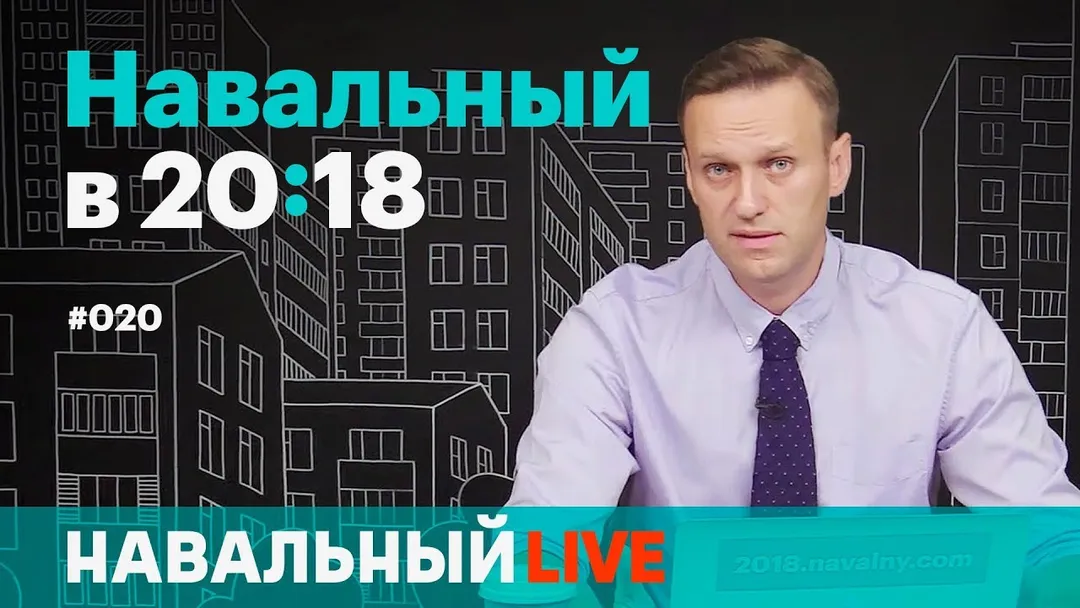
Sobchak and the election, a migrant uprising, Lyaskin beat himself up, intimidation of a schoolboy in Vladivostok
[music]
Hello everyone, it's 8:18 p.m. in Moscow.
That means we're live in the Navalny Live studio.
I'm Alexei Navalny, here to
discuss the latest news with you. What's
happening in our country that's worth paying attention to?
You can send me questions on Twitter using
the hashtag #Navalny2018. We have lots of
different topics today.
But I'll start immodestly — I'll start with myself,
with our campaign. You probably know that
we've begun an active autumn tour,
traveling to the regions and holding active
public appearances in cities. Right after this
broadcast, I'm heading to the airport and flying to
Novosibirsk, where tomorrow at 6:00 p.m.
I have an event.
And I want to say that so far these trips are going
great. Thank you very much to everyone who
comes to these meetings in the cities, because
even in relatively small
cities — Murmansk, for example, is still
drawing thousands of people. And of course,
what can we say about such huge
cities as Yekaterinburg or
Omsk?
What's the main takeaway from this? There are two takeaways.
First — or rather, there are two things people
are sick of. That's the conclusion: people are really
tired of monopoly. They're tired of
being constantly told that
especially in the regions, everyone is supposedly so
pro-Putin, everyone loves United Russia so much, that
when people finally get a chance
to show, even just by coming to a rally, that
“Guys, no — please notice us.
We live here in the region, but that doesn't mean
we're just going to keep nodding along all the time,
pretending everything is wonderful.” No, they don't want
to put up with monopoly. Everyone is deeply
fed up with it. That's exactly why our
rallies — there are lots of arguments about attendance,
some say around 8,000, others say no, no,
6,000. “No, are you crazy? No,”
“6,500.” But we're not very interested
in taking part in those arguments. The main thing
is that nobody denies that among
political rallies, these were the biggest
held in these cities in
recent years.
And that also reflects the second thing people are sick of.
The second thing they're tired of is that
they're tired of this kind of election
campaigning, including presidential campaigns,
the way it's always done. People want
candidates to come to them. People want
them to speak in front of them. And I think this is
exactly the right strategy for us:
to behave like normal, real
candidates, as if we were already living right now
in the beautiful Russia of the future.
Despite what they say — “Yes, we
won't let him run, the campaign isn't real” — I
try to behave like a normal
candidate. What is a normal candidate supposed to do?
Come to Murmansk or
Yekaterinburg — it doesn't matter — stand there in the rain,
answer people's questions, and
tell them about your program, your
ideas, your
view of what's happening. People appreciate that
because, well, because
they're fed up. Eduard Chernenko writes to me — and he's absolutely right, I see —
“All the presidential candidates have eighty headquarters between them,
and of those,
Navalny has all 80.”
That's exactly how it is. Several people have already
announced that they're running in the election — and what are they
doing? I'm not even criticizing
these specific candidates right now — Zyuganov,
Yavlinsky, or Putin. I'm criticizing the
political practice itself. It really
— I won't even shy away from the word — infuriates me. You've
announced your candidacy, so hold some meetings.
What are you doing? Remember how in the last
presidential election there was that remarkable
candidate Mikhail Prokhorov — he
remember how many meetings with
voters he held during his entire
campaign? Six.
That's not how election
campaigns can work. It shouldn't be that
some strange people in Moscow
meet for debates that are watched by
relatively few people, because the main
candidate isn't there. They do
nothing at all. If they travel to the regions, they
meet with their own activists. But these
normal, uncensored, human
meetings just don't happen. And one of the goals of our
campaign is to break this
disgusting political practice and
force everyone else to start moving
along with us. We very much want
other candidates, looking at us,
to do the same, so there can be a real comparison.
We've held a meeting — let the others
come to Murmansk, Yekaterinburg, or
Omsk and hold their own meetings. Then we'll see
what questions were asked there, and people will watch
and be able to compare one candidate with
another. That's why these meetings are
so important to us, and we'll keep holding them.
Although, of course, right now we are
facing major resistance.
And that resistance will grow.
After last weekend, when we had
such extremely successful meetings, they
— I'll be honest — surprised even us a little. We
expected people to come. We have excellently functioning
headquarters, real headquarters,
not some fake setup, and not just some
campaign where we, you know, just hang up
photos of random people with balloons.
No — people are genuinely working with us. We
knew people would come, but we were pleasantly
surprised by how many actually showed up. I
think that, of course, the Kremlin — I don't think it
I’m sure the local authorities were too.
They were simply shocked by how many people
showed up. That is exactly why, already this
week—whereas last week we, in
various cities, submitted applications for rallies
and received 27 refusals—now there are already more than 50
refusals, and we have now seen real
serious resistance, which
is taking all sorts of, uh, different
forms. But one of the, of course, most
ugly and age-old forms is intimidating
people—especially intimidating young
people, and the kind of thing that is happening in schools.
Many of you have probably already seen this
video with a recording of a conversation
with a 16-year-old schoolboy in Vladivostok, where
I’ll be this weekend. They assembled a whole
group there, a whole team: there was
the principal, some psychologist, an inspector from
the juvenile affairs commission, and they
were intimidating this young man because
he had put on a badge reading
“Navalny 2018.” A short video—let’s
watch it so you can simply recall what
this is about. On what day can we
meet?
I don’t know what issue you wanted to
meet with me about.
Right now.
Well, now we’ve met about that issue.
With my parents, I can do Monday.
I understood that.
A submission to the commission for
juvenile affairs. Tell me, please,
why are you now just brazenly lying
that you don’t know that you have been
placed on the commission’s register? But no one
told me. — So you don’t know? — I don’t know, I
wasn’t warned; apparently they did it without me.
They put me on it. — There is your signature stating
that you were notified that you are
on the register. — That’s not true. I was notified that I
would have, today, a court hearing, roughly
speaking—and the hearing already took place. Those materials
that I, in the Soviet school system—well, I was
a little Octobrist and
a Pioneer (Soviet youth organizations), and of course we had
things of that sort,
dress-downs. I remember someone burned so much hay there.
But I studied in military towns—those are
always kind of half-village places—and
we expelled those children from the Pioneers. But
this now, in the 21st century, in 2017,
when he is being threatened with prison,
with various commissions, with ending up on such
lists that you’ll never again be admitted to any university
—for what? For a badge reading
“Navalny 2018.” And in a country whose
Constitution says that it is
a democratic country. And these
disgusting adults are, basically, forcibly
going after a sixteen-year-old boy—who, by the way,
is brave; he stands up to them. He doesn’t
agree with them at all, and they lie and
pressure him. But this is the disgusting
thing that is happening. And this is one of the reasons
why we are running our election
campaign. Because these things disfigure
the country; they disfigure education, among
other things. What can these teachers possibly teach
if they behave this way? And this
boy came out of that room of
punishment and spoke with his
peers. Everyone knows that our principal
is
a liar,
a dishonest person. Everyone knows that they
work for this disgusting regime,
and do so on their own initiative. Maybe
you saw that in today’s post I
published an interview with this boy, and his
homeroom teacher told him
that only a traitor could come to school
wearing such a badge, and that she was obliged to report
to the school principal about this
“betrayal.” But how will they
regard these teachers? How will they
regard education, or school in general?
But it is obvious that this breaks things overall. These
methods are now being used in all
regions. In Novosibirsk we are seeing
mass mailings and even something like
commercial ads claiming that supposedly
special cameras will record everyone,
your faces will be entered into files, and
based on those files, uh, later we will
expel you or refuse to admit you to
certain universities. All of this is, of course, complete
lies, but it is being spread by the authorities themselves.
And many—well, I don’t know whether many or not many—
some people probably do listen
to it; at least that is their
calculation. Well, we’ll see whether it works out
or not. I will speak regardless of
how many people come: if there are many people, good; if there are few,
that too is part of my work as a candidate, and I
will do it. In Vladivostok, they are writing that
they will close the bridge to
Russky Island
so that from the campus
of Far Eastern Federal University people cannot
get to the meeting. When we were first
told about this, I thought it was
some kind of joke, but then
confirmations started coming in; the local press is also
saying that under the pretext of either
a marathon or something else, the bridge will be
closed.
In Novosibirsk, uh, *Matilda* will be shown
deliberately a month earlier
than its nationwide premiere in order to
distract some of the people from this
rally. It is the only screening of *Matilda*.
And in Krasnoyarsk, wonderfully enough, there
the official refusal to authorize the rally was based on
the claim that Navalny has no right
to speak about a better future for Russia. That is
almost exactly how it was worded, verbatim.
speaks and talks about images
of a better future, so that means a refusal
to let you hold this rally, one way or
another
Right now I'm flying to Novosibirsk, then I
will be in Vladivostok, in Khabarovsk, everywhere
in all three of these cities at 6 p.m.
Please come to these meetings
and bring your friends and acquaintances with you
Support me or don't support me, if there are
people you know who criticize me and
want to ask me
tough questions, bring them along, excellent
I'm ready for those questions; again, that's also
part of a candidate's job, and I will do it
Please help me notify as
many people as possible that these
meetings are taking place; it's very important. My
screen is just exploding with messages, where
our editor is writing to me marked urgent
saying that Nikolai Lyaskin is not being released
from the police station right now, even though a very
and they're conducting a personal search, that
is, the victim here, our Nikolai Lyaskin—he
was hit on the head with a pipe, and now, as I
understand it, they're conducting a personal search of him and
apparently taking away his phone and things like that
but we'll talk about Lyaskin in quite
some detail today. We'll see, maybe
some more news will come in
smb From Russia writes to us
Just a fact: our teachers at the
staff meeting before September 1 (the start of the school year in Russia)
were forbidden to criticize, to criticize
the state's education policy. And
why were they forbidden? Why did anyone even
think of such an idea? Because
any normal teacher is going to criticize
the education policy
of the state right now, because even a normal
teacher, even if they have a more or less
decent salary—though all of them have
tiny salaries—what do they do? Do they teach
someone? They spend all day filling out
some paperwork. Teachers are groaning all across the
country because they simply can't keep
endlessly dealing with this kind of
reporting instead of, uh, teaching
children. In Ufa, lawlessly, they are not
approving a rally, writes Viktor R.
What are we going to do?
What do you mean—it's not only in Ufa; in most
cities, they arbitrarily refuse to approve
rallies. You probably saw that in the city of
St. Petersburg it was stated outright
that they would not approve it because Navalny
is a provocateur and his supporters are provocateurs
but we will hold them, and they will all
have to approve them—we will demand
approval, because it's a simple matter
either I have the right to meet with
people, or people have the right
to hear candidates out, or we give up
that right. As long as we have some
approved events, and we want
to hold approved events, all
our rallies are held and go very
well, very organized, with a high
level of public order. But if
they keep not agreeing—if they keep
refusing us—that means, yes, am I supposed to
stop the election campaign?
No, I will not stop it. And Evgeny
Nilchenko asks: has Lyaskin been released
from the police station? No, he still hasn't been released. Ksenia
Sobchak
And I'm flooded with questions, and now I
will talk about it. A lot of people are asking me
how I feel about Sobchak
planning to put forward her candidacy for
president, whether I've heard about it, whether I like
it or not, whether I will
quarrel with Ksenia Sobchak, given that
well, I'm on good terms with her
I really am on good
terms with her—well, in a sense
friendly, companionable terms—and with her husband
I'm friends
And now I'll answer all these questions
Let's launch a poll right away that
will run on Twitter and on
VK, and it will read as follows
Does your
political interests, uh, align with candidate Ksenia
Sobchak? While we discuss this,
please vote. And how do I feel about it?
I feel extremely negative about it, and it will be
easy—very easy—for me to criticize Ksenia Sobchak
in completely plain terms, despite the fact
that I am with her on
good terms, because
I still don't understand—it seems she has made
the decision not even to put forward her
candidacy, but to take part in this
rather disgusting Kremlin game
called, let's
drag into the election some kind of
liberal laughingstock in order to
distract attention—and that's the only way
to describe it. It's not that Ksenia Sobchak
has decided to do something there. I mean, she
has not yet announced that she is taking part
but judging by the way she is more than
posturing, and neither saying yes nor no, back and
forth, she does in fact want to run
and I—well, I will be very upset and
disappointed by Ksenia's behavior if she
takes part in all of this. And
that's because the Kremlin's plan here is very
simple: they
well, I don't know, with some kind of
money, opportunities, or something else
access to television, want to
tempt her, draw her in. Her campaign will probably
be financed by some oligarchs
or by the Presidential Administration. For what purpose?
Because they need, as I already said on
this program on air, a caricatured
a liberal candidate, especially in circumstances
where, if they decide they don’t want to let me run
in the election, they’ll say, “Guys, sure, we’re not going to let
Navalny run — he’s an extremist,”
a criminal. But you wanted
someone to represent that position — well, here’s Ksenia
Sobchak. Look, she says exactly
what the opposition wants — look
how great she is. She, uh,
supports paid education, paid
healthcare, paid parking,
she supports raising the retirement age.
There you go — that’s your candidate, there she is,
a wonderful opposition figure. After all, the whole opposition
wants exactly that. In other words, Sobchak, being
a very vivid, recognizable,
attractive person, but holding
rather brutal views on politics
and economics — I mean, she has this sort of
you know, early-1990s democrat
mindset, the kind that recoils at the word “social.” That’s
a sincere position. That is, she won’t
even lie, she won’t
pretend, and she won’t say
terrible things on purpose
just to get fewer votes — she’ll
try to get more, and she’ll say
it outright: yes, we need to raise
the retirement age, that’s great.
Uh, she’ll repeat all those monstrous
things of hers about how all these people in
Russia are so poor — why? Well, because
they’re drunks, they don’t want to work, and all
the rest of those disgusting
clichés that were handed down to us
from the 1990s, about how
everything should be paid for, from
parking to healthcare, and, uh, plus
all of that — let’s put it all against the backdrop of
beautiful photos of yacht vacations,
entertainment, *Dom-2* (a Russian reality TV show), *Blond in Chocolate* (a Russian reality show),
and everything else, uh.
That, as I understand it, is
the Kremlin’s plan: to put forward
a caricature of a liberal with brutal
positions, who is supposed to embody
the opposition, so to speak, and who
will naturally get very few votes
and once again drive the public into a rage
simply by her political stance, and for
some fairly long
period will once again make the word “opposition”
a dirty word, because, well, there it is —
look, look at this face
of the opposition. There she is, sailing around on a yacht, and
she thinks we all need to
raise the retirement age, and that in Russia
there are so many poor people because they work poorly
or don’t work hard enough, uh.
[music]
Why does Sobchak herself need this, you ask me?
Well, once again, I hope Ksenia
will probably see this filler clip, or
maybe she’s watching it now. Ksenia, I hope you
won’t take part in all this, and that
everything I’m saying now won’t lead to you later coming to me
and saying, “Navalny, why did you
criticize me so unfairly? You thought badly
of me. I would never have gotten involved
in that.” If that turns out to be the case, I will, uh,
offer you my sincere apologies, and I hope that
won’t happen. But in general, why would
Sobchak do it? That’s more or less clear. We have to
recognize, after all, that she is not a politician.
She
works — and I say this without any irony — but
in a somewhat different field: she’s in
show business. So, uh, for her, taking part in
an election campaign, with any
result, even if everyone calls her
a puppet, a spoiler, whatever — that’s
still a plus for her show-business career, because
it gets you more likes, more
Instagram followers, and you get paid
higher fees for hosting weddings. It’s one thing when you
show up to host the wedding of some
businessman or some crooked official and
get €35,000 for emceeing it, but
it’s another thing when the groom’s father says, “And
now our wedding is being hosted by the future
president of Russia, Ksenia Sobchak,” and the whole
wedding will be accompanied by those
great jokes. Well, of course that
doubles the price tag. So
it’s roughly clear why this might appeal to
Ksyusha, but I very much hope she
won’t play this rather
unpleasant game. Austin Asphalt writes to me:
“In any case, she has the right
to run. What’s wrong with that? If she’s
a bad candidate, people just won’t vote for her, and
that’s that.” Of course, yes — she’s the same kind of person as
I am, with the same constitutional rights.
So yes, she has the right to run.
The other issue is that we have to look at
these things as a whole. We understand that if
you want to run, well then
run: set up campaign offices, make
political statements. You can’t just
do it like that, you know — bang, launch it, and
suddenly collect 300,000 signatures. Right now
we’re at the point where we have around eighty
headquarters, and a thousand people come to meet me,
but we worked for nine months. We
raised money, we opened these offices, I
met with volunteers, we carried out
enormous, colossal, expensive
work: raising money, holding rallies.
In other words, it’s a process. But if you just
up and announce on Instagram tomorrow, “I’m
running for president” — where are you
collecting signatures? “Oh, signatures for her
will somehow be collected.” And where is your campaign office? “Oh, the office will somehow
organize itself.” Everything will get done because
the presidential administration will do it for you.
We understand very well how
all this works. It’s impossible to collect
300,000 signatures if you don’t already have
the fundraising infrastructure, no matter how many
fairy tales they tell us about how it
will supposedly collect money through some kind of commercial
enterprises. Well, we
understand that this is deception, so of course she
has the right to take part in the elections, but
she does not have the right to deceive us
about who really is
the real interested party and the real
organizer of such an election
campaign. Alexander Mikheev, well, it’s obvious
that they decided to show that we
are giving up our position, to distract attention. Well,
of course, it’s right there on the surface. In
fact, I think that not only
Ksenia... Alexei, turn the cup around,
otherwise it reads “USA, hi.” No, it says
“Hi, Ksyusha,” not “USA, hi.”
I think that not only Ksenia will not be
brought in — there are many different
candidates being considered. Well, of course, from
the Kremlin’s point of view, Ksyusha could probably
be one of the quite successful candidates
for these caricature liberals, because
once again, she sincerely believes in all
these rather monstrous things that she
says. “Alexei, why are you being so harsh?”
a girl asks me. I’m not
being harsh. As a candidate should, I
have to say everything plainly. Once
again, if she were sitting here, I would have
said it all to her directly, to her face, and
in fact, we even met not so
long ago. I said roughly the same thing, directly
and to her face. That’s my position.
We’re not playing games here. This is not
some intrigue about who should
host some show or not
host it. This is politics. It’s a question of
how the country will develop, how
the opposition will develop, what the
situation in our country will be, possibly for years
to come. So I simply don’t think
there’s any room for being delicate here, so I
once again, I have a very good attitude toward her.
I respect her as a person who
really earns her living through hard
work. She is actually a very
hardworking and capable person, but
taking part in politics in this format is
of course spoiler activity, deception, and participation
on the same side as the crooks.
And fgnius asks: “Is Ksyusha even
this flamboyant candidate, a child from a well-connected
family, living in a bubble, living however she wants, and
then sitting there like a princess, saying everyone else is
trash?” Well, she really is from a
well-connected family, and again she will be presented as
a privileged rich kid, but she is, as I already
said, quite a hardworking
person, and she earns her money, well,
not at all just because she comes from
some family and receives it. Well, and
let her keep earning it there — I would like
her to stay there rather than
make money from election campaigns.
Alexander Mikheev asks me whether
teachers who stuff ballot boxes
at every election are traitors. Well, of course they
are. They have betrayed us. They are not only traitors, they
are criminals as well, and traitors, because
they are working against the country’s future.
Finally — I’ve been waiting for this message. In huge
letters: “Kolya has been released,” wrote Zhdanov.
Zhdanov is the head of the legal department
of FBK (Anti-Corruption Foundation). He writes that Lyaskin has been released, and
we’ll discuss Lyaskin in a moment. For now, please
write to me, because I can’t see from here
what our voting results are
regarding Ksyusha: does candidate Sobchak represent
your interests or not?
While people are writing to me, I’ll read another one. Oleg
Bourbon says: “A test for Ksenia Sobchak of whether she has
any common sense.”
Well yes, it is a test, and we can see that common
sense is clearly there, because she still hasn’t
thrown herself into it headfirst, as if into deep water. As
it seems to me, the decision is about 80% made
that she will take part, but she
has not yet announced it, because she
is, as I understand it, meeting with various people,
trying to feel out all these
different options, and well, it may
turn out that someone will say, “Oh, it
was all a joke,” or some kind of TV project.
“What should I do?” asks Yesenia Meldoniyu.
“If you constantly run into prejudiced
treatment among
teachers because of your political
views, even though there is no crime involved?”
Political views cannot, in themselves,
constitute any crime at all.
But I’m curious — where do you study if
you are constantly facing prejudiced
treatment from teachers because of
your political views? A normal person
will either agree with your
political views, or simply
leave you alone and not discuss them
with you. That’s probably an important
point: I’m certainly not suggesting that everyone
drop out of their universities, vocational colleges, or
schools if you have political
conflicts with teachers. But it is the first
sign of a bad educational institution if
they try to persecute you for your
political views. So, on Twitter,
14% of people say that Ksenia Sobchak
represents their political views, while
86% say she does not. On VKontakte,
Ksenia Sobchak represents the interests of six
percent of our viewers, while 94
percent say no. Well, as usual,
VKontakte is more radical, Twitter less
radical, although here it’s not entirely clear
what the word “radical” even means in this context.
Putin’s visit to Yandex — did we talk about that?
No, asks Paul Schutza 34 rus. Well,
What a name—we haven't talked about that.
There was a lot of discussion today,
all sorts of jokes connected with what kind of
security measures Yandex took there.
They wouldn't let anyone go to the bathroom alone,
and one person wasn't let in at all. Well, actually,
nothing all that
extraordinary happened at Yandex.
The day after tomorrow is, I think, its twentieth anniversary.
It's a hugely important event for the company, and that's why
well, they invited Putin. Most likely,
he probably even wanted to come himself—he's
currently trying to be friendly with high
technology and to make it look like
it's friendly with him. It's clear that security measures in
Russia are, in principle,
a little ridiculous when you look at them. I
understand that at Yandex they simply
dismantled the bike parking. Well, it's not hard
to imagine why—they could have removed it,
and they did remove it, but overall, well,
it was right that Putin went there.
Yandex did the right thing by inviting him.
After all, it's a giant company that we
are all proud of, and it's right that the head
of state—even if he's as unpleasant a
man as Putin—still came to the
largest internet company. I mean, well,
it seems petty to me to pick at them
over the fact that they invited him
or that they didn't do something to him there,
didn't hit him over the head with a computer. Well,
probably
there's no need to do that, Darya.
Starik... Starikashkina says: Alexei,
your campaign is changing the political
culture of Russian society. That is
our indirect goal. Of course,
we are fighting for power, but we want all
candidates to run proper election
campaigns, so that there is a different political
process, so that a candidate who does not
do the same things we do, in
particular, who does not meet outdoors
with city residents in any weather,
would not be considered a candidate at all.
That is very important to us. Alexei, my
opinion remains the same: if Navalny is not on the ballot,
my family and I will not
go to the polls. Let VV (Vladimir Vladimirovich Putin) play his games.
Alexei, you're thinking absolutely correctly. If
they don't let us into the election—well, it's not about
me, but about independent candidates in
general—uh, then what kind of election is that? Well, to
go vote in that case is unnecessary.
The attack on Nikolai Lyaskin. Let's
discuss it—this is an extremely pressing topic.
Of course, it concerns—this has long since
gone beyond just our
election campaign and our headquarters. It
concerns, in general,
the situation in the country, because at first
it looked monstrous: the head of our
headquarters in Moscow—officially called the coordinator—
went out to help us carry leaflets, and he
was hit on the head with an iron pipe. Uh,
it looked monstrous. It was clear that
he had been set up there. But what happened
afterward
looks even more monstrous.
So, what does the police version look like? Uh,
It was announced repeatedly and shown on
television. But, for example, federal
channels like NTV didn't talk about the fact that
this was clearly an attack on Lyaskin. Instead,
they all started pushing this wild
story, and I think that is where
the whole scheme lies.
So what is the police of the
Russian Federation trying to prove to us?
That some man—by the way, let's
watch a short clip of his
police interrogation, which was broadcast on
television even before Lyaskin
took part in the identification lineup. That's a separate
absurd point: Lyaskin is about to
identify the attacker, but millions of
people have already seen him on TV.
Let's watch a short clip.
For two people, for one he didn't show
the photographs,
including one of himself,
and promised to go to the police and file reports, as it were.
Basically,
he offered 150,000 rubles (about $2,500 at the time), and that's not a small amount of money,
especially since
he said he wouldn't file a report.
That was what struck me.
Now tell me, please: does he look like
a Navalny volunteer, or like
someone you could trust the moment
you first saw him? But the police version
sounds exactly like this: that this
man here,
who has, I think, three prior convictions and
has a certificate stating that he has
a mental disorder and is registered with a
neuropsychiatric clinic, came from Leningrad
Region to Moscow. In Leningrad Region
he heard that he could earn some extra money
by becoming a Navalny volunteer, so he came to
Moscow,
learned that there was a certain Nikolai Lyaskin—he
called him Alexei Lyaskin in this
video—approached him at headquarters and said,
'Listen, Lyaskin, I'm this kind of
guy from Leningrad Region. Look,
I've come here, I need to make some extra
money.' And Lyaskin tells him,
'You've come to the right place. Here's
a photo of me, and here are photos of
another person. Please stage
an attack on us by hitting us on the head, and
I'll pay you 150,000 rubles (about $2,500 at the time) for it.'
'Okay, deal.' Well, he gave him about 10
thousand rubles (about $170 at the time) up front, and then this happened. After that
he hits Lyaskin on the head
and sends him a text message on his phone.
with the word "Done"
and they want people to believe it, they
want us to believe it, and they
A huge number of people should not be underestimated here
— that’s how television works.
Because people don’t know the context.
They don’t understand anything; you just show them
a report on NTV (a Russian state-aligned TV channel) saying, “Wow,”
“there’s been an exposé — it turns out a certain
Lyaskin
ordered an attack on himself.” People
watch that and say, “Well, that explains what our
opposition is like. Right, that’s how they operate.”
“Good, great, the police solved the whole thing.”
And of course this second part of this
farcical spectacle with
this man’s “shocking confessions”
of course shows that there was
a plan behind it from the very beginning, and that
unfortunately points directly to the fact that
this is not just some kind of provocation at the level of
I don’t know, the Nashi movement (a pro-Kremlin youth movement) or
just some random lunatics. This is not
some police initiative — it is specifically
a provocation organized
by the Presidential Administration, because
from the start the idea was to bring in the media,
to find some person,
send him to the campaign headquarters so he could speak with
Lyaskin, after which Lyaskin would be struck on the
head, and the next day they would claim that
the attack on him had been staged, and
basically there are two possibilities:
either one of their people hit Lyaskin on the
head and they’re now covering for him by simply
grabbing some
guy and forcing him to say something,
or else they sent him there from the start. I think
that’s what happened.
I think the next stage of events will be
as follows: right now they are using
this for a media offensive, in order
to
simply discredit
Lyaskin and the whole campaign, and they’ll keep dragging
his name through the mud — they already are, with various, uh,
Kremlin media outlets, political scientists,
and analysts explaining how these
opposition figures, you know, attack
themselves. Then, under that cover, they’ll
organize other attacks and
say, “Well, obviously, this attack
was staged — they attack themselves,”
that’s what they do.
Every time someone there — God forbid —
gets hit on the head or
someone gets pelted with eggs, they’ll say, “Well,
obviously. That’s how they get publicity.” The situation
will supposedly have “shown” that they pay money
to have eggs thrown at them, for
having brilliant green antiseptic splashed in their eyes, or
even acid — that they pay for all of it themselves. And
that’s what they’ll use afterward. Then
this man — they don’t
want him to end up in court, because
in court he’d be asked questions like: where did you
talk to him?
Where exactly? And if it was in some café,
there must be surveillance footage left.
And how did he give you 10,000 rubles? Where is that
10,000 rubles? Well, judging by
the way the man spoke, saying he came
to work at Alexei Lyaskin’s headquarters, he couldn’t
possibly answer — he won’t be able to
answer those questions. So my assumption is that they’ll
now send him for
evaluation — he was registered at a psychoneurological dispensary (a state mental health clinic), after all.
They’ll send him for a psychological
and psychiatric evaluation at
the Serbsky Institute (Russia’s main state forensic psychiatry center) for, uh, two
or three months, and he’ll disappear there, and then
gradually they’ll relieve him of
criminal liability, saying that, well,
Jones is insane, he cannot be held
criminally responsible, and then he’ll
go back somewhere to Leningrad Region
and be out of sight. And the whole case will gradually
fall apart, disintegrate — but during
all that time
they’ll keep going after Lyaskin, they’ll keep
telling everyone what horrible people we
are, ordering attacks on
ourselves. And, uh, this is not just a media
provocation — don’t forget, it’s a media provocation
involving a steel pipe with which
a man was struck on the head. Just consider
the kind of people we’re dealing with.
Consider what these officials are planning.
Some Kiriyenko (Sergei Kiriyenko, a senior Kremlin official) or his deputies are sitting there and
they are actually planning this
combination: “Let’s have this guy
hit that one on the head, and then they’ll say…”
There is not the slightest doubt that this was
organized by officials, because, well,
to make the police participate in
this lie, and to make the mass
media cover all of it,
to take these recordings from the police — the interrogation
recordings — put them out there, show all these
people — well, of course, uh, of course that indicates
that this was happening at a high level. And
however ridiculous all of this is, it still
will not be an obstacle
to using it in
propaganda. By the way, uh, I can see
people are asking me
about the text message. When Kolya was still in the hospital,
they had done an MRI, and that night he already
wrote to me, “Listen,” and sent me a screenshot of this
text message, saying, “Some weird crap — look,”
“I discovered that I got a text message with the word
‘Done.’ It all looks very strange.”
Well, theoretically one could assume that
the attacker mixed up the phones and sent the
text message to me, but
it looks bizarre. I told him, “You’re at the
police station — show them that text message, show it to them right away,” and
he showed it to them and handed it over that same night.
the police officers. And now, so, he is being
told that he ordered all of this, and here
is the proof that this was your order —
the fact that one of the attackers sent you a text message.
As far as I understand, as far as I’ve
spoken with Lyaskin, this person came
to the campaign office; he spoke with him once
in the presence of about 15 witnesses there at the office. Well,
anyone can come into the campaign office and
say, “Hello, I’m a volunteer. I want to
work here with you.” He appears in some
photographs; he came by several times.
After that, the office on Lesnaya Street never
spoke with him without witnesses,
as far as I understand. In general,
it’s difficult, almost impossible, to imagine, you know,
that even if someone wanted
to organize such a provocation and stage
some kind of rehearsal attack — well,
it’s unlikely that you would place that kind of trust in the first
random person, someone who looks like an alcoholic
and a repeat offender, and become so trusting
that you would ask him to carry out
an attack staged against yourselves. Nevertheless,
that is what’s happening. Vladimir Ilyin writes:
“Congratulations to Lyaskin, let’s give him likes.” And
why congratulate Lyaskin? He’s still sitting there
under a travel restriction (a pledge not to leave), that is, we’re
congratulating him because he wasn’t jailed, and
uh, after being hit on the head, the man ended up
with this hanging over him — uh, right now he’s
under some kind of restriction on leaving,
and they may even tighten it further or put him under house arrest. He
has been stuck there for three straight days without leaving
the police station, where no
investigative actions are being carried out with him; he’s
just sitting there. So it’s too early, uh,
to congratulate him. Natalya Prokopchik: “A terrible
act of meanness in Lyaskin’s case. Stay strong.”
A terrible act of meanness, uh.
Lena Oreshkina: “Shameful, brazen
behavior, absolutely. These people are
cynical scoundrels, and they should be treated
no other way.” GSRG says: “Alexei,
check all volunteers for prior
convictions and psychiatric registration.” How do you
imagine that? We currently have 160,000
volunteers, and there is no database — no legal database exists
where you can check whether you
or I have a criminal record, drug registration,
or any other official registration. It’s impossible, even
if we wanted to. Our offices
operate as election campaign
headquarters, which obviously means that
anyone can come in,
put on a T-shirt that says “Navalny 2018,”
take pictures with all the volunteers,
come up and take a picture with me, and
then go hit someone on the
head with a pipe and say, “Here’s a photo of me
with Navalny, here’s a photo of me at the campaign office, and
they’re the ones who ordered me to do all this.” Well,
that’s how our campaign is structured. We are running
a real campaign, and it is open; it
rules out the idea that we would be checking
these people. We don’t have that capability, and
we don’t have that desire either. But we understand
perfectly well that despite the fact that
99% are normal, honest, sincere people,
there is still 1% of crooks who can easily be
sent in to infiltrate us, very easily infiltrate us.
Ekaterina Vasilchenko sends thanks,
offers support, and writes: “See you tomorrow
in Novosibirsk.” Come to Novosibirsk —
tomorrow it will be
+8°C and rainy, so please come
so I’m not standing there alone. Here,
at this wonderful — what’s it called —
the city park…
the event starts...
They write an interesting thing. Returning to
teachers: you talk about teachers as
traitors, but have you considered that they could
simply be thrown out of their jobs
for refusing? You can understand them, can’t you?
So far, we still don’t know of precedents where they
were fired for this. Well, let’s
be honest about it. I mean, I am far
from the idea that we should imprison
or shoot hundreds of thousands of Russian
teachers who take part in election fraud
at every election, all the time.
But no one is literally forcing them every time.
You can leave, you can take a day off, you
can take sick leave, you can simply
say, “I don’t want to participate in this,” and
“do it without me.” But they do participate because
either they are weak-willed,
spineless, or because of time off
or because they are paid some money
for serving on election commissions now. So
I understand the difficulty of their situation, but
I refuse to sympathize with them. This is,
you know, not Stalin’s time.
And nowadays, it’s not as though they can simply be fired
for this. If you want to refuse and not take part
in falsifications, then refuse and don’t take part.
That is precisely why there are schools in Moscow where
principals say, “No, in my school
nothing like that will happen,” and it does not
happen there. And there are schools that say,
“All right, just write down what
you want us to do, and we’ll do it.” It is always a choice,
the choice of a specific individual. So,
updated results on Sobchak: on
Twitter, 12% of people say that she
represents their interests.
88% do not see her as their candidate.
On VKontakte, 6.5% of respondents say
that Sobchak represents their interests; 93%
say no.
Where are the famous 86%? They’re not writing to Nemagiya (a Russian YouTube channel).
Alexei Kreiter asks: “So what’s happening there?”
Nothing new is happening, as far as
I understand. Nemagiya,
one of Nemagiya’s participants was questioned
in Moscow; they were all intimidated there. Khovansky,
that blogger who also...
some fairly harsh videos against Tinkov
I recorded them, but was forced to take them down. Well,
that is,
people are afraid of this. We’re not scared. I can
say it plainly, and I said everything
I think about Tinkov, because first of all
I’m a lawyer; second, I’m simply used to
this; third, I’ve got a whole bunch of
lawyers sitting here who
can help me if anything happens. But a person who
just found themselves in a situation where people rush in,
saw the door open, smash it down, and then
all sorts of lawyers with folders come in and start
feeding them nonsense: “Protokon will sue you,”
“they’ll ruin you financially.” Of course people get scared, and in that
sense, unfortunately, Tinkov
has completely lost morally, and
from a PR standpoint he has completely lost in this
situation. But organizationally and legally
he has, of course, managed to silence these people
to everyone’s great regret.
Bomb threats—I wanted to say a couple of words
about what is happening, what continues
to happen: bomb threats in Russian
cities. The topic is not making it onto
the federal TV channels at all, but nevertheless it is
an absolutely massive phenomenon. On September 17,
nine cities, 48 buildings.
On September 18, 47 incidents in Moscow alone.
On September 19, 20 major cities. That is,
on September 21, today, there are 12
buildings in Moscow under bomb threat, and
the State Duma (the lower house of Russia’s parliament) is already saying that the damage from these
so-called “bombings” has amounted to no
less than 1 billion rubles (about US$17 million at the time). I think it is
higher. After all, there have been hundreds of thousands of evacuees.
Just imagine how much revenue is lost by
a large shopping mall that
is evacuated for the entire day, how much revenue
transport facilities lose,
the damage has been colossal. And what
is most infuriating in this situation
—what I want to say—is: where is
our SORM system, what is it called,
the system
for operational investigative activities? That is the
very thing,
those “black boxes” installed at every
internet provider, every telephone company,
everywhere, everywhere, everywhere. Billions and billions
of Russian taxpayers’ money have been spent
on it. The Russian police
and the FSB (Russia’s security service) can listen to and record
every phone call. It is very
easy for them to do—practically elementary.
They do it without a court order; they force
providers to buy this equipment, and
so what?
And it turns out that with nothing more than
telephone terrorism, you can literally
terrorize
the entire country, inflict damage worth
billions of rubles, and nothing will happen
and it is impossible to prevent it,
impossible to find these people using some kind of
super technology, identify
their voices and isolate them. But when it comes time
to fight rallies and protests, they claim they have
super-equipment that will find
all of you, the police will decode everything and enter it
into databases. But with telephone terrorists, why
can’t you do that? That’s the question.
Why are we paying to maintain this whole system, why
are we maintaining these departments, whatever
they’re called—Department K, I think, in the Interior Ministry,
that deal with cybersecurity?
What are the enormous FSB services for? Total,
absolute incompetence. That is what
characterizes the behavior of our
special services in this situation with this telephone
terrorism, which fortunately has not yet led
to human casualties, but has caused
extremely serious, very serious damage to the
country’s economy.
Alexei asks me, Gryphon,
“Please comment on the situation with Binbank.”
I’ll comment on it now.
And this is not only about
Binbank. This is really a question about the banking
system of our country. Just like with telephone
terrorism, you see, which I was
just talking about—we spent an enormous
amount of money creating a system of
security, it has devoured the whole country. More than
a third of our budget goes to military and police spending,
and when it is supposed
to work and protect us from telephone
terrorists—zero effect. The same
situation exists with the banking system. So, the Central Bank
announced a bailout of Binbank—it is the 12th-largest
bank in the country. Quite recently they
also announced a bailout of Otkritie Bank. That means
that over the past couple of weeks
it has emerged that two of the country’s largest banks
have effectively gone bankrupt, and that they
were conducting their
business operations completely improperly.
They were running them badly,
stupidly, for many months, and
the Central Bank did not notice. And on the
Central Bank’s board of directors,
nearly half the people are involved
in so-called banking supervision,
and this is a total failure of banking supervision.
What are all these people with enormous
salaries doing? What is Elvira
Nabiullina doing, and why is she constantly
being placed on all these lists and rankings as
the best central banker in the world? Where
is this banking supervision? Your biggest
banks
are now saying, “Oh, you know,
we ran the business badly, we didn’t account for the risks,
we bought all this stuff left and
right for nothing, we shouldn’t have bailed out
smaller banks.” And then, as in the well-known joke,
“and then I went bankrupt.” And
now we need trillions without
without exaggeration, spend a trillion on
saving these, these banks and these
bankers. Here is the question I want
to put to a vote.
On VKontakte (a Russian social network) and Twitter: should
failed bankers lose their fortunes?
fortunes? This is an important thing, after all.
The Central Bank is saving the banks and saving these bankers.
We do not see them being arrested or
crying; they are billionaires and
multimillionaires, and their personal fortunes
are being preserved. And who will get all this
property? That is, how did banking supervision
look at all this? For example,
Binbank bought up all the five-star
hotels in Moscow. They were buying them left and right,
probably, generally speaking, without having
any experience managing a chain of
hotels. They were simply investing money;
they were chaotically buying up everything around them.
And now it turns out that the personal wealth
of these people will, one way or another, be preserved. So
let's vote: should these
bankers, who are now, well, rather
sadly saying, "We failed to cope with
market realities"—should these bankers
also become poor, or at least no longer
be rich people? Because because of them
clients will suffer, and we will pay for their mistakes
because it is our money that the Central Bank
will spend on the bailout, because it is with our
money that all these
banks will be nationalized, because we are the ones who will suffer from
the fact that there will be less competition in the
banking sector, and we will have to pay for all of this.
Well, shouldn't these bankers
also become, well, ordinary citizens and
go get a job somewhere, earning a salary—
I don't know, even a large one, 200,000 rubles a month (about 200,000 RUB), but
still with limits? They probably should
have their ten-room apartments taken away, their
villas, their yachts. Probably that is how this should
work: if they came to us, to the
Central Bank, to the Russian state, to us
and said, "Guys, there's a hole in the bank's balance sheet,
so
please somehow cover this hole for us."
What did Binbank do? It effectively
raised money in the pension market
from around 4 million people. They
were collecting money through their own
private pension fund, and with this
pension money they were financing for themselves
this beautiful life: we'll buy this
hotel, we'll buy that hotel, and over here
a five-star, a six-star,
a ten-star hotel—we'll buy everything.
And we will beautifully advertise on billboards and on our
websites how all the
five-star hotels belong to us.
A cool, beautiful life—that's very nice.
And all of it sparkles and glitters,
but it ended with the fact that we now have
to pay hundreds of billions of rubles for
it. I would like these bankers
to share with all of us the burden
of their failed business. That is number
one. And I would also like the people from
banking supervision who slept through
this, who were participants in all of this—
every bank files reports twice a day,
twice a day, and of course banking
supervision at the Central Bank could not have failed to know that Otkritie
had been heading toward catastrophe for months, and that Binbank
had been heading toward catastrophe for months. These people from the
Central Bank—should they
share
with us some kind of
responsibility? For example, should they be fired
from their jobs? For example, should they be stripped of
their huge salaries and bonuses? For example, they should not
be given official apartments, and
their big black cars should be taken away.
Let them ride the metro. They worked
badly, they failed, but that, unfortunately,
does not happen. Please vote.
Meanwhile, I am being told that Zhdanov, our
lawyer, reports about the alleged attacker of
Lyaskin.
His status is unclear. Forty-eight hours have passed,
but there has been no court hearing on his arrest. This is
exactly what I was saying: they do not want him
to end up in court, because in court
there should be an open hearing, right?
Journalists would probably ask him questions,
because in court he would have to
answer certain questions.
Investigators, lawyers—some kind of
outline of the charges would have to be stated. Now
it will turn out that either the hearing has already taken place and it was
some kind of secret one, or they decided before
trial to send him to a psychiatric hospital. Well, that is my
prediction. I may be wrong, but it seems to me
that after he fulfilled
his function and went on television to say
that, supposedly, Lyaskin organized
the attack on himself, he will somehow
gradually, uh, gradually disappear somewhere.
Grigory from Manhattan says: "I know one
teacher who stuffs ballots for United Russia and considers
Alexei a criminal." That is the kind of picture
that exists. Well, yes, that is probably
already a clinical case, when
a person stuffs ballots for United Russia but considers
me a criminal—that is, of course, already
close to pathology, but
this tradition of hypocrisy in our country
leads to the fact that many people
simply come to live with this idea, and it seems to me
that while they are stuffing ballots, while they are
committing a crime, they think that in this way
they are also defending the Motherland, because
you have to protect it from some kind of—these people,
they went and voted however they liked, on their own,
you cannot allow them to vote
the way they want. I have to stuff ballots, and by doing so
help—help our Motherland. Should
failed bankers lose their fortunes?
The results are the same for us and on Twitter as well.
And on VKontakte too. Yes: 90%, no: 10%. My question is
to that 10%: why do you
love these failed bankers so much? Well,
all right.
Uh, well, if they worked, if they were
businessmen, they took certain risks, they
made some deals with the Central Bank, and
it didn’t work out for them, they went bankrupt, and we
are supposed to pay their debts—and you want them to
keep their fancy yachts and fancy houses?
But no one is saying they should
end up destitute or beg for alms in the metro. Well,
surely a significant part of their personal
fortunes—it would be logical if they
lost them. But still, here 10% think
they should not lose them, while 90% think
that, after all, they should.
started NG
In the future, do you plan
to remove teachers from the process of organizing
elections? Absolutely. Teachers should not
be doing this at all. This should be handled
by commissions; it should be handled
by representatives of the candidates. In
normal elections, there will always be
candidate representatives. We should, and
we can, use school buildings for
organizing the electoral process, but
those are still polling stations. But
why force teachers to be members of
election commissions? That’s simply
idiotic. There will be no teachers there,
no doctors there, no
housing maintenance office employees (ZhEK, municipal housing services) there. This is all a matter for
the election participants, observers, people
who are interested in the political process.
They should organize all of this in such a way
that they can see the honesty and
transparency of it all and be
convinced of it.
Konstantin Molin asks: it’s strange,
why are teachers opposed to
Navalny? It’s this government that mistreats them—he comes,
pays them next to nothing, shows them no respect, drags them to
rallies and then forces them to elections.
They are not against me—that’s a big
misconception. But still,
why, for example, did this video
with audio of this kind of interrogation of a
schoolboy from Vladivostok get such
a reaction? Because, fortunately,
it is still an isolated case. But this is what happens
when, as the saying goes, if you make a fool pray to God,
he’ll smash his own forehead. That’s how some
teachers act. But the majority, by and large,
are perfectly normal in their attitude; there is
no negativity. Of course, they are often
simply more susceptible—well, more
easily influenced by state propaganda. But
it is absolutely wrong to think that
they are all directly against us and
ready to defend this regime. It’s just that many
of them do not believe that it is possible—uh, possible
for things to change for the better. Vladimir Sancho writes
that he found a Navalny 2018 badge, and wears it to
work and to the store, with stickers on his bag.
That is absolutely the right approach.
You can campaign, and you should campaign,
using whatever methods are available. It may seem to you
that no one notices a badge, but lots of people do notice it,
and it really is
a means of campaigning. So
take part in all of this.
But is it really hard to be
Nabiullina in a country where there is Zhirinovsky
with his talk of a 30-kopek ruble and so on?
You have to admit, I wouldn’t want to be
Nabiullina. Well, listen, it’s not hard to be
Nabiullina—being anyone is hard. Is it not hard to be a school
teacher? Is it not hard to be me?
Or Alexei? What, is anyone’s life easy? Come on.
Let’s feel sorry for Nabiullina because
she’s supposedly the one who suffers most. There’s
Zhirinovsky pressuring her with his 30-kopek ruble nonsense.
The head of any central bank
in any country is a person who lives under
constant stress, under pressure from
different political forces and different
schools of economic thought. Some want tight
monetary policy; others want to hand out loans
to everyone. If you don’t want that, then don’t go into
the Central Bank. So Nabiullina—
I assure you—is a very highly paid
person. She will leave the Central Bank,
and she will be a millionaire, while you will not.
You understand, she failed at banking
supervision, and she will still be a very, very rich
person who, after leaving public service,
will spend many years sitting
—unless, of course, we come to power. When
we come to power, we will not allow that—
she’ll be sitting on the boards of directors of all kinds of
companies, importantly adjusting her glasses
and pontificating, talking about what a
great banking expert she is.
Feel sorry for yourself, not for Elvira Nabiullina.
She really should not be pitied at all. I
would vote for Sobchak, Medvedev writes,
Evgeny—but only after two Navalny terms,
that is,
in 2028. Well, that would be a normal
option, but I’m not sure that I would, uh—
that is, after two terms, support
Ksyusha (diminutive of Ksenia Sobchak) in the election, because once again, her
political views are really not very
pleasant. She may be a nice, likable person, but what she
says is downright barbaric.
RBC says the Council of Europe is calling on
the Russian authorities to allow Alexei
Navalny to take part in the elections. I haven’t seen that
news yet; apparently it has just come out, and
it is probably connected with
the review, because the Council of
Europe was considering the question of how
Russia is implementing the ruling of the European
Court in the Kirovles case, and they were supposed
to review it yesterday, and today
They were supposed to say what had actually happened there.
So I don't know what happened.
But from this RBC (a Russian business media outlet) headline that was sent to me,
which people are posting here in the comments, I
can see that, well, apparently they admitted that
they admitted the obvious: that Russia is not
complying with the ruling of the European Court
of Human Rights. We have two completely separate topics.
Let me say briefly: the Ministry of
Defense—I just wanted to note this. Let's
watch this very short video about
a helicopter firing. Can we show it?
Do we have that video?
[applause]
Well, fortunately no one was killed, though there are
people who were injured. But something like this can happen
during military exercises involving thousands of people and equipment—someone pressed
the wrong button, something happened, a shot was fired.
The question is: why are you lying, you scoundrels? Here is
the statement from the Ministry of Defense.
The sequence of statements
from the Ministry of Defense was that they said
it never happened, that it was made up by some
ill-intentioned people, that only a
madman could even think of such a thing—while by then
YouTube was already full of all kinds of
videos about it. Everyone knew that as a result of
some kind of mistake, this shot had been
fired, but the Ministry of Defense
kept lying right up to the very last moment, and then
it was simply forced to admit that
it was an accidental missile launch. But
first they said that this video was from
a different time. What I want to say is simply
one thing: unfortunately, sadly,
the Russian Ministry of Defense always lies.
In any situation, it just
lies endlessly and constantly. When they lie
about military operations—well, like when
in Syria they supposedly bombed 100,000
targets, and every missile that didn't go astray
supposedly hit a rebel headquarters—
that's normal enough; all armies in the world always
lie, that's part of war. But when they
lie endlessly about events like this, that is
disgusting—very, very unpleasant.
Shame on you, Ministry of Defense. The last
topic—good Lord, I've already gone over time—is the uprising
of migrants. Still, I will say this.
Uh,
What happened just now in the southeast
of Moscow, not far from my home in Maryino,
I was simply watching it all there—
there really were migrant riots.
And it's a pretty frightening thing, because
well, I live there, and I really saw that
the Moscow mayor's office, in effect the Russian government,
has created a ghetto—a monstrous ghetto—
where a huge number of migrants
have absolutely no rights, and they
constantly push propaganda about how
everything is terrible in Europe, and they think that here
nothing like that could ever explode.
Let's briefly watch this video of what
is happening there.
Bye, bye.
I'm already out of time, so I won't
show more clips where you can simply hear
gunfire, where they are storming this
little booth where the security guards are sitting.
It all looks terrifying. Judging by
everything, the situation really was that
the shopping mall's security guards beat
one of the migrants, almost killed him,
and threw him out into the street somewhere
half-dead. And as a result, they really got
an uprising. Right now they are being arrested
by the hundreds. But guys, you need to think about
the fact that
situations like this will inevitably
keep happening, and they will happen
more and more often. This is a direct consequence
of the policy of the Russian Federation; it is a direct
consequence of the visa-free regime, which on the
one hand creates a huge
number of migrants, and on the other hand
creates their total lack of rights. But they
are here in the position of slaves, and indeed
people think they can be treated that way. I mean, what are we
even talking about? He was beaten half to death—call a hospital?
Really?
Ridiculous. They threw him over the fence, and that was it.
What are they going to do to us? There are
hundreds of thousands of them here, and the next generation of these
migrants, who are growing up and whom our
children will encounter, will be people who
will be Uzbek or Tajik by
ethnicity, but they were born here already,
they know no other language, and they
will naturally believe that they have
every right to speak up—and they will indeed have
every right to demand things, and they
will behave far more boldly
than those you just saw in the
video. And the measure I am proposing—
a visa regime with the countries of Central Asia—
is exactly the right one, because on the one
hand there will be fewer migrants, and on the other
hand we will give them certain rights: there will be
work permits, they will have
medical insurance, and it will be impossible
to treat them the way they are treated
now—as slaves.
Therefore,
if you support the introduction of a visa regime
with the countries of Central Asia, support
my candidacy, because I am the
only candidate running in the
election who is saying that he will introduce
a visa regime with the countries of Central Asia, because
all the others are cowardly keeping
silent about it.
In closing, I want once again to thank
those who came to my rallies and meetings
last weekend. This weekend I will be
in Novosibirsk, Vladivostok, and Khabarovsk.
Come to the meeting. After that, we will
travel to cities across the country; we will continue
a real election campaign. I am ready
to answer your questions—pleasant ones,
unpleasant ones, tough ones and not-so-tough ones. That is
my job as a candidate, and I will do it.
Thank you very much. See you next
week.
[music]