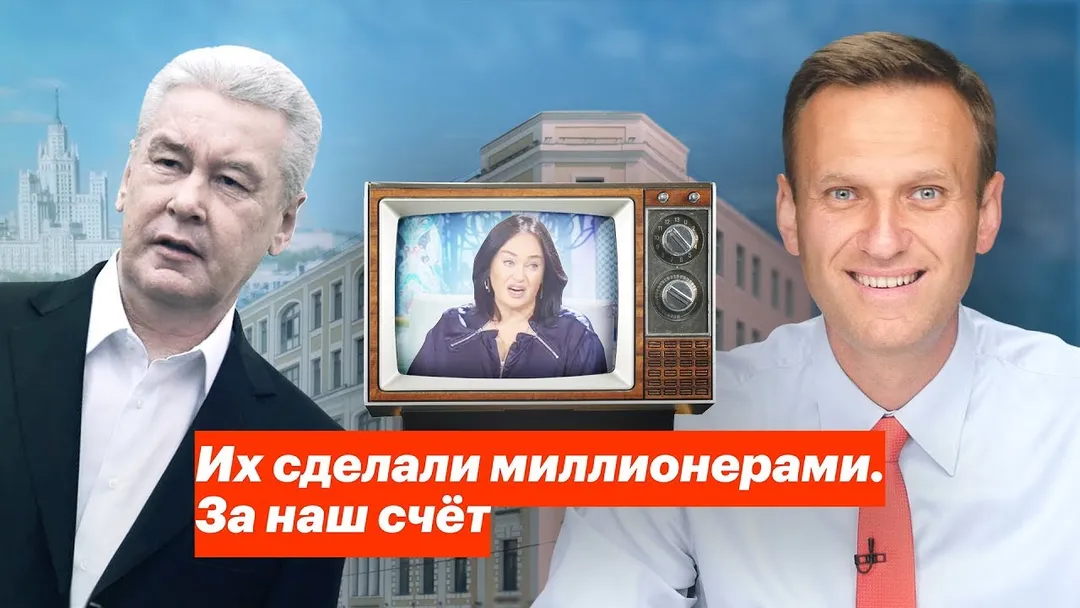
They made them millionaires. At our expense.
[music]
well,
how wonderful it is to own an apartment in Moscow.
It’s a thought that has crossed the mind of every
resident of Russia: everyone wants an apartment in
Moscow. Those who already have one want to have
another one, but in the city center, because you can
at the very least rent it out and live off
that income comfortably anywhere you like—
even in Thailand. The only question is: how do you get one?
Prices are brutal. For example, in this
building, apartments start at 50 million
rubles apiece. Where is anyone supposed to get that kind of money?
Well, you don’t have to. Our investigation today
is about how expensive,
highly coveted apartments in central Moscow
are handed out for free—and you don’t need to be
a Hero of the Soviet Union (a top Soviet honorary title) or
save children from a fire. You can simply
write on Instagram about how much better Moscow has become
under Sergei Semyonovich (Sergei Sobyanin), and there you go—an apartment.
Back in the late 19th century, this spot was home to
a rental apartment building and manufacturing facilities owned by the merchant
Bakhrushin. The entire block was built up by them
and occupied. On the site of this corner
yellow building stood a different one—here,
take a look at the photo. Very charming, and
very fitting for the location. It had an
unusual architectural feature:
an internal spiral staircase at the corner
of the building with asymmetrical windows. Thanks to that,
the house was very recognizable. It was often
photographed and filmed. Here it is in
1935, in the prewar Stalin era. Here it is
in
1958, and in 1959 during the Khrushchev Thaw.
Here’s the 1970s, and here’s a photo from the wild
1990s—our little house is still standing there peacefully.
And even in 2005, the famous staircase is still
in place, and the house even seems to be occupied—you
can see curtains in the windows. In short, this
building outlived the tsar, the empire, survived
the revolution, Lenin, Stalin, stood through
both world wars, and didn’t go anywhere during
perestroika or the 1990s.
A historic building, cultural heritage in the truest sense—
something to cherish, dust off,
take pride in, and show on guided tours. But today,
as you can see for yourself, it’s gone. In its place
there’s also something yellowish, but
completely different: a modern building.
The Bakhrushin apartment building managed to survive
a great deal, but it did not survive Putin’s Russia, and
in its place there appeared not just anything,
but a true symbol of Putin’s Russia:
a shameless bureaucrats’ nest in the capital.
Why shameless? Well, because we,
as a society, as
taxpayers—who are we willing to hand apartments to for free?
To orphans,
veterans, the very sick, the desperately
needy, military personnel, people on housing waiting lists—
people who are all crowded together
in a one-room apartment and have no
way to earn enough on their own. To people
who have rendered extraordinary service
to society, and for which
they ought to be given apartments. But here, from
these windows, from apartments worth nearly
100 million rubles each,
dozens of pairs of eyes are looking down at us.
Civil servants to whom this literally most
elite Moscow real estate
was handed out practically for free. And these are
not some top bosses, but very often
minor clerks, nameless
deputy assistants to deputy assistants working for
the Moscow authorities, who have long since turned into
a real mafia. I would very much like
the whole country to watch this video and understand
the scheme by which officials become millionaires
at our expense. Everyone is always
discussing their salaries, but salary is only
a small part of what they actually
get from us. I’ll tell you the story of our
bureaucrats’ nest from the very beginning. It is
very interesting—and very shameless.
The corner building on Sadovnicheskaya Embankment
was in terrible condition throughout the 2000s.
Ordinary residents had long since been resettled, and
either homeless people or migrant workers were living there.
But despite its deplorable
condition, in 2009 it was still decided that the building should
be preserved and renovated. And
literally a week after that
decision—what a coincidence—on
Sadovnicheskaya Embankment, a collapse occurred.
Entire sections of that building—you can
see it clearly in old photographs—not even the adjacent one,
but the one after that—collapsed, and under the rubble
three workers were killed. The tragedy and the issue
were widely discussed in the media. The next
morning, Resin himself was already at the scene—
the head of Moscow’s construction complex.
By the way, he is now a deputy from United
Russia and an aide to Patriarch Kirill. What
did Resin say back then? Let’s listen.
Originally, we planned to preserve these buildings
and renovate them. Now a decision will be made
to demolish them and in their place
reconstruct, so to speak, exactly the same type of
architecture.
And now, as they say, watch closely.
The collapse happened here, but
they demolished all of this, including the corner building
we’re interested in. This simple trick was,
of course, noticed by absolutely everyone. On every
channel in those days there were unbelievable
reports: they are destroying our
cultural heritage, Moscow has lost yet
another historic block today. But
on Sadovnicheskaya Embankment, with astonishing speed
and professional efficiency, they destroyed
19th-century buildings. Practically nothing remains
of the four-story building constructed in 1906.
Once again, for everyone:
they repeat that there are no protected landmarks here,
not even nearby.
the entire block, the entire block, this whole area
not a single politician, not this building
who did this, and why the hell was it done like that
at a practical, technical speed
how quickly this planned destruction was carried out
no one expected it from them
the idealization is understandable—he's already an old man
but the Moscow authorities insisted that everything
would be fine. Yes, they're demolishing the entire block because
it cannot be restored, but we
will build exactly the same thing, and best of all,
it will be for benefit recipients and people on the housing waiting list
by the end of the week, the historic block would be completely
razed to the ground. In its place, they planned
to build about 10,000 square meters
of new housing, and as the authorities promised,
all of it would go to people on the waiting list. It
was slated for demolition and for
the construction of municipal city
housing to resettle residents
of the Central District. Now this plan
will definitely be carried out
the Moscow authorities told us: here there
will be 10,000 square meters of housing
for those who need it
for example, people being relocated from dilapidated housing
or, as stated in a decree of the Moscow government,
it is designated for benefit recipients and
young families. At this point, one might
stop and say: all right, to hell with it
those idiot officials demolished
a historic block, but there's nothing
to be done now. But at least the people on the waiting list
or at least residents of dilapidated buildings in
this central district won't have to move to Yuzhnoye Butovo (a far-out residential district in Moscow)
but will be able to stay here, in their own neighborhood
let's see what happened next
the building was demolished, and in its place there appeared
an improvised parking lot
that was probably the last time when
benefit recipients could visit this
site. In 2015, the government
of Moscow, using its own funds—from the city budget—
began building a new
building on the vacant lot. The pace of construction was simply
shocking. Just look at
the sign: from scratch to full completion
in just 14 months. And by the beginning of 2018,
in the brand-new gleaming building
the apartments were ready to be allocated. Young
families and people on the waiting list were practically
packed and ready to go. What a location, what views, and
what a setting. One square meter in this
district costs 500,000 rubles, and before
Sergei Sobyanin stands a difficult choice
he could give the apartments to people on the waiting list, as
promised. After all, everything here was torn down to hell
for the sake of those on the waiting list. Or
if not, then as is customary with
city property, these apartments could
simply be sold at auction for a lot of
money and replenish the budget, and then
buy, for example, medicine for pensioners. But
why sell them if you can hand them out
for free, or almost free, to the most
needy
the most vulnerable
let's look at those sixth-floor windows with
their picturesque view of the embankment. Somewhere
there is a wonderful apartment
with an area of
135 square meters (about 1,450 sq ft). One like that costs 70
million rubles, and only
a very wealthy person could afford
to buy it. But when you work at Moscow City Hall
run by shameless
crooks, miracles happen
the apartment goes to the seven-year-old son
of Moscow's culture minister, Alexander Kibovsky
—Volodya Kibovsky, born in 2012
a responsible first-grader and
property owner. It's even listed in his father's declaration
this apartment is listed there. All right, maybe
the minister's family had nowhere to live, but
no—from that same declaration we can see
that they already have
a 174-square-meter apartment (about 1,873 sq ft), which, believe it or not,
they also bought from the city of Moscow
at a super-discounted price. It is located
in the elite residential complex Kupecheskaya
Usadba, very close by, in Zamoskvorechye
less than a 15-minute walk away. Its market
value is 150 million rubles. Let's move on to
the next lucky recipient among the
"people on the waiting list": apartment No. 53, 141
square meters (about 1,518 sq ft), market value 75
million rubles. The owner is Artur Lvovich Kiskin
back under Luzhkov (former Moscow mayor Yuri Luzhkov), he
headed the city's housing and utilities department, and
later he became the man in charge of
capital repairs. He is the head of the Capital Repair
Fund for Apartment Buildings of the City
of Moscow, the person responsible for
tilework, trash chute repairs,
and plaster in our building entrances. The job is
undoubtedly a dirty one, but his earnings, apparently,
are not bad. A year before this discounted
purchase, Kiskin's son bought an almost 200-
square-meter apartment on Malaya Pirogovskaya Street
for 145 million rubles. His wife also has
another 165 square meters nearby in an elite
club-style building—that's worth about 120 million
rubles. And you and I are handing this family
another 141 square meters
in the city center. Between the apartments of Kibovsky
and Kiskin there also settled, side by side,
three more Moscow City Hall officials. Each
of them has an apartment of 147
square meters (about 1,582 sq ft): Yuliana Knyazhevskaya
chair of the Committee for Architecture and
Urban Planning of the City of Moscow
Apartment 64 belongs to Oleg Dmitrievich Antokhin
who is the head of Moscow State Construction Supervision
and here's another "person on the waiting list"
Mikhail Kalinin, head of the department
for valuation of city property of the City
of Moscow
you've never heard of anything like that, and neither have we
You may not have heard, but Sobyanin did, and so here it is.
This is prime Moscow real estate.
The kind you could sell as soon as tomorrow and
become a dollar millionaire. In fact,
12 of the 24 occupied apartments in this
building belong to employees of Sobyanin's
mayor's office, and it's impossible not to notice that
the overwhelming majority of them, except for one or two,
are directly connected to construction and
city property. In other words, their
departments either built this house or
sold it, or demolished the previous
historic building. So let's deal with them
all right away. Listen carefully and
remember the names and positions — it's important.
Yemelyanov, Alexei Alexandrovich
Head of the Moscow Department of Cultural
Heritage. His apartment is nearly 180 square meters
(about 1,940 square feet). He has worked in the department since the 1990s,
and it was his department that refused to
recognize the Bakhrushin house that stood on this
site as a cultural heritage landmark. But now
his new apartment is worth 90 million rubles (about $1 million).
Shakhmuradova, Sabina Ruslanovna, head of
the department for coordinating work on land
management sites and district operations
at the Moscow City Property Department.
But you can no longer find her in the state registry extracts.
A month after the purchase,
of the 180-square-meter apartment
(about 1,940 square feet), she transferred it to her mother, who has a different last name.
If this woman at least has a position, however
unclear it may be, then her neighbor
Dilerov, Ilnur Ilesurovich, is a complete
mystery. He worked as an aide to the Minister
of Economy of the Republic of Tatarstan (a federal subject of Russia). On the
Moscow mayor's office website, there isn't a single word about him.
But in an article about development near Dubki Park,
he appears as an aide to
Moscow's chief construction official,
Khusnullin, and he also has 180 square meters (about 1,940 square feet).
Next, an apartment of 144 square meters
(about 1,550 square feet). The owner is Kuznetsova, Natalia
Vladimirovna, deputy head
of the department coordinating the work
of the urban planning policy and
construction complex of the city of Moscow. So you
understand: there's Sobyanin, then he has
a deputy, Khusnullin; Khusnullin has
deputies; and one of those deputies has
yet another deputy — and we are giving
that person an apartment worth 70 million rubles (about $780,000).
Hang in there, dear viewers, we're
continuing. Another 144-square-meter apartment
(about 1,550 square feet): Logachyova, Ekaterina Ivanovna,
deputy head of the Department
for Territorial Executive Bodies
of the city of Moscow. She became
a government official in 2017, and in
2018 we bought her an apartment in this
building.
Stepanov, Maxim Sergeyevich.
Born in 1989, he isn't even 30 yet,
our dear Maxim Sergeyevich. He works
as deputy head of the Department
of Urban Planning Policy of the city of Moscow.
In his entire life, he could have saved
at most 5 million rubles (about $56,000), but his apartment
is worth 50 million rubles (about $560,000). Another
owner, not much older, is Buloy
Boris Alexeyevich, deputy
press secretary to Sobyanin. I won't even
comment on how ridiculous that position is,
but in 2012 the Presidential Property Management Department
already allocated him an apartment in
an elite residential complex on
Starovolynskaya Street. That apartment was
131 square meters (about 1,410 square feet), with a market value of at least 80
million rubles (about $890,000), and it was
officially transferred to him by the Russian
Federation, as confirmed by the registry extract.
It didn't go anywhere, so please explain to me
why on earth we are giving him another
apartment. What is he doing in our building? These are
the twelve friends of Sobyanin I wanted
to introduce you to. Every single case
is outrageous in its brazenness
and injustice. But believe me, this is still
far from everything. Before we move on to
the other neighbors, we need to deal with
the giant elephant in the room —
namely, the question of how these
apartments ended up in the ownership of
Moscow officials.
Where did each of them get 70 or 90
million rubles to buy them? If they bought them,
of course they do not have that kind of
money. The apartments were sold at different
prices — so heavily discounted that you could
say they were practically given away. You understand,
you can't, without documents, either
sell, transfer, or gift
state property. There has to be
a document, for example one like this, from which
we once learned that the TV
liar Vladimir Solovyov received
an apartment from the Moscow government at a price far
below market value. In other words, he
formally bought it, but in practice the city
gave him a great deal of money. In our
case, everything is completely classified.
We checked databases and archives, made calls and requests —
we did everything — and there is not a single accessible document
explaining why these people received
apartments from the city, or if they bought them,
then at what price. We understand that this
secrecy exists because the apartments were
effectively stolen from the city through
sales at laughable prices. And purely
analytically, we can prove that none
of these officials could have bought them at
market price. We took the financial disclosures of all
these Sobyanin lackeys, especially since they had been publicly available
for many years, and
simply estimated how much they could have
saved over recent years. The result
surprised us greatly: almost none of them
could even theoretically have had
more than 6 to 7 million in her accounts, and then
we found another very interesting
resident of this building who helped
us refine the calculations: this is Olga Timofeeva
— if I'm not mistaken, a State Duma speaker
and, most importantly,
co-chair of the All-Russia People's
Front, known for its tough
anti-corruption campaign. Humanity,
respect, courage, honor — all of
that... who could ever forget how
she learned from her elders to help people, supports
spiritual values, and always honorably keeps her
word. And her income in Russia
has been known since 2012, but
most importantly, before the last election
in 2016 she published a special
pre-election declaration listing
the balances in her bank accounts. Let's look:
in September 2016, she had
226,000 rubles in VTB (about $3,500 at the time), and
exactly two years later she buys a 140-
square-meter apartment in this building on
Sadovnicheskaya. Her income for those two years was 9
million rubles. Let's assume she
lived frugally and saved half of it — four
and a half million. But that's all she
had at most, all she could have had for
buying an apartment whose market value
was 70 million rubles. Fine, forget the
market price — let's take the developer price,
that is, a heavily discounted value
for the apartment, and the cadastral value there is 40
million rubles. And we have no doubt that
Sobyanin was selling these apartments for one
tenth of their cadastral value.
Do I even need to point out that in this area
of Moscow, for 5 million rubles you can't
buy even a room — at best, a parking space.
So apparently everyone there is for sale:
politicians, and journalists too, well,
everyone has their price — but in
our building there aren't only officials; there are also people
who are more entertaining. I didn't start this video
by mentioning Instagram for nothing, where
paid performers praise Sergei
Semyonovich (Sergei Sobyanin), and we understood that they were
being paid to fawn over the thieves at City Hall, but
we didn't suspect it was this much. So who
is it here that grabbed a 107.6-square-meter apartment
on the fifth floor?
[applause]
Good afternoon, Larisa Andreyevna Guzeeva.
A star of Channel One and of all Soviet
cinema, who so sincerely, so
honestly told us about the wonderful
Mayor Sobyanin: "But if you don't come
and vote..."
Larisa Guzeeva praises Sobyanin; Sobyanin
gives her an apartment in the center for one
tenth of the price. So who, then,
turns out, financed it? You and I did.
We financed the far-from-poor Larisa Andreyevna — well,
to the tune of about 80 million rubles. But why? Who
decided this? In what law does it say that we
must pay for apartments for wealthy
TV hosts? I even decided to call
Larisa Guzeeva
to ask her how that happened.
Larisa Andreyevna, this is Navalny speaking.
Alexei is bothering you. I believe you've long been
waiting for my call. I
wanted, Larisa Andreyevna, to discuss with you
your apartment at 80 Sadovnicheskaya.
Larisa Andreyevna refused to speak with us and said
nothing — she just hung up.
Larisa Andreyevna, hello again, once more,
it's Navalny again, about your apartment.
Please talk to me.
I want to know — please explain to me:
you received an apartment measuring one hundred seventy-
six square meters in a building
on Sadovnicheskaya...
[music]
Very well, I want to know under what terms
you bought it, or whether the city gave it to you.
My name is Alexei Navalny.
[music]
Between you and
...please don't hang up on me.
Please.
[music]
Larisa Andreyevna, and I'm sure you
know who I am.
[music]
I think you are, I think you are
an open person and can explain
how exactly you got this apartment.
I've never... well, let's just say,
let's get acquainted, let's meet.
I'd be happy to meet with you.
You have a very large apartment, so it
seems you received it from the city.
...
So you can see that it's really me, you see, well, you
can see it's me, you've confirmed that, right?
Navalny.
Larisa Andreyevna Guzeeva does not want to
talk to us, despite the fact that
we, generally speaking, paid for the apartment with an area of
176 square meters in
a luxury residential building. Larisa Andreyevna,
sorry to have bothered you, but
the people who
paid for these
gorgeous luxury apartments for you and your neighbors also have
the right to know why. Please tell us,
tell the whole country why it was fair and
right to give actress Guzeeva
a 107.6-square-meter apartment worth 90 million
rubles.
If this was payment for your posts on
Instagram and videos supporting Sobyanin,
then let Sobyanin pay you himself, because he
robbed us in order to pay you for
helping him stay in power
and keep robbing us. That's the scheme
that was set in motion, and not a single day in her life...
In the city center, for example — not in St. Petersburg, where when I
had my own apartment, not here, I
always live way out in the middle of nowhere. Believe me, I have never
had any other option. I have probably never had rich
lovers or husbands — never. No one there
has ever in my life given me even a single
square centimeter.
I understand that you are probably already tired of hearing this,
but I think it is necessary and important
to list by name the other residents
of this building.
The whole country knows its beneficiaries and
people on waiting lists, its orphans and fire victims. Devikin
Igor Nikolaevich, head of administrative affairs for the State Duma (the lower house of Russia’s parliament),
former head of the security service
for Volodin (Vyacheslav Volodin, senior Russian official). Pristanskov Dmitry
Vladimirovich, former head of property management — he
resigned in December 2018 for frankly
corrupt reasons and received an
apartment after that: 132 square meters.
Shkolov Evgeny Mikhailovich, former
Putin aide on personnel matters,
received a 150-square-meter apartment and four
months later resigned. Kruz Andrei
Feliksovich, head of the inspectorate
of the Accounts Chamber of the Russian Federation (the state audit office),
which fights
corruption under Kudrin’s supervision — 136 square meters.
Trunin Ilya Vyacheslavovich,
Deputy Finance Minister of the Russian
Federation.
134 square meters. Nagumanov, no-ip vazy k vich.
Head of the FSB (Russia’s security service) for Arkhangelsk Region.
That is the man whose FSB building was the site where an anarchist blew himself up.
136 square meters in Moscow, for some reason.
Though they are in Arkhangelsk. Yakovleva Elena Polna
Director of the Department of Budget Policy
in the sphere of public administration,
the judicial system, and the state
civil service — 146 square meters. Malyshev
Fyodor Ivanovich, adviser in the Expert
Directorate of the President.
136 square meters. Baryshev Pavel Fedorych,
Deputy Minister of EMERCOM (Russia’s emergency ministry) — 135 square meters. And to
finish the list, I want to mention this
wonderful lady: Abramchenko Viktoria
Valeryevna, head of Rosreestr (Russia’s state real estate registry), responsible
for destroying the real estate registration system
in Russia. All these “Russian Federation individuals”
instead of the surnames
of Chemezov, Sechin, Rogozin —
that is under her jurisdiction. She and her staff, manually,
alter the data and conceal
the real property holdings of corrupt
officials.
150 square meters in central Moscow. An important thing
that everyone should understand in
Putin’s Russia is that the question of how much
officials earn in salary
is meaningless. Sure, on paper he may have 4
million rubles a year, but then through a scheme like this
he grabs an apartment worth 80
million rubles, and on top of his salary
gets the equivalent of 20 years of annual income and does not even
pay a single kopeck in tax on it. You,
from your salary of 50,000 rubles a month, will pay
income tax and social contributions, but they will not.
You will get a tiny pension and
struggle to survive, while these figures have received
two or three apartments while in government service. One in
some building like this can be rented out for 300,000 rubles
a month, and that is it:
a pension for life. Nevertheless, I have
good news. Right now you have
an excellent opportunity to say: I do not want
to pay for your luxury apartments,
and to say it in a way that both Sobyanin (Moscow’s mayor) and
Putin will hear. On September 8 there will be regional elections.
They will also take place in Moscow, where thanks to United
Russia (the ruling party), these kinds of tricks can be pulled off.
In Moscow and in St. Petersburg and everywhere else, we must
go to the polling stations and make sure that as
few United Russia candidates as possible
are elected. For that to happen, we need
to coordinate and vote the same way.
If we scatter our votes, United Russia
will win. For this purpose, we created the Smart Voting
website. Register, and we
will tell you whom to vote for in order to
upset a United Russia candidate. Tell them that
you no longer want to buy these apartments for them.
Subscribe to our channel.
They tell the truth here.
