Navalny Circles: Healthcare (full version)
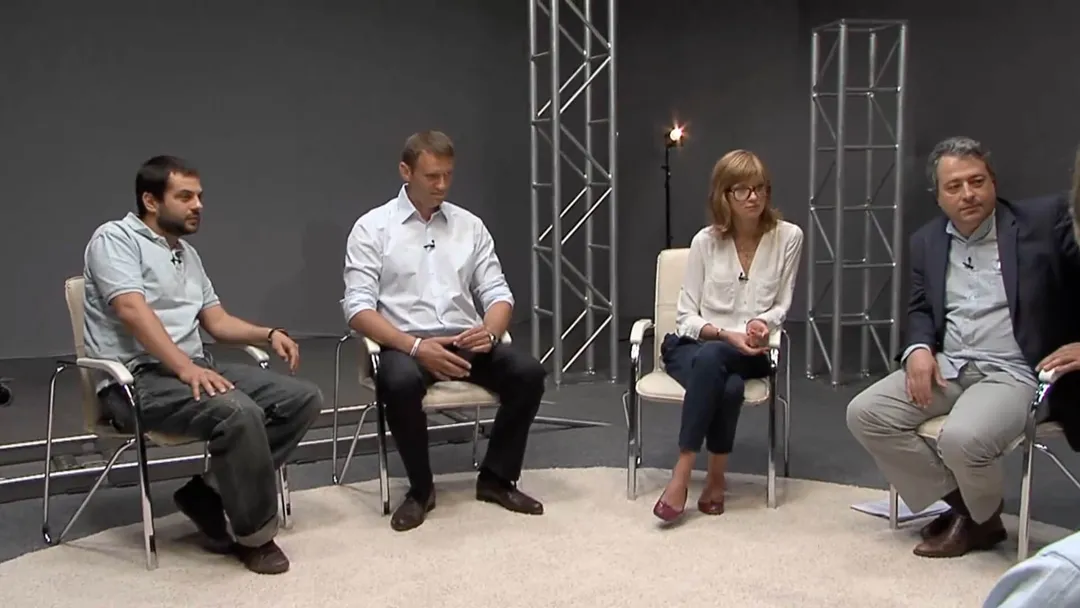
Friends, thank you very much for coming
today to meet with me and my team, because
for us it is fundamentally important
to maintain an ongoing professional
discussion on various issues.
Today we are talking about healthcare,
which for many years has commonly been described
as languishing in poverty, but
in recent years in Moscow it has had money,
and yet it still continues to languish. In
Moscow healthcare, over the past
few years, 900 billion rubles have been invested. But we
still see
dissatisfaction both from doctors and
from the public. And we can see that
our basic indicators—treatment outcomes,
prevention, and all the other metrics—
are not improving. Today I would like to talk
about what we need to do
to make medicine closer
to people. What do we need to do so that
people feel that a doctor is not
someone from another planet, not
some kind of administrator, and not just part
of a medical system headed by the
head of the health department,
but rather the person who
actually treats them, someone they can
turn to personally in order
to know, um, how to treat their children,
how to care for their elderly parents, and so
on, and so forth. How can we make sure
that medicine truly heals
Moscow residents. And that Moscow residents are satisfied with
their healthcare. All right, let me say a few
words, yes. We have gathered here
because we see you as, well, so to
speak, a likely future mayor. And, uh,
so to speak, we expect something from the authorities. Well,
strictly speaking, I can speak for
myself, I can speak about my circle of
colleagues and friends, I can speak about those who
signed a certain document that we
once called the Declaration of
Independence of Russian Doctors. And that
is not a very large number of people—about 3,000
people—but still, it is a certain
number of people. I can say what
we expect from the future authorities. We expect,
above all, professional autonomy.
That is what I would like to have for myself,
right? And, so to speak, I would not want to see
you as my boss,
and I would not want to see the health department
as my
boss either.
I would like doctors to be
given the opportunity to practice
medicine. Yes, medicine and
healthcare are two somewhat
different things. They overlap in many
ways, but healthcare administration
is indeed handled by officials,
who approve public vaccination programs,
approve or do not approve certain drugs,
authorize or do not authorize
instruments, open clinics, and so on,
yes. But the doctor-patient relationship,
here in the studio, we actually have two
practicing physicians, Leila and me, right?
So, we talked it over and
immediately agreed on this point:
the doctor-patient relationship should, as far as possible,
be allowed to develop
on its own. You see, colleagues, if you
agree with what I am saying, then—uh,
and if not, then—
Excuse me for interrupting, I just wanted
to ask: won’t this lead to a situation where
doctors become a kind of closed-off,
and patients, if they are dissatisfied with something,
will not even be able to complain? And right now
we already have a situation where
patients, well, practically cannot
appeal various possible
medical errors or simply negligent
performance of their
duties. If there is no
oversight at all, if we remove any
administrative intervention from
this, then it will turn out that the medical,
the physicians’ community, is completely unchecked.
No, you see, this is not about
eliminating all intervention. Nor is it
about saying that we can immediately build
an ideal system. We need to start
moving in the right direction.
The right direction is the direction
of freedom; it is the direction of lifting
restrictions. The current system of
restrictions is structured in such a way that
bad doctors are not prevented from doing
bad work—we know this
and see it—but good doctors are prevented
from doing good work. Of course,
any freedom carries the risk
that someone will abuse it,
yes, but as things stand
now, this is not freedom either, and,
so to speak, it is not good. When
I say that, uh,
freedom means we should not treat
every doctor as a potential
drug dealer. I am not a drug dealer. I should be
allowed to prescribe to patients
with cancer or
any other condition whatever I consider necessary,
namely opioid analgesics. Am I right
in understanding that the role of
professional communities—that is,
self-regulating organizations—should be strengthened, and that
intervention by administrative bodies is not always
necessary? Doctors themselves
organize into a community, they feel
responsibility to one another and
to patients, and regulate such
matters themselves. Indeed, well, they ought
to feel that way, in my view. And so
Here I completely agree.
With Maxim, and I’ll probably start with a different
topic, which is probably also worth
discussing. It is specifically the issue of
the professional training of doctors. It
includes not only an understanding of
how a patient should be treated, that is,
the actual set of medical skills, but also
more broadly, the things we talk about
in relation to all
professions. This includes a doctor’s self-respect
and an understanding of their place
in the hierarchy Maxim is talking about.
In other words, for a doctor to
meet all the necessary standards, this
must be built in from the outset, both in
education and in the formation of such a
doctor. A doctor must respect themselves
and respect the patient. From that will grow
this understanding of
the need for freedom. Unfortunately, I
think that today there are a great many
doctors who do not really
understand that this freedom exists or what
to do with it. There are people who
have been boxed into the limits of
the conditions in which they work, conditions of
frankly indecent salaries, in any case.
A doctor, a young specialist,
who goes to work at a respected
clinic in Moscow—I only just yesterday
spoke with a Candidate of Medical Sciences
who, in my view, has very good
prospects. I’m judging this as someone from
an older generation, yes, and I would like
these doctors to take up this
baton. And he tells me that
his salary is 14,000 rubles (about $150), while
the salary of an orderly in that
clinic is 17,000 rubles (about $180). You do not need to make
any complicated deductions to
understand that doctors have effectively been
left to a system in which
patients will “thank” them, bypassing
the official channels of payment, so to speak.
Yes. And we are not talking about private
medicine; we are talking now about
state healthcare. Here I absolutely agree both with
you and with Maxim,
because the current system of this
excessive and strange state
regulation, and above all simply
statistics that are being manipulated, leads
to a situation where doctors often
simply have to falsify
statistics in order to
earn more. They have to invent more
insurance cases out of thin air,
just write them in so that they can
get paid. And instead of treating people,
they are occupied not with healing people but with paperwork,
just producing papers for the Department of
Health. Yes. And there is one more very
important thing we need to understand,
yes. And I actually would not like
us to focus on money, because
it is so customary: doctors come and
complain that they are underpaid, right? It is possible
to earn decent money in medicine, yes, and
so on. But that is not the point. They should
be paid more. But first and foremost
we need to talk about the doctor as an
independent legal and
economic entity. Right now, a doctor
is not really anything in their own right. Not an object,
not a subject, so to speak. A footballer,
for example, signs with a team.
Excuse me. I would not want
a doctor to be viewed as an
economic entity. As a
legal one, perhaps I would agree. But
why an economic one as well? We can
bring some Brazilian footballer to a team,
but why can we not also allow ourselves to
let a doctor, please, in the end,
act independently? Give them freedom, give
them the opportunity to be an independent
legal and economic entity, and then let
doctors themselves build
their own relationships. Patient: that immediately raises a lot of
questions. I mean, I’m actually not a
medical professional; I’m just an ordinary patient. Well,
you look like a healthy patient. That’s not something I
need just yet. Yes, all right, not an IV drip yet.
No. But you are talking about a free
economic entity. Here is a simple
question from someone who is, of course, not connected with
your profession. Where does the money come from
for you to hire
a radiologist?
A radiologist for 100,000 or 200,000 rubles (about $1,100–$2,200).
If we are talking about compulsory health insurance, then it is clear that
a completely different
principle of budget management applies there. So how
is that issue resolved? You know, this is
slightly outside my area, yes? I apologize.
That is exactly why we are going to
elect a mayor.
What I can tell you is that, once again, there is actually a lot of money
in Moscow’s healthcare system.
We spent on the healthcare modernization program
alone
100 billion rubles (about $1.1 billion). We purchased
a huge amount of equipment—
ultrasound machines and CT scanners. Right now there is no one
to operate them. That is why I say that first and
foremost we need to invest in personnel,
because if we have scanners worth
$3 million just sitting there
under a dust cover, with no one to operate them,
then what exactly are we investing for? Yes,
absolutely. And, so to speak, when I
was taking people around—you see, we have something a bit like
Saudi Arabia here: an enormous
amount of very expensive, very expensive
equipment that no one knows how to operate.
Yes, you go to a clinic in Boston, and there
you see a machine, and they tell me, well,
I brought doctors from Moscow there, and they
said, "Oh, we already have 64-slice, 128-slice scans there,
while here they only have four-slice ones.
Seven days a week, 24 hours a day, while ours
works only until 3 p.m., with a break.
And the main thing is the report we get here—
what exactly are we supposed to do with it? But here
we get a professional assessment specifically of the
equipment you’re talking about.
Unfortunately, having some familiarity
with private clinics in Moscow, including
some fairly high-level ones, I’ll say
frankly: I don’t trust
the results they produce. In other words,
the same high-end
medical technologies may be there, but here
overall there is a lack of professionalism, and it depends on
the tasks managers set
for doctors.
But managers shouldn’t be setting tasks
for doctors. A doctor’s tasks are set, so to speak,
by life itself. Right? A sick person simply comes in—
that is the task.
The key phrase here is a doctor’s freedom. A doctor’s freedom
implies private medicine. Can
a doctor work as an independent
practitioner? Of course, by all means. Absolutely. But
why is it that today he doesn’t have that
opportunity? He can work, but he can
only be incorporated into some
organization. In other words, he
joins some organization,
and in practice that becomes a closed subject. If he’s not
particularly proactive in that sense, then he
simply won’t get involved in this whole business of private
practice, because it is
frightening simply by its very structure.
That is, just imagine
that a doctor could have, in the evening,
after his main job,
a private office where he would
practice. That’s probably unrealistic.
Simply because doctors, I’ll say it again,
are generally not
businesspeople, and to get into all of this
is insanely complicated,
it’s almost—almost impossible. Well,
on this point I completely agree with
Maxim: yes, we really do need to clearly
understand healthcare as a system
for delivering medical care, as
management, and the treatment of a patient as, well,
a function
of the doctor’s vocation. Those really are two
different things. And the situation that, well,
I, for one, can clearly see is that we
really can install
magnificent equipment of any
European standard, but to operate
it, unfortunately, there’s no one. And
that’s the situation. I entered medicine
back in the 1990s and left
medicine in the early 2000s. And
from what I observe now, judging by
the level of what is happening now,
professionalism is declining, unfortunately. That’s
a fact. And, incidentally, it’s not
just about salaries. In fact,
here too I can agree with my colleague
that in principle a person can earn money
perfectly honestly, without taking any kind of
under-the-table payments. No, they can earn. It’s
simply not true that salaries are
everywhere in Moscow hospitals extremely
low. No, if you go to a private
clinic, then yes, probably. But
in the state sector—
there’s only one way. No, of course I’m not
talking about public healthcare.
I’m saying that a doctor who wants
to change things can, yes, indeed,
move into private healthcare,
go into private medicine and earn—
Excuse me, speaking as a patient: you say that
a doctor can earn more by going to a
private clinic. And again, you still haven’t
answered. I still want to hear from
someone where the money comes from
so that medicine outside the private sector
could make the kind of choices you’re
talking about—hire any specialists, pay the
salaries they deserve. In other words,
again, if you’re saying that
you all move into private medicine,
where things are good for you, then I’m left here with my
condition and no one to treat me. These are crucial issues.
No—may I finish? So there is
a kind of framework. Right now we have
the compulsory health insurance system (OMS), yes, and we also have
the system of private clinics. For now, that isn’t
changing. So within the framework of what
exists, do you see a solution to the problems
you’re talking about—problems connected with
professionalism, pay,
the ability to earn, the ability
for doctors to be independent—or does this
require some different model,
above all a different financing model? No,
look, it seems to me that we need to
move gradually, right? We’re talking
about where to begin. Not in a year, not
in five years—it’s impossible to solve all problems
at once. We need to start with
some simple measures, so to speak:
stop looking at doctors as if they were
drug dealers. First. Allow them
to prescribe what they believe is necessary. And
get rid of the enormous amount of paperwork,
multiple signatures on sick leave forms,
and so on. Stop
treating everyone like crooks. Yes,
crime has to be fought, of course, but
fight it when it has actually
been committed, so to speak. There’s no need
for this excessive
preventive control,
right—abolish this, that,
and the third thing; there are very specific measures.
Yes, focus on medical education,
make medical education more
attractive to people.
To intelligent, educated people, yes, because the level of
medical students, well, actually,
yes, that is
a separate story. So, uh, well,
more English, more mathematics,
there are quite specific proposals there,
yes, start moving in the right
direction. After that, there is no need to immediately
break the compulsory health insurance system, no need to immediately—does it
satisfy you within the CHI system? No,
of course it does not, you understand? A lot of things
are unsatisfactory. I do not know how it
works. That is, we do not know—it is some kind of
fiction. It exists, supposedly. For the patient
with people
just ask: have you used it
just imagine, I practically do not
go to—no, you understand, within this
system, with quotas and everything else,
a great deal can be done, yes, and
it is possible to adapt somehow. I am against
reforming everything at once and
changing it all immediately. People are used to one thing;
we need, we need to remove restrictions one
after another, and, so to speak, understand, uh, what
our priorities are. Medical
education, uh, the doctor as an independent
actor. That does not mean that tomorrow he
will suddenly be vested with everything. We will buy him
insurance. If we have there
an independent actor, then how does that
fit with the CHI system, where there really
will always be economic standards?
Otherwise you cannot—may I interrupt you?
I am sorry. The point is not that right now
the whole world does not revolve around the CHI system.
The CHI system is simply a way of distributing
money. We simply need to understand clearly
that Moscow has money for healthcare. In
Moscow, for every Muscovite there is
four times more money allocated to healthcare
than for any other citizen
of Russia. And if we introduce the principle that money
follows the patient, we need to understand
that you as a patient, I as a patient, as
an ordinary Muscovite, all of us have
a little bag of money allocated from
the budget. We simply need to give each person
the right to carry that little bag of money
to any doctor we
want to see. And I would like, perhaps,
to turn our discussion a little now
toward, uh, your
area of expertise, our key proposal
in our program on expanding the network of
outpatient clinics and
moving toward making sure that
clinics are accessible, which more likely
means not building huge
new clinics, but bringing doctors closer
to people. Right now, under the standard, for a
general practitioner appointment, 8 minutes are allotted. This is
absolute madness. It seems to me that we need
not to suffer from gigantomania, but to do it so that
the city would rather rent
small offices in residential courtyards. After all,
we can place a doctor, this
independent, free doctor, in
every courtyard, rent a space,
put a general practitioner there, a family
doctor, equip the office there with
an ultrasound room, a small staff, and
make it so that on average, for every 1,200
Muscovites, there is one doctor who knows
that Muscovite personally, knows their family,
knows their history of chronic
illnesses, and so on, so that I know
exactly who my doctor is and that my money,
which is assigned to me—I could, if
I trust the doctor in my courtyard, I could bring him
that money. If I do not trust him,
I go to the next courtyard and take my
money there. In other words, we want to move
healthcare much closer to people, so that
the distance between you and your
regular general practitioner
is very, very short.
A good, wonderful idea. I believe
that, overall, it is not even very
new. But I return again to my point: where do we get
the doctors who, for you as a patient,
will be satisfactory—like that family doctor
who will satisfy you with the quality of his
medical knowledge and his ability, in general,
to treat people? So, returning to this,
I absolutely agree again with Maxim,
that without breaking what exists
today, but adding something brick by brick
to it, so to speak, constructively,
we still, as everywhere, as in
everything in our lives—and healthcare is
only the topic of our discussion today—
need to return to
education. Well then, tell me, do you agree
with the statement that our medicine,
our medical education, is somehow
stuck at the level of 1960? Absolutely.
My son studied from the same textbooks.
He studied at the Second Medical Institute
(a former Moscow medical school). Well, now it is called
RSMU, or RGMU, whereas in my time it
was called the Second Med. In many
specialties, they were using the very same
textbooks that were used when I was a student.
Yes, in medicine, generally speaking,
knowledge is updated, well, every 5
years or so, you understand—though it varies
by field, of course. There has been a kind of
negative selection, yes, among
the teaching staff, so to speak—the weaker ones
very often stay behind, yes, they remain
to teach at universities, and so on. So
the number of problems here is simply enormous,
yes, so to speak, and you mentioned
professional communities,
but there are no professional ones yet
communities, and no one is allowing these
professional communities
to develop. Uh, so to speak, officials
immediately take the initiative into their own hands, and
if they need to create, say,
a professional cardiology
community, they just appoint one right away. That’s not
how it grows, you know, so to speak.
The best scientist is not the one who was
appointed the best scientist, right? It’s the one
who has the best results and who
is recognized by the professional community. And
in some field, a strong community may emerge in 5 years,
while in another it may take
20 years. Well, that means
that’s just how it is: you have to be patient, you have to wait, you have to
cultivate all of this. In that connection,
and in light of what you’re saying,
I wanted to get your assessment of our
proposal in the area of, well,
the fundamental, uh, the fundamental
part of healthcare, which
is that at least
40% of the money that goes toward
endless capital expenditures, toward
modernization, and the purchase of new
equipment, should instead be
invested in doctors’ education so that
in 5–7 years
we start seeing results. Because a modern doctor is
a doctor who absolutely
must speak English.
A modern doctor is a doctor
who may have studied abroad for a year or two,
and so on and so forth. In other words,
if we now take some of these
billions that we definitely have
in the Moscow city budget and invest
some of that there, without even worrying that
medical universities are federally run institutions.
It doesn’t matter whether they’re federal institutions or not.
We still have to treat Muscovites
here, in our city. That’s why we want
to invest enormous sums in training doctors.
We have that money. Yes, that’s
a wonderful idea. Yes. As for
opening these mini
clinics, these offices in every
courtyard, again, that possibility should be allowed,
but it shouldn’t be mandated, right?
You shouldn’t order that this office must necessarily be staffed
with a specific roster, fully manned, and so
on. Because then, you see, I
from my own experience working in Tarusa (a town in Russia),
well, fortunately, I found my friend
and colleague Artemy Nikich Okhotno quickly.
I had been watching his development there since about
his fourth year of medical school, and the next
therapist I managed to recruit and
bring there, to Tarusa, only some
4 years later, you understand? So yes,
so to speak, we endured, waited, searched. Uh,
it’s very, very difficult, yes, very difficult
to find a good one. Everyone understands that finding
a good writer, scientist, musician, or doctor
isn’t as simple as just whistling and paying. No.
But in Moscow, after all, the staffing
problem with doctors is not as severe
as it is in the rest of the country, because
this has a negative effect on the country
as a whole. But Moscow does siphon off
the best personnel, at least from
the nearby regions. And it seems to me
there isn’t a massive shortage
of doctors in Moscow—or is there, after all?
What do you think? It depends on the
specialty.
It depends on the specialty. Depending
on the specialty. You have to
understand that, again, say,
there’s no enormous shortage, no. I mean,
to say that Moscow’s operating rooms will
close tomorrow because of a lack of
anesthesiologists? No, of course they won’t.
But, for example, there is a shortage in
anesthesiology and resuscitation services,
quite clearly. And in terms of staffing
there are major problems. And if
we’re talking about a specific, uh,
area within anesthesiology
and resuscitation, then the situation there may
be even worse. For example, I
just know of a fairly specialized
department where, when I left, the
standard team consisted of two doctors
and, well, usually an intern or resident.
Now one person is on duty. Well, let me
go back to what you were saying about
education and staffing, because, well,
there was the question: will the patient
actually like this doctor? And here I
return to my role as a patient, yes,
because I don’t know how this is structured from
the standpoint of training, but I do understand that
from my point of view as a patient, the
main problem with training, aside from
textbooks from the 1960s, is
the complete absence of any ethical
component, any ethical dimension, in that
training.
That’s very hard, very difficult
to teach, you understand? To cultivate
a soul in a person is very hard, yes, and a course
But this isn’t a question of the soul; it’s a question of
basic standards for how to treat a patient.
Some kind of
rules, essentially, yes—what you can and cannot do
in how you behave with a patient. We won’t even
get into how much this is taught on a residual basis
in medical school nowadays.
Many ordinary people far removed
from medicine view doctors as
some kind of, well, mafia, as it were: they
don’t expose one another, don’t turn one another in, like
housing maintenance office workers (ZhEK, Soviet/Russian municipal housing services) who stick up for each other,
and doctors are seen the same way. No, well,
of course doctors cover for—What did he do there?
How many pairs of scissors he left behind in your stomach,
his fellow doctors will never turn him in.
That’s a problem too, right? Well, well,
yes, it is, but again, that issue too,
can’t be solved just like that, you know? There’s
also one more very important point here. I
know that some of those
present will disagree with me, but we need
to understand that medicine, generally speaking,
medicine itself is not a service
industry, right? And I insist
on that, yes, because in the end you can
reduce everything to the idea that there is
production and services. You could
say that a priest’s work is
spiritual services, and a teacher is
providing educational services, and so on,
yes, but that only offends people and
that’s all. But in fact it not only— not only,
so to speak, offends people, it also
creates completely wrong
relationships, yes.
prescribe—what can I do for you—that’s
wrong.
Naturally, a patient would like
it to be a service industry.
Of course, there is a service component,
you see; schools have one too.
There is, so to speak, a component there as well:
the hallways should be clean. A patient would like—
doesn’t want the doctor to talk? Let me
let me tell you, as a patient, what I
want first and foremost. I want
to understand what is being done to me.
Why? I want people to talk to me,
to explain their actions and, essentially,
for me not to be in the position of some
silent idiot on whom various
procedures are being performed. The doctor should
understand what is happening to you. I
hope the doctor understands that. No,
first of all, very often they do not. But
secondly, you see, what you want—
what you mean is: "I want the doctors
I deal with to be sensitive,
subtle, deeply empathetic people,
you know? Well yes, of course, we all
want that."
nivakatsiya
at the very least
what it means, at least, why they prescribed it to me
prescribed it.
That is exactly why we are proposing this
crucial principle: the money follows the
patient. Doctors are people too; they are different.
Some are more sensitive, some less so.
Each of us should have the opportunity
to refuse this doctor and go to another.
If your local clinic has some awful
woman who yells at everyone, then you
leave and take your money with you. And that
woman who yells at everyone—she
understands that patients are leaving
her, and she won’t receive
anything. This is crucial, and we can
do it right now. I would like,
perhaps, you know, to briefly touch on
something concerning, in general,
the structure of healthcare in Moscow. In my
view, we still have
a medical infrastructure that
is based on principles
from the middle of the last century, when the main
threat to health was considered to be
infectious diseases, and there was this kind of
mobilization-style medicine. Let’s
treat those who—wash your hands before eating—
wash your hands before eating—and treat huge
numbers of people who suddenly
came down with, I don’t know, bubonic plague.
Uh-huh. Now the main threat to health is
the diseases that cannot
be cured in two weeks.
Cardiovascular diseases,
cancer, and so on and so forth.
Therefore,
we really need to move to a system
in which a specific doctor treats
a person over a long period—well,
for months, years, and so on—and gives them
ongoing advice. That is much more like
the kind of doctor you can come to
and actually talk to, someone you can
tell: "Yesterday it was like this,
today it’s different." But our, our system
is geared toward the idea that most
illnesses are supposedly something where you
need to get to a brilliant doctor
who will cure you in a week or two.
But modern diseases
are not something that can be treated in a week or
two, right? Well, perhaps such an
idealized model is possible. Only if
we speak about our realities, still,
well, I, as someone working in private
medicine, would still distinguish between,
probably, the capabilities of public
healthcare and private
healthcare. And here, private does not
necessarily mean some kind of VIP medicine.
It too can be accessible for many, many
people in Moscow. But here the question is
that those very funds in the
bag that you were talking about, as I
understand it, can circulate both into
private medicine and through voluntary health insurance, right? As
a patient, I want to see a doctor. What
difference does it make to me where I pay that money?
And if the state has guaranteed me the
money, I can give it to either a private or a
public doctor. There is
no difference. But here we must not
forget one more point, namely what
we are talking about. You see, medicine
is not all the same. There is planned care. Well,
what we are, in fact, talking about now
really is something with which I probably
completely agree. Yes, absolutely,
A person should probably be treated by
the same doctor, well, roughly speaking, for their entire
life. Well, as far as that is possible,
but there is emergency medicine. And this
situation
is a situation that requires fairly
strict government intervention
and fairly strict government
regulation, because this is
a matter of state security. And here, uh,
it is absolutely not
well, for a megacity like Moscow,
well, say, the Perm tragedy,
the Lame Horse tragedy (the deadly 2009 nightclub fire in Perm) is, unfortunately,
a very real possibility. And
here, uh, this is precisely
mobilization-based healthcare.
It is simply, uh, again, ambulance services,
emergency medical care, emergency
medicine—this is exactly mobilization-based
healthcare. It is healthcare
that must be built on a very
almost semi-military principle. Alexei, I
have this right—may I ask? Am I right
in understanding that you also believe, as
Leila was saying, that some basic
simple things, not especially
high-level perhaps, but still
patient-oriented, should remain
fully within the compulsory health insurance system, and everything else should be private
medicine, or not?
I believe there is no contradiction in that
whatsoever. We simply need to—look,
the city has a large amount of, well,
medical services available, doesn’t it? No? Do you
think it doesn’t? I think it does. There is
insurance. This insurance covers
medical care. It covers
our healthcare needs.
It doesn’t matter which doctor you go to. The main thing
is that behind you there is that proverbial
bag of money. And you must know for sure
that the state will cover both your
medications and your treatment with any
doctor you choose to see. That’s
all. And given that private clinics
even have different prices among themselves, yes, you
understand that this bag
will pay for an appointment at one place at
one rate, and at another place at another. That is
your choice. If you want to see
the most elite doctor in
Moscow, the nicest possible one,
but whose appointment costs three times as much—that
is your choice. No, the money for health insurance is not something you are paying for
for the rest of your life
for medical care as if—no, not for
the rest of your life, just for a year, that’s all
—money. I agree with Maxim. So there are two
things: education and the economic model.
The economic model may even be
the primary one, because it is the principle
by which the structure is organized. How exactly it
works, why, what mechanisms will make it
function—I haven’t heard that. I don’t understand.
This is actually important to me as a
patient, because based on this
today I understand where it is safe for me to go
and where it is better not to venture.
I would like to understand what kind of
model is being planned there—is there any version of an
economic model? How is it being decided?
Still, healthcare as a model, especially
healthcare in Russia, cannot
run on market rails, and it
absolutely does not run on market principles.
Rather, I would speak about infrastructure.
You see, whatever the current situation may be from
the standpoint of the economic model,
perhaps, from that perspective, we should not invest
huge amounts of money in training doctors. But from
the standpoint of reason and development, we
must invest huge amounts of money in
education. Because what does the economic
model tell us? If we
spend 100 billion rubles (about US$1.1 billion) on training
doctors, most likely they will simply go off to
America, because salaries there are
higher. But from the standpoint that we
need to treat Muscovites both now and in 10 years’ time,
we need to invest money in
medical education. What kind of long-term
economic model do we have? If for us it is all about the here
and now, and this is our last term,
and after that we need to get out of here quickly, then
that tells us that the economic
model really does matter, that is, there
must be some mechanisms built in. It is not
just about how much money we are
specifically going to pay for this. It is not just a bill.
But I clearly agree that it
must be long-term, and then
it turns out that everything we are talking
about is primary. The problem there
is with standards. In fact, it is
a problem because the standards that
the standards that have now been written out, yes,
however else to put it, they simply
have nothing to do with
how they can be implemented within this economic
model.
It is hard for me to explain how it could work, but I can
describe how it looks to me
right now. So at the moment, those very
notorious standards that doctors
are all howling about now.
I want to say myself that as recently as five years
ago I was saying that the trouble with our
practical medicine was the lack of
standards. And now it turns out that
the road to hell is paved with good
intentions. Because the standards that have been handed down to
us, which are mandatory for
us to follow, are simply not
workable in some specialties. Let’s just say
that some people may be producing
slightly more reasonable ones, while others are
completely hellish, right? There is nothing like this anywhere else in the world.
What is being done, what we refer to here
as “standards,” is something entirely different. It is
a document a page and a half to two pages long,
consisting of a table that includes
items like 0.1, the frequency of service provision, and
so on and so forth. It has absolutely nothing to do with
medicine.
It has to do with planning, yes,
so to speak, yes, indeed,
the state must, must, yes, yes, and
it is mandatory. So it,
yes, well, you see, in our system planning,
planning in medicine is really
forecasting. But in our case
forecasting has, so to speak, been replaced by something else.
They ask you how many
tests you are going to perform next year, say
200, right, and if you do not do them,
if by the end of the year you have only done 100, then go and draw
blood from whoever you can, because you have to
use up those reagents, right?
If you did 300, then you will be punished for
not having done 100. So this
simply has to be abolished. So when I
say abolish it, abolish all this,
abolish this kind of planning, when I speak about
freedom, abolish this so-called routine health screening
(dispensarization), this foolish thing, yes, it is simply nonsense, it is
a fiction, it does not work at all. And all of this
simply needs to be stopped, abolished,
and in a sense we need to start almost from
a blank slate. The alternative,
probably, at this point, again,
if we are talking about an alternative, would be
to break the whole system all over again. It has already been
broken once. And now, in fact,
those of us who work in clinical
practical medicine are precisely
living among the ruins of what was already
broken. Or rather, maybe not broken—
it was destroyed. Listen, let us not
cling to these myths that there once was
some kind of great Soviet
medicine. I studied from 1980 to
1988. As for buying medicines—yes,
no, listen, listen. Well,
colleagues or not, I went through all of this,
and I have read all of it. You see,
the lag began, if we are talking, so to speak,
about our medicine falling behind,
it began in the mid-1950s with the Doctors’ Plot
(the anti-Semitic Stalin-era campaign against doctors). We are talking about the Moscow
healthcare system. We proceed from the fact
that we have mandatory
health insurance. In addition, the
Moscow budget contains a huge
amount of money allocated for
capital investment, major repairs, and so on, and
so forth. We need to discuss how
to spend what we have within the current
imperfect system. Well, of course,
here I am again pulling the blanket toward
education. And education in this sense
means not only the younger generation, yes, but also
this so-called continuing
professional development that we have,
which in our case is also an entirely formal
exercise. You see, every five
years we receive a specialist certificate,
we renew it, but it all comes back
to exactly the same place. In other words, keeping up with
broader global
trends in medicine, unfortunately,
without knowing English, is simply
impossible. But even so, let us suppose
that if one approaches it
in a serious, fundamental way and devotes to it effort and
material, moral, and
time resources, then it would still be possible
to move things forward, well, at least to some
extent. All of that would be better than
the way things are now. I completely
agree with you. Suppose we have an excellent,
properly trained, wonderfully
educated graduate. But that does not yet
exist. Well, wait. Just
wait. When that person does exist, and when he is
also given freedom, then we will need
to see what he does. We have not yet reached
the point of freedom. So far, we have only begun with
education. No, we said education
and freedom. Freedom without education is
a dangerous thing. Indeed, that is exactly
what we were really talking about today,
yes. Education without freedom is
useless, yes, because you cannot apply it
anywhere. So what we need is education and
freedom. I wanted to briefly touch on an
interesting issue and get
your opinion as professionals on
this subject. Not long ago, the chair of the
Supreme Court spoke about
bribe-takers in the country. And it turned out that
the main bribe-takers in the country are
teachers and doctors. They are the main villains,
the ones from whom, supposedly, everyone suffers most—
traffic police officers, teachers, and doctors.
And this leads to the fact that, indeed,
the image of a doctor is often that of someone
who, well, without a bottle of cognac
or an envelope of cash, will never do anything
for you, and that this system does not work
any other way and never will. So
what do you think about that? Well, what do I
think about it? I think that it is
not true.
I do not think so. You see, I
can speak for myself and for my
colleagues, but that is not how we work. That is
really all I can say. This does exist in our
environment. After all, in our country
there is quite a strong stereotype
of the doctor as a villain. And as we can see
now, including from the state,
as an extortionist, yes, and they even say so themselves,
that it is not us, the officials, who are the extortionists, but rather
yes, of course, we do have problems,
the officials say, but the main culprits, of course, are...
The extortionists are doctors across the country.
Let's be honest, this really is
a fairly widespread phenomenon in many
clinics. These are the kinds of relationships
that have taken shape. And it seems to me that all this time
we've been talking about the same thing. All
our problems come down to one thing: how
this is structured from the standpoint of, excuse me,
economics and process organization. It's all
about the same thing. When you were talking
about a doctor who holds a Candidate of Medical Sciences degree
and earns 14,000 rubles at their job, then
that cognac is exactly what we are, right here,
bringing into existence. In a system where
you have 8 minutes to examine a patient, 100
rubles for some procedure that
actually costs more, and a salary of 14,000 rubles, we
naturally create a system of bribery
as a matter of course. It's built into this model,
yes, it's built into it. It's very easy to manage through regulation,
of course; it's a very
convenient model, when everyone is supposedly
guilty, and at any moment it can be controlled in some
way. So this
model, there it is.
It's a question of self-respect and self-esteem, it's
a question, again, of upbringing,
upbringing.
the model, freedom, yes, and self-respect,
all of this comes from the same general place.
That's what I'm talking about: it's mutual. This
stereotype exists too. I was also
remembering a case when
I was stopped by an officer from the
what do they call it now,
traffic patrol service, and he was hinting at something,
and I said, "You know,
unfortunately, I don't pay bribes." And somehow, in the
conversation—though I try not to get into them—
they still keep pressing. They apparently have
methods, it seems,
of neuro-linguistic programming,
where they somehow draw out certain
information. And when the word 'doctor' came up, I was told,
"Well, my dear, if anyone would,
it would be you, wouldn't it?" So there you are, standing there
trying to explain that I'm not like that, unfortunately."
Well, that's all the time we have, friends. Thank you
very much. This was a very interesting
discussion. The key points I took away for
myself are precisely
education and freedom. We need to invest more
of the money we already have
into doctors' education, because we
understand that the return may not come in
a year or two, but it is the kind of return
that is needed—the kind patients need.
Doctors need to be freed from excessive
administrative duties. We need to give them
more freedom so that they can
treat people instead of being constantly
overregulated and doing some kind of
bookkeeping work all the time. Our
healthcare program is
a living document. We are refining it, we are
adding to it. And for us, it is fundamentally
important to have this kind of direct communication
with the professional community. Thank you
so much. Thank you. Thank you. Good luck.
Thank you. Very cool.
[applause]
And this is in his
