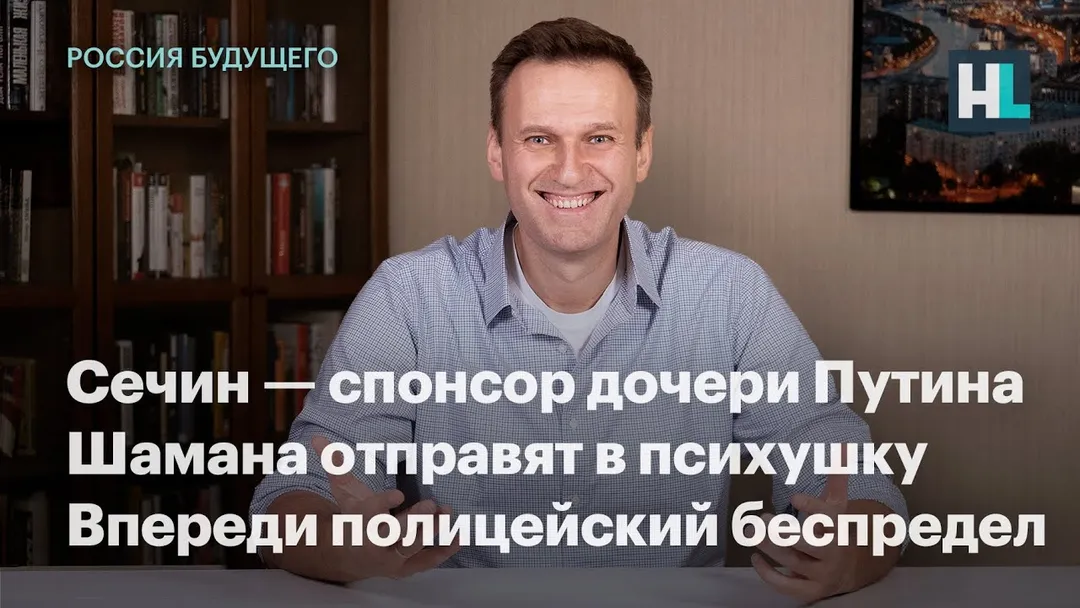
Sechin is sponsoring Putin’s daughter, the shaman will be sent to a psychiatric hospital, and police lawlessness lies ahead
[music]
Good evening, everyone. In Moscow, it is exactly 8:00 p.m.
That means we are live on air
as usual at this time on Thursdays
with the program *Russia of the Future*, and I am its
permanent host, just as exhausted
as everyone else by quarantine, self-isolation, and
everything that is happening — Alexei Navalny.
Or, this week, the man who
must answer for his vile behavior — that's how
United Russia deputy Ernest
Makarenko, one of the leaders of United Russia
in New Moscow, I think in
Novo-Peredelkino.
And our petition on ROI has been approved. You
know that we were collecting signatures for
the Five Steps program. Of course you know — I
have been driving you crazy lately
with these signatures, with this campaign, and I will
keep doing it because it is very important.
And now they have been giving us the runaround,
specifically on the government
website, because what we were doing before
was very important, and what we are continuing to do
is super important, and
collecting lots of signatures, no matter where,
is probably even more important than these 100,000 on
the state portal. But
the state portal is a formal
mechanism that the government will have to
respond to. So please, while this program
is on — last time the program was watched by
100,000 people at peak live viewership — we
have, I think, about 37,000 signatures left
to collect. And in fact, Plan A today is this:
at 1:30 p.m. we learned that the petition
had been approved, and the plan is to collect these 100,000
signatures in 24 hours. Signing is a little
more complicated than usual there — it is not
just an email; it is a verified
signature. But I very much hope that we
will collect them within a day, and of course I would like
us to gather the remaining number while this
broadcast is on. So please, you have
plenty of time: you can watch me,
listen to me for a while, and then
just switch over and vote. If you have already
voted, call out: Mom, Grandma, or
son, daughter, come over here — and let
them vote too. This is very, very
important. Send your questions with the hashtag
#RussiaOfTheFuture on Twitter; they will be
passed along to me, and I will try to answer them.
Let me remind you that you can
become friends of our channel,
click the Sponsor button, and you can
find the link in the description. And there, under
the link to this petition on ROI, there is
a link showing how to send little ducks —
wonderful little ducks that run across
the screen. Each duck brings us
a few rubles in support of our
movement, our program, and our channel.
There are already a lot of questions, I can see.
Right now, 32,000 people are watching our live
broadcast — 32,000 right now, guys.
Just one minute of your time, and we
will make this vote happen, so
please, do not be lazy.
People are asking me: what do the numbers mean? What
do the numbers on my mug mean? Well,
go ahead and guess.
Whoever guesses first and writes it — that person
wins. I would even give some kind of prize, but
it is unclear how to track who was first
to figure out what these numbers mean — numbers that, by the way,
should make Nikita
Mikhalkov (a prominent Russian filmmaker and public figure) nervous.
666, 36, and 9 — that is
a seriously
serious thing. Anyway, with the hashtag #Russia
OfTheFuture, live on air,
we will talk about the elections today, about the fact that
there are, of course, many questions about this. I can see
questions already about the police and everything else.
We will discuss all of it, but I want to begin with
ombudsman Vladimir Vorontsov, who
is currently under arrest. He has
not yet officially been recognized by any
human rights organization as a political prisoner,
but I absolutely believe that
we should already consider him one.
And what is happening right now is very important:
right now, within the Interior Ministry system, where, well,
everyone is squeezed, intimidated,
terrified, anxious, and afraid of one
another, informing on one another — even there,
there is now a campaign underway in his
support. Some people are even openly
signing their names. There may not be many of them, but
as you can see, there are people with covered faces,
and there are also people with completely uncovered faces.
Show us — there are even some
majors there, I saw them — that is, there are
senior officers. That is great. In the last
program I said that it was very
important whether we would now see, within the system,
some kind of campaign in support of Vorontsov.
Because who is Vorontsov? He is the leader
of the police union, and now
the bosses, the employer, are effectively
jailing the leader of the police union in order
to make life worse for ordinary cops,
so that there will be no such person
who would defend the ordinary cop. And if
those ordinary cops do absolutely nothing
to stand up for Vorontsov, that
of course means that, well,
our law enforcement system is completely finished.
It is not in any
sense a law enforcement body; it is
a mafia-like structure. You may be sitting there now and
saying, “Come on, enough already, it has always
been mafia-like, we know all about it.”
But still, it is a huge structure.
There are all kinds of different people there. They
may have different attitudes
toward civilians, yes, but if they cannot even defend themselves…
want to fight against this
injustice and help themselves. Well, that
means things are really bad, so
let's keep an eye on all of this. I just
want to state very clearly, on my own behalf,
that I absolutely believe that, in
the circumstances in which all this
is happening, Vorontsov is unquestionably
a political prisoner of the system, a person
who has suffered for defending
police officers and for demanding
respect for their labor rights, first and foremost
— their rights — and he is unquestionably being subjected
to political repression by the leadership
of the Ministry of Internal Affairs. This
is something people absolutely need to know. 45,000
people
are watching us live. I can't
read this: hard sign, e, hard
sign, pi, and an exclamation mark writes to me
that yes, the inscription on the mug is a link to
the petition on ROI. Exactly right. And our
main link of the day, which I hope you will
visit, is r.ru and then these
numbers that I don't know. It's quite possible
that they really did come up with some
numbers to make it all look very
much like 666. If you're thinking right now
that I'm some kind of complete
paranoid maniac, that's not true, because
back when there was a mayoral
election, the polling station where I vote
really was, through some kind of
manipulation, assigned the number
1488 to it, and before the election they trolled me, saying
look, nationalist Navalny, and even his
polling station is 1488. So that's the kind of
funny
thing that happened with our number. Go
to ROI and vote. 45,000 people are
watching us live. I'm really
tempted to say that until you
vote, until we reach 100,000, I
won't end this livestream. Honestly, it
scares me a little myself, because what if
— I don't know — at least the part of you
that loves these hellishly long broadcasts
deliberately won't vote so that
I stay live on air for two days.
Please go and vote — it's important
just to give a slap in the face to
this whole government that says
that, well, these are some kind of, you know,
Ukrainian bots or State Department bots
that voted, not real half a million
people, but just who-knows-who. And now
now there is the state ROI, and on this
state ROI we need to quickly collect
100,000. If we collect these 100,000 very quickly,
then Putin, to whom they will of course
bring it and say, 'Hey, Vladimir
Vladimirovich, did you see? They collected it in
a few hours,' then it means this whole
thing is supported by millions. It's very
important to begin with the first big
story — the remarkable story
of Anatoly Bykov. I spoke about it
last time on the program, and in fairly
great detail, but quite a lot of
people from Krasnoyarsk wrote to me and scolded me for
calling it the Krasnoyarsk
Oblast, because it turns out that everyone there
gets really worked up about it — I mean, it is of course
a krai (territory), and in the heat of the live broadcast I
said oblast, and apparently that terribly
annoys all the local residents. Please forgive me
for that. But anyway, I was sent
a lot of interesting
details, and the sequence of
events is important, because even if
we
set aside for the moment the Interior Ministry staff and all
the federal media calling him a contract killer and so
on, this is actually a story about
how there are local guys with a complicated
history, and now Moscow guys
who understand that the locals will beat their
United Russia candidates have teamed up
for the election campaign, and we
will talk later today in more detail
about innovations in electoral
legislation. This is exactly what they are
moving toward. Bykov is being kept off the ballot because
his term expired — or rather, let me put it correctly now,
so that the whole
sequence is clear: in April, he
— this Anatoly Bykov — already had
a suspended sentence, and his
disqualification period during which he was
barred from participating in elections was ending, and
already, as part of preparations to
keep him out of the election — and most importantly to
keep his party, which he
controls in Krasnoyarsk Krai, out of the election — and there
he controls the party holding the license
for Patriots of Russia. Well, you know how the
party system works in Russia: basically, you
can, in principle, bring money to Moscow
and buy yourself a branch of some party
— left-wing, right-wing, liberal — and United Russia too.
You can buy United Russia; buying
United Russia is harder, but if you bring enough money
and praise their leader, then United
Russia will be sold to you. So Bykov,
by some means — we won't get into exactly which
ones — controls part of Patriots
of Russia and really is beating United Russia there.
And so his term, within the framework of which
he was prohibited from
participating in elections, is ending, and they
started in advance churning out material about him
— this is what journalists from Krasnoyarsk
wrote to me about — special commissioned
reports, preparing the local public for the idea
that Bykov is already
someone who must not be allowed into the election at all,
some kind of contract killing — and now, here,
let's take a look: back in February of this year
That year, NTV aired a report. I’ll stay in the corner
so we don’t get banned, but this is
actually very simple. It’s important, important to understand the whole
sequence of how they prepared all this.
That’s all. 44 seconds. NTV against Bykov. Three months
ago, the lives of three entrepreneurs
took a shocking turn: new owners
suddenly appeared for their land. How
could this happen in 2020, decades
after the 1990s? It became clear
after the raiders’ confession: “We’re from
Bykov, from Bykov, from Bykov. Don’t
go anywhere, guys,” they say. “It’ll be worse
for you. We have power. We have
Petrovich. Anatoly Petrovich Bykov. I think
there’s only one like him in the region.” Negotiations, according to
the businessmen, were conducted by one of
the aides of the influential businessman
Alexei Talyu. Incidentally, he was recently
detained for driving a car while
under the influence of drugs.
Anatoly Bykov, whose surname
the raiders are using as cover, is indeed a figure
well known far beyond
Krasnoyarsk: the former head of an aluminum
plant, a philanthropist, and, as they say, a very
influential
businessman. So, until just recently, it seemed
that this Bykov—well, no one really had
anything against him. He existed quite
legally. He was barred from the elections
after a law was passed under which
people convicted of serious offenses, even with suspended
sentences, cannot run for office. But he
continued to exist quite legally, was
a completely normal politician, he had
a local party branch, and basically in
Krasnoyarsk everyone understood that he was
popular, and some people around him were
popular too. He was almost beating United Russia, but
until recently, basically,
he hadn’t said anything against the authorities. And now
let’s look at how Bykov’s rhetoric changed,
and after that, essentially, he was handed
what appears to have been a political
sentence: in order to keep you
out of the elections, we’ll also put you in jail. And
for 28 seconds, here’s what Bykov has recently
been saying about Putin: “I get the feeling
that our president doesn’t live in Russia. He
lives on another planet. I would even
recommend that our president, instead of
the occasional little fishing trip and vacation with our fellow countryman,
Defense Minister Shoigu, travel through
Siberian villages, settlements, and districts—just
take a little tour. If they’re afraid to do that, I’m
ready to travel alongside them and show them
what our Russia really looks like today,”
the modern one.
And naturally, this simply could not be
accepted by the Kremlin and the local United Russia officials
because Bykov, whatever you may think of him,
whatever peculiarities his biography may have,
is saying literally the same thing
that roughly every other
Russian man, especially in Siberia, says. He
is saying: “What, have you people in Moscow
completely lost touch? Go drive around and
see what our roads are like.” That’s exactly
what he’s saying, word for word. But he’s not
just some random guy saying it—he’s running
for office. He has money, that’s a fact, he’s
a fairly wealthy man, he has
a party branch, and now he could
crush United Russia. So they began
carrying out a special operation. In fact,
in its details it’s actually very
funny, because it shows what hellish
prostitution
our federal TV channels are engaged in. And to an even
greater, even more disgusting
degree of prostitution than even official
officials. There is this particular
journalist named Pavel Brykin. I had never even
heard of his existence. Again,
Krasnoyarsk journalists sent me
the story. He’s an incredible guy. He has
a special trick. First of all, he
is always traveling around with some cops
and he’s basically what you’d call—I don’t
really like the term—but what you’d call
an obvious stooge journalist.
A journalist, meaning he works for
equally corrupt law enforcement officers
who are either carrying out a political
order or some kind of paid
job. And he has a special trick: he
gets hit by a car. He did it in Krasnoyarsk,
and in Vladivostok too.
Can you imagine? This keeps happening to
the journalist: some people
he’s making reports about
start running him over with a car, he falls
somewhere, and then there he is, lying on the ground
afterward, giving an interview about how terrible
it all was. Let’s watch such an episode in
Krasnoyarsk; there was a similar one in Vladivostok.
A traffic accident has just occurred in Krasnoyarsk
in the courtyard of a building on
Chernyshevsky Street, I think.
75A. This is where the closest aide to
Anatoly Petrovich Bykov lives.
Alexei got out of the car, got into his
Mercedes, noticed our film crew,
which happened to be in his way, and
despite
that, sharply pressed the gas pedal and
ran over my right
leg. You understand—he’s lying there, dying, but
dying and still not giving up.
With weakening hands, he holds the microphone and says, “You
know, I got run over,” and this kind of thing
has now happened to him for the second time. Well, it’s
his signature trick: he sees, you know,
like soccer players—someone nudges him and he immediately
drops, lies there, and screams, “My God, it hurts!”
And there’s another wonderful
reporter like that. Here’s what he says:
the person who at that moment was behind
the wheel of the car. 31 seconds. Alexei Talk
Listen, I walk up and ask, “What happened?” He
pulls out, snatches the microphone, and says, “I’m
a journalist with Russia 24. I’ll have you jailed. You’re
obstructing journalistic activity,”
and then asks the question: “Why are you taking money
from crime boss Anatoly
Bykov?”
That was the whole situation — an absolute
provocation, with enormous sums of money spent on it.
NTV immediately shows up, literally
within 10 minutes. They don’t hide the fact that they
flew in from Moscow, that they’ll stay here
until they’ve filmed
an interview with Anatoly Petrovich, until they’ve
shot their reports there
— provocative ones. But the most interesting thing in
all of this is the sheer
monumental about-face by the entire system. Yes, I
don’t doubt for a second that later clips from
this program will be shown on repeat, saying that
Navalny is defending crime boss
Bykov. But let’s look
at how the current regional governor,
a man named Uss, a United Russia member, and very much
a supporter of the authorities, quite recently
spoke about Anatoly
Bykov himself: “I’ve known Anatoly Petrovich
for a long time, and to me he is not only a politician, not
only a regional legislator, but also, as a person,
a highly extraordinary and
talented man — talented in everything, starting
with the way he organizes the work
of people in his district and ending with his ability
to lay out a proper feast or organize a
magnificent tournament. I don’t know of a single
undertaking that Bykov has failed to pull off, failed to
carry out at the finest, the very
best level. But in the region he is known,
naturally, above all for his
social initiatives. It is hard to find among
the deputies another person who has
done so much both to support
disadvantaged children and to develop sports
and to support veterans, in concrete,
targeted ways, or through large-scale
events. Therefore, he is a Figure, he is
a figure with a capital F, and one of the
key pillars of our mighty
region.” The best man on Earth, a pillar,
a cornerstone — the whole region rests on him. And
those social programs — what can you say? Every
deputy knows him; they adore and love him. All of
United Russia was crazy about Anatoly Bykov, but
then suddenly something happened
— it looks like he might beat United
Russia, and that was it. Moscow said, “You know,
it’s time for you to stop loving Anatoly Bykov,” and they
stopped. Now, I’m not claiming that
I know how things are arranged in Krasnoyarsk
or how it all happened there, or that I understand the true
picture surrounding Anatoly
Bykov himself. I don’t know — I admit that.
I admit it completely,
honestly. But it’s so disgusting to watch how you
were all practically fawning over him there, because
most likely he was giving you
money too. And now, when he started speaking out
against this government, and you understand that he
can beat you on anti-government slogans, he
has to be crushed: bring in a bunch of hired
journalists and simply wage, across the whole country,
a propaganda campaign against him with
these so-called journalists. Why am I
dwelling on this? Because there’s this whole line about how
all Krasnoyarsk journalists are supposedly
bought and corrupt. Well, for the local ones
it’s harder to switch sides just
like that. I mean, you were just
praising Bykov, you were just on
normal terms with him there. People — you
know people vote for him — you can’t
just, the very next day,
So maybe Krasnoyarsk journalists haven’t
reached that degree, that level
of spinal flexibility that
people — excuse me, I’m getting worked up —
their colleagues in
Moscow have. They can’t do it that quickly, and
that’s why Moscow is pushing the line that
everyone there is completely corrupt. And one
of the main drivers of this
anti-Bykov theme goes on air and
tells them directly, well,
“you know, yes, journalists from Moscow came
and, amazingly enough, really filmed
all the investigative actions, but
that’s simply because we come from Moscow,
we’re such honest journalists, while all the locals are
of course corrupt. Let’s listen — 21 seconds.”
“Local journalists curse us and
insult us, writing online, ‘Why did these
bought-off Moscow journalists come here
and get permission?’ I’ll explain: because you
local journalists are not trusted, because
for some reason you all treat with great respect
these dubious
‘authority’ businessmen (a euphemism for underworld-linked figures), and you do not
speak, you do not tell the truth about these
people.” See how nicely
Vladimir Solovyov laughed — heh-heh-heh-heh. So, in other words,
that’s the reaction: we’re being accused
of being corrupt, but we’re not corrupt. Because
you used to praise Bykov, right? United
Russia — all of you praised Bykov as long as
he seemed to be for Putin, or simply
kept quiet. And when it became clear that he was, well,
gaining a lot of support but still wouldn’t challenge
United Russia’s monopoly, then as soon as he
stepped beyond those bounds, that was it:
he became the worst of all, journalists became
corrupt, and they wouldn’t even let a local journalist...
Let’s look at the report at 1 minute 14 seconds.
Federal
colleagues, mocking his surname,
call him ‘Alkashkin’ (a mocking distortion implying “drunkard”). Returning again to
the subject of Anatoly Bykov’s arrest, as an example of
to the people who are here defending him right now
standing up for him, and using rather strange
expressions at that—because their patron, the so-called
man they see
there in all sorts of different positions,
they see him as their protector, a kind of
Robin Hood. He doesn’t talk like that, after all. As for
the admirers of Anatoly
Petrovich, at least learn how to conduct
yourselves the way Bykov does, and only then start shouting
that you’re right, and so on. And don’t
degrade yourselves and turn into this kind of—well,
basically some kind of lout who knows nothing except swearing
and other crude expressions. And
the settlement called Udachny (“Lucky”) became unlucky on May 7
for Anatoly Petrovich Bykov and for
his songbird Dima—what’s his last name, Polushin?
Dmitry Polushin. Well, judging by his face, he looked to me like
Dmitry the drunk. It’s surprising
that this drunk Dmitry couldn’t manage it,
because he sat at the dacha for a long time
thinking about how to come to his senses
after, on May 7, his ATM
stopped working and he could no longer hire anyone on the
banks of the Yenisei, and he doesn’t actually want to work.
His mug is already this huge,
already stinking all the way from Krasnoyarsk. I’m already
switching back to your language again.
Yes, that’s Dmitry for you.
See how easily it comes out when you talk like a drunk?
Just a moment ago everything was okay, and now
suddenly all the local corrupt people who
are defending him, and the local journalists—
they’re drunks, they stink, and so on. Why
am I going on about this for so long? Because,
first, this is going to keep happening;
second, Krasnoyarsk Krai is one of
the most important federal subjects in Russia, and I very much
hope that all residents of Krasnoyarsk
Krai will pay attention to this. You
may have voted for Bykov before, or not
voted for Bykov before; maybe
you don’t like him, but probably even more
than that, you really shouldn’t
like this boorishness. I mean, I can’t call it
the boorishness of Muscovites—I’m a Muscovite myself
and I take that perfectly normally. It’s the boorishness
of an utterly bought-and-paid-for
hack, from the same Bykov camp, feeding from the same
trough. And now he comes here and lectures everyone.
That’s why United Russia in
Krasnoyarsk Krai needs to be crushed, routed,
not given a single vote. Well, including because
people themselves
should decide: if Bykov is really that bad, then probably
they won’t vote for him. And if, well,
okay, he’s some kind of
rich man in his district—suppose he
can even buy something there, shower all the
pensioners with gifts, and they elect him—but probably
his party as a whole, in elections across the entire
region—a huge region—is unlikely to be able to buy
everyone. Let people decide for themselves. And if this
Bykov lived perfectly normally for 20 years and
now they’re fabricating some kind of case against him
over something from 24 years ago, then that’s
simply a mockery of all the local
people, and people should be outraged by it, should
resist it. This concerns all
regions. 78,000 people are watching us live right now.
That’s about twice as many as
we still need to gather right now on our ROI (Russian Public Initiative platform)
to reach
100,000 votes. We can’t get there.
Why? Because you’re sitting there like this,
in front of the screen with
your tea, thinking: ah, whatever, someone
will vote without me, my
vote doesn’t matter anyway.
It’s very important that you specifically don’t
get lazy. And you say, oh, I don’t remember
my password, and I don’t remember my login, I, I—
I know perfectly well all these—not excuses, but
thoughts—that I myself have every
time someone tells me to
sign something, do something, submit something. You log in, and
what was the password again? Well, okay,
like, come on, Lyoshka (diminutive of Alexei), keep talking about something else,
some other people
will vote. No—they won’t vote for you.
No other people will do it. You vote,
right now. It’s very important. We’ve got 68,000 votes.
There’s almost nothing left—32,000.
Right. Nina Pavlovna Zinchenko asks me:
“Good evening, Alexei, what do you think
about the merger of the NAO and
Arkhangelsk Oblast, and how is it beneficial
to the authorities?” Excellent question. And an excellent
post on this topic was written by FBK director
Ivan Zhdanov, who is himself actually
from that NAO—the Nenets Autonomous Okrug.
And this really is
—well, for people who don’t
closely follow these regions, or regions in general,
it may seem like some kind of nonsense,
some insignificant issue. But in
fact, everyone who follows this knows
it’s a significant issue, because
the NAO has a sea of money—
a huge amount of oil money. In
per capita terms, it’s a very rich region,
while
it’s also a corrupt region. But since
there are few residents and everyone knows each other there,
of course there is corruption, but everyone is kind of
in plain sight,
so it’s not that easy to steal a lot. And
Arkhangelsk Oblast is a huge region,
very poor, and we can debate for a long time
whether that’s fair or unfair, but the fact is
that the residents of the NAO would never, under any
circumstances, vote for a merger with
Arkhangelsk Oblast. That’s the second issue:
how we are supposed to ensure some degree of
equality among regions. That is, the fact
that Arkhangelsk Oblast
is closer to NAO oil does not mean that
it has a greater right to it than—I don’t
I know, Ryazan Oblast is a separate issue.
The question is how equality should be ensured there
among all the federal subjects, but
the fact is that if you hold an honest
vote, this will never happen, and
in the referendum that will take place there,
both federal subjects have to
vote. You can’t just do it so that
Arkhangelsk Oblast says, well,
basically, we’re incorporating you into ourselves — that’s
not allowed. The Nenets Autonomous Okrug (NAO) has to
vote for it too. That’s impossible, and so
these
so-called innovations in remote voting,
electronic voting, voting by
mail — voting by whatever means — have already inspired plenty
of jokes about voting with a TV remote
control, probably. And at this
referendum — I don’t know exactly when it
will happen, when it’s scheduled — we
will see either new tricks or at least
a full-scale vote-rigging operation.
Because they will have to falsify
basically all the votes cast in the NAO,
every single one of them, and that’s very important.
Ah, there are a lot of questions here about
merging regions. You see, people,
if we don’t live there, it seems to us that
whether they merge or not is none of our business. But
these things actually matter. They concern
logistics, they concern
funding per capita,
average wages, and so on.
It’s all complicated; everything in Russia’s regions
is very, very complicated, and we inherited
as a legacy
this kind of complicated, strange, and
idiotic — I’m being honest, idiotic —
federal system, one that is often
completely inexplicable.
But what the Kremlin is doing is not trying to
act fairly. Once again, it
starts cheating, and in this
particular situation there will be
a massive fraud against both all the residents of the NAO and
all the residents of Arkhangelsk Oblast,
because they will be forced to take part in
some kind of fake vote.
We’ll be watching this very closely.
So, Alexei, after the “Five
Steps” petition gathers the required number of signatures
on ROI (the Russian Public Initiative platform), what happens next? asks
Viktor Medved. Well, it’s not like
100,000 votes will make a casino-like ding
and money will start pouring out of
your laptop screen. No. After
we collect 100,000 — and as part of our
broader political campaign, we’re collecting
signatures here, applying
political pressure on the authorities there — we’ll
also have a formal mechanism, among other things.
Because right now the authorities say: we don’t
know, some people are demanding something from us on
the internet, we haven’t heard anything
about it at all. We have our position — it was stated by
Siluanov, it was stated by Putin — we fulfilled
one demand. Well, it wasn’t even really one
demand; we just did something
because we wanted to do it. But in fact,
as Putin says, there is no such thing as a
constructive agenda requiring us
to pay money to anyone at all.
No one is constructively demanding that from us, and
so when we collect 100,000 signatures, there will be
a document sitting in the Russian government
that they are obliged to respond to.
This was Putin’s initiative, and Putin
said that 100,000
verified signatures — a law was passed on this —
must receive official consideration. And we
understand that during that review
they’ll squirm and twist around,
wriggle like snakes, dodge, lie, and once again
spin some story. But the fact remains
a fact: they will have to say yes or no, and
we will put them in a situation
where a huge, organized number of people
has said:
we demand direct financial assistance. Here are five
specific points. You’ve already almost
fulfilled one; now fulfill the other four. And they
will have to respond. That is very important within
the political process.
But overall, as before, everything is still very
complicated. I
see a question from “Around the World in Nine” — damn, how do you
come up with these names? Alexei, Vladimir
Milov said that these ham-fisted devils and
economically — I won’t repeat that word
—
it rhymes with “McDuck” —
have screwed up Rosneft. How so? Watch
Milov; he understands this very well.
He really is one of the best
experts on this subject. Look,
you can simply — better yet — look at
Milov’s work; you can look at Rosneft’s market capitalization,
you can generally show the financial
figures, look at the financial indicators
of Rosneft to understand just how badly
things have been messed up there. And Sechin really — I mean,
he is one of — well, you can’t say that
he’s one of the dumbest people
in the country. He’s a very cunning, thieving
official, he’s insanely rich, he’s
absolutely greedy, a criminal
kind of guy. In that sense he’s not stupid, but for
a person who holds
public office, he is certainly
doing stupid things and systematically
looting, squandering, and
wrecking the company Rosneft. A very
funny thing — good that you asked me about it —
happened literally today, actually,
because you may remember that in
the previous program I told you about
how Putin’s eldest daughter, Maria
Vorontsova, got a new toy. She
Now she will be in charge of genetics.
And then there's this:
the younger one, Katerina Tikhonova, is playing around with
some kind of innovation center that will be
built at Moscow State University, and there will be some kind of
giant Valley, with a huge amount of
money, and she is de facto running
Moscow State University in practice, yes, because the rector,
Sadovnichy,
who was her academic supervisor and now
looks after her. Well, he's this little old man
they keep around simply because he is
Katerina Tikhonova's puppet, basically.
The older daughter was also handed a huge
fat slice of the pie, probably even fatter
than the younger one's: some kind of innovations in
genetics. That's especially very
funny, because in the previous program I
told you that a BBC report had come out
saying that Putin's daughter
would be handling all this genetics stuff
and that Rosneft had poured a ton of money into it, to which
Sechin said—I showed you this in the last program—
that it was all nonsense, all lies, that we
have absolutely nothing to do with it,
with any genetics center,
with any genetics at all—have you lost your minds? We
will go to court, they literally said.
Meaning, we'll sue everyone and get everyone
convicted. And today, what happens?
Today Putin is holding an online meeting
on this exact genetics issue, and
it turns out that Russia is now going to
make, of course, endless
breakthroughs in genetics, and all of this will be
commanded by Putin's daughter. Three
centers are being created in different parts of Russia, and all of it
will of course be financed by the company
Rosneft, which will serve as the main
coordinating center. Why the company
Rosneft? What does the company
Rosneft have to do with this? It's unclear. But just
last week they denied it, and now they're saying
yes. Let's watch 50 seconds of Putin: "As part of
the national Science project, there are being created
three world-class genome centers.
Each of them should represent
a consortium of research
institutes, universities, industrial and
innovative companies, stretching from
Novosibirsk to Crimea. The main
technological partner of the program
has become Rosneft. Igor Ivanovich, you
reported to me quite recently that
the relevant agreement with
the government had been signed.
Today, tell us about Rosneft's concrete steps within
the genetic technology development program.
Let's look at how work is progressing in
the key areas today, in this
case in genetics. What problems
require prompt solutions in order to
move forward faster?"
Forward. Eighty-five thousand people are watching us
live right now, and you just heard
Putin, and you were probably thinking, somewhere I've
heard something familiar. Of course—it's exactly the same
thing we had with
nanotechnology: breakthrough solutions,
scientific centers all across Russia, from
Siberia to Crimea, the best scientists,
nanotechnology, Skolkovo, super-
mega-tech-nology—the same thing again. And
the old-timers remember the "energy
superpower" and so on and so forth.
When they dragged out all those crooks,
the Kovalchuk brothers, and made one of
them the head of the Academy of Sciences, they told the same
stories about amazing,
marvelous technologies.
There's nothing. Absolutely everything has collapsed, but they
keep trying to invent a miracle
pill specifically for Putin. I really
mean, it's not just that I believe it—I believe,
I'm convinced of it, because, among other things,
I have some information. But Putin is just
this strange old man
who believes in miracles. At some point he was told
this:
"Vladimir Vladimirovich, you know,
they've invented all sorts of things. They have
computers, they have factories, they produce chips,
they make, I don't know, iPhones together with
the Chinese, they churn them out. These people have breakthroughs, those
people have breakthroughs, and we, with the help of
nanotechnology—some guy told us
at an exhibition that it's possible to invent a pill
for immortality. Maybe within
nanotechnology we'll make a breakthrough and
even patch you up, since you want to
run the country for 12 years." And they started
all that nonsense with Chubais. Who else
should we put in charge? Who's our effective
manager? Chubais. Let's get Chubais. Chubais
will invent the immortality pill. And so
they spent hundreds of billions of rubles
on projects that failed completely,
just utterly—everything wrecked, everything stolen,
absolutely everything, and the end result is zero, because
they simply fed Putin a load of nonsense about
how they would invent some kind of super-
pill and cure everyone and there would be
a giant breakthrough. Of course, no
breakthrough is possible if for 20 years you've
been falling apart. It doesn't work like, you know,
there was some palace or little house and you
ran it over with a KamAZ truck, and some part of it
remained completely intact. That's not how it works. But
they keep believing, and now
some new crook has come along and
said, "Vladimir Vladimirovich, so,
things didn't work out with nanotechnology,
of course. Fine, we'll write off all those
hundreds of billions of rubles. Now we'll
move on to the genetic code, the genome, and all that,
and they fed that old man a load of nonsense with
some pseudo-scientific expressions
and that's what we'll get."
There’ll be a breakthrough, 100 percent—it won’t just be some
immortality pill; it’ll be more like
like in the movies: you plug something in and suddenly there’s a superpower,
and you’re in a Superman suit
flying over planet Earth and, I don’t know,
chasing Americans while they squeal and
hide from you. And they really believe in this.
As for Sechin, of course—I mean, Sechin
is a sly crook; naturally, he doesn’t believe
any of it, but he’s already rubbing his hands together
because wherever Putin’s daughter is involved, there will be
colossal sums of money, and you can take as much
money as you want out of this, I don’t know,
Rosneft—this oil, this petroleum
money trough. He’s already stealing from it
as much as he wants, but now you can
just
loot completely unchecked, as much as you like,
because this is the project of Putin’s geneticist
daughter. Naturally, the crafty crook
Sechin—the first thing he says, right away, is:
“Let’s do all of this
through the taxable base,” meaning
the man’s first thought is: let’s also
pay no taxes at all on this, on this
account. And you’ll soon see
an unprecedented display of generosity, when
under cover of all this talk about some kind of
scientific centers from Novosibirsk to Crimea
colossal sums will be written off, and in the end
of course nothing will come of it.
But Katerina Tikhonova’s son-in-law—that is,
the first
son-in-law of Putin’s younger daughter—has become
the youngest... And Maria Vorontsova,
Putin’s elder daughter, together with all her, I don’t
even know who her husband is,
they’re all simply going to enrich themselves
beyond measure. Let’s listen to Sechin,
who immediately starts mumbling something
about taxes, saying let’s
do something here with the taxable base...
Dear Vladimir Vladimirovich, in connection with your
instruction
on the scientific and technical program for the development of genetic
technologies, I would ask you, dear
Vladimir Vladimirovich, to support the initiatives
of the company as a technological partner
of the Federal
Scientific and Technical Program for the Development
of Genetic Technologies in the coming
years, and to consider the possibility
of excluding Rosneft’s investments in
genetic technologies from the calculation of the
taxable
base. Seriously? Rosneft, a technological
partner in genetics? Everyone finds that absolutely ridiculous.
But yes, it’s ridiculous in itself, not to mention
how wild it looks when they simply
take one separate genetics project
and discuss it now, in the middle of an epidemic,
staging an entire online meeting with
Putin, who’s sitting in his bunker, but
holding a meeting on genetics. Why?
Because it’s his daughter, his own daughter.
So she has to be given full respect, and
all the cronies around her are
rubbing their hands together because, well, there will be
absolutely unchecked and
very safe embezzlement.
A couple of people, mainly—it’s all of course
a money grab. Well, someone has to be jailed,
and they’ll jail a couple of people. We’ve seen that with
the cosmodrome (spaceport) and with all the major
construction projects. But where Putin’s daughter is involved,
of course no one will be jailed,
because these are sacred projects, and no one will be allowed
even to stammer that some money
went astray. So keep a very close eye on this.
Now, an important point about
a person who has no such
high-ranking relatives, and what’s more,
he even went to work for an
organization that enjoys absolutely no
favor from the government or
from Rosneft—the story of our Ruslan
Shaveddinov. The latest update on him is this:
he was taken somewhere—Novaya Zemlya (a remote Russian Arctic archipelago),
and he was on Novaya Zemlya in some
little village, but now he’s been taken
to this nuclear test site, literally to
the middle of nowhere, into the snow. There’s a helicopter
landing pad there and nothing else.
And Ruslan, along with several other
unfortunate people there,
spends the whole day clearing
this helicopter pad, carrying snow away
in boxes and dumping it somewhere.
Naturally, everything gets covered with snow again, and
they do this constantly. There is
absolutely no communication there, and up to this point
all of Shaveddinov’s rights are being violated.
He cannot speak either with his mother or with
his lawyers—absolutely no one. There are no
means of communication, and we cannot
pass on any belongings to him at all.
And there,
why is this segment
called “The Snow Will Soon Become Dirty”? I
was very struck when I learned
that they melt snow there and
right now they consider themselves lucky because
the snow is still clean, and they can drink melted snow
because there is no other drinking water.
But soon the snow will become dirty and unfit
for drinking, and then water will have to be carried
from the nearest source, which is located
two kilometers away. So Shaveddinov—our
lawmakers... well, it’s the kind of thing you can’t even
really describe.
Just one absurd example: there is a television there,
but no broadcasts reach it.
And when Ruslan was brought there, the local
military personnel didn’t even
know that the Russian government had changed.
That’s how isolated these people are.
One moment—Vladlen Los, our lawyer,
will explain how we tried to
We’re going to court — in other words, we’re doing what we can.
In this situation, we are constantly using the courts
to demand that Shevi at least be given back
the right to get in touch, like everyone else.
Military personnel — soldiers, privates, contract servicemen, whoever
they may be — have the full right to regularly
contact their relatives.
Shvedin has been deprived of that right for several months already.
He has been denied that right. 1 minute 7 seconds. Los
will explain.
Dino was taken from the military unit where he
was serving, to an unknown location.
Contrary to the court’s ruling, he stopped
communicating, and to all of our
official inquiries, we received no
response. We filed a lawsuit with
the Arkhangelsk Garrison Court so that
Ruslan would not be prevented from using
the telephone. Nako
is a nuclear test site and an isolated
radio-technical post. The hearing was scheduled
for May 14 on the grounds of the military unit.
You can’t just get in there — you need a pass
from the Ministry of Defense, which we
requested through the court two days before the hearing.
The Ministry of Defense refused to issue us
passes, citing the coronavirus
epidemic. We filed a motion to
postpone the proceedings. The court
rescheduled it for the 3rd.
And next time, Ruslan’s right to
defense may just as easily
be restricted by officials from the Ministry
of Defense, just as his
right to use
communications is being restricted now. I still call on everyone who
knows something, understands something, who has
someone serving there, or someone who goes
back and forth there, to get in touch with us and
tell us at least some details about
Ruslan’s life, because right now this is
our only source of information.
Some military people, decent people, who
were there, saw everything with their own
eyes, and are simply retelling to us
what is happening to him, because we still
have not had the opportunity
to contact him, and even his lawyers — well, no one,
absolutely no one can get in touch with him.
I see a lot of questions. Alex Ger asks where
to see the figures and calculations by the economists
that Lyubov Sobol referred to — right on
the Five Steps website, plus a huge
amount of material is provided there.
And there’s a major interview with Guriev,
and a huge number of posts by Konstantin
Sonin. Well, all the, I would say, prominent
economists
of Russian origin have
spoken on this subject. A lot has been written
in articles — you’ll find all these calculations there. Michael
asks why Sobchak and
Lyubov Sobol argued about payments that no one
is going to make. And Stasia Caulfield
asks: Alexei, please comment on the Sobol
–Sobchak debate. There are many, many questions on this topic.
91,000 people are watching us
live. Guys, subscribe.
Go right now to ROI. We have 91,000, and we still
need — what, probably 25,000 more, maybe
— to collect. Though I’m being told here that
apparently my wife can’t log in to the presidential
state services portal (Gosuslugi); it says the
password is incorrect. Violetta writes:
“Gosuslugi is tricky with the temporary password,”
“they send it with a delay.” Dmitry Sitnikov says, “I can’t
vote on ROI — it won’t link my email.”
Well, it’s obvious they don’t want this. I think
right now someone in the government is calling
some people at the Ministry of Communications and saying,
“Are you idiots? Why did you even allow this petition
through?” And they’re making excuses, saying, “Well,
the deadline expired, two weeks passed — actually
even three weeks passed. We’re obliged to publish it.”
But over there they’re yelling in terrifying voices
to remove it, or cut the vote count, or something else,
because of course they do not want
this petition to appear, because it is yet
another news hook for people to
discuss. And precisely in connection with these debates
which went, well, very successfully from the point
of view of, well, overall
debate as a form of political action,
which I love very much and which many of you
also love — they went just brilliantly. And
170,000 people watched them simultaneously
on three different platforms. We
broadcast them here, they were also
broadcast by Echo of Moscow, and they were broadcast
by Sobchak on her own channel, and probably
someone else restreamed them too. But at least we
know that 170,000 people
were watching at the same time. I wish my
live streams got numbers like that. I mean, it’s very cool. It
shows just how much people miss
debates. And in general, everyone watching
can see
how important political discussion is, and how it affects those in power,
and how attention to
political discussion matters. There was a question:
why Sobchak with Putin? Why did Sobchak and
Sobol discuss something Putin would never
do? But he did carry out point number
one — well, his point was number three,
but one of the five points he almost
fulfilled, including because these
debates took place, and also because there was
huge interest in them. They use various
indicators
to figure out what the people want. But for us too,
it’s interesting to know what people want and how they
will vote. Can you imagine how interested they are,
and how vitally important it is for them
to understand what we think, to understand how
they need to scheme around us, to understand how, how
to do something formally while in practice
paying no one. And in that sense, the debates
were very important. I watched them.
And, of course, Lyubov Sobol was there.
She absolutely demolished Sobchak, simply because in
that case, what was the argument against it? Well, the whole
argumentation against it, essentially from Sobchak,
the main argument boiled down to
several points: that it was populism, and now
after Putin has already carried out
one of the points from our five-step plan, they
are no longer talking about it anymore; now it is no longer populism.
It is completely normal. Second: why do you
want to give Sechin 20,000 rubles?
Let's take a look. Sobchak, with this
argument of hers that she kept repeating endlessly,
we are not going to answer why Sechin needs
20,000 rubles. I repeat, this is also a direct quote from Alexei
Navalny from an interview with Echo of Moscow
where he is asked, "Does Sechin need it too?
20,000?" "Yes, Sechin too. Well, I think Sechin
will be pleased to receive from Navalny
20,000 rubles." Well, this line of
argument is laughable, obviously. Yes, of course, you do not
want to give Sechin 20,000 rubles. But much
more than that, you want
another 146 million people to receive 20,000 rubles each. In that sense, I
am ready to give it to Sechin too, and
everyone understands that, and the polls that
were held on every platform showed that, well,
absolutely no one found this argument
convincing. And, well, of course, the weakness
of Sobchak's position. And, frankly, her
whatever polite word one might choose,
she is not very smart, and most often
when you saw her doing
an interview with someone, that person
there was, well, a direct connection between the microphone and
her mouth. There are a lot of jokes about this
among the journalists who work with her.
That is, she constantly has
someone in her earpiece who simply
tells her what to say. And in that sense,
she is quite a unique person
because she has mastered this skill very
well; it is not so easy to sit there with an earpiece
in your ear. For example, I find it difficult if
the director is telling me something, so I
never have an earpiece because
when they are saying something
it distracts you. You have to think of something,
rephrase it somehow, whereas she just has
a completely direct, direct
connection there, and without that earpiece
nothing works for her anymore. And in particular,
for some reason she brought up again the argument about
which I told you in the previous
program. I said that Sobchak would
lie that she was the first, and that is how she
began her debate. Well, because
no other argument occurred to her.
"23 seconds. I am against lies and
distortions, which, unfortunately, you, in
particular, Lyubov Eduardovna, engage in.
You engage in it. You know, you are like
political Chinese: you take other people's
ideas, modify them somehow,
and not only pass them off as your own,
but also accuse everyone around you
of distorting things."
"Political Chinese stole the idea." Well,
you can argue endlessly about whose idea it was first,
but in essence
there are absolutely no substantive arguments
against this idea; it is impossible to argue against it
in any truly rational and
thoughtful way, because a substantive
argument is an argument. Here, for example,
someone asked on Navalny's Politician program, and
a person with this name asks:
"Alexei, good evening. Putin is handing out
10,000 rubles. Won't that be followed by inflation?
Will everything get more expensive?" The answer is no. Many calculations
have been made on this subject. No, all economists
who understand macroeconomics
say no: neither from 10,000 nor from
20,000 rubles for each person will inflation
increase at all. And that same
well-known economist Konstantin Sonin
published a post not only on this topic
well, quite a long post, effectively
an article, saying that this epidemic, and in general
this crisis, will not cause inflation.
In general, this is very important for understanding
whether direct assistance can be provided
or whether direct assistance cannot be provided.
Therefore, essentially, all
the substantive, important arguments, well,
each of us really does think about this:
can we really hand out
20,000 rubles to everyone right now? Will there be enough
money? Will there be inflation? Will
the country go bankrupt? These are valid questions,
valid questions. They have all been discussed, and
there are answers to them, including on our
Five Steps website, and so all that remains
to argue about, all the arguments one can
argue with, are some kind of nonsense on the subject
of whether Sechin also gets 20,000 rubles. And now
it is especially difficult because Putin
has started giving 10,000 rubles per child, and then
the question arises: what, should Sechin's
children get 20,000 too, and Putin's grandchildren
10,000, and everyone else as well? Well,
already the Kremlin propagandists have, as it were,
run into this part of the issue: that rich people also
have children, and they can apply, or they can choose not to
apply for these 10,000. It was actually
quite striking; I noticed it because sometimes you have
to pay attention because sometimes you have to
immerse yourself in the amazing life
of insects, dive to the bottom like in the film
*Parasite*, go down to the bottom, and there at the bottom we discover
a person who used to swim fairly
high up and was quite
important. There are two such marginal figures
I want to talk with you about.
There is an opinion that, really, why even
talk about them, because they are marginal
and ridiculous, and instead we should be discussing
more interesting topics. But this is very
Amusingly, and it seemed telling to me that
even this sort of servant class of the authorities
at the lower levels, looking at these
debates, this discussion—well, in fact it was
interesting. Whether Sobchak was good or bad,
she did agree to these debates, she agreed,
she took part, there was a whole saga around it
about whether she would agree or not, and the host there,
there was an argument over whether the host judged fairly. I
think she was very fair, and many
thanks to Echo of Moscow and Tatyana
Felgengauer
for the live broadcast. Overall, it was watched by
several million people—great. And so
all of this—if we then look down to the bottom, we
will see how these nasty little
servants of the authorities, who also want
somehow to take part in politics, they too
are like: well, debates—we want that too,
it’s cool to somehow feel involved in
this life, because it’s boring just
to collect a salary and sit in some
obscurity at Russia Today or somewhere there in
some kind of irrelevant
part of United Russia—they also really
want in on it, and
and the biggest
and the biggest fans of watching these
parasites at the bottom were just, with
crying emojis, forwarding me
a funny Telegram discussion between
the former leader of Moscow’s United
Russia, Andrei Metelsky. Why did I
say earlier that this fish used to swim
quite high up? Well now it has
sunk to the bottom, because lately
he’s been driven out from everywhere thanks to
Smart Voting; he was kicked out, and now he
is desperately trying to claw his way back somewhere, and
doing some very strange things,
for example recording some video about
how masks should be worn—we’ll look at it later
in the section about
how the regime is being introduced across Russia, well, that is,
he’s trying to attract some attention
to himself. In particular, he was walking around
his district and staging PR events; he was helping
families in need. Let’s watch: 1
minute 23 seconds. For more than a month already,
United Russia, United Russia volunteers,
have been working in the city, helping
Muscovites on weekends, holidays, and on
ordinary
days. We believe this is our civic
duty; we believe this is our important and
responsible work. United Russia was,
is, and will remain the party that will
protect
Muscovites. Of course, it’s probably easier
to make accusations while lying on the couch. But we call on
everyone, all political forces, all
political organizations, everyone who
cares: come and let’s help
our neighbors. I would like to say
thank you to everyone for not abandoning us in this
difficult time and for continuing to support us, just as
in ordinary times. I want to express my heartfelt
gratitude for the help and the
support provided. We are doing the right thing. And
thank you to Muscovites for their understanding and
[music]
support. Help your
loved ones, and most importantly, if you
need help, call
us. What heart-rending music.
Help the doctors, call us. 95,000 people are
watching us live, and together we are
observing the life of bottom-dwellers,
bottom-dwelling admirers of the authorities and its
supporters. So then, Metelsky
put out this rather nauseating video on
his Telegram channel, where it was seen by
hardly anyone, basically
the main audience for this video was, well,
the person who had just seen it and challenged him
to a debate. Guess who? Remember that
girl who, basically,
became famous—she formally calls herself
a journalist. She works for Russia Today, but
she became known after there was
a rally organized by the mayor’s office itself
against the mayor’s office, against the renovation program; it was
a rally specially staged in order to
break up this large movement of Muscovites.
I also went to that rally, I too
went there,
with my family, and there I was taken away by
the police.
Naturally, that became what everyone discussed, rather than
what was being said from the stage, and online
there circulated a video of Katya Vinokurova sobbing
and saying that everything had been so good
until Navalny showed up. Let’s recall that
video, because everything had been so good
until Navalny appeared. Everything had been so
great. And so, basically, Vinokurova
she works, she is one of
them—I mean, one of those parasites who
are there. And so, she also wants
it too—Sobol and Sobchak are sparring, discussing
some kind of programs, so she needed something too, and she
decided to go after this
Metelsky. And then between them there
followed a hilarious little scene.
Katya Vinokurova writes him an address,
saying: you, Metelsky, a United Russia member, are doing a bad job
you are shamelessly doing PR off the residents
of Izmailovo; you are not a resident of Izmailovo at all,
you do not live there, and in general you are putting
the residents at risk. After that, Metelsky,
who also—well, a former leader, he
is probably still the formal leader
of Moscow’s United Russia—but you’ve been
thrown out from everywhere, no one pays
any attention to you anymore, so he also needs to take part in
some kind of political discussion
and he records a video for her on
Telegram where he shows his passport and
He says he lives in the Eastern District.
Let's
take a look. Good evening, Katya, I decided
to record a video message for you. First of all,
I want to say just a little bit: as the secretary of the Moscow
city organization of the United
Russia party, so this is almost a joke already. Although—
jokes aside—you wanted to talk to me,
well then, come to my
party office, we'll sort everything out, and I'll answer
all the questions that
interest you. Yes, you wanted to become a deputy,
well, that's possible too. Go through
the preliminary voting procedure,
the so-called primary. Prove that you are
better, and we will nominate you in the 205th electoral
district. What's more, then I won't have to
make any financial contributions or
take any other steps—the party will
support you. Katya, so don't be shy,
come by, we don't bite. One more thing I'd
like to tell you: I've lived for a long time in
the Eastern District. To prove it, I'm showing you
my passport, look. So, Katya, I
live in the Eastern District, so good evening,
neighbor.
What a video message, huh.
There are only a few dozen people so far, but it's important for me to show
just how much even these people want it—they have
a pull toward public politics. And in
fact, how much they have this kind of
simple, cynical attitude. The guy just
says, well, come join us in United
Russia and we'll make you a deputy—you won't even
have to spend any money. Too bad he didn't
say the most important line, because
everyone else will pay for you with their money. Well,
and then they kept challenging each other, very
amusingly, to debates, and then Yekaterina
Vinokurova, for her part, recorded
the following video for him.
Andrei Nikolaevich,
Metelsky, you can wave
around
your passport all you want. We still haven't seen
whether you are actually a resident of our district. First of all, you
created a crowd, which
is a violation of every possible public health rule,
yes. That is, instead of helping
families, you created a threat of infecting them.
second,
back in the fall, in response to my
proposal to simply talk,
you sent back the reply: I don't know who you are.
Well then, I'm glad you stopped being
a deputy, because you are a unique kind of
deputy—one who did nothing for us,
did not take part in the life of our
district, and never helped us in any way at all.
Please, I am asking you very much: right now, do not
violate our sanitary and
epidemiological safety measures. That's all, thank you.
Come on, don't tell me this isn't adorable. When I
was watching this, I mean, this is
really something: two people standing at the same
feeding trough. There it is, the trough. Here they go—
budget money—they bend down into it,
they eat from it, and then they
say to each other, sort of sweetly, let's cut each
other down, challenge each other to debates. Then there was
a long saga. I'll just show you one more
video from Yekaterina Vinokurova. Well,
just, simply—
adorable. And the second point: yes, I'm trying
to stop touching my badly cut
bangs with my
hands, like all Muscovites. So then,
Andrei Nikolaevich, first: please, once again,
stop dragging an entourage around behind you.
Just stop.
Stop. Second: stop
waving your passport around, because you
have nothing to do with our district or with
its problems,
at all.
Leave our district to us—to Muscovites, to us,
the residents of our neighborhood and our
district. And really, if you have any
conscience at all, then you simply should not be going to the State Duma (the lower house of Russia's parliament)
at all. Thank you very much.
Well, I think half the
viewers are melting right now, and the other half
have thrown up on their laptop keyboards, but
in fact it's important to remember that both one and
the other are people who get money from
us. Vinokurova, in the literal sense of the word,
is a journalist on state
television; Metelsky is a United Russia member. So
these are people we pay money to. I mean,
I'm just amazed—they are still
arranging debates, and it's so sweet
to watch how they—they want to be in politics,
they also
want to respect themselves, and later they want
to tell their children and grandchildren that
you know, we took part in
political battles, we faced off once
in debates. I propose that Vinokurova and
Metelsky hold a debate—right here, even
on the Navalny Live channel. We will give you
an audience; lots of people will watch you.
Come and argue about something, anything at all.
We're all for debates. A lot of people write saying,
let's have more debates, more debates,
organize them. I'd do nothing but organize them.
I keep telling Sobol: Lyuba, let's
do new debates. But first of all,
technically it's not always easy to do, and
second,
representatives of the authorities most often simply
refuse. We can put together as many
pairs of various liberals here as we want,
very liberal ones or
half-liberals, because right now they don't
have all that much to argue about
these days. What you really want, though,
is for people to disagree, for them to have
different views on what's happening—then it
An interesting debate. Well, we’ll try—maybe
we’ll manage to achieve something.
But in any case, this discussion is
super important, and this conversation is super important
for putting pressure on the authorities, however
strange that may look or sound.
It may seem odd that Sobol and Sobchak were arguing on Echo
of Moscow (a Russian radio station), but the pressure was felt by Putin, who
sits in the Kremlin, because even judging by
the number of viewers, it was clear that this was
the number one issue, and there was no way around it. And
when the authorities have no way out and they
understand that they have to do at least something,
they will take the first step—and Putin did take
the first step. And yes, let me praise him for that.
He did absolutely the right thing. We want
more—we want all
Five Steps to be carried out, so sign up right
now. 95,000 people are watching us
live, and we still need 71,000 votes.
We’ve already collected a lot, guys—we just need a little more.
Just a little more—please don’t be lazy,
vote, those of you who haven’t
voted yet on the Five Steps website.
Go there and vote, because, well,
every vote is like a small, you know,
red flag that we are lining up
in front of the Russian government and personally
in front of Putin, so that they understand that
if you want to get out of this situation
and preserve at least some approval rating, you have to
give people money—and they have now. And
thanks to our campaign, we forced
the authorities, and 27 million Russian families will receive
at least some help: 10,000 rubles (about $110) per
child. The conditions are rather strange,
in terms of how they were set up:
[music]
from age three to fifteen inclusive. Well,
naturally, everyone is writing: what, does a two-year-old not
need money? And at 16, do they not
need it? Do they not need to be fed? It’s a strange
thing. I mean, it’s clear why: because
they still want to hand out as little money as
possible. But now they are already paying out
a substantial amount—many, many
billions of rubles from the reserve fund,
which, strictly speaking,
is meant for exactly this purpose, and they could
spend much more without any risk of
inflation. So we need to keep up the pressure.
This is very important. Let’s look at what
Putin said about this
10,000-ruble (about $110) payment per child: “Starting June 1
of this year, there will be
a one-time payment of 10,000 rubles
for every child from age 3 until
they turn 16. And I want
to emphasize: right now, people are in no position
to be collecting certificates
and official extracts, so we made, in my view,
the right and fair decision: for
receiving this one-time assistance, we will not
introduce any formal
criteria. Right now, there can be only
one
condition: everyone must receive assistance,”
everyone who needs it. I repeat: every
Russian family with children aged
3 to 15 inclusive will be able to apply for
this kind of
one-time
assistance.” It was so satisfying to watch that.
Well, in fact, I really do think
that it’s important to say here that Putin
made the right decision. Yes, we pushed him into it,
but that, essentially, is what
politics is: people, voters, force
a politician’s hand, and he makes
a decision, while they pressure him
from different sides so that it is the right one. And
look at the rhetoric: assistance must
be given to everyone. That is literally what we
were saying. Before that, they told us,
through the words of Siluanov, Nabiullina, Gref,
and everyone else: what do you mean, help for everyone?
That’s nonsense. No such help. Sobchak was saying
the same thing too: what do you mean, help for everyone? It should be targeted
to the middle class or to some specific groups, but
you can’t give it to everyone, because that would be
helicopter money—horrible, horrible, horrible—and they’d
just be throwing it around. But it turned out
that none of that was true, and it turned out that
there is, and I was asking everyone there how,
how easy or difficult the application process was.
Yes, the Gosuslugi website (Russia’s public services portal) did crash at first.
In the early months, incidentally, we
spent many billions of rubles on it,
and the person who built
that public services website is now
serving as Russia’s communications minister. So
that man clearly has very clumsy hands, but
even so, they are now accepting these
applications. There have been some incidents, like
for example in
Stavropol, where there was video of people standing
outside the Pension Fund office in order to
get a SNILS number (Russia’s personal insurance account number). Let’s watch 30
seconds of it—and there they all are, yes, I’m filming it.
As I understand it, these incidents are still
isolated, and connected with the fact that there are
quite a lot of people who
basically never got a SNILS number
and don’t understand how to get one, so they
ran to these Pension Fund offices. Right now
everyone’s applications are being accepted—or at least, for the most part, they are being accepted
fairly well. And this also proves the point:
they told us that no such
proper system existed through which money could be given
to everyone. But they managed it. More than that, they even managed
to carve out the age bracket from 3 to 15—it would have been much easier
to pay everyone from 0 to 18, which is what
we proposed. But they managed even under a more
complicated system, nevertheless, to accept applications from everyone.
Why are they doing this? Because
there is public pressure. Without public pressure,
they won’t do a damn thing. And we
can see that, incidentally, right now, with
some benefits that had supposedly been promised to small
businesses, preferential payroll loans
and so on. Because yes, Putin came out
and made promises, but as the saying goes, you can wait three years for what’s promised, and
if there’s no public pressure, even some
supposedly sacred things that he
stood there swearing by—they simply
don’t get carried out. Right now there’s this whole saga going on, and once again
it’s starting up with the adoption of this
Constitution. And remember when all of this
was being passed, and they explained to us that it was necessary
to do some super important things, while
tucked inside was this little thing
about extending Putin’s terms in office—but supposedly very important
one of those very important things was
hot meals for schoolchildren, and there was a whole
big saga about how finally Vladimir
Vladimirovich, right there in the Constitution, we
would write that our children should be given hot meals, or at least
something warm for breakfast at
schools, because this was a breakthrough, a
grand breakthrough for Russia. And everyone
said, finally, thank God. And then
you’d think that such a measure—an odd one, really,
which, for example, already existed in Moscow—and
which really should have been adopted
long ago as a matter of course—they would surely be able
to implement it. Let’s remember how Putin
talked about these free meals
for schoolchildren: in this connection, I propose
to provide free hot meals
to all primary school students from the first
through fourth
grade. What applause. I’d play you
more of that video if I could—just the entire
United Russia party finally celebrating this “brilliant idea.”
And what happened next? Well, our headquarters in Irkutsk
simply published the response sent by
the regional government, the Ministry of
Education, and it says in plain language
that, guys, at the present time
the Irkutsk Region cannot provide this
and all these efforts related to
school meals have been postponed until September 1, 2022.
Do you understand? Some kind of—good Lord—
well, you don’t want to call them lousy children’s meals, but
let’s be honest, not especially
expensive school meals—for the Irkutsk
Region, where not long ago they forced
the governor to resign. The governor
was a Communist, so apparently he was
the problem. And now a United Russia politician is there again
running everything, and the Irkutsk Region—
energy, industry—it’s a super
developed region. You’d think everything there
should be fine, and yet they can’t
provide these miserable hot meals
because in Russia, in order to get what you’ve been promised,
you have to fight for it.
You have to sink your teeth into it and
drag it out. If you don’t drag it out, well,
then that’s it—those hot meals just
dissolve somewhere among the many, many, many
many other promises made to businesses.
They promised them something there—there was a great post
about it. Even Sberbank is already causing outrage; all
these reposts came from the owner of
a St. Petersburg chain of stores, coffee shops, and the
Sever-Metropol confectionery company
Elena Shevchenko. She simply published
a list of how many documents Sberbank
demanded from her in order for them
to issue this payroll loan.
There were 33 items. Do you understand? You need
to drag in a separate accountant just so they can
collect all these documents. Let me point out
for those who maybe aren’t following very closely or
aren’t aware: this is not
for the sake of giving you some
interest-free loan worth a bazillion
dollars, and not so they can simply give
you a large amount on favorable terms.
This is so they can give you a repayable
loan calculated at 12,000 rubles per
employee—maybe a little more in St. Petersburg
because it’s based on the subsistence minimum, on the
minimum wage. In other words, for them to give you
just
peanuts, you have to come up with 33 documents.
So why is it set up this way? So that
it becomes impossible: you bring them in,
they say more, more, more—and eventually you give up
or you’ve already gone bankrupt by that point,
because if they just promised you something,
they’ll never simply give you anything. Exactly the same
thing with doctors. You’d think that now,
with the epidemic, doctors are overwhelmed. When, on one of the
programs a couple of months
ago, I was discussing with you here the fact that doctors needed
protective equipment, it seemed
like something exotic, and nobody really understood what
we meant, because nobody was talking
about it. Now everyone is talking. We
demanded that doctors be paid more, but
we supported the union, the union demanded it,
and now absolutely everyone is talking about it.
Putin came out and basically said, I swear, we’ll do everything,
everyone will get their payments. But you can see the whole
internet is flooded with pay slips showing that
someone was paid 500 rubles
credited, someone else 200 rubles
credited, even though they said everyone working
with COVID would get an 80,000-ruble bonus. They
recalculate it by the hour and by the
minute and end up paying no one. In Nizhny
Novgorod, at the Sormovo ambulance substation, people
the ambulance doctors are simply holding
an impromptu meeting because
they aren’t being paid, and they’re being forced to work with
COVID patients. But never mind—Putin promised it,
so let him pay you. A meeting like that takes place,
34 seconds long, and damn it, you have to go to
members of parliament, make a fuss,
to the Investigative Committee,
you have to contact the prosecutor’s office, the Investigative
Committee, write complaints—otherwise they say, we don’t have
any such
orga...
the Nizhny Novgorod administration
they wrote to the administration
the president, yes, and the administration passes it down to you
and now the health minister says
of the Nizhny Novgorod Region, named David
Melik-Huseynov has already said it—what do you think
what did he say? That these people were right
to gather, and that we are paying them their wages
No, he told them that this was a provocation and
a paid hit job. Well, I mean, sure, of course
someone deliberately went there, damn it, you see
to the Sormovo ambulance substation as provocateurs, they
were sitting at home thinking, what kind of
provocation should we stage? Let's go to the
Sormovo district and gather there at the substation
to demand the extra payment that actually
is supposedly being paid. I mean, seriously, the guy comes out
and says, we've paid everyone the full amount
of it. Provocation... I'm just saying that
first of all, these doctors are doing the right thing, and I
think that all medical workers across the country right now
simply should just
go on strike. Of course, they must continue
to provide medical care to people, but
they should strike in the sense of making public statements
expressing outrage, holding meetings, because
they won't give anything. Right now they promise something during
this period, but as soon as things start
to die down—we'll talk now about how
they fake that decline—you'll get not a ruble
not even a kopeck. So right now we need to
grab hold of this government and demand that they
pay out. And that is exactly why I urge you
to subscribe. 96,000 people are watching us
live—subscribe to Rai
subscribe to Five Steps. Invite more
people. We have collected half a million signatures
so far across all platforms. We managed to get them to
carry it out—well, partially. They fulfilled one
demand. Once there are 10 million, they won't
be able to go anywhere. They—they will fulfill all five
points, including paying 20,000 rubles (about 20,000 RUB)
to every adult for April and May
Because the money exists, but they will
only give it out if we force them into
a very narrow corridor where there are only two
options: either you pay and preserve some
approval rating, or nothing
will be left of it. United Russia will get
zero votes in the vote on the
constitution; you'll have to
falsify 100% of the votes because
no one will vote. A mass campaign
is underway, this is very important, and you shouldn't, well,
underestimate your personal contribution to all this
because, well, if they do anything
only for themselves—well, they
think rationally in their own interests, they will do
anything. I saw a very funny video
that came up this week about
cadets—cadets, well, schoolkids
just kids studying at a military school
they got into the State Duma, went
into the cafeteria, looked at the prices, and were just
amazed at how all this works. Fourteen seconds
we are in the cafeteria of the State
Duma. Take a look at the
prices for the people's elected
representatives. That's a life, huh?
Gentlemen, I mean, the Speaker of the State Duma
Volodin and the other deputies have built for themselves
a little paradise, but when they are asked
the question, guys, let's
give our people money like they do in the U.S.—it
just twists them up when they hear that in Europe they give it, in
the U.S. they give it, they give it everywhere—they really
can't stand it, and they start inventing some
completely absurd arguments. When
Volodin was told, give like in the U.S., he
just starts saying, well, what do you mean, like in
the U.S.? Do you know that there, supposedly, you need
to pay $72,000 to be put on a
ventilator? I mean, he just makes up
whatever nonsense comes to mind just to explain why
they shouldn't pay, because if you ask him
why a salad there costs
12 rubles, he'll find an equally
plausible explanation, make something
up—and here he'll just as easily lie
about why there's no need to pay. Let's watch 40 seconds
and when we are talking, among other things, about
providing citizens in these countries with
financial assistance, my friends, we must
admit that financial assistance should
solve a specific problem for people. In the
United States of America, the problem
is
today the accessibility of
medical treatment, accessibility of, if you
like, those same machines
for artificial lung ventilation (ventilators)
staying on those machines for two weeks
costs $72,000, while
citizens are being given
$1,000 each, you understand? He just completely
pulled that number out of thin air. I mean,
of course in America no one was denied access to
a ventilator until they took
$72,000 from every homeless person, and in return gave them $1,000
—he's just making it up. But the real
situation of Russia's residents is explained to Volodin and to all
of us by Yana Khanova from
Angarsk. I saw this video, and we
published it on May 9, and May 9 is
a holiday—great, truly a great
holiday—and all the endless officials
keep talking about how our grandfathers and
great-grandfathers died so that, well, and then
comes the usual list: so there would be peaceful skies
over our heads, so that the fascist
plague, and so on and so forth
and among other things, they said, so that
people could live decently. And it's very
important to realize, damn it, that these things are also
connected: that in 2020, in Russia,
there really are people who
record video appeals saying that
they have nothing to eat, and that this too is somehow
This has to do with the fact that our grandfathers died so that
videos like the one I’m about to show you
— 1 minute 37 seconds long — simply would not
exist. Hello, my name is Yana Khanova.
I’m from the city of Angarsk, Irkutsk Region.
Our town is small and not well known,
especially not in Moscow, and probably even less so
to Vladimir Vladimirovich, our
“respected,” in
quotation marks. The fact is that in our city
the situation is catastrophic.
Because we are in self-isolation,
since there is now a coronavirus pandemic,
I was simply forced
to resign from
my job. We have two children, and
we live in rented
housing. We have no money to pay the rent.
There is no money, there is nothing to eat. I am forced
to turn to charitable
foundations so they can at least help with
oil, pasta, buckwheat, rice, because
I have nothing to feed my
children.
[music]
And I can’t get
a job anywhere because everything is closed, and individual entrepreneurs
are selling off their
businesses, and things like that.
We will most likely soon be
kicked out of our rented place as well.
There will be nowhere to go, nothing to
eat, that’s all. Thank you very much.
Vladimir
Vladimirovich, 999,000 people are watching us live,
and of course someone will say
something like: well, listen, this is Yana Khanova, she
must have done something wrong herself. Well,
she should have had some job, maybe
something more stable, saved something up.
She’s an adult, after all — children, a rented
apartment — she should have put something aside,
and so on. Probably Yana Khanova
did something in her life — including some things
that didn’t work out very well, maybe somewhere she
was unlucky. But Yana Khanova, like everyone
else, damn it, lives in a country with
100 dollar billionaires. She
lives in a country with enormous amounts
of oil and gas, and some of that belongs to her — simply
by birthright, if you like. That
privilege belongs to Yana Khanova, to you, to
Sechin, to Putin, to everyone else.
The privilege is that some part
of these enormous oil and gas revenues belongs
to her as well. So this is not about
Yana Khanova buying
a Bentley or a yacht like Sechin or
Usmanov, or a huge house being built
by all of Putin’s relatives, friends, neighbors,
and former colleagues. No — she is simply saying:
there is no food. And so Yana Khanova should
be the reason for this whole push, so that
we can say: guys, we need to fight for people like
Yana Khanova. And people who
have been luckier — maybe you do not
need these thousands, but you still need
to stand up so that everyone gets them, because
that is the right policy, it is
social justice, and overall it is
the country’s development. In general, because
right now everyone is asking for help, and things will get worse for everyone; we
are sliding backward. And our “Five Steps” campaign
is this campaign because we want us to
slide backward less, at a slower pace at least,
and preferably
move forward at least a little. This
is very important. 999,000 people are watching live.
We only have a few more
signatures left to collect, so please
go and vote right now. So,
I see a lot of questions, such as this one from
Kantsler Gorchakova: “Tell us about the Khachaturyan sisters.”
The authorities still cannot seem to
leave those unfortunate girls alone, even though the fact
of self-defense has already been recognized, as far as I
understand. I saw reports in the media that their case was to
be reclassified — or rather, not even reclassified:
the Investigative Committee
and the prosecutor’s office acknowledged the fact that
they really had been subjected to abuse
and violence over a long
period of time. But nevertheless,
they continue to be charged with intentional
murder rather than killing in self-defense.
But I have stated my position here many times.
All these videos that
were recorded inside the family, and then all those
investigative reenactments — they are
impossible to watch. I mean, those children,
those unfortunate girls, were subjected
to years of abuse,
at the hands of their father, and they could
do absolutely nothing. They were
completely dependent, and of course the fact
that in the end they, I don’t know, started
stabbing him with a knife — that was the most
genuine self-defense, because there was
no other way for them to defend themselves except
to attack him while he was asleep.
Because they were small, miserable,
broken-down girls, and there was simply
a big sadistic father. In that sense, I
stand by what I’ve said and believe — I mean,
of course a lot of other things are happening now,
but this should not be abandoned either.
Mekom asks me: “Alexei, what
is this? Tell us about the Russian
ventilators — are they defective?” This is
truly some kind of national
disgrace. More than that, it is some completely
hellish story. Russian ventilators
are produced at a Rostec plant, and these
ventilators are in short supply everywhere.
And remember, I explained here in detail
how they were sent to America with great fanfare,
and then it turned out
that now tragic, terrible things have happened.
There were cases in Moscow—one person died, and in
St. Petersburg, I think, five people died. Because
these ventilators, these AIVL machines, catch fire
plain and simple. I mean, they
were defective. They’ve all been withdrawn now, they’re
no longer being used. And it turned out that,
besides that, it became clear that our
our
Rostec, whose director owns
an apartment worth 5 billion rubles (about $55 million) overlooking
Red Square, is incapable of producing
a lousy ventilator. It’s not exactly a very complicated
piece of technology, let’s be honest.
They said they had donated some of these AIVL machines
to America, and then
it turned out they had sold them to America.
Then, when it became clear that they catch fire,
the Americans said they would not
use them. And by the way, they hadn’t even
used them.
Why? Because our voltage is
220 volts, while in America it’s, what,
110 or 120. So basically,
they gave them something that
couldn’t be used—and on top of that, it catches fire.
I mean, this is just
of course—this is genuinely very embarrassing.
It’s very embarrassing, very shameful. And against that backdrop,
it’s wild to listen to all these Putin-style
talking points. In the first half of the program, I
was talking about the Great Plan
for genetic centers from
[place omitted in source] to Crimea, which will be run by Putin’s daughter.
What genetic centers? If you
can’t even produce ventilators, where there are
basically just pumps and tubes
and not much else,
then what are we even talking about? Right, as for what I think about canceling
the OGE and postponing the Unified State Exam (Russia’s national school exam), I’m not going to comment yet.
I need to talk to various people
about it first, because I’m just afraid
that if I jump in now with some opinion of my own,
I’ll just blurt something out and then you’ll laugh at me.
[music]
Ring on the way asks:
“Alexei, what do you think
about the government not making payments for
16-year-olds and 17-year-olds? Are they
children? Are they not children, or do they not eat?” Well, as I
already said, this is complete nonsense. It’s
totally unclear why: from 0 to 18, they are children.
By law, they are children, and therefore each of them
should receive 10,000 rubles (about $110). Putin
is simply lowballing it. Apparently they calculated that
if they only include the younger ones and
leave out the older kids, they’ll have to pay out
much more money otherwise, and consequently
Igor
Ivanovich Sechin and the rest of the gang will have much less to steal.
That’s why they’re allocating only a little.
So this needs to be fought for—it’s very
important. Right.
Oru asks: “Alexei, what do you think about
mass antibody testing of Muscovites for
coronavirus antibodies?”
As I understand it, it still won’t be
universal—that is, it won’t be mandatory.
So it’s not like what Nikita
Mikhalkov was afraid of, that they’d drag all of us off for
some kind of
tests and implant chips in us. No, it’s
selective and voluntary—you’ll be able to
come in and take an antibody test. Well, I, I
don’t know what it will actually be like, what kind of
tests they’ll use, whether they’ll be reliable or not. From
the Moscow city government, I expect anything,
up to and including the possibility that this will be
a completely fake exercise and they’ll simply steal
money through it. But overall, the fact that they’re
at least saying they will do
more testing is, of course, very
good. And we have a huge, enormous number
of questions about the police, because
basically right now the authorities are doing this thing where,
under cover of all this virus chaos, under
cover of the fact that, well, basically nothing
is clear—because really, nothing is clear.
What’s happening? Everyone is discussing how Putin
made a speech and said he was lifting these
measures, after which he handed everything over to the regions,
and, well, overall nothing was understandable.
Let’s actually take a look at Putin
and how he spoke and said that he
was stopping the extension of
self-isolation: “Today, May 11, the previously announced
period of non-working days expires.
“In total, starting from March 30, it
lasted more than six
weeks. This extraordinary measure
made it possible
to slow down the development
of the epidemic. All the measures that
I mentioned earlier allow us to move on to
the next stage of fighting the epidemic.”
And nobody understood what had happened. There were
a lot of jokes, but honestly—even I,
I mean, I’m a lawyer, I follow this closely,
I sat there watching, and then when it
ended, it was like: so, can we go for a walk or
not? Well, I can see there are more people
on the streets, the parking lot at the business center was packed
the next day, but overall
it was genuinely unclear. I saw a great notice
that people were posting
on Facebook. Let’s really put it up
and see whether it’s possible to understand what’s
written here. Show us,
please. Remove the questions from the screen
so I can see it. “In full accordance with
the president’s directive, Moscow will
carry out further strengthening of the suspension
of the introduction of quarantine measures with the preservation of the cancellation
of wages in the event of non-attendance
by company employees...” As far as I
understand, this isn’t a comedy bit, it isn’t
some kind of parody—this is actually
one of those real notices, and
it really is just incomprehensible—nobody can understand it.
understands what kind of regime the country is under right now, what
you’re allowed to do and what you’re not. Why
are governors making the decisions, and, well, the authorities
Putin isn’t exactly delegating
responsibility — he’s hiding from
responsibility. He’s sitting in a bunker, he
hardly sees anyone, and he wants
as few decisions as possible to be made
by him personally, because the consequences of those
decisions can be completely different. What if they turn out
bad? Better for me to do
nothing. In that sense, he’s no
Supreme Commander-in-Chief at all, just
a frightened old man in a bunker. Right
now, 100,000 people are watching live.
Hooray. I’m very glad, and I want to shame
all those who still haven’t voted
on Rai. So anyway,
out of this strange uncertainty,
everyone is seriously, every single day,
in every conversation, discussing with each
other that it’s unclear what’s happening with
this virus, the authorities have tried — you know,
they were handed a lemon, and from those lemons
they need to make lemonade, and that lemonade
consists of the fact that they are simultaneously
pushing our
life — certain aspects of our lives — into
a long-term framework, if we don’t actively
resist it. That means the new law on
elections and the new amendments to the Law on
Police — they’re going all in there. That
is, basically, the adoption of these
amendments to the police law — people here are
asking a lot about them, actually —
finally turns Russia into
a police state. Even now, in
fact, it already is a police
state, because, well, you may have
rights — they’re written into law — but
the courts will never protect you, and you
can’t file a complaint against anyone except in very
rare cases, basically, even despite
the fact that the law is on your side. You
can sue, you can at least right now
write that they violated such-and-such
provisions of the law, but you’re unlikely to win.
And now even formally, this, this
applies even less
to people like me, to political
activists, political figures, because
well, no laws really apply
to me anyway. But still, for
most ordinary citizens who
don’t get involved in politics, it was hard
to imagine that tomorrow the cops would simply
smash a car window and start
searching the car — what they call
an inspection — and you wouldn’t be able
to do anything. Now that’s possible.
Before, an ordinary citizen could hardly
imagine that a police officer could simply
— and as we can see, the police
have been behaving super strangely lately,
I mean, they’re behaving absolutely
absurdly, even right now while they still don’t have
any special powers, but nevertheless
again, I’m not going to show you 20 videos
like I did on previous
broadcasts, but look at this one
video of a man being detained. Where was it,
in Zelenodolsk. A man was riding on a
bus without a mask — look how they drag him out of
that bus. Good Lord, in that
Zelenodolsk, just yesterday absolutely everyone
was without masks, and still is without
masks, but they saw one person and had to
tick their boxes — look how they drag that
poor guy. Let’s watch. We’ve got it too, guys, well—
Yeah, we’ll go in a mask — no, there are tissues, well—
there are wet wipes, do they replace
masks? What? They don’t replace anything. They do, actually—
really. What are you doing, guys? You’re being
filmed — this will be shown on the internet later.
Why are you doing this? Last name? I’ll get out, I’ll
get out. Don’t touch me, I
will get out. A criminal, as if he’d killed
someone.
What did he do, what?
Please, let go. Step back, I’m telling you.
You—
They’re going to work, guys, to work.
The boys are going to
work.
No need — calm down. Please.
Put on a mask — well, they’ll buy masks now.
What are you doing? Come on, please.
Let them go. Did they kill someone or what?
Look.
I mean, they’re swine, scumbags, and fascists.
There are absolutely no other words for it. Go ahead and sue
me in your Zelenodolsk for
insulting government representatives while
on duty — they really are scumbags and
fascists. Over a mask, they’re wrenching his arms behind his back, and
he’s screaming that it hurts, and they’re dragging him off somewhere.
And right now they actually have no
grounds for this at all. And these amendments
that are being passed now, under cover of the
fact that no one is really watching
or paying attention and we’re all trying
to understand what’s happening, they’re simply
untieing
the police’s hands. I mean,
you could do a long legal analysis. I
won’t torture you with all that
legal mumbo-jumbo, but overall
the idea is that everything there is now being made
as vague as possible so that
the police have the greatest possible
number of grounds to do whatever they want, and
it’s all written in such a way that afterward you
won’t be able to complain, because, well,
for example, before, a personal
search — what is a personal search? A personal
search means they can, like,
stop you on the street and, generally speaking — yes, but to reach
into your pockets, before they needed to have
evidence — that is, if there is evidence that
you are carrying drugs, that you are a participant
in a crime, then this could be done. Now this
is being replaced with “grounds”
to believe, you see. So before,
“grounds to believe” was for checking
documents. But in order to then, say,
search a person or strip them or something
like that, you needed actual evidence. Now
that too is just “grounds.” So basically, you
could hardly imagine that tomorrow
you’d be stopped on the street and they’d start
going through your pockets — police officers — and you’d
say, “What are you doing? You have no
right to do that.” And usually they didn’t do it,
yes, we rarely came across things like
that. Now this will become absolutely
completely legal. And all under the so-called right
of a “personal inspection,” which can, in
principle, literally go as far as
stripping someone naked — such a harsh form of personal search.
It’s simply undressing a person. There will be
some police officers, security personnel — they will have
the power to do this preventively,
essentially without any real
substantial grounds for it. That is,
the area becomes so blurred that
a person can simply — well, just like this —
end up in the police: served in the army, went
into the police, and that’s it, they gave you an ID
and now you can stop people and simply
frisk them on the street,
and there’s nothing anyone can do against you.
Absolutely nothing.
Even
the requirement to identify themselves — before, well, they
didn’t do that before at rallies,
especially there: they run up, grab you, and so on.
Now they are allowed not to identify themselves because
you may refrain from identifying yourself if
you are supposedly in the process of
stopping an offense, dragging away some unfortunate person. And
take that bus example — you saw it: he was sitting on the bus,
he wasn’t wearing a mask, three idiots walked in
and said, “Oh, a violator.” From that moment on, they
are considered to be in the course of stopping
an offense. Or, say, at a protest,
everyone came to a rally, it was declared
“unauthorized,” there are 5,000 Rosgvardiya officers (Russia’s National Guard)
there, and from that moment on they are
in the process of stopping an offense. They
are not required to identify themselves to you, not
required to show their badge. And there, there’s
a separate clause stating that
police officers now bear no
responsibility — that is, it is separately
spelled out, you understand. I mean, in
principle, a police officer is not responsible
if he is not doing something
illegal — if he does something lawful, okay; if he does something
illegal, he bears responsibility. But now
this is written out separately — absurd, but
it is separately stated that he bears no
responsibility. And of course, a very
very telling example of all this
is the situation with breaking into cars.
Because, okay, going through someone’s
pockets somewhere, or stopping them to check
documents — but getting into
a car, that’s something more, right?
After all, a car is very much your personal
space. It’s a place where you
spend a lot of time, a place where
your belongings are kept,
a place where drugs or something else can be planted,
I mean, it is
a significant part of your property, and now
from a formal point of view,
answering the question whether any
police officer can simply break into
a car for no reason, some Interior Ministry person will tell you: no,
of course not, there is a closed list
of cases. Let’s look — I took an image from Meduza
with that closed list: for
saving citizens’ lives, for ensuring
citizens’ safety, for stopping
a crime, for checking reports of
a terrorist threat, for clarifying the circumstan-
ces of an accident, and so on, in search of
prohibited items, for detaining
suspects
or defendants. In other words, any police officer can easily
find a reason. He’ll say, “Well yes, I
did it to clarify the circumstances
of an accident,” or “I did it
in search of prohibited items” — got into
the car. And what does “get into the car” mean? It means
breaking it open, smashing
the window. You come back to your car and
the window is smashed, and they’re sitting there — who knows, maybe
they just — well, as usual, God, the cops —
needed somewhere warm to drink beer
so they wrecked the car, got inside, sat there,
smoked, drank beer. You come back and
the window is broken, the cops broke it, and
there’s nothing you can do. And then you’ll be left trying to
prove something. This is a zone of absolute, total
lawlessness. This needs to be talked about, and it
needs — sorry that I keep coming back
to my own point — they will revise this, whether they apply it or not,
only if they understand: zero votes for United Russia,
zero votes for United Russia, zero votes
for Putin. If they understand that in a country
of 147 million people, maybe there are a million
police officers and Rosgvardiya personnel who like
this sort of thing, and they will explain that
of course they won’t arbitrarily
break into cars just to drink beer — but if
140 million people, or 80 million people, not only
dislike it, but actively dislike it,
they write against it, they speak out against it,
they discuss it among themselves,
and in the monitoring system they bring Putin
a memo saying, “You know, Vladimir
Vladimirovich, on our social network
VKontakte, the number of negative
comments about the police, about this law, and
about you personally has increased by”
280,000 views. And then they won’t accept it.
They won’t. But as long as we stay silent, they will.
They will accept it. Just imagine that in
the situation with our police, I basically started this
program with the idea of protecting the police,
protecting all decent police officers. I don’t
see any contradiction here, but overall
our policing system—let’s
be honest—is just a gathering of
corrupt people and perverts, really,
and some kind of slackers, because the system
is so degraded that the worse you are,
the better your chances of rising through it.
You’re from Krasnoyarsk, the same city I
mentioned at the start of the program. Well, you
saw some absolutely wild cases this week.
Two girls, aged 17 and 18,
asked a police patrol crew for help.
They said a man had attacked them
and committed
violent acts of a sexual
nature against them. What happened next?
They were charged with an administrative offense
for violating
self-isolation rules. No joke. And only after
a scandal did they find the
attacker, and the police said they would not
fine these girls. Thank you very much.
And there were all sorts of hints that
the girls must have been doing something wrong,
or were in the wrong place at the wrong time,
or had broken some rule. Yes, whatever
16-year-old
and 17-year-old girls
do all kinds of
foolish things, but excuse me—
when they come to the police and say
someone committed some kind of sexual
violent act against them, and they’re told, “Oh yeah?
What were you doing out on the street? Let’s
fine you,” that says the entire
police system is completely rotten, and
if those officers are not fired
immediately, if no case is opened against them
for abuse of office or some other official crime,
instead they say, “Fine, to hell with you, since
the newspapers are writing about it,” says
the precinct chief, rolling his eyes,
“all right, damn it, we won’t
fine you.” That’s how the Russian
police work. And if this police force, which is already
completely out of control, without
oversight from the courts, the prosecutor’s office, or society
at all—if you simply remove any
remaining restraints, even formal ones, it will be
a total nightmare, and we will feel it
very, very soon. And people not
involved in politics will feel it
even more, because if it’s some
political activist, at least they’ll
film it, put it on YouTube somewhere,
and send it to me, you understand, and
some number of people—a million
people—will see that video. But with an ordinary
person, they’ll force him into a car, twist his arms,
plant anything they want on him, beat him up
in the street, strip-search him. A pretty woman is walking along,
they’ll go through her bag, paw through all her things, and then say,
“Well, that’s just how it is. We thought she was
a drug courier (someone who hides drug stashes), and we had grounds
to suspect that she was making a drop,”
and that’s it. And you won’t even be able to sue,
you won’t even be able to file complaints anymore, because
they’ll openly laugh in your face.
This cannot be allowed. And the only way to prevent it,
is by one method only, once again:
go after United Russia, go after
Putin’s approval rating. So if you have
some acquaintances, I don’t know,
who are usually the kind of
fun-loving people often inclined not to
I don’t know, well,
like law enforcement very much—explain to them:
if you vote for Putin, then
tomorrow this is how they’ll search you
on the street, this is how they’ll climb into your car.
That’s where we need to strike, so that all these
people run out and vote against
Putin. That’s very important. And on this topic, people
keep asking me a lot about the Shaman, and
on the one hand, I’ve probably already talked about him
for the third or fourth time—about the Shaman,
Alexander Gabyshev—in my program, and
the first time I laughed, the second time
I laughed, the third time I was kind of joking, but
now it’s not funny to me at all,
not funny at all, because
really, without exaggeration, the situation
is that there is Putin, who is
obsessed with all sorts of, I don’t know,
astrology and esotericism in general, and he
is genuinely, freaking panic-stricken by this
Shaman. By now it has become completely clear
that they’ve really gone after this Shaman, and they’ve
locked him up for 24 hours and opened a criminal case against him.
He’s just some guy from Yakutia (a republic in northeastern Russia)
recording videos, with some
equally strange people around him, and they are genuinely
afraid of them because they believe in shamans,
just as they believe in all these
other things of theirs. They all go to astrologers, they
have special people
who help protect them from
negative influences. I mean, really—
the man is sitting in a bunker. The danger
of coronavirus exists for everyone, for all
leaders on planet Earth and for ordinary
people too, there is a coronavirus risk, and
yet only in our country does the president actually
sit in a bunker. Well, maybe there are also
some crazy African
dictators or someone else like that who are
hiding away the same way, but ours is sitting in a bunker and
he is afraid of the Shaman, and this Shaman is constantly
being jailed so that he won’t march on Moscow with
other shamans and beat his drum, damn it,
because they are genuinely afraid of that
drum. But when they are afraid, look at how
There’s video showing how they stormed the place.
There really are people going in there with shields.
Some kind of special forces unit is carrying shields, I mean—
And this “shaman” is just, like, basically—
a guy, I don’t know, around 40
years old, short in stature.
frail-looking, and a whole squad is coming with shields in order
to arrest him.
Let’s watch the clip.
Hello.
Hello. Why are you violating
self-isolation? What do you mean, no?
What
self-isolation? What self-isolation?
Police ID, please. Please step away from
the cordon.
Please, come on, come on. According to
the federal law on the police. So you’re
basically driving us away now? What kind of
cordon is this? Cordon, cordon—move back,
please, to a certain distance.
Come on.
Come on. Do you understand what
is happening? Why?
That’s it.
It’s some absurd parody of the film
*Star Wars*: a village house, a cat,
a barking dog, and people are marching in with shields, and well—
this is absolute lawlessness. He was
detained, taken to a psychiatric hospital, and we
understand that in that psych ward they’ll simply
finish him off. We know how all this works.
A huge amount has been written on this subject,
including texts by Soviet dissidents (opponents of the Soviet regime), it’s just—
they start “treating” you, and after a while you turn into
a vegetable. That’s how
that very punitive psychiatry works.
People really like to joke about all this, about all these
what do you call them,
those sulfazine-type things, when you can no longer
throw someone in prison for various
reasons—including because, well, everyone, people
have been following this shaman. At first it was
funny, so a lot of people probably, I don’t
know, maybe a third of Russia’s residents know
about this funny thing—that Putin
got scared of a shaman, and they’re following this
situation, so jailing him seems
inconvenient. So instead they decided to simply
medicate him to death. But this is lawlessness.
Whatever this shaman may be like, I don’t know,
eccentric or not eccentric,
he hadn’t done anything bad to anyone, and they
staged a public
police outrage around him. Can these people
and their superiors be given new powers?
Of course not. People ask me: and the project—
“Scanner,” Alexei, what do you think, how
will the police restore public trust in themselves?
Well, first they need to be put in
conditions where they at least have to
want, or feel compelled, to restore trust in themselves, and
the only way to create such conditions is through
mass public discontent, when everyone
understands—not the rank-and-file cops, they already
know everyone hates them, but
their political bosses need to understand that
no one is going to vote for them.
In fact, reform of the Interior Ministry (MVD) and
attempts to make some changes in the MVD
only happened after one
of the Moscow police chiefs, Yevsyukov,
went and shot people—only then did everyone
I mean, it was no longer possible to hide
the fact that mid-level bosses
were basically just psychopaths,
alcoholics, and corrupt officials, and then there began
some kind of semblance of a purge, which
very quickly degenerated, and all this
re-certification turned into, well,
the same old thing: the bosses promoted their own people,
while honest—or at least more or less decent—people
were pushed out, and it became harder for them
to work. And the worse a person was, the
faster he advanced. But we need
precisely
to keep pressing this issue so that all of United Russia
sits there worrying that
they’ll get zero votes, including because of the law on
the police. That is very important.
And another important thing
that isn’t so easy to explain:
write to me about how to explain it better. I’m saying:
let’s be outraged. People ask, “But what’s the
strategy? Explain what needs to be done.”
Register for Smart Voting,
just speak out about it to your neighbors,
campaign, talk, mention it, write about it.
That’s how it works. There is no clear,
three-point plan for what exactly
needs to be done. Just don’t stay silent. You
interact in your ordinary life with
five people—well, tell each of them. That’s how
public opinion is built.
Because later, when there’s some kind of
poll, the person you’ve already
spoken to—and someone else has spoken to as well—when asked
“Are you outraged by the police?” he
will say, “Yes, I am.” “Have you heard lately
that people are outraged
by the police?” He’ll say yes—he’ll remember that I
spoke to him, that he heard it. “Do you think it’s possible
to vote for the United Russia party?” He
will say, “No, of course not,” because he
knows that people are outraged. That’s exactly how
it all works: through a real collapse
in these people’s ratings, because, well, well—
it really is lawlessness. One more thing: I promised not
to show you a million videos, but nevertheless
I’ll show you one.
In Murmansk, there’s a serviceman there, you understand—
this isn’t just some, you know, “shaman” type of person.
A serviceman from a brigade—how they
were put into quarantine, or rather, how they were supposed to be
put into quarantine, and how the authorities and
the police actually did it: they simply locked them in
a room and literally nailed the door shut. Can you
even imagine what that is like?
what is happening to servicemen, a video from
Murmansk. Well done to our headquarters team,
they're finding all of this...
apartment
number
what is this? Yes.
the door really is
blocked. You're locked in? What do you mean?
Locked in. Well, you see, they locked me in. Why?
Well, because they said not to go anywhere
not to leave. And who said that? They say
the brigade commander. Wow. But why? Well,
because apparently I was in contact with someone with coronavirus
or something like that.
you know? Yeah. The guys from Oksana's place are also
stuck inside, three of them.
What a nightmare. Listen, Yurik, and how are you
eating? Do you have anything to eat? Maybe
someone should bring you something? Yeah, Alexei
Popov already brought me things today, and cigarettes too.
He brought everything. So he opened the door for you himself?
Apparently not. Mishulin
comes around, screws it shut, unscrews it, opens it.
Listen, did they think about sending you to the hospital?
Send me? No, the hospital staff are supposed to
come to me themselves, you understand?
We called and all that. But for some reason they aren't taking it. So there are
two of you there? Who else is there? Ara? Ara? Wow.
They just locked up two people, yeah.
Unbelievable. And what about your temperature, do you have a
thermometer? No, I don't. Nobody has
brought me one.
I mean, is this normal at all? I mean,
it's the 21st century, the year 2020, and they've locked up some
people, and then what, complain to the police or something? Well,
because that boss there,
the brigade chief or whoever he is, he also very clearly
feels that possibility
for lawlessness, and of course says, yeah, just
lock them up. If they get hungry, they'll
shout loudly from the window: come
let us out for a smoke or something,
bring us something to drink. I mean, it's just
complete lawlessness. Can you, within the framework of
this lawlessness, give additional
powers to the police? Of course not. 102,000
people are watching us live.
I urge everyone to sign. For two, almost two hours
now I've been hosting this broadcast. Remember, I
promised you I wouldn't end it until
we collected 100,000 signatures.
But I can see that the biggest
number of messages coming in
right now are saying that it's impossible
to register, something's wrong there.
Mukhetdinov.
But if you can't, then tomorrow probably
it won't work out for us. I mean, it's clear
why they're doing this. They don't
want me, live on air... Well, it was obvious
that if everyone were able to sign
with 102,000 people watching right now, then we could, in
principle, in a single live broadcast
collect 100,000 votes. But that's
unpleasant for them: 100,000 people now, and
tomorrow another 500,000 to 600,000, maybe a million
will watch me there, uh, live on air
celebrating, I don't know, with a party popper ready, saying we've
collected 100,000 signatures. The authorities
really don't like that. But that's fine, we'll collect them
anyway. So, I've told you about
the police. That's one major
key area that will seriously
change everything that is happening in
Russia. The second area is elections,
and hardly anyone is paying much attention to that either
because, well, there are many other things going on, because
with the coronavirus, it's unclear what's happening,
and it was passed in a super rushed, storm-the-barricades kind of way
— everything was introduced there in a single day,
quickly, bang bang bang, and suddenly a new law on
elections that simply changes everything. And if
you ask me now — and there are many
questions — whether there are any real elections left at all in
Russia now, whether it still makes sense to go
to elections now — well, my answer is: I don't know,
guys, because I genuinely don't know. What
has happened now with this package of
amendments to election law, it
will change everything, both for establishment candidates and for
non-establishment ones, because first of all they
expanded these grounds
related to criminal cases, expanded the number of criminal
articles that prohibit people from
taking part in elections, and this is aimed
at elections — it's aimed precisely against
active people, the ones who stand out or make noise. All these
criminal charges of medium severity now —
before it was only serious crimes, now it's
medium-severity ones too, like for pickets, for example.
All those so-called extremist charges,
all the ones they, uh, fabricate
against — sorry, fabricate against everyone —
will now become an obstacle and a ban
on participating in elections. But
that's step number one. Step number two
is aimed at those who want
to run for office. Step number two is aimed
at everyone already, because now they have
enormously, on a colossal scale,
expanded electronic voting,
voting by mail, voting outside
polling stations, and this takes
elections completely out of the reach of any
kind of oversight. And honestly, I still don't understand
what to do about it. I mean, I don't have
some kind of, oh my God, now I'm going to
call on you to boycott elections. Of course
not. And it's clear that this is their response to
Smart Voting. By the way, register —
they're afraid of Smart Voting, they're
afraid that we'll outvote them,
including because
they falsified electronic voting.
And in Russia right now there is one person
who is a genuine victim of
electronic voting — a man named Roman
Yuneman, who was running for...
In a district in southern Moscow, he fell just short of victory.
By the way, he wasn’t even included
in Smart Voting. That is, well, he just—
because under Smart Voting’s criteria,
we couldn’t endorse him.
He was a new person; we couldn’t be
sure that he would perform well, and
so he didn’t make it into Smart Voting. But
nevertheless, he
won—the only one in all of Moscow. In
the main, Smart Voting got it right in 44
out of 45 cases. In Yunin’s case,
we got it wrong, but he still won, and
it was precisely through electronic voting that
several votes were stolen from him. He was short
by—what was it—votes. Well, “short” is not quite
the word: the United Russia candidate beat him by 84 votes
specifically because of that electronic voting.
This morning, Yuni Man called
and asked, specifically for our
program, to record what he thinks about
what’s happening, because he is, in a way,
the only person so far—though soon there will be many like him—
whose victory was genuinely
stolen through electronic voting.
Let’s listen.
As for pushing through
this electronic voting system in
the State Duma (the lower house of Russia’s parliament)—they’ve already pushed it through. It’s a complete nightmare.
First of all, the bill is a framework law, meaning
it now allows
electronic voting to be introduced in any region
of Russia, in any election. And most importantly,
the system itself is not actually regulated. That
is, there’s just one sentence at the federal
level, and everything else will be governed at the level
of various subordinate regulations,
rules issued by territorial
election commissions. In short,
they can introduce absolutely anything under the guise
of electronic voting. And
besides the fact that the system itself is opaque,
this electronic voting system is also
being used to herd public-sector employees to the polls. That
is, even if you held super-honest,
super-transparent electronic voting,
public-sector workers who vote would still
think that the authorities know
how they voted, and there’s no way
around that. It can’t be avoided, and I think
that’s the government’s main goal here:
to introduce, that is, to introduce a new
tool for coercing public-sector employees,
because their ratings are falling. And this is one
of their
latest innovations, because how else
do you force people to vote for the party
of power, even against their own will?
And despite the fact that this is truly
an absolute horror, I believe we still
need to keep participating in elections and
keep fighting. That means we need even
more independent candidates, and we need
to fight, including against electronic
voting. Our team is
working on plans for how at least
to reduce the harm caused by this rollout
of electronic voting in
elections. Now, take note: Niman
said something important that doesn’t immediately
occur to you—and it didn’t occur to me right away either,
for that matter—because
when you hear “electronic voting,” you immediately
think of fraud. And we understand
that it’s rigged, because it was we,
the FBK (Anti-Corruption Foundation), who published the full list of people
who took part in Moscow’s
electronic voting, including in
Niman’s district, even though we had no way of obtaining it.
It was simply actually sent to him
anonymously—basically by people from
inside the system. And if it can be obtained, then
it included surnames, first names, patronymics, and phone numbers
of all those people. I mean, this is just
unthinkable. It shows that
the system is completely full of holes. And I immediately
think about fraud. But here’s a very
important point: look, when a person is
a public-sector employee—say, someone from
a municipal service, or city hall, or whoever—
we have huge numbers of public-sector workers.
Any state-owned enterprise,
something like Rosneft (a major Russian state oil company), an enterprise
owned by Rostec (a Russian state defense and technology conglomerate), a town-forming major factory—
and everyone is told: right, folks, we’re voting electronically.
Come and vote. And
the workers say, “So, is it secret?” And they’re
told, “It’s secret.” But then you come in, you enter
some system, type in your surname, and
tick a box for or against. And
you understand perfectly well that it’s not secret at all. At the same time,
as far as we understand, it actually is
secret, but the authorities don’t say anything outright—
they just sort of wink, and the
public-sector employee thinks: to hell with it,
why get involved, because they’ll probably
see how I voted, and my factory director
or shop supervisor will see that I
voted against United Russia, and then
something bad will happen to me. That’s
what this whole strategy is counting on: that
public-sector workers—and people in general—
become paranoid and see
some kind of threat everywhere. In principle, yes, whatever—
so you voted against United Russia,
what’s going to happen to you, even if you’re a public-sector employee?
Nothing. I mean, really, nothing
will happen to you. That’s been tested many times.
But you still think: what if? What if they see?
We have huge numbers of people who
go into a voting booth, behind the
curtain, and believe that everywhere
there are hidden cameras installed
recording who they voted for.
Can you imagine what people will think
when they vote electronically?
That of course everyone knows everything, and they will
vote the way they’re supposed to. That is the most important thing.
thing, but besides that
candidate registration there will be made much more
difficult. Well, you remember that everyone
for example, in Moscow and definitely in the regions
is also being barred. They say, "You have
forged signatures," because there
the number of supposedly invalid signatures
can be very small, no more than 10%.
Now it's 5%, plus there are also technical details
I won't bore you with, but the actual preparation
of signature sheets is very complicated. I mean,
before, a voter had to write the date in their own
hand and sign; now
they have to write their surname by hand. So
those of you who have collected signatures know that, well,
good Lord, you go door to door, and there are
elderly people sitting there. They don't want to write anything,
they can't write anything. And then they'll write it
all crooked like this, and you've ruined the whole signature
sheet. So that
is, that's it.
This will drastically change, in general,
the whole structure of elections. And Ivan, read
what the director of FBK (Anti-Corruption Foundation) wrote about this
in a detailed post. All representatives of the
election observer community are there
just in shock, writing about it. But as of today,
for now, you and I are proceeding from the assumption
that in any case, uh, elections are our
chance to crush United Russia. Elections are
our chance not to vote for Putin under any
circumstances, and in general to put political pressure on
them. So for now we are
registering for Smart Voting
because it is the simplest and most
effective way to beat them, and we will
keep doing it. But overall, we will make
a decision each time based on the specific case. In
general, I mean, overall, it's logical:
just think about it. They are really doing this
against Smart Voting. That means we need to
keep registering for Smart
Voting, and then we'll act according to
the situation. But the main thing is, all of this is
sad, what's happening. And even without
any polls, we can see that both Putin and
the authorities understand that in fair elections
or even relatively fair elections, they
would lose, and that defeat is inevitable.
That is exactly why they are doing all this.
So let's be angered by what is happening
but in some sense also
encouraged. I'll take a couple of questions.
So, Kiryunya Krasavchik asks:
how is the new hospital in Moscow? There were photos from
the construction site. But how many patients are there now?
Actually, that's an excellent question. So,
this was the hospital that Sobyanin wanted
to build quickly, like in China, but so far
there's no sign that anything there is actually
treating anyone. Alexei, what do you think about
the St. George ribbons that were hung
in all the apartment building entrances? Well, what do I think?
It's some kind of showboating. Really, just
some incomprehensible, pointless
display. They'd be better off handing out masks
in every entrance. Speaking of falsifications
that are now being used in elections
and, in general, programs of falsification and
lies,
right now the main political process
actually underway in Russia—I've talked about the police,
I've talked about changing elections, but the main
political process that is going on, and
which will affect what the authorities will
do during the vote on
the Constitution and during elections, is very important
to understand. It is a game—a game with mortality.
What is happening right now is
enormous.
Well, they are clearly
manipulating things in a very complicated way. Because these are
people who have physically died, this is physically
rising mortality, and I
had assumed they wouldn't shift it
into different categories—but that is exactly what they
are doing now. And well, we are simply
seeing a huge scandal unfolding right now
already of an international nature, because
it all began when the newspaper Financial
Times and
the newspaper The New York Times published
major investigative articles, and
they wrote that in Russia the authorities are falsifying
mortality data, and that mortality in
practice is at least 70% higher than
what the official data says. This
concerns everyone, it concerns
foreigners, it concerns the whole world.
It's not a matter of saying, "This concerns us
so back off, foreigners." All the data on
infection rates, mortality, and
fatality percentages are extremely
important for the whole world, because nobody
understands a damn thing, really, about what
to do. There is some Swedish model,
an Indian one, a Chinese one, a European one, and
there is some kind of Russian model where
it's completely unclear what is happening—some kind of chaos.
Maybe there is self-isolation, maybe there isn't; well,
some general carelessness, which is also
a model. And in principle, it is in the interests of
humanity, for the future, to find out how
a model based on enormous negligence
worked—and I almost used a swear word—
let's say, with mass deception. But for that
with mass deception regarding, say,
infection rates. But simply no one
expected that they would manipulate
mortality figures like this. And now, of course, it is important
for everyone, and for us, to know what the real
death toll from the disease is.
And we are seeing astonishing things
happening with the statistics now, after
Putin declared that, well,
we are letting everyone out here,
that we are starting to ease the measures, that
overall, we have supposedly reached a turning point.
The charts have simply flatlined, of course.
The funniest thing is happening in Krasnodar
Krai, which, as we know, is basically run by
crooks and bandits, and that’s where the most ridiculous
chart is. Please show it to us.
Krasnodar Krai. Well, you see,
it was just going up and up and up, and then
bam—97 people, and it doesn’t grow anymore, and
Krasnodar Krai just reports the same thing every day
showing exactly the same statistics, and
Leonid Volkov even started some kind of
flash mob on Twitter; he writes a lot about
this. And from a mathematical
point of view, he examines all of it
and is now basically making bets:
What number will Krasnodar
Krai, Kursk Oblast, and other
regions report tomorrow? You see, Kursk Oblast too
is the same, because they were told: no more than
100, and definitely don’t increase it, so they give
literally the same number every day, and it’s very
funny. In Kabardino-Balkaria, it’s even
started going down, even though from the hospitals we can see
that things are nothing like that. In any
case, from the standpoint of a mathematical
model, you can cheat—but this is just stupidly
writing down the same number over and over. It’s like that same
Volodin I showed you before
when he won in Saratov Oblast:
at every polling station he had
62.2%. And the mathematical model
shows that the probability of that is about one in a billion
that it would turn out that way. Same thing here.
It’s impossible that in the enormous
Krasnodar Krai—if I’m not mistaken, the third or
fourth most populous federal subject
of the Russian Federation—there would constantly be one
and the same number. Impossible, impossible.
It’s impossible that in Moscow Oblast the governor,
Vorobyov, came out and said, “Our infection rate is
going down,” and from that moment on
if we look at the Moscow Oblast chart, it
just goes down. Is there a Moscow Oblast chart?
Show it. You see, it goes straight down in
steps—down, down, down.
Impossible. Here’s what a real
chart looks like. Let’s look.
The Czech Republic—show us the chart for the Czech Republic.
You see? It varies. It jumped up,
then dropped down; there are different factors,
different numbers of tests. That looks like
a normal chart. But when your chart is
a perfectly flat shelf, that means manipulation.
But now, this
is about mortality. And we need to know what the
mortality is in order to understand what
to do with the healthcare system.
Look, there’s a very important video on Alliance
of Doctors; they released it, and there
the union chairman explains the difference
between mortality and case fatality.
The virus’s case fatality rate, that is,
the probability of dying from it—well, the virus
is more or less the same everywhere; there may be some
mutations, but it’s still one virus, and
therefore the case fatality rate will be roughly the same
everywhere. But mortality depends on
the healthcare system. That is,
it is, in principle, the overall number
of people who have died, and right now the authorities are simply
hiding that number because they want
to say that we’ve gotten through everything, and they want
to say that we have a great
healthcare system. In some regions this
looks absolutely monstrous. In Dagestan,
the number of doctors who have died is 27 people
at a minimum. We know this because there is
simply a list—the doctors themselves keep a list
of their deceased colleagues. But the official
figure in Dagestan is 20 people. So there
is just total
falsification going on against us, when they are
literally lying to us about the number of
infected people. And I started talking about
the fact that this is becoming an international scandal, so
well then, the newspapers The New York Times and
the Financial Times wrote about this,
including by simply citing
completely official figures. Today
a big article came out in Meduza (an independent Russian media outlet), where they
go into this in fairly substantial detail.
At this point it’s impossible
to deny it. And even these
foreign newspapers wrote it based on
official sources. Zakharova, my
favorite, threw a whole hysterical fit,
saying that they would send
special letters to the editors-in-chief,
complained about them to UNESCO and
Sportloto (a Soviet-era state lottery, used here sarcastically) and the UN, and declared that
they would throw all these newspapers out of Russia altogether.
23 seconds of Maria Zakharova first,
on Vladimir Solovyov’s program, where she was talking about
how awful these foreigners are. We
have prepared
these letters; they will be sent—they have already
been sent by our embassy, the embassy
of Russia in Britain and the embassy of Russia in
the United States of America, for delivery
to the editors-in-chief of these newspapers. We are talking
about the Financial Times and The New York Times,
respectively. Go to the
website and you will see such a statement, with
huge banners saying, “Fake News,” and what awful
newspapers they are for deciding to smear
the wonderful Russian reality. And then
the Moscow government department
comes out and says, “Ah yes, you know,
our statistics are structured in such a way that we
record as having died from coronavirus only those
for whom the pathologist indicated that it was
the primary cause of death. But there can also be
an alternative cause of death—those are people
who had coronavirus and were
admitted to the hospital, but died from other causes,
from a stroke, a heart attack, and so on. But
you and I know that this is the position of
well, the majority of doctors, in my opinion, that
People don’t die from the coronavirus itself; they die from
complications associated with the coronavirus, and
all those complications—even though it’s obvious
what the cause of death is: the person got infected
with the coronavirus. They had been living perfectly well with
that heart defect and could have lived another 20
years, then caught the coronavirus and died, but they
don’t list it that way—they write down the heart defect, and that has already
become clear. But the funniest thing happened
when
the dimmest governor in Russia came out—
Governor Beglov, the governor of the city of
St. Petersburg, who is
at the same time a disgrace to that city. He
came out and basically staged a session of
exposing everyone, live on air.
He went before the St. Petersburg Legislative Assembly and
said: yes, we have such-and-such a number
of COVID cases and
deaths from COVID, and such-and-such a number
of people who fell ill and died from
community-acquired pneumonia, and that number
is several times higher. And everyone is sitting there watching
and saying: Beglov, what are you doing? You just revealed
a state secret—that in reality
the number of deaths is much higher; you’re just
putting them all under
community-acquired pneumonia. In other words,
the man is simultaneously falsifying
the data—obviously on Golikova’s orders (Tatyana Golikova, a senior Russian government official)
because this is being done across the whole country
—and at the same time he’s explaining
how he falsifies it. Let’s listen. Today
we have at our disposal a total of
5,925 specialized hospital beds in
fifteen city hospitals and two
federal medical centers. This
has allowed us to prepare for a rise in
coronavirus cases. As of May 12,
the total number of cases is 8,850 people.
Of them,
1,700 have recovered.
There have been 84 fatal cases.
58. In addition to coronavirus, we are also seeing today
an excess over the average rate of
community-acquired
pneumonia compared with the average
multi-year level. In the last
week, it was 5.5 times higher than average.
Since March 1, a total of
have fallen ill with community-acquired pneumonia:
11,223 people.
Recovered:
5
924. Died:
694. So what can one even say about
the official figures? All this data
published on the website
StopCoronavirus, which the official task force cites,
simply make no
sense. I mean, the guy comes out and says:
yes, 60 people died from COVID, and from
pneumonia, 700. So what kind of
death toll does that give you—something like
760 people? And that’s about 10 times higher
than your official figures. And that’s why we
all understand that the real death toll is
10 times higher—an order of magnitude higher, many times
higher. And now a huge number of
doctors are already writing: hello, in my hospital
20 people are dying a day, and you
say nothing is happening. And right now
97,000 people are watching live. I
understand that you have different views on this;
right now everyone has different views on
everything. In fact, nobody knows exactly what
to do. But the fact is that you cannot lie
about this, because in order
to understand what to do, how it works,
how people get infected, where they die
more often, what influenced it, how
to treat them—you need accurate data. And
whether you don’t believe in the coronavirus
or do believe in it, whether you believe in masks or
don’t believe in masks, and so on and so
forth—wherever you may fall on
this spectrum of attitudes toward the coronavirus,
in any case our basic position
should be that you must not lie about
the statistics. Because when you lie, it
means we will fight it
worse, and more people will die in the future
because of it.
And why did I say this is the most important
process right now? Because in a month they’ll be
holding their vote. They are lifting
this whole regime now and lying about
the death toll because Putin
needs to hold his vote on
the Constitution. During the constitutional vote
they will lie about how wonderful our
healthcare system is and how
important it is
to support the Constitution, because that
support will be good for
the healthcare system. They will lie
that we have the best
mortality rate in the world, according to the official data.
Right now, the official position
of our state is that
we’re the best—without any embarrassment they
say we’re the best in the world
because our death rate is supposedly
10 times lower than everyone else’s. We
can see that this is completely falsified. But
on my last program I was outraged that they
had hidden the mortality data for Moscow.
After the program, they published those
mortality figures. And there too, everyone
saw a spike; they saw that
mortality was much higher than in the same
month last year. But they
will lie, and they keep lying; they will
say that everything is wonderful, and they’ll bring out
that Dr. Myasnikov (Alexander Myasnikov, a Russian TV doctor) whom I
mention now in every program—well,
after all, he’s the official chief
information guy for all of this.
the coronavirus. And now he's already pushing for
the Constitution, and they will, and they will. Here,
just watch: over the next month, endlessly
they'll keep showing these mugs and saying
how important it is to vote for the Constitution
because it's tied to Russian
healthcare. Look, medicine
concerns absolutely everyone: me, you, our
children, our parents, absolutely everyone. Medicine
today is subordinate to local authorities, and we don't
have the same high, decent
standard of medical care everywhere. To have
equally accessible care everywhere across the country,
equally high-quality, decent
medical care, I believe it is necessary
to put this principle into the country's
basic law. And along with this video, in order
to really, well, sort of highlight
and create context around these
sellouts like this Dr. Myasnikov and
all the rest, here's a small excerpt from
Irina Shikhman's film. Probably many of
you have seen it, but I'll repeat it anyway
because it's important. She released
a substantial film on her channel where, where
doctors simply talk about how they, uh, how
they are forced to lie about the coronavirus,
to lie about low infection rates, to lie
about low mortality. And there she
says that this Dr. Myasnikov
while holding a government position at
the coronavirus information center,
while serving as chief physician of a state
hospital, being the chief loudmouth and
spokesman who's seemingly everywhere, he
charges money. And can you imagine how brazen
these bastards really are: for his time, we
journalists are supposed to pay him because
even though, through his official position, we've already paid him
to talk to journalists. Well,
that's how everything works. Pasha Bolokhov asks me
what the early lifting
of quarantine being carried out by the
government will lead to. Well, in fact,
what we are seeing now is a mass
lifting of restrictions. Well, there wasn't really any quarantine, but
still, I think—and I know many people don't
agree with this—but as I understand it, this is
still
the main view held by most scientists.
It is that if you, when you
have not reached any plateau, when
there is currently no sustained decline in cases,
lifting restrictions will lead to
more deaths, a greater
number of infections, and a heavier burden
on the, uh, healthcare system. This is being done
in order to announce these
elections now. I think that in the next
couple of weeks, Putin will announce a new
date for the vote on his
constitutional amendments. And because they need
to hold this vote in the summer, and in order
to hold it in the summer, they need to announce it
right now. And to announce it now, they need
to say that we have defeated the epidemic.
So now they are simply, on a mass scale,
switching to this so-called
mask regime.
But overall, they have more or less
canceled everything. Even in Moscow, just
look how many more people there are,
how many more cars there are, how many
more people are simply going to work. Well,
because now everyone is expected to go.
Because before, at least some people
—workers at state enterprises, for example—were paid
their salaries even while staying home. Now
everyone has been told they need to go. And, and
the only measure they adopted
is this mask regime, which
like everything our authorities do, is awful. And
you'd think, after two months of being in
this strange hell with the coronavirus, and after
watching all the countries of the world, with so many
stupid mistakes made—not just by us, but in
the States, in Britain, everywhere—there would by now be
some kind of experience. But what is happening with
masks in Russia is just really
a complete trash fire—again, chaos, theft, and
lawlessness, plus endless stupidity.
So now in Moscow
there is a mask regime, there are fines in Moscow,
they won't let you into the metro without masks, but
at the same time, quite recently, the chair
of the committee on
Moscow healthcare, answering a question from Maxim
Kruglov, head of the Yabloko faction (a liberal political party) in the
Moscow City Duma, was speaking on March 18,
not that long ago, already in the middle of all this, and said:
"Masks are all nonsense."
Let's watch. "Please tell us, after all,
what problems are there in the fight against
the coronavirus? And let me be more specific:
masks. That is clearly a useful
preventive measure. But why
are masks unavailable in practically every pharmacy in the city?
As for masks, I just want
to draw your attention to the fact that not everyone needs
to wear masks. You should also
take note of that. Masks are necessary
only for those who are in contact,
for medical personnel, and
therefore everything that is needed in
the pharmacies of the Health Department—they
have it."
And now they've lurched in the opposite
direction. Fine, they could have admitted: you know, we
didn't have complete information,
we spoke out against masks, now we've
introduced them. So let's buy them for everyone. I
already put out a piece on how they bought masks worth 400
million rubles of budget money. Let's buy
masks and hand them out for free. But no, damn it,
they won't let you into the metro without a mask, they won't let you into the metro
without gloves. Okay, fine,
then give them out for free, because otherwise a metro ride
becomes more expensive by what—60 rubles.
a mask properly, according to the rules. We want people
to wear masks, not to keep walking around
in the same one for a week, right? Otherwise they will
wear it for a week, and as is well known, a mask
becomes a source of infection. We do not
want the mask to become a source
of infection, so we want people
to use masks properly, namely
to change them every 3 hours, and gloves
to truly be single-use
gloves, so that no one dries them or washes them
with soap. So then the cost of the fare,
the cost of a mask for one trip,
the cost of a mask for a round trip is 60
rubles. So buy the damn masks already
and hand them out for free. No—just recently they were still
saying masks were nonsense. Now
they say masks are mandatory and you will be
fined over these masks, and as I showed here
in the video, people will be dragged off buses for
these masks. United Russia (the ruling political party), the very same
Metelsky, is recording little videos for us too
about how important these masks are. Come on, if we have
Metelsky, let’s watch
Metelsky and have a laugh, dear friends.
Very often on social media, in anonymous
Telegram channels—and not only anonymous
Telegram channels—they ask me, “Andrei
Nikolaevich, what is the proper way to wear a mask?”
Listen, it’s certainly an interesting question.
Why? Because with a mask, which
side should face out—this way or that way? It’s unclear
how exactly you’re supposed to wear
a mask, friends.
I’ll explain: you can wear a mask either way
because a mask serves to
protect our mucous membranes, the mucous membranes of our
nose and the lining of our mouth from
germs getting in there, and the mask is precisely
that kind of filter. But many go further
and say: there is a colored layer, and there is
a white layer. The white layer is a bit softer, the colored one
is stiffer, and in principle, probably
it would be correct
to wear it with the soft white layer closer to
the body. Well, I agree with that too, although I wear it
differently all the time. But the main thing
is probably something else: here, in this
mask, right here, there is a kind of
wire, a metal strip, and what you need to do
is the following: wear it like this,
wear it like this, but make sure that
this wire is on top. And you do it
very simply: you take the mask, put it on,
press it here so that air does not
get through, stretch it out like this, and the mask
is ready. I’m wearing a mask.
Friends, I advise you to do exactly the same.
Take care of yourselves, protect yourselves, absolutely.
Wear a mask when you are in
public places. And most importantly,
take care of yourselves—or better yet, stay
home. Put it on, press it down, the mask is ready. In
a mask, friends. This is the leader of Moscow’s United
Russia branch, whom we once again
thoroughly kicked out of the Moscow City
Duma, but he is still in United Russia, and
he really addresses Muscovites as if
they were imbeciles, and he flat-out refuses to hear
the question: dude, why should we have to buy
them at our own expense? Because, well, first of all,
you did not help anyone here when we
were sitting under quarantine, and you are selling
them in the metro. The BBC published an investigation, and
the masks being sold in the Moscow
metro, and the gloves, were procured as follows: masks
were bought for 1.64 rubles each, gloves
were bought for 4 rubles 37 kopecks, and they sell masks
for 30 rubles and gloves for 20 rubles, which means
a markup of 1,800% and 450%.
What are you even talking about? What are you doing, you crooks and bastards?
Then couldn’t you at least—well, if you
bought them for 1.60 rubles—maybe you could
sort of sell them to us, your own people,
our dear government, in our metro?
Maybe you could at least sell them to us for 2 rubles? But no,
not a chance—20. Who is making money off this? Who
is profiting from this right now, seriously?
There is really no conscience. But United Russia tells us,
“I’m wearing a mask, friends.” Yeah, we will wear masks too
—you buy them with your own money.
On Moscow newspapers, Sobyanin spends
far more money. The same thing is happening now
in all regions, in all regions there is simply
complete chaos around these masks.
The police are detaining people, everyone is outraged, and
without exception, in every region
of Russia where a mask mandate has been introduced,
the governor’s administration spends its
annual PR budget—an amount greater than what would be needed
to provide masks for absolutely all
residents. And there is not a single region, not
one single region in our rich country
where masks are given out for free. We really need to demand it.
We really need to demand it. Until we start
demanding and expressing outrage, and again,
forgive me, saying to United Russia, “You
will get zero votes,” they will give us nothing. In
Bashkiria (the Republic of Bashkortostan), where the local governor introduced
this mask
mandate, our headquarters published a great video today. A
United Russia deputy there
records videos in Instagram stories about
how outraged she is by these
masks—saying they have created some kind of lawless mess,
huge fines against people, and so on.
Well, there are several different stories there; I’ll
show them to you now. In one of them she is, so to speak,
all fired up
by people writing to her, “Well done,”
“Well done.” For the first time in her entire career
as a United Russia politician, people finally supported her,
and now she is all puffed up and
talking about how she is against the authorities. This
shows that even this
government, even those sitting there, those—well,
those unquestionably bad, disgusting people from
United Russia—there are no good ones there.
people. Even they are worried about it.
the fact that, damn it, something unclear is happening.
So they need to be crushed.
So they really just need to be
subjected to public shaming every single day.
So that every United Russia party member, like this one here,
this United Russia member from Bashkiria (Bashkortostan), would record videos like this.
Let's watch. We continue our segment on freaks
and deputies, and now
already this morning we were sent
the bill that we voted on.
I abstained from voting
because this bill once again
once again
imposed fines. And do you know for what? For the fact that a person
doesn't have a mask. And even if
you are walking in a park, even if you are
standing alone in the middle of the street and you
aren't wearing a mask, you will be fined.
... rubles under the law.
rubles. I'll send it along now, take a look.
So keep in mind that this is how things work here.
That is, right now we can't
fine people 15,000 rubles, but at least for
masks—carry masks with you, dear
friends, wear masks. Although there is absolutely no point in it.
We keep getting sick
and infecting each other; until everyone has been through it,
this won't end. It's a normal
practice. Well, and probably I will soon stop
being a depu... It turns out I didn't finish
what I was saying there. Well, I don't see any point
in staying there as a deputy, and so on. I
just want to see the reaction now,
what all of this will
look like, because in principle many
issues were resolved well. And, well, the question
again is something else: do you yourselves comply with
the mask regime? Many people don't comply.
It's all there on camera, but otherwise it
is as if it doesn't exist at all. People also
walk around without masks. You know, I'm shocked.
Thank you for the tremendous
support. I'm not going anywhere, but
tomorrow at the committee meeting I will raise the issue of
making sure that our executive
branch finally learns properly how to apply our
laws, the laws of the State Assembly, because
largely because of them, uh, people always blame
the legislative branch, because
the executive enforces things incorrectly,
vaguely, wrongly, and instead of warnings
immediately fines people 1,000 rubles instead of
warnings—straight away 15,000 rubles, and so
on. So this is an issue I want to
discuss with our leadership, with our
State Assembly, and I think we will probably
still come to some kind of common
conclusion so that our citizens are not punished
for no reason and not treated as criminals.
Thank you for your support.
Friends, see how she's talking now—practically like
an opposition figure, saying the authorities should actually...
The logic of officials... so that our—come on—
so that our citizens are not punished. Thank you
for the support, because, well, a person can feel
with their fingertips that Bashkiria (Bashkortostan)
is saying: Have you completely lost it over there?
Have you mixed things up? Our governor is a billionaire, and
he is making us buy these masks, while
we were out of work for two months
or a month and a half, and they gave us nothing. At least buy
some masks—for you this is genuinely a ridiculous,
just, well, on the scale of the country, on the scale of
any region, these are truly laughable
expenses. But they won't even provide masks unless
you force them to. So
every one of these United Russia members posts
their stories, puts things up, does something,
and you shouldn't—he posted a photo with
a little dog, and you shouldn't be charmed and write,
"What a cute dog you have." You need to
just go there and write: so, you
will never be a deputy again.
Because we hate you. Pay for
people's masks. Pay for our masks. Get
out of here, out of our wonderful
Instagram, you disgusting United Russia hack. That's what
everyone needs to tell them so that
they feel it. Then they will
start scrambling, then they will do something
for us. The funniest situation with masks,
of course, is with Beglov. As I already said, he is
the dumbest governor in Russia. And, well,
naturally, in the mask situation he introduced
a mask mandate, and three days later, speaking publicly,
he said that actually specialists had told him
that masks don't work. Let's watch. I
consulted many doctors. They all
say in one voice—academics and ordinary doctors alike—
that a mask does not
work. Well, masks don't work, but
we are introducing them, introducing fines. At the same time, that same
Beglov, when he was asked in the Legislative Assembly
a completely logical, normal question—
dear Beglov, if we have introduced
a mandatory mask regime, maybe we should give
people masks for free? What does he say? That in
St. Petersburg there are a lot of newcomers, so there's no need
to hand them out. In our city there are many people—both
newcomers and locals. Well, also, I don't know,
many come to us from other regions
for work and everything else. So how are we supposed to
hand out these masks and
gloves—ask for a passport and say,
"Are you registered?" Or not give them out
to anyone at all? There in the Legislative Assembly even the
United Russia deputies were cracking up laughing. Listen, this is
because Beglov is known for—well, you know,
in St. Petersburg everyone there is
hung up on these things—he was supposed to be a true Petersburger
both in fact and in spirit, but this guy
came from elsewhere; he was born in Baku, so he is
the very definition of an outsider to the city of
St. Petersburg, and then he comes out and says
something truly idiotic. Well then, fine—
do newcomers need to be given masks or not?
All right then, so does that mean Petersburg residents are forbidden...
St. Petersburg residents infecting everyone else, uh, uh.
A newcomer—well, if he's a newcomer because of the
"porebrik" (the St. Petersburg word for curb), then let him walk around without a mask.
What nonsense is this? If we're talking about
the health of all city residents, then yes, the authorities
should be interested in giving masks to everyone.
But they aren't giving out masks, and they're spouting some
utter nonsense about there being a large number of
newcomers. I mean, it's a disgrace. All those people
who, in the country's second-largest city, really are
watching some ridiculous peacock climb up onto
the podium and say all this to the deputies, and
the deputies just—well, and then in the end they all
applaud and go home. This government needs to be crushed.
By the way, the deputies
from the opposition in St. Petersburg—Maxim
Reznik—they're doing this really well.
Good for them.
And it's 10:37 p.m.
I've been live for more than two hours, and we still haven't
managed to collect, after all,
the votes. Even though there are still 100,000
viewers right now, the app—the program—isn't
letting people vote, unfortunately.
Very unfortunately. So please, right now it's
very important to them that during the broadcast we
don't reach 100,000. Still, tonight,
tomorrow morning—okay, we'll get there, it's
not a big deal. If it didn't happen during the day,
we'll do it in half a day, within 24 hours.
No problem. The main thing is to get it done. So
if you couldn't do it, go and vote.
I want to wrap up with two news items—or rather, three
news items. Small, small bits of news. Don't
be alarmed, please. They're basically from the
world of culture.
Uh, the first one made an
enormous impression on me. I saw the photo and
just stared at it open-mouthed. Please show
the photo. It's a miracle in
Novosibirsk—a miracle of beauty has happened.
Let's take a look.
And this is the local opera house, well, the
main architectural symbol
of Novosibirsk, and as you can see, it is
well, there you have it.
[music]
lit up. Remember, for a while there was
this trend
among a certain kind of youth—some
car, a lowered ride, and
they liked attaching
a neon light underneath so it would drive along and
cast this neon glow onto the asphalt.
I mean, it genuinely looks like a shameful
embarrassment. This is a complete disgrace.
It cost
412 million rubles (about US$4.5 million). But the worst part is that there's
this head of the theater, whose last name is
Kekhman, a well-known sort of
crook, con man, some kind of corrupt operator,
and a local oddball too. But back when
people in Novosibirsk were outraged and
were saying, "Have you lost your minds?
412 million rubles for lighting up a theater?
You want to spend that in our
city?"—he literally said the following.
Why did I decide to bring this up at all?
Because back then, when there wasn't even any basis for it yet,
he said: "412 million rubles is not just lighting, it's
a unique project for us. When the
Guggenheim Museum was being built in Bilbao, Spain,
everyone said it was insane spending,
why was it needed? But after that, Bilbao
became a center of contemporary art.
The opera house is the dominant feature; I didn't just
hang something up," blah blah blah blah blah. So
the man is literally saying that we're going to
spend 412 million rubles, but it will be
an outstanding artistic project. It's like
the Guggenheim Museum in Bilbao. What a
comparison—give me a break. And in the end he's now
trying to sell this to the residents
of Novosibirsk, saying that this
pathetic neon lighting
which is just embarrassing—seriously, in the
21st century, in a major city, to make
something that looks like a village community center (DK, a Soviet-style House of Culture), simply
in the center of Novosibirsk, a science city,
is just unbelievable. There will be elections there,
guys—sweep out the local administration
that approved all this, just sweep out
all those United Russia people, get rid of that
Kekhman, take part in smart voting.
Because this is a real mockery, a kind of
cultural humiliation, if you like.
They're showing us this—showing you this
and us too, for that matter—and saying:
"Look, this really is like the
Guggenheim Museum. It's great, this is
the greatness of Russian culture. On this,
412 million rubles is not too much to spend." And we're supposed to mumble
and just say, "Yes, I guess this is
really very beautiful, this neon
lighting—great. At a school disco, I had
pretty much the same kind of lighting
in the settlement of Kalinets, at Alabino Secondary
School, you know? Well, I don't want to
see this in Novosibirsk. I hope the residents
of Novosibirsk don't want to see it either and
will take the next step, namely
deal with all the United Russia people.
And the next item—also, in effect, a piece of cultural
news—I wanted to share at the end:
in the Transbaikal city of
Krasnokamensk, on Stroiteley Avenue,
there appeared
an inscription. Is there a photo of this inscription?
Can you show it closer? Anyway, it says there,
if I paraphrase it in words
I can say on air: "Putin is a penis."
The inscription is, let's be honest,
quite common.
Either in that form, or with the last
word in a much more common Russian version, and
frankly, we are not inclined—none of
none of the ordinary residents of Russia who
walk past ordinary fences are inclined, well,
kind of overestimate
It can appear about any person.
I think there are quite a lot of inscriptions like that about me in Russia too.
Quite a lot, but now we are living in
a new reality, so the head of the city of
Krasnokamensk has appealed to the police and the FSB (Russia’s Federal Security Service)
so that an investigation could be carried out into
this shocking
incident. But I really liked
the way he commented on it. So, he
confirmed that he had contacted the FSB and said
the following:
“The security service is handling this.”
SB — that’s a hashtag. I think this is simply
truly brilliant. You know, before, if something was written on a fence,
it was just written there,
like, well, some three-letter word
was written there. Now it’s a crime that has
its own
special legal classification. It’s called
a hashtag. This is what awaits us,
our amazing future, including in connection
with
all these laws and amendments to the law
on the police. And I want to wrap up by
showing what our future will really look like
after some time
if we do not
resist, if we stay silent.
Our future after some time... There is
a website, or rather a Twitter account,
called Panorama. It publishes
satirical news — all sorts of very
funny stories. I mean, they
make things up that are just completely
super-mega absurd, and everyone laughs at them. And
in particular, they once posted a story
saying that in Belgium a law had been passed
under which
the promotion of traditional
family values was banned. So, Belgium
became the first country in the world to introduce criminal
liability for promoting
traditional family values. Everyone
really had a laugh —
it was a great parody of what
the Russian authorities do and how
the Russian authorities lie about what
is happening in Europe. Everyone laughed, but then
the human rights commissioner in
the city of Sevastopol, an official,
went on television and literally
retold that story as if it were real.
“Hello. Today our guest is
Pavel Yuryevich Bui, the human rights commissioner
for Sevastopol. Our meeting today
today...
If all this were happening in Belgium,
you and I would already have been brought to
criminal liability — 5 to 7 years in prison —
because recently Belgium passed
a law banning the promotion of family
values. Let’s clarify once again:
the promotion of family values
is punishable by law —
it has been punishable by law in Belgium for
a week already as of now. So this
active pressure coming from
the West — they are trying to impose
their so-called culture on us, and
unfortunately many of our citizens still think
that yes, it is some kind of beacon, that everything there
is wonderful. But in fact, things are not so
wonderful there — quite the opposite.”
People who have been there, and even those who moved to
Germany and other European countries,
are coming back — they are fleeing
back. This is a government of idiots. It is,
without any doubt, a government of idiots, incapable
of distinguishing — well, that is, incapable
of understanding information at all,
people who read nothing,
know nothing. But the most dangerous thing
is that this ridiculous peacock of a man
will never take back his words. And now that he has
been caught out and everyone has laughed at him,
he will now go around with even greater fury
from one program to another,
I don’t know, maybe even to schools — this human rights commissioner
will keep going around and
telling this story even more aggressively, because
now he absolutely has to prove
that it was not fake news. Because if it was
fake news, then you are an idiot. And you do not
want to say that you are an idiot,
so it was not fake news but
a real one. Yes, he will keep going around and
saying it, and in the end it will turn out that this
is how it works step by step: one person says something,
then someone like Zakharova (Maria Zakharova, Russian Foreign Ministry spokeswoman) says it next,
then another, then a third — all of them, this United
Russia crowd, this gathering of thieves and fools, they
say absurd things, lie, and
on top of those lies another floor of
our state gets built. But how long can all this
stand on this foundation of lies,
and will it be comfortable for us to live in it?
Absolutely not. So in any
case, since we are living in this,
we must not stay silent, we must not be afraid, and we
must not just sit around — we need to do
something, at least sign up somewhere, at least
spread information,
register for Smart Voting,
fight Putin and United Russia.
Thank you very much to everyone who watched, and everyone
who has not yet been able to vote, please
vote both on the RAI website and on the
Five Steps website — it is very important.
And no one will give us money, including from
the budget, unless we ourselves wrench it away from this
government. Thank you, see you next
Thursday. Bye.
[music]
H
[music]
Y