It's time for "Volodya" to retire, and for the authorities to reckon with us
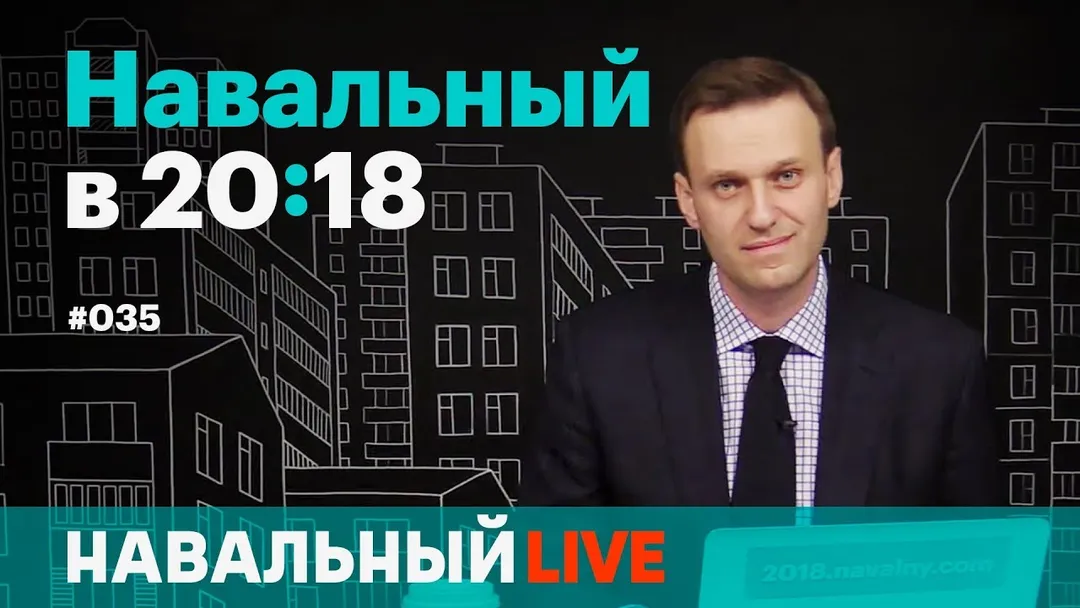
[music]
[music]
we
[music]
Hello everyone. It's 8:18 p.m. in Moscow, which means
that for the first time in 2018, I'm going live.
Happy New Year to everyone.
I hope everything goes well for you this
year. Following the final tradition of our
program, I should say: in the studio is
Alexei Navalny.
And also tell you what some official called me
over the past week.
But actually, nothing happened. All the government bodies
did so little this week
that nobody called me anything at all.
So I have nothing to add except: okay, Alexei
Navalny.
Today we have a kind of
relaxed post-New Year's
broadcast with you, because honestly I don't really
understand who's even watching livestreams right now.
I really don't understand where
all the Russians have gone. There's no one on the streets.
It's cold, miserable, and there's no snow yet,
at least in Moscow. In some
shopping malls there's nobody either. It's unlikely everyone
has gone abroad, so I don't
know where people are. But maybe we'll
find them all now, and maybe you're all
sitting on YouTube right now and are about to
watch this live broadcast.
Don't forget to hit like today. I
wanted today to spend more time answering your
questions, devote more time to that,
and ask you more about how you'd
like Navalny LIVE to develop,
because this year we're going to
put effort into it, and we really need
your feedback: what you want to see, what
to do with it. For us, this is a strange kind of
guerrilla television. We don't really know how
to do it properly, so please
guide us and point us in the right direction.
Still, I do have one important task
for this broadcast. It was given to me by our
investigations department, which over the last
two months has kept coming to me about it.
They said: in the new year, the first
broadcast absolutely has to be devoted to the fact
that Volodya is old and Volodya needs to be replaced.
And this really is a big problem
for the investigations department.
Volodya, please show us Volodya.
Now you'll see in the corner of the screen—no,
Volodya isn't appearing there. But our Volodya
is not a person holding
something in his hands. Volodya is actually
the thing being held by a person. This is Georgy
Alburov, who is holding our
legendary drone named Volodya, which
filmed all those famous dachas
belonging to crooks, flying everywhere. And the overwhelming
majority of the videos, especially over
the last—well, over the last year or two,
all the videos you've seen with footage
showing
various real estate properties—those were all
shot by Volodya. Right now you're seeing
the shamanic dance Georgy Alburov
always performs before launching
Volodya. There were lots of stories
that amused us, claiming that
of course all these video recordings, all these
flyovers,
must have been provided by some FSB operatives, these secret
FSB drones filming everything,
with various super-organizations leaking it to us.
I think it was
Zyuganov who said somewhere that these were
CIA satellites,
no less, helping us film,
for example, Medvedev's dacha in Plyos,
because of course filming there would be impossible—
the security there is supposedly so tight. But now you're
seeing unique footage of the drone, after filming
the dacha in Plyos, flying back. Now you can see
that very same FSB guy and CIA man
who was operating this drone. There he is,
flying around. And this person
in shorts and a T-shirt is exactly the one
standing on the shore—whoops—with that thing
on his head, controlling the drone.
That, in fact, is Georgy
Alburov, who filmed the famous dacha
of Medvedev in Plyos, which started
the investigation *He Is Not Dimon to You*.
But the thing is, Volodya has served us
By the way, Volodya is apparently also called that because part of the name
is just DJI, but somehow my partner
named it Volodya, and so the drone Volodya
served us faithfully for two years, but
it's already obsolete because
Volodya can only fly 2 kilometers (about 1.2 miles),
while modern drones can fly 7 kilometers (about 4.3 miles).
It's getting harder and harder for us
to get close to certain sites.
For example, when we were filming in Psekhako
that same Medvedev dacha near Sochi,
we had to launch it practically out of snowdrifts
up in the mountains. In other words, with
Volodya, you have to get fairly close
to a guarded site, which in fact
isn't always possible. So we
need a new drone, and during this
broadcast we want to raise money for this new
drone.
If you go to Georgy Alburov's Twitter,
you'll see the exact specifications of what
he wants to buy. I'll say that this drone,
the one he's buying, is called
some new, modern DJI
Inspire 2. We need the drone, we need
a camera for it, and we need some other
additional things, mounts, and all
those items. On Alburov's Twitter you
can find the full specifications and links
to all the prices. Altogether, it costs 410.
thousand rubles if you buy it in the U.S. or
in Hong Kong. In Russia, it costs about
500,000 rubles, but we hope that
some kind person will buy it for us one day
in the U.S. and bring it to us — just, well, simply
bring it over as a passenger, if the opportunity comes up, so
the goal of this livestream is, in one stream or
maybe over two streams, to raise 410
thousand rubles, and let’s say all the money
that you, uh, that you throw my way
during this livestream will not
go toward buying Volodya
and most importantly, we need to choose
a new name for this drone. We’ll name it
in honor of the person who donates
the most money. So, if your name is
Pyotr and you donate the most
money, it’ll be Drone Petya. If your name is
Ramzan, then it’ll be Drone Ramzan. So
as you can see, there’s now a progress bar for your
donations — send them in
the first prize is the name of the new drone. The second
prize is
a hoodie from our official store
for the second-largest donation. Third is
a stylish winter hat from our official
store, and it will go to the person whose
donation is the third largest. So
send us money
Sancho Panza asks me, Alexei,
what did you like for New Year’s — a big
herring under a fur coat (a traditional layered salad with herring and beets) or Olivier salad? I’m an
Olivier person. All those New Year stereotypes
including the ones about food, they absolutely
apply to our family. It never happens
that there’s neither one thing nor the other
— no Olivier on the New Year’s table and no herring
under a fur coat. No, when it comes to the New Year’s table, I
absolutely love Olivier — that very
Soviet kind. But actually, for the New Year
I’d say, of course, in principle, probably
not just me, but all Russian citizens
need to slow down with the food right now — we’ve eaten
a whole lot lately. You can send
your questions to me on
Twitter with the hashtag #Navalny2018, and I’ll
be reading them live and
trying to answer them. Best Baski asks
me about Grudinin. There are a lot of questions
about Grudinin — does Grudinin have a program,
how do you view his movement? I’ve already
answered: I view Grudinin fairly normally,
and he seems more decent to me than many
other candidates, but still
he is not a real candidate, regardless
of his platform, because
as he himself recently said, he was asked
where he was going for New Year’s,
and he said: I’m going to Germany because I have a vacation package
we bought it back when I still didn’t know
that I’d be running for president — like, two
months ago. But you can’t be
a normal candidate if two months
ago you didn’t know you were being nominated for
president. That’s not how people run for president,
so
despite the fact that Grudinin seems like
a decent enough guy, and he does have some kind of
communist program, still
that changes nothing. These elections
have stopped being any kind of real election. And
the thing I get asked about most, and I’ve
received a ton of emails about, is this: what
are you going to do, what are you going to be doing in
the next six years, Masha asks. And in general
there are lots and lots of questions about the plan
for 2018 — what are we going to do
in 2018? Well, in 2018
you and I are going to do what is
aimed at forcing them
to reckon with
us. Because 2018, for us
especially at the start of the year, will be
marked by the fact that they threw us
out of the political system altogether and declared
that these people here, the ones who are active,
the active political class,
regardless of whether they support
Navalny or not, those
people who want to go to elections, beat us,
and are ready to compete with us — they
must be barred from any participation
in politics. That was said to us directly at the
meeting of the Central Election
Commission, and symbolically
they kicked me off the ballot and put on it
only those whom they themselves
had chosen. And our task in 2018
is to do exactly this by any means
— make the authorities
reckon with us. For that, all last year
we were building a political system of influence. We
built it. It is large — tens of
thousands of people. It is our
ability to do different things. It is
our Navalny LIVE channel, it is the videos
that we distribute, it is volunteers, it is
election observers. That is, we know
with absolute certainty that we
represent tens of millions of people, and
we are the only ones who have a real
political structure — something no
party has, and no candidate has.
Take note: in Tyumen, right
before New Year’s, some people also
tried to stage Putin’s nomination. Well,
they gathered outside and somehow wanted
to vote the way we did
in 20 cities. Nine people showed up there — 9
people came to nominate Vladimir
Putin in the city of Tyumen
So we know with absolute certainty
that we represent a great many people, and that we are
truly a large — the largest —
political structure, in fact
the only real political structure. And we
will use it in 2018 by every
possible method to force them to reckon with
to take us into account, so that
we refuse to exist within a system in
which they have simply declared us
nonexistent people who
are not supposed to influence anything, whose
opinions can simply be thrown out and
ignored. That will not happen, and we will not
let it happen. To prevent that, we will
do everything we can. That is why we are taking part in
our electoral strike
— a voters' strike — to show that
this is not an election. And when you throw out
candidates, we do not consider that an election. We
do not see ourselves as your serfs,
your peasants — people you can line up however you like
and who will still go vote anyway. So we
are not going. We are urging everyone not to go, but
at the same time we are organizing election observers, and
of course, together with you we must also organize
street demonstrations, because the current
government is built this way: it has cut us off from
absolutely everything. We do not exist in newspapers,
we do not exist on television. There are only YouTube channels,
and they do not let us into elections. So, in
essence, there can be no real public
show of strength other than taking to the streets.
That is why, on the 28th, I
urge everyone to take part in the street
actions as part of the strike. It will take place in
a large number of cities. In the description of
this video, you can find a link,
find your city, and join. Why
is it necessary to take part in all this? I'll explain
using an example that is not connected either to these
elections or, seemingly, directly connected at all
to the events that
are happening. Let me show you now
a chart that was just shown on air
right before me by Vladimir Milov
on the program *Where's the Money?* You can see here the increase in
the gasoline excise tax.
What is the gasoline excise tax? It is something that you
pay whether you are a driver or not — it does not matter who you are.
You pay it because it is built into the price
of bread, into the price of milk, into the price of flour,
into the price of every item
sold in a store. And of course, in addition,
if you are a driver, then you literally
pay it yourself. You can see on this chart: here is the price
of oil — it was rising, and the excise tax was rising too; then
the price of oil fell, and the gasoline excise tax
still kept rising.
Now the price of oil is recovering, but still
the gasoline excise tax is increasing. Why?
Why are taxes on Gazprom being reduced, while
the gasoline excise tax — that is, a tax on us,
a tax on all the country's residents — keeps going up?
The point is that decisions of this kind
are key decisions for the country's economy.
This is, among other things, inflation. A rise in
excise taxes
on gasoline will significantly affect
inflation. No one even asked us. In this
country, there was not even any discussion at all.
None. And not only us — they did not ask
anyone: not the Communists, not A Just Russia (a Russian political party),
well, they do not ask them either. No one
is ever asked. They just sit silently in the State Duma (the lower house of Russia's parliament) and
press the button. This government believes
it can do absolutely anything,
whatever it wants,
even things that are absurd from an economic point of view,
because you cannot raise the excise tax
on gasoline right now. Instead, you need
to look for other mechanisms to increase
tax revenues — for example, as I already said,
Gazprom, Rosneft, oil and gas — all
these wonderful companies that do not
want to pay taxes or dividends.
Instead, they are squeezing the population, squeezing small
business, medium-sized business, and business in general, and
no one asks anyone anything.
That is why our strike, our movement
this year is not even about saying, "Look at us,
we're so great, we're so
cool — wow, what a cute GIF, that's me with
a corgi when I was filming
the video about Shuvalov." It's not about us being
so impressive and active and having carried out
nominations in every city. They do not ask us.
In fact, they do not ask anyone
at all. People, in principle, are not
represented; their opinions are not represented.
No one is even discussing these things.
There are no people,
no party or movement that goes to
the Duma podium
or at least onto some TV talk show, onto
any platform at all, and says, "Wait a second, folks,
we are against raising excise taxes. You do not have the
right to raise them. Debate us.
There are no such debates. No one
discusses this. So on January 28, whether you are for me
or against me, if you believe that
your voice should count, if the government
must take your opinion into account,
sign up and come out, because
until that happens, nothing
good will happen. Let me remind you that
during this broadcast, we are currently
raising money for Volodya's
new quadcopter for the Anti-Corruption Foundation
that will be able to fly much
longer and film the dachas and houses of crooks
much better. So send money;
it will all go toward the quadcopter, and we will report
on everything that
we collect. The person who sends
the largest amount as of now will get to name
this quadcopter. By the way, I just
thought: if it's a woman, then
the quadcopter will be Masha, or maybe Elena — well,
that would be fine too. In general, we're for
gender equality.
Social asks: "Alexei, if
you become president, what will you
do after two consecutive terms?
Will you leave politics, or continue?"
to lead a party or something else, you know.
You see, in principle, this is how it is for us.
In Russia, that sounds like a trick question.
If you become president, what will you...
...do afterward? Why? Because...
...we simply don’t know any presidents...
...who, broadly speaking, did anything...
...after leaving the presidency, because...
...more often than not, country leaders were...
...leaders for life, apart from Gorbachev.
And Yeltsin died fairly soon after...
...leaving the presidency. I believe that...
...a former president can do many things.
They can do whatever they want, really—if they want...
...to teach, teach; if they want, write books; if they want...
...go fishing.
It’s normal when a person becomes...
...president...
...and then leaves the office and...
...does something else. In America, for example, you...
...often see these...
...photographs.
The former presidents who are still alive—there are...
...about five or six of them—they’re these funny...
...old guys, or not quite old guys, but...
...Obama isn’t even an old guy, really—he has...
...plenty to do. And in that sense, we need to...
...create a country in which—build...
...a country in which a person becomes...
...president, then stops being...
...president, and then goes on to do...
...something else. After all, it’s an ordinary...
...profession—a very important profession, a very...
...public profession, but still only a...
...profession. Citizens hire you...
...to serve them. 132 new questions.
I’ll try to pick one now. Well, here...
...a lot of people are writing to me about Grudinin.
By the way, I noticed that they’ve started...
...going after him pretty aggressively in the media...
...and on social media.
I don’t know who benefits from that, but...
...it is happening. But once again I just want to...
...urge you: there’s no point in...
...analyzing all of this. It’s foolish. They want...
...that from us—they want me to sit here now...
...criticizing them, praising them, or digging through...
...their platform. It doesn’t matter...
...because it does not affect the outcome...
...of the election. But ask yourselves this:
Will anything be decided politically...
...in this election? No. Is any of the actual...
...current candidates really challenging, or at least...
...trying to challenge...
...Putin’s first place? No. So you and I...
...know perfectly well that Putin...
...will get more than 70 percent in this election.
And all this supposed math...
...this attempt to engineer some clever...
...voting results—is doomed to...
...failure, because they sat down and figured out...
...what numbers they need to get...
...more than 70 percent, and they...
...took them, and they will get the result they want.
What matters for us is simply not to take part in this...
...indecent, shameful spectacle. They’re boosting dislikes?
Come on, as usual...
...why the dislikes? I don’t know how many...
...people are watching online right now, just...
...everyone hit like at the same time and then...
...we’ll have more likes than dislikes.
A user asks me:
Why is the cat—Chuck Norris—looking sad?
It’s drawn on the wall to your left. Once...
...this cat that’s drawn there—you can see it in...
...the little window, but if I block it with my back...
...it looks like it disappeared temporarily. There were just...
...a ton of comments asking where...
...the cat had gone. I was sure you didn’t even...
...notice it.
[music]
Are your campaign headquarters going to make proper...
...leaflets? asks Blanca Bianco.
We’d like to distribute material that is...
...more substantive and better argued.
Yes, of course, we’re going to start doing that. Right now...
...we’ve made the first strike leaflet. You...
...can download it from the website.
But we’ll be doing much more. This was...
...just the first one; before New Year’s, we...
...quickly put something together. There are a lot...
...of questions about Iran, and everyone...
...is asking me to say something about what...
...is happening in Iran, and to explain what...
...is going on there. Well, listen, guys, I can...
...honestly tell you that I myself don’t understand...
...what is happening in Iran. I know one thing:
...I know the same as you do: on December 28...
...protests began in Iran. They...
...began unexpectedly on the outskirts of the country.
These were fairly large-scale protests which...
...however, as I understand it, were somewhat...
...smaller than the famous protests of 2009.
Back then, they were connected with the obvious...
...falsification of voting results. Now...
...they were tied to more social...
...causes. It all began over rising...
...egg prices. Let’s take a look—we have...
...literally 30 seconds of what the...
...protests in Iran looked like.
Well, you saw it—these protests...
...were...
...fairly aggressive in nature.
They were accompanied by a great deal of...
...violence. At least twenty people...
...have died, according to the latest reports.
It’s quite difficult to make sense of it, because at...
...the same time there were both...
...pro-government protests and...
...anti-government protests.
Naturally, the authorities first and foremost...
...are trying to muddy the waters and...
...mix everything up. But remember how it was in...
...Russia in 2011.
How it was there on March 26 and June 12...
...propaganda constantly spreads...
...monstrous lies, of course, and now...
...official Iran, official Tehran...
says that, of course, of course,
these protests were financed by Israel and
the U.S., by some foreign enemies, and that these
people who took part in the protests
are all supposedly some kind of foreign
agents receiving money from abroad, that is,
it is simply a complete, exact copy of
what the Kremlin says—the very same
lying propaganda; just replace America with
Israel and Saudi Arabia, and there it is
something absolutely identical, all from the same
playbook. Every authoritarian regime
operates according to the same manual.
It appeared right on time, so, so
from that point of view, we learned nothing new
about how
an authoritarian regime deals with protests.
As I understand it, these protests are now
mostly suppressed, but an interesting
I tried to look into it: I asked an acquaintance of mine,
who has contacts in Iran,
to write to them and ask for their opinion.
And he is a lawyer working in Tehran,
that is, a representative of that kind of
educated class, and the response was roughly
that basically, no, we are not taking part in these protests;
we were active in 2009,
but now we are not, and we do not know
anyone who is participating in them, so
nothing of the sort that the
progressive
part of society would be involved in is happening now. This is
very interesting, because right now
it was not the same people protesting as in
2009. In 2009, the protests in Iran
were similar to our 2011 protests in Russia, whereas
now this is, on the one hand, a kind of
social protest, a regional protest,
and a protest of the poor against the economic
dead end the country is in,
but at the same time with a clearly anti-clerical
and anti-clerical undertone, judging by the slogans—
against the dominance of religion and against these
Islamic Revolutionary Guard structures,
against repression. In other words, it is a fiery,
interesting movement that is definitely not
a movement of some Iranian
hipsters, but presumably we will learn more over time
about what was happening there.
I want to say one thing, and what is obvious is
what numerous
studies show: these regimes, like in Iran
or the one they are now trying to build in
Russia, which is moving in leaps and bounds
somewhere toward that kind of
regime, like in Iran or Belarus,
are precisely what generate instability.
They boast and say that their main
achievement is some kind of stability, but
I read an interesting study, and
next time I will talk about it in more detail,
including what it is called, so that you can perhaps
read it yourselves if you are interested. It
analyzed all postwar
authoritarian regimes of this kind. The main
conclusion of the study was that
the likelihood of instability in such
regimes, which try to create stability through repression,
is
significantly higher than in any
democratic country. Yes, you look at a
democratic country and there is
a government crisis all the time,
someone cannot form a
government, these people won the election, those
people lost the election, and it seems that
democracy is weak, the leaders are weak, and they
are sitting on a volcano and are constantly being replaced.
But from the point of view of real, long-term
stability, of course a democratic
country is far better, more reliable, and again,
more stable. And all these guys who
say that they are protecting their
country from some
outside enemies who are trying
to undermine stability are in fact almost
certain to end in some kind of
problems, or there will be problems during
their time in power,
as is happening in Russia, as
it is happening in Iran. So this is one more
reason why we must
take part in our strikes, why we
must go out into the streets: Putin is leading
the country toward instability. If there are
any upheavals in Russia,
this regime will fall sooner or later, because
nobody needs it, it is meaningless, it
will fall, and the longer it sits in the Kremlin,
the greater the likelihood that its fall will
take place with some kind of
upheaval—and it is he who is to blame for that,
not the people who come out to
peaceful rallies. We, paradoxical as it may seem,
are coming out in favor of stability,
against revolution—and revolution means, I do not know,
burning buildings,
what we are now seeing in Iran, and it will
happen precisely because, because
Putin, because these people want to sit
in power for decades. Twitter: 1. Alexei
In the event of victory, what will you do with
the church people? We will do nothing
to the church people. I assure you,
let the church people exist separately, and we
will exist separately, as it is written in
the Constitution. Please, let the church people
collect their donations
and manage them. We will not even
tax them, but they simply must not
run the state, as is happening now.
I remind you that at the bottom
of the screen you can see a progress bar—we are
raising money for our quadcopter
because the quadcopter named Volodya
has become obsolete, and we need a new one. We
need to raise 410,000 rubles (about several thousand U.S. dollars), and
the person who sends the largest
Donate the full amount.
He
will give the quadcopter his name, and
for some reason that's what it's called, into battle, so there you go.
Ramzan to Ramzan, so if Musa is a file, then Dimon is a file.
So it will be called Dimon. So, Alexei, what do you think
about the idea that we need to monitor
the livestreams from polling stations on March 18?
Ozero 20 asks me. Well, it's the right
idea, absolutely right, and in general
it's quite obvious. The other issue is
that we remember very well what happened with
the livestreams in 2012, and later
Putin promised a lot about what that meant:
watch the livestreams, you'll be able to
download everything in full, then there will be
video distribution. First of all, it was almost
impossible to obtain any
video recordings after the election, and secondly,
there was practically nowhere—really nowhere at all—
even when people brought in evidence: look, you
say that 1,000 people passed through this polling station,
but we watch the video and see that
only 200 actually voted. Even in such
completely obvious cases, or when
the falsification was simply recorded
on video,
the court could do nothing. But the idea is
absolutely correct. Of course, right now
we are working through all these things technically:
how to get access to these videos,
how they can be used, and how they can be
used. Arkady Gorelkin asks me:
Hello, Alexei. A strike and
rallies are good, but those are only two
methods of nonviolent resistance, and
198
why not use others as well?
You're absolutely right, Arkady. We should
use every method: strikes,
rallies—well, what we're doing now,
the voters' strike. There can also be
real strikes. Just today I read that
a woman—I don't remember her name, unfortunately—
a Nobel Peace Prize laureate,
of Iranian origin, an Iranian woman,
called on the people of Iran not to pay taxes,
not to pay utility bills, and to withdraw money from
state banks. There are
various methods of nonviolent
resistance. We should use those among
them that are effective and that we
know how to carry out. That's why I call on people to do
all the things—the most obvious ones, and the most
necessary right now are: a voters'
strike; if you don't want to take part, then make sure
others don't go—rather, go monitor the elections;
and come out
to peaceful rallies. Those are the three main
methods. But of course we should use others
as well, and do so constantly. Friton
asks: how much land can be given
to citizens—1 hectare, 4 hectares? How much
land do we have? How many hectares would be
appropriate, as mentioned in the relevant
law? Well, you know that we have
the so-called Far Eastern Hectare law
(a Russian program granting 1 hectare of land in the Far East).
We also monitored it for
implementation and for possible corruption,
and we saw that corruption
really was present. As soon as they started
distributing land, the system crashed, and then
it turned out that the most investment-
attractive plots, first of all
in Primorye,
already belonged to certain people. But overall
this whole program has failed.
Practically no one wants to receive a
Far Eastern hectare, because, well,
it's just a gimmick.
If you live in Moscow, or Samara, or
Ufa, why would you need this Far Eastern hectare?
You can't do anything with it. You can't sell it;
that's explicitly prohibited. On one
hectare, doing agriculture is not really feasible.
No—even if you were lucky enough
to get a hectare near, I don't know,
a road, near electricity, near
gas, you still can't really do anything
with it. It's one hectare. You need a more
complex arrangement—getting 10 people,
20 people involved. And of course, on 99 percent of
the lands where these hectares are offered
in the Far East, they're simply unsuitable
for living. And who needs hectares
in Magadan, in Kolyma (a remote region in Russia's Far East)? Who needs them?
Probably only somewhere very close to
a city, where you could build a shop,
a shopping center, or an apartment building—yes, there
sure, let's distribute it there, and then maybe
build something.
But overall, this land is of no use to anyone. It is
worth zero rubles and zero kopecks, so in
the European part of the country
we have so much land that we can give it out
to anyone who actually wants to do something
with it, or at least sell it
if you managed to resell it and
make money from it through speculation—
well, thank God, it's not exactly in high demand now,
so let people buy and resell it; the person who bought it
will at least pay taxes on it.
So I believe that, of course,
bringing land into market circulation should
happen more actively. It's just absurd:
we live in the largest country on
planet Earth, and we're handing out one hectare each
somewhere in places where even bears hardly ever
go. That doesn't work and cannot
work. We need, in the European part
of the country first and foremost,
to bring land into market circulation. So,
they're asking about the film about Putin.
There are several questions, but I'm not revealing
any secrets
or any plans of the investigations department. Well, if
by the way, if we raise money today...
for our quadcopter,
then it will make any kind of work like that easier for us.
A reminder that today we are
raising money for a new drone. The person
who makes the largest
donation will get to name this drone.
Why not stage a mass act of sabotage
on TV? asks Ivan Cheskidov.
Excellent question, Cheskidov. And how exactly do you
propose to do it—burn down the Ostankino
Tower? But it already burned once, and as I understand it,
mass television broadcasting
does not depend very much on
the Ostankino Tower. Back in 2011,
I was also fascinated by various
ideas about cable networks. You know
that most often, when people watch TV—
well, you probably don't, but those who do—
people who watch television
receive it not through a radio antenna
but through a cable network, and theoretically
you could tap into a cable network and
broadcast the film *He Is Not Dimon to You* there, but
we found no
simple technical way to do it.
It's all very complicated. Besides, it would be
a direct violation of the law.
I think that in a case like this, since
they use our money to feed us horrible,
monstrous propaganda, it might be justified,
but unfortunately, technically
it's not very feasible. So, someone asks me:
Will there be detentions on January 28?
I don't want to spend my 14th birthday
in a police station. I'm on Fomicheva—well, where
could you possibly spend your
14th birthday in a better place? And what could be a more memorable
14th birthday? I don't think there will
be any detentions. In any case,
we submitted a preliminary application a month in advance,
then we'll submit another one 15 days ahead, as
required by law, and in that sense we, on our
side, will be 100 percent
in compliance with the law and with the rulings
of the Constitutional Court in our country, and
the Constitution itself in our country is
on our side.
But theoretically, something could
happen. But I want to point out that there were
detentions on March 26, and there were detentions
later too, though far fewer. There were, and
there were people—please, if anyone has the exact figures,
as I recall, around 400 complaints in total
have been filed by various organizations. You—
you're only 14 years old—go out to the
rally for your country and for your own
future, for your own prospects.
Because as long as these ghouls in power
remain where they are, you have no prospects—
no chance of a normal job, a normal
quality of life in this country. There are things
more important than spending three hours
at a police station after being detained. But by the way,
I'm sure nothing like that will happen, at least
on our side we will do
everything entirely, entirely legally. Will you
run in 2024?
Nikanor asks me. Nikanor, under the
law that the Central Election Commission cited,
I am generally barred from
running for anything at all. There were
many questions about whether I could run for parliament
or for any other elected
office. Strictly speaking, I would only be able to after 2030,
which means not for a very long time yet.
But I don't care about those laws,
Ivan, Nikanor—we should all
not give a damn about them.
The issue isn't the law; the issue is that we
are still allowing them to disregard us and
ignore us. That's why we must
act accordingly, including now in the
form of a strike, so that they announce
new elections—or, without even announcing new ones,
register us for the next election.
Register us.
Let real, leading independent candidates
run—whether that's me or another candidate.
By that time there may be a candidate
far better. But simply judging by
what they are doing now, they will never register
anyone. Never. And after 2030 they will
simply fabricate a new criminal case
against me and say once again,
"Wait another ten years." So we must
force them to scrap these laws and
stop carrying out these illegal actions.
Oh, the U.S. State Department just donated 2,018 rubles.
Excellent. So, the broadcast was interrupted—what
is happening? I don't know. I can't see that
the stream was interrupted. Maybe
we've had some kind of
internet outage.
Good evening, asks Naumov.
Yevgeny: I'm interested to know whether hackers
helped you in any way by providing hidden
information. Yes, thank you. Well, Yevgeny,
at the beginning of our broadcast I showed
a video of how
an employee of the investigations department, Burov,
was flying a drone over Medvedev's dacha (country house),
and that's how we do everything. Why would we need
hackers? What hidden information would we need if
in Plyos, a town with a population of just a few thousand, a huge, gigantic
residence worth 20 billion rubles
has been built for Medvedev, and
every dog in Ivanovo Region knows about it?
Not to mention the town of Plyos itself. What hackers
are you talking about? We don't need any hackers. We
did indeed use hacked correspondence in the film *He Is Not Dimon to You*,
namely hacked correspondence
from Medvedev, but by that time
it had already been sitting on the internet for two and a half years,
it's just that not everyone—everyone was too
lazy to read it. But we were not
too lazy.
We actually read it, unfortunately.
Corruption in Russia is so blatant that
you don’t need any hackers at all. But what kind of
What exactly are hackers supposed to reveal to you—that
Putin’s dollar billionaires—that
he became a billionaire because Putin
gave him preferential loans? No
hackers are needed for that, unfortunately.
To investigate in Russia, can you
go as an election monitor
if you’re underage? People ask me that.
By the way, it’s not called a “caretaker,”
it’s an observer, although “caretaker” is a great
word. A minor cannot serve
as an observer—I mean in the legal
sense, an observer who comes in with
official paperwork, says “I’m an observer,” and is
given a badge, and then sits there and
does whatever observers do there. But a minor
or really any person can probably be
in a different role—not an observer, but
more like a watcher: someone who stands by
the entrance with one of those clickers, you know, like the ones
flight attendants use on planes, and counts
how many actual people physically entered the polling station.
That’s the most important thing. So, Evgeny—Alexei,
if you become president, will you ban or
allow painting tree trunks?
It just seems to me like the dumbest thing in
our country. Well, I’m not ready to answer
that question. I’m simply not informed enough. As I
understand it, tree trunks were painted so that
hares, deer,
and chipmunks wouldn’t gnaw on
those trees. I don’t know—rats maybe, who
knows what eats them in urban conditions.
So I’m not ready right now to say that there’s no
need to paint them. Maybe environmentalists
would say it is necessary. I don’t know enough about it
at the moment—I’ll look into the issue. Some
groups on VKontakte (a Russian social network) have sold out and are posting
all sorts of nonsense about you. Sadly, writes
Konstantin Yuldashev. Elections mean money. These
some VKontakte groups didn’t just now
sell out—they’ve been writing nonsense about me for
many, many years. Fine, VKontakte groups—
but there are bought-off journalists, entire TV channels,
whole workforces that have sold out in order to
write nonsense about me, about you.
Konstantin, you have to treat this
calmly. You just need to pay
attention to such groups and leave those
groups, call them out, label them for what
they are—sellouts,
mercenaries, and treat them
in a special, clearly defined
way.
That’s how the admins of these groups should be treated. But this is
what the authorities do: they bribe
people, they corrupt people, and for money these
people spread lies. That’s how it works.
We can counter it only
with our own media outlets
and our own work. We were asked: let’s
talk about it. Amazing, baffling things
are happening in Syria, and no one can
figure out what happened. At first
there were reports that a terrible
tragedy had occurred: two people had died, apparently
helicopter pilots. Either they crashed in a
helicopter,
or they were shot down, or the helicopter ran into
difficult conditions. Then, I think yesterday,
the newspaper *Kommersant* reported
in a news story that, it turns out,
our base had come under attack, and during that attack
seven aircraft were destroyed and
two people were killed. Frankly, that
sounds pretty shocking, because
seven aircraft, including a new
plane—those losses in any case amount
all those losses,
material losses, not to mention
human lives,
are measured in
billions of rubles. Seven aircraft is
almost a third of our
air contingent currently stationed in Syria.
That means these are enormous losses,
absolutely monstrous ones. The Ministry of
Defense, of course, immediately denied it.
But the Ministry of Defense—well, it
lies all the time.
Analysts from CIT, a non-profit,
as I understand it, organization—
well, basically activists who monitor
the situation and debunk various fake stories—
they also said, essentially siding with
the Ministry of Defense, that the newspaper
*Kommersant* was most likely lying, because
if that many
aircraft had really been destroyed, and it were such a major ISIS victory,
then they of course would have spread
video of it. They would have—you can see now
a post from the CIT community—there would have been
some footage, some organization
within ISIS would have claimed
responsibility, and none of that
happened, which is very unlike
how this usually happens. And overall
I was inclined to agree.
But now, literally two hours before the broadcast,
photos finally started to appear
of those very aircraft—damaged, not
destroyed, but obviously damaged to
such an extent that they can no longer
be used. And now it is being claimed that
it was not seven aircraft but nine, and
up to two people were killed, and the Ministry of
Defense, already under the weight of
the evidence, is saying that two
people were killed during the shelling.
Not because of bad weather conditions—
the helicopter pilots.
And all of this once again raises the two most
important questions: first of all,
who attacked our base so effectively and
destroyed a third of our air group
if we defeated ISIS, if Putin completely
Recently, it was said that Russia had won,
that it had crushed and destroyed ISIS,
that it had killed all its leaders and commanders. But then who,
could have done this? After all, this is still
our most heavily guarded base in that
area, protected both by Assad's troops and by us,
and then suddenly things like this happen.
So it turns out we did not kill off ISIS after all,
we did not defeat ISIS. That's the first point. The second, and more important one, is this:
more important question: in principle, what
is happening there, and what are we doing there? Why
did all of this happen at all, and why are we
going to pay these billions of rubles
for the destroyed aircraft, not to mention
the priceless human lives that were
lost there, while their relatives are suffering?
Why is any of this necessary at all? What
is happening in Syria that matters so much to me
or to you? What for? Why are you and I ready to
pay for all this and support it?
Can anyone explain it to us? Once again, we
come back to the question of why
people need to go out to rallies, why we need
to demand that they
take us into account, so that they explain to us
what is happening in Syria and what exactly we are doing
there in the first place.
As of the latest estimate this summer, the operation in Syria
was put at 140 billion rubles
most likely much, much more.
Remember, we once did a kind of
just-for-fun calculation, but still
it revealed an interesting fact: we calculated
how much the diesel fuel cost that was burned by
the aircraft-carrying cruiser Pyotr Veliky when it
sailed to Syria and back. The fuel alone
came to 128 million rubles — and that
was the minimum; in reality it was probably much more.
Uh...
Repairs, according to the state
news agency TASS, for that cruiser, "Kuzya"
— Admiral Kuznetsov —
will cost 40 billion rubles after the deployment.
That's more than the budget
of a city with over a million residents.
Not every million-plus city
has a budget that large — 40 billion rubles.
Because it was barely staying afloat,
and all of its
diesel systems failed. Forty billion has to be spent.
Why? For what? Why did this
happen at all? Who needed any of this in the first place?
We were given an explanation: supposedly, we had to
fight in Syria because there are a great many
terrorists there, and some of those
terrorists came from Russia. And the FSB
told us that from the CIS countries alone
nearly 5,000
militant terrorists had gone to Syria; of those, 3,000
were from Dagestan and Chechnya, mainly
from Dagestan. So, supposedly, we had to kill them there,
crush them, bomb them, so that they
would not come back here and start blowing things up
here. And that sounds a little strange, because
if our main task, our main
problem, is that here
in Dagestan, or anywhere else — I don't know,
in Saratov or Vologda —
terrorists emerge and then go there, then maybe
we should spend money here so that in
Dagestan these terrorists do not appear in the first place —
in particular, by fighting injustice in
Dagestan, in particular by fighting
lawlessness of various kinds, so that there is no
breeding ground on which
these Islamist terrorists arise.
So that
their propaganda works less effectively, perhaps.
That needs to be done in any case. Well,
3,000 people left Dagestan for Syria.
Some of them we killed there, some we did not. But
how are we going to make sure they do not
come back? They can return, they
will return, maybe not directly — who can even
sort that out at all?
He went to Egypt, to Mersa, supposedly to study something,
or maybe he fought in Syria — you can't tell.
All right, suppose we figured it out: they came back here, and we
locked them up for ten years. But we can't
just kill them. You can't have some checkpoint where
someone says, "Hello, where have you come from?" — "I
came from Syria" — and then pulls out a gun, bang,
shoots them in the head, "Next." Well,
that obviously cannot be how it works. Right, you can
try them for mercenarism and give them ten years each.
So we imprison those 3,000 people for ten years,
Dagestani Muslims who fought in
Syria. But then what? They are in prison,
and ten years later they get out — and they are hardly
likely to have become less embittered. And in any
case, prisons are a real
breeding ground for
the spread of extremist ideas. You have
probably read a lot lately
in the media about how there used to be
"red zones" in prisons,
where the administration kept strict order;
"black zones," where criminal underworld rules dominated;
and now there are appearing zones or units
that are "green," where everything is run according to Sharia.
So let's just lock all of them up now, and
there will be more "green" prison zones,
and those prisons will become suppliers
of extremists and terrorists who will
come back and do what they
wanted to do. In other words, these are pointless
measures. If we have extremism in Dagestan,
then let's fight
extremism in Dagestan. They talk as if
we are going to kill all the Dagestanis there, but
because in Syria we are fighting on
the side of the Shiites against the Sunnis, well then
even more of our Muslims — not only
from Dagestan and Chechnya, but soon, I would think, from
Tatarstan and elsewhere — will be going to
Syria. And one way or another, it is impossible to kill them all there,
as we have just seen for ourselves.
They will keep coming back here anyway.
strange, incomprehensible, inexplicable things that no one can make sense of
The only realistic
explanation is that Putin
has lost his mind. He has simply gone mad. As for those
matters of international politics, he is not interested in
what is happening here, and so he rushes around
in Syria, because competing there with
the Americans will lead to nothing good.
We already went through all of this in Afghanistan.
It is impossible to tell who there is
a mujahid and who is just an ordinary peasant, and if you
talk to anyone who served
in Dagestan, they will tell us the same thing:
by day he is a peasant, and by night a mujahid,
he digs up his rifle and goes off to shoot at someone.
And there is no way to solve this
problem except by killing the entire
population, and killing the entire population is also
impossible. Therefore our presence in
Syria is pointless. The losses we are
suffering, both material and especially
human, are meaningless. Why
are Russian citizens dying there? And it was no accident that
Putin stated, right before
the election, that he had once again
for the third time achieved victory and was withdrawing troops
from Syria, because the war in Syria is extremely
unpopular. No one understands why this
is happening. So where are our
representatives, the representatives of those people
who do not think that we should
be spending money on the war in Syria? Where are they in the State Duma (the lower house of Russia’s parliament)?
Where are they in the Federation Council (the upper house of parliament)? Where are they on
television? Where are the people who
raise their voices and say,
why fight there? Why the hell do we need
Syria and Palmyra?
when we need to rebuild
Russian cities. These people are not
represented. These people, in these
presidential elections, were thrown out —
me included. I stated that I was not
going to sponsor Syria while in
Russia there is such a large number of
problems.
All of these people were kicked out of the election, and
only those remained who say, essentially, go ahead,
come on, Aleppo, Palmyra is ours, and all the rest.
So it seems to me that what
is happening now is not even really about
the lies of the Ministry of Defense, and
the Ministry of Defense is obliged to lie.
As was written in various ancient Chinese
treatises, war is the way of deception.
The Ministry of Defense is supposed to lie; it is a
propaganda
organ. When it comes to combat
operations, it is one of the instruments of waging
war: to lie endlessly, understate its own
losses,
and exaggerate the enemy’s losses.
Yes, exactly, with that sort of expression, like there was
in that GIF just now. So this is not about
the Ministry of Defense lying. The Ministry of
Defense is an instrument of political
power, and Putin personally is obliged
to explain to all of us where the
lives of young and not-so-young people are being spent,
where tens and hundreds of billions
of rubles are going, and what all this is for. Because
the original goal — to kill Dagestanis
who went off somewhere to fight
around Aleppo — is clearly, in principle,
absurd-sounding, and it is
unachievable. And we have seen that three times
they reported that ISIS had been defeated,
and still 30 percent of our
aircraft
has been destroyed or damaged. I very much hope
that when the number of
victims reaches even two — and two
people is already a tragedy —
Who is depicted in your Twitter avatar?
In my Twitter avatar,
there are two wrestlers, one of whom
is gouging the other wrestler’s eyes out.
But I have had that avatar for a long time, historically speaking.
To be honest, it is long past time
to change it, but I have grown attached to it somehow. In which city
will you be during the
strike? asks Nikita Zatsepin.
Nikita Zatsepin, your question
shows a misunderstanding of the principle of the strike.
During the strike — right now I am in Moscow, and during
the strike tomorrow I may
be in another city. The strike is a
continuing process. Our strike does not
consist of simply not going to the polling station on election day
and then from our window
making obscene gestures or something else in
the direction of the Kremlin. The strike is ongoing, and it
consists in the fact that you, Nikita Zatsepin,
must persuade a couple of people,
talk to them, have a conversation, and
explain to them that they should not go to
the election.
With all your relatives, you should
print out a leaflet
and distribute it, and we will make a new leaflet,
a better one. You also should — just like
I am hugging this little dog — you should
hug and cherish your relatives
in order to explain to them that they must not
go to the election. It is absolutely not
decent and not good. I remind you that
today we are raising money for
Vолодя’s replacement — this is our
quadcopter. I can see that our meter is moving rather, rather weakly.
But, well, I was told that
Alexei was supposedly unhappy with
fundraising after New Year’s. After
New Year’s everyone is out of money, but yes,
maybe I was wrong. But we need a
gift — a copter. We will raise money for it on this
program, and on the next program
we will finish it off. In any case, the person who
makes the largest donation —
their name will become
Under the name of the quadcopter, We All White writes:
each one costs more than a billion rubles.
A Su-30, Su-35, or Su-34 aircraft, yes, that's how I
understand it from the figures on the official
state procurement website—that is, the price at
which the Ministry of Defense purchases
these aircraft from the manufacturers. It's insane.
As I said, this mortar
shelling of the defeated ISIS cost us
many, many billions of rubles,
and it's clear why. What else?
Why is Putin so concerned with Syria?
Maxim writes: "With complete disregard for the various
peoples of our country, they are driving the country into
poverty. Poor pensioners and war veterans
are selling vegetables in the markets. They should have taken better care of that.
Absolutely, you're right. And the main thing is
that no one can say this
not in elections, not on TV talk shows,
nowhere.
There should be a political space where
different people are present: some
are all for, "Come on, let's wage war in Syria," while others
should come out and say this obvious
thing that you wrote, Maxim. But no—
there are no such politicians, and they are pushed out of elections.
That is exactly why we must
make them reckon with us, because
in fact, the sensible majority in our country
the greater part of the population in our country
is on our side on this issue. So, are you for the ridiculous...
...this looks like a garbled line. Good
evening. Alexei, a little earlier you placed
the political regime of the Republic of Belarus and Iran in the same category.
As a resident of the former country, I'd be interested if you could explain, please,
writes Hiko from the Republic of Belarus.
Belarus—well, of course not, I can't
put them in the same category. That would be an oversimplification,
a stretch. Comparing the regimes of Iran and Belarus
—of course, they are essentially very different regimes.
Iran is, after all, a kind of
clerical autocracy.
Belarus is, of course, an authoritarian regime,
but of a completely different character. What I meant was
that Russia is moving somewhere in between
these two directions. On the one hand,
even our official state officials like
to throw around phrases like
"Orthodox Iran," and we see that more and more
judging by the State Duma (the lower house of Russia's parliament),
it is turning into some kind of...
people there are spouting all sorts of nonsense about
Orthodoxy—just complete nonsense, utterly insane.
On the other hand, Putin's regime
quite plainly borrows directly from Belarus
all these inventions—from laws on foreign
agents to fines for rallies, to increased
arrests for rallies. That is, Putin, in
principle, doesn't invent his own idiotic
laws—he takes them from Belarus.
That is, of course, very, very noticeable, haha.
Alexei, what are your thoughts,
regarding the creation of an independent
nationwide media outlet based on YouTube,
built solely on reports by local
journalists?
Creating such a channel to cover
the real situation would be better than campaigning for you.
That would be a great idea, but it's fairly
difficult to implement. You probably remember
the contest I ran—a contest for video
bloggers from the regions. All of that was
quite difficult. The main thing is that it
requires fairly substantial resources,
significant expenses. Even if we had
the same kind of guerrilla television as
Navalny Live, it would still involve
certain costs, and a regional network
would cost even more. People may still
work on enthusiasm for a month or two, but then
you need to cover at least some expenses,
if not salaries. That's fairly difficult.
Managing it is difficult too, most importantly. But
we are trying to do it, though we're not very
good at it—we're not really
I'm in a rather strange situation,
because even when I'm working on developing
Navalny Live, I never thought that in
my life I would be doing something
like this. And that brings me back to an important
topic for me that I wanted to discuss with you.
Please write to me and tell me what
you would like to see here,
what you think should be done.
What should Navalny Live be developing right now?
What would make you watch it?
What needs to be improved? What needs
to be shut down?
What needs to be changed? What new things should we make?
Some kind of program? One of the ideas we have
that I think we could implement quickly is
some kind of show—
I don't know what to call it—a program about the rights
of women, for women, and about women. That is,
we want to give feminists
of all kinds a voice. You know that even
within the feminist
community there are huge, ongoing
debates: are you real
feminists or not real feminists?
And we have a lot of airtime, and we
want to launch a program like that,
to give them all a platform so that they can
discuss what matters to them, and we would listen,
criticize, agree—it would be
simple to do, or at least possible
to do. I really don't know how
popular it would be, but the more developed a
country is, the more these issues are discussed there.
So in Russia, they need to be discussed too.
Alexei, how do you feel
about the fact that police officers cannot
travel abroad? Simka asks.
It's idiocy. My acquaintances in the police
and the FSB (Russia's Federal Security Service), and military personnel too,
all have this problem. It's simply stupidity, because
as someone who didn't have an international passport for many
years, I can say for certain:
that vacationing in Russia is much more expensive than
abroad, and so when we
don’t allow police officers to go abroad, we
are telling them: you pay more
money for your family’s vacation. This is complete
nonsense, and ordinary police officers carry no such state
secrets, of course.
There’s no reason to take away his foreign
passport and not let him leave the country. As for
Navalny Live—well, getting back to
write to me, I don’t see people writing to me
with the hashtag #Navalny2018. You wrote about
something connected with our
channel, I can see that. Complain to Alaska, well—
by the way, there are quite a lot of fans in paradise
of the healthcare system about Navalny.
Lev, here’s a suggestion, writes Pasha Kuzhel
chik: as the first prize in a contest,
give the winner Volodya, and that
would encourage more people. But we ourselves can’t
give away Volodya—after all, it’s quite expensive.
We want to send it into retirement, but I mean
we’re not going to give Volodya a quiet retirement.
No way—he has to keep working.
Someone will be flying a new copter under
some new name, and we’ll use Volodya too
for our work.
That’s too much of a luxury. After all, we’re
an organization that exists on donations; it’s not
a luxury we can afford just to
hand it out left and right
or give it to someone as a gift. Alexei, what turnout percentage
in the 2018 election would be shameful
for the authorities? asks Konstantin Dashyev.
Konstantin, it doesn’t matter—there is no
specific threshold. For them, 51 percent is
fine; 49 percent is shameful, yes, terrible.
Or 30 percent is shameful and terrible. That’s not
what we should be thinking about. The math doesn’t
matter; what matters is the political question.
Don’t go, and persuade everyone else not to go.
Illegitimacy is a feeling people have; there
may be quite high turnout, and yet everyone will
understand perfectly well what it is,
what these elections are. Let me remind you that we’re
raising money today for a quadcopter. Everything
you send will be
directed to the investigations department fund for
the purchase of a quadcopter and equipment
for it. All of this costs 410,000 rubles (about 4,100 USD).
We’d like to have something humorous on
the Navalny Live channel, writes Vata
1990. Yes, we really do want something
funny, but there’s one problem:
you need people who actually know how to make jokes.
I mean, you can’t just—I can’t just take
any random person, sit them down here,
and say, “Be funny.”
If it worked that way, I’d
make great jokes myself, but
basically, for me it works only with
mixed success. But yes, we’re trying
to come up with some kind of program like that.
It’ll probably just be hard to do it entirely
live. We need debates,
journalistic investigations, writes
Alex Krivonosov to Alexei.
But again, you understand, guys, this
is connected with a specific
kind of separate substantive work.
It’s not a matter of us simply providing
someone with airtime. The issue is that
first we have to organize de
bates and new journalistic
investigations,
and then also put them on air. In other words,
we would have to create an entire
new thing like that. And what if
we turned Navalny Live into a platform
for science communication? Useful and
interesting, writes Nadezhda Baranova. That’s an excellent
idea, a very good idea. Write to us about
who could appear here
to popularize science—yes, that’s the right
word, the right word—and at the same time maybe
fight some of the obscurantism
that’s overtaking our country. That’s
a very good idea—I’m writing it down right now.
There’s so much trash in Russia every day
that it’s enough to make a news bulletin of
ten to fifteen minutes.
That overlaps with Kamikadze, but not everyone
watches him. A lot of people do watch Kamikadze,
but we would make it
Honestly, I’ll even reveal our
plan: we’re thinking about making
some kind of news show. I mean, not
necessarily about trash—just normal,
honest,
human news. It’s quite a complicated
process, but we’re trying
to move toward it somehow. And great,
even if we overlap completely, I don’t
think we can steal an audience
from Kamikadze, or that he can steal
ours, or that this Navalny Live channel
takes viewers away from my main
channel. I think the more content
appears on YouTube, the more people
come in overall, and that’s better. 68 new
questions—but I’ve already gone two minutes over.
Also, don’t ask about PUBG—
whether I’ll play it. I probably won’t,
but I need to find the time.
A charity broadcast so that we could
collect donations and help someone—
we need all the donations ourselves right now. Here
we’re raising money because we need to maintain this
TV channel, we need to buy copters,
we need to finance our strike,
so of course we’re ready to organize
charity projects. In fact,
we don’t mind giving airtime here.
We raised money here for Mediazona, and I actively
supported, and still support, fundraising, but
to regularly invite various
charitable organizations so that
they can collect donations through us—I don’t
I think that’s the right thing to do, and sorry
for this slight bit of selfishness, but a show about
technology and games is a great idea, a very
good one. A show about movies—actually, I
would really love a show about movies.
We need someone who can talk about it
in an interesting way. Besides, there may
possibly be problems here with copyright.
I don’t understand how BadComedian (a popular Russian film reviewer on YouTube) deals with this problem.
He literally shows
chunks of movies, and he doesn’t get banned.
We need to look into this issue. Maybe
it would be a good idea. So, I see you’ve sent me
a lot of interesting suggestions about
[music]
Navalny LIVE and what we can do here.
We’ll have—I’ll write all of this down
carefully. Thank you very much, and
the guys who run the channel—we
are going to work even more actively this year.
We’ll brainstorm and try
to understand which of these things we’re ready
to implement in the near future. And please,
we need your feedback. You see, we don’t really understand everything ourselves.
We’re not—like in that old joke, on average,
“I’m not a real plumber”—we’re not real
TV hosts or TV channel executives.
And without your feedback, your advice, your
opinions about what should be done here or
shouldn’t be done, we won’t be able to do it
on our own. Right now, we’re doing some things based on
instinct.
But you—you are the power here. All this
television is made to entertain you
and to bring new people here.
We’ll be doing this in 2018,
and we’ll be doing it in order to
make the authorities reckon with us, and
everyone can make a major contribution.
In the description of this video, find the link to
the group for the January 28 rally in your city.
Be sure to join it, and bring
as many more people as possible into this group. We’ve
raised 158,000
rubles (about 158,000 RUB). Thank you very much. As of now, on May 1,
someone made a joke—currently in first place
right now, I’m being told,
it’s 18,200 rubles, and the user named
Trump. So yes, that really is
funny—I have to give credit to your sense of
humor.
If by the next broadcast, where I hope
we’ll make it to 410,000 rubles, nobody
outbids Trump, then the new quadcopter
the super quadcopter of the Anti-Corruption Foundation
will be called Trump. However you decide, that’s how it will be. Thank you very much.
See you
next Thursday.
[music]
