Rybka Blocked, What Is Happening in Syria, Putin Did Not Violate the Law
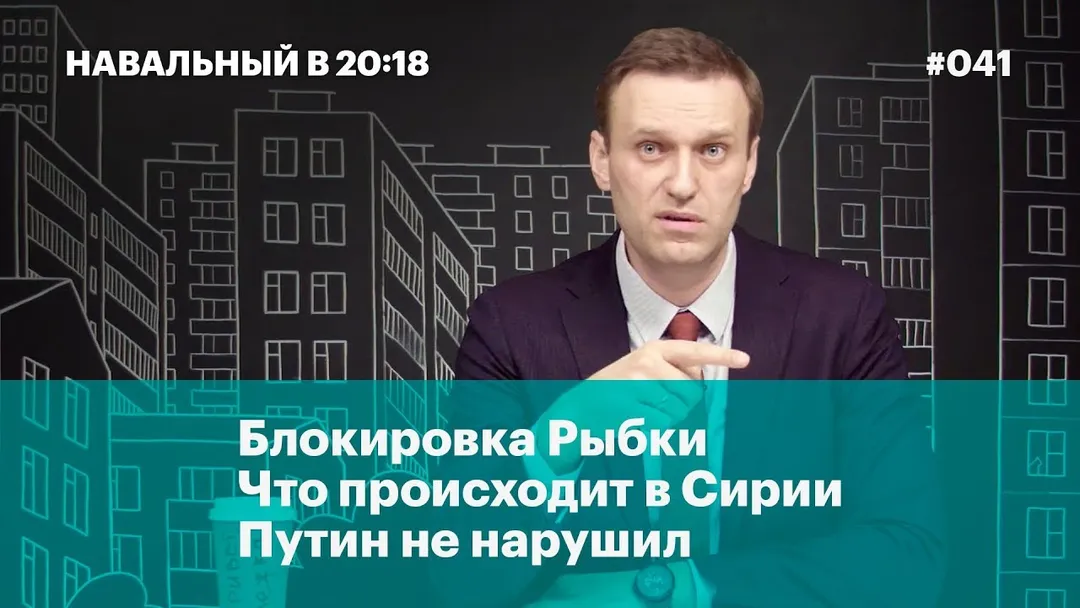
[music]
Hello. It's 8:18 p.m. in Moscow. Alexei is in the studio.
Navalny, or a political loser, as
Sergei Prikhodko called me — the same man who
fortunately continues to be the subject
of constant publications, the hero
of remarkable, astonishing discussions
that are taking place in blogs, in
the mass media. We are very pleased
that this topic remains in the spotlight.
We are very glad that people are discussing not only
Ms. Rybka and the various circumstances
that took place at the dacha (country house), but also
the main thing, properly speaking: the fact of corruption.
The fact that Mr. Prikhodko, who
calls me a loser, is
a bribe-taker. At this point I don't even know which is better:
to be a loser or a bribe-taker. In
my view, it's better to be a loser.
But Sergei Prikhodko probably feels today
that he is once again the winner, because
they blocked my blog, Navalny
dot com, and
for us this is the main news. We want
to discuss it right at the start. But let me remind you
that you can send me questions on
Twitter with the hashtag #Navalny
2018. I will try to answer them, and
today we are raising money in support of
the Voters' Strike. So then, Sergei
Prikhodko, Oleg Deripaska, all these
wonderful people, whom, of course,
Vladimir Putin supports,
blocked my blog today, and I have
not the slightest doubt that this is
of course not only about the pocket
Ust-Labinsk court — yes, the Ust-Labinsk
court, a tame court —
because Mr. Deripaska
basically owns that whole town — but also about
the political desire of the authorities
to block this. Look at what they did:
they blocked the Navalny 2018 website, the
Navalny.com website, the strike website, and the
observer recruitment website — in other words, all at once
they blocked them after the ruling of
this court. This is absolutely illegal,
because, naturally, the strike website
or the observer recruitment website are in no way
connected with
Deripaska's private life, nor are they connected with
Prikhodko's private life or with Rybka. There is nothing there,
and more than that, this directly
contradicts what is written even in
Roskomnadzor's own unlawful decision. Nevertheless,
they basically said: great idea,
if there's some fake ruling saying
we can block something related to Navalny,
let's block everything at once. I want
to say: we will do everything, and I believe we will succeed,
in making sure that this information is not
removed from the internet. Roskomnadzor has already
forced 29 media outlets
to delete certain information, and now they are
running after everyone. Yes, they have now
made our lives much more difficult, though
we are fighting the blocking fairly effectively
nonetheless.
In any case, we will absolutely do
everything to ensure that information about the adventures of
Deripaska and the adventures of Prikhodko not only
remains on the Russian internet,
but becomes even more accessible, so that
a large number — an even greater number —
of people can see it. I hope you
will help us. Thanks to you, our
film has already reached five million
views. Please keep going:
send it to your grandmothers, grandfathers, to everyone.
Let millions of Russian citizens know
what is happening. And of course, fighting
blocks, knowing how to get around them,
is now simply a basic life skill in Russia
today.
If you still haven't learned how to do it,
make sure you do. I wanted to show you
some kind of guide, a short guide
on how to bypass blocks, but
then I remembered that in Russia
even
instructions on bypassing blocks are banned. If I
show you something now, then
Roskomnadzor will be obliged to block those
people who explained how
to fight blocking. Still, I think
I'll take the risk and show you 40
seconds of explanation on how to bypass
blocks, and I even somewhat hope that
after this Roskomnadzor will block those
who gave this 40-second explanation. Blocking
popular internet resources is a matter
of little use,
essentially pointless, and as was emphasized by the
Russian Ministry of Communications, it fosters in
citizens legal nihilism and
increases their computer literacy.
This is dedicated to everyone suffering from blocked
social networks but who can still watch us.
There are many ways to bypass website blocking.
There are plenty of them.
One of the simplest is to download an app
that changes your apparent country location
to one where the resource is allowed. Often this
method opens access to many websites.
Another option is to use
an anonymizer; it also allows you to access
websites without being tied to your computer's
address. Not entirely convenient, of course.
Still, quite something — the Russia-24 TV channel
was explaining how to get around blocks.
You've probably already guessed: they were doing
this because evil officials
had blocked websites in Ukraine. Exactly right:
as soon as decisions were made in Ukraine
to block Russian websites,
righteous anger filled
all the very same officials who
block websites inside Russia began to...
to tell us on television, to explain to us
the Ukrainians, yes, about how to get around
the blocks. Well, those instructions will be useful
to us too. Still, the simplest thing
you can do is download
my blog's app.
The links are in the description for this video.
There is an app for Android, and there is
an app for iOS.
No blocking will stop it, and you
can use it easily. I don't even want
to go into great detail for you
about the legal aspects. Well,
it's practically pointless. Any person
who is even a little bit of a lawyer, or at least
somewhat familiar with legal procedures
in this country, will simply start
laughing out loud if you tell them the story
of how
on a weekend you can come to court,
immediately get a hearing scheduled, and on
that same weekend day
obtain interim measures that will block
something, somewhere, across the whole country, while
without notifying the actual, let's say,
affected or involved parties. More than that, from
the court's official position, this does not concern me
at all. No.
Just appreciate the elegance of the Deripaska
- Prikhodko - Putin combination.
We'll block Navalny's resources, and when you
come and say,
"Hey, give me the paperwork," they'll say, "This doesn't concern
you." That is the official wording: that
Navalny's interests were not affected
by the blocking of Navalny's resources.
Everything is clear with the Russian courts.
What interests me more is the moral
assessment of what was happening on Deripaska's yacht,
with Prikhodko and so on. So, we
see that all the people involved in our case
were silent all week, silent. Prikhodko
said something along the lines that he would deal
with them man-to-man,
but wouldn't. After that, they started blocking everything,
and the first official
high-ranking official who
spoke out on whether this was acceptable or not,
whether what
was happening on that yacht was normal or not, was the minister—
in fact, the minister
for Open Government, Mikhail Abyzov. You
know that he is an old friend
of the Anti-Corruption Foundation,
because he is usually the one who blocks everything we
have collected. Several times we gathered 100,000
signatures in support of various
bills, and under the procedure it was precisely
Abyzov and his ministry that were supposed to review them,
and they successfully
buried them every time.
We released an investigative film about the luxury
real estate of Mr. Abyzov in Italy.
Today, the TV Rain channel, thanks to them,
got a brief comment on how the minister
assesses what happened, including from
a moral point of view. Let's watch.
There.
1 minute 21 seconds. Complete nonsense, and don't
confuse
normal comradely, friendly
relations with some kind of offerings
or bribes. A bribe implies the provision of
a service, and it's complete nonsense in essence. I
worked in business for 20 years; all
the oligarchs are, one way or another, either my friends
or people I have worked with. I have
friendly relations with
them. So now I can't go into a restaurant with them?
Why not? What difference does it make? Maybe
I can't? What the hell is the point here?
What's the key issue? Can you explain to me what
is expensive, and what about a car? Is a car allowed?
There is something to listen to in this, and there's no need
to turn everything into absolute nonsense and
some kind of complete phantasmagoria.
The fact that people want publicity and for that
purpose inflate certain stories or dig into
dirty laundry and private life—that is a matter of
upbringing. That's a question for their parents. Everyone has
their own moral standard. I can say
that Prikhodko is an absolutely decent man. I
have worked with him for many years. He is a person
who deserves
the highest praise and deep respect,
a consummate professional and a true friend, and I
am glad that I work with such people. And all those
who throw mud around—God will judge
them.
I'm trying to find my moral standard; it
has fallen so low that it's impossible to find it
anywhere. It's apparently on the fourth floor or
the third, because, well—even to me
Abyzov, a government minister,
sitting in his Italian villa
with Prikhodko and Deripaska,
surrounded by dancing girls and escorts,
addresses me and says something like,
"Alexei, where is your moral standard? What
is happening to you? That's a question for your
parents—they raised you badly,"
they say. And meanwhile, when they
address me, meanwhile they have
some naked girls, escort services,
they are talking, they are giving each other bribes—
there is nothing normal about that. A minister, to the whole
country, can say: yes, he's a good,
most honest man, a wonderful exemplary
official. Well, you can see how far
this government has degraded. But these people are not even
embarrassed. He could at least have said, "I am not
going to discuss this; it concerns only
Prikhodko," or said, "This person
always lies, just as he lied there about me,
so none of this interests me." But no, they
actually, you understand, are still trying to climb up
onto the podium and, standing there in nothing but their underwear above
us, say, "Come on, guys, what are you doing?"
you’re digging through our dirty laundry
it’s indecent, and on top of that they’re shaming us for it
for being indecent. I suggest that you
remember the episode that happened to
Mikhail Mikhailovich Kasyanov, whose home,
his residence, his apartment, was quite obviously
illegally entered by the FSB (Russia’s security service) or some other agents, I don’t know who exactly,
who installed a camera and filmed him several
times over several days, and all those
various bits of footage from his private life,
his personal relationships there, they
broadcast on television. And when
Kasyanov went to court and said, well,
actually, everything has been violated here:
the right to privacy,
illegal surveillance and operational-search
activity, illegal filming, and
basically every possible norm was violated here,
violated—I don’t know, in principle this is
something that simply cannot be shown
on television, with that kind of content, with
those dialogues.
Kasyanov lost in every court, and everywhere
he was denied. They said, more or less,
Kasyanov, this doesn’t concern private life,
it doesn’t affect anyone’s private life. But when we aren’t
filming anyone with a hidden camera and simply show
what
one of the participants photographed on Instagram,
then suddenly there are questions about our upbringing,
questions about our moral standards,
which, apparently, have fallen so low they’re lying at Abyzov’s feet
and at Prikhodko’s feet—brazen,
absolutely, just brazenly
and, excuse me, completely shameless
people with no conscience at all. So
of course they need to be crushed, of course this
government must be fought, of course we need to
spread this video so that
at the very least those arrogant expressions
might somehow slide off their faces, because, well,
it’s simply impossible to listen to them still
trying to prove that they are somehow
highly moral people, while we are the ones digging through
dirty laundry. Unfortunately, I was very upset by
Instagram. Instagram is
Facebook and Zuckerberg, after all,
because I still don’t think YouTube
will delete our videos, at least not for now
—so far it’s holding out. But Instagram deleted two
photos. And since we have these
photos, we’ll show those very
photos. Here is photo number one: we
see Deripaska with Nastya Rybka on a yacht,
and photo number two.
Unfortunately, Instagram, at the request
of Roskomnadzor (Russia’s media and internet regulator), deleted them and thereby, well, became
part of the Russian censorship
and corruption machine. That is very
disappointing. But I see that quite a lot of
Western media are writing about this, and I hope that
the public will now somehow give
Zuckerberg—or whoever made those decisions—a good dressing-down,
because, well,
this is completely, absolutely outrageous,
it is unacceptable when
they take the side of crooks and
help those crooks hide their
corrupt little schemes. This whole affair already has
many participants: Rybka, Prikhodko,
Deripaska—and a lot has already been written about
different people. Some write about Deripaska,
publishing articles and investigations
about why this might have happened; some even
come up with conspiracy theories about who commissioned
the investigation against Deripaska. It’s always
very funny to read these enormous biographies.
Then there’s Prikhodko.
There’s a very interesting recollection about Prikhodko
in a book by Yelena Tregubova,
*Tales of a Kremlin Digger*,
a book published in the early 2000s. There’s a very
interesting section about Prikhodko there—read it. A lot is also written about
Rybka herself, and there is one
absolutely astonishing figure in
this whole case named Alex Leslie.
This very Alex Leslie—I don’t even know
who exactly he is; I find it hard
to define this person’s occupation, but
he is described as a sex coach, and for Rybka
he is a sex trainer, a guru at the same time,
and also, well, some kind of scientific
supervisor—or some kind of mentor,
because she keeps talking about
him. Let’s listen for a few seconds to what
Nastya says about Alex Leslie.
two trainers who for almost a year have been
helping... look, yes, that’s what it’s supposed to...
[music]
everyone knows how... I’m saying, well, this is
some kind of her trainer, and she repeatedly
stated that Deripaska arranged all of this
because he is jealous of Alex
Leslie, and she is putting Alex Leslie forward as
a presidential candidate. Here he is at the wheel,
sitting there—so cool—dancing.
He turned out to be an astonishing person, because
when people started googling him, well,
just googling him, we found out that his
real name is not Alex Leslie
but Alexander Kirillov, including because
when lawsuits were filed over reposts about him, it turned out
that he is, no less, a resident
of the Skolkovo Innovation Center. You can see
his photo there at Skolkovo—this
photo
was on the website until quite recently
of the Skolkovo Innovation Center. If
you go there right now, you will
read an absolutely astonishing
profile
of Alex Leslie on the innovation center’s website.
You see, they have bashfully removed the photo, but
it still says that he is a science director and theologian,
and an investor in the Center for Intelligent
Forecasting Systems, a participant
and speaker at international congresses,
an author and developer.
artificial intelligence systems with
increasing complexity, an increase in
complexity, and he works at that very
wonderful, amazing innovation
center, Skolkovo, on which you and I
dear YouTube viewers, spent 100
32 billion rubles (about 1.4 billion USD at the time), so
just look, you can see it from this, from
the government decree. This is not my
analysis; this is money that was allocated
to the Skolkovo information center, where
artificial systems
of artificial intelligence with increasing
complexity
are being handled by Alexander Kirillov. These
and
and Alex Leslie—I spent some time
trying to find some trace of his
scientific work. There obviously should
be some, because, well, frankly, I have
no complaints about Alexei
at all. There is even a kind of—not
admiration, exactly, but recognition of his audacity
that he even got in there and
became part of this amazing
Medvedev innovation center
Skolkovo, but I was looking for some traces
of scientific work or some visualization
of some kind of project involving artificial
intelligence, space programs—they've got
a lot of things written there.
I found it, I found it. There was a 52-second video
but I cut it down because I thought you
wouldn't survive it. Now you're going to watch 26 seconds
of an innovation project that
obviously, or most likely, was funded by
the Skolkovo innovation center.
Twenty-six seconds, dear Russians.
And now, the future president of the Russian
Federation.
Alex Leslie will present to you the new Kim
of Russia... That was Alex Leslie,
a resident of the information and innovation center
Skolkovo, on which you and I spent
132 billion rubles (about 1.4 billion USD at the time).
A perfect video. This is the best resident. I
really think Alex Leslie should be
made the symbol of the innovation center.
He and the bear shouldn't be there together—and maybe
even Medvedev could appear there in the same way
like this, taking part. There were
three girls, yeees—and the fourth should be
Medvedev lying there with an iPhone or something
turning around and talking about how
Russia is expecting a breakthrough in innovation. That's
exactly
how it should be. It's absolutely brilliant,
amazing, I think—just super.
It perfectly characterizes everything happening in our
country. And those of you who expect that from
Putin or from Medvedev there could be
some improvements in our country,
technological breakthroughs or anything like that—
well, Elon Musk is launching something, and
we'll be able to do it too, we'll be able to make something
in artificial intelligence or something
in biotechnology, nanotechnology—all of you who
are waiting for that, guys, watch this
clip more often. This is the ceiling of innovation
technology that it can provide,
the Putin regime—this is the ceiling. And what's more,
if you get upset about it, they
will block it, and I have no doubt that
tomorrow or the day after, Roskomnadzor (Russia’s media and internet regulator)
will declare that this also needs to be
blocked. By the way, the previous episode,
Navalny 2018, exactly the same way, they
put it on the register of banned websites. This one
they'll add too, because these are secret
technologies that he has just shown—
not everyone should see them, not everyone.
From amusing topics, let's move on to something serious,
even partly sad, because after all
the main international news story, and
a very serious one, with long-term
consequences for
Russia, of course, was the situation—was
the situation in Syria, connected with the so-
called Wagner guys, and a huge
number of media outlets, a huge number of people,
spent the week, basically, discussing
what happened, because even now
we don't really understand what happened, and
there are probably some facts that
cannot be denied: there was some kind of
combat clash in Syria, and in the course of it
of that clash
the Americans bombed and destroyed a column
of certain people. No one really understands who
they were. Among those people there were
some Russian citizens, and
the estimates varied wildly. So, at first
they were talking about hundreds of these people,
moreover,
including Igor Strelkov,
who, well, we know for sure that he
maintains ties with these people and
has some information. Then it was
said that 20 people had died, then
Bloomberg, accordingly, stated that actually
200 people had died. There is an
organization, a research community
group calling itself CIT (Conflict Intelligence Team); they
write a lot about this, by the way. I recommend it to everyone. Ruslan Leviev, for
example, Ruslan Leviev
said that 200 people is
an obvious exaggeration, but most likely
there were 30 to 40 dead there, and we still
cannot understand what exactly
happened there, how many people died, how many
were Russian citizens. But today Maria
Zakharova stated that as a result of the
strike, five Russians may have been killed,
and she still doubts whether they were Russians
at all. And that is an obvious lie. Well, frankly,
Ms. Zakharova never
speaks a single word of truth,
because already now there is
documentary confirmation
of the deaths of at least 8 people, that is,
there are already—it's horrible—those very
weeping wives, those children left
orphaned
funerals and so on—at least 8
Russian citizens who, whatever letters and however
we may have regarded them—you may
consider them good, you may consider them bad,
you may consider them anyone at all, but one way or
another
some number of Russian citizens
were killed. We do not know who was killed there and
why they died, because the
reports that have been appearing over
the last few days, well, they generally
look monstrous, because
the American command says that
the Americans bombed a convoy in which
some people were traveling, and before
they bombed this convoy, they requested
information from Russia's Ministry of Defense
on whether there were Russian servicemen, quasi-
servicemen there, and the Ministry of Defense
told them there were none. This is the official
statement of the U.S. Secretary of Defense. Well, that
is, of course we should all treat it with
skepticism, but this is a serious accusation, it is
an accusation that the Ministry of Defense
simply sold out, betrayed Russian
citizens. It does not matter whether they were servicemen or not,
they said there were no Russians there,
after which they were all blown apart and killed
—our citizens. And we see that the Americans
are, generally speaking, reluctantly admitting this, because
well, nobody likes the idea of some kind of
clash in which Americans and Russians
kill each other. The entire press
naturally jumps on this: World War
III, rising escalation—nobody
wants that. But if these facts
are confirmed, this is of course a serious
question for the Ministry of Defense, which, well,
quite simply—again, it does not matter whether they were bad or
good—they were Russian citizens, and they
said: please, bomb ours, there are none of them there,
even though they knew ours were there. And
of course, what was absolutely monstrous was the statement by
Mr. Peskov after the first reports
including fairly well-founded
reports that at least dozens of
people had died there. He was asked whether it was necessary
to declare some kind of mourning or at least
do something, and Peskov said roughly
the following: what mourning? What are you talking about? I do not understand
what is happening there, and in general there are no
Russian citizens there, no servicemen
—no, there is nobody there, and there is nothing
to talk about. I repeat, at that very moment
interviews, video interviews, were being published
—you can watch them—featuring
those very people giving tearful
accounts, some Cossacks, unit leaders, all sorts of people
—whoever they may be—they state that yes,
ours were killed, from our district, from our
city, from our—whatever you call it—
Cossack association
These facts exist, everyone knows about these facts, and
state officials are the only ones
who simply disown Russian
citizens and betray
Russian citizens. And once again, we all must
raise the question: what are we doing in Syria, and
who exactly are these Russian citizens
who are doing something there
and taking part in some operations. And I
would simply like to draw attention to the fact that
there is this discussion going on: well, there is
the Wagner PMC, a private military company
like the Americans have
they do roughly the same thing that
the Americans do. No, guys, let's
establish some clear facts.
There is a certain man who is called
Wagner. About this man, it is known
what his surname and first name are, there is a photograph of him, his name is
Dmitry Utkin. Here he is at a Kremlin
reception of some kind at which
Putin is also present. No organization
under the name of Wagner exists, and
it cannot exist, because many people
mistakenly believe—I even see
interviews with some clowns who also
sign themselves as the head of some kind of
private military company
the head of this or that—this
cannot be. Even a law on private
military companies in Russia has not even
been considered in its first reading; it is not even clear where
it is sitting at all.
In Russia, there is Article 359 of the Criminal Code
called mercenarism
and any Russian citizens who, for
money, for payment, somewhere out there
fight, do something, with a weapon in
their hands—under this article they are mercenaries, they
must be brought to criminal
liability. So, as you can see, we
have at the very least a gray zone, obviously
some corrupt people, some kind of
organization that receives money
—from where and how? It cannot be
a legal entity
it cannot be, under the laws of the Russian
Federation. Which means there is some kind of
huge flow of cash, or something
else. We know this now; repeatedly
Fontanka has written about this extensively
in many investigations: that this very
so-called Wagner group, that is,
some illegal armed
formation engaged in who knows what
but at the very least in combat operations
in Donbas and in Syria, but
is in fact financed by the man
whom we will henceforth call Putin's chef
—Mr. Prigozhin—about whom we
have done a great many investigations, and about
which we know for certain that he
is feeding off by robbing
the Ministry of Defense, but perhaps he
because they receive from them absolutely
staggeringly large contracts, and this is
a cartel-style collusion. But look at our
investigation: it documents
proven corruption. Maybe part of
the money he steals, and part of it is given to the man
with Wagner; maybe it is connected in
one way or another, but in any case
what we see here is a very strange and
suspicious connection between this
Putin's chef and the people fighting in Syria
What's more, it was stated not long ago that
— I'll read it now — Fontanka (a Russian news outlet)
wrote in 2017 that a quarter of
the oil and gas extracted in
territory not controlled by Assad could go
to a company linked to Putin's chef
Yevgeny Prigozhin; in return, he is supposed to
liberate
these plants and oil-processing facilities
some gas fields, and so on
So this is how it seems to work: there are
certain people who are financed by
the Russian state, because, well, who else
is paying these poor men, the compensation, and so
the so-called death benefits and everything else? These
people all train in training
camps of the Ministry of Defense
near Molkino (a locality in southern Russia); people talk about this too, and it
involves Cossack leaders — really, all the people
participating in all of this. That is, they
train at an official base of the
Ministry of Defense, and then go on
to retake or seize certain gas
fields and oil fields for
Prigozhin. And why do we need this? Why are we
connected to this? Why does the Russian state
need any of this? Why should Russian citizens
have to take part in some kind of
clashes — with, I don't know, anyone at all, with
Americans, with Kurds, and so on? For
what? So that Putin's chef
can make money? And the latest article that
appeared in Kommersant (a Russian newspaper) — moreover, another
statement by the Ministry of Defense
shows an extremely strange thing overall. That
is, it effectively states that
these armed Wagner groups
were already acting even without coordination with our min-
istry of defense, trying, as it were, to
capture some military facility
that the Americans bombed, and this was either
a lack of coordination or something else. In other words,
there are some groups effectively financed
with taxpayers' money — groups that, well,
de facto act on behalf of the Russian Federation
— after all, not everyone knows they are Russian —
the Ministry of Defense sends them, they all
obviously arrive through our military
base, and what they are doing is solving the personal
financial problem of this Prigozhin fellow.
All of this looks very, very dubious
and, of course, all of this must be
investigated carefully, in the most
thorough way possible.
And once again I want to stress that there is no
parallel here. In interviews one often has to
read: well, in the world the Americans have
private military companies, and we have
a private military company too. But they
exist all over the world and do not take part in
combat operations. They sign
official contracts with the U.S. Department of Defense
or with other organizations
for security services, for example. They guard things,
they conduct training. In particular, in
Iraq, that same company Blackwater
— the famous private military company —
that is constantly compared to
Wagner, trained the local police.
As soon as facts become known about their
involvement in direct combat clashes,
those cases are investigated. You can find
that 125 specific cases were investigated
when these private military companies,
American ones, took part in
direct combat operations, because
they are not allowed to participate in them. They
were guarding something and were attacked. But in our case
the situation is completely different: some people,
very strange people, are actually waging war in
active combat. How can that possibly be
proper? It is obvious that no private
military company, without the support of
a regular army, is simply not capable of
fighting a war, because, well, a private military
company cannot have aviation, cannot have
drones, cannot have satellite
imagery, satellite communications, cannot have
tanks — at least not in a Russian
private military company. So this is
some kind of fairly gigantic gray
zone, a go-between between the Ministry of
Defense and that crook Prigozhin, and in that
zone there are literally billions of
dollars — at the very least, many tens of
billions of rubles — which these sides
are dragging off in different directions. And again,
the question is: why do we need this? Exactly, I
saw a post on Twitter that put it well:
people are dying, and
someone is raking in money by the shovel-load. People are dying,
and you and I will have to pay death benefits
to the families of the dead.
Socially, this is definitely, truly
a human tragedy, however you may relate to them:
children left orphaned, wives, and everything
else. Besides that, people will
be coming back, and it is not very clear in what
mental state. Again, read the interview
with the wife of one of the dead men. She
writes that he served in Donbas, and then
came home, got bored, and started
thinking about his rifle: where is my
dear rifle? He grew restless and went off to this
the episode where he was given that rifle
didn’t end very well, but still
when people get sentimental about having a rifle, the answer is
from the normal point of view, if you join the army, in the army
you are issued a rifle; if you enter the regular army
you’ll be given your own rifle, and it will be kept
under a number in the armory; you’ll receive it
when you’re supposed to, and you’ll
shoot when you’re supposed to shoot
that’s how it works: you got an order from the commander-in-chief, but we
with our own hands are simply creating some kind of
gangs that will later roam around
Russia and do who knows what, and well, I mean
this won’t lead to anything good
it will cost us an enormous
amount of money, and again the main
question is: why do we need any of this? Well, I’ve got
a message from Andrei Shpagin: Nino Rota is dying
Putin’s crazed [__]—well, you can
feel about them however you like; some people
consider them heroes, others consider them
not heroes at all, but obviously these people
went there to make money, but they are still
Russian citizens; they live next door to you
in the neighboring building. Those crazed [__] didn’t
come from some other country—they live here, and
however you may feel about them, you will
be paying their expenses, and that’s a lot of dollars
It’s a stupid idea to rejoice that they
were killed over there, like
“400 Putin supporters got bombed”
by the Americans”—that is an absolutely stupid position
because these are Russian citizens; here
their families are still here, their acquaintances are here
some have died, some will return
here, and it’s unclear what will be
going through their heads. This is our shared
problem, and of course we
need to treat this problem accordingly: we must
demand that this lying government
this disgusting Putin, who
has already said several times that we
withdrew
our ground forces from Syrian territory
explain to us what is happening. If you
withdrew them, then who was killed there, whose wives are here
weeping in Sverdlovsk Oblast (a region in Russia)?
Let them answer that, then.
Vladislav Lozinsky: In the Beautiful Russia of the Future
of the Future, won’t they jam the internet
of Elon Musk? Is that within Musk’s power—Elon Musk’s, I mean?
First he has to roll out his own internet—at least that’s what he said
it all sounds nice; we’ll see. But
to wrap up the Syria topic, the main thing
we need—I propose that everyone simply
I urge everyone to focus on
the personalities of these people [__]. They are not
[__], but simply to say that we
as a state, as a society, as communities—whoever
you like—we must get an answer to the
question of why people with the same
passports as ours are dying somewhere, and for what
they are dying, and why there are some kind of
murky financial flows connected with
their deaths
Andrei asks me whether it could
turn out that, as a result of low turnout,
foreign presidents will say to Putin,
“Sorry, man, we don’t want to have
anything to do with you.” That won’t happen, Andrei, because
foreign presidents don’t really care what
is happening here. Foreign presidents
say: let these Russians sort out
their own problems. I mean, if they
allow Putin to stay in power for 18 years
and rob them openly, then that is
the Russians’ problem. There’s no need to expect that
some Western politicians
will be outraged; they will consider him
a crook, a completely indecent
person, and we will suffer because of it, but
they will not solve our problems. So, well,
since we’ve started talking about
the elections
I’ve once again sunk to the bottom, where, according to
Bykov’s words, my moral bar lies
because somewhere down there, next to that
moral bar, deep below
lie our so-called elections and
the ratings of the so-called candidates
and, as you remember, we promised
we would continue conducting weekly
opinion polls so that you
could get real polling data on what
is actually happening now. Let’s take a look.
Let’s start with the candidates’ ratings. What would happen
if the election were held this Sunday?
First slide, please.
On the first slide, we see that, well, basically
nothing has changed. Putin’s rating
is still 80 percent; Zhirinovsky has
7 percent; Grudinin, 6 percent. But
a one-percent change, for us,
actually means nothing, because
it is within the margin of error. We still see
the main thing: Grudinin and Zhirinovsky
are fighting for second place, and all these
candidates have absolutely no
chance of forcing a second round or
of being noticed in any way in
this election. In other words, nothing at all
is happening with them. Let’s look at
the negative ratings—maybe they managed
to do at least something so that their negative
ratings would rise. Let’s see
whom our country hates. Next
slide.
Here is the next slide. “Hate” may be too strong a word, but
we can see that our
voters are still very strongly
irritated by Ksenia Sobchak, by a wide
margin. Next come Grigory
Yavlinsky and Zhirinovsky.
Putin, meanwhile, still has a low
negative rating. Obviously, people are simply already
afraid to say
whether they like him or don’t like him; they all don’t
include him in their negative ratings. Why?
The ratings aren’t rising, and the anti-ratings aren’t rising either.
Nothing at all is changing in the ratings.
This gives us the answer to that question.
The next slide gives us the answer. Let’s take a look.
Let’s look at the campaign materials—
which candidates’ materials have you
come across over the past two weeks?
Let’s go straight to the last column right away.
We look there: “none of the above.”
Seventy-four percent—that is, basically
74 percent of people, an overwhelming majority,
don’t see any campaigning at all and
don’t see any election campaign at all.
Well, there’s Zhirinovsky,
and of course Putin and Grudinin.
Zhirinovsky and Sobchak are at least somewhat visible,
since they show up on television.
So,
the minimum is Sobchak at 7 percent,
Zhirinovsky at 12 percent, Grudinin—well,
Putin is at 17 percent, not that far ahead, actually.
People notice them, but all the rest of our
fellow citizens don’t see any
election campaign at all. That’s rather depressing.
And by the way, have you seen
any campaign
materials? Today, an employee from our
office showed me
some campaign material that, for example,
Mr. Tsvetkov had put out:
improperly parked BMWs
decorated
with the logos of the Party of Growth and everything else.
So you can see what they’re doing:
they’re doing nothing.
Some little gimmicks for, say,
a funny photo, something for social media,
some statement that 27 people will discuss
on Facebook—but nothing meaningful,
not on a single important issue.
They don’t speak out on any of them. But for you,
we specifically asked
what people themselves consider important.
And it’s quite interesting—let’s see
which topics people want
the candidates to speak about: the quality of
education and healthcare—59
percent. That’s the number one issue. Russian citizens
want them to talk about that. Rising
prices and poverty—50 percent. Housing and utilities—47
percent. Corruption—which I’m glad to see—40
percent of people think it needs to be
discussed. Now let’s see
where the issues are that our candidates keep
going on and on about. Let’s go,
go, go, go all the way to the bottom.
There we see the country’s participation in international
military conflicts. It’s an important issue for me,
but
still, civil rights,
democratic freedoms, freedom of speech—
5 percent. Russia in
international politics—12 percent. And yet,
that’s all our candidates are talking about right now.
Grudinin says he’ll annex
Donbas (the war-torn region in eastern Ukraine). Sobchak goes, in the middle of the campaign, for
four days to the U.S., and there too they act
as if they’re great masters of foreign policy.
Yavlinsky is asked about Syria. It’s an important
issue, and I support him on that, but even so
the fact remains: most
people are not interested in international
politics at all. They don’t care about
Ukraine, America, Syria, or Donbas.
They want to know why prices are rising.
They want to hear something about corruption.
They want to hear something about the state of
healthcare and education.
But apparently there are no events, no statements on these issues,
no debates on them—nothing at all.
It’s total emptiness. So, really,
there isn’t much to discuss here.
There is no election campaign. These candidates
are doing everything they can not to be noticed.
There’s a month left until the election, a month left,
and not one of these
candidates, as far as I know,
has any debate performance or even a single video
that has managed, in terms of views, even to
outdo this livestream of mine. And not because
I’m so amazing—
it’s because they’re not.
It’s because they don’t do a damn thing,
and don’t want to, because of the terms of the deal.
So don’t go to this election, don’t
take part in this disgrace.
Sign up as an observer
to stop them from falsifying turnout,
and don’t be part of this shameful, worthless,
pathetic spectacle. If the candidate isn’t
fighting for your vote, then why would you go
to the polling station? You can’t be more
active than the candidate—surely you agree
that’s obvious. It looks strange
when you sit there arguing with me
somewhere on social media, saying, “I absolutely
have to go vote,” while your candidate
whose name is on the ballot isn’t actually
participating in this election de facto—he just signed up,
and that’s it. And you’re rushing somewhere—don’t.
Don’t go there. Boycott it, and urge
everyone else to boycott it too. But do take part in
the campaign—well, I see people are asking.
“I’ve already signed up as an observer—should I wait for
training?” Of course. We’ll train everyone, and
of course we’ll send
prepared people to polling
stations. Okay, Alyosha Dementyev—well,
come back, I only caught part of it.
“I’m 19 years old…” I read that you were a participant
in a rally in Monchegorsk (a town in Murmansk Region), then I
didn’t manage to read the rest, so for now,
while they bring it back to me—here’s another question: “What do you think
about the news that money was allocated for the killing of
stray animals?” Well, the killing of animals
—of stray animals—was allocated funding too. Just
can one meet up with you
and take a photo with you in Moscow?
It’s very easy to take a photo with me in Moscow.
At any rally, there will be a march.
By the way, come to the Nemtsov March (a memorial march for opposition politician Boris Nemtsov).
At the Nemtsov March, you can take photos with me there.
As for the news that
the Moscow city government really
allocated money for killing stray
animals—not only in Moscow, but at the federal level as well,
in all the cities that will host the World Cup.
It’s not
or money for sterilizing animals.
They’re talking about killing them, but that is stupidity,
cruelty.
And besides, it’s a pointless waste
of money. There are tons of studies that
show that populations of stray
animals—even if you kill all the cats and
dogs,
within three years the population comes back.
That’s just how big cities work:
the population of stray
animals recovers. So it is senseless,
stupid, and cruel. Is it normal
that my relatives call me a traitor because
I support you? No,
it is not normal that they call you
a traitor. If you support me,
if you support our movement,
then you are a patriot of Russia to a much
greater extent, apparently, than your relatives are.
My dear friend, talk to them.
Show them the video about
“the little fish” (apparently referring to an investigative video), and by the way, show them Abyzov’s house.
First show them the comments,
show them Prikhodko (a Russian official), whom I showed you today,
show them the TV Rain (Dozhd) report, show them his house,
show them his estate in Italy, and ask your relatives:
“My dear family, do you think
I am a patriot or a traitor when I
speak out against people like Abyzov, against
people like Prikhodko?” And it seems to me that any
normal person would of course say:
it doesn’t matter whether they like me or not,
they would say, “Well of course, that’s a patriot.”
It’s hard to ask Little Roll what
will happen to Volodya’s quadcopter when
Navalny becomes president—whether Volodya
will be in charge of reconnaissance in the country. But
Volodya’s quadcopter is still operational; we
use it and will keep using it. It’s just that
it isn’t suitable for the most important
operations. But of course we will
use it.
I hope that when I become president
of Russia, there will be higher-quality methods
and tools for reconnaissance than
quadcopters that can fly only three
kilometers (about 1.9 miles). Look—there are satellites,
satellites.
Technology has advanced so far now
that objects the size of
a pack of cigarettes can already be seen from orbit. We
want to move beyond quadcopters. As for
campaigning, let’s talk a little
about that. We’ve established that our opponents’
candidates aren’t doing a damn thing at all,
so there’s no campaigning from them.
But Vladimir Putin
is not asleep, Vladimir Putin is not dozing, and he is not
using his electoral fund—he is simply
constantly present on television. What’s more,
they have started rerunning a film that is
an absolutely sycophantic, disgusting film
which was made, unfortunately, by the wonderful
director Oliver Stone about Putin, and they began
showing it on Channel One.
And the Central Election Commission, after
numerous complaints—by the way,
including from Yavlinsky himself—stated that
it does not recommend showing this film,
but after reviewing it, found no campaigning in it. Now,
here is a leaflet—our leaflet—on
which, as you can see, there is not
a single mention of Putin, not a single surname,
not a single candidate. And yet the Central
Election Commission considers it prohibited
because it creates a negative image
of some candidate. So apparently, once again,
they understand that the word “deception”
of course means
Putin—but his name is not written there.
The Central Election Commission
considers this campaigning, and the police across
the country are confiscating these leaflets. But
the film about Putin contains no campaigning,
they say. Let me now show you
literally one minute and seven seconds from
this film, and you tell me yourselves:
campaigning is the creation of a positive
image of a candidate. In this excerpt, the CEC
did not see any creation
of a positive image of the candidate. What
are you about to see in these one minute and seven seconds?
Did you think this would last long? These were not the best
times for the country. There is a war in Chechnya,
and the situation is terrible.
And moreover,
in August 1999, Russia entered
the Second Chechen War.
And it was a very difficult
test for the country. I had to
practically take upon myself
responsibility for this situation.
You did a great deal during your first term:
you strengthened industry,
electronics, machine-building, agriculture,
increased GDP, raised
incomes, reformed the army,
resolved the Chechen conflict,
stopped privatization. A true son
of Russia. —Not exactly. I did not stop
privatization; I simply tried to make
it more fair. I did
everything so that state
property would not be sold off for next to nothing. We
put an end to the schemes under which
the oligarchy was created, and under which
people in the first stage were left behind.
Billionaires? Vladimir Vladimirovich, you...
You're so cool, so great. No, no—well, I...
I'm not great, I'm just—well, really...
just very cool, Vladimir Vladimirovich.
How did you manage to solve all of Russia's problems?
Russia—after all, Russia was practically in
ruins, and you solved all the problems. Well, I solved
most of them. We still have problems, of course, but
yes, I solved most of them. And this is not
the creation of a positive image. It
says that, well, he got rid of
the oligarchs, showing Gusinsky and
Berezovsky, who have long since
been gone.
At the same time, in reality Putin is
the father of Russia's oligarchs, not Yeltsin.
Under Yeltsin there were nine billionaires; under
him there are more than a hundred. And this is not
creating a positive image for him. Channel One
stopped showing this film as
some kind of—well, it's just a herd there, but what really
especially outrages me is that
the Central Election Commission
lies so blatantly that it says this leaflet, it, it
constitutes some kind of violation of
election law. As for that
film—they watched it and supposedly found no
violations at all. But
they're crooks, what else can you say. Twenty-seven thousand
people are watching us live right now.
Kyiv—yes, Danila asks me:
register on Twitter
to ask how to campaign among
Putin supporters. Their logic is
ironclad: if not Putin, then who?
I work for the Russian Ministry of Defense.
Exactly. That's why they created
this kind of election, where a person takes
the ballot and sees Sobchak, Yavlinsky,
Grudinin—people who aren't really campaigning.
And of course he'll say to you—no matter whom
you try to persuade—he'll say, "Are you nuts?
What is he even doing here? Voting for anyone
is worse—I'd rather vote for Putin." That's what all this
was designed for. So right now it's important simply
to tell people that, well, it just doesn't happen
that in a country of 145 million people
there isn't another person. There are much
richer countries with larger
populations, and they change power regularly.
One president replaces another, and no
catastrophe happens, nothing terrible occurs.
On the contrary, people live better because
power is replaceable. And if we think that in
a country of 145 million people there isn't, or won't be,
even one person who can
govern, then that is genuine
Russophobia. No one knew Putin until
Yeltsin, the 'Family' (Yeltsin's inner circle), and
Berezovsky made him president. What
does that mean—that Russia would have fallen into
some kind of abyss, I don't know, that it would have
shattered into pieces, or we all would have died
if Putin hadn't appeared? Of course not.
Obviously not. So you need to show
the example of other countries and say that there are
two iron facts. Fact number one: if
power changes regularly, the country
gets richer
and lives better. Fact number two: if power
doesn't change, the country gets poorer, lives worse, and
then ask your acquaintances, well,
has your salary's purchasing
power—has your salary gone up or
down? Have milk prices over the last five
years gone up
or down? Has your real income gone up or
down? Prices for, I don't know, phones and
food, for what—for gasoline—have they gone up
or down?
Well, maybe Putin did a good job, and you
think well of him—fine, he worked,
you think he worked well. But probably
he should be replaced by someone. There need to be some
methods of pressure, levers of influence. The people should
have someone to hold accountable; he probably should
answer questions. Probably all of his
entourage—from Deripaska to
the Rotenbergs (businessmen close to the Kremlin), to—well,
in short, all these
guys, the Rotenbergs, Timchenko, and all
the rest—they probably should provide
some kind of accounting of how exactly they
earned their billions. Officials
should answer for their palaces. Talk about this
and show them more videos.
That is, you shouldn't immediately tell such
stubborn people that Putin is your
bad guy, a scoundrel, and so on. Say instead:
start simply—there must be turnover of
power. Putin was good, fine, he ruled
for long enough—18 years. Let's replace him with someone
else, because in recent years
there is obvious decay, obvious decline
in people's incomes, simply across the board. And here's
another topic, by the way.
I was absolutely furious, just beside myself,
about Putin and about what
our country has turned into. We have
an activist, Ilya Popov.
He's twenty years old. He lives in a place you've
probably never even heard of.
He, Ilya, lives in the settlement of Zykova, or
Zaykov—most likely Zaykov—which you've
also probably never heard of, because it
is very far away, in the Irbitsky District
of Sverdlovsk Region—so, very
far away, a small settlement. This Ilya Popov
is an absolutely wonderful person. He
took these leaflets—"Real Citizens, I
am coming"—and went around posting them all over his settlement
because he was campaigning for a voters' strike.
So, using surveillance camera
footage—just imagine, in the settlement of
damn Zykova in Irbitsky District—some
police officers apparently had nothing else to do, they had no
other business except, from the camera footage,
surveillance footage.
They couldn't find this person or establish his whereabouts.
So they took him to court.
He was fined 1,000 rubles, and then
they took him to the factory administration office.
At the dairy plant in the settlement of Zykova, there is
the Irbit Dairy Plant, which belongs,
incidentally, to the state, and
to this state-owned dairy plant they brought him
to the director.
There, the director gave him
a lecture about how I am with foreign
agents, that he is engaged in extremist
activity, and forced him—or rather fired him.
He said, “Take out a pen and write your resignation right now.”
He apparently decided not to escalate things and said, well,
“Fine, I’ll write it.” They fired the guy because
he was putting up those leaflets. The director’s
name is Sergey Suyetin, I think—Svetishcha?
Sergey Suyetin, exactly right. Well, I
read this and got really angry. I thought, what a
bastard this Sergey Suyetin is, really.
Most importantly—why? Fine, even if you
support Putin, even if you back
Putin—your employee, in his free time outside
of work, was going around putting up these leaflets.
You’re at this dairy plant in some settlement—why are you
interfering with him? Why do you think
it’s necessary to summon him and say,
“Write a resignation letter, because we
have to throw you out of the factory for
putting up leaflets”? And I very
quickly found the reason.
If you google the Irbit Dairy Plant
and google this very Sergey
Suyetin, the director of this plant, you
will find out why he likes this government.
Because this dairy plant,
which is state-owned, not long ago announced a
procurement
for a car for this very Suyetin—
that car was a Lexus 570 for 7 million
rubles. A dairy plant in the settlement of Zykova
in Irbit District, Sverdlovsk Region.
After a huge scandal there,
even the ONF (All-Russia People’s Front) got upset, and they
canceled the purchase. But just think
about this man’s sheer audacity: you work
at a state-owned factory. I don’t want to offend
anyone in Zykova, in the middle of nowhere, but
you want, with state money,
to buy a car that
presidents of developed countries don’t even buy.
Go on, show me—find me a president
of some Scandinavian country, or, I don’t know,
the head of a major region—California’s GDP
is bigger than Russia’s GDP—yes, look at
what the governor of California drives. I doubt
you’ll see a Lexus 570 there.
And that’s why this bastard hates
this very Ilya Popov, because
he speaks out against this, because we
want to create a government under which it will be
impossible. First, the state does not
need to own any dairy plant. Second,
it certainly does not need to
buy a car—let alone buy
itself a Lexus 570 for 7 million rubles.
The average salary at this plant
is 25,000–30,000 rubles. This Ilya Popov
worked there as a trainee foreman
and earned 10,000 rubles there. So you
pay people 10,000 to 30,000 rubles and
want to buy a car for 7 million.
That’s why they adore this government so much.
So here is the dairy plant’s website. If we
go there now, it looks like this. Please show
me—there, you see? This is
the dairy plant’s website: “Everyone to the elections,”
“Everyone to Putin’s re-election,” because this
Sergey Suyetin is a disgusting crook. He
adores this government with every fiber of his being.
What other government, what other system
would allow him to post procurements like that? In
any normal country, he’d be jailed. It wouldn’t even
occur to anyone. Why, workers at a dairy plant
would punch your face in for something like that.
In a normal society, in a normal
system, this is unimaginable. And they
all need Putin, because Putin gives
them all this, gives them the ability to keep
everyone in poverty, to pay their workers
minimum wages, while driving past them
through puddles and mud so that, you know,
the water splashes right into those workers’ faces
from his fancy Lexus 570.
After we come to power, we’ll deal with this
Suyetin. And I want to call on
the residents of the settlement of Zykova to tell this
Suyetin, when you meet him, everything you think
needs to be said.
About the opposition—I also wanted to
show you an interesting
video, because a very interesting situation is
developing in one particular
district of the Moscow region where the opposition
won and came to power—in
Krasnoselsky District.
You know that in several districts of Moscow
independent deputies won the majority, but in
Krasnoselsky District in particular
they really
put Ilya Yashin in charge of the municipal council.
He brought in his own supporters, and they have
a very clear political line there.
They say it outright: we are against
Putin, we are the Solidarnost movement, we
are fighting this government. But in this district
we are the власти, and you, the opposition, are
the minority. And of course, United
Russia, Sobyanin, Rakova—they just can’t
calm down. They created special
movements literally called “Against
Yashin,” and they hold pickets outside his
municipal office. And it’s very interesting
to watch. It’s curious to see how
this is supposed to work: they came to power,
there is some opposition—Putin’s people are pushing back,
they’re there, but those people most likely are being paid.
they get paid off, but the husband doesn't
isn't paid off, and in any case we obviously
there are people in the Krasnoselsky District who
don't like Yashin, and
and right now they're simply barging into his
municipal office, disrupting these meetings
well, taking advantage of the fact that the police
support them in an informal way, and so
let's just take literally a few
seconds—up to 55 seconds—on how exactly
a normal politician who has come to power
handles things, how he suppresses the opposition
in his district—55 seconds, basically
girls, the agenda still has various items left
if there are any proposals on the issue
that I want to put to you
in working order. Thank you, colleagues. With that,
I declare the meeting of the Council of Deputies
closed
those questions were heard
and so on. Let's start with this: you can see what kind of
situation has developed around your movement
we are ready to ensure representation at
the meetings of the Council of Deputies. I can
guarantee you that on all issues
on the agenda, if desired, we will provide
time to speak, in accordance with common sense
that works
completely. We talked—this is how we
will deal with the opposition in the Beautiful
Russia of the Future. This is what every
politician should do. Look, Yashin didn't
die from it; it's his job. There are some
people who are pretty... well, they still
haven't... they force their way into the meeting hall, they
shout, they stand there with signs against Ya...
their movement is called 'Against Yashin'
I sat them down, talked to them, shook hands with them, and already
the tone was completely different. That's the work
of a normal politician, and our country
will become normal when politicians and
officials... Yashin, by the way, yes,
he is an opposition politician, but municipal
officials—if you live in Moscow, then he
gets his salary from your
taxes, and in that sense he earns
his salary, because even with
the opposition he communicates the way one ought to communicate
with the opposition
our time is almost up. One very
small topic, and perhaps you've already
read about it on my blog—well, it's a
small but pleasant victory, a small
victory over idiocy. Did you see that
photograph for which our activist in
Arkhangelsk was charged? It's the famous photograph from the
Victory Parade (the Soviet/Russian WWII victory commemoration parade)
He was prosecuted for
displaying Nazi symbols, and he could have
as you can see in the photo, he could have been
put on the list of extremists, and I organized
a special campaign against idiocy because
to be honest, it infuriated me too
It's a well-known
wartime photograph from our history, and these
idiots—when I say 'these idiots,' I mean
everyone involved, really: the FSB, the Interior Ministry, the courts
everyone was involved, and at every link in this
chain they said, well yes, here's a person who
posted this photograph
it's in history textbooks, so apparently we
need to punish him for extremism and
fine him
and after we launched it—after I
told this story
thousands of people took part in the campaign
against idiocy by reposting, as a sign
of protest, this photograph. And today, in
the appellate court, he was acquitted
obviously under our pressure. I congratulate you all
on this. Let's work in such a way
that we can achieve at least small victories
over the idiocy of this government, of these idiots
there are many of them, they keep pressing on us, and for now, unfortunately, we are
losing to them overall. But when we
come together, we can deal
a fairly painful blow to idiocy and to idiots
and many thanks to everyone who watched
see you next Thursday
sign up as election observers—we'll catch
the crooks red-handed. Goodbye
[music]
