Alexei Navalny answers questions at Shtabikon
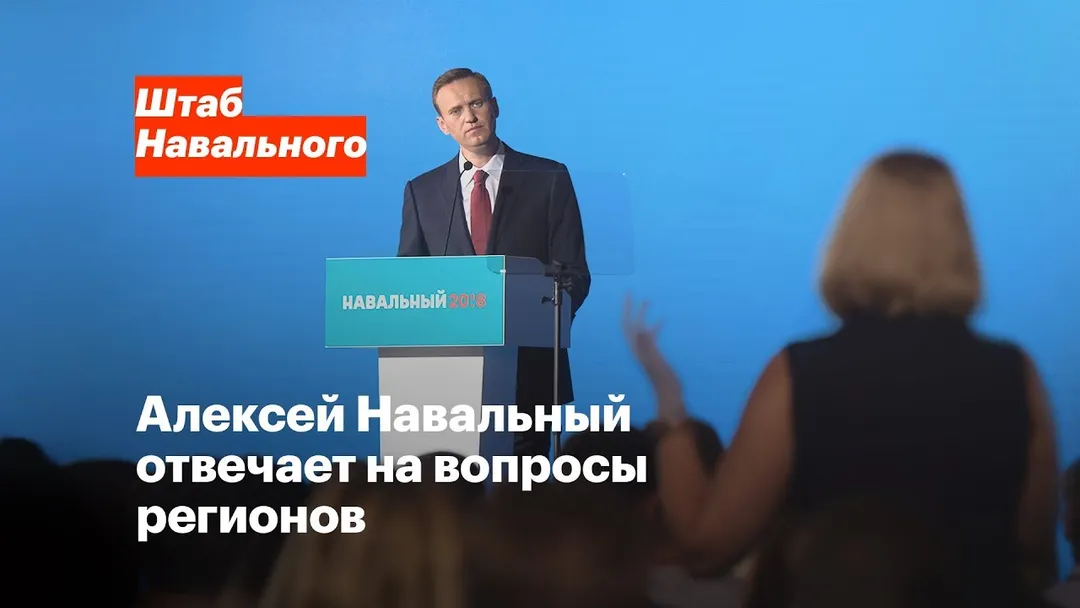
[music]
Thank you very much, friends. I applaud you.
You did a great job coming here to see us.
I want this meeting to be as open as possible.
Ask candid questions, tough ones, whatever you like.
Go ahead — I'm ready and happy to answer.
I want to answer them. I see the first question. Hello, everyone.
Hi, this is Cheboksary. My name is Yaroslav.
Hi. I have the following question about
what will happen to
car manufacturing and the import
of cars into Russia.
Right now, there are protective tariffs
on the import of foreign cars into Russia, and
they artificially inflate the price of our
cars. So what happens next? Well, first of all,
as I already said, the basic thing is that we
need to decide whether this will happen under this
government or under ours.
And under us, it will be better. That's not
the next question. We will do something very
simple: we will look at it, we will think it through.
These protective tariffs have not
been around since 1988. Since 1988, people
who wanted to buy a car have been overpaying
compared with prices anywhere in Europe,
and we were told that this was extremely important, that it
would boost the Russian auto industry. Did it boost
the Russian auto industry? We know perfectly well that
all trade barriers always harm what is
inside the country. Therefore,
of course, I oppose all these tariffs.
They are not needed. AvtoVAZ should not
be under state control.
KAMAZ should not be under
state control.
Anatoly Serdyukov should not be sitting
on KAMAZ's board of directors, nor should all these
wonderful people from Rostec and so on.
That is, we must remove
the state from the auto industry.
Direct ownership, while at the same time
of course providing general support
to the automotive industry, but without
protective tariffs, which, as we know very well,
always
do harm and nothing else.
I am absolutely convinced that in a country as large
as Russia, there can be and there will be
an excellent auto industry — but without
giant and useless interference
from the state. Another question — Sochi.
Konstantin: I have a question. What will happen to
the legacy of the Sochi Olympics,
which is now standing empty
and completely unused?
Konstantina: That's exactly what I wanted to ask — what is happening now,
what is happening to this Olympic legacy?
In fact, it is
falling apart. All the companies are bankrupt,
and nobody works there — everything is simply
empty. Some of you may remember
that I had a memorable argument with
Alexei Alexeyevich Venediktov (editor-in-chief of Echo of Moscow),
when we
published our report on the Sochi
Olympics and showed with figures that
30 percent of all the money had been stolen. And we
said that VEB (Vnesheconombank) loans, first and foremost,
would never be repaid. We
ran the numbers and saw that it was impossible, and we were
of course told by both the government and even
liberal public figures like Venediktov
that we were wrong: 'Guys, all the
money will come back, all of this will work.' But
it turned out, of course, that it doesn't work
that way and never will, and
indeed, all those loans were written off.
The Fisht Stadium in Sochi,
which was built at enormous expense,
is being rebuilt. All the other
infrastructure facilities likewise are either
standing closed or being handed over,
as the media center was handed over to Roldugin,
who is supposedly there nurturing
young talent. I hope that at least
those notorious
billions in Panamanian accounts will at least
somehow serve some good for Russia
and benefit children. But I'm afraid,
unfortunately, that the future of the Olympic
facilities does not look bright. These are
huge sites that are very difficult
to maintain, and most likely, with them — well,
at least under this
government — exactly the same thing will happen as
has happened to Olympic facilities in
many other countries. The Olympics are not
profitable; they are loss-making, and so all of it
will slowly decay and fall apart.
We simply need to, as quickly as possible,
sell it off, take it off the books, and stop
keeping it on the City of Sochi's balance sheet,
because it cannot afford it. In other words,
sell it all so that some
businesspeople and entrepreneurs can at least
earn something there and at least
bring some money into the budget, instead of
burning through it.
This question is mostly about the campaign. Well, let's
take any questions.
Yes, please. Sergei Bespalov, Mercury.
Sergei.
If this is the speech you are going to give
as a presidential candidate, then we have
a good start. First of all, and
second, on the issue of pensioners: we need
to speak to pensioners, we need to tell them something,
because I often see among
older people who
come to us that they say roughly this:
'We already know there's some Navalny,
and after that it all becomes a muddle in our heads.' But
we still haven't directly addressed them. What
could you say to them that we could
pass on, because these people are already
coming to us?
We are doing quite a lot of work on this issue.
And as you know, Vladimir Milov writes a lot about this.
And several other economic
experts as well—we have something to say.
Specifically, here are the key points. First, we have run the numbers and can see
that there is no need to raise the retirement age.
In Russia, that is useless and senseless.
What Russia needs to raise is
labor productivity. When we
propose raising the retirement age
to effectively above the average life expectancy
for men,
well, that simply sounds idiotic.
That is why we are not raising the retirement
age—we are restoring
all those stolen pension savings
that have been taken away since 2014, and we
believe—we can see from the budget—that it is
possible to pay pensions at the level of
a real subsistence minimum, and
the source of the money for this is very clear:
proper dividends from state-owned
companies. When oil prices rise,
Gazprom and all the others who are allowed
to pay low dividends, or who are allowed
to pay lower taxes per
barrel of oil extracted, should pay
what they are supposed to pay. Then we
will have enough money
to finance the pension system.
But the main thing is overall economic
growth and, overall, higher
labor productivity. But specifically
for pensioners, these are exactly the
things we would say. What do you think—will this
work?
Well, of course, right now I am still, so to speak,
speaking as part of the campaign staff. Yes, we will try.
This is our eternal
well, not a problem—an eternal issue, and for us
your feedback is especially important,
as is the feedback from the people working on the ground,
so that they come and tell us: guys, make it simpler,
simpler. Because from this kind of
Facebook crowd, we constantly get the opposite
pressure: make it more complicated, more complicated.
They say: you're speaking too simply, that's populism.
We need to find a middle ground. So I am
trying to remember who is waving at me so that
I do not forget anyone. So, Ulyanovsk, then
Vladimir, good afternoon. Dmitry Shestakov.
Ulyanovsk. Hi, Alexei. A question about the boycott
of the election.
If we are considering such an option,
yes—if we succeed, what comes next?
I address this in the final part of my speech.
We will do it today, we will do it
tomorrow, we will keep doing it. We will not
get tired of it, and we will not give up. So let us
treat this as a process
of political struggle. All right,
let's take your case: you live in Ulyanovsk.
The election boycott either works or it does not,
and then tomorrow comes—what is it, March 7—and
you say: well, all right, basically
I am no longer interested in this
political activity. I agree with
everything that this is a struggle for the country.
Why did I say that we are engaged in
saving Russia? It is not just that I inserted
some catchy line into the speech
that we will post in a video and send somewhere. I
really do see this campaign exactly that way,
and I ask you to see it that way too.
They are dragging it into a pit, into catastrophe, while
we are pulling it back.
So we need to treat this as
a marathon distance. We are fighting in this
election. I am sure that in this election we
could have won if we had not even
equal access,
but simply if we had been allowed in and had at least
some access to the media, even if unfair. I
have absolutely no doubt about our victory,
not just in some historical
perspective,
but in the foreseeable future—in our
victory, not merely that of our children and grandchildren,
but our own victory. But we have to realize
that they are not fools either, right?
They will come up with something, they will
come up with something to save themselves. Right now
this boycott is happening in
Yekaterinburg,
and they have already come up with a lottery.
They are raffling off apartments. You understand, before
they would raffle off, I do not know, buns or
maybe washing machines,
but now six apartments have been bought in order
to raffle them off in a lottery at
polling stations.
They are raffling off cars. I do not know,
maybe they will clone Filipp Kirkorov (a Russian pop star) and he will
sing at every polling station. They
will keep inventing things. These are people
who are fighting, in their own way, for the country—they
want to take it away from us and
profit from it. So at any moment
when the question arises of what
to do next, we will sit down and think it through. I do not
know—you may come again if we have
the money for it. We will sit here and say:
what is the proper thing to do, according to conscience and
honesty? And I am sure that the road
will be fairly straight, and we will
keep walking along it. That is all. I do not see any
other path.
Vladimir from Tula.
Vladimir, I have
the following question.
You are very often asked about
whether you will bring up at the
federal level issues that matter
to the regions.
But you probably know that we have a large
group of territories
that are governed by outsider teams. That is,
if it matters to Putin's government,
then it means using Russia as
a cash cow and move the money there
then for these people it is important to use, well,
say, the Vladimir Region, and then
after retirement, get out either to another part
of Russia or somewhere else altogether
there was quite an exotic girl there, I
remember when we opened a штаб (campaign office) for you there, so
so my question is this: would you be able to
for us to hear from your own lips that
in the event of your victory, first of all
the current outsider governors will be
removed, and secondly, that this practice
will stop altogether here—do you really
have
the slightest doubt that if we
win this campaign, we would leave
these governors in place? Of course
they cannot remain in power; they are
enemies of Russia, enemies of the entire people
of course, we are doing this so that elections
for governor are real elections, without any
idiotic municipal filters, so that
it is easy for everyone to take part in these
elections, and of course there should be no appointments
at all—it is harmful. We have simply
seen that the quality of the governors
has sharply declined. After all, they told us
what? They said there was no need to
elect governors, that governors should not be elected, they should
be appointed instead, because criminals would
rush for power. Yes, but it turned out that
it is precisely the appointees who are, excuse me,
complete crooks. They are much worse than
any elected governor, even if
the elected governor was not all that great
so yes, of course—only elected
governors. And all these people should
be, if they did not commit crimes,
subject to lustration, and if they did commit
crimes, then they should end up—we will discuss with you
Alitsin. My name is Valeria Stul, and
my question concerns Tula specifically. In
Tula there is a huge number of defense
enterprises, and one way or another, in every
third family, someone works at one of them
checkpoint, but the rest
how will you address the issue of
military spending, because you
advocate cutting spending, and
does that threaten higher unemployment in
Tula? Because in talking to people, I
have heard that one of the arguments is
that under Putin, a huge amount of
funds go to the army, and
a large number of orders come in, so one way or another
people at these defense enterprises receive
fairly high salaries
Well, all right, I was there—I remember our
conversation in Tula very well, when we opened
the штаб (campaign office) there. Very high salaries? What are they?
They get 25,000 to 35,000 rubles, and those lucky enough
get 40,000. So yes, we really do
advocate reducing the military
and police budget, but that budget
is so enormous that we understand that
even if we cut it by a sufficient
percentage to increase spending on
education and healthcare,
within it
there will still be a sea of money
that will be enough both to
raise salaries for personnel
in the police and military, and to
maintain a normal defense procurement order
That is not just me saying it, nor is it a study by
the Anti-Corruption Foundation
the Accounts Chamber said that, believe it or not,
30 percent of the money allocated for
the defense order is cashed out in the first
two weeks—that is, 30 percent of it is simply
immediately turned
into wheeled suitcases stuffed with five-thousand-ruble notes
so of course
of course this is happening at half of
your Tula defense enterprises, by the way
Serdyukov sits on the board of directors of them
and such rules and practices
exist there. So of course we do not
believe that it is necessary
to cut defense procurement in any serious or significant way
so that people would
end up without jobs. Absolutely not.
What must be reduced there first and foremost is
corruption. The money freed up by that
is enormous potential for
development, including in the defense sector. Therefore
it is especially important for your штаб (campaign office) to
explain this and say that
of course no one will suffer; the country still has
more than enough money. As I said,
oil prices have fallen, but these people's appetites
have not shrunk. But even at $52
per barrel, even at $40 per barrel,
that is a sea of money—enough money
for the country
to go on living just fine. Guys, Viktor
next, from Oryol, will ask the question that I am
asked most often. Viktor Zaryadov, city of Oryol
The question I am asked most often
as a volunteer—probably not only me, but other
coordinators too—is: when will Navalny come to us?
When will the tour around the country continue?
Listen, I will come to you on the 11th
—September 11—after a visit with
your brother, who is being held there
near Oryol. We actually postponed
the start of my regional trips—they
were supposed to begin on the 8th, precisely
because they scheduled
my visit with him for the 11th. But I think from
September 13—I am afraid to say exactly right now
because I do not have the schedule at hand—we
will start traveling around the
regions quite actively, and we will come to Oryol
of course. We had just flown to
St. Petersburg. Hi, Polina
I have two questions. The first question is about
foreign policy—you touched on the scientific
people who come because of illness
Are you really going to ask about Crimea? No, no.
No, no, no, no, no — not about interaction with
other countries, but
people are very concerned, and the second question
actually concerns affordable housing for
people. As for interaction with other countries,
there is no need to invent anything — we will
be friends with everyone. Objectively, where is there
a country that is hostile toward
Russia? Where is it? Before and after Putin's
policies, of course, Ukraine has become
generally hostile toward us there.
Georgia is partly so, but essentially there are no
countries right now that are
hostile to us, and that is a wonderful
moment. It is also
one of the historic opportunities for our
country. Overall, everyone likes us — in the West
and in the East. This is a wonderful time
to develop foreign trade,
to make money from all
of this. We need to stop engaging in this
foreign-policy nonsense
that Putin is engaged in. It is clear why
he does not want to discuss domestic
problems.
He wants to discuss Damascus, Aleppo,
and all that, but we will talk about what
is happening inside the country. We do not need
these mechanisms of distraction. We will
be friends with everyone. Affordable housing
is something for which I am criticized, even
within our own team and even within
the policy group, but I truly
believe that we must include in the program
— and we will include — a provision that
we must have a special
separate affordable housing campaign
that includes, first and foremost,
reducing housing costs by
completely freeing all builders
in city centers from virtually all
permits for the construction of buildings under
four stories — just take the land and build.
The land is there — just build,
and no permits should be needed. Right now, to
build even, say,
a four-story building, it takes two years
to process permits, and you have to pay
an enormous number of bribes. That is why we
will drastically reduce regulation in this sector,
radically.
And by doing so,
we will increase supply and reduce housing
prices. And the second thing for which many
criticize me:
I believe the state should
subsidize
interest rates. It is absurd that right now we are
all being offered mortgage loans
at 11 or 12 percent. In
China, the lucky ones can get them at 10
percent. But the Central Bank says
inflation is 4 percent. If inflation is 4, why are we
telling this poor person, who has no
home, that he must pay 10? We could already,
starting tomorrow, issue
mortgage loans at 4 percent annually,
or 3 percent annually with a small
subsidy. Do you remember at what rate
Putin's associates got a loan to
buy Sibur? Half a percent in foreign currency.
It was around a trillion — or $3 billion.
I do not know — we rescue
banks, we rescue various state-owned enterprises,
we again pay off those same Sochi
loans, we make everything easier for everyone, but we are afraid
to give some citizen who has
two children a preferential mortgage loan.
Therefore, I absolutely believe that the problem
of housing in Russia will be solved when people can
take out a mortgage as in European
countries — 1.5 percent, 2 percent, 3
percent. We are ready to offer that right now.
I will stand firmly on this, because
the housing problem in Russia is not
economic, but political. People
have nowhere to live. Construction is an excellent
multiplier for the entire economy — let it
develop.
Alexei Vors, Alexei Vorsin, city of
Khabarovsk.
I have a question. Good afternoon. My question is about the development
of the Far East. I understand that for
the federal center,
the Far East is perhaps just one of
Russia's regions, yes, but for the people of the
Far East themselves, the question of their own
identity and the question of seeing themselves
as a distinct region is, in a sense,
quite politically important, and in connection
with this, my question is as follows:
Will your political program include
some separate section specifically
on the development of the Far East? I mean
that this is quite important, quite
important and significant from the point of view
of a political statement precisely for the
people of the Far East themselves, when they see
themselves in a separate line or
paragraph. I can honestly tell you that we
currently have several different versions
of the program; we are still debating
and choosing the best one. In some versions this is included,
in others it is not. We do not want
to write just general things like, 'We support
the development of the Far East,' because that
appears in absolutely every program of every
presidential candidate. Let us, together with you,
fill this with something real.
Absolutely. You know, we spend quite a lot of time
on this; our lawyers are engaged in
anti-corruption oversight of this
area, including the 'Far Eastern Hectare' program
that we can see has
completely failed. 50,000 people
have registered for this Far Eastern Hectare program.
although we could frame this in terms of millions
we really want to include in the program
something that will resonate with your
voters, something you’ll be able to speak well about
let’s work out these, uh,
these several points together, but I’m in favor of
including something like that, of course, but
otherwise, how are we going to campaign in
the Far East? I understand perfectly well that you
as soon as I arrive, the first question
I’ll be asked is: so, what are you going to
do about the Far East? There are
10 million people living across that vast territory
while in the neighboring Chinese territory
there are 50 to 100 million people, and
overall, it doesn’t look very promising
so of course we need to spell out
something very specific. Let’s, with your
help, get this done. Korall, then
Vologda
Good afternoon, my name is Vadim. Thank you
very much, Leonid, for counting me in, because
at the moment I’m taking the place of two
people, in a sense. First of all, unfortunately, we, uh,
ended up with two people from each city
that’s how it worked out. We really wanted to have
a third person as well, because we have
another wonderful volunteer whom
we would have liked to bring with us, but
unfortunately, the budget of our organization didn’t
allow it, so I’m passing along to you
his greetings. — Valentina Belyaeva sends her regards too, and
from me as well.
And here is his question. Right now, each of us who
is sitting in this hall and wants to ask a
question
is trying to choose a question that
would cover a large part of the population
that would address a large part of
the program, and so on. This question is
specific, but at the same time I think
I won’t have any other chance
to ask something this specific, and
with all the talk about weapons, gay parades, drugs, and whatever else
people bring up, I want to ask whether Navalny and his
team have any view on discrimination against
men in light of the labor code: there are no
benefits or concessions for having a child,
a longer workweek,
work in Russia’s Far North,
the absence of an additional day off
for work in rural areas, there is
a list of jobs prohibited for women, and so
on; military duty, one-year
conscription slavery only for men,
military reserve obligations only for men, leave
for childcare only for female military personnel,
pensions for men come five years
later, the criminal code, and so on, and so
forth. So, in other words, the question is
whether, alongside feminists, there are
people who in principle, right now,
as is developing strongly in the West,
are fighting for men’s rights there,
while in our country it’s not really accepted
to discuss it. It’s not that it is
the main issue right now, and at the same time
— I didn’t quite understand the question. — You know, there was even
a court case when a serviceman filed suit
because he was not granted leave
to care for a child, and he lost even
in the European Court
Let me answer: I am for equality, and of course
I believe, for example, that parental leave
can and should be taken
by a man on equal terms with a woman, and
but at the same time, let me say honestly, with
all that said, even though I support equality, right now
to focus especially on fighting for men’s rights
in Russia
would be a little
like legal casuistry. After all,
in Russia the biggest real
problem is the violation of women’s rights. They
consistently receive lower pay for the same
work, they are discriminated against in
Russia, and very often this is considered
normal. In general,
society’s attitude toward women is such
that if she is a single mother, then she is more
or less seen as a lost cause, and generally
as someone not worth paying attention to. Like,
my God, she’s thirty and she’s a single
mother — that’s it, she may as well lie down in a coffin
already. That absolutely should not happen
We must ensure that these people
can work normally and have the opportunity
to develop. In principle, unfortunately, our society
encourages things like
socially acceptable non-payment
of child support, and so on and so forth
So, in electoral terms, the significant
issue is the protection of women’s rights, and we
will talk about it — not because
some feminists say so, but because I
actually believe it. But we are for
equal rights from every point of view, from every
side. If there are factors that
discriminate against men, then setting aside
all the smiles and smirks, we should just as
firmly speak out against that too. That
happens less often in Russia, more in
the West, perhaps, but as society develops
in Russia, this will happen more often, and this kind of
topic will become more relevant. That’s my
honest answer
Vologda, then Tver, Samara. Alexei
Hi, Yevgeny Domozhirov here
So, it’s no secret that
a huge number of volunteers came to
us after the March 26 rallies and after the *He Is Not Dimon to You* investigation
and then after June 12 as well
A huge number of volunteers
are now asking, probably since
July or August, whether there will
be another big rally, because
many say that this is what
motivated them — they knew the date, they
They were preparing, and now they want to come out again.
This is one of the questions that needs an answer.
Including those who want to hear from you.
It can’t be decided right now, not this very second, but...
In our informal conversations there,
during the coffee breaks. But tell me, people...
want another rally, and we do have that demand.
It’s there. If people want it, we need to plan it.
It’s simple. But why did our rallies happen...
while most of the other rallies that...
are constantly being announced by some committee...
for protest actions, by PARNAS (a Russian opposition party), go much...
worse? There’s enormous preparation involved.
A lot of money. We’re raising that money,
and maybe by the Kremlin’s standards
it’s not much, but it’s still substantial money.
A lot of your work, arrests — where is Elvira,
the one who’s in detention? Hi, Elvira, hi.
Kazan headquarters — how many of you were there because of...
the authorized rally, people...
Five people were detained, right? I’m not afraid...
of ending up in a special detention center, and neither are Volkov
nor Rubanov. We’ve all been through it.
It’s completely normal. It’s a sign
of good work. But I’m definitely not saying this:
this nonsense that unauthorized rallies...
mean throwing people under the bus for...
Unauthorized rallies, for me,
are a hundred times better. Look at how
the last March for a Free Internet went.
It was authorized, damn it, in Moscow, and there
they detained 15 people.
They confiscated all the signs. Did you see it on
video, how the police were cutting the word “bastards” out of
a sign that said, “Come to your senses, don’t touch the internet, you bastards”?
So if that’s how things are, what
difference does it make to us anymore, authorized or
unauthorized? It’s all the same.
They detain people anyway, so...
I’m in favor. Today, I want to get from you
some kind of feedback so that
we can decide. Of course, absolutely, we will hold
another rally like this, and we’ll keep holding them.
After all, Medvedev is still there, the dachas are still there,
all the other guys are still in place, so we
have to do this, and we will.
A specific date hasn’t been set.
We’ll discuss it today. And one more
small provocative question, from
a supporter who keeps pestering me
literally every day — my son is worn out by it.
When is the merch store, Volkov? I keep getting asked about it constantly.
The merch store.
Not just your son — seven times a
day I ask Leonid about it.
I’m asking too, and meanwhile in my pocket
my phone is blowing up right now.
in the relevant chat. Our latest
update, after spending three weeks
overcoming problems with the banks, is that
the delivery service backed out.
For some reason, they really
latched onto this particular thing very hard.
Either they’re afraid that we’ll actually
sell a lot of it and make a lot of
money, or they’re very afraid
of the symbolism. But honestly, we haven’t faced this kind of
resistance even
when renting the Volgograd headquarters office.
This is real lawlessness. What are we
going to do? Even if we have to send it out by damn
carrier pigeons, in the next few...
It hasn’t launched yet, but we’ll find a solution.
I promised. Next: Samara, Belgorod...
then further in that direction. I...
Really, we understand that we’re
losing money. People want to buy these
T-shirts. It’s excellent campaign funding.
But we’d already made arrangements, already
delivered everything to the warehouse, to this distribution center.
Everything was already connected to
the computer system. Everything was supposed to start working.
Then the next day they call and say, “Sorry, we’ve
had something come up. Could you
pick it up from the warehouse?” Well, what can you do?
They really are very
for some reason afraid of this store.
We say: fine, just comply, let it sit
in your warehouse, and then it can be shipped from there.
“Please take it away.” Sorry, Alexei.
Hello.
Kostya called me over, so I came to the stream.
It’s time for questions.
I have a pointed question.
In your program, you talk about
what will happen to Vladimir Putin.
You promise security guarantees
to Vladimir Putin and to
members of his family. Does that mean that all of
us here — and you, Leonid, and I — will not
make any extra effort
to save our esteemed...
from The Hague tribunal? I’d say not exactly.
Not quite. What I’m saying about
guarantees for Putin is literally this: if
he agrees to a peaceful transfer of power,
if he stops clinging to power, and if he
agrees to hold normal
elections, then he and the members of his family
must be guaranteed safety by us,
because that is in the interests of the majority, it is
in the interests of the country.
Even though for you personally, and
for me personally, for a whole range of different
reasons, doing that would be fairly
unpleasant. But we need to set aside our own discomfort
for the sake of everyone’s interests. As for
The Hague tribunal,
that’s a completely different matter, and we cannot
settle it. All I’m saying is
a guarantee of safety for him from
the Russian state, if he
agrees to a peaceful transition and we come
to power. That’s all I mean. Samara?
Alexei, good evening. Ekaterina Gryaz...
Samara.
Just to clarify: does that mean Putin
will face no criminal liability, and...
Medvedev will stay in office.
To continue, I wanted to understand—well, where...
where Medvedev is supposed to fit into all this. But listen,
Putin is the founding father of this regime;
everything rests on him. This whole
propaganda machine has worked for
him.
Through family ties,
through his closest friends,
he controls the economy. So he is
the main load-bearing element of this system,
the one with whom this kind of dialogue can be conducted,
if any dialogue is possible at all. And who is Medvedev?
Should we give him security guarantees because he dances well?
Security guarantees?
Or because he nicely furnished his
dacha in Psekhako? No, I see no point
in discussing anything with Dmitry Medvedev
because he is entirely a derivative
of Putin. He is nobody. Tomorrow they could remove him,
replace him with anyone—Shoigu, Rogozin,
Lavrov—and no one would remember
this Medvedev at all, not even
that he ever existed. Except us—we will not forget
that he existed.
That is why I do not consider Dmitry
Medvedev an important element of this
political system, although yes,
he is one of Putin's closest loyalists, many times over.
But simply because of that, why should we tomorrow
be handing out security guarantees
to Timchenko and everyone else? Then why
are we even here? A follow-up question.
Originally I had two questions: one
regional, and one about the campaign.
The regional one is probably obvious.
I'm from Samara, and in both Samara and
Tolyatti, a very important question is what to do
about AvtoVAZ. Is it a case of 'what is dead cannot die,'
or are there still some other options?
Actually, I've watched many of your
interviews, and I haven't heard an answer to this
question. I'd be grateful for one. As for
the campaign: March 2018 passes,
this structure has been built up
very well by the federal team and by us.
Will it be preserved? How do you see it now—
in what form will it remain, and what
its tasks will be?
In other words, what will we be doing in April
2018? Thank you. Well, as for the auto industry,
I was just talking about it, but let me repeat
specifically for the residents of these
regions. First, the auto industry, into which
huge amounts of money are poured, needs
transparency.
Because, along with everything else, these
colossal, unimaginable sums of money
allocated by the Soviet government,
the Yeltsin government, and the Putin
government—it is unclear where, for the most part,
they have gone. These customs duties are not providing
help. Therefore, I believe that there, first of all,
basic order and
transparency must be established. Second, the duties are not
serving their purpose; they should be abolished. And third, we need
to develop the auto industry with the involvement of
foreign manufacturers. That is,
it's not simply that it is dead and can no longer
live. Well, in a certain sense it is,
but we understand that a
country with a market of 150 million people
can support a normal
auto industry. The task here is simply to cooperate properly
with those countries and
companies that are capable of producing
good cars. We just need to admit
that on our own, completely
independently, we cannot
produce them, so we need
to invite them here on favorable terms
and work together with them. Now, as for
the question of what we will be doing
in 2018:
after the election—after victory in the election,
or after the unlikely event of not winning
the election—well, as I already said, this
political struggle is a political
marathon. After 2018, you remain in
the country, you do not emigrate, you live here in 2018, 2019,
2020, 2025, just like everyone else. And so we will
do, from a political point of view, what
normal, honest people are supposed to do.
Because life is short—you hardly have time
to look back before it is already over.
So you have to live it in such a way that you know
that in this life you did some
right, decent things and fought for
the right things. That is what we will do every
day, regardless of who
we are,
whether we are president or volunteers, whether we won
the election or did not win. What we will do is
wake up and, each time, do the same
thing: improve something around us. That's
all. There is no other option.
[applause]
I've noticed that so far 95 percent of the questions
have been for Alexei. At the opening I was
there, so now I'm bringing some fairness to this:
Belgorod, Ulan-Ude, Murmansk.
And then we'll decide. Good afternoon. Actually,
I have a rather unusual
question. You yourselves basically know what the
state of prisons in our country is right now.
And when you become president,
will that change for the better, and
will people who were
illegally convicted be released? Guys, are you
seriously asking this? You work at Alexei
Navalny's campaign headquarters—does he support
the release of people who were illegally
convicted? Of course we do. My
brother is in prison on a completely
fabricated case, and I myself was jailed
over it. I spent eight and a half
months behind bars, a little less. The
election campaign has been going on for a month and a half.
spent some time under arrest during that period, so
of course all political prisoners
will be released — that would be decree number one.
Even before judicial reform,
even before everything else, before the adoption of
a law declaring his fight against
illicit enrichment unlawful — the release of
political prisoners, the repeal of
political criminal code articles 200 and 282,
and so on — in general, the repeal of all anti-
extremism legislation. As for
the prison system, in terms of the size of the
prison population, we are second only to
the United States, even though our overall population
our population is much, much
smaller than theirs.
We have terrible prisons, we have enormous
sentences, and most importantly, it does not work.
The cruelty of the punishment applied
in Russia does not lead to people
committing fewer crimes, so
of course we need a more humane
penal enforcement system. All these
widely practiced beatings, torture,
rape, and monstrous living conditions
in detention — besides the fact that they are
inhumane, they also do not work.
They are harmful.
Here, if a person goes to prison once,
they never really get out of that cycle for the rest of their life.
So of course this sector needs
fundamental reform, and in that sense the experience
of the Scandinavian countries
should be much closer to us than what
is happening now — this hellish
Gulag-style system (the Soviet forced labor camp system) is in fact one
of those things that cannot be reformed.
There, you really just need to
clear everyone out and build everything from scratch.
Ulan-Ude.
Then Murmansk, then Aleksin. Hello.
I’m very nervous. This is a very important question for
probably for us all, a very difficult and
very much a question about the future. During campaigning,
during canvassing walks and other
events, yes, our indigenous
population basically always says
that Alexei Navalny previously
attended the Russian Marches and supported
nationalists, so we cannot
support
Navalny. We try
to argue that it was a long time ago, maybe
his views have changed somehow since then.
We would like to hear from you what
can be said, what arguments
can be used. Then say this directly:
precisely because he went to the Russian Marches
he will, more than anyone, defend
the rights of all Russian citizens, including
the residents of Buryatia,
regardless of whether they are Buryat
or Russian. Because what is commonly called a
nationalist agenda — well, yes, I
really do support restricting
migration.
I really do support
the introduction of a visa regime.
But this is a problem that affects everyone,
right? In the Far East, in Eastern
Siberia, this is a problem that concerns
China as well, and in that sense
one of the bills I introduced,
for example, concerns the fact that we should
automatically grant Russian citizenship
to anyone who, according to any document, either
they themselves or their parents were either Russian
or representatives of any nationality
living on the territory
of the Russian Federation. In that sense, my
attendance at the Russian Marches, and anything
that someone might somehow
interpret as part of a nationalist
agenda, is about defending the citizens of Russia.
I support the formation of a political
Russian civic nation, not ethnic
nationalism. For me, all the people who
live in Russia need roughly
the same things, including
protection from illegal migration. So this
is what needs to be said, and said specifically.
You need to say: yes, Navalny went
to the Russian March.
But which politicians, for example, spoke out for
allowing Marha to be admitted to the elections?
Who there said they supported
those who went on hunger strike? Everyone else stays silent, while
who actually went there?
And I exposed all this —
your Buryat officials. Zayakin,
a member of our team, went there
a million times and many times
met with people there. In that sense, I do not see how
nationalism, or anything
I have said on the subject, contradicts even
a single interest of, say,
a Buryat,
a Yakut, a Russian, a Tatar, a Bashkir, and so
on and so forth. We are all one
civic nation here, and we must defend
ourselves against those occupiers who
rob all of us and funnel the money into offshore
accounts. It is against them that
our shared nationalism should be directed. That is exactly what I have always
stood for. All my speeches
at the Russian Marches, in videos, and so on
can be shown to anyone, and no one will ever
find any trace of ethnic
nationalism in them, or any advocacy of
the superiority of one nation over another.
I think that answers it on my end.
Murmansk, Orenburg, Kemerovo.
Hello, Alexei, and as a human rights
advocate first and foremost, I want to thank you for
your previous answer. For a long time it
troubled me, as a human rights defender, regarding your
nationalist views, and many people
reproached me for supporting you.
As a human rights advocate,
I have another question, no less sensitive.
about the state of LGBT rights in Russia.
As a human rights advocate, I have long been
troubled by this question, as have my colleagues.
Would you be prepared to adopt a program for
improving LGBT rights and to adopt
some laws to protect the rights and freedoms
of the LGBT community? Thank you for the question. So,
first, we stand for equality,
absolutely, and equality for everyone.
No one may be discriminated against, much less
beaten, punished, insulted, or otherwise harmed
on any grounds whatsoever, including
sexual orientation, gender,
nationality, or anything else. Second,
in the Beautiful Russia of the Future (a political slogan referring to a democratic future Russia), there may not even be a need for
special laws, because it is all already provided for.
These thugs who attack
and beat people can be imprisoned; they should be
imprisoned under Russia's current laws.
They are hooligans who attack people.
So of course there is a conservative
part of society, there are religious people, and everyone
has every right to hold pickets and protest against one
another. If I become president, then please, everyone
will be able to hold their public events on
equal terms. But as soon as anyone starts
infringing on someone else's rights, especially physically
or restricting them, then fine—against you
we will open a criminal case or
an administrative one, depending on the degree
of violence being used.
Only equality—and this is the most important point
for Russia in every respect, not
just when it comes to gender. This is
a matter of principle.
Absolutely. Long ago, somehow,
during the 2013 campaign, people very often
sent in these so-called provocateurs
who would ask me tricky questions:
"Now we're going to ask you about
gay pride parades, about gays," and so on. I
am not at all embarrassed to speak on this subject.
I do not believe that my statements that
there should be equality in Russia
would somehow damage me in the eyes of voters.
Quite the opposite, in fact.
For a long time now, without the slightest problem or
embarrassment, I have answered any questions
related to the gay community and its
interests. All right, the question you
were actually asking was whether,
if we prepare a report on
the state of LGBT rights, together with a program
for changing the situation, from human rights
organizations, would you be ready to consider adopting it
going forward? Well, that all
depends on what kind of report it is.
Human rights advocates write many different reports,
and they are different people; with many of them I
disagree, because
many of them criticize me for that very
proposal to introduce a visa regime. I
stand by that and will never give it up.
And at the same time, I believe that this is 100 times
more protective of human rights than what
they propose, because in that way
I am also standing up for migrants' rights. I want
them to be able to enter the country properly, so that
they have insurance, so that if, God forbid, someone
falls from the third floor at a construction site,
he does not die by the roadside, but is properly
treated in a hospital, paid for by the insurance
they purchased. So we need to look at
what kind of report it is and send it to our
policy group—to Volodya Ashurkov.
Write to him.
They will review everything. Well, of course, yes. Thank you.
That's all—Orenburg, Kemerovo,
and then Biysk, Kirov, Novosibirsk—we keep going, and
then we'll see what comes next.
Hello, my name is Natalia, I am
the coordinator for the city of Orenburg. I want
to say thank you very much for
giving us—me personally—the chance to fight
injustice. I gave you that chance? Thank you
very much for coming here, for fighting,
and for doing this—I applaud you.
Thank you very much for allowing me
to stand here on this stage before you,
because fighting alone
is very hard, practically impossible. And
when you united people not only in
Moscow and St. Petersburg, but also in the regions,
that is wonderful, thank you very much. I
have the following question.
Ramzan Kadyrov is a threat
to national security and a problem
for Russia. What are you going to do about him?
Because I believe that by legal
means, it is impossible to fight him.
First, regarding your earlier
remark, it is important to understand that we
do not need to fight alone. Once again,
I just want to say that we have an enormous
number of people. And again, I am not saying this
to inspire you, but
in fact—just name for me
a political party that has 150,000
volunteers. All right, let's
discount our volunteers, let's say
only 10 percent of our volunteers
count as genuine,
real volunteers—that is 15,000 people. Who
has that many? Not even close—no
political force, no
public organization comes close. We
truly have the biggest, the most powerful
political network. No one has ever
built anything like it, no one has ever
mobilized one like it. So thank you for
taking part in this. It is important to understand that we
are many, and in fact we speak for the majority.
Second, as for Ramzan Kadyrov, your
assessment is absolutely correct: he is a threat
to national security. All the information
we have about him indicates that he
is committing a crime, so no—you
are very much mistaken when you say
that there is no way to fight him.
There are legal methods—so of course there is a way.
There is really nothing complicated here. First of all, he should have been
the subject
of an investigation into the murder
of Boris Nemtsov.
That is where we must begin. Legal methods
do exist.
But remember there was that mayor of Makhachkala, Said
Amirov.
People used to say about him, well, he is so entrenched there,
there is absolutely no way to remove him,
because if you remove him,
a civil war will start there.
He really was guarded by—whether it was
gangsters or the police, it was hard to tell anymore.
This was a man who actually wanted to shoot down
an airplane with an anti-aircraft missile system—so, in other words,
he really was a local king, and it seemed impossible
to remove him. But no—they arrested him and
took him to Moscow, and absolutely nothing
changed. Nobody even made a peep.
So this is a big—an enormous and very
harmful—myth, that supposedly in the
Caucasus everything depends on one
person—in Dagestan on one man,
and in Chechnya on another. It is just as much a myth
as when people used to say over and over that, supposedly,
it was impossible to change the government in Bashkortostan (a republic in Russia),
impossible to change the authorities—or now they say
that if Putin is gone, Russia will somehow collapse.
A proper, honest, objective
investigation into all the people
who were involved, as I repeat, at least
in Nemtsov’s murder,
and in other crimes, other crimes—
we will investigate everyone according to the law,
we will investigate everyone under the law and send them
to a fair trial, and a jury will hand down
the punishment they deserve.
And this applies to all officials, except—
Kemerovo. I’ll turn to Ksenia next.
Kemerovo. Our region, Kuzbass, lives off
coal, and we have several regions like this.
But
developed countries are moving toward
working with renewable energy sources
instead.
Is there a section in your program about this, and
when these sources are eventually
developed in our country, what
will happen to regions like Kuzbass?
Yes, we do have a section in our program about this. We
have Vladimir Milov working on it—the person
I mentioned earlier; he came here to visit you.
When it comes to coal
energy, we truly have some of the best
specialists, people who understand it very well.
We are certainly in favor of
green energy and new technologies,
renewable sources—but at the same time
we understand very well
that this cannot be done overnight, and that
coal power will continue to exist
for a long time, and nuclear power will
continue to exist as well, and
unfortunately, diesel fuel will also still be used
at power plants. As for Kuzbass,
we see clear examples of how people
mine coal,
sell it to their own company—their very own company
registered somewhere in the Bahamas and
the Cayman Islands—and then that company sells it on.
In practice, it all ends up going to
the neighboring power plant, but all of it
passes through intermediaries who
take a cut for themselves, while these same mine owners
keep everything in offshore accounts.
This is what the extractive sector needs most of all—
fighting this practice first and foremost.
That applies to the raw materials sector in general, and the coal industry in particular,
as well as oil and any other sector. We know exactly
how to do this; we know how to get it done.
We already have draft legislation on this subject.
So what we will do, as a kind of
first step, is make sure these
companies pay proper taxes,
pay proper wages, and do not move
their profits outside the Russian Federation.
That will free up fairly substantial resources
that will allow the region to develop,
including Kuzbass. And one more
additional question from a member of
our campaign staff, Serafima: will there
be some kind of investigation into Putin’s palace?
Serafima, every one of our
investigations concerning Putin—well, that is
the nature of it: any investigation that
concerns Roldugin, or Rotenberg, or
Timchenko, also concerns
Putin. I’m not going to talk about
any of our plans for
specific investigations, but listen—I
am running in an election
where my main opponent is
Vladimir Putin. As I’ve already said, and
I am not at all shy about repeating it,
I truly consider him the father of this
corrupt system, the chief
corrupt figure. So we will have a lot to say about
him.
We will show a great deal. So, Lilia,
then I’ll go from the front row somewhere over there
to that side.
Friends, obviously, so that everyone—
I’m not going anywhere, I’m here,
I’m staying here, I’ll be spending time with you,
so you will all have
a chance to talk. The only, the only
way to keep this fair
is to stick to the timing. We still have
been very precise so far. Putin is always
late; accordingly, we will
act by contrast. So here
we are: we started exactly on schedule,
we are moving according to schedule, and at 5:30 p.m. we have
A coffee break, so this is where we’ll pause.
We’ll stop there at 5:30 p.m. Alexei will stay here.
He will remain, and then, as part of some intensive
informal conversation, you’ll be able to do everything
very simply. Or: hello, everyone.
My name is not Alexei, my name is Lily, and I am our...
client of the headquarters and dry rations, Bashkortostan (a republic in Russia).
I have a simple question about the campaign: how are we
going to hold meetings with you this fall?
If even at the campaign office opening, all the volunteers
couldn’t fit into the office, and at the rally
thousands of people came—does that mean
it’s going to be stadiums now, or will these be rallies
with you? Then maybe, the question is, near the train station?
Maybe we need to organize a nationwide Russian rally?
Will there be rallies with you in different cities?
A stadium? Well, that’s flattering, of course.
I’m not Sergey Shnurov (frontman of the Russian band Leningrad), after all, to fill venues like that, and I’m not
I don’t know, not rapper Gnoyny (Russian battle rapper), either, to fill
stadiums.
Well, we’ll hold them. The thing is that
it will get cooler by then—the farther east
and the farther north you go, the cooler it gets.
So we’ll proceed based on the specifics of each region.
I don’t know—well, in Mordovia (a republic in Russia), I held
meetings on the edge of a forest because there simply
wasn’t any suitable community space. In Ufa,
if we can find a hall with 2,000 seats where we
can hold a meeting,
then we’ll do it there. If not, we’ll probably hold it
somewhere outdoors, with the obvious risk, of course,
of bad weather. In other words, we will hold
these meetings. At first, we had
meetings with volunteers.
Now, of course, the time has come for
open meetings.
We’ll invite everyone to them, and of course they
will be more difficult—you understand that yourself
from the standpoint of
all sorts of restrictions and everything else. But
there’s nothing to be done. As the saying goes, if you’ve taken it on,
you have to see it through. So we will
hold meetings. We have something to say. I’m
not afraid of meeting with voters.
There are people who support us and will come to
these meetings. We’re not afraid that they might
not be large. Well, if they turn out
to be small, that’s not a problem either.
I’m not afraid of small gatherings.
So we’ll hold them.
We’ll proceed based on the characteristics of each region. You
know yourselves that for each of you, everything is very
different. When we first started traveling, we
thought, my God, what’s going to happen in Ufa and in
Kazan?
But in Ufa and Kazan, everything went wonderfully.
In some regions that seemed
completely trouble-free, everything turned out to be more difficult.
What someone in the Kremlin
might suddenly come up with at any given moment—we never know.
But we will, we will hold meetings with
voters, and of course this is the most important
part of the campaign. And here, this is already
your huge and fairly difficult job.
I just come, speak, answer questions,
take photos, and leave. You are the ones who have to organize all of this.
We’ll soon send out plans there.
Tomorrow we’ll be discussing them in detail.
We’ll talk about this at the seminar—how we’re going to organize these
fall meetings. Compared with that,
everything that came before will seem like a walk in the park.
Everything that happened before that—well, probably somewhere...
Will we file official notifications? Of course we will.
We will. Kirov, then Biysk. Georgy, your
view on restrictions on freedom of speech?
That’s clear, but not through such absurd
articles as 354.1, “rehabilitation of Nazism.”
354.1—is that the article on rehabilitation of Nazism?
Alexei Volkov, please look into that.
You have someone here who is being prosecuted under that
article. Well, listen, these kinds of articles—
all the articles adopted at the initiative of
Irina Yarovaya (Russian politician)—they are all harmful and need
to be repealed. We have a project called the rehabilitation
of law, and
we can see that these articles really need
to be removed. They don’t work, and nobody
needs them.
We already have articles in the law that
regulate all this fascist symbolism.
What Yarovaya came up with is, of course,
complete nonsense. But the issue isn’t even
the stupidity of the law—it’s how it is enforced.
What is happening in Volgograd is
an obvious fabrication of a criminal case.
These criminal cases over likes—people
post documentary films,
war newsreels, someone likes them, and
criminal cases are opened against them
because, supposedly, in the documentary
there was a swastika, so that counts as Nazi
propaganda. That is, of course, absolute nonsense.
And the people who initiate these criminal
cases should themselves be the subject
of investigation. The main thing here is
the enforcement practice.
Law enforcement agencies must
stop engaging in this nonsense, that’s
all.
Biysk. Anatoly—hello.
Semyon, Biysk. My question is this: we all know that
in many regions
the environmental situation is extremely bad. What will you
do when you become president?
After all, you can’t just, for example, immediately switch everything to
electric vehicles all at once,
or shut down harmful factories that are the cause
of poor environmental conditions.
You can’t change everything in a single moment, but
we do have
the well-studied, decades-long experience of European
countries. There were rivers in Germany—like the Rhine—
that were effectively dead rivers.
Many rivers in Germany were essentially
completely dead, but now you can drink the water from them,
and fish live there—you can catch those fish and
fry them for dinner. So we will
move along the same path they followed.
European countries—we can't just, tomorrow,
ban all internal combustion
engines.
But Europe is already introducing restrictions,
rules setting dates in the 2020s after which
after that date
it will no longer be possible to use internal combustion
engines—only
electric cars. We will follow that
path.
There is no need to reinvent anything. European
countries, the United States,
Australia, New Zealand—they have made
a tremendous breakthrough in environmental policy over
the past 15–20 years. In other words, all of this
has been very well studied. We will do
what they did, and success will await us
just as it did for them. Novosibirsk.
Then Saransk, Arkhangelsk.
Sergei Boyko, Novosibirsk. After—what are you
doing here? The choice is obvious, of course.
You.
And nevertheless, first of all,
thank you very much for the event. It is clear
that the most interesting part is still ahead, but
the thoughtful, serious approach to organizing it
is already evident, including from our volunteers.
An equally serious question: as you
probably remember, we have only one
city in Russia where an opposition
presidential candidate was able to
speak in the central square
properly, fully, at a rally
in 2017—in
Chelyabinsk. Also, very importantly,
here they allow campaign pickets in the city center; here
no one is detained, arrested, or
charged with any criminal offenses
against people who, in a sense,
went too far in elections at Moscow's command—this
is important, and we understand that. So I
will continue after all: even if we are talking
about private property rights, it is not
just some insanely rich tycoons
—even law enforcement officers there, colonels in
uniform, spend the day hesitating in front of
the door, because private property
means they do not dare enter against the owner's will.
In that connection, a question: well, we can already
see clearly that Novosibirsk is
significantly, significantly more democratic
than Moscow, where everything is banned. So when
we win in 2018, shouldn't we
move the capital closer to the geographic center of Russia?
Move the capital closer?
And if the most democratic place turns out to be
the Far East,
Vladivostok, for example? Of course, the regions
are very different. It is not just that
it catches the eye—you can really feel it in
some regions that only yesterday were
fairly
normal, more or less democratic,
and now new governors are simply putting on some kind of show.
In some places—Novosibirsk,
Yekaterinburg—they are somehow holding on.
Everything varies greatly. But I understand that
this may not be a very popular
point of view: I do not think we should
move the capital.
It would take an enormous amount of money. We would have to
basically take money away from everyone, from
all the regions, in order to drag
the capital somewhere far away. I believe—I
wrote about this many years
ago, and this is a considered position of mine,
which can be verified—I believe that
the administrative center, the capital, should
be moved out of the Kremlin, and we
really do need a new capital:
a small, compact, modern city.
But it should not be far away; perhaps it
should be somewhere between St. Petersburg and
Moscow.
There was a famous general plan from the 1930s
that even won awards for
the construction of such a new city,
located somewhere around Bologoye
(a town between Moscow and St. Petersburg), stretching out quickly like a comet
in the direction of Moscow.
That is, the authorities should not sit in the Kremlin.
The Kremlin is a medieval fortress, and
tourists should be walking there. In principle,
government bodies should not occupy the entire
business center.
We should build a small city
with new technologies somewhere outside
Moscow, and give the whole center back to business, to people,
and to development in general.
What exists now—this madness
with traffic jams, this monstrous city
that has pulled in 10 percent
of the country's population, even more—
is absolute nonsense. But moving it
that far away
—with all due respect, here in the European
part there are 110 million people, and there 40 million, while
the Far East has only about 10
million. If right now we are forcing
millions of people, hundreds of thousands of
officials from Novosibirsk, Yekaterinburg,
and Chelyabinsk to fly to Moscow every week,
then by moving the capital there we would force
tens of millions of officials already, every
day, to fly to Novosibirsk.
That might be good for Novosibirsk,
but overall it would not be so good for the country.
So a new, compact
administrative center—yes;
huge, enormous spending on relocating the
capital—I do not think that is necessary. And now, Saransk.
Saransk.
Hello, Alexei, my name is Eldar, I am
the coordinator of the campaign headquarters in Saransk,
and I have a question concerning
mentality. In Mordovia (a republic in Russia), many
people know that practically 99 percent
of the vote there goes to Mr. Putin, to the authorities.
Putin, and what’s frightening is that we...
conducted a survey like that.
It was a small one, and indeed both the older
generation and the younger one really, apart from
Putin and United Russia, can’t imagine anyone else.
And yes, as a campaign headquarters there,
we’ll certainly get votes,
definitely enough for the task
that has been set, of course, let’s say, probably.
We hope so. But what will happen to
these people when the government changes?
They sincerely believed in it. So will we
have to engage in some kind of propaganda,
have to do something to change this mentality,
this view of
the government? Will we work with the media and
make arrangements to air some of our
investigations on the federal TV channels? And
I also have an additional question.
There really is one, Olechka, that
came up—as far as I know, about secret voting
on
I just—no, that’s not what I meant. I even know the system, how
they count all of this and falsify it, yes.
And so this question came up: will we in the
future move to a system of,
say, online voting, digital
voting—will we work somehow in that direction?
First: well, I don’t believe in
mentality. I mean, of course, in some
things it shows itself—national
cuisine or something else—but this whole idea
that we have some kind of mentality that somehow
gets in the way—
well, that’s not true. You say people believe
Putin and the government, but yesterday they believed
the Soviet government and believed that
communism would arrive by the year 2000 and that
every citizen would have an apartment.
They voted at party meetings and
donated money to the Peace Fund (a Soviet public fund), and so on.
They believed all of that. Then they believed Yeltsin,
they believed Putin, they believed Merkushkin,
and now the new governor will also get
99 percent too. The point is that
[music]
the ones responsible for all change are precisely
that one percent of the active population.
Not an elite in the sense of people in
expensive cars, or the richest people, or those
living in the center within the Boulevard Ring (central Moscow),
but an elite in the sense that, well, those of you who
are active—you are part of that one percent
of the active population, and it is that group that makes all
the changes. It’s just that right now the Putin-era elite
is literally turning people into slaves,
it is destroying them, it does not let them think.
But they haven’t seen anything else for 18 years,
they keep hearing the same thing over and over. So in the new
beautiful Russia of the future, we won’t need
any special programs with a “25th frame”
that teaches people freedom; we just need
to leave them alone. Don’t interfere with them.
Make sure there are real elections
in Mordovia, in all cities, in Saransk,
that there is real political competition,
that
the punishment for election
fraud is not just
strict, but stricter than for serious criminal
offenses. Then it will gradually begin
to work. We’ve seen this many times in all
countries—it works, and in Russia it
will work too. But I just want to say that
again, within these discussions about
mentality, we are told that it will be so
difficult in the national republics
to make it work. They said this about Buryatia,
they said it, naturally, about Tatarstan,
they said it about Bashkortostan. I don’t notice that in
the national republics it is somehow especially
hard for us. I mean, yes, you can
say that in rural areas the signal there already
gets through differently, the means of communication
Of course, Mordovia is one of the most
difficult regions, because there, well, there
everything is simply squeezed tight, hemmed in.
It was the only place where the police
checked my documents even when I entered
the hotel. They handed out all the keys
and said that at night it was forbidden
to leave the hotel.
So yes, of course, that is a local peculiarity, but
it is not a peculiarity connected with mentality, but with
specific crooks, excuse me, with
thugs.
who tormented these people for years
and set up the police, the mass media,
and everything else in such a way that this whole
society will function normally
once we simply stop tyrannizing
people. And the second question was about
digital voting. Well yes, you know,
I’m a big fan and supporter of this idea.
Volkov wrote in his book about electronic
democracy. I even remember that once we went
with Leonid and Vladimir
to Estonia, where they explained in quite
a lot of detail how
electronic voting works. It is one of the
few countries where you can vote
over the internet, and I truly believe
that this is, so to speak, advanced—the leading
edge. We need to introduce this in Russia, and
it is fairly inexpensive and would greatly
improve the quality of public
administration. As agreed in the schedule,
it is now exactly 5:30 p.m. The microphone goes to Dmitry from
Arkhangelsk for the final question.
After that, a coffee break and informal conversation.
Hello, Alexei, I’ve already been introduced.
Well, in general, I often come across the opinion
that people come up and say
something along the lines of:
“There goes your Navalny again, nothing but
promises.”
“He only wants power. He’ll promise
money, money, money—and then he’ll come in and...”
it will be the same Putin, or even Yeltsin
and nothing will change, and people firmly
believe that every politician
is only striving for power, and nothing more
and only cares about himself, not about anyone else
I partly agree, but only with the
part that anyone can make promises, that is,
saying something and making promises is one thing, but
keeping promises is another, and right now in our country
what happens is that the promises
politicians make are not regulated in any way
by law; legally, the failure to fulfill these
promises is not regulated, so we have
a question from our entire campaign office
in Arkhangelsk: are you ready to sign
some kind of document
a legal one, that would
provide for a certain
degree of responsibility for failing to keep promises
both yours and those of other politicians
deputies, people in politics? Well, look,
this is what I talked about at the opening of
every campaign office: this is the main problem
of our election campaign in general
and of any independent one,
because people do not believe politicians, and well,
why would they? They have never seen
normal politicians; they have always been
deceived in elections, everything has always
been rigged, always, sort of
like Mirovaya, whom I already mentioned here, right?
Good Lord, I remember at our party meetings
in Yabloko (a Russian liberal political party), how she stood at the podium shouting
about how much she loved democracy, how much she hated
Putin, and now what has she simply
turned into? Of course people
looking at that say that all politicians
will deceive us, so here there is one
main argument that we should
make: well, let’s look specifically at
Navalny—his activities over the last
years are fairly easy to trace
he said that his Anti-Corruption Foundation
would be financed only
by donations, and that it would be the most
transparent campaign—and he has followed through on that
for many years we have published reports, and
we are financed only
by the money of specific individuals. He said
he would conduct investigations, and he
does them
every political statement can be
traced there in the blog, in the mass
media, since the early
2000s
I stand by every word. In some places
I may have said some harsh things
sometimes I said some foolish things, but I
say so openly and admit when they were foolish
but on every
substantive political statement, I
have not changed my position a single time
even at moments when it was quite
an unpopular thing. So specifically
for me, for our team, there is one
way to persuade people: we need to say, let’s
look, guys, he wasn’t born yesterday
you can trace at least ten years of his
political activity, and
we will see that this activity
is unquestionably connected with keeping
promises, and it is a consistent
political position throughout. And the
bills that we introduce, they
will address the failure to fulfill
promises. I simply think that a law under which
I don’t know, you would put a politician in
prison for failing to keep promises—that
is utopian, it is simply impossible to do
then there will be promises, but they will be
very vague, and there must be
accountability
of another kind, and it works in all
countries: when a person does not keep
a promise
what happens to him? He is not reelected, he
simply loses the election. If he is a bad
politician, said one thing and then does
another, he simply will never again be
elected to anything. That is the main
form of accountability that should exist, and
it will work in the Russia of the future
when we free up elections and the Kremlin does not
impose candidates, and there are
free media that will call out
that candidate for failing to keep
campaign promises. That is the only way. And
that’s it
let’s move on, strictly according to the plan that
you have—I remind you—on the back of your badge
we have a coffee break, and don’t
be late. If the guys want to say more about
the townspeople—thank you very much, Leonid. Very
briefly: just once again, how many people are here?
About 80 people. We are the tip of the pyramid, which
includes hundreds of thousands of people, and in
the active stage of the campaign there will be far
more people. Guys, let’s not think of ourselves as
dissidents. It is very important not to think
that we are some small, marginal group, that we
have locked ourselves in the office—look, Putin’s
grandmas will break down our doors and run in here
as if we are living on a besieged ship
everyone everywhere has this mentality, and we are like that, and
people do not accept us, voters do not understand us
something is wrong. That is not true, that
factually does not correspond
to reality. There is no structure
larger than ours; there simply is none
You are running
an organization that is bigger than any
other—bigger than the Communists, who
have sat in the Duma (the lower house of Russia’s parliament) for years and receive hundreds
of millions of rubles from the budget—bigger than
the LDPR, bigger than United Russia in
practice. And this organization is qualitatively
better, because the people in it are ready
to work for free. All we have to do
to do
to learn how to manage it properly, and we
will defeat everyone, because all the others, by
comparison with us, are just little ones, while we are huge
and wonderful. Thank you very much for
listening to me at night. We’re not saying goodbye; we’ll
stay in touch
[music]