Alexei Navalny on the YouTube channel "Top Secret"
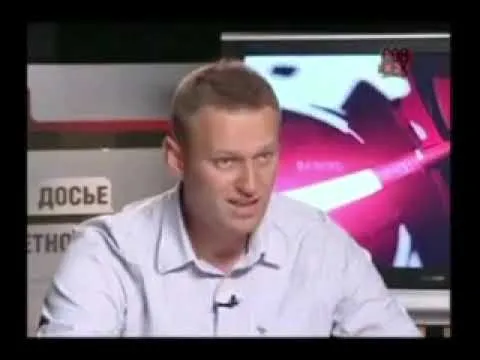
Hello, this is *Our Time* on the air. In the
studio is Stanislav Kucher. Today, without
any long introductions, we’ll be speaking with
Alexei Navalny, a man who, on the one
hand, has already become the virtual mayor
of Moscow, whom some call, well,
a Robin Hood, an anti-corruption fighter, and,
the future president of Russia, the first
president of Russia to emerge from the
virtual sphere. And at the same time, he is also
called a man who is effectively on the payroll
of American—at a minimum, the embassy, and at
maximum, the intelligence services—whose
task is, well, to tear apart
Russia. Those are fairly serious
accusations. They were voiced by
representatives of United Russia (the ruling Russian political party). So
this man is unquestionably one of the
most striking figures in today’s
public and political life of the country.
And, incidentally, a good acquaintance of mine
as well—that’s how it turned out. Welcome,
Alexei.
>> Hello. I seem to have many names. Yes, yes,
so we decided that we’d speak
informally. We even have a few amusing
episodes from
our shared past,
>> a shared television past.
>> A television past, yes, which
will probably have some bearing on
this conversation. Right away, for you, Alexei,
and for our viewers, I’ll say that
since my civic position
is fairly well known, and so that no one can
immediately accuse us of the fact that I’ve
invited you here and now together we’re going to
undermine things, rock the boat of Russian
statehood, I’m going to ask
many of the questions that were sent to me by
people who don’t believe in you,
who, accordingly, are skeptical
about everything you do.
That is, I’ll often be speaking from
the side of those—just imagine that I’ll
sometimes simply be putting on the
gloves, so to speak, of your friends from
United Russia, in quotation marks, right?
>> Wonderful. My task is to convince these
people of something, so please, go ahead.
>> So, to begin with, you have a blog
on LiveJournal, so how many
friends do you currently have there? And what
does that mean? How many people read you, so that
those people who, I repeat, don’t live on the
internet can understand what kind of
audience you’re currently able to influence. For
those who don’t use the internet very often,
what exactly is a blog? A blog
is essentially your own little
personal mass media outlet.
You write whatever you want there. The number of regular
subscribers to my blog right now is about
48,000 people. Regular readers, that is,
unique users who
come by every day in order to
read it, number roughly 100,000 to 150,000 per
day. So it’s a fairly large
audience. Of course, I’m not inclined
to exaggerate my fame or
my ability to influence what’s happening,
but still, it’s quite a lot—it’s
comparable to the circulation of a fairly
large newspaper. I think this is actually
happening not because
I write so wonderfully or
for some other reason people come.
It seems to me that what attracts people is precisely
this format of practical
impact. I don’t just write, “Look,
look, over here something has been
stolen again.” I write about it. I say that
these are the people who stole it, here is the complaint
I’m sending to the prosecutor’s office. I
name this specific person. I
believe he is a criminal. We investigate this
case. Through the blog I gather
experts from completely different fields.
In other words, a blog is a tool
for practical work. That’s why, it seems to
me, many people come and watch,
and they’re even ready to
take part together with me. And, as I already said, we
find experts in all sorts of fields there,
in road construction,
the supply of medical equipment. I
spend quite a lot of time
investigating corruption in public procurement.
The state buys everything imaginable, from
semolina porridge to optical sights.
It’s absolutely impossible to understand
everything. Keeping a staff of experts in
every field is also impossible and expensive.
So the blog is a tool where
any person who wants to make
some personal, perhaps
small contribution to the fight against corruption,
or simply help, can come and
help.
>> There was a scandal involving embezzlement, in
which you accused one of the largest
giants of the Russian economy,
the company Transneft.
What happened? Why did it occur to you
at that time to take up this particular case?
Well, Transneft—I’ll use some
strong language here. They are well-known
crooks, and for quite a while now, for several
years already, I’ve been engaged in—if you can
call it a dialogue—though in fact I’m trying
to bring the management of this company to
criminal responsibility. It all began
back in 2007, when
we discovered that the company Transneft,
which is effectively a monopolist
in the transportation of petroleum products
within the country, is a company with
100 percent state
share capital. I own their
shares, but they are preferred shares only.
100% of the common shares belong to
the state. In other words, it is a state-owned
company that belongs to all of us,
it belongs to you.
>> When did you become a shareholder in this
company?
>> In 2007.
>> Why? Was it simply in order to
investigate its activities, or just
or was it because you thought it was
a good business and I simply wanted to
invest a small part of my
funds. It is a good business, a monopoly,
which
and oil is the main business in our country. They
move that oil back and forth. It is a good
business; it makes sense to invest in it.
After investing, I saw that there were no
profits at all. We started looking into where
the profits were going. It turned out that the company
Transneft, besides
transporting oil, is also
the largest charitable donor in the Russian
Federation, one of the largest in the world. In
2007–2008
they donated
$500 million to charity. Just
think about that: half a billion dollars for
charity. And yet there was no trace of this
>> Well done.
>> there was no trace of this charity
anywhere. I spoke with all the
heads of real
charitable foundations that
treat children and do other such work. I asked,
have you received anything from them at all? No one
had seen anything. So I started legal proceedings and
spent many months in court with them to
force the company to disclose the list of
recipients to whom they had given money
for charity. Paradoxically,
a state-owned company spends
half a billion dollars on
charity. At the same time, they
completely classified all of their
charitable giving. They say, "We will not
tell anyone; we did not give a single
kopeck." That is astonishing. We managed
to identify the only recipient of their
charitable assistance. It was a,
a foundation with a very telling
name: Kremlin-9. As you might guess
from the name, this was not really about
helping children. It was an organization
founded by former employees of the
Federal Protective Service. What purposes
they received this money for is hard
to say. My version, my view,
based on what is happening
in the company and based on their
actual practices, is that
through this supposed charity they were
in fact paying law enforcement
agencies of all kinds. And in exchange for protection, they
cover up the corruption taking place
inside Transneft. And here we come
to my main investigation and,
probably, one of the best-known things
I have done. So, the company
Transneft was carrying out the largest
construction project since the collapse of the
Soviet Union, the so-called
Eastern Siberia–Pacific Ocean oil pipeline,
through which oil from Eastern
Siberia was to be transported to
China. A wonderful project that everyone
supported. It leads to diversification of
oil export routes, so there was no
problem with that. What was suspicious
was that the cost of the pipeline
kept rising constantly. Even now, no one
really knows how much it cost. But the
last officially recorded
figure was about $17 billion, which
is a great deal. Of course, it was built
out there in the taiga, in Siberia, under difficult
conditions and so on, but even taking
that into account, it was an astonishingly high price. And all
the market participants I managed
to speak with while investigating this
case all said in unison: "They stole everything,
looted everything. The corruption is absolutely
staggering." I started looking for documents,
and I managed to uncover a report,
documents that the company itself,
Transneft, had provided to the Accounts Chamber (Russia's state audit body),
when the Accounts Chamber was auditing them. Now
pay attention here, this is important. These are
not the results of my investigation, not
the results of some analysts. Not
some assumptions of mine or my own
calculations, not my estimates. These are the calculations and
documents of the company itself,
Transneft, which it provided
to the Accounts Chamber. They were signed off on by
lawyers, engineers, the first
vice president of Transneft, and so on.
A huge, thick report
describing how they stole, how they
squandered money,
how they laundered money, and so on. So
based on this dry
legal document, it clearly follows
that in the construction of this pipeline
no less than $4 billion was stolen.
Every contractor who
built anything on this gigantic
project of the century, personally overseen by
Vladimir Vladimirovich Putin, who
regularly flew there by helicopter and
signed the pipes so ceremonially,
every contractor was simply
a shell company with nothing
behind it. Just imagine,
right,
a contract to build, say, 1,000 km
of the pipeline in the conditions of Eastern Siberia
goes to a company whose authorized
capital is 10,000 rubles (about $100) and which does not have a single
employee. Is that even possible? In
Russia, it would seem, even at Russia’s
level of corruption, something like that would be impossible, but
it was happening. More than that, a significant
share of the contracts was awarded
to organizations that had simply been
registered using stolen passports.
In other words, these people took the contracts, pocketed
half of the money right away, and then subcontracted
the work out to real companies. And that is how
absolutely everything worked. In other words, all
the prices were inflated several times over.
A portion of it was stolen just through design work alone,
just on the design stage there were
5 billion rubles (about $50 million) stolen. This is stated in black
and white in Transneft’s own
documents. They conducted an internal
audit for the Accounts Chamber (Russia’s state audit office). But when
they finished it all and submitted it to the Accounts
Chamber, these documents should, it would seem,
have caused a huge scandal. There it was, there was
the proof. There were the terrible
crimes. There were the corrupt officials—catch them
red-handed and throw them in jail. But no. What
did the Accounts Chamber do? It classified
all the audit results.
The documents went nowhere. Everything here was kept under
lock and key. No investigations,
no criminal cases. Everything was stopped
after that. Later, when I spoke with
a representative of the law enforcement
agencies, they said: "Yes, documents like that
did come in. They told us, ‘Jail them all,’
but a week later another order came in: ‘Shut it all
down, hand over all the documents.’"
>> All right, but how did you personally get hold of
these documents that point to
the theft? That show these $4 billion
were stolen? After all, you’re
a lawyer, yes, and already somewhat well known,
with experience, but still—you’re not Henry
Reznik (a prominent Russian attorney), not a member of the Public Chamber (a state advisory body),
so how did you get documents that
in theory should have been marked
secret?
>> Well, in a sense, they did carry some kind of
classification. In fact, legally speaking,
they could not actually be classified as secret,
because this is not
a state secret. But they were concealed,
hidden in practice. Exactly. But
you can’t hide an awl in a sack. First of all, dozens of people
took part in this audit,
because everything was being checked by specially
created commissions. That’s the first point.
So this document was in the hands of many people
at Transneft, many people at the Accounts
Chamber, and many people in
law enforcement. So
>> Transneft. Wait a second—Transneft
has no interest in sinking itself.
It’s unlikely they came and
said, "Alexei, now we’re going to
tell you how we were stealing here." Right. And
as far as I know, the Accounts Chamber
received many appeals once this
case became high-profile. And the Accounts
Chamber, let’s put it this way, walked it back. In other
words, it said that things were not at all
the way Navalny was trying to
present them. Not at all. We have
no complaints against Transneft. And the people in
law enforcement whom
you’re referring to now—well, I mean,
who are these people exactly? I mean,
>> Well, look, it’s just that,
>> when you say “Transneft,”
that means a lot of people. There are
people there—the villains—who were taking this money
for themselves. There are people who
knew about it, maybe even took part in the schemes,
but didn’t personally pocket much
from it. Maybe someone didn’t share with
someone else. One way or another, the world is not without
good people. And even at
Transneft there are quite a lot of
people who work there and whom all this
simply infuriates—what is going on.
They see every single day how these
people steal everything and move it all
off to Cyprus and then to Switzerland. And
it is done practically out in the open. Just
imagine it: again, at Transneft there are
a whole lot of seconded officers from
the FSB (Russia’s security service), a whole lot from the MVD (Interior Ministry), and with sums
this enormous, in theory all of it
is being monitored. And so the scale
of the corruption—the day-to-day observation
of this corruption—involved
dozens of people. And among them, of course,
without any doubt, there were those whom
this, frankly speaking, irritated
and who, seeing that there was no
investigation, may have
passed these documents to me. To name
a specific person—someone like,
you know, Stas, this particular person, he
works there—would mean that this
person could possibly be deprived of
their freedom, and more likely even their life
would be put at risk. So I cannot disclose
the specific source.
>> And why haven’t they sued you yet—I mean,
Transneft?
>> That is an excellent, absolutely
excellent question, because
>> despite the fact that the answer is very simple,
it means things are not so simple. And the answer is very
simple: everything I am saying
is true from beginning to end.
In its public
statements, yes, in its rhetoric, Transneft does not
hold back. The head of the company,
Nikolai Tokarev, called me
a village idiot on air on Channel Two.
the channel in its official press releases
there they say that I’m supposedly some kind of
CIA agent. In their response to my statement of claim
filed with the arbitration court, they write
that I studied in America on money from
the U.S. State Department and work for some kind of
offshore funds, and so on. Notice
right away: if they’re saying this, then
that is, roughly speaking, they could simply have
ignored Navalny and said: "There’s no
such person, and that’s that." Yes. But since they
are, accordingly, acknowledging that such a
person exists, calling him
a village idiot and a CIA agent, and at the same time
not suing him, that
is, for me, evidence that
they really do have something to hide
after all.
>> They’re up to their necks in it.
Absolutely. Besides, it’s impossible
to ignore me, because, as
I said, the principle of my work
is that if I report
some fact of corruption, I take
formal steps to bring
those people to justice. So
if I had simply said, published,
look how terribly these people stole $4
billion, well, as usual they would have
ignored it. But I—and, by the way,
I brought in the readers of my blog.
We sent several thousand complaints to
the Presidential Administration,
the Prosecutor General’s Office.
I initiated proceedings in all
the law enforcement agencies that I could
possibly initiate them in. In other words, I
formalized the process. Transneft must,
at the very least, answer these
questions.
>> And what happens? Does it answer these
questions? Is there any response from the Presidential Administration,
the Prosecutor General’s Office, the Interior Ministry,
the FSB (Federal Security Service)?
>> Well, you have to understand: I’m not a utopian, not a
romantic. I understand what kind of system
I exist in. It’s obvious that
Transneft, whose security service employs
a huge number of
those half-retired former
FSB colonels and generals,
and which, as I already said, through its
charitable activities supports a huge
number of former and current
members of the security services, and who,
naturally, if they were able to steal
billions under the total formal oversight
of the security services,
then obviously they were paying something off there.
Well, it would be naive to suppose that after
my complaint, special forces with
helicopters would immediately descend on them and
arrest everyone, though there would be good reason to. So
naturally, they resist, all the
cases fall apart, and they have a fairly
well, there is a fairly
clear strategy for dealing with these
situations, yes; the prosecutor’s office, despite the fact that
I would like to note that both Medvedev
and Putin both spoke publicly,
saying that what’s needed here is an
investigation. So, at the very least,
my first step was to tell as many
people as possible about it.
>> So Medvedev and Putin reacted
to it? They did react, absolutely right,
they reacted publicly and said that
there needed to be an investigation. But then the question becomes
how much control
Medvedev and even Putin actually have
over these people? And to what extent
are these people sitting there not
being asked to
investigate something that is in fact a request to
investigate their own corruption?
All right. Now a bit more about the high-profile cases, and
then I’ll ask a few questions, I don’t
know, of a more personal, human kind,
because you can’t do without those. And the next high-profile
project associated with your
name was RosPil. So, RosPil was
when, uh,
as I understand it, you simply wanted
to formalize, in a way, part of your
work further—that is, bring in people who
would professionally, for pay,
handle the paperwork. Well, now
you can explain what exactly is meant.
But the main, main result
that amazed everyone at the time, at the
moment the RosPil project was announced, was,
of course, that within—again, you can specify
the exact time frame in a moment—uh,
an absolutely record-breaking
amount of money was raised from ordinary people. That is,
people turned out to be willing to donate
their own personal money to fight
corruption. Later, Boris Nemtsov used a similar
approach with his
team in order to raise money
to publish an additional print run of the
book *Putin. Corruption.* And again, this
showed that people are ready to finance
the opposition out of their own pockets. And
in my view, this is simply
a tremendous,
I don’t want to attach any value judgment to it right now,
whether positive or not, but it is an entirely new
step in the development of our
society. A tool has appeared
for the independent financing of civic
movements. Tell us about the RosPil project—what
stage is it at now? How
did the RosPil project come about in the first place? From
the simple understanding that the biggest
buyer of anything in our
country is the state, which, with
our money, buys things, and that
It’s called public procurement. In
a year, the state spends—and all of us together,
as taxpayers, spend on it—
about 5 trillion rubles. And even President Medvedev himself
has openly said in
his speeches that no less than one
trillion out of those five is simply
stolen. Right now in Russia there is
a portal for so-called state procurement, where
every institution, from
a hospital in Ryazan to the FSB (Russia’s Federal Security Service),
posts that it wants to purchase
such-and-such at such-and-such a price. And each of
us, in theory, can go in, check, and
see whether the price is high, low,
and so on. You can find
a huge number of violations there, but my idea
is that it’s not enough just
to find them—you have to try to stop them.
That’s why I proposed that we all together
launch the RosPil project. All together,
well, I simply appealed to
an unlimited circle of people, because
in order to file complaints about these
procurements and get them canceled, you need
to go to court, to the antimonopoly
service, to the prosecutor’s office. So you
wanted to create a team, like
a professional team that would
handle the routine work. Routine work in which
there should be no fewer than
five people working. I’m not,
generally speaking, either rich or poor,
but to finance these people
in addition—at least
six people—I simply don’t have the money. So
I decided on this experiment, which,
of course, at the time seemed very
risky. I suggested that everyone simply
chip in money for it. I
set up a separate account. I said that it
would all be completely transparent. There would be
special people who would have
full access to the account and would fully
monitor all expenses and all
incoming funds. And I set the goal that
the minimum target for the year was to raise 3
million rubles, and the maximum target for the year
was to raise 5 million rubles. Honestly,
I was worried. You make a big announcement,
and then bang—you raise
100,000. What do you do then? It’s unclear. Or
you raise a million, which is a lot, but
still not enough. But in two weeks we
raised 5 million. In other words, we met the annual
maximum target in two weeks, which,
of course, made me very
happy—but also astonished me, because,
as you rightly said, we are seeing,
our civil society move into
a new stage, because people are already
so enraged by this completely
open, brazen corruption that
they’re not even trying to hide anymore,
there’s no “watch my hands” trick—they’re just
stealing in broad daylight because they know
we can’t do anything. And people are
ready to fight this corruption,
not by throwing grenades at government
buildings. Instead, someone simply
decides: “I’ll send him 400 rubles
and let him hire lawyers and sue
these people.” So far we have raised
almost 7 million rubles already.
The average transfer is 400 rubles.
About 15,000 people. 15,000 people
have sent me some small amount
or other. Right now we already have
three people working. We are fairly
careful in selecting people, because I
understand the enormous responsibility,
because if a person paid those 400
rubles, they have every right to ask, “What did you
do with those 400 rubles? How
effectively did we spend them?” And if we
are fighting for efficiency in public
procurement, then at the very least our own
spending absolutely must be
transparent and efficient. So far we’ve
managed that. There haven’t yet been any conflicts
where someone accused us of misusing
funds.
>> No, from the very beginning everything was set up
in such a way that, well, that’s impossible.
Or it would be exposed immediately. And I think that
became one of the reasons
why people do in fact send money.
Because it’s clear that if I were to, I mean,
take the money for myself—yes, tomorrow
I could take those 7 million rubles
for myself, because formally people are giving them
to me as a gift, simply so that we can optimize
the tax side of things.
But if I take even
a single kopeck for myself, a group of
monitors who do not report to me
and who have the password to this account will see it immediately. And
then I’ll be exposed at once
for what I am. And that would be the end of all my wonderful plans.
Exactly. So if I
understand that the stakes are high,
>> What’s more, in Alexei’s blog it was written
rather amusingly that if
one of the monitors—for example, you have
Anton Nosik there, right—were to buy
himself a new Leica camera, then
naturally everyone would immediately understand
what was going on, of course, yes,
>> and practically an antique one at that, yes,
so naturally it would be obvious to everyone
what was happening. So far, though,
no one has managed to catch anyone out. But around the RosPil project
there was, uh, a recent remarkable
scandal connected with reports that the FSB
was collecting information on people who
donated money to the project. Or wasn’t
it? So what was the final story? Or was it actually
not the FSB after all? Some pro-Kremlin
young people.
>> There was a very strange situation that
at first just seemed strange, and then it turned out
that the situation was illegal. And
suddenly, people who had donated
money—who had sent their 400
rubles (about $4), started getting calls from some people who
began asking questions. And from those
questions it was clear that the side
making the calls had access to
all the transaction records, all the financial data, and
so on. I do not have that data,
you understand? People got alarmed and started
calling me to ask, "Where exactly did you
leak our data to, anyway?"
>> So once again, what did this look like?
Out of nowhere, a number belonging to
an ordinary person.
>> You sent me your 400 rubles. Then you
get a call from some woman on your mobile
phone or your home phone?
>> Yes. She calls and says she is from some
nonexistent newspaper. Basically, people
quickly discovered that this nonexistent
newspaper was asking, "So, you
sent money to Navalny. Why? And
did you really send it?"
"And you also sent money somewhere else. And
why was that? Explain." People do not like
questions like that. They are not doing anything
illegal, but at the very least it
means that someone has their
personal data and information about activity
on their accounts." People started coming to me
with questions, thinking that I had
given that information to someone. But under
the terms of how this payment system
works, I myself do not see that kind of
information. I do not even see the surnames of the people
who send me money. When
the number of such complaints, well,
passed a certain threshold, we contacted
Yandex, and Yandex
because we collect money through Yandex
Money, officially
first replied to me, and then officially
commented in the media that yes,
the Federal Security Service (FSB),
had requested documents on everyone who
had transferred money to RosPil (Navalny’s anti-corruption project), and then also
separately requested all transactions for a certain
sample of people, after which, uh, those—those
data ended up in the hands of some
people who, by indirect indications—I
cannot say this with 100% certainty—
appear to be commissars of the Nashi movement (a pro-Kremlin youth movement). And
that raises a whole series of questions.
The first question, of course, the most
important one: why is the FSB, instead of
investigating what we are investigating—how
these people are stealing? We have loads of
proven cases showing that this tender
for 100 million rubles (about $1 million) is completely
corrupt. Okay. Let us suppose
they are investigating that too, that they
are also working on it. Maybe
for some unclear reason, they
for some unclear reason, in order to
conduct operational-search activities
against me and request these
documents, must have had serious
grounds. In theory, one assumes that
they had some grounds, they
requested this information, and then they
passed it on to some third parties,
who most likely are not
employees of the FSB or the MVD (Interior Ministry). And these
third parties, for unclear—for incomprehensible
reasons, were calling donors. So
the situation is extremely strange. Well,
more broadly, it shows that
FSB officers and the police are engaged in
complete nonsense and absurdity, some kind of
political surveillance, instead of
doing what they are actually supposed to do. The
Federal Security Service is
supposed to be dealing with state
security. Instead, it is doing exactly the
opposite. We are the ones dealing with state security,
because
taxpayers, in addition to
paying taxes, also pay me so that I can
hire lawyers, so that we can do the
work that law enforcement
agencies are supposed to do. And on top of that, they
also leak this information to some
Nashi movement people or some other unclear
individuals who go around calling people.
But obviously this was done in order to
>> All right, in your view, what was this?
Why was all of this done?
>> I think that, first of all, it was stupidity,
of course. And second, the goal here
was clearly some kind of political
provocation. Another goal here was
to stop the flow of donations, because
as you quite rightly said,
this experiment that I carried out successfully
was the first of its kind in
modern Russian history. No one had financed
projects of this sort—
semi-political or anti-corruption ones.
Before that, in Russia people raised money, well,
to treat a sick child, which is understandable,
noble, and so on. But when people
raise money simply in order
to go after corrupt officials in
power, that means that tomorrow they may
quite possibly really raise money for
public television, a genuine
public political party.
>> Exactly. They will create a political
party. Well, if we raised, uh, more than
$250,000, yes, in about 2
months, then it is entirely possible that someone
else could raise $2 million in
a year and use that money to build a real
political party in which there will be no
There’s no cash in the shadows there, and there won’t be any
kind of suspicious transactions that
would actually be funded simply by
ordinary people, right? If a million people pay
100 rubles a month, then that’s 100
million rubles a month. That really is enough to
support a strong
political party with regional branches and so
on, and so on. That’s why the authorities
really dislike any projects aimed at raising
money. The way they think, within their whole
mindset, is that if money appears,
it must mean it came from the CIA or the U.S. State Department
or from some fugitive oligarchs or
someone else. But here, in this case,
they have nothing to counter with: here are 15,000 people,
go ahead and check. I’m even glad they
did check. Now they have nothing to say. They’ve
seen that these are real, genuine
15,000 Russian citizens,
who don’t believe them, but instead believe—well,
not even in me, but in the idea that people need to
unite and fight them. I
understand that you’re about to say some fine
words. Those fine words will sound
good, and they’ll be sincere, but
still. Who protects you?
You understand perfectly well that at any
moment, uh, you can be taken out of
this activity in any number of ways.
Well, you see,
>> if you’re stepping on the interests of people this
serious, where there are billions of
rubles and dollars at stake, right, and where on top of that
there are almost certainly also some personal
grievances,
then simply too many people,
too many people’s interests
end up being affected.
>> One of them could turn out to be
a complete thug. Yes,
>> you don’t want to hear platitudes from me.
But other than those fine
words, I have no other explanation, because
that is what protects me, or, let’s say,
what keeps me from being afraid of all this.
My inner conviction that I’m
doing the right thing, and that this is the only
possible thing—the thing I am obliged to do, in
a sense. Who protects me physically
there? No one. Who can protect me from
them? These people are the state—the authorities. They
control everything here: the courts,
the police, the FSB (Russia’s security service), the prosecutor’s office—everything under the sun.
the housing office, the utilities, hot water, cold water,
gas supply, the foreign intelligence service.
Everything. So without any doubt, these
people can do whatever they want to you, to me,
to Ivan Petrov, to Ivan Sidorov—anything
they want.
>> The question is: "Why don’t they?"
>> I don’t know.
>> Have you asked yourself that?
>> I have asked myself that. I just don’t know.
First of all,
um, maybe for some of them, within some kind of
conceptual framework,
those who really want to
check who’s behind me,
by tapping my one and only phone,
looking through my legal casework,
my financial flows, and so on,
can quite easily establish that no one
is behind me, that I don’t have any money
to speak of. And all this activity—well, I
carry it out using what I earn myself,
spending whatever amount I can,
>> in short, that you’re on your own,
>> right? That I’m on my own. And so, within
that way of seeing the world, some of
them, yes, understand that basically
there’s no hidden motive—I’m doing this because I
have to. As for those who really are crooks and
actually thieves and killers, whose
interests I’m stepping on, and who
want to do something—well, I don’t know. So
if you’re asking me, "Why
haven’t you been killed yet?"—the answer to that question
I don’t know, Stas. It’s obvious that
discrediting me is far
more effective than hitting me over the head with a metal bar.
That is, and so
what is the task when it comes to me? Not to
say, "Navalny got hit
over the head with a metal bar, so he must have been right about everything."
But if he himself is a crook and a thief, then
that’s a different matter. Then we can
say that everything he said
was false, because he himself is a crook.
And there are constant attempts here to, I don’t
know, somehow manufacture criminal cases against
me, based on
things that at least
look plausible, but
starting with complete nonsense like this,
when just a couple of days
ago I went to the police and gave
a statement about why the RosPil logo
was supposedly an insult to the state
coat of arms, and so on.
>> All right, let’s talk now about specific, specific
cases. So, uh, let’s start with
the most recent one. This is
the criminal case that has already been opened over,
>> it’s a very strange situation, this business about
insulting the coat of arms.
>> Ah, there was an inquiry based on a letter
from just some person on the internet,
somewhere in Penza, and
a decision was issued refusing
to open a criminal case. They said:
"No crime took place." Then one
of the deputies of the State Duma (the lower house of Russia’s parliament), a member
of United Russia, filed a complaint with the
Prosecutor General. They launched a real
investigation, and even extended it. And as part of
that investigation, I was recently
asked in and shown this thick folder.
documents. In this fat little folder, among other things,
there is, uh,
an expert opinion from some institute
of cultural studies, which says that
it really is desecration. And
the investigator told me that
a criminal case will be opened, in which
I will, well, at the first stage, be treated
as a witness.
A witness to this terrible act of
desecration of the state
coat of arms of the Russian Federation.
>> And how exactly did you desecrate it,
>> Gera? The RosPil logo. I—I didn’t
desecrate anything, and no one else did
either. The point is that
the RosPil logo is, well,
a perhaps ironic, but still
affectionately reimagined version of the state
coat of arms of the Russian Federation. And there our
wonderful little bird, yes, the double-headed
eagle, is holding not a scepter and
orb, but two saws in its claws. That’s
RosPil. And it was made by a person—
an actually unknown person on
the internet. And the website says that
the author of the logo is unknown. But the meaning of all this is
completely obvious. We want
Russia’s coat of arms to be real, that is,
to return to its true meaning.
Because right now, what is displayed on
the RosPil website is the real
coat of arms. It represents state power,
which has a saw in each claw and
uses them to actively carve up, steal,
loot, rip apart all those
petrodollars that
are raining down on us from every direction.
We want Russia’s coat of arms to become
normal in terms of its meaning. But
some figures in the State Duma (the lower house of Russia’s parliament)
seem to think that these two saws,
which the eagle is holding, are
a desecration of the anthem. By the way,
I’d like to draw them onto
various coats of arms of various Russian
agencies, starting with the tax
service, the bailiff service, and all sorts of others—
there’s no shortage of them. Some hold axes,
and the Russian Post has some kind of
crazy thing in its emblem, and so on. None of that
is considered desecration. But our two
saws are.
>> Now, about the criminal case concerning damage caused
to the Kirovles enterprise in the amount of
more than
more than a billion rubles.
>> More than a million. Just over one million.
Yes. Yes, yes.
>> 1,000,000 rubles.
>> It’s just that they keep bringing us new
updates here. I thought, could it really have
gone up even more?
Well, it’s clear that the governor of Kirov Region,
Nikita Belykh, whose unpaid adviser
you were
at the time, said that
the criminal case was based on
the testimony of a single
person, the former director of Kirovles,
Vyacheslav Apolyov—or Opava, right,
Opolev, right,
>> Whoops.
>> That’s quite a mistake. Well, lots of vowels.
And he does not consider it serious or likely to have
any real judicial future, but nevertheless
still, what’s your view—
legally speaking, how could you have stolen
this money? Or is the criminal case not about
how you stole it, but how you
skillfully advised someone else to steal it?
>> This isn’t even about—it isn’t even about
me stealing this money. It’s
called causing damage without
signs of theft.
That’s the allegation.
>> How does that work?
>> I mean, I’m not a lawyer, so
and
>> well, under this article in Russia,
90% of those prosecuted are
train conductors who let fare-dodgers ride.
An inspector comes along and says, “Oh, you’ve got
a fare-dodger here?” The conductor says, “No,
that’s not a fare-dodger, it’s just a person. I didn’t take any money
from him. But since you’re transporting him, and
he could have bought a ticket, then you caused
damage, even though you didn’t steal anything.”
>> Lost profit,
>> something like that. And according to our fantasists
from the Investigative Committee, while I was
an unpaid adviser to the governor of Kirov Region
on a voluntary basis—that is, I was never
a government official—
I gave this enterprise some kind of
bad advice, imposed some sort of business scheme,
as a result of which they
suffered damages of 1,300,000 rubles. Overall,
this enterprise’s losses are 200 million rubles.
So the other 199 million
don’t interest anyone. The only thing that matters is
some invented, supposedly
advice of mine that caused them 1 million rubles
in damage. Besides, this damage—well, the enterprise
itself has to establish it
for itself somehow. How is damage determined? They
say, “We have damages.” The owner of the
enterprise says, “Damages.”
But the owner of the enterprise—the government
of Kirov Region—says, “There are no damages.”
The enterprise says, “There are no damages.” What’s more,
this case has already been dragging on for many
months.
It was investigated at every stage. And at the
stage, at the level of Kirov Region, it
was investigated. An investigator came,
took my statement, and issued
a decision refusing to open
there was no criminal case, nothing at all. It
was overturned, and that ruling was taken to
a higher level, to the level of the
Volga Federal District. The same thing
was investigated and investigated,
and they issued a so-called refusal
order: there was nothing there. That too
was overturned and taken to the very highest
level, to the Investigative Committee.
an investigator for especially important cases.
This is probably a unique case in the
history of the Investigative Committee.
Investigators for especially important cases
were looking into a case involving damages of
1,300,000 rubles (about 1.3 million RUB). And under that kind of statute, too, yes,
they dragged it out there for a long time, also
calling me in to give explanations. And then
a representative of the Investigative Committee,
Mr. Markin, said on television:
"We have opened a criminal case against
Navalny because he, through some kind of
corporate raid, tried to seize
an enterprise."
To this day, I have not received a single document. I
have already gone to court, because, well, if
they say that a criminal case has been opened
against me, then by law they
must immediately give me
the order initiating the case so that
I can exercise my right to a defense. But
as of today, we see nothing
except some statements of theirs
simply on television. Not a single piece of paperwork
exists. This whole case is stitched together with white
thread. It is completely obvious that
they dragged it out and escalated it to the highest
possible level so that it could simply
by political decision
be, uh,
formally opened. And what will happen next?
At this point, no one
knows.
Now I want to move on to two key,
not exactly accusations, but versions,
that exist regarding why
you do what you do
and which are, let's say,
alternative to your own account, to what you
say—that you are doing this
entirely independently, because
you are doing what you must, and come what may,
right. Well, simply because, uh, I, as
a journalist, will now just set aside
my own value judgments.
Whether I believe you or not, I think that is
for whoever needs to decide. Clear enough. So, one
version is that Navalny is
an American project.
An American project. Uh, well, you yourself
have probably read books and newspapers and know
the history of how Americans operate abroad. And
they really do have various
projects. This is not a figment of Soviet
foreign-affairs journalists' imagination, as
I once thought. Still,
you have to give them credit. The Americans.
They really do have think tanks,
institutions that work on
developing long-term, uh, plans for
economic and political expansion in
a number of countries, and they really do
look within those countries for politicians loyal to
their ideas.
Moreover, let me put it this way: as
someone trained in American studies,
a person who has spent a great deal of time in the States,
traveled there, hitchhiked,
crossed the whole country at 19, and has
a lot of friends there, yes—I share many of the values
of those people, and I am not afraid to
say so. I consider them
an outstanding, very strong people. Yes.
Another matter is what I think about their
state policy, their foreign
policy—Iraq and so on. So,
uh, they are a nation of pragmatists,
and idealists, strangely enough, that is,
where idealism, belief in
the ideals of freedom, personal initiative,
and self-reliance, on the one hand,
and on the other hand pragmatism: the fact that
of course they will not miss an extra cent and
will try to spread their ideals
to the whole world, because they sincerely
believe that this is right. So
in principle, when they take some
country where there really is a dictatorship
and where, in their view, everything is bad, and try
to help that country become a democracy, from
their American point of view there is nothing
wrong with that. So they find
a young politician who speaks
English
or is learning English, right? And then
they simply help him in one way or another.
They provide him with a certain
cover through their more
serious people in government
structures. They give him money in some
way. And this practice is widespread;
it exists all over the world. That is a fact. So
tell me: are you
a participant in that policy?
And if not, why not? And finally,
why not?
>> Well, that's a common question I get,
if you boil all of this down briefly: aren't
you an American spy? And
>> those are different things, let me repeat—not necessarily
a spy,
>> but an agent of influence or something else. Well,
you know, our country has a long-standing
tradition of conspiratorial thinking.
Not only ours. In America there are
even more hardcore conspiracy theorists. And I, well,
you know, with people who are convinced that
there are spies everywhere, it is quite hard
to prove anything. So all I can do is simply
say: let’s look at what I actually do
and at who is making these accusations against me.
It’s the usual pattern: we hear
that Navalny is working for
the Americans. When I say, “You stole
a billion,” they tell me, “And you’re
an American spy.” So where does all this
come from? You see, when people have nothing
to say, the loudest and most prominent
people accusing me of working for
the Americans are the very same
people from Transneft. The people who looted
that company, who robbed it from
top to bottom—instead of
explaining to anyone where they spent
the money on “charity,” how they
built this tower, they say, “He’s
an American spy, we’re not going to answer
anything.” And for me, there’s a very simple
way to prove it. I say:
“Let’s look at my work
overall.” More than 90% of my
investigations and information I simply get
from open sources. I take a business
newspaper where, unfortunately, every single
day there’s a description of some scheme
for how a billion was stolen from some company. I
base my work on this completely open
and public information when conducting my
investigations. My organizational
capacity is obvious and visible to everyone. I
have a small team there—
four people. All the methods, mechanisms,
ways of finding information, and so on—
all of it is completely open. These supposed
amazing, as you put it, more
high-ranking handlers or patrons—
well, where are they? And the main question is,
Stas, tell me this: I’m the one
investigating corruption here, and the person
who stole a billion, moved it into a
Swiss bank, laundered it somewhere, and
invested it in real estate in the U.S. or
Israel—which one is more likely to be an American
spy? No, well, you answered that question perfectly
when you had—well,
“duel” is probably too strong a word, but I mean
with Yevgeny Fyodorov, chairman
of the State Duma committee on
entrepreneurship, and on air at Finam
FM, where the idea was
for Fyodorov
to prove that you were wrong in claiming
that United Russia is a party of thieves and
crooks. That conversation basically showed
all of this. By the way, it’s all online.
You can watch how amusing
it looked. It really was a show.
It was real infotainment, but at the
same time, Alexei was genuinely convincing there
when talking about United Russia—
who has how much money abroad,
where their money is, where their children are, and so on and so forth.
Exactly. If we’re looking for
>> an agent, Alexei, that’s not what I mean right now.
Still, I’ll say it again: right now I’m
talking about something slightly different. That is,
as for the guys from United
Russia, especially the ones you
mentioned, there’s nowhere left to put a mark on them—they’re that tainted,
that’s obvious. I mean you specifically—I just
need a simple answer. So, are you
financially connected to the Americans
in any way,
>> Well, of course not. Of course not.
As for
>> trips and meetings at the mansion
of the U.S. ambassador, right nearby
on Spaso House (the U.S. ambassador’s residence in Moscow).
>> Never happened, never happened. There was some kind of reception
hosted by the U.S. ambassador,
people said you were there
>> I was invited once to something. But that
never happened. But first of all, I don’t
see anything wrong with
speaking with the U.S. ambassador.
Next. More than that, I am absolutely
trying to cooperate with
U.S. law enforcement agencies.
Why? Because all our crooks
who steal here also launder money, including
in the United States. In the U.S. there is
legislation under which—well,
first of all, money laundering is a
federal crime, and people can actually
go to prison for it. Second, they have
the Foreign Corrupt Practices Act,
under which, if an
American company is involved in
corruption in Russia, those people can
be prosecuted under U.S. law. That’s exactly what
brought down the company
Daimler, which we already talked about
here, and so on. So when our
crooks set up offshore structures in
the state of Delaware and use those offshore entities
to steal money, and since neither our
police nor our prosecutors are going to investigate it,
I try to make sure all of it
is investigated in the United States. And it
can also be investigated in
the United Kingdom as well, because
our largest companies are
listed on the London Stock Exchange. Since
their criminal activity has this
cross-border, transcontinental
character, I am without any doubt doing
everything possible to involve
law enforcement agencies in other countries.
If we can’t jail them under our laws and with
our crooked police officers, then we’ll
try to have them caught by the FBI or,
I don’t know, some British
law enforcement agency. That’s what needs
to be done, and I will keep doing it.
As for any cooperation
beyond that, it’s quite easy
to verify. Please, let the FSB (Russia’s Federal Security Service)
requested all my transactions there. Let them
let them, let them check and see who
is financing what. And I’ll repeat: the main
question is this: how is it that
our officials, sitting in the State Duma
(the lower house of Russia’s parliament), in the Russian government, all have
dual citizenship,
all own property abroad,
all have bank accounts. And under
the laws of those countries, this is plainly unjustified
enrichment. Any one of them could immediately be
picked up crossing the border. So
the question is: who has been recruited there? I
am absolutely certain that a significant part of
our corrupt, venal elite,
really is just absolutely
an easy target for recruitment. And
a significant part has already been recruited,
because those people could be, tomorrow,
when they travel to London, arrested
for money laundering and put away for many
years. And yet they live quite comfortably,
their children study there, their families
vacation there. And look at the official
asset declarations of our government: there,
half of them have houses in Spain, Cyprus, and so
on.
When I write something online about
commenting on your activities,
comments immediately start coming in, including
from people who
are completely in favor, fully approve — there are many of them.
Then there’s the next one — well, about
the American spy, I already mentioned that,
we seem to have dealt with that. And the next
thesis is: Navalny is a Kremlin project. And
that’s the only reason he is so freely
able to do what he does.
That’s the only reason, obviously. You’re married,
>> right? I have two children.
>> That’s the only reason his wife doesn’t nag him
every day saying, "Stop doing this
already." Because in reality
it’s a Kremlin project. A Medvedev
project, or a project of the elites who
>> The Kremlin told my wife not to nag me
>> or of the elites who, well, something like that, yes,
or of the elites backing Medvedev and
want to push him into the presidency, and so
they are counting on Navalny. That’s why the order has been given
to everyone who needs to hear it: don’t touch him.
And what’s more, there’s one exotic
idea: that the criminal case which
the Investigative Committee has now opened — and in our country
the Investigative Committee now reports
directly to the president, right — so
this too is supposedly an idea cooked up in the Kremlin
with the aim of truly bringing you
to the federal level, because now
after the Investigative
Committee of the Russian Federation announced a
criminal case, that’s it — now it’s impossible
not to notice Navalny. Soon
even the federal TV channels will be forced
simply to talk about it. See how
great that is? Everyone is working for me — both
the Americans and the investigators — Americans too.
They forgot the Americans, yes. That’s all
settled then.
>> I understand perfectly.
>> As a lawyer, I can see the logic — that
there is a logic to it here. Yes,
>> I understand that. There are people who simply
don’t believe that anything happens
for no reason. And all the more so there are people who, in
their lives, have never done anything
for no reason. So when, well, simply
someone starts writing a complaint to the
prosecutor’s office about a crime, then
he can’t possibly be doing it just because
he’s outraged by corruption — so either
someone paid him for it, or someone is
behind it, and so on. It’s impossible
to convince such people otherwise. I
am perfectly fine with people who
are skeptical about my
activities. I’m ready to persuade them. Everything I do
can be checked,
traced, examined under
a microscope. That is, I try in general
to live in such a way, uh, that you could
show me, I don’t know, live on air
all the time. Well, that’s partly for
my own safety too. The fewer secrets
you have, the better. Well, those who think
that there’s some kind of project behind everything,
for them, someone is always
working for someone. He who looks
will always find something. Exactly.
No, but in that sense, in that sense I
do understand you, because I don’t
have anything like your level of popularity online,
but even so, with my fairly short
experience working
on the internet, in blogs, I’ve already had enough accusations, uh, that
there’s money behind it, and that I’m somehow
being secretly funded practically with
American money. So
we are carrying out detailed
and the radio station Kommersant FM, where I
work, and, uh, the fact that I’ve already managed
to be called both a Jew and an anti-Semite, and, well, basically
to be on everyone’s payroll.
>> So then the question arises: Navalny was on
Kuchera’s show? Then why, if he’s
so oppositional, if they’re both so
oppositional, why are they allowed on
television? They’ve been banned, but where do they
get their money? That’s the question that comes up,
Stas, are you more of a Kremlin project or
an American one? You see, from that,
you understand, out of absolutely nothing
a conspiracy theory gets built. Uh-huh.
They said such terrible things about corruption
on television. It can’t have been
for no reason, so someone must have allowed it. And
if someone allowed it, then it all must have had
some purpose, and so on. Ah, well, we didn’t
we will never convince these people.
>> Moving on, moving on. As for
the future, yes, and your political future
in particular,
have various political
forces invited you to join them?
>> Russia, Forward! (a political initiative associated with Dmitry Medvedev),
>> for example, or Right Cause, or PARNAS,
the systemic or non-systemic opposition.
I was a member of the Yabloko political party,
from which I was expelled for promoting
nationalist ideas. After that, I
did not join any political
movements,
well, any structured ones. No,
no one invited me anywhere, asked me to join,
and so on. As for that kind of non-systemic
opposition like PARNAS and the like, I
generally view their
activities positively; I consider them my
allies and sincere people. But
overall, what they are doing
strategically, I consider fairly
meaningless. As systemic poli... I
believe that trying to register
a party now, running to the Ministry of Justice
for a piece of paper—I don't need that. I am engaged in
my own work. More or less,
some people support me. And whether
more people support me or fewer
people support me, I will keep doing what I
do. I think it is effective.
Practical pressure on the authorities—that is what
we need to be doing. As for registering a party,
you are only playing into their hands. That is exactly what
they want. All they want
is to send you through this labyrinth.
Go to notaries, register your
regional branch, collect signatures, take them to
the Ministry of Justice. At the Ministry of Justice, we reject you, then you
go to court, and so on. That is not
political activity.
>> So you do not intend to join PARNAS?
intend to.
>> I do not intend to join any
political parties. Ah, and as for
the question of parties and
whether this is some Kremlin project, pro-Kremlin,
near-Kremlin, and so on—I have never
received, I have not even received such
offers, it seems to me, because
to any reasonably sensible person
my answer would be obvious.
>> All right. But still, do you have any idea of creating,
for example, your own movement,
your own party?
>> We live in the 21st century, in a post-industrial
society. That is the reality in practice.
The question is whether I am going to create
what is called a Leninist-type party,
the kind of thing they came up with in the 19th century,
namely cells. I will collect from everyone
lists, these cells will elect chairmen
and so on. I would be formalizing
and building this little pyramid, and I do not
need that. There are people who
support me now. They exist in practice,
they are there as a matter of fact. So why do you need this
movement? The movement already exists. If
I collect these people's names and
hang the list on the wall in my office,
will that make my work any easier? All right. As I understand it, you
still want to change
the system, uh, of life in this country, the system
of governing this country, the people who
are currently governing our
country, the country we live in, the one in
which your children live, as far as I
understand. They do not live somewhere else,
>> They live in the Maryino district of
Moscow.
>> Right. So, accordingly, you
intend to change this system somehow,
and there are legal ways of changing this
system through, uh, elections.
And there are also
illegal ones,
or semi-legal ones, the Egyptian
option, the Middle Eastern option.
>> Entirely legal. And I believe that what
happened in Egypt and Tunisia was
simply the consequence of what those
authorities had been doing. And I think such a scenario
will play out in Russia, because
all these guys have usurped and
concentrated a colossal amount of
power, which they simply cannot
handle. They have it, but they
cannot do anything with it and are no longer of any
use to anyone. I
believe that the political concept, if
you like, the political concept,
the political strategy, consists in
putting pressure on the authorities
from different directions. My
activity is one of
those directions; what I am doing is
perhaps a narrow one, until
we force them, uh, to open up,
to make the system free enough and give
everyone the opportunity to take part in
elections. And when that happens, when everyone
can participate in elections without the threat
of being removed from the ballot, and so
on, then it will be time to take part
in elections and then form legitimate
government. Sooner or later, that will happen.
Either they will do it themselves, or, as in the
Tunisian scenario, they will be thrown out into the
street and forced to do it. There is no other way
this can develop. Because
right now, every person who wants
to become, say, a deputy in the
Uryupinsk district (a proverbial small Russian backwater), either has to
go bowing to United Russia, or
has to pay someone money. And if
if he is disliked by someone, by the mayor
of his city, that person gives the order
the election commission simply won't
register them, or it removes them from the ballot.
In other words, elections have stopped being
a mechanism that forms
genuinely popular power,
legitimate authority. There are just some
people there—some got in by accident, some
didn't. And there they are, sitting
on the dais, riding around in cars with
flashing lights, calling themselves the authorities. Everyone
else they simply, through
the election commission, shut out. How do you
assess the prospects of the Right Cause party under
Mikhail Prokhorov?
Well, on the one hand, I welcome
the creation of any groups there that
are now going to fight United Russia,
because United Russia is
the very foundation
of usurpation, that kind of monopolist
that provides political cover for all
crimes, including corruption.
So in that sense, it's not a bad thing.
On the other hand, my concern is—I don't
know Prokhorov personally, I don't know how
charismatic a politician he may be, or
whether he can really lead people—but from what I've
seen of businessmen who go into
politics, every single one of them has
ended in what you'd call a fiasco,
right? These business methods,
strong-arm tactics, and so on have never worked in
a political party. Here Prokhorov,
Mikhail, needs to understand clearly that
leading a political party and bringing
it to victory is nothing like
snatching Norilsk Nickel from the state
for next to nothing and then
selling it for a huge profit. Those are
slightly different kinds of work. And here all those
so-called effective management tricks
don't work. Different mechanisms apply. That's
the first point. Second, I'm afraid that United
Russia is simply creating for itself
a sparring partner. Because if we
look at the latest regional elections,
they all ran on the right idea: everyone
against United Russia. United Russia is
the party of crooks and thieves. Vote for anyone
as long as it's against them. United Russia is creating
this kind of bogeyman for itself so it can say:
'Oh, you're against us? Sure, we're bad, but look at
them—that's where the oligarchs are.'
>> Those are the real oligarchs.
>> And that's the alternative to us. It's either them, or us and
Putin. What's the alternative to us? Look:
an oligarch, Courchevel (the French ski resort associated in Russia with luxury scandals), some kind of
scandals, billions, offshore accounts
and houses somewhere abroad. Yes, maybe we
have a couple of wealthy
millionaires on United Russia's list. But
why are you pointing fingers at us? Look, he's got 15
billion. It's unclear how he
made it. So I think that for
United Russia this is more likely, unfortunately,
a gift. Unless Prokhorov
actually decides to play a truly
serious game—if he genuinely
goes into politics in earnest, and not just
push some fake
liberal-market
agenda and talk exclusively about
his rather unpopular initiatives to
change the Labor Code, and so on.
But if he answers the questions
people will ask him: 'What is your attitude toward
Putin? What is your attitude toward corruption?'
'What do you think of Medvedev, who
looks like a fairly helpless
figure? What are you going to do with
all these people?' If he finds the strength in
himself to answer those questions
directly and honestly, instead of playing games and being
like some laboratory rat
scrambling over obstacles and then, after that,
running on a wheel,
but instead tries real independent politics,
then perhaps there may be some prospects. Well,
I wish him luck. Overall I'm skeptical,
but I do wish him luck.
>> Khodorkovsky and Lebedev advised you
to leave the country. Have you heard about that?
>> I have. Didn't it make you think?
Well, you see, for me, leaving
the country would mean that everything I
have done was, first of all, pointless, and that I
never really believed in any of it, and that it has
no future—because you cannot
fight corruption from London.
If you want to fight
corruption here—and most importantly, bring
new people into that fight, which is my
main task—then you have to
share the risks with those people. That's it. Well,
no one will ever—I will never be able to
convince
you here in Moscow to do something
if I'm trying to persuade you over
the phone or on Skype while sitting in London.
>> In your view, is it possible in Russia in the near future
to have a revolution—not in the sense
of people merely taking to the streets, but protest
marches after which the authorities
either undertake reforms or
step down?
But in the most undesirable sense for everyone—
with bloodshed?
>> I think it's possible. I think it is
possible. It's hard to say: it could
happen in a year, or in a month,
or it could happen in five years. But the more
they keep trying to clamp all this
down, the more likely such a
scenario becomes, because in practice
they're not really managing to suppress much. And
it's clear that this government is being held up by, well,
a kind of fiction. It would only take some
single small event to be enough for
for everything there to be turned upside down there
upside down. But the more they dig in their heels and
the more they do so—because for them, power
means entirely practical things.
It means your personal safety,
the safety of your family, your money, your
business associates, their families, and their money. In
other words, for Putin there are specific
people—all these Kovalchuks, the
Rotenberg brothers, Timchenko—who are sitting
in Switzerland. So it is clear that as a result of
changes
of some kind—positive changes, any changes at all—all these
people will, at the very least, lose
the ability to keep making money. That is why
the longer they proceed from the assumption
that “we won’t give it up, and we will
be here like Gaddafi, we will
defend so-called sovereignty with a gun,” while in
practice they are simply defending their Swiss bank accounts,
the more likely such a scenario becomes.
>> What do you think about Khodorkovsky? And
the president, at a recent press conference,
said that Khodorkovsky’s release
poses no threat to Russian society, is not
dangerous for Russian society. What do
you think he meant?
>> I think he—Medvedev—meant
exclusively to maintain his supposedly
liberal image, because
he is supposed to play precisely the role of
the good cop in practice. Well,
he says he is not dangerous, yes, not
dangerous—Khodorkovsky is not dangerous. That is obvious
to absolutely everyone. There is no doubt whatsoever
that Khodorkovsky committed some
economic crimes. Absolutely
certainly. But the first time he was imprisoned
not for that, but for political
reasons. In any case, he has already served 7
years. Khodorkovsky’s second case was
an absolute mockery of common
sense, of the justice system, and so
on. So as things stand now, Khodorkovsky
for everything he did—
and he certainly did commit things—has already paid for it
by serving time. At this point he does not pose, does not have
any real social
danger or threat, and so on. More than that,
there is now testimony that
in the second trial there was
pressure on the court. The court secretary is giving
testimony. If you are the guarantor
of the Constitution, then you should not
just say that Khodorkovsky poses no
danger. Then you should,
forgive me, take steps to ensure that
justice is done. If there is extremely
serious evidence that the
court was pressured, then come on—you are
the guarantor of the Constitution, deal with it. But
Medvedev limits himself to these
sorts of joking little remarks. This
simply shows that he cannot
influence the situation. This paranoid government
regards
Khodorkovsky as its personal enemy,
someone who, once out of prison, will change
the political situation in some way. I
actually doubt that this could
happen, but in any case for them he is
some kind of uncontrollable factor,
>> like a member of the tsar’s family after
the revolution,
>> well, something like that,
>> who could be used as a banner.
>> Yes, yes. Exactly. That is why for
them he is an uncontrollable factor. So
they would rather keep him in prison on completely
What is happening now is
completely illegal and absurd.
>> Last question, Alexei. We are out of airtime,
unfortunately. And
Russia in 2000
in five years. Not exactly a forecast, but
how do you imagine what kind of
country it will be? What will you be doing in five years?
What will Putin be doing in five years? What will
our fellow citizens be doing in five years? What
would be, I don’t know, two main scenarios, or
three, or maybe one?
>> Scenarios?
Well, I’m not a very good political
forecaster, and certainly not a political scientist,
but the way I see the logic of how these
events are developing is this:
Russia will continue to remain
a very rich country. In fact, in terms
of the amount of money that
is coming in, the Soviet Union in its entire
history never had this kind of money. The Russian
Empire did not either. In other words, we are very
rich right now. If we continue
to develop the way we are now, this money will
for the most part continue to be
wasted or stolen, which
may by that time lead to
some kind of revolution, in a harsher or
less harsh form.
The optimal scenario is that
the optimal—though probably still
unlikely—scenario is that as a result of
some event, these two
gentlemen, Putin and Medvedev,
wake up one morning and realize that things cannot
go on like this, that all of this is leading to
disaster for them—perhaps
a personal disaster. And that the threat
to their safety and lives lies more
in the fact that they are holding on to
power. And they begin, well, to share
power in the broad sense of the word. They
start taking what they have piled up for themselves and
returning power to municipalities, to
the regions, restoring some kind of
elections, and finally launching some
basic anti-corruption processes, and
dealing with some of the most odious figures.
obvious crooks start being
jailed, and so on. And in this way, they
would, well, simply give up power gently
and in return receive some kind of
security guarantees for themselves, their families, and
so on. That way, they remain in
history as people who, well, somehow
brought Russia to a different level, rather than
ending up like Ceaușescu
shot by a wall.
>> So you don’t rule out reforms carried out by
Putin and Medvedev under
certain circumstances.
>> I don’t rule it out, but as I said, I
consider this scenario unlikely. And
that’s because, well, apparently they
are afraid of it, and they think that this
is too dangerous for them. Although, it seems to me,
the real danger is something else.
>> And what do you see yourself doing in five years?
>> Right now, I’m not trying to define
what exactly I’ll be doing in five years. I’ll
keep doing what I’m doing until
I achieve some kind of result.
If there is an opportunity to run for
office, I will run.
I will fight for political
positions. I will fight to hold
certain posts through fair competition,
to take on leadership roles.
If there is a system in which I can
compete honestly, I will compete. If there
continues to be this crooked system
of corruption and total control,
then I will fight against that system.
>> Are you a happy person?
>> I’m a happy person in the sense that I
do what I like. My
family supports me. Yes, I think
yes, I’ve been lucky.
>> Thank you. Alexei Navalny was the guest on
the program *Our Time*. Stanislav Kucher
asked the questions. Thank you, Alexei. All the best
to you. Be free.