Alexei Navalny on the program “Topical Issues” on Finam FM
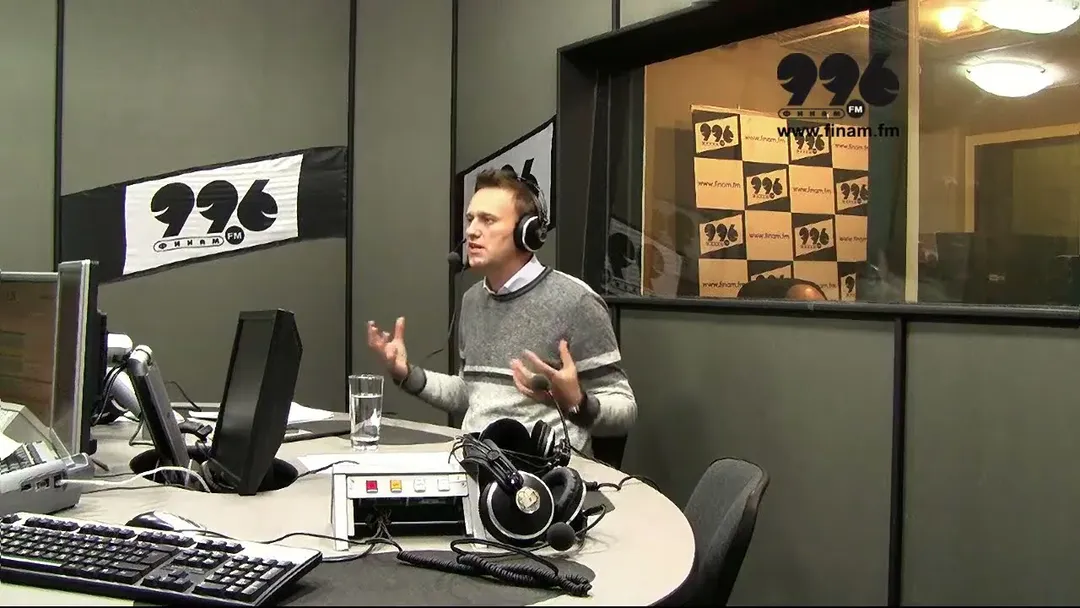
It is 9 p.m. in Moscow. Yury is at the microphone.
Yury Pronko. This is Dry Residue on Finam FM.
Today we were supposed to have a debate, or
rather a nice little tea gathering. With
three people? Yes, three. So, well,
certain changes have taken place. Uh—
the counterpart to my guest today, who
has arrived—I already told you about it on
Twitter, yes, he is here. Those watching
the live web broadcast can see him. Alexei
Navalny. Good evening.
>> Good evening. They probably thought
it was going to be an angry tea party.
>> An angry tea party, yes. So, the point is this.
Well, I wrote about it in
my blog. Uh, you could also see
Alexei Navalny's reaction there, but for those who
haven't read it, we'll hear it now,
that reaction, yes. United Russia's lawyers,
to my great regret,
effectively forbade a deputy of the
Russian State Duma, a member of
the party faction and the General Council of this
political force, from taking part today
in a debate with Alexei
Navalny, explaining it as a direct
ban. Yevgeny
Fyodorov wrote to me about this in a letter he sent,
citing, as it were, the election
campaign in the country. Unofficially,
from what we discussed on the phone,
the answer was as follows: of course,
the conversation would be about Putin.
And accordingly, I can't do it. This is outside
the current legal grounds, outside
the legal framework. When I suggested,
let me make an arrangement with Alexei so that
we don't mention that surname on air. Yes,
I was told: "No, well, how could we not
how could we not mention him?" Yes, that was
what Yevgeny Fyodorov told me. I regret it.
And let me say right away to everyone ready
to tear apart the United Russia deputy now:
he himself was ready to come. Alexei? Ah,
and, by the way, to speak specifically about
Putin with you, but it didn't work out. Now
a brief comment to wrap up this topic.
Alexei Navalny.
>> Ah, well, first of all, I would like to thank
Yevgeny Fyodorov very much. I have no doubt
that he had enough courage to come, and he
would have come this time too. As for
any legal explanations, that's
simply ridiculous, especially given that
today United Russia challenged the
League of Voters to some kind of debate. So
there's apparently no problem there. Evidently, these are
debates where the word "Putin" is forbidden
to be mentioned. So there is absolutely no
legal explanation. That is
perfectly obvious. And it is clear to me that
this fits within an election
strategy that consists in the fact that
all events must be
completely controlled. Notice
that Putin is holding
campaign rallies that are closed off; entry
is by passport, yes, at a factory, in a workshop,
and so on. We are rapidly moving toward
a system described in
wonderful Soviet political jokes about
the bosses coming to a factory.
Yes, there's one where a worker is eating a sandwich with black
caviar, and then admits that all night long he
was gouging the eyes out of sprats. That's
what completely controlled events look like,
completely controlled questions. People stand there
with stiff, frozen faces, holding
placards, and then some person
comes out and says, "We'll go for you
to Moscow and beat up the protesters." This is Alexei
Navalny, founder not only of
RosPil, but also RosVybory. This is what
we're going to talk about right now, because,
as it seems to me, this is a very important
and fundamental point. But let me remind you of
the ways to get in touch. So, uh,
there are a huge number of questions. I
will try today to minimize my own
presence on air and give you as much opportunity as possible
to speak with Alexei.
So, the finam.fm portal is carrying
a live web broadcast, and that is also the address for
your messages. And 65-10-996, Moscow area code 495,
is our multi-line phone number. For now,
please don't call yet, for now just write. Yes,
when, uh, the time comes for calls, I will
announce it separately. Alexei,
RosVybory. What is it?
>> RosVybory is a system in which we recruit people, so to speak.
We campaign so that they
become election observers. We register them,
and assign them
to the polling stations where, in our view,
fraud was committed.
The last election showed
a monstrous level of rigging, and in
the most unexpected places. By the way,
when Putin addresses
the working people of the Urals, he should
remember that, for example, in the city of
Yekaterinburg, where the working people of the
Urals are, United Russia got 25%, while in
the city of Moscow it got 56%. This shows that
in the city of Moscow, well, obviously, by about a factor of two
was roughly added to United
Russia. We will not allow this, or
we will try not to allow it on March 4.
To do this, at every polling station where
the results were anomalous—for example, at one
station it was 25%, and across the street 60%. At
all of these stations we will place two
or three observers each. Well, at the very
least, we will try. Yesterday we launched
this project. Today I can say,
I brought a bit of statistics, uh, around
4,600 people from 500 cities
have registered. The top five
cities are Moscow, St. Petersburg, Yaroslavl,
Tula, and Yekaterinburg.
>> So that's in 24 hours, right, after
the launch?
>> Yes, in the 24 hours after launch. Overall,
we are satisfied. Our
technical benchmark, the target
we have set for ourselves, is
20,000 people: 10,000 in Moscow, where
there were, in absolute terms, yes, by
the number of voters and the number of
polling stations, significant falsifications, and
10,000 across the rest of the country.
Of course, we will try to focus on
cities where, again, there were
anomalies. Ufa, Saransk—yes, the only
city, if you do not count the cities of the Caucasus,
where United Russia got nearly
99%, which is obviously impossible when
in neighboring regions it was getting
25%. The same thing.
>> Are you planning to cover Saratov Region,
>> if people can be found. I mean, we cannot
do it otherwise—we do not have anyone there, and we are not
putting people on buses and shipping in protest-minded
results.
>> If in Saratov Region, I hope,
there is some group of people who
can cover some of the most
high-risk polling stations, we will gladly
help those people coordinate,
we will coordinate them. This project in no
way contradicts other projects.
We have Golos (an independent election-monitoring group), Citizen Observer,
and, naturally, there are party projects,
the Communists, A Just Russia. The Yabloko
project remains, although Yavlinsky has been removed from
the election. And here the issue is
to eliminate duplication, eliminate
any overlap in work, and distribute everything
properly. We will work
on this.
>> Alexei Navalny has a complicated relationship with him.
As I understand it, that is with Grigory
Yavlinsky. Nevertheless, his removal,
how do you see it? Well, this is,
you understand, in this system of rigging and
deception, simply an additional
insult. I have a normal attitude toward
Grigory Yavlinsky. Uh, I do have
some things we could
argue about, but for me it is absolutely
obvious that Grigory Yavlinsky has
the right to run for president, if only
because his party, two months ago,
received 2.5 million votes. But
what else does he have to prove? With that
vote count,
>> with that vote count, what else, and to whom, does
Yavlinsky have to prove anything? It is obvious that he
has the right to run.
>> Mm-hmm. Well then, I suggest we quickly
run through the most frequently
asked questions. Prokhorov.
>> Well, Prokhorov? Uh,
I am not going to speak against Prokhorov.
Whether he is controlled, whether he is a Kremlin man, and
so on—let Prokhorov prove everything
himself. And I welcome the appearance of some
new person on this political
stage, in this political game. Some
of his behavior, well, looks
quite questionable to me, but everything
depends on him. That is, he must
state completely directly, clearly, and unambiguously
his position on the main issues
of the political agenda—personally on
Putin, on the major corruption cases,
on all the Timchenkos and Rotenbergs, and so
on, on Magnitsky, on
Khodorkovsky, on court cases, on
abuse in the judicial system,
and law enforcement agencies. When he
forms his position, when he
says it directly in debates, in his
public appearances, then we will
judge him in real live broadcasts, of course.
And tell me, please,
still, once again, if I may generalize
the questions,
the majority of radio listeners
are asking what to do. That is, in the
previous election—I mean the
parliamentary one—here in this studio you
voiced
a specific
>> vote for any party except United Russia. And
>> what is the specific proposal now?
>> And here too I have a very clear
specific understanding of what needs to be done.
But let me say right away that, of course, the idea
of "Vote for anyone against Putin"
looks weaker and less
convincing than voting for any party
against United Russia. However, I
I urge everyone to treat these elections
as nothing more than a mere formality.
In other words, there is a chief crook, and he
has created a system for himself
of succession to the throne, which he has labeled
"elections." We must achieve real,
genuine, fair elections. So,
the most effective strategy
is to vote against this chief
crook who is taking elections away from us. So,
we have no choice but to embrace
the idea: come to the polls and vote for
anyone but Putin. That will not be a vote
in support of Zyuganov,
Zhirinovsky, Prokhorov, or anyone else. It
will be a vote specifically against Putin. We
must campaign against him,
and that campaign should consist of
simply telling the truth about
him. We must come and vote
against him, and we must serve as
election observers so as not to let them
steal our votes, as happened in
the previous elections.
>> Alexei Navalny, Dry Residue on Finam
FM. Send your questions to finam.fm.
Another topic that concerns everyone.
Some listeners write that what troubles them is
Alexei Navalny's nationalism.
>> Yuri, I've said this on your program a hundred thousand times already.
If something troubles someone, no problem. I'll answer
all the questions.
>> Briefly, just briefly. What is the point, then,
of Alexei Navalny going to
the Russian March, joining its organizing committee, and at the same time
prompting people to ask: "So, are you
a liberal or a nationalist?" And the most
common question, Alexei, is: who exactly is
Mr. Navalny?"
>> Ah, well, that's like the old joke about
the monkey: are you liberals or
nationalists? Do you remember how that
joke ends? Right. "What am I supposed to do,
tear myself in two?" It's the same thing
here. It's a stupid way to frame
the question, because why should a person—any
person, not just me—who simply has
a certain system of views about life,
necessarily have to squeeze himself into
some kind of rigid framework? I'm a liberal, but a right-wing
liberal, or a left-wing liberal, or a
libertarian, or something else. As for
nationalism, there are
specific issues, specific
tensions. Are there problems with migrants?
Yes. We have the world's second-largest
number of illegal migrants
in the world. Is there a problem of ethnically based crime?
Yes. Is there a problem with the Caucasus as a black hole
and an offshore zone, both in the economic and
political sense? Yes. There is. Let's
discuss these issues. Discussing them
does not mean that I must
necessarily label myself a nationalist,
a liberal, a democrat, a right-wing
conservative, or anything else at all. I
simply want to look for answers to these
questions. You're avoiding the answer. So do
you think these "-isms"
only get in the way?
>> They are, well, completely irrelevant; they are not
needed. What for? If we want to discuss
the issue of migration, let's discuss it.
Do we really have to start calling each other
nationalists in order to do that?
>> Mm-hmm.
>> No, not necessarily. I'm discussing it. And as for
the Russian Marches and so on,
people take to the streets—different kinds of people,
some normal, some
crazy, some simply good
people, some actual fascists—
they come out because the problems exist.
There are problems. But Putin tells us
that everything is
wonderful in the Caucasus, while we know that
there is a civil war going on there.
>> I read it, of course.
>> Uh-huh. And?
>> Well, it's a collection of clichés,
bits and pieces from Wikipedia. Just
a set of banalities. First we're told about the crisis of
multiculturalism,
multiculturalism,
and then we're essentially offered the very same thing
all over again, just under some other
vague name. It's this kind of
mishmash, an absolute mishmash, which was
apparently written for him by some, I don't
know, slick journalist or
speechwriter. And honestly, I don't even
understand why he wrote it. Because
as far as I can see, all
commentators, from liberals
to the far right, criticized
this article. And rightly so, basically,
because what exactly did he write
there? It's completely unclear what it's even about. And,
by the way, I'd like to point out
that the remarkable thing is
that with these articles of his,
Putin is dispelling the myth that
the opposition has nothing to offer, while we
do. Because if you read
his articles, they're absolute emptiness.
The man has been in power for 13 years, and his
programmatic articles are simply...
it's just mush and water, basically. And
the platform of any candidate, from Zyuganov
to Prokhorov, Yavlinsky, Zhirinovsky,
is ten times more clear,
more specific. At least there it's clear,
what the person wants. But
Putin is just blah blah blah,
empty chatter. He's not even a promise-maker anymore,
it's just completely about nothing.
>> Alexei Navalny on Finam FM.
The day before, yes. Or a day earlier,
Mr. Kadyrov called you
a chatterbox, though admittedly a very
professionally trained
operative of certain special services.
>> Yes, he called me a chatterbox and even
a coward, because I don't publish
specific names in my investigations and
so on. Well, I explain that by saying
that most likely Mr. Kadyrov doesn't know how
to read, or reads syllable by syllable, judging
by his biography and behavior. That's a fair
assumption, because in absolutely
all the investigations we do,
I always name specific people
whom I believe should be brought
to justice, charged, and put
in the dock. What's more, in the
next couple of days we will publish
an excellent investigation into graft in
Chechnya, because
it shows exactly how state procurement works in Chechnya.
For several months, one of our
staff members worked on a special project where
specific crooks will also be named
who are sitting in Chechnya and who
are skimming off the state budget there. Those
names we will publish. And after that,
it will be up to Mr. Kadyrov. That is,
he's said A, so now let him
say B. We'll give him the names and see
what he does with them.
>> And the new U.S. ambassador to Russia, in an interview
with our colleagues, distanced himself from you. Mr.
McFaul said that
>> Oh my God, it's all over, the client's leaving,
he's pulling out. Yes, somehow he
was a disappointment.
>> Thank God. It would have been much more unpleasant
if he had said that I was their project.
Well, what was he supposed to say? In your view, why
do these
absurd claims keep coming up that you're some kind of
State Department project, or I don't know,
something else? By the way, your counterpart a year
ago accused you of exactly that. Unfortunately,
Yevgeny Fyodorov isn't here,
though a year ago he basically anticipated
everything. He was actually the first person who
shaped this whole pattern of responding
to the opposition, which boils down to very
simple things. I say, "You've stolen everything."
They reply, "You're an American
spy." I say, "Bring
this or that crook to justice. Here's the
document." And they tell me, "Well, I guess
you're a CIA influence agent," and so on. That's their
answer. But what else can they say
in their own defense? I ask them:
"Guys, why does a gas pipeline in Russia
cost three times more than the same one in
Germany? Could it be because it's being built by
crooks, the Rotenbergs, Putin's friends?"
They say, "Navalny came out
against the pipeline, probably on orders from
the Chinese, who don't want Russia to
do whatever blah blah blah," and so
on. There is no actual answer to any of these questions.
Look, on every painful
issue they do one very simple thing.
They do not answer the specific question.
There is a universal explanation: you
are asking these questions because you have been
bought off by anti-Russian forces. What
anti-Russian forces are these, and why are officials
who have already bought up all the elite
real estate in London? According to official
data, Russian officials are the main
buyers of property in London's most exclusive
districts; they have Spanish
passports
and live there, yet somehow they are not
considered influence agents or CIA operatives
who have been recruited. But the opposition is.
Take the fugitive deputy prosecutor of the Moscow
Region, who was caught in Poland with a Lithuanian
passport. The question is: when this man
was obtaining a Lithuanian passport, did he not
perhaps come to the attention of
foreign intelligence services, given that
by virtue of his position as first deputy prosecutor
of the Moscow Region, the country's second most
populous federal subject, he 100%
certainly had access to state secrets.
>> Uh-huh. And what were our FSB and foreign intelligence
services and so on doing when an official
was obtaining citizenship of a foreign
state? For some reason, these questions
do not interest Putin and his brave intelligence officers.
>> You don't have dual citizenship?
>> I do not have dual citizenship.
>> Alexei Navalny, to sum up: do you have
dual citizenship? No. There you have it,
don't doubt it, don't doubt it.
So, uh, there is a live web broadcast going on.
on the website 65199.6.
We’ll connect in 7 minutes, and in the meantime send
your messages to our portal, finam.fm. Alexei,
so, look,
this is a very important point.
So,
there was Bolotnaya (Bolotnaya Square in Moscow).
>> Uh-huh.
>> there was Sakharov Avenue (Prospekt Akademika Sakharova in Moscow).
A rally for February 4 has been announced, but not approved.
The authorities refused today. And at 7 o’clock I
was discussing with people from the organizing committee, which you
are also part of, yes. Mm, there are, generally speaking, different
positions, including ones that could lead to an escalation
of the situation, to a crackdown, if, well,
it is not authorized, and yet
people are still determined to come out
on February 4. And then again on March 4.
Again, I don’t want to turn this now
into political-science chatter. There is a party
of the first round, and there is a party of the second round.
This looks like some kind of setup to me,
dressed up nicely.
But, well, only just—
>> I don’t even understand what’s so nice about this
setup. Let the first round or the second round
produce whatever result he actually
gets, and let there be the round that
really ought to take place. But this kind of
party line, I don’t buy it at all. That is,
it’s a party for rigging things more
or rigging them less.
>> Well, to give a couple of people a chance to come out,
so they can say, look, we have democracy. He didn’t win in the first
round, so it goes to a second round,
but in the second round, of course,
he will win convincingly. They’re even
naming his opponent already, and so on.
No, that’s not the point. I want to understand,
on the one hand there is RosVybory (a civic election-monitoring initiative), yes, you
are trying to put up a barrier with your
colleagues, yes, like-minded people
in this segment, right.
>> On the other hand, there is the magical central
election commission.
>> Uh-huh.
>> They may still be learning, but generally speaking,
they are masters of their craft. So what can
neutralize the situation so that the country does not
slide into legal nihilism, on the one hand,
and, on the other hand, into
repression? Because if
you analyze it again, our
listeners can look at these questions.
There are a great many, uh, questions connected
precisely with this topic: what comes next, right,
people are asking the question, this eternal
Russian question, but most importantly, there are
two extreme positions: chaos and
repression. I don’t know who has such
two extreme positions. So, in order
for the country not to slide anywhere, not in
some direction we do not
like, we need two things: law and
order. And in elections, those who
win should be the ones who actually win the elections.
They should get the seats.
>> So if it’s Putin, then it’s Putin.
>> If it is—if Putin wins, well, then
Putin wins, naturally. And what is so
wrong with that in a fair election, if he
wins? It’s just that fair elections are the kind of thing
where everyone who wants to should,
everyone who wants to and has the right to
run should be able to take part. There’s
Yavlinsky, I don’t know, Nemtsov,
Kasparov, whoever. Everyone who wants to and
can gather some reasonable number of
signatures and has support—they
should take part in these elections.
So, in order for things not to
slide off anywhere, new
parliamentary elections must be announced after a political
reform that gives everyone
who wants to take part in elections
the opportunity to do so. Who will carry out this
reform?
>> And this political reform should,
naturally, be carried out by the existing
officials, the current State Duma,
such as it is, the president,
the prime minister, and so on. But they are
already trying to carry it out. Medvedev
said today that everyone will get
the opportunity to create their own party.
Wonderful. Only now let’s have
political reform, real
political reform without all this
cheating and, in any case, without any
arrangements that would, uh, nullify
the achievements of this political reform. And
in December of this year let’s hold elections to the
State Duma, after which we will announce
presidential elections and hold fair
presidential elections, in which, once again,
I repeat, and maybe people will throw
tomatoes at me, it is entirely possible that
Vladimir Vladimirovich Putin or, say,
Dmitry Anatolyevich Medvedev will win. They do have some
support. Just now, while I was driving,
I was listening on the radio: Levada (the Levada Center, an independent pollster) says Putin has
37% support, which is substantial support. And even
if there is free access to the media, he will
still have, I think, fairly
significant support, and he will be able
to claim a significant role in
politics and possibly even victory.
>> So, in other words, you are counting on
the authorities being reasonable?
>> And I’m counting on the good sense
of the Russian people. I have complete confidence in them
absolutely. Why should those in power matter here? What is
power? It’s just a handful of crooks
who simply seized it,
usurped that power, declared themselves
to be somebody, hung the state emblem above themselves,
and say: "We are the power here."
The source of power is the people. Those
people who gathered, uh, at
Sakharovo (likely referring to Sakharov Avenue in Moscow), who gathered in Nizhny
Tagil at the factory — they are the power,
and they should, uh, turn their different
points of view into votes.
That is what must happen. And I absolutely believe
that we will not let, uh,
these people push us around like this for
however many more years they want. Well,
I don’t know, this lifetime term for
Putin will not become reality. I
don’t think that will happen. I hope it
won’t happen. I will do everything I can
to make sure it does not happen, together with
my colleagues, friends, and everyone
who shares these views. I
hope you are with us. Yury,
just look at the respectable insinuations
that are simply pouring out today from
my guest today. He
has no counterpart here today. So,
as someone wrote today in Live
Journal, Frank will have to speak on behalf of
United Russia. On behalf of all of United Russia.
Nothing of the sort. I will not speak for
that party, Alexei. Many people are waiting for a leader.
It seems to me that this is a dead-end,
really, path. Yes, I want to hear
your opinion specifically because
many people see you precisely as that kind of
leader, let’s say, for a new Russia.
>> Well, listen, first of all,
we do not need any leader. What we need is lawfully
elected government. If the person who
is elected is truly elected
with, I don’t know, 80 percent, 90, seventy-
something, as Putin once was, right? Then
that would be fine — that person would have received
a stronger mandate to govern. But
no leader is needed. As for
my own ambitions and
prospects, I view them rather
critically. Polls, the polls that
are conducted, show that my
name recognition across Russia is 6 percent, and in Moscow
15 percent. So all this talk that I
have some kind of core base of supporters —
well, there are supporters, people who
hold the same beliefs as
I do. They clearly exist. Uh, probably if
I had greater access to the media,
free access, if there were no censorship,
there would probably be more of them. But I have no
such illusions. And I
understand perfectly well that in free
elections everyone will reappear,
show themselves, crawl out, and so on. Again,
there will be plenty of people from the current Putin-era
and United Russia camp who want in.
>> They’re not all going to fly off to the Moon,
>> all of them. And there will be old politicians from
the 1990s, politicians from the 2000s, and
some new politicians who have
appeared completely from scratch.
Prokhorov, for example — they will all be there, they
will run in the elections. They all have
supporters, just as I do, I think. And then
after that it becomes a matter of competition. Whoever
is chosen is chosen. I don’t have this attitude of
“give me everything or
nothing.” Like, “elect me
president or I’ll jump off a cliff.” Well,
whoever gets elected, gets elected.
>> Alexei, nevertheless, in your
intensity one can sense, forgive me, hatred
toward the so-called national leader.
No. Well, it would be strange if it
couldn’t be sensed, because toward the
system created by the national
leader I feel very real
hatred, because this system robs
me, robs my children, and deprives
my people of a future. And of course I
hate this system. It is a
feudal system. It is a system of new
estate-based social order in which
these crooks — some 300 families and their children —
have grabbed everything for themselves. They have latched onto
the country and are sucking out oil, gas,
metals, the nation’s wealth. They invest all of it
abroad. They do not tie
their future to our country. Their children
live there, study there, and so on. And here they feed us
some nonsense
about us being American spies. Though
if anyone are American spies, it is this entire
Putin gang, who were
recruited long ago, at the very moment
they were buying their luxury
real estate in London.
>> Alexei Navalny, in the studio of Finam FM.
Tell me, today Mr. President
said that he is ready to meet, uh,
well, with people like you. Yes, actually, he
said that he would deliberately not go to
such a meeting, but is prepared to consider it.
Will you go to meet Medvedev?
>> I don't understand what it means to be ready
to meet. They keep saying some kind of
strange things. 'Ready to meet.'
The president, then, is a formal
position.
>> So he is supposed to do certain formal
things. People are demanding free
elections from him, Churov's resignation, and so on. I
was—unfortunately, I didn't have the chance
to be at Bolotnaya (the Bolotnaya Square protest in Moscow); I was at Sakharova (Academician Sakharov Avenue in Moscow), and
the resolution was read out there.
Uh, and I support that resolution. It contains
very simple things, very appropriate and
the entirely lawful removal of that Churov
and an investigation into the falsifications, new
elections, the release of political prisoners, and
so on. We have every right to demand
this. And there is no need for any negotiations
or any kind of chatter in order for
Medvedev to fulfill these lawful demands.
He is obliged to do it. As for
some other kind of negotiating
process, Leonid Parfyonov said it
perfectly today.
I have nothing to add. What is being proposed is
a round table between thieves and
those they robbed, on the subject of legitimizing
the theft that has already taken place and discussing
how to improve public perceptions of future
theft. We do not need round tables like that.
I don't understand this format
of these vague, 'let's sit down,'
'talk about something,' where someone will somehow
outmaneuver someone else, bribe someone somewhere, and
once again end up who knows where. And now
Medvedev is already shouting that he's a lawyer and even,
as he calls himself, a scholar in the field of
law. Well then, let him take
the Constitution, look at the legislation,
see what powers he has under that
Constitution, and do what he is obliged
to do under the Constitution and current
law. Nothing else should be demanded of him
and he should not be doing anything
else.
>> And Alexei Navalny is with us today on Finam FM.
What kind of relationship do you have with Belkovsky?
How so?
We have a good relationship. He's surely been
on your show, so you could
judge for yourself—he's a very witty, sparkling person.
Oh, a regular guest. Well then,
>> by the way, he always sits in your seat. Where
you're sitting now.
>> Well, there must be some kind of conspiracy
behind that. Please start calling this
spot 'Navalny-Belkovsky territory'
Out of the majority, out of the huge number
of all our political analysts and so on, I
believe that Belkovsky is
truly a person who has
a sharp political instinct.
That's why I always read him with pleasure. And he is
someone with a wonderful
sense of humor. I always gladly
read him, uh, I'm friends with him. We even
periodically go to each other's birthday
parties.
>> I don't know. Uh-huh.
>> So, you see, Navalny today
you understand, in our world there are limits to
>> hiding things—it's impossible. That's why I
always try to say things exactly as they are.
Because if I say, for example, that I don't know
Belkovsky, there are
a million people who have seen me
cheerfully celebrating his birthday with him.
What's more, in the future it's entirely
possible that if he doesn't invite me,
I'll gladly go to his birthday
party anyway—we go there with my wife and so
on. So what exactly would I be hiding?
There's nothing here to be ashamed of, nothing
to fear. It's great.
>> So honesty is the best policy.
>> But whose project are you? Answer this
question. It's a question I've long
wanted to ask you, right?
Yury, I'm your project. I am a project—I want
to confess, if I may. I want to make
a statement. I am Yury Pronko's project, because
this is not a joke at all, and people should
note that after each of your
broadcasts, where you conduct the conversation in a rather
provocative way,
things like this are born—like 'United
Russia is the party of crooks and thieves.' That was your
doing, by the way. You simply asked how I
felt about the broadcast with Fyodorov, which
was watched by almost
a million people online alone. That was your
invention too. So it must be said that you
are in fact the Professor Moriarty
standing behind the Navalny project. That's
how it is.
>> Thank you, Alexei. There is even applause
from our colleagues behind the glass.
Alexei Navalny today on Finam FM.
From this moment on, ladies and gentlemen, I will fall silent. I
will only greet you and ask you
to introduce yourselves. Then the only
request is: very clearly, briefly,
ask a specific question to Alexei Navalny. And
we'll keep that pace until 10:00 p.m. 65
1099.6 and finam.fm
those are our means of communication. On the portal
there is a live web broadcast. By the way, you wrote,
saying it isn't there. No, it is there. I
have everything here. I open it and see
myself and Alexei. One call, one
message. Good evening.
>> One call, one message. Good evening.
>> Good evening.
>> Please turn off your radio.
Please introduce yourself briefly.
>> One second.
>> No, no, forgive me, but I asked
all of you, we have little time. Yes, let's keep
up the pace of a Viennese waltz. Good evening. What
is your name? Hello.
Hello.
What on earth is going on? Ah, good evening.
>> Good evening, Roman, Moscow.
>> Briefly.
>> Uh, the attitude toward the concept
of Mikhail Khazin and, well, Neakonov—I would like
to hear Navalny's view.
>> The question is clear. I'm afraid I may greatly
disappoint everyone. I'm not familiar with it.
>> Let's move on. Because, once again
I'll stress: time, time, time, time.
So, and for Navalny: can you, and are you prepared to
say what assets the current prime minister
owns, stakes in
companies, shares in businesses, his protégés
and the like, rather than according to the official declaration,
and roughly how much are they worth?
>> Well, everything, everything that we
say about the prime minister must
be based on certain documents. Now,
as for the prime minister specifically,
there are documents connected with the so-
called Putin palace, right? There is
a living, real, actual
witness, Sergei Kolesnikov, who
is now forced to remain abroad. He
has published a large number of
documents, so, uh, there is no need
to make up anything about some kind of
Putin's gigantic fortune. Here
we have a fact, uh, that is fairly
easy to prove: that Putin
and his friends created an offshore
slush fund from which he paid for his
personal projects. Into this
fund, people like Abramovich and all the
others chipped in. These materials are enough
to bring criminal charges against Putin.
criminal liability.
>> Moving on. A call. Good evening.
>> Hello. My name is Nikolai, and I have a
question for Alexei Anatolyevich.
>> Hello.
Alexei Anatolyevich, what do you think:
does such a legislative
initiative make sense as a ban on a parliamentary
majority, that is, limiting any party's representation
in parliament to
50%, and then distributing the remaining
votes according to some proportional
principle?
>> Thank you.
>> Well, Nikolai, I think that this
initiative makes no sense. More than that, it
again contradicts the basic idea that
power belongs to the people. If
someone really gets 60 or
70% of the vote, if people actually voted for them, then they
should get that. It's just that right now, uh,
forgive the idiotic word, but 70
or 60 percent are fake. If someone
gets them for real, why not?
>> Ivan, a student at Gubkin University.
Alexei, why didn't you want
to run for president? Well, first of all,
I didn't even have, to begin with, the
technical ability, because
I was being held in Special Detention Center No. 1,
which does not have sufficient
infrastructure for nominating people for
the presidency. And secondly, Ivan, I want
to remind you of what I said at the beginning of the
program. What is happening is not
a presidential election in the Russian
Federation. Yavlinsky
additionally
demonstrated that what is
happening is this: he had votes in the
election, he has support, and
he collected signatures, and is he participating?
No, because he was not allowed to. In
the election, only those people take part
whom Vladimir Putin put on the list
of people he would like
to compete against.
>> Of course, the very idea of saying someone was
"allowed" is idiotic. Well, that's my brief remark.
Sergei, St. Petersburg. Alexei, do you agree with
the constitutional reform project
of Ryzhkov: a parliamentary-presidential
republic? And, uh,
>> I'm also afraid of disappointing everyone. I can't
say. Which Ryzhkov are we talking about? Which
Ryzhkov do you mean? Vladimir or
Nikolai? Or rather, I'm not ready to comment,
because I'm not familiar with the details. And,
Maxim, a question for the host. Doesn't it disgust you
to listen to this demagoguery? Navalny, like a
broken record, keeps repeating his
clichés. So, if he's my project, then what
is he really droning on about, actually?
>> Me? No, I enjoy it.
>> Listen, here's an interesting thing.
Sometimes journalists come to my
office, uh, well, asking me about things, and
then my employees, who sit at
In the next room, they laugh, they say:
"We can do it instead of you," because
you keep saying the same thing all the time. And
indeed, by now all these phrases
are known by heart. So what is there to talk about?
I talk about what I know. When I
talk about corruption, I talk about
completely specific cases, about
investigations. I have several of them.
Whenever people say to me:
"Why do you call United Russia
the party of crooks and thieves?" I say:
"Because I demand that Mr.
Kostin, a member of the Supreme Council of the
United Russia party and head of VTB, return
the money stolen, including from me."
I have a specific case,
an investigation. I prove that they stole it all.
That is exactly what I talk about. What else?
I'm not going to make things up and talk
about things I know nothing about. I sing about what I know.
A huge number of letters come in.
Alexei Navalny, Finam FM, Summary
65199.6, and FINAM.fm is our means of
communication. I won't find those
letters right now, but I remember the wording.
Alexei, the people of Dagestan are with you.
>> Thank you very much, that's nice to hear. And I absolutely believe
that a large number of
people in Dagestan, in Chechnya, and, I am not afraid
to say it, in Ingushetia, are capable of
distinguishing this husk of nonsense about how
people say Navalny means fascism and that he's a fascist, and
understanding that the root of the problems
happening there is corruption too.
Because this "stop feeding
the Caucasus" means: stop feeding
the brazen, insolent Caucasian elite,
this parasitic gang as well,
which receives federal money and
drives around in SUVs with smirks on their faces past the impoverished
population.
>> Good evening, you're on the air.
>> Hello, Yuri Alexeyevich, good evening.
My name is Dmitry, from the town of Ramenskoye.
>> Hello. Yes, go ahead.
>> I have a question for Alexei. Alexei, uh,
do you understand that now,
the time has come for new candidates,
those very new candidates, unlike,
the Putins, the Mironovs, and
so on, and from you as another
new candidate. And right now, right now,
what is needed is your
program, a clearly structured
program, in order
to present yourself. I'm just very concerned
about you. I believe you are exactly the
candidate who truly deserves
to become our president. And I'm afraid that
this moment may pass if you do not
take advantage of it. In other words, you need to
simply create a clearly
structured program of your own and
make it as
public as possible so that
the maximum number of people in our
country can
>> Yes, I understand. Excuse me, please. Yes,
we're short on time. So, point by point.
As for new candidates and new
politicians, I completely agree with that.
I think the time really has come for
new politicians, new
political approaches, and new people.
Uh, as for the program, well, I
work on certain issues
professionally, and practically every
day. So I already have a published
program in articles, on my blog, and so on,
a fairly clear and understandable one on
corruption, corporate governance,
fighting corruption, especially corruption in
state-owned companies. So
I already have all that. I also have
very clear ideas on
judicial reform and various other issues.
As for some broader
more developed political program,
of course there will be one, but first of all
we must achieve the conditions in which
there is a reason to present a program, namely
free elections. If I
roll out a program now and start taking it
from one radio station to another,
that does not mean I am actually waging
a struggle for power. What we need are elections,
competition in those elections, and then,
of course, a program will be presented and
there will be a substantive discussion. Alexei,
there are lots of questions. Let me summarize now. So,
about Yale, yes, and why the opposition goes into
the U.S. Embassy.
>> So, about Yale—what's the deal with Yale?
Look, Yale is one of the very best
universities in the world. Yale Law
School, I believe,
is the best in the world, and I am very glad that
I got in. By the way, there's one thing
that actually makes it easy for me now
to argue with the authorities about Yale. The
presidential envoy
of the Russian Federation to the
Ural Federal District, I don't remember
his last name, graduated from Yale, uh, School
of Management for two years. I was at Yale for half a year,
while he was there for two years, so he is four times more
of a Yale man than I am. Nevertheless,
no one has any complaints against him.
And I believe it would be wonderful
if people from Russia
had the opportunity to go study at places
like Yale, Harvard, and other top
institutions. And this is simply
an excellent law school. I
am very glad I got there. I learned a lot there.
And, well, this is really a question of
whether it is good to receive a good
education, or whether we should rather get
a bad one. I am trying to get
a good education and am very pleased
that I was at Yale. Those people who,
who think that studying abroad
automatically means that something is
wrong, are crazy.
>> It automatically means recruitment.
>> It automatically means recruitment. They
are crazy. I will give as an example,
a country where there is also a fairly high
level of paranoia—China—which has simply
flooded all the
prestigious higher education institutions
in America with its students. They send 100,000 people a year
and pay for them themselves. That is,
the Chinese state pays for
students to go study at Yale,
Harvard, Stanford, and all the other
places. We alone just sit here doing nothing.
>> That is true. I have another example.
There is the Juilliard School in New York. It is one of the
best music schools. And about 90%
of the student body are Chinese. These are Chinese students,
>> right? Chinese students come there and
absorb that knowledge, then go
back to China and apply that knowledge
in practice. But with us, unfortunately,
the country’s best university, Moscow State University (MSU), is
ranked in the second—well, in the second
hundred. And we still keep somehow
trying manically to prove something to someone,
instead of actually improving
our own higher education institutions, and until
we are finally able to reach
that level, sending our best
students abroad. This is normal
practice. Peter I (Peter the Great) did this, and any
normal country does this now. Unfortunately,
this is not happening in our country.
>> Good evening. You are on the air.
>> Hello.
>> My name is Konstantin.
>> Uh-huh.
>> I’m from Vladimir. Alexei, let us imagine for
a moment that you received unlimited power in the
country. And please tell us,
what would your first decree be?
>> Thank you.
>> Well, first of all, let us not
go there,
>> please note, unlimited power.
>> Right. Yes. And I am thinking, already reflecting
on what I would do. As is well known,
the project destroys its father and master,
so, Yuri, watch out. Let us not
do that.
>> Just look at what is happening today. Yes,
>> I had only just started dreaming about the dividends
I could receive under absolute
power. Absolute power, no less. But we should not
imagine that someone, including
me, has absolute power in the
country, because let us imagine instead
that there will be no such system in which
someone has absolute or some kind of
autocratic, as now, power in the
country. Recently I published—or rather,
Grigory Chkhartishvili, also known as Boris
Akunin, published
our conversation, and we spoke there
about the problems that, I believe,
are more important and less important. I believe
that the main reform that must
take place is judicial reform, because
that is the foundation of everything. There must be a place
where justice is achieved. That is,
there are a huge number of conflicts—
political, economic, whatever kind you
like. A dispute between the opposition and
the authorities, between those wishing to hold
a march and those refusing permission, between
Khodorkovsky and the Federal Penitentiary Service, between Magnitsky
or Magnitsky’s relatives and the police,
all of this must be resolved in an
honest, fair court. Until there is such a court,
we will not be able to carry out either
normal reform, or political reform, or
economic reform. That is the priority.
>> And Andrei, a student, asks: "Will there be
repressions?"
>> What is meant by repressions? Against whom?
Against whom? Alexei, speaking more generally,
again, I asked a short question
deliberately, yes, there have been many such questions
since March 4.
>> I do not think the authorities are capable of
mass repressions. Not because they
do not want to, but because they
are not really even capable of it,
when all is said and done. This system of manual
control cannot do
absolutely anything. That is, one specific
person, or maybe five people—they can
they can jail, crush, kill, whatever,
but they are not capable of any kind of mass repression
because that would actually have to be
organized. They can't—even when they themselves
initiate some kind of anti-corruption
case, they can't put anyone in jail. Take
the beginning of that case again, the one against
the prosecutors who were protecting the mining
business, and where
>> and, and nothing happened. The Prosecutor's Office, before
the eyes of the entire country, before the eyes of
the president, the FSB (Federal Security Service), the international community,
is simply covering for its own prosecutors,
who are implicated in criminal
offenses, in full view of the whole country.
They can't do anything about it. They are not
capable of organizing anything that
requires any kind of complex system of
administration, because this is
a system of manual decision-making.
In order to get anything done at all,
they have to keep calling one another.
Medvedev calls Putin, Putin calls some
Naryshkin, Naryshkin calls some
Ryshkin, and so on. And by the tenth
phone call, nothing works out. And
>> Have you ever gotten a call from the apparatus or from
the presidential administration, even once?
>> Never in my life have I spoken with them. I've never even
seen, face to face, well,
anyone from the presidential administration
and so on.
>> So the line of thinking that the pendulum will swing
the other way—that Navalny is not
a State Department project, but a Kremlin project. So you're
going to disappoint the public there too.
>> Quite a lot—about a year ago
there was a great deal of discussion,
uh, all these Kremlin
propagandists were talking about the evidence
that I was first a project of
Medvedev, then they said I was a project of
Putin, and now apparently
their PR concept has changed, and they
are trying to prove that I am a project of some
Americans.
>> I see. Let's move on. Good evening, you're on
the air. Hello,
>> Hello,
Marina. Please tell us, what do you
think of Mikhail Veller? I think very
highly of Mikhail Veller. He
writes wonderful books, and as
a publicist, and even, I would call him,
a politician. He speaks very convincingly
about important things. I think very highly of him.
>> Short question, short answer. Alexei
Navalny. Bottom line, Finam FM 65
1099.6 and FINAM.fm communication channels.
A great question from Madim. How has
your political activity affected
your family members? Recently on Twitter
you posted a photo of your daughter. Doesn't
your fame get in the way of your family? I
always like questions like that, they're,
you know, warm questions, really.
Not about this disgusting state of affairs
surrounding us, but about the fact that
there is a person, Navalny, yes—a family man, a husband,
a father. How would you answer?
>> I wouldn't say it has
affected them in any special way. It's been fine. My
family supports me. They were
prepared for it.
>> So they really do support you.
>> Absolutely, they really do. I think
it's unlikely I could do what I do
without my family's support. There are
some negative things—there have been more
crazy phone calls in the
middle of the night and so on. That is, of course,
unpleasant. But otherwise
well, when they locked me up—well, "locked up" is
too strong a word—they detained me for those
15 days, some people came up to my
daughter at school and shook her hand. Well, that was
very nice.
>> Then why did you go ahead and
hold that unauthorized march?
Maybe you shouldn't have done it?
>> Yura, how could we not go? You've been
robbed
and these brazen election commission mugs stare at you from
the screen and say everything is fine. And
the president meets with these brazen
faces, and in front of everyone they say, "You are
a real wizard." And they snicker nastily,
knowing that everyone is watching them right now,
and they stole from everyone, and these
millions of people who were robbed sit there unable to do
anything. So yes, we
said that we were protesting against this,
that we would march to the center of the city in order
to, well, at least in this, generally speaking,
not very aggressive way,
express our civic position and
show that we are people and that we
exist. And if you think that we're
invisible here, no, that's not true. So
that's why we went.
>> Did those 15 days make you rethink
any of your values?
Actually, it's an interesting
experience, and really every person
would benefit from serving
15 days in detention in order to start appreciating again
some very simple things, like
socks, for example, yes, the ability
to wash once a day, some kind of boiling water,
yes, it’s an important thing that in
ordinary life you don’t think about, but there
you really need it, and you can’t get it.
can’t.
>> But this isn’t prison. And here, when I was
recognized there as a political prisoner, of course,
it’s a little funny compared with those
people who are actually sitting in prison.
This is not exactly prison. It’s a
special detention center with a fairly lenient
attitude there. And especially when out of
100 places, about 80 of us were
political detainees, and the administration, in
general, well, you can’t say that they
were really picking on us much. Well, it was
an interesting time.
>> But my values didn’t change. Well, well, it seems to me
that, after all, a person
who lays claim to some kind of
political struggle, or in general
claims to be a normal
person with normal, well-established
views on life, something as trivial as 15
days in detention is unlikely to shake his
basic beliefs and
reference points. Good evening.
>> Hello. Good evening. First of all, I wanted
to thank Alexei for what he does.
It’s very necessary, it’s very important.
Second, what do you think,
has the election campaign begun?
for the presidency from the moment
when, so to speak, the reshuffling
of regional administration heads began, in fact
after the well-known party was actually rejected. And
uh, so that it was clear that
those administrations that oversaw the
polling stations where the party, so to speak, failed,
had their heads simply removed,
and now they will be, well, how to put it,
less loyal, I guess.
>> Yes, absolutely right. We see a
situation in which governors are also
being removed if they delivered low results.
There are
we see precedents where commissions
that produced poor results, specifically
precinct-level ones, are being disbanded, merged
and so on. It’s clear that the authorities are now
operating, perhaps, in their usual
rather stupid, inefficient manual-control
mode, but they are still steering things toward
ensuring that the election result is
guaranteed, so that there is no
unpredictability. Putin’s ratings
are falling.
In any case, they are not rising. They already
can’t do anything
to significantly raise
Putin’s rating. Simply because he has been in power for 13
years. And by now it is obvious to everyone
that he puffed himself up,
played the tough guy. He has done
absolutely nothing. Therefore their only
way is to help themselves through some kind of
political technology methods,
by replacing a more loyal or less
loyal governor, throwing out a more decent one
and bringing in someone more hardline. Well
and so on. Pronko, don’t go easy on
Navalny. He didn’t answer the question about
the opposition going to the U.S. Embassy. I
won’t go easy on him, especially since I was told today
that when absolute power comes,
then those who
helped it along, yes, they’ll somehow be dealt with,
>> Yes, so, very briefly:
I don’t understand it; this is all absolutely hysterical
in the State Duma (the lower house of Russia’s parliament), something unbelievable. So,
all these United Russia people go to the embassy
ten times more often. You’ve all simply forgotten,
dear radio listeners, about the time when
Clinton replaced Bush. United Russia had
an entire program about how
United Russia and the Republican Party
were quite close, and so on. Just
go online and look at the news
archives on the internet. They
went in droves to Congress, to the State Department,
made friends there, hugged, kissed. And
there was such friendship with the Americans that, compared with it,
Nemtsov’s visit, or
Chirikova’s, and all the others going to the
American embassy to meet
the ambassador, was just a ridiculous
little event. I don’t see any issue at all.
It’s all completely made up.
>> Good evening, you’re on the air.
Hello.
>> Hello. Good evening.
>> Yes, hello. Please introduce yourself
briefly.
>> Yes,
>> No, there’s no time. Good evening. Hello.
>> I can’t talk right now.
>> Hello.
>> Hello. Yes,
>> Hello, Sergey Moskal speaking. I have
a question. Alexei, there was a case when
your email was hacked. You said that
some of the emails were fake, but
the blogger Politresh, after checking the electronic
digital signature, proved that they were
authentic. How would you comment on
this situation?
>> Thank you. I have a feeling that this
was a journalist calling. That’s my, my, perhaps
mistaken impression. You see, there are these
somehow a large number of
anonymous bloggers who, on a daily
mode, they publish things about me there
sensational investigations there, about all sorts of things,
about how I supposedly committed some enormous
number of various misdeeds
and so on. In other words, my email was hacked,
and some of the messages in that email account were
forged. People who know how
to hack email obviously have
sufficient skills to
forge other things as well. So
I urge everyone to look critically
at what I do, but it seems to me
that my work is fairly transparent. And everything
that happens in modern society,
especially given that here everyone is already
being followed around by a camera from LifeNews (a Russian tabloid TV outlet) or
the NTV channel, can be critically
assessed in terms of any person's real
activity, including corrupt kickback schemes.
Many people, by the way, do criticize us, and we
respond to that criticism, including criticism of
my work on specific
investigations and so on. So
if someone wants to criticize me,
criticize me for something real,
there's no need to make things up.
>> How do you call those aliens who
give money to Navalny? Let me add to
that. So,
>> Is that connection through some prankster or what?
I don't have the phone number
>> Contact with aliens is only through Yuri,
please. No, it's pointless.
Pointless. But the paid smear campaign is underway now,
yes, those well-known pictures,
that were shown by the well-known
smear machine. And it's completely obvious
that, again, these knee-jerk
responses from all those Kremlin
crooks are very standard. That is,
this is what they do when once again they are
accused of being crooks:
they hire a bunch of
dubious paid bloggers who
spend all day churning out posts about me,
spreading various bits of information on
the internet. In doing so, from my point
of view, they only make it worse for themselves. We
remember how for a whole year they actively
fought against the phrase 'United Russia'
'the party of crooks,' and in fact greatly helped
to popularize it.
>> Do you believe Kudrin?
>> What do you mean, do I believe Kudrin? Kudrin exists
for me in different
forms. There's Kudrin the new politician,
who makes various statements. Some
things he says are right. He came to the
rally—good for him. Kudrin, who was
the head at VTB Bank, on the other hand—
that word came up again—for me, I
really don't like that version of him at all. He was
the head of the supervisory board, and he did not
answer my letters, did not attend the
shareholders' meeting, did not investigate, and did not
do what he was supposed to do by virtue of
his position as head of the
supervisory board. He should have
investigated the facts of theft/corruption that
I investigated. I have all the
evidence, and he stayed silent and did nothing.
did nothing.
>> Let's take one more call and then
wrap up. Good evening.
>> No. Good evening. Hello.
>> Hello.
>> Hello. Good evening.
>> Yes, you're on the air. What's your name?
Albert, from Shchyolkovo.
>> Mm-hmm. A question for Alexei,
>> yes,
>> briefly: is there any point in fighting at all, or
not?
>> Albert, I'm honestly upset and disappointed that
you're asking that question. Of course there is.
Uh, we must fight, we must
fight for our rights. We must
fight for what I would even call our
natural rights. How can we possibly
allow these people, who are in fact only a
small bunch, and many of whom
ended up in power more or less by accident,
because Yeltsin (Russia's first president after the Soviet Union) happened to be in that kind of mood,
and so were Voloshin and Tanya
Dyachenko and the rest of them—it's a gang
of crooks. They appointed this Putin, and he
then usurped power there with a small group of friends.
And now we're wondering whether
it's worth fighting? Of course it is. Who are these
people compared to us? There are millions of us
people.
>> Alexei, Nemtsov, Kasparov, and so on.
The more often I hear the name Navalny next to
theirs, the less support I have for Navalny.
Alexei, exercise strict face control
over the people around you. Never place
yourself next to these people. Don't say
'we' about them.
>> This is not the time when we should
—you see, I do have certain
political disagreements or whatever else
with Nemtsov, with Kasparov, and with
anyone else at all, with Yavlinsky and so
on, but what unites me with them is that
together we demand fair, free
elections. So I am not going to
introduce some kind of face control now and
think about whom I should be standing on
stage with. I think about why I am on
that stage and why people have gathered here. I
think about what I want to say to these
people. So I can only speak for myself and
I certainly will not hesitate
to join forces with any people who
are demanding fair, free elections, just as
I am.
>> A huge number of letters have come in with
support and wishes of good luck. Thank you
very much
to everyone listening to our station.
>> Alexei, as we wrap up our latest
conversation,
in your view,
will 2012 be a year of hopes
lost, or a year when we will truly
be able to change something?
>> 2011 was the year of hope, and
2012 is the year in which we
must make every effort
to ensure that these changes happen. That means
we now have the support of the masses,
broad sections of the population support us, and there are
more and more of us. We have already shown our strength. And
most importantly, we are absolutely
right now, and everyone understands that. They
are completely wrong, and everyone understands
that too. Truth and
common sense are on our side.
>> Olga, strength and perseverance to you; Alexei,
you are a hero of our time.
>> Thank you very much.
>> Thank you very much. Alexei Navalny was
with us today on "In the Bottom Line" on Finam FM.
Many thanks to everyone who listened, who
watched, who wrote in, who called. Uh,
so, and finally, some of you
asked me when, after all,
the Navalny debates would take place. No, not
debates, not debates — we had planned a tea-time chat
for today. Navalny and, uh,
that is, Alexei Navalny and Yevgeny
Fyodorov. So,
Mr. Fyodorov wrote to me in a letter
that after March 4 he is ready to come.
I don't know how interested
Alexei will be in meeting after March 4.
>> We'll see what happens after March 4
.
>> Well, in short, if you insist,
we'll hold that kind of tea-time chat, and
maybe we'll find someone else as an
opponent for our guest today.
Thanks again to everyone. News is next.