Alexei Navalny on the program Face to Face. Part 1
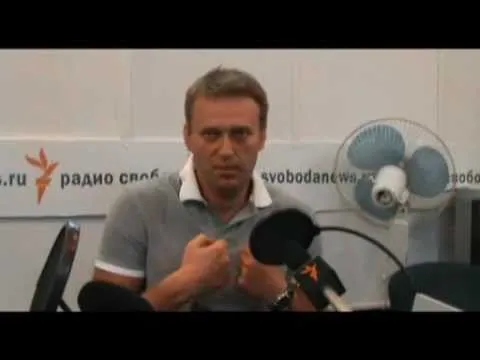
On the air is the program Face to Face at the Microphone.
Danila Galperovich
The guest on this edition of our program
is the well-known blogger and creator of the website
RosPil, Alexei Navalny, and he is being interviewed by
him
Russian journalist Olga Romanova.
Alexei, good afternoon. Good afternoon. Welcome
to the Radio Svoboda studio.
Of course, we will be talking about the latest
developments, namely the confirmation
that a criminal case has been opened
against Alexei Navalny. And also,
naturally, about his RosPil project.
[music]
We will also discuss some real, perhaps practical, ways
to fight corruption, the relationship
with the current authorities, and so on. Please.
Well, freedom is a very important
thing.
And you know better than most that you can lose it
quite soon, and with
a high degree of probability. So tell me, RosPil,
Transneft (Russia's state oil pipeline company), oil,
protocols for minority shareholders—is that more important
than freedom? Freedom is, of course, more important than anything, but
freedom must be for everyone, so there is no point
in engaging in any kind of
activity if you are not demanding freedom
for everyone.
So I do not want to say that I am sitting here
getting some masochistic
pleasure from the fact that there is a threat
that tomorrow I could be thrown into
a pretrial detention center. But any person
who engages in politics in our
country, if he does so sincerely,
understands that such a threat potentially
exists. You simply have to be aware of it and
work with that threat intelligently.
The question has come up historically:
the number of people who, when faced with reasoning like
what you have just expressed, can be counted
on the fingers of one hand, and who choose
action. What is the reason? Why is that?
Why do so few people, let us say, understand that something
has to change and that, yes, of course, they will have to
pay for it? With that awareness—sensible
people—why are there so few
of them?
In principle, I believe all historical
allusions to what happened before are
useful and important, and one should know them. But in
practice they are inapplicable. We live here and
now, in an information-driven
post-industrial society, and so
on. It is pointless to discuss, and I never
analyze why there are so few of these people.
One must try—first of all,
to be one of them, and one must
try to make sure that such people appear. I
hope that, and probably this would be
the most gratifying and important result
of my work—well, an intermediate
result, since I have not finished yet—that
such people are appearing, and I can see that
someone, looking at me—and people from the regions write
to me—and they are conducting their own
small investigations, achieving results,
defending their rights in the town of
Uryupinsk, where in fact this is
often far more dangerous than doing
what I do in Moscow, because no one
writes about you, no one invites you onto
Radio Svoboda. In Uryupinsk, the media do not
write about you. If
you are jailed tomorrow, not a single journalist
will write about it. But such people
are appearing. I can see that, well, some of my
limited actions—I have fairly
modest organizational resources—
are already leading to the emergence of such people. Well,
that is wonderful. That means this is what we need to
do, and not reflect on whether it would be nice
if there were not 15 of them, but 25 or
125. Greg White, please. And the fact that a criminal case has been opened—
can we say that this somehow
either
frightens off supporters, or—what
are you hearing through your networks? Are people getting scared, or is it
having the opposite effect on everyone?
It has energized people. There are subjective things
and objective ones. The objective fact
is that, as far as
the RosPil project is concerned, people have started donating
more money to it. It seems to me
that this is not because
after this criminal case was opened
the main motive for people became the fact that
this simply infuriates and irritates them. They
do not understand what they can do to
help, so they simply send
their 400 rubles (about $13 at the time) simply as a sign
of protest. Mm-hmm.
And even the fact that the FSB (Russia's security service) knows who
is sending how much, where, and when—
shortly before that, the FSB requested data
about RosPil. I am sure that was
illegal, and Yandex disclosed this fact. That
also led to a surge in money
transfers. In this way, people
were showing: yes, to hell with the fact that
you know our names—we are still going to
do this. So I think that, as
usual, all these stupid and clumsy
actions by the authorities, which obviously
demonstrate their corruption,
incompetence, and stupidity, lead
to our ranks growing—the real
front, not the one they are trying to manufacture, but
the real one. By the way, then your...
the attitude toward the initiative launched by Putin
the Popular Front, because of course this is
the very same
phrase, “Popular Front.” I remember
popular fronts in the USSR and Russia, that is,
popular fronts were movements that
at one time helped the Baltic states
gain
independence. And in Moscow there was even a
Moscow Popular Front. We even remember
someone like Sergei Stankevich
who—well, yes. But I’m speaking here, as it were,
about more recent history: even in Russia, in
my lifetime, these fronts have been created
countless times, that is, fronts of national
salvation, all sorts of regional fronts
and so on. So what is your attitude? Why is that?
This is quite obviously a political technology stunt
and, to my surprise, a political technology stunt
of rather low quality. Over the last
several years, after all, the administration
of the president had been doing things somewhat
well, a little more
sophisticatedly. It is perfectly obvious that the brand
of United Russia no longer works. Any
single-mandate candidate running
somewhere in the regions hides his affiliation
with United Russia, because when he
says, “I’m from United Russia,” in most
cases it costs him votes. That
has become the main reason
for this—well, they call it rebranding. I’m not
sure it will work, because
first, they will still run under the
name of United Russia; the ballots will say
United Russia. Second, why did I say
it was low-quality political technology? If we
look at all those people who declared
they were joining the Front, we see all the same
people, just in profile. Yes, Shokhin is a member of the Gen-
eral Council. Who else did they show us? Klintsevich,
he is a member
of the party. Shmakov from the trade unions—well,
he is effectively a member of United Russia. They
signed an agreement with it many years
ago. The only person I noticed there
who is not a member of United Russia and not
affiliated with it is Losakov from the
motorists’ movement, who somehow
ended up there. Well, whether he stays there
forever and ruins his reputation, or maybe
he leaves—but at any rate, we do not see anyone new
there. It is perfectly obvious that they
will say tomorrow that a million
public associations have joined us, but everyone will
know that these public associations are
the usual groups—
Chernobyl veterans, disabled people, Afghan war veterans,
those formal organizations that exist alongside the authorities
and in practice have nothing to do
with Afghan veterans or with
Chernobyl survivors or with disabled people. Olga
Romanova, please. I want to talk about
exactly that—about the authorities. Is Navalny
a Kremlin project? Well, I don’t want to discuss what
trolls write. About something
else: there once was a man named Seredenko
who for many years headed the Moscow
Arbitration Court, the Moscow Arbitration
Court. A few months ago he showed up
on Alexei Navalny’s blog when he was having
coffee with Larisa Kalanda, who is the head
of a department
at Rosneft, the wife of Kalanda, who at one time was responsible for
judicial appointments. Well,
it was an interesting story. And so
during Navalny’s time
in the Moscow Arbitration Court, he mostly
kept losing, losing his cases
against Rosneft and Transneft; somehow
things were not going well. And then in April Anton
Ivanov, the head of the Supreme Arbitration Court,
removes this comrade and sends him
to work in the city of Bryansk, and in his place
appoints some fellow we do not yet know
there. And suddenly I
see
the names from the Moscow
court, as well as Kalanda, and suddenly I see that
immediately after that, at that very moment,
Rosneft—bang, Transneft—and Navalny
suddenly starts winning in the Moscow
Arbitration Court. At that point I think: no, I don’t believe
of course that Navalny is a Kremlin project,
but either I congratulate everyone on the triumph of
justice, or this is a Kremlin
project. Well, first of all, I want to say that
it was not Anton Ivanov who appointed and removed everyone, but
me personally. And before that it was all
thought up by Churchill in 1917.
And it should also be said that all of this happened
because someone was pulling the strings. Yes, pulling the strings.
So I was the puppet master behind it all; everything happened
not by accident. All these
um, court proceedings in arbitration over
the disclosure of information—we pursued them for 3 years, 3
years of continuous losses, but we were weaving
our web. That is, every lost
case gave us some formal
well, certain things, decisions from which it was already
impossible to retreat, and we did everything
In the end, we built the legal strategy
in such a way that we brought all
the cases to a point after which, if
we had lost, then all of it would have gone down the drain
and all of President
Medvedev’s
initiatives to attract investors and so on would have collapsed
Because if the shareholder had lost
Navalny, Rosneft, Transneft, and so
on. This means that
any minority shareholder would not
receive any information at all,
that is absolutely guaranteed by law. Which means
well, no investors could be brought here,
by any means whatsoever.
It seems that the Human Rights Council
under the President of Russia will discuss
your situation in a broad sense, like
how a criminal case is being opened against you, how
the names of your donors
Ravat Vokhma
to what extent a structure like the council
for human rights under the
president can perhaps do anything as
I don't know, an ally, a person there,
or rather a community, a body that is on the same
field. And in general, what do you think, how does
Dmitry
Medvedev view your activities? I think Dmitry Medvedev
views my activities negatively
because I view
Dmitry Medvedev's activities negatively. I am the one who
promotes the theory of the bad and the good
cop. Dmitry Medvedev is the same kind of
bad and corrupt cop
that Vladimir Putin is. This is
completely one
and the same power; they are doing the same thing, the same
crooks, thieves, and from time to time
murderers work for them. So here we should not
in any way fall into this
trap and think
that Medvedev is the good one and Putin is the bad one.
Let's support the good Medvedev
against the bad one.
A large part of our liberal
opposition plays this game with great pleasure,
though not all of it, only part.
But it is a game, and it is absolute self-deception.
As for
the Human Rights Council, on the one hand I am
grateful to the people there
for paying attention to this. On the
other hand, the president's Human Rights Council is, of course, an absolutely fake
structure.
It is needed, and it should not
exist in a normal situation.
Because either cases are resolved in accordance
with the law and written rules—the criminal
procedure, the Criminal Code, and so on—
or they are not resolved at all. With all due
respect to the people, to some of the people
who sit on this council, all their
wonderful statements that they will
take up the Magnitsky case (Sergei Magnitsky, the Russian lawyer who died in custody), that they will
take up the Khodorkovsky case (Mikhail Khodorkovsky, the former oil tycoon and Kremlin critic), I don't know, they have announced many
different cases that they said they would
take up, but so far it has led nowhere. And
this too is
self-deception: they are supposedly doing something
and supposedly resolving
police mistakes, but nothing
happens. Therefore, such a structure should not
exist; it is unnecessary. And the fact that it
does exist shows that there is no law, which means
written rules do not exist. And on a larger
scale, what are you counting on? Do you
think that at some point the authorities
will be forced to open up space for
real critics, for a real
opposition? Or
are you heading toward the fate of other
opposition figures who are either outside
the country or outside
the political field? I do not believe in the power
of the vertical of power, and I see that there is no
such powerful
vertical, and there does not even exist
any particularly powerful systemic
machine of repression. They can jail
specific individuals selectively, but overall they are not even
capable of more or less seriously
repressing the non-systemic opposition
they are completely not in a
position to do that. What is called the
vertical of power is such chaos and disorder
and
a system of reacting to external
stimuli, like Pavlov's dog
sitting there: the light comes on, it
starts barking, and they begin solving some, some
problem.
So there are two possible
ways events can unfold. Overall, I see it like
this: either they do eventually
realize what edge they have come to and
voluntarily delegate power in the
broad sense of the word, namely
share power with the regions,
municipalities, the opposition, with
whoever, because the fact that they have
concentrated all power there in
the Kremlin at the highest level—they have
concentrated it formally, but
they cannot use it; they cannot
carry this burden. So in order
to make things easier for themselves, and in order
to
preserve their physical freedom,
their lives, and so on, they will have to
do it sooner or later. Or, if after all
they keep going to the end, then it will be
some kind of scenario—well, I have said many times
that we are forced to call it
the Tunisian scenario
because there is simply no other
name for it. Olya ironically said here
that you might be a Kremlin project.
And I will go
further: that you might be an absolute PR
project, and especially people who
base their views on your biography say this.
This is what that person did after
receiving an education in economics and law:
he did nothing but
try to get among the people, sometimes even in
the literal sense of the word, and by creating
a movement of the same name. And then to be
popular on the street, and then to derive
certain dividends from that. And all of his
activity in politics, just like his
anti-corruption activity,
is aimed at gaining
recognition and popularity, and through that
money.
Well,
if a person really wants to solve
substantive problems, then public
politics, which takes various forms,
is the only path. You can
deceive yourself as much as you like, join
all these human rights councils,
do small-scale work there, and say,
"I’m not getting into politics. I’m just
dealing with corruption, investigating corruption,"
or, "I’m not getting into politics. I’m working on
the problem of public procurement" — that is deception and a lie.
It cannot be done that way. If you want to solve
the problem of corruption or the problem
of public procurement, you have to engage in
public politics, which means that
you go to the people, that you fight for
the sympathy of those people, that you want
those people to support you so that
you can use that support
for real change. From my point
of view, that is what is called normal
honest public politics. From the point
of view of some crooks, this is PR. Well,
it seems to me that this is a completely
perverted logic. Everything they
do — what they are engaged in — is just
an endless Channel One (Russia’s main state TV channel), where they
show: when they need to talk
about technological development, there they are in
white lab coats; when they need to talk
about industrialization, the white lab coats
come off and blue coveralls go on. That
seems like PR to me. But the fact that I
appeal to people and try to persuade them of something
and ask for their support — that is normal.