Alexei Navalny on the program “Face to Face” Part 2
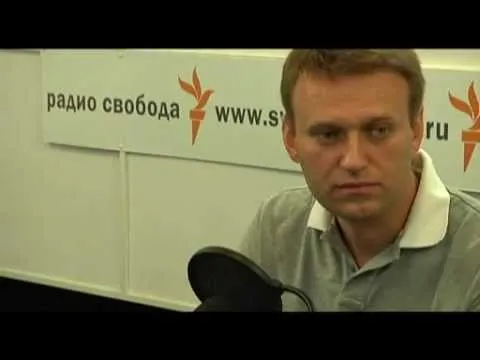
On the air at Radio Svoboda (Radio Liberty) is the program Face to Face,
and our guest is Alexei Navalny, a blogger,
the creator of the online project RosPil, and an active
participant in Russian
public and political life, answering
questions from Gregory White of The Wall Street
Journal and Olga Romanova, a Russian
journalist who writes for several publications at once.
And as I promised at the beginning
of the second part, we will hear the forecast of one
of our colleagues, namely Matvei
Ganapolsky, which he gave to Radio
Svoboda (Radio Liberty) sitting right here in this studio, and
I have to say, when I heard this forecast
— admittedly, I heard it in a recording — I had a bad
feeling. So, soon
Navalny will go to prison. So how will it happen?
It will be very simple. Everyone will shout that this is
impossible, that it's political, and so on.
First there will be an investigation, then he will
be forced to come to court, and then, exactly as in
the spirit of
Khodorkovsky's case, the prosecutor will say that he is
a bandit, a murderer, with his legs ankle-deep in
blood, after which he will have
handcuffs put on him right in the courtroom, because the judge will simply
read out what the prosecutor said. And
after that he will be sent away for about five years. Well,
not five — three years. Why am I saying this?
Because it's clear who is preparing to
be president, and he is not going to
spoil his mood and his years
in office because of this buzzing mosquito
who keeps carrying out all sorts of investigations.
I believe he is doing something very important
for Russia, and that is precisely why I
suggest that he leave Russia
immediately. People need to understand that
in this country only one person is without sin;
everyone else is compromised. All the squeals
and cries — people think, and I among them,
that he is fighting corruption — the authorities
have finally taken notice of this, and
the decision has been made. You understand, they had to
weigh whether to open a criminal case
against a man associated with
the fight against corruption. I understand that this
decision did not come easily to the authorities. I understand
that they calculated everything: the reaction of the West,
so to speak, the cries of human rights activists, and so
on.
But someone said: what, do you want
all this to go on until what year? No,
guys, that won't happen. The case has been set in motion.
I repeat: Navalny will be in prison very
soon. That was Matvei Gonopolsky on
the program of my colleague Elena Rykovtseva,
Press Hour.
So, what is your reaction? Well, if you think
that I am deeply shocked by these words,
for the past three years I have been hearing all this
at weekly intervals. People
either ask, why haven't you gone to prison yet,
or they say, well then, you will go to prison
soon.
As I said at the beginning of the program, this is
a certain inherent risk. Well, not even a risk,
but rather simply a fact of life for anyone
engaged in independent
public or political
activity, especially if they are involved in
investigations. I understood this risk from the very
beginning. And you will not leave? Well,
of course I will not leave, because then
everything loses its meaning, everything I have done
loses its meaning. People will believe you
only if you share with them
these risks. I will never be able to persuade anyone
in Uryupinsk or Bryansk
to do even something similar
if I myself am sitting somewhere and giving clever advice from
London. That does not work. Besides, these
investigations cannot be conducted from there. I
studied in America for half a year; I understand
perfectly well that it is technically impossible.
Every time you file a crime report,
the police call you in
to give explanations, and so on. In other words,
the whole thing would fall apart. And first of all I would
lose people's trust — my main
resource, probably my only resource
that I have.
And besides, most importantly,
I believe we must not be afraid of them, we cannot be.
They should be afraid of us, and they are
far more afraid of us, because, well,
they can imprison anyone. So what
now? And what conclusion follows from that? Shall we
all live under the bed, or else
all move to London, and whoever cannot get to
London will move to Ukraine? Olga Romanova,
please. Idiots. What idiots? These people
seriously think that prison is very
frightening. No, prison is frightening, no question about it,
but there are things far worse than prison,
far worse. Yes, prison is
frightening, but it seems to me much more frightening
to work, if tomorrow you were appointed
an official in, say, some department, I don't know,
the health department responsible for medicines.
To my mind, that is more frightening, simply
more frightening on a human level. Yes, in terms of
your family,
to society,
just how could you look people in the eye? Well, I
do not want to strike a pose here.
thing. It can be a dangerous thing, it
can be something deadly dangerous, as
we saw in the case of Magnitsky (Sergei Magnitsky, the Russian lawyer who died in custody). And
therefore ending up there is undesirable for
any person, but I absolutely agree
that there are things scarier and more important than
prison. Well, that is true for certain people. Here I
would also jump in, because if it were
so obvious, I think the situation in
Russia would be a little different. That is, if
priorities were arranged the way you
set them for yourself. And priorities
will be set that way if there are people who
will set those priorities. Well,
I set them as best I can, and I
am sure that now there will appear many more
people who will inspire others with examples like these.
I do not want to overestimate my own
importance, but if I manage to inspire
even just a couple of people, well then it means
I will not have done it all in vain. Do you suppose
that in increasing the number of these people
the technologies that
exist now, and which you, among other things,
for example, use in organizing the project
RosPil (Navalny's anti-corruption project). Well, without any
doubt. Because right now I do not need
a single kopeck, and I do not need any help
or participation from the state in order to
tell, say, 200,000 people about something
within 5 minutes. I can do that
easily. When I published the documents
from the Transneft investigation, I set
the goal of reaching an audience of 1 million people, and we
reached it fairly quickly, in 2
weeks. Now we can reach, without
spending a single kopeck, an audience of 5 million
people. Time is working for us, the audience
is growing. Modern technical methods
are, after all, technical, but they are very important.
Grek, please. Well, also, what we hear
from the Kremlin is that the blogosphere, well,
fine, it chats among itself, but it in no way
has any influence. The people, these people, do not want
to vote, and it has no effect at all on the broader
political situation. What you are doing
and with this audience, do you feel that there is
broader reach or influence? I believe that
there is definitely influence, and in the Kremlin
they understand that there is influence. Otherwise, if
there were no influence, why would they have
invented their own Front (the All-Russia People's Front)? They could have just gone ahead with
United Russia, and the opinion polls
that say people support
the slogan 'United Russia is the party of crooks and
thieves' are also an indirect, but
confirmation of all this. Besides, it is
fundamentally wrong to think that in order
to achieve some kind of change,
I, or someone else,
sitting in every village, for that
needs television reach. No,
we need to convince 1% of the active population.
All change is made by that 1%; it is with
that group that we need to work. Because if there were
an opportunity to tell every granny
about corruption, I would tell every granny
about it. There is no such opportunity. Well,
then that is that, topic closed, we will keep pushing
through.
Suppose unexpectedly your spirit enters, I do not know,
Medvedev or Putin. Quickly, quickly,
quickly: what would you start with? What would have to be done quickly
first, and then what?
What would you start with, what would you change, right
tomorrow?
If in 5 minutes any kind of
wild spirit enters Medvedev,
he will do absolutely nothing. He will
do exactly the same thing, because
Medvedev is within such
constraints. If in 5 minutes there is a button and I use
that button, then the first thing that needs
to be done is, let us say, to restore meaning
to words. When Medvedev talks a lot
about things—let me explain now—when he
talks about fighting corruption,
then, if the spirit has returned in 5 minutes, I
would actually begin fighting corruption.
That means concrete legal cases. We
would begin, first of all—if you like, call it
a warning to others—we would start jailing those people
who should
be behind bars. That would be done first
of all. Well, in a hypothetical situation
it is strange, yes—a military coup happened,
a spirit entered someone, and so on. If we
are talking about some kind of systemic changes,
about coming to power through elections,
then of course everything should be built differently.
But what Medvedev should do now
if he sincerely wants change, is that he
must jail those who deserve
to be in prison. The consciousness
of people, when they are told
the same thing, they will want
Well, it will be a normal, quite normal
kind of Stalinist thing. It is not about people's consciousness.
I understand the question; it is a well-known theme:
'kill the dragon, become the dragon,' and so on.
It is not about people's consciousness; it is
exclusively about the awareness and political
will of the person who comes in. When
a person comes who will
will jail them, but then after four or
eight years will leave without taking anything for himself and
having refused those enormous resources.
That kind of power—how could that be? That just doesn't happen.
Look, you've jailed a lot of people, and a lot of those people have
acquaintances among deputies,
members of parliament, deputy ministers,
who could literally, within some
period of time, so to speak, organize a conspiracy. And
it would not necessarily be
a conspiracy to overthrow you; it would be a conspiracy
to ensure total paralysis instead.
And so the circle closes: what you need is not unlimited
power, but legitimate power. But
in fact, all of this is possible
to carry out only if you have
substantial support in society.
Putin has de facto
legitimacy, because after all
a fairly large number of people
support him. In practice, he doesn't need
any elections or anything like that,
since there is a sizable number of people
who support him; he has
legitimacy. Reforms and changes like these
can be carried out by a person who
is genuinely supported—whether that's
a dictator, or simply a junta. But we
see, both in recent history and in less
recent history, many examples of times when
people with political support
carried out outstanding reforms, including in
the area of fighting corruption, and everything
went perfectly well. The classic example is
Georgia. Yes, another classic example is
Hong Kong, and so on and so forth. I don't
see why Russia should be somehow
fundamentally different. If you
do what you are supposed to do, according to
the rules, everyone will support you; you will jail them all,
no junta will emerge, and
society will fully support you.
So, do you want to be president?
I am involved in politics in order to
naturally hold political
offices that make it possible to resolve
certain issues, carry out reforms, solve
problems. Naturally, the presidency is one of
those offices. If there were elections in Russia,
I would take part
in them. So yes—that is my answer to the question
asked by Olya, in the way she phrased it: yes.
Yes.