Alexei Navalny on the program "Perekhvat" on Echo of Moscow (a Russian radio station)
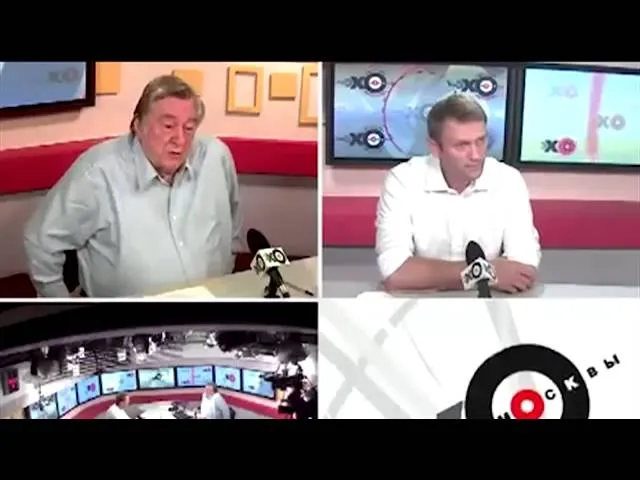
dear
radio listeners, today before you
quite unusually for a host’s role
and my
guest is Alexei Anatolyevich Navalny
who has come to me for this
duel. Good evening. Good
evening. Now, Alexander Gelyevich, in your
constant pre-election lists
you talk about corruption and theft. Your
opponent talks about tunnels,
traffic jams, playgrounds, and both he and you, you both
are, in general, striving for the Moscow throne. You
want to seize Moscow. But Moscow is not just
traffic jams, it is not only
thieving officials. Moscow has always for
Russia been an icon. Moscow for Russia
has always been a mysterious, magnificent
beloved place for which Russian
people laid down their lives. 28
died near
Moscow. Minin and Pozharsky came here
to fight. So tell us, what is
Moscow to you, and why has Moscow today ceased
to be an icon for Russians? Why is it that from Moscow
these dark poisons are pouring out, and all
the rest of Russia is recoiling from Moscow?
I would like to know: you,
seeking to come to City Hall and become Moscow’s
grand prince, how will you restore to
Moscow its mysterious messianic
significance? First of all, I would like
to note that if we now asked the citizens of
Russia what they think of Moscow,
I assure you, we would hear all sorts of
epithets, but certainly not “icon,” and certainly not
some holy place that everyone
is rushing toward. The epithets would not be very flattering. And
my campaign for the post of mayor of Moscow is precisely
a struggle against the idea that someone—
some officials or some people
who claim to be great
statesmen—should treat the post of
mayor of Moscow as a throne. These
people now think they are princes. They
now think they are sitting on some kind of
throne and disposing of Moscow’s immense
wealth. But Moscow’s wealth is
the wealth of all Russia, and they simply use it
at their own discretion. I want to become mayor
of a city that, with the large sums of money
we currently have, will provide
Muscovites with a normal European
quality of life. Moscow is very rich, after all. Unlike
the rest of Russia, the budget of
Moscow is surpassed only by the budgets of New York
and Shanghai. Our average salary in Moscow
is comparable to the income level of residents
of Spain, almost comparable to the income
of residents of Italy. But the quality of life,
you must agree, in Spain and Italy is much,
much higher than in Moscow. Therefore I
will probably, perhaps, disappoint you:
I am not setting myself any metaphysical goals.
I am setting myself
one goal only: to come to the city and
make its wealth work
for Muscovites. Yes, well, and they now
work for Muscovites against all of Russia.
Today, today Russia looks at this
fat
gilded city and its rotten dwellings. I am simply saying
that you are going to Moscow in order
to make life for Muscovites even better, but
that life as such will leave
the rest of Russia’s citizens with their slums and
rotting roads, houses, and dim lightbulbs in
their entryways. Not exactly. What we now
see—something bloated, fat, and
gleaming with gold, as you put it—is
precisely the Moscow budget, but it works
not for Muscovites. Take note:
despite the fact that Moscow attracts
citizens from all over Russia here, and even
citizens from neighboring countries, the quality
of life of Muscovites does not improve because of this.
Muscovites only suffer from the fact that everyone
comes to Moscow. Moscow is very expensive.
It is practically impossible to live in Moscow. Food
is twice as expensive as in any
European country. Clothes are twice
as expensive. Gasoline is expensive. The cost of living in
Moscow is very high. The environment
is dreadful. You were indeed right to say
that there is a bloated budget, but
unfortunately this bloated budget is now
being used in the interests of a certain
group of people. If we look at
the cost of any transport interchange,
it is twice as high. But that is not
a show
of force; it is an indicator that yet another
person sent from the Kremlin to the mayor’s office
will become a billionaire from that interchange and
take that billion off somewhere to Switzerland.
And both Muscovites and the residents of Ryazan, in such
an old Russian melancholy, will
watch this and understand that something
is not right. You did not hear me,
because I was talking about things not
connected with road junctions. It seemed to me that
Moscow is valuable to Russia and to all
humanity because of its unique
Moscow mystery. Fine, I’ll come at you
from another altitude, from
a different angle. You spoke about the billions being taken out of
Moscow. Those billions
are, generally speaking, not being taken out of Moscow; they
are being taken out of Russia. Moscow is a pump,
a terrible vacuum cleaner by means of which
all the valuables extracted in
Russia are siphoned away. Here in Moscow there are these
banks, offices, corporations that
channel every Russian kopeck
earned somewhere in Siberia, in
Norilsk or in the oil fields of Tyumen,
they channel it abroad, invest it
in another civilization. Therefore Moscow itself
In itself, it is, broadly speaking,
the womb from which, in ninety-
one, this terrible, monstrous
oligarchic order emerged, and you will come here
again to repair roads, and you will come
here to slap the hands of thieving officials,
to improve life in Moscow. Why Moscow here?
This, this is Moscow, this is not Moscow. Well,
first of all, this is simply a system of power.
Then one could say that they emerged
in their time from Yekaterinburg in the form of
Yeltsin, then they emerged in the form of
Putin. In fact, the cities have nothing to do with it here.
It is simply that a certain group of people
seized and usurped it.
- This is national rent. It works for
their enrichment. You are absolutely right
when you say that Moscow sucks everything dry,
but in this sense Moscow is
a transit point. Over the last 15
years we have sold $3 trillion worth of oil and gas,
dollars' worth—colossal sums of money. With
comparable sums, Brezhnev built
factories and plants and developed the whole country.
What have we gotten over the last 15 years?
Name for me at least one major
enterprise that was built in
Russia. Therefore, I can probably speak about
some lofty matters only second, tenth, or even twenty-fifth
in line, but right now I would like to talk
this way:
so
about some down-to-earth processes that
need to be put in order in Moscow. If we in Moscow
reduce the level of corruption by at least
25%—which can easily be done, and which I
know exactly how to do—then colossal
wealth will go to Muscovites. Let us suppose
I allow for the possibility that we reduce the level of
corruption. But the system that was
created pumps Russian wealth
abroad even without corruption; it pumps it
out legally as well. That is how this system is built, that is how
the laws are built, that is how
the corporations are built. As you prepare, well, to become the leader
of Moscow, do you want, more broadly, later on—not
at the level of Moscow, of course, but later on,
because your career may continue further and
you may go beyond the Kremlin walls—do you want
to change this damned system,
this terrible damned system that
has shoved us into a black hole? Absolutely
right, that is the main task of my
political activity. I want
Russia's national wealth to work
for the people of Russia. This pump
that you describe so wonderfully
in artistic terms—I observe it
in very concrete terms when I
investigate corruption in all these
Gazproms, Rosnefts, and so on. And these are
completely concrete things. I would not
call it a system. It is simply, well,
a fairly primitive, crude financial
scheme. You know that our main
trader of Russian oil is a friend
of Vladimir Putin, Gennady Timchenko. He
even gave up his Russian
citizenship; he is a citizen of Finland,
living in Switzerland, and through his
Swiss offshore company he sells
most of Russia's oil, and now
he is also building the metro and roads in Moscow.
This is not a system; it is three specific
people who said: come on, you
take over all the oil, and we will
sell all the oil through your company; you will
become a billionaire from this. And he did become
a billionaire. So what is there to say about a system?
No one agrees with this; 99% of Russia's residents
simply do not agree with it, and I
am building my political
activity around how to transform it—not by cutting off heads,
not by pushing people away from this feeding trough, not by staging
a revolution. We are talking about changing, I repeat,
the system, about changing the gigantic
complex of relationships that has taken shape since
ninety-one in Russia. We are talking about replacing
the elites. How do you change elites, and through what? My
answer is: through the concentration
of will that now exists among the citizens of
Russia, who have understood everything that
is happening. We must concentrate this political
will and express it, including
at the elections on the eighth. Good.
Political will is wonderful; moreover,
there is no point in engaging in politics without political will.
You are entering
politics, you are entering politics sharply, you
are entering politics like
a battering ram there, steel-like—
I am going like a soft little cat. No, no, there is no iron here. I
am talking about completely normal, obvious
things. I speak to young people, to
businessmen, to pensioners. These are
very simple things. Why do we need
a
battering ram? It is wrong to sell citizens'
oil through an offshore company; oil
and gas should work for the citizens of Russia.
Everyone agrees with this. The task is not even
to break down any wall. The task is simply
to gather, now at the elections in Moscow, 2
million people who will come to vote and
say: that's it, we do not want this anymore. We do not
want any Moscow road
to cost three times more than in Europe. We do not
want this. Stop.
Ale
That is naive, because they gathered
I don't know, a million Muscovites in the ninetieth year and said: We
do not want to live like this. And after they
said, We do not want to live like this, there appeared
Timchenko, or somewhere there in
Solidarity they came, they broke
the Russian backbone. And after that there arose
an unhappy, dispossessed country, deprived of
prospects strategically, unfortunately.
It so happened that they came out in those years.
They were told that they wanted to get out, but they were...
deceived — they were deceived by people
who made promises and lied. Try...
Try not to deceive Muscovites once again.
Explain this: if you are going into power, then surely
you are not going into power simply
to win. You are going into power, apparently, with
some greater purpose. I want to change
life for the better. I want to remain the same
person who lives the same
life, with the same family, the same
way of life, and who is capable of
demonstrating to everyone that power is not
necessarily enrichment, that power is not
working for yourself and your own interests, because power
— if you mean power — is
the concentrated will of the people, who
through power realize their historical
path. You have a major project; you are going
into power in order to transform
Russia, to move it from
one civilizational level to another, or are you
going in order to seize power
because in your speeches, which
really do great damage
to the authorities — they wound the authorities painfully — but I
still do not see the breath of great concepts,
great projects. A Russian, a Russian
president, a Russian tsar — without this
great project he is nothing. Alexandr
Andreyevich, you are a writer and a poet, so
probably, if one takes you as a target, as
history, as your target
audience — probably I have not yet found the right
words that would inspire you
sufficiently. However, I believe
that the simple idea that national wealth
should not belong to a narrow group of people but
should belong to everyone and work for everyone — this is
exactly what
will pull Russia to a new, including
civilizational, level, because what is
happening to us now? We really have
become a raw-material appendage; we are
ruled by some strange, accidental leaders
who
are looting and taking things off somewhere to Switzerland. We
are not really any kind of civilization at all; we are simply
a failed state. Are you a communist, then?
Because after all, it was precisely in Soviet times that all
wealth belonged to everyone, to the state;
it was concentrated in the hands of a powerful,
strong, centralized state and
directed into development, into education, into
universities, into rockets, into defense. Do you
adhere to that grand project? And
I believe there should be other systems
of distribution. Socialism and communism
did not work, and that economic system
that existed in the Soviet Union led
to the fact that yes, we had rockets, yes, we
had factories, but for the most part we had
an impoverished population. I spent my whole life living in
military towns. Excuse me, I remember
how I stood for hours in line for milk.
My mother, an officer’s wife, at five in the morning
would get in line for meat, so that
is not an ideal for me. However,
I see that now we are much poorer than
we ought to be living. Russia is very rich, and if
even returning to those times, back then
at least we had a gigantic army
that we were feeding; back then at least there were
enterprises in countries of socialist
orientation that we were feeding with those same
petrodollars, whereas now we have
nothing at all. Everything that you and I have,
everything that 140 million citizens of the country have, is
simply the data on the number of billionaires. In
2000 there were six of them, and now
there are 131, and then they tell us: dear citizens,
Navalny and Prokhanov, be satisfied with the fact that
Russia has many dollar billionaires. I
am not prepared to be satisfied with that either.
I am not a propagandist, just as I do not want to
propagandize you. We are talking about an election
campaign; every voter matters to me. I
understand, but Moscow... you will go... come on...
a new dialogue will change approaches, wishes, for
this. Please try, for now, not
very successfully.
the common good for all — that is a concept. Now
look, Alexandr, this is very, this is really
a very clear concept, listen.
This is an absolutely clear concept for me.
For me these are both philosophical and conceptual things.
If I know that in Moscow public procurement
150 billion rubles are stolen every year — 30,000
for each Muscovite — then for me the concept is
to return this money to Muscovites; for me
that is the point. I know that this will improve life. I
know that this works for the good
of Russian civilization, if we
restore order. Law and order is
very much a concept. Now, if I were
in your place, and you were Prokhanov, I would
try to answer my question in this way:
yes, I believe that
the national wealth is being plundered. Yes,
I believe that this immense wealth
could be directed into
development. Today’s Russia is not
developing; it is standing still. I am offering you
a development project, a mobilization project. I
propose directing all these resources
into defense, into
the conditions of growing military threats, into
universities, because knowledge
is collapsing. I
propose demonstrating a concept
of a common cause that will unite all
Russians, Jews, Tatars, Tajiks into one
huge society under construction.
I have read a great deal of literature
on this subject, and I am absolutely convinced that
yes, we must invest national
wealth, but first and foremost not in
Defense—we absolutely must invest in it.
But investing in building institutions
—for example, investing now in the judicial
system in Russia—is 100 times more important, 100
times more beneficial from every point of view, than
any defense spending or any nanotechnology.
The judicial system, the political system—
these are the things on which the country will stand.
It will stand for 300 years if we
properly establish jury trials,
if in Moscow I manage to secure the election of
justices of the peace, that will be simply
a tremendous pillar that will become one
of the foundations of Russian civilization. These are
the things I believe in. As for the idea that I should
churn out 300,000 tanks right now, 300—
churn out even one modern one—look,
America has everything you are talking about, and
America has a gigantic national debt.
Here is the important thing, the most important thing.
The key point, perhaps, in our dispute: I
maintain that it is impossible to build a
modern tank until we defeat
corruption. We have now allocated for defense
20 trillion rubles for several years.
That money will be stolen, and you and I know it, and the whole
country knows that money will be stolen or
simply squandered.
Corruption—first we must make sure
that military institutes, design
institutes, are not rented out
by their directors, but actually work, and
then we will build a tank. But a tank—
you cannot just say, “Let’s build
one.” It is pointless to defeat corruption and
take money away from these thieves if that
money will serve to create a
hedonistic way of life, as if you were talking
about development. That money must be
directed toward development. What is
development? You see, development means
people should live better. It is not
necessarily some kind of hedonism. If I
want finally to sort out the housing and utilities system
(ZhKKh—public housing and коммунal services), which affects everyone every day,
you understand, no less than any tank. We have
nearly 20% of households that still
carry water—excuse me—not with a shoulder yoke, but in
buckets; 17% of households have no sewage system.
That is what we need to be doing. And I want
that money to be invested, among
other things, in this, so that people gain
additional time—perhaps so that
they can design your tank.
Right now he cannot design a tank;
he has no sewage system. I assure
you, and I believe that sewage and
tank construction are very closely
connected. Fine, when I become
president of Russia, I will make you
minister for housing and utilities, because—
damn.
I will not join you, because if you do not
believe that Russia needs institutions,
that it needs a fight against corruption, needs
a judicial system, needs normal
political will, then we will never fix housing and utilities,
and the money you allocate
for housing and utilities will be stolen too, unfortunately. So when
I become president, my minister, my
minister for housing and utilities, will carefully study your
campaign speeches and will act according
to your model. Fine, I will have a different
minister. Fine. You have spoken several times
about Russian civilization.
Yes, these are, generally speaking, well, rather precious
references, and many people present you
as a Russian nationalist, or at least
as a Russian patriot, and for me
this is very important, because I believe that
the Russian factor in Russia today is
no less significant than the factor of the degradation of all
institutions.
Whom do you consider yourself to be, and
what does Russianness mean to you? A Russian—
what is that? Someone who lives at the level of
European standards? A Russian is someone
who has a warm water closet? A Russian—
is that someone who has a kosovorotka (traditional Russian shirt) from Arkhangelsk?
For me it is all simpler, much
simpler. For me, a Russian is
a matter of self-identification.
A Russian is a person who speaks
Russian, considers Russian
their native language, and considers themselves Russian. For
me, that makes them Russian. Please—
a huge number of Russians now live abroad,
having fled Russia; a huge
number of them are Russian in the first
generation, and then they become half-Japanese, half-
French. Our task, our task is to make sure
they do not flee. Most importantly. By the way,
those criteria you are
talking about do not describe Russianness.
Russianness—what, in your view, should it be?
Should he know how to play the balalaika? I am
saying maybe it is the balalaika, or
maybe, I repeat, the hopak (a folk dance), or
the quadrille, or maybe, I repeat,
some kind of collar or something. Look,
there are Russians who left, for example, for
Latin America.
Between them and us, for example,
there is even a different cultural code.
If we mention the cartoon “Nu, Pogodi!” (a classic Soviet animated series), we may not find
common topics of conversation with them. But they are
undoubtedly Russian. They have preserved the Russian
language, they speak Russian, they consider
themselves Russian. For me they are, of course,
Russian, even despite the fact that they
may not be imbued with lofty ideas, and
even despite the fact that they will never
return to Russia and do not want
to return to Russia. If they consider
themselves Russian, then for me they are unquestionably
Russian.
Those who left Russia because of the shame of its
lack of sewage—they are exotic Russians, but
It seems to me that Russianness—just like, say, Germanness or Jewishness—
is explained through certain designs, certain purposes
for which these peoples were created
on earth. After all, it wasn’t as if one
single huge global people was created.
Although humanity does seem to be mixing in this cauldron,
and there are philosophers who say that the future
belongs to humanity
as one earthly people. But after all, all peoples—they
were created for some great
special task of their own. So what I want to understand is:
do you feel that Russians were created for
some special Russian task, that
Russian messianism is not nonsense, not
absurdity—that if Jews call themselves
a messianic people, then Russians too, through the words
of their great thinkers, call themselves
messianic—
is it possible not to feel that, at least
to feel that such a discussion exists? Yes, if
we look at the main
subject of Russian philosophy—Russian
philosophy studies what? Precisely the special
position of the Russian people,
their particular tasks, the special mission of the Russian
people. One can argue about this a great deal. But
still, when I run in elections, I would rather
act as an administrator. When
I say Russian or non-Russian, for me
that means: should this person be granted citizenship
through a simplified procedure, or should they not
be granted citizenship through a simplified procedure? These
are, I agree, very down-to-earth categories.
But a person who is an official, from
my point of view, is obliged, in some
sense, to keep themselves grounded. Yes, and for example, I
introduced a bill—
Come on, soar a little. Talk to me. Why
keep grounding yourself all the time? Soar, take flight—why shouldn’t
a person who seeks power
rise above things? Why shouldn’t he soar into
certain directions—well, not into directions
where one shouldn’t get carried away, of course. But there are things
an official must do, and there are things
philosophers must do, things thinkers
must do, and so on. In this
case, I’m not hiring you. I’m
simply interested in you as a person, as
an individual. I want to understand what
your inner spiritual monad is made of. So
what, I repeat, in your view, is Russian
messianism—or is there no such thing at all? Are a Russian and
a Luxembourger one and the same, so to
speak, anthropological phenomenon? Or
is there, after all, such a thing as a Russian sky,
a Russian mystery, a Russian
question—something over which
both Russian philosophers and world philosophers struggle?
Or is all this, I repeat, complete nonsense? There are,
without a doubt, questions that trouble
the Russian people specifically. That is a separate,
specific issue. Look, perhaps
again—I apologize—I’m too
down-to-earth, but this is the largest
divided people in the world, or at least
the largest divided people in Europe.
That is a major problem. There is the problem
of degradation, there is the problem of alcoholism,
there is the problem of villages, there are problems with
the birth rate. These are the questions that stand
before Russians as a people, and we must
solve them. And probably right now the task is not
some super-task, but simply this: if we speak of
such things, then it consists in
not degrading, in
preserving ourselves, in making our
lives better through the same national
wealth that we possess, and making
this life better both for Russians and for those
peoples who live on the territory
of Russia. Yes, you are right that the Russian people
are a divided people, and that
in essence a monstrous blow has been dealt
to Russians by forces that
divided them. Perhaps it was not the Revolution
of 1917 that divided them so terribly,
but this counterrevolution of 1991
did. And in that, in that
sense, in that sense, we are a tragic
people, we are a wounded people. And after
the break, after the news, when they start
messing with our heads again with these
Syrian missiles, let’s talk about this
Russian drama, this Russian
problematic. Our passionate conversation—
I am Alexander Prokhanov, who by some misunderstanding
has found himself in the role of host, and opposite
me is Alexander Ivanovich Navalny. So, we
were interrupted, it seems, on the word Russian, on
the phrase ‘Russian wounded one,’ I think
I said. Indeed, the Russian is not simply
a divided people, but an unemployed
people—a people from whom they took away not
just jobs in factories or in
workshops or in sewing or
haberdashery shops. From Russians they took away
a gigantic imperial labor, which
Russians carried out throughout the tension of
their entire history. They were deprived of empire;
the Russian people were told that they are a people
of a nation-state, and therefore
the Russian
is so embittered, so
rebellious against injustice, because we
live in one of the most unjust
states in the world. Russians have had taken away from them—or
people are trying to take away—their dream of earthly
absolute beauty, of the good, of
justice. So I want to understand whether your
consciousness, which impels you to seek
power, has these kind of
deep motivations, or whether you are
again talking only about housing and utilities. Well, I would say:
you call these deep motivations; I
would call them, forgive me, somewhat
invented motivations. With great
interest, when I was preparing for this broadcast,
I read up on it with great interest.
I read your interview with Lukashenko, and you
asked him roughly the same question
about the Empire, about how the Sovie-
Union collapsed, and whether Russia can now be
an empire, to which Lukashenko—as I understand it,
a politician you find very appealing—
said, "Excuse me, Alexander
Andreyevich, Russia can no longer be
any kind of empire; it simply doesn't have the capacity anymore,
neither financially nor morally, to be an empire.
The Soviet Union, as an empire, was brought down not
simply by some villains, but by that very
disgusting Soviet
nomenklatura that no longer had any idea
except how to place their
children in MGIMO (Moscow State Institute of International Relations), how to place their children in
the KGB so that they could work abroad
and bring back Yugoslav boots and vouchers
that could be spent at Beryozka stores (hard-currency Soviet shops).
Those were exactly the people who destroyed everything,
in effect, and the Soviet Union could not withstand
various disasters and upheavals such as
the Afghan war and Chernobyl; it collapsed, to
great regret, to enormous regret.
And it is a tragedy for the Russian people that
millions of Russians ended up abroad. Unfortunately,
certain steps by the authorities, including
the current authorities, have led to
our betraying millions of citizens.
For example, Putin effectively simply sold off
for gas hundreds of thousands of Russians who lived
in
Turkmenistan. These are not deep, abstract issues; these are
entirely concrete problems that
we must solve. If we still have Russians
living, for example, in
Uzbekistan, and they cannot get
Russian citizenship—they simply cannot—
and they struggle, you understand: a person who
runs from one passport office to
another trying to obtain citizenship,
an ordinary Russian person who was born
in Tashkent, he is not talking about any
deep issues. He is simply desperate
to become a citizen of Russia. I, for example,
drafted a bill under which any
person belonging to an indigenous nationality—Russian,
Tatar, Chechen, Ossetian—living in
the territory of Russia should
receive Russian citizenship
by simple notification. Our United
Russia party does not want to pass this law.
There is a similar law in Ukraine,
there is such a law in Georgia, in Israel, and so
on. We ourselves do not want to accept our own citizens.
Here we tell them, come,
but at the same time we put up a huge number of
obstacles. Maybe you'll say again,
"There you go again, Navalny, talking about housing and utilities," but I
am saying: let's solve
people's concrete problems. A person
who
somewhere out there in a village in the Vologda region, it seems to me,
does not long for an empire. He
longs because there is no work, and
he longs because we have
colossal inequality. As you rightly
said, he longs because
85% of the national wealth
belongs to three families or so. That is what
he longs over, and that is what we must change.
The drinking peasant in the village no longer even longs for that;
perhaps he longs for an axe. But do you want to bring all Russians
living outside Russia back into the country? I want
to give them the opportunity, I want to give them the opportunity.
The Russians from the Baltics already won't come. How
are you going to reunite a divided
people? How are you going to reunite this
divided people? How are you going to heal
this wound, this fracture? What is the remedy?
Citizenship is laughable. The Germans after
1945 patiently waited
until 1991. They did not reconcile themselves
to the loss of East Germany; they waited.
They knew that
German destiny would be bound up with
a single territory. Uh-huh, they... I think that
...
... and therefore—look. They did not
just wait; they built a state, they
increased the power of their state, they
grew GDP, they built a real
country one could be proud of, a country in which
citizens grow richer, and all the other Germans
from other countries looked at West Germany (FRG) and
said, yes, probably we want to live there.
What is Russia doing now? We are robbing our
people—Russians and non-Russians alike, everyone
living here, we are robbing them. We see that
a small group of people is simply, before
all our eyes, pulling everything out into their own
endless Switzerland, endless Monaco,
and so on. So I would heal all
this by giving those who want it the opportunity
to return to Russia—that is the first thing.
And the second way to heal it
is to show that we are building
a just society. Russian society
craves justice; it craves not even equal distribution
of wealth, but simply...
The United States has more billionaires, yes, but
why on earth should we? We seem to produce
nothing, do nothing, we simply pump oil and gas
out of the ground, and yet
in an amazing way people first spend their whole
lives in public service, and then when they leave public service
they become billionaires. This
is what prevents Russian civilization from
getting back on its feet.
There were times, for example, after
the revolution, after the February Revolution
of 1917, after October
1917, when Russia was terribly
poor, it was dreadfully impoverished and destitute. But
that did not prevent the leaders of the country
from formulating a grand idea and carrying it out.
and to carry it out, indeed to carry it out
not on the idea of equal distribution
of the product. This idea was formulated
as the idea of a gigantic dream, a gigantic
kind of striving toward the unattainable, toward
paradise. What I would like to hear from you is
You’re asking me again—there was a lot going on then,
many different things, but I would like to draw your
attention to the fact that such colossal
injustice and inequality and
wealth and opportunity did not exist
I have a very hard time imagining
Soviet Russia in Stalin’s time
the Soviet Union, that Stalin, excuse
me, had opened a Swiss bank
numbered account. And all his closest
associates were buying villas in Monaco. And
everyone, and from time to time all of them, with their whole
merry company, would go flying off
to London on planes they had borrowed
for a while from the Red Army in order
to watch football. I simply cannot imagine
anything like that at all. Whereas now that is exactly what
is happening. Back then, different energies
were driving people, but back then it definitely was not
the energy of enrichment; back then it definitely
was not the energy of, let’s grab
something here, haul it off to Switzerland, and then
dispose of it. What distinguishes Stalin from modern leaders
is not only that. What distinguishes Stalin from
modern leaders is precisely
the presence in Stalin of a huge, gigantic
project and a sense of colossal disasters
that were bearing down on Russia, and
an understanding that in the context of those disasters
it was necessary to undertake an enormous,
concentrated, backbreaking effort. I just—
all these possible
historical parallels and allusions are, in
general, fairly meaningless, I think.
Different times, different people. But I simply
urge you to understand that to speak now of
some kind of
imperial idea against the backdrop of, excuse me, this
public utilities mess and the fact that the Kremlin is now filled
with, well, simply low-grade
crooks—it’s just laughable. There can be no
great overarching idea when they all have
numbered accounts in Switzerland. It simply cannot
exist, and in principle it cannot be born.
Only when power changes in Russia and
a government comes that truly
serves the people, that says:
Guys, we are building a just society
for everyone who lives in this country, in Moscow, in
any city—when people understand that there are
glimmers of hope, that there is social
mobility, that the higher
idea of a good life is not
to get a job at Gazprom and steal
a million dollars there, is not
to get into the FSB (Russia’s security service) and
provide protection for someone, or become a customs officer and take
bribes, but that the higher idea is that I
will work for myself, for my family, for
society; I will build a super-tank. Right now
no one is going to build the super-tanks that you
so badly need—no one is going to build super-tanks.
Everyone wants to get a job at Gazprom. I
hear you, I hear you. I’m even ready to sign on to your
answer, to subscribe to your theses, but just a little more and you’ll say
that I should run for office, and you imagine me
as some kind of preliminary leader
for a transition, after whom, once he clears
the ground, there should come a
strategic leader. Well, that’s nothing, that’s not
offensive. Of course, right now in Russia there are simply
no strategic leaders at all. And you are, as it were,
clearing, clearing the road for the one
who will come next. I would like power to change hands. I
do not want any kind of lifelong rule. I
would like to come in, serve my
legally prescribed term, and leave
as a person of whom they will say: yes, he was
the first honest mayor in Russia. He was
the first honest president in Russia
who did what the people wanted from him
and who did not amass immense wealth; he
received his salary and was satisfied with that.
He was satisfied that he had served the people.
Maybe that sounds very lofty, but
that is exactly how it is. No, it does not sound lofty;
it sounds right, fair. It seems to me
that now, of course, you are consumed by
this struggle
this struggle that you are waging. You are
a passionate fighter, and I can see that you are giving
this struggle all your strength—physical,
moral, and spiritual. But I remember you during
the period of Bolotnaya Square (the Moscow protest movement), during
those vast Bolotnaya gatherings, and then
I spoke out against you, against Bolotnaya. I
was on Poklonnaya (Poklonnaya Hill, site of a pro-government rally); I fought on the other
side, forgiving the authorities many of their failings,
forgiving the authorities many flaws and holes,
because it seemed to me—not only
seemed; I am convinced—that Bolotnaya Square
was not seeking a change of leader; it was capable
of cutting down power as such. From Bolotnaya
Square, for many Russian people, there breathed
that orange revolution
that sweeps away regimes together with the state
as a whole. And when you were
at Bolotnaya, when you saw how the
human mass filling those squares was growing,
when you saw the excitement, when you compared
the situation unfolding in Moscow with what
had happened in Egypt, in Serbia, and elsewhere,
did you really not feel that this
orange whirlwind would not merely scorch
the vile elite, but would burn
Moscow to the ground? Let me simply tell you and explain
why I ended up at Bolotnaya, why it
arose at all: because I was one of
the people who pushed this
concept—United Russia is the party of crooks
and thieves. Vote for anyone but United Russia.
Vote for anyone but United Russia.
In Russia, I was probably the person who
came up with it, who created this movement,
but at a certain point I simply became part
of this movement. I don’t want to exaggerate
my personal role, and I was fighting the
party that, for me, precisely
embodies corruption, for me
embodies national defeat, for
me embodies the country’s degradation, and
when in Moscow, in my city, they simply
brazenly, this United Russia party,
added 20% of the vote to their own total, I, together
with all the election observers, went out on December 5
to the square. I absolutely didn’t care
about Egypt,
Tunisia, Yugoslavia, or Ukraine. I went there
to defend my votes. I went there
to express my outrage, because these people are thieves, they
steal oil, gas, the nation’s wealth,
and on top of that they stole my votes, and together with
me people came out; they dispersed them, 100 people,
as you remember, were then thrown into
a special detention center, myself included. In response
to that, 100,000 people came out to Bolotnaya Square
(a major protest site in Moscow). I assure you, there were no reflections
or whirlwinds of an Orange Revolution there
— there was simply, perhaps, fury, there was
anger at what you were doing.
How can this be? How is this possible? We
understood that they hadn’t just stolen votes
from us for appearances’ sake,
not just to show, “Look, we
got 50%,” but in order to pass
any laws they wanted, and any laws they want
to pass are passed, again, in order to
enrich themselves at our expense. So for me
this was and remains a very normal,
proper, rational struggle for my
country and for my children’s future, obviously.
By the way, all the crowds that came out into
the squares, whether it was Tahrir or the squares
of Belgrade, they all felt roughly the
same thing you did. But every time there appeared
some mysterious force that
threw them against machine guns, others against— No,
there is no such mysterious force. That’s how
these orange explosions arose. Well, I think
that, again, without exaggerating my role
in all this, it is nevertheless necessary
to admit that it was one of the key ones.
Right, no mysterious forces
exist. Unfortunately, both in the government
and, to a large extent, in the opposition, there is simply
chaos and a lack of understanding of what needs to be done.
Well, no one knows how to organize
revolutions; no one has much experience
organizing them. So what we see is: people
go out into the streets, people want to go into the streets,
people are burning with it, people all go out into the streets together, and
any conspiracy theories
about how this can somehow be
controlled — it cannot be controlled.
If people want to go, they go, and that’s
all. Yes, well, of course I feel completely
differently. I think that crowds are controlled,
chaos is controlled, and historical
processes are controlled too. Oddly enough, who
controls them? Who could have controlled me, or
is controlling me now? I know someone
is controlling— Just suppose it. No, just
understand—
just a minute—
Yes, you create a certain political
meaning, you operate
within this field. And this field can be controlled, or
created, by entire institutions, entire
groups, entire huge
political formations. You create your own poli-
tics here and now over the course of 45 minutes.
Indeed, you are controlling the situation
— that’s true, you are the host. However, if
you try to extend this field of yours
and control the political process,
not even me, but the political process,
that’s impossible to control, because it
is objective. Quite simply, objectively, hundreds of thousands
of Muscovites are dissatisfied. Look,
Alexei, then there is no politics. What you’re
talking about is simply spontaneous
behavior by certain human masses.
Politics is the management of the political
process. Politics is the management
of the masses. Politics is the most complex
technology that drives this billiard ball
into precisely this pocket. Not exactly.
There are simply catalysts. There was
dissatisfaction with United Russia; someone
came up with the concept “vote for anyone
but United Russia,” it worked, and this is
just that from time to time there appear
people who slightly adjust
the whole movement. But look, why in
Moscow would everyone speak out against United
Russia? Because, for example, if we
look at the Moscow City Duma, 95% of it is
United Russia. We understand perfectly well that
this in no way corresponds
to Muscovites’ political preferences.
Such a disproportion is created, such a
weight hanging over things, which sooner or later will collapse,
because Muscovites do not want to see 95%
United Russia. 25% — yes, 30% — yes, but not 95%.
So there’s your precondition: if someone
finds the right place where they need to
strike, this overhang will collapse. Of course I
will do everything to find that
place and make that overhang collapse. Because
these people should not be sitting in the Mos-
cow City Duma; they are sitting on stolen mandates.
Of course, that overhang could
turn out to be the dome of the Russian state. No,
nothing of the sort. That’s exactly the point: as I
keep saying, major politicians understand perfectly well
and calculate their moves. They
understand the detonation of any social
explosion. Major politicians,
they go ahead and create these
huge explosions.
would go down in history in a positive light
and not negatively, like Yeltsin. Well, here I
categorically disagree with you. And
the role of each of them will of course be
assessed, and I think that Putin, as the father
of Russian corruption, will
be perceived very negatively by posterity.
However, I want to tell you that Putin
is undoubtedly a major politician, but
nevertheless it does not look like he is managing
any processes. He is simply
in chaos. He is a man who reads
an opinion poll and comes up with what
to do today, what kind of
law to invent in order to shift the agenda.
He cannot do anything. Look, we have
oil prices above $100 per
barrel, and yet there is no economic growth. Where
are we pumping and pumping? We ought to be
happy. Russia is now living through a period
when it could have the maximum
amount of national wealth.
Money is pouring in like a river, yet we simply
cannot do anything with it, nothing at all. And
Putin controls nothing; he is incapable
of doing anything. He is incapable of
doing it. Oil, oil brings income
to Russia not because of corruption, but because
the economic bloc and the
oligarchic system are such that
Russian oil belongs to non-Russian
people. Interesting. Then explain this
to me, please: Putin has been in power for 13 years,
so why is it that he is not fighting this
oligarchic system? That is the problem, his huge
problem and his guilt. When I spoke about
Putin’s positive significance, I was talking
about the fact that in 2000 he stopped
the disintegration of the state. But his guilt is that
he did not launch development and did not break
the back of this.
It is not that he does not want to break its back—
he creates these oligarchs. Look:
the oligarchs who emerged, the likes of
Timchenko, the Rotenbergs, that whole dacha
cooperative Ozero (a well-known group of Putin associates), all his St. Petersburg
friends—they became billionaires. He
creates oligarchs; he bases
his power on oligarchs. I understand how to
fight them. One can of course say
that if a cow had horns, God would have given them to it, but nevertheless
I understand very clearly what needs to be done
so that wealth is distributed
more fairly, and everyone understands this.
Putin bases his power on something
entirely different, which is why he too is
in a state of major political chaos, simply
in this chaos and in these murky waters. Unfortunately,
from these murky waters he pulls out things when you
turn away from him, yes? In order to
talk to me, he takes out a little
fishing rod and catches goldfish from
these murky waters. By the way, Bolotnaya (the 2011–2012 protest movement) has always
struck me—and still does—how many of your
allies from that time, those who were
beside you either at Bolotnaya or in the media
or... I have the feeling that no one
has recoiled from me. Whom do you mean?
Well, the liberal elites, some
liberals who turned out to be
your, so to speak, troubadours—they
are condemning you now, they are going after you
like bulldogs. In other words, you are in the
position of a person whom very many
have betrayed, and that inspires, let us say, in me
disgust toward the entire liberal
community. Frankly, first of all I do not
understand what the liberal elite is—that is
the first thing. With many people I
really do have major disagreements.
This is connected with the fact that I do, after all,
I am an adult. I have
a certain system of views, and I am not
going to adjust my views to
please this or that person. If I, for
example, among the candidates for mayor of Moscow,
have the toughest program on migration,
for example, I am not going to
adjust it, because I simply believe
in what I am saying. That
provokes criticism from certain people who
hold much more radical or
left-liberal views than I do. But that is
a normal political process. Well,
it is one thing to disagree, another
thing to throw stones at yesterday’s ally.
People are different. The political
process is characterized by ambitious
people pursuing their own ambitions. Unfortunately,
sometimes ugly things happen.
However, on the whole I would
like to say that I see people behaving
decently on the whole.
So this is a kind of tolerance toward
your opponents? Or perhaps even toward
those who are ready to lead you to crucifixion?
That is a good trait. I would say it is simply
a philosophical attitude: people are people.
Man is weak. I cannot expect people
each and every one of them to be some kind of
rock. They are in different
circumstances; they depend on many different
factors—people, money, and so on.
One has to treat that with understanding. And
suppose, for example, you won the
election and became mayor of Moscow—would you begin
removing Lenin
and dismantling the Kremlin necropolis? That is a typical
question, probably even the most
striking question on which a mayor cannot and
has no right to make any
decision, because we have, for example,
a huge Orthodox Christian community and a huge
demand within the Orthodox community—I am
Orthodox myself—for the removal, for example,
and burial of Lenin. And there is a huge
number of people—I think millions in
Moscow—who are categorically against it.
This issue can be resolved only
through a referendum, and I think that is exactly
the point. It is not an issue of primary importance; it simply
splits society. And this cannot be
a decision made by Moscow alone—that is out of the question. Only
a referendum. And probably the struggle between two groups,
a struggle, for example, between Orthodox believers
and—I don’t know what to call them,
the opposite group—well, Soviet-minded
people. Though an Orthodox person can also be Soviet-minded. I myself
am also Soviet, you understand. I am simultaneously
both Soviet and Orthodox, let’s put it that way. But
nevertheless, this is a struggle between two groups,
a public struggle between two groups for, well, for
the middle ground of public opinion. In this
struggle, sooner or later someone will probably
win, but neither the president nor the mayor
has the right to make such a
unilateral decision. That is a good answer. I
think time will of course show. It is true,
the struggle between the Reds and the Whites, as we
call it, has already lasted almost a whole century
and there is no end to it, none at all. It happens everywhere.
There is a struggle between the right and the left,
a struggle between liberals and conservatives.
It is a struggle over different approaches; it is a struggle
between the scarlet and the white, a struggle between
supporters of Nicholas II and Stalin. This
struggle fills us with this, well, this
division, and ending this struggle is
of course an enormous ideological
task. And the technology for ending this
struggle is still not fully known to me. But
it is very important. I think this is not
of course these wounds and the consequences of this
struggle, we
the Russian people, the people of Russia,
will feel for a very long time. But here
our task is simply to relate normally
to the study of history, to
a normal analysis of historical
processes, and to making life-and-death
political decisions about Lenin in the mausoleum
simply without hysteria, on the basis
of some genuinely basic
public opinion. All right, Alexei, I
am satisfied with our conversation. In
conclusion, I would like to give you a present.
A few days ago my
new novel came out, called The Golden Time.
It is a novel—it is a metaphor about
the Bolotnaya events (the 2011–2012 anti-government protests in Moscow), about the Orange
movements, and among the prototypes you will find yourself. But of course this is
a blurred image; it is not a literal
portrait of you, because we are practically
strangers. I imagined and edited you onto
a matrix that I invented in the novel. But
I would like it if perhaps you, well,
if not before the election, then after the election,
would read this novel, and I very much hope
that perhaps it might, in a way, warn you
about the dangers or perhaps the mistakes
that lie in wait for you. Thank you very much.
I am very grateful for this gift. I accept it with
some apprehension, because
who knows how you have written me there, but I will
read it with pleasure. Dangers and mistakes
lie in wait for every politician. I
try to check myself against a certain
inner compass, and perhaps I can even
say this categorically: the imperative
of Alexei Navalny that lives within
every person—and I have it too. I
am sure that if I orient myself
toward moral and ethical values there, and
remain faithful to my main political
principle—not to lie and not to steal—then everything
will work out and everything will be fine, both for me and
for those people who follow me. I
am sure that everything will be fine in Moscow and
in Russia, because ours is the just cause and
we will definitely win. By the way, speaking of
aesthetics, we still have one more minute before
we finish. You see, there is Moscow in the Empire
style, there is Moscow
in the Art Nouveau style, there is Moscow
in the Constructivist style. So one might
suppose that if, say, you become
mayor, a Navalny Moscow style will emerge.
Do you think about aesthetics? Because
you are filled with the excitement of battle. I
think a lot about aesthetics, and my main
conclusion from these reflections
is that it definitely should not
be some kind of Moscow shaped by
a despot’s whim. I am not going to impose this
or that style, like Luzhkov, who
would personally sketch little turrets onto finished
buildings. I am definitely not going to
do that. Of course I would like to become the
mayor who leaves a legacy for
decades, perhaps for hundreds of years, in
Moscow’s architectural appearance. But let
those be decisions that are
associated with me, but adopted
by the professional community, and not simply
‘Navalny drew something here,’
and now we have this little monstrosity. We
I want—I want you truly not
to sketch little turrets, but God save you from
knocking down those towers that are called
the Kremlin towers. Thank you for our meeting.
Thank you.