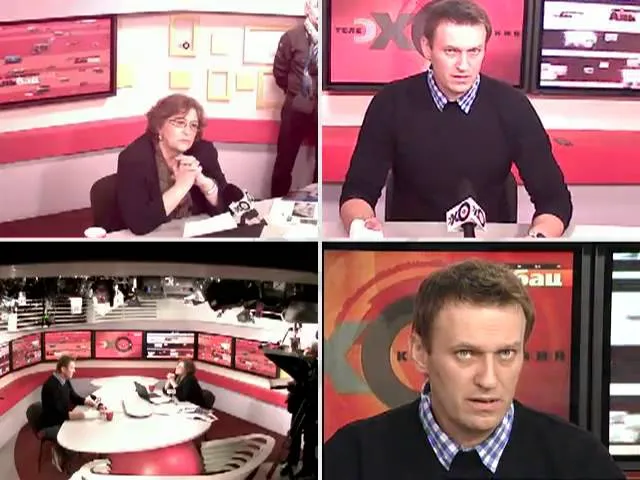
Alexei Navalny on the program “Full Albats” dated April 18, 2013
... all computer equipment, mobile phones,
phones, and vitamins. I should add that Alexei
Navalny will be a guest in our studio
literally in just a few minutes.
Roskomnadzor (Russia’s federal media and communications watchdog) will soon remove
the Wikipedia article about smoking marijuana from
the blacklist of websites, as a source told RIA
Novosti, citing a representative of the agency.
Vladimir Pikov said the new version of the article
meets all the requirements
of Roskomnadzor and experts from the Federal
Drug Control Service
last Friday.
Representatives of Russian Wikipedia
published a notice that the article had been added
to the blacklist of websites
for information about methods of
drug use. The authors decided
to edit the article rather than delete it.
The dollar at
Tomorrow your photos of me in that vest
are just unbelievably persistent, really.
They’re just everywhere, all the time, I just don’t like it
and now everyone is teasing me, calling me a nerd.
Because of that vest. But a vest is an attribute
of a nerd.
Absolutely. Guys, when we start
the program, no filming, no little jokes.
Agreed?
Yes, if I hear it, I’ll throw you out immediately. Lawyer, politician, and
blogger Alexei Navalny on Full Albats
today after 8 p.m.
This Monday, the guest of the program
Flight Analysis is the editor-in-chief
of the publishing house New Literary
Observer, Irina Prokhorova. After two I’ll
step away. There you are filming him while we’re here, and
I’m filming you.
I’m filming—how could I not?
The agency—how could we do without the agency? Why the hell
do we need you then? Well, there you go, yes.
My wife—why? How?
[music]
Zhenya, what filming? We agreed on that.
None. Come on, guys, let’s agree:
right away. I really don’t like any of this
stuff at all. Yes, but since
the editor-in-chief
pushed me into it, I had no other
choice.
Shouldn’t it be turned off completely, or put on silent?
It’ll cause interference then.
You need to put it down, you understand, so that it
so that
I’m sitting down because I need
to spread out my papers. And it starts at 19:00 (7 p.m.).
Tickets at the Central House of Writers (CDL). Information by phone: +7 495
691 631. For viewers aged 12 and up.
[music]
years old. They left these frames here. Now this is a good
photo, by the way. Who is that? I don’t know.
A good photo. Lyoshka, I don’t even know.
It’s some really good photo of you. It
makes you look so glamorous.
That’s glamorous, exactly.
That’s a good thing. So why are you hanging my
photos somewhere near a church, I’d like to ask?
Well, because that’s what the artists said, ah—
I always… it’s good, but it’s just
well,
so… it really just needs a bear
there, and maybe a husky too. It’s just
really a bit much somehow. When it comes
to covers, I prefer to trust
the artists, because afterward I’m not
objective. And you’ll learn about that in the new
issue of Delta magazine. Also read about the main
operation… Ar—Lyosh, don’t you remember what
Beketov’s newspaper was called? Guys, no—
Khimki… Khimki Pravda, Khimki
Pravda, yes. And for academics and viewers: the story
of the escape of six American diplomats from
Iran, as well as David’s farewell—what
kind of weapon was used by the man who killed
the famous… and a new cartoon by
Andrei Bilzho. You can buy the magazine Diletant not
only in stores but also on the Diletant website.
Your pilot in the sea
of information. This program is broadcast by
company C. That’s it.
[music]
Let’s go. The TV company
RTVi and Echo of Moscow radio present
the program Full
[music]
Albats. Good evening, 20:07 on the air.
Radio station
… I’m Yevgenia, and as always on Monday I
begin our program devoted
to the key events of the week, the events
that will have an impact on politics
in the coming weeks and months. A few
hours ago, very sad
news came in: our colleague, the editor-in-chief,
the former editor-in-chief
of Khimki Pravda, Mikhail Beketov, has died.
He was a man whom
the attack had left maimed in recent years.
Beketov was a very
courageous man, a true fighter, a true
journalist. May he rest in peace.
Today is one of those days when suddenly
the news is full of all kinds of sad events.
Earlier today came the news that
has passed away
from this life
Baroness and the only woman prime minister
of Great Britain,
who carried out in Britain rather
painful market
reforms. Many will say that these were
controversial reforms. For our country,
Margaret Thatcher, like Ronald
Reagan, played a very major role because
in the end, because during
perestroika, Thatcher was the first
to recognize in Mikhail Gorbachev
Mikhail Sergeyevich, then General Secretary of the CPSU (Communist Party of the Soviet Union).
a man with whom the West
is ready, ready to speak not as with
the leader of an evil empire, but as with the leader
of a country preparing for reforms, and in
the fact that Gorbachev was able to undertake
the most important political reforms, which in
the end gave us freedom. There is
of course also the role of Baroness Margaret Thatcher
Those are the stories today.
Returning to events in Russia.
On April 1, a trial began in Kirov in the case
which has already
been dubbed the Alexei Navalny case. The outcome
of this trial will undoubtedly have
the most serious impact on Russian
politics, on the development of the political
situation in the country, not only in the coming
months. I think it will largely determine
the form and essence of the regime in
the country for years to come. And today, politician
and founder of the Anti-Corruption Foundation
Rospil, Alexei Navalny, is in the Echo of Moscow studio.
Alexei, hello. Good evening.
Thank you for coming. The very first question:
obviously, those watching us on
Setevizor and those watching us on other
TV channels can see that your
arm is in a cast. Tell us, what kind of
gangster bullet was it? Whom did you beat up, or who beat you up?
Soviet film classics teach us that
there is one most reliable way to store
diamonds: in a plaster cast.
which, according to the Investigative Committee,
he had been stealing for many years. In fact,
it was actually an old childhood injury.
A broken little finger—it regularly
gets broken again. It looks scary,
but in fact it's nothing serious. I see. Yulia,
your beautiful Yulia didn't beat you, did she? Well, if
Yulia had beaten me, there would be much more
plaster. All right.
Then seriously.
Today online, on social
media, people are discussing your fate
for two reasons. First,
because last Thursday you made
what I consider a rather risky
statement on the eve of the trial, saying that you
want to become president of Russia. Yes, that
was a question on the program
asked, I think, by Tikhon Dzyadko and Filipp
—and you answered: yes, I want to be
president of Russia. And strangely enough, this
suddenly—even though this was not the first time you had
said it—caused
a very intense and, I would say,
very approving reaction. Well, for me it was
a great surprise that, first of all, it
provoked such a strong reaction, because
I said absolutely nothing new.
And my fundamental position is
that it's actually rather strange that people
who want to change something in the country and
feel that they can change something in the country
could say something
to the contrary. Yes, I want to change everything here.
I feel that I can change
a great deal, and in this situation I have many times
said that I would fight for leadership
positions, including the presidency,
in order to change something. But I
do not want, excuse me, to hear on the news
in my country that the editor-in-chief
of a newspaper has died, after being brutally beaten
several years ago, and before that his
car was blown up, and most likely he was killed by
the head of the local administration. Everyone
basically knows all this, but he is free. I do not
want to know that the Kashin case still has not been
investigated. I do not want my country
to have 20 people imprisoned in the Bolotnaya case (the prosecution of protesters after the 2012 Bolotnaya Square rally), and
so on. If I want to change everything, I want everything
to change. I feel I have the strength for it. That is why I
say that I will fight for
it, for all of it. Perhaps some people
see this as a kind of
self-protective stance on the eve of
this trial—that in the dock there will be
not just some kind of
blogger and anti-corruption fighter, but a man who
has declared presidential ambitions. Well, some people
may think so, fine. My position
has always remained consistent.
If someone had asked me, I would have said it; if they hadn't asked,
it seems to me I had spoken about it before
as well, yes. But if earlier, for the Kremlin, you were
the founder of the Anti-Corruption Foundation
Rospil, you were a blogger, you were
a person who went out to street
rallies,
demonstrations, and probably some of them
viewed this, so to speak, to
some extent as populism, and so on. But now
with your statement you have set your sights
on the main thing—power. Yes,
I don't care at all what I am to the Kremlin. What matters to me is
what I am to myself and to those people
who support me. And if I
had said, let's say I will simply
fight corruption, but I am not ready
to take responsibility for anything
more, those people would have told me: well, sorry,
Alexei, we can't support you
because this is effective work,
whereas this is more the work of a human rights advocate.
or anti-corruption, but
as it is declared in Russia now,
is a sham activity, you see.
If a person says, "I'm just here
fighting corruption a little on Wednesdays and
Thursdays, but I'm not involved in politics," that is
an absolute fiction. If this kind of
opposition
says, "Well, we're the opposition, but we just
won't criticize Putin because we're for a
positive agenda," that's a fake
opposition. I'm not going to engage in a sham,
and I'm sure that the people
who support me, and whose support
I value, would turn away from me
instantly, because they are intelligent people.
Okay. If we have the chance, we'll
come back to this. I should tell our
listeners and viewers that more than
330 questions came in through the program's website.
Here are some of them. So, I printed them out
and tried to organize them; I'll ask as many as I can.
My next
question for you is this: online, a discussion has begun
about what you, Alexei Navalny, should
do ahead of the trial, since
many are convinced that the authorities
intend to imprison you.
And specifically,
today the well-known columnist Alexander
Morozov, on the website slon.ru,
posed the following question: Which is better from the point
of view of future political history:
to go to prison on fabricated
charges saying, "I will be a presidential candidate," or to leave
the country? And Morozov answers that for
all of us, it would now be better if abroad,
outside our homeland, there accumulated a large number
of educated, intelligent, and respectable
compatriots who will be needed
immediately after the wooden clog
is kicked away. I would like
Alexei Navalny to take his family and leave, because
in any case, time is on his
side. This is a question
that, believe me, is being discussed
by phone, on Skype, publicly and privately,
by many people who, uh, support you
and who see you as
a possible future president of Russia.
Many are discussing what the right thing to do here is.
What would you say? Well, first of all, I
am not inclined to heighten
the drama here. It is quite possible. I
have no doubt that this will end
with an indictment, with a guilty
verdict, but it is quite possible that it
will be a suspended sentence. That also solves many
problems for the Kremlin: I will never again be able
to run for office in this system as long as it
exists. That's the first point. Second, I
really do read such things regularly. They are
interesting from a journalistic point of view, but
for me, that kind of alternative has never existed.
Never. And this is not some kind of pose; it is
a clear decision that I made many years
ago, and my family shares it. I am
absolutely convinced that one cannot
engage seriously in politics here in
Russia without sharing the political risks
of every person who goes with me
to these demonstrations. If I call someone
to come,
I must share the risks with them, because
some people have been imprisoned, and those
16 people are in jail now. I regularly go to the hearings on
the extensions of their detention; I see the relatives of these
people. I want to have every
right to look them properly in the eye. I
do not in any way condemn those people
who are forced to emigrate now,
because who knows what kind of
difficulties and problems there may be, and so on. And
if a person, an ordinary activist, understands
that they may be arrested tomorrow, then probably
it is a good, correct decision to leave. But
for me, then all of this would lose its meaning. But if
you
are being given today, and we
published your answers to questions in
which, in particular, you say that if they
give you a suspended sentence, then they deprive you
of the opportunity to run for the Moscow City Duma
or, that is, for the post of mayor of Moscow. At
any moment, a suspended sentence can be converted
into a real prison term; that is, over you, above your
head—if they imprison you—you face a term of
up to 10 years. That's true, and it's not true, because
all these terrible threats have, in
fact, already been carried out many years
ago, because none of us could
take part in elections: everyone is either removed from elections
or it is pointless
to do so because the elections
are rigged. A person can be
thrown in prison right as they leave
a radio station. They can say that you
raped someone, or that drugs are lying
in your pocket. No problem. People are sitting
in prison right now for nothing, and before that
they were imprisoned too. Over the last 5 and even 10 years, we
have many examples of people
being jailed for nothing. All these
hypothetical threats have already been carried out.
I won't lose anything of that sort if Putin doesn't
—I don't know—pick up his red telephone and
whether it will be Judge Yegorova or me who tells them to put him behind bars
I don't know, someone there—well, tomorrow it will be
in prison. Anyone could be. And you have no
doubt that the instructions in your case
are being given personally by Vladimir Putin? Well, of course I
have no doubt about that. There are
not just vague feelings here, there are also
objective facts that point
to it. But there has never been a case like this one
with these charges being opened and
investigated at the level of the Main
Investigative Directorate of the Investigative
Committee. Nor has there been a case where I had more
investigators on my team than
Serdyukov did. Yes, the FSB is overseeing it, and there
the number of searches and seized items
is just off the charts. I don't know,
maybe some cotton case in
Uzbekistan in Soviet times
wasn't investigated on this scale. So
naturally, resources like that
and that level of organizational effort can only be deployed
if you have political instructions
from the highest level. And we all know that
Bastrykin values such instructions very highly
for one thing, and for another, we know
that, in principle, criminal cases in Russia are not investigated
without some kind of instructions
—direct political instructions. Otherwise there wouldn't be
such corruption. Returning to your
case: first of all, you wrote—and I read it—
that you filed a motion,
your lawyers filed a motion
for a preliminary hearing. Why were you
denied that?
We have no idea what that
was connected to. It's simply an obvious
violation of the criminal procedure
code, happening out of
nowhere. But we can see there is great
haste. First they limited us in
Moscow in our review of the case materials,
even though we were not dragging things out and were reviewing them
fairly quickly. There were 31 volumes there, yes, 31 volumes, and we had not
finished reading them when they
forbade us from continuing and sent everything to
Kirov. Remember that story where
the prosecutor's office, in a day—less than a day—
read all 31 volumes, approved them, and said
everything had been sent to Kirov, and now they had scheduled
a hearing on the merits right away for some reason. That simply does not
happen in practice. And most
importantly, it's a pointless violation.
Why was it necessary? Nevertheless, the judge
in Kirov went along with it. Maybe they
are trying to show in advance that, well, here we are,
we're so tough, and no kind of
lawlessness scares us. Well, it's that kind of, you know,
swaggering pose. Or maybe it's simply connected with
some general mess—they were told to move faster
with the proceedings, and so they made a mistake.
And after that, what did you file? Well, of course
we appealed it. In any case, they will
now proceed directly to the merits. We
have already filed complaints against the judge with the judicial panel,
we appealed, and in April witnesses will already be called.
Witnesses? What is this going to
look like at all? That's all at the court's discretion. Well,
of course, if he begins hearing the case
on the merits, he has to determine the procedure:
how many witnesses there will be, how many from which
side.
Right now they have listed
around 50 people as witnesses. Will they hear all of them?
Not all of them.
The issue of expert examinations is very troubling.
We will file motions, we will demand that all these
made-up figures that
the Investigative Committee is talking about be
confirmed by some kind of expert analysis. There is none of that
in the case file. We will file motions and demand all of that.
As for what the judge will grant
and what he won't, we'll see. All right, I
still want to dig a little deeper into
this whole story because
I have completely
read the previous case, the one that
came before this,
and I honestly cannot understand—no matter how
I may feel about you—I cannot understand how
the court intends to prove all of this. But first I have a few
questions for you.
So please tell me:
you went to Kirov when Belykh—
Nikita Belykh, after the Union of Right Forces (SPS) lost the
2007 elections, right?—after some
time
[music]
Right Cause or something like that, yes—and Belykh
was appointed governor of Kirov
Region, and he went there, as
he said, with his team, including
Maria Gaidar, and you went there with him. So
what was the argument for you personally to go to
Kirov Region? Why did you go there?
It was interesting—interesting to see how everything
was organized, to help with something.
At the time, Belykh invited me so that I could
work on
improving the transparency of property management.
I worked on that then, and I still
work on these processes involving the protection of
minority shareholders' rights. The largest
minority shareholder in Kirov
Region is the region itself,
which owns stakes in a huge number of enterprises.
A minority shareholder, yes, because in some cases it
owns 100 percent, in others 0.2 percent, in others 5 percent.
Naturally, its rights are violated, and this
property was managed, and still is managed,
not very efficient, like any
state-owned property. So that kind of
expertise was in demand, and a new team arrives
a new team—and in fact, it was Belykh’s team
it was completely new and, generally speaking, not
very tied to Kirov Region, that is,
they were absolutely new people. Nobody knows
anything, there’s no inside information, and it’s extremely difficult
to make sense of anything at all.
They say: here’s an enterprise,
a huge enterprise, employing 4,500
people, and it’s running at a loss—so what do you do with it?
Bankrupt it? Not bankrupt it? You need
to spend several months digging through all
the paperwork, understanding all the financial processes
and the economic processes taking place in order
to make any recommendations.
Naturally, all the local elites were
keeping a fig in their pocket (a Russian expression meaning hidden ill will). They were waiting for the governor
to fail somehow, and so
it was extremely important for Belykh to bring in
people who, on the one hand,
would engage in objective
normal work, investigations, and on
the other hand would be loyal
to him. Mm-hmm. And I think we should
say, for the benefit of our listeners and especially
our viewers in other countries,
that Kirov Region is one of
the poorest regions in the Russian Federation.
In Soviet times, it had a great many
military-industrial enterprises of various kinds
and prison camps, so that’s how it was structured.
Kirov was actually a closed city
in the Soviet Union. Absolutely right.
Yes.
And before he came there as governor—
before he was appointed governor—
Nikita Belykh—there had always been this kind of
mixture
of Communists and people from various
penal colonies who ruled the
region. Yes, so it had its own
very particular character.
A team went there, and in some ways it still
remains. Maybe it’s not quite as
peculiar now, but still, you mentioned several times
that you worked
as an unpaid public adviser.
That’s absolutely right. But how does that work—what
does it mean, an adviser who doesn’t
get paid? So you must have had some kind of
internal motivation, so to speak.
Why did you work for Belykh so much? What kind of
work in the world is worth doing
for free, or even
paying out of your own pocket? Well, many times in my
life I worked while receiving practically no
money. In Yabloko (the Russian liberal political party), there was a period when I was paid very
little. Still, in
Kirov Region, for some time
especially during the first six months, I was living between two
cities. In the last six months, my
family moved to Kirov too, so you can’t
say that I shut down all my Moscow
activities. I still had an office that
was still bringing in some
profit, and I also had some income in
Kirov Region. My expenses were
fairly low. I lived there in a
hotel
that belonged to the regional administration, something
like a retreat center. You didn’t pay for it?
I didn’t pay for it, and I ate there too.
They paid for it at the official
rates, which were very low, so
the cost of living there was very
low. The work there was very interesting,
and it was a very useful year for me.
All right. When you moved your family there and
Dasha started school there, what money were
you living on? I lived on the money that I
continued to earn, and on the money
that I had in savings in
Moscow. So you kept your office? I did.
It remained open; people worked for me there all
that time in the office. And the money—you
earned it as a lawyer? As an attorney, yes.
As an attorney. All right.
I still don’t really understand the point
of working for free. That has always
bothered me. Well, all right—you’re here in
Moscow making big money,
I assume. Well, sorry for such an
indelicate question. All right, let me
rephrase it.
People earn a lot of money and receive large
salaries, while many people work without
any fee at all. So the question is: what interest do you have
in working here without pay?
It’s interesting, probably. It’s simply a large
audience—you’re speaking now to
a million
people. Well—
All right, next question.
So, regarding Pyotr Ofitserov, who
is involved in the Kirovles case, yes, the alleged embezzlement at
Kirovles. So again, for listeners
who may not know, this is Navalny’s case.
It turns out Navalny organized
conceived and organized a criminal
community, yes—or a gang, or a
criminal group, a criminal group
involving
the general director, according to the latest version
of the investigator. Even before the trip
to Kirov Region, I had already come up with
a criminal plan to steal 16 million rubles (about US$250,000 at the time), back in
Moscow—back in Moscow I devised the plan, and for
this plan I recruited Ofitserov, then arrived.
there, there, and also brought in someone else there
deviously, that very Opalev
the director of Kirov and in 20092
already, uh, a criminal group of three people
and it was this group that stole 16 million rubles (about 16 million RUB), and moreover this is
case
the signs of embezzlement changed
it was assumed that this Opalev was not a member
of my criminal group, and I forced him
now he is already a member of the criminal group
and he admitted it. So, as for
the first case, the case that was
closed in April, which I read, yes, there
according to one
expert assessment, there was damage caused, without
signs of theft, amounting to 589,000 rubles (about 589,000 RUB) at first
it was 1.2 million, but then 589,000, yes. At first
it was 1,200,000, then 589,000. How
exactly, how did
this figure of 16 million come about? 16 million is the entire
turnover of the company Vyatka Timber Company
which belongs to Ofitserov for all four months
of its operation. That is, they did, well, this kind of
paradoxical, strange thing, but nevertheless
they simply took the entire sales volume
that is, all the money that passed through
the settlement account and said that all of it
was stolen, just like what was done with
Khodorkovsky, all according to the second case
against Khodorkovsky. Well, Khodorkovsky’s case
after all, that was a big case, a large
company, a huge number of companies
subsidiaries, sub-subsidiaries, and so on. I don’t quite
understand how all this is even going to
play out in court. But quite honestly, I would have
published all the materials online, and
many people read them. So the prosecutor will
say: Ofitserov, you stole 16
million rubles (about 16 million RUB), and then Ofitserov will
show him a payment record proving that for 15 million rubles (about 15 million RUB)
he bought this timber, sold it, and received
the difference, about half a million rubles (about 500,000 RUB), and this money
he spent on wages for people who actually
worked there; I think there were seven of them
people. How are they going to prove that
16 million people—16 million rubles—were stolen? I
just, well, can’t even imagine it
And is there anything in the indictment that
would show, like, their logic? In the indictment
there is nothing. The indictment simply contains these
16 million rubles, saying that they intended
to steal them and did steal them, and as
evidence they cite the fact that I knew
Ofitserov before, the testimony of this
Opalev—it is mainly built on that—and
some of my email correspondence with Ofitserov
of the sort where I tell him: set up
an email account on Gmail, not on Mail.ru
because Gmail is safer and you can
correspond secretly there, and this is presented
as some kind of conspiratorial collusion. Like,
they agreed on secrecy, so
they must have been up to some shady business. And that’s
all. We will publish the indictment
there is also wiretapping there
of phone conversations, from which, of course, to
everyone’s regret, people will see that I use a lot of
profanity. Publishing it in
the press, as we know, as of today, will no longer
be allowed; there will be lots of dots there in
10 days, it won’t be allowed; in 10 days there will be
lots of dots if someone wants to publish this
wiretap, but it also works in my favor
Yes, a person may, every oth-
there, swear every other word, but excuse
me, on the phone, so no one
is arranging something like: so, you
skimmed off a million rubles, bring me
200,000—or anything even remotely like that
there is nothing like that there. Of course, I knew in
detail and specifics how this
company worked, but I needed that in order
to understand what to do with this
Kirovles. I can say that in the end I
turned out to be right, because they bankrupted it
I kept saying for half a year that
that was it, Kirovles was doomed, they would bankrupt it
and they did bankrupt it, a year after I left
We have to take a break now and
we’ll return to the studio after
the news. We’re still live on the
internet, on the Vizor network, so
[music]
in
London, on Downing Street 10, at the
gates of the British prime minister’s residence
of the United Kingdom, as the news reports, people
have come to honor the memory of Margaret Thatcher
the country’s only female prime minister
who died today at the age of 87
among those gathered are many tourists
at a separate entrance to the residence stand
journalists with cameras and
photojournalists. On the parliament building
British flags are flying at half-mast. People
continue to arrive. What
is preventing
The Finance Ministry proposes raising excise taxes
on Euro 4 and Euro 5 gasoline; this was
announced today by the head of the ministry, Anton
Siluanov. According to him, excise taxes now
on high-quality gasoline are much lower
and are rising more slowly than those on
lower-quality fuel. Siluanov recalled that
the difference between excise tax levels was
introduced specifically in order to
encourage the transition to the production and
the sale of higher-quality gasoline
the Communist Party faction (KPRF) will not support
the candidacy of the current head of the NBA
Oh, how radical Zyuganov is, oh my
Zyuganov is not a radical, though
Support the principle—not for five minutes, he did not
Support it at the end of his term of office
of authority at the end of
June, the Moscow City Court found lawful the refusal
by investigators to open a case over a violation of
the privacy of Boris
Nemtsov; the politician's appeal against the court ruling was
rejected, lawyer Vadim Prokhorov reported
in December 2011, New published
recordings of Nemtsov's phone conversations in which
he used obscene language to
express his opinion about the protest rallies
for fair—expresses an opinion, in what other
terms can one express an opinion about
this rally? Sukhov left his post
by mutual agreement with the publication's management
he himself told RIA
Novosti that he parted ways with
his colleagues without conflict. He simply
had completed his tasks in the holding company and was ready
to move on. Pavel Sukhov was
appointed editor-in-chief of the Vedomosti website in May
2011, after that position was vacated by
Elizaveta Osetinskaya. In Moscow
tomorrow, variable cloudiness is expected
with light precipitation in places, plus 5 to 7 degrees Celsius
Irina Renko, Echo news service
[music]
of Moscow. Opinions
of Moscow present the program Full
Alba. Good evening once again, in the studio
Alexei Navalny, without any
preface
we continue the conversation we were having before
the break. Next, I have a question for you. You
were you planning to start some kind of business
in Kirov? No, of course not. So you did not
have the idea that since in Kirov
or rather in Kirov Region, aside from
the military-industrial complex, there is only timber, and that it would be necessary
to set up some kind of timber business? Well,
first of all, the timber business is a fairly
dubious enterprise, as the story of
Ofitserov, by the way, showed. Second, I
understood that I was going to Kirov for
a fairly short time, and third,
if some official really wants
to do business while sitting in the administration, he
of course does business with budget
money; it's much easier and 100 times
more effective. There it is, cash
just take it and
he says that Kirovles was practically already
bankrupt. And by the way, we should tell our
listeners that the Timber Company
is, in fact, a company that
belongs to Pyotr Ofitserov, an accomplice of
Navalny. Well, what else would you call him?
An accomplice is an accomplice, and a criminal case is a criminal case, and
there is a criminal case. But the business accounted for
VLK accounted for 2% of the total volume
of Kirovles, and he was counting on what
any normal
entrepreneur counts on. At first it was not
clear that things there were so bad
and, well, this is normal business. There are a great many
timber traders
some of them do quite well
make money and work perfectly well
He was counting on his own
entrepreneurial abilities and
responded to one of the many
statements that Nikita Belykh made, including
here on Echo of Moscow: come
entrepreneurs, help raise our Kirov
Region, work, and so on. That is true,
by the way, many people went there then, to Kirov
many went then, you remember, the first
six months, even the first year, it was terribly
fashionable to go there and start putting
some kind of
business structure in place
resulting from criminal activity
led by you, Alexei Anatolyevich
the Navalny group
This is also an interesting situation because
the injured party both does not exist and does
exist, because Kirovles itself and its
bankruptcy manager, and then
the arbitration court that reviewed these contracts,
said that there was no
crime and that, overall, all of this was normal
but investigators, as it were, have the right
to forcibly recognize someone as an injured party, that is,
in principle, right now you can be
recognized as an injured party on the grounds that I stole
timber from you, for example, yes. Well, we see in
the case materials that the investigator issues
a ruling recognizing as the injured party
the bankruptcy manager of Kirovles; he says
to him: I recognize you as the injured party; 16 million was stolen from you
16 million, to which below
he signs: all right, but I learned about this
only from your ruling. Well, that's
all. That's how an injured party appears. And
under our law, in economic
offenses, isn't an injured party required?
Well, formally there is one; that is, they themselves
recognized one. This is a state-owned
enterprise; they recognized it as
the injured party. But by law, for that
there must be an expert examination, because
it is assumed that the investigator does not
possess any knowledge that would
allow him simply to conduct an accounting
or have an economic expert assessment say that
your timber was stolen or that you sold the timber at
an undervalued price and that the damage amounts to
such-and-such rubles. An investigator cannot do that
that's why an expert examination is always conducted
accounting, merchandise, financial
whatever kind you like. In our case, there is no expert examination
not a single one. There is only an expert report that supposedly
in the previous case—one expert examination
spoke of damages without any signs of theft
1,200, then 500,000, and both of them 589
000, and both expert examinations were highly
questionable and were repeatedly
appealed. But now they have simply, without any
expert examinations at all, declared it to be 16 million rubles. But this
is by no means some exclusive invention
I mean, look at any of my other
cases. Take the case where my
brother is also involved—they simply took a company
that had been providing services for three years and
there had been no problems with it. They took
the total amount, the volume of those services over three years, and
said that all of it was stolen money
it's simply ridiculous, of course. Absolutely
because you can look at the
payment records and see that there was a contractor and
there was a subcontractor, services, cost price—but
they say that this entire
economic activity was
fraud, and therefore all the money that
passed through was stolen. And where it
went after being stolen is unclear. So
apparently those diamonds are still lying in
my cast, because the stolen money must be
somewhere—but where exactly, by the way?
And this, by the way, is an interesting thing, because
more often than not
with this kind of theft charge they also
tack on a money-laundering article, because
first you stole the money and then laundered it. Well
somehow it ended up in an account, in cash, and
so on. We don't have that in our case, because
everyone understands—you can clearly see how much
money came in, and you can see how it was then
distributed as salaries. That's all. And here
it's completely impossible to pin money laundering on it
but they managed without laundering
he agreed to cooperate with the investigation
the former general director
of Kirovles (a timber company). His case was handled under a special procedure
he was tried that way and received a suspended sentence. So
Explain this, because it is completely unclear:
which facts that were established in
Opalev's case are now being used as the basis
for your case? And is it really true that no
evidence in
court is required for the charges brought against
This concerns what is called prejudice (preclusive effect): there is a certain
fact
an established, established fact
set by a court decision that has entered into legal force. There is
a court ruling in his case which says
that Opalev was a member of a criminal group
consisting of Opalev, Navalny, and Ofitserov
and that they stole 16 million rubles. Therefore
theoretically, there is no need to prove anything
anymore—there is already preclusion, the court
has already established this
fact: that there was a criminal group and that
16 million rubles were stolen. But how can that be established without you?
How can it be established that there was a criminal group? Well
that is the legal peculiarity of
this very preclusion. But I think that
of course they will not
get away with it in our trial by relying
exclusively on preclusion and doing neither
expert examinations nor witness questioning, and so
on. That is unlikely. Of course, nothing
can be ruled out, but it is possible
Wait, could it happen that on April 17
the trial opens in Kirov and
the judge says: since in the case of
Vyacheslav Opalev it was established that there was a criminal group
led by Navalny, we find
Navalny guilty and send him
to prison, or give him a suspended sentence—could that happen?
Theoretically, of course, it could, but it is extremely
unlikely. As far as I have spoken with
lawyers, they explained to me that in any case
there still has to be a trial; it is necessary to
prove your and Ofitserov's guilt. Well, yes
since we are not being tried under the special procedure
that means they must call
witnesses and so on. But they could
question two or three witnesses and
then say that no expert examinations are
needed, and then still apply that very
Which specific facts were recognized by the court
in Opalev's case? As I already
said: that there was a criminal group, that
Opalev was a member of this group and stole 16
million as part of this group, for which he
received 4.5 years suspended. And were you
questioned at that trial? No, it was under
the special procedure—that is the peculiarity of it
it went under the special procedure; in half a day he was
convicted without expert examinations, without questioning
witnesses, without anything, because he
admitted guilt. He admitted guilt and entered into
a so-called deal with justice (plea agreement), and
the judge says to him, well, the logic, the logic of this
special procedure is that
you have admitted it, you agree with what
the investigators and the prosecutor's office are charging you with—quickly
Get a minor punishment and go
home. I want to—well, excuse me, I
really don't understand. So all of this
will be brought to court, yes, and the judge in your
case, relying on this prejudicial ruling, can
immediately say, that's it, Navalny—well, not immediately,
can't say that either.
There is evidence in the case file; he
has to question certain witnesses
he has to examine certain materials,
expert reports, and so on. Another matter is that
the judge may examine them, or may not examine them,
may examine them to one extent, or to
another extent; may question only
the prosecution's witnesses, may
also question defense witnesses.
The judge may already have given some local press outlet
an interview and said that this rather
lengthy trial—so why then cancel
the preliminary hearing altogether? I completely understa— I
as I already said, this case
is strange, because, well, here they are, these
payment orders, here are the bank transfers.
It's obvious you can't steal 16 million rubles if
you paid 15 million of it and can fully
prove it. It's simple. And what
happened to the 1 million? Well, that 1 million is
the margin, that profit which
remained in the company's account and was
paid out as salaries. All of this is visible.
The documents that were posted on
the internet—any accountant who goes in
and looks at them will see that this is exactly how it is. And
everyone who has looked said yes, that's
right. Were you acquainted with Opalev before
coming to Kirov? No, of course not. I had never been to Kirov
before arriving there; I'd never even heard of it.
So when you arrived in Kirov, what kind of
relationship did you have with Opa—? Well, he was
the head of one of the institutions
which, with regard to which, with regard to
that institution, I had instructions from
the governor to look into it, well,
he would come, sit in on meetings, and so on.
As I understand it, the investigation, the prosecution,
claims that you coerced Opalev
into making the deal. Right now they say I coerced him, and
then they said Opalev agreed to it,
that he was my accomplice.
So, are there any recordings
of your conversations with Opalev?
There are some, there are lots of different things there,
but basically all of it is based
primarily on Opalev's own testimony and
that of one of his employees. But here's the thing:
with Opalev, everything is quite clear; we can plainly
see it from the chronology. We also posted these
documents. A criminal case was opened against him
on charges of abuse of official powers
when he was
general director.
In 200—, that case was mysteriously
closed. And a week later, his
testimony against me appears. That's all there is to it.
It's completely clear, very simple. But unfortunately
we simply have very little
time. Tell me, is there any chance
at all—do you allow for the possibility that
you
will be acquitted? The main thing for me is that I be
acquitted in the eyes of public opinion. That's why
I'm posting all these documents.
You understand, of course I don't consider that possible.
I'm a normal person living in the real
world; I understand that no one will allow
Navalny to go and win
a triumphant victory, not just in court but
effectively over this Putin regime, over
this
crowd of crooks and the rest of them, because
the evidence of my innocence is
obvious to everyone. But nevertheless they went
so far as to
fabricate—well, everyone who studied
the materials of this case, and so on, knows that. So
why, why would they endure all the negative fallout and not
get some modest little
reward in the form of a guilty verdict?
So you rule out the possibility of acquittal, meaning
you definitely will— I rule out that
possibility. Because if such possibilities
existed, this case would have been dropped
several months ago, and criminal cases would have been
opened over the knowingly
unlawful prosecution
of me, against the investigators
and everyone else. Here we simply need
to remind our listeners and
viewers that when in Apri—
in 201— the previous criminal case over
Kirovles (a timber company) against Navalny was closed,
the investigator issued a ruling stating
that the prosecutor's office owed you
an apology. Yes, of course. When that case
for several months was dragged out in exactly the same way,
bounced from one level to another,
cancelled and reopened again, but in the end
they finally understood it was a dead end.
I had a document stating that I had the right to
rehabilitation, the right to an apology from
the prosecutor, and the right to compensation for all
expenses that I had incurred. And then you
published a post about the agent
Bastrykin's Czech agent
and a statement about that trip to
the woods with Sokolov, and then Bastrykin staged
a hysterical outburst at the deputy editor-in-chief
of Novaya Gazeta, who
as Sokolov claimed, Bastrykin had promised
him that his head would end up in one place
and his legs in another, and Bastrykin himself would
investigate the case. So yes, and then
Bastrykin staged one of his
remarkable hysterics at a colleague from the
Investigative Committee, where he shouted that
there is such a criminal as
Navalny
then later something about a foreign agent
then I was charged—that was at the end of
July 2012.
All right, one more question. There was a lot of
talk that the Kremlin had
offered you—don't shout, I'm already
—nevertheless, that you were offered
a deal back in December 2012, namely
specifically, please, I would like
well, stop bringing people out into the streets and
after, on December 15, 2012, you
came out and called people to an
unauthorized rally at Lubyanka (the square associated with the FSB security service headquarters)
that was when the decision was made: all right,
now we're going to put you in prison. Well, no
one ever made me any offers, at least not
in the form of proposals
stated orally. Never. I never
saw anyone there and never spoke with
anyone. There were no intermediaries
who came and said anything. That is,
there were some people who relayed
the Kremlin's view that if he wants to
engage in legal politics,
register, in their understanding, some kind of
puppet candidates, we won't allow him to do that. So
there is some confirmation for that version,
which is that
indeed, after I—well, they
knew that I had insisted that the December 15
action would be unauthorized—they
opened three criminal cases four days apart
and it was so blatantly
illegal. Three cases—what were they? The case
involving SPS was the first case where my brother was involved; it
still
exists to this day, yes. Then there was SPS, then there was also
that unfortunate distillery, and they
opened those cases, and Gozman, Nemtsov,
Gaidar, Belykh, and everyone else were running around
shouting, what nonsense—the SPS case, there was no
damage there and there could not have been; SPS does not
exist, there is no injured party. Nevertheless,
the case was opened. You are listed as
a defendant in two cases and a witness
in two more, in two more cases. All right.
You know, there is still one thing I don't understand.
And it's already been 10 years for them.
London, in Tver, which
bought the country's largest oil company
and so on. Why would they want the headache
of also having Navalny in prison? I don't
understand. No, it's all very clear. Where do they
need to repent? Everything is fine: they jailed
Khodorkovsky, he is in prison, and they feel
great. Sechin, who organized
that case, feels great; they took
it into
Rosneft, they throw money around, they brought in stolen assets
and profit from it; they feel
wonderful. There is a certain negative side,
connected with the fact that at every
conference, every press conference with
foreign journalists, they ask
about Khodorkovsky, to which Putin says, 'We
do everything according to the law.' And it's not only that
there is also the situation of capital fleeing
Russia, and that is already a more complex
matter.
Capital is fleeing Russia because
there is no justice in Russia, no rule of law,
no way to protect capital, and therefore
any capital, even stolen
capital that officials skim off
the budget, also flees to the British
Virgin Islands or to Cyprus because
there is legal protection there. Here, if you look at
state corporations, if you look at
the contracts of Rosneft or any state corporation
they sign, it says everywhere
in those contracts that the applicable law is
English law and everything will be
heard in the Royal Courts of Justice
in London. They flee because there is no
justice here for anyone—not for
Serdyukov, not for those unfortunate people who
are imprisoned in the Bolotnaya case, not for
Navalny.
All right, Alexei, I simply can't—so many
people sent in questions, so I have to
ask you at least a few questions
from this enormous list. Later
I'll give them to you; if you want, you can answer them yourself.
So, Alexei, after coming to power,
do you plan to limit the term
of holding the office of president, or
will it still be for life? That seems to be what
everyone already takes for granted when someone comes to power. Well,
I'm pleased that some people think that way,
but I'm not pleased that some people
seriously believe that the presidency—
that I believe the presidency in Russia
can be lifelong. Even now it is
formally limited. I simply believe that
all these consecutive/non-consecutive
these dubious legal tricks
need to be thrown out, and it should be clearly fixed: no
more than two terms.
no more than two presidential terms
terms of four
years. Then a candidate for president
[applause]
So it is time for us to do only one thing
to push for
fair elections in Russia, in which I and other
people seeking to govern
the country could take part. Because
when we are discussing things like this now
it really does make us look ridiculous
to ourselves, to those who are with us, and to those who are against
us. We do not have free elections anywhere. We
recently had elections in Zhukovsky
according to observers, I mean, the most
anti-Putin place, with the lowest level
of voting for United Russia and the lowest
support for Putin, and there there was vote-buying
of voters, some kind of incomprehensible
media manipulation—they were blatantly rigging
the elections. So what can we say about
the presidential election now? Come on, what kind of
election is that for you, if you yourself say that
if you are given a suspended sentence, then in that
way they will deprive you of the opportunity
to ever run for office, because for
their word alone they cannot forbid me anything
or decide it. There is the people of the Russian
Federation, and they are the ones who decide everything here. The fact
that right now some gang of crooks
has temporarily usurped power
and says that during this period
while these crooks are usurping power here
they can do something—our task
is to remove this criminal gang from power
then the time will come when there will be no
"they"—there will be law, rights, and order. I
absolutely believe that such times
will come. How
exactly can those whom you call a criminal
gang be removed? In the same way they are removed
in many countries throughout
the whole span of human history: people
will take to the streets and throw them out of the Kremlin
or they will flee from there themselves because
the system will stop functioning. We can see
that economic growth in Russia is falling. Right now we have
a forecast from the Ministry of Economic Development
of 2.5% economic growth. These people
have driven the country into a dead end—politically,
ideologically, economically, in every
possible way—so they are no longer capable of leading
Russia out of this dead end. But the country exists, the people
exist, and so sooner or later these
people, these crooks in power, will
be kicked out one way or another. So you
believe that elections in Russia are possible
only after the current rulers of the
Kremlin leave office? Elections are possible
after we force those people
who are sitting there now—or some new people
—or we ourselves carry out real
political reform and make sure that
the elections are fair. And I think they
themselves, under certain circumstances,
realizing that just a little more,
that thread will snap and they will lose
their lives, their freedom, and their capital—they may
agree to it themselves. And we saw that after
the first rally on Bolotnaya Square (a major Moscow protest site), they
were so frightened that they came forward with
the idea of political reform. Of course they
later backtracked when the initial fear
passed, but they did declare a political
reform. That means that they, as
crooks—but rationally thinking crooks—
they
So you allow for the possibility that
Putin could dissolve the State
Duma and call new elections? We will force him
to do it. It all depends on us. We
will force him to do it. If we work
ineffectively, why would he do it?
He will just enjoy his
stolen billions and fly around in a
private jet or whatever else, I do not know
No, this is no illusion—we will force him. Well, who else
is going to force him? There is simply no one else.
No one else, there is nobody. There is us
—ordinary people—and there is Putin, who fully
understands everything, who has usurped power. There is
a large part of the population that, for
one reason or another, is fairly
passive. So our task and our
responsibility is that of
the progressive class. There is no one besides us
—either we do it
or no one will. Who else—Barack Obama will help us?
Or the world government? No,
the world government is perfectly comfortable
interacting with Putin
because Putin transfers there his
stolen money, and here Putin controls
the nuclear missiles. Nothing else is
really of interest to Barack Obama, by and large.
There is, of course, a bit of rhetoric about
why you are mistreating human rights
organizations, but that is all. Uh-huh, and
Vasilevsky asks you: when you become
president of Russia, how will you restore
order in the courts, the prosecutor's office, and the Interior Ministry? This is
by the way a very serious question now, and
salaries have been increased many times over for all
the security services—for the FSB, the Interior Ministry, the military, and so
on. In this way Putin is creating for himself
this base, this support base—these are people who
If they were suddenly ready to defend, including
with weapons in their hands—which is exactly what did not happen
with the Soviet authorities in August of ninety-
one—they will not defend anything.
They will not defend anything with weapons in their hands, and none of
them needs any of this. Of course, some of them
feel grateful to Putin
for singling them out as a kind of
oprichniki (Ivan the Terrible’s personal enforcers) and raising their salaries,
but to suppose that these people, for the sake of
Putin’s billions, in the event of
a crisis, would go out and shoot at someone—I
simply cannot imagine that at all.
They obey him now and are ready
to endure all these ritual humiliations and
take part in the ritual humiliation of other
people because Putin currently has power
and strength. But as soon as that power and strength
diminish even a little, they will run away
instantly. The collapse of the Soviet Union
showed that clearly. They were all these supposedly
tough guys, fighters against extremism and
against human rights activists, but as soon as the wind began to blow
in the other direction, they were all blown away. Then it blew
the other way again, and there they all were once more,
coming running back and starting to talk about what great
patriots of the Soviet
Union they were, and how could anyone have destroyed such a
wonderful country.
These are the kind of people who are Komsomol members today,
democrats tomorrow, the day after that they are for Yeltsin,
then for Chernomyrdin, and then back again to
Putin. These people will support any
government that feeds them, and so on.
But to hope that in the event of a crisis
they will defend it with weapons in their hands—this is not something
they need. We have a few seconds left.
Have you already written your speech for
the court? We’ll go on the seventeenth, and then
we’ll understand how the trial will generally be structured
going forward. Then it will be time to write
the speeches. But of course I understand what I will say there; we
understand the line of defense. Well, I am absolutely not
guilty; all the documents point to that.
So it is not much of a problem for me
to write a speech for the court. So you already
clearly know what your approach will be? Will it be
a political speech? We have a clear
line of defense. Of course, I believe, and I am sure,
and it seems to me this is known to everyone and clear to everyone,
that I am being persecuted for political
motives. That is what I will talk about. I will
talk about political matters and about
persecution for political motives. I
have lawyers who will
focus on purely legal
Unfortunately, we have to leave the
air now. Thank you very much to everyone who was here.
Thank you, Alexei Navalny, and Alyosha,
good luck to you. Thank you. Goodbye, we’ll speak again.
Let’s hope in
a week I’ll be back...
But I don’t understand—they have to
somehow, they have to
prove something, the way they did in the second
Khodorkovsky case. There they went down the route of
transfer pricing; they
argued that in the second case too, they also
argued transfer pricing. Another
question is that they did all of that within the framework
of the legislation that existed at the time, but
in your case, I simply
don’t understand. Maybe they will
conduct some kind of expert examination that we
just don’t know about? No, no, that’s no longer possible.
A new examination can only be ordered in court now.
The investigation is already over,
that’s it. But the court can request an expert examination; the court
can order that a judicial examination be conducted. We
will demand that. But there is no other
expert examination there. I mean, of course
you can find an expert who will say that
black is white, but you understand, when
you take the number three and say that it is the number two—
not even any expert could
do that. By the way, we need to book, I mean,
I said book those hotels and tickets,
one hotel.