Alexei Navalny on the program Full Albats dated February 27, 2012
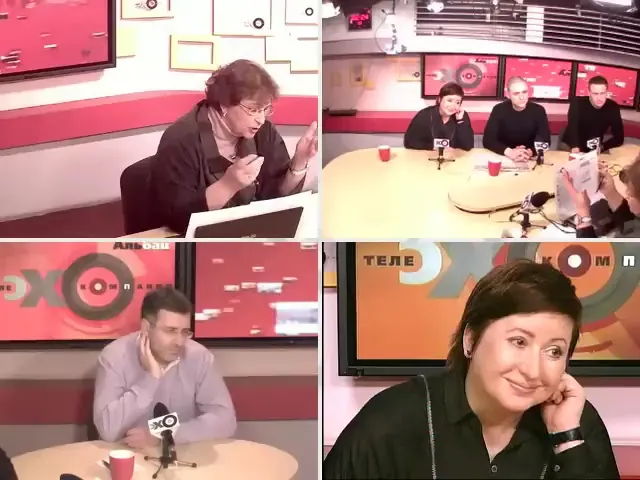
RTVI television and Echo of Moscow radio
present the program Full Albats.
>> Good evening. 10:12 p.m.
On the air are Echo of Moscow radio and
RTVI television. I am Yevgenia Albats. And
as always on Mondays, I begin our
program devoted to the key events
of the week, the events that will
have an impact on politics in the coming
weeks and months. In fact, today
marks the beginning of the final, the last
week before the presidential election in
the Russian Federation. Today, in the newspaper
Moskovskiye Novosti (Moscow News), another
article by candidate Putin appeared, in which he
informed us that our friends are Iran and
Syria, and everyone else is more or less
our enemy. And today there was also a whole host
of various
of news items about the now weeks-long
cold civil war,
which, in effect, to all of his
political opponents was declared by the leading
candidate.
And today, I invited into the Echo of Moscow studio
people who have recently been very
active in opposition
politics and, in fact, probably the very people Putin
was talking about
at Luzhniki Stadium, at a meeting with his, uh,
supporters, when he said that there are
those who run abroad, yes, who,
well, uh, are ready to betray their homeland.
I’ll find the exact quote for you in a couple of minutes.
Well, in any case, it’s clear whom I
invited into the studio today. Here we have
Alexei Navalny
here, well, as you know, the creator of the website
RosPil, a man who is now already very
well known in Russian politics, a lawyer
and politician. Alexei, good evening.
>> Good evening.
>> Here is Sergei Udaltsov, leader of the Left
Front. Sergei, good evening.
>> Good evening.
>> Olga Romanova, a member of the League of Voters.
In fact, that remarkable event yesterday
on the Garden Ring was organized
first and foremost by the League of Voters, and its
representative is here with us in the studio. Olga,
good evening.
>> Good evening.
>> And as an arbitrator, almost
always I try, if Sergei Maratovich
Guriev, rector of the New Economic School of Russia
(Russian Economic School), if fortunately he is in Moscow,
I mean you, Sergei Maratovich, don’t be alarmed,
don’t be alarmed, this is not...
>> We have a big country, we have many smart,
educated people. Yes, it also seems to me
that they are all talking about one
candidate. What is it? I’m saying that we
have a big country. So, the topic of our,
today’s program, in fact, I have
formulated as follows: if Putin
loses on March 4, we cannot rule that out
because, uh, the data
from independent polls that have been conducted
show that Vladimir Putin has no chance
of being elected in the first round, according to
internet polls,
in fact. And the big,
the three major polling organizations, they,
in my view, are solely engaged in
working for
a reality, an imagined reality, in order
to convince people that
they have no alternative. But here is how
the internet responds: a poll on the social network
VKontakte, yes, 500,000 people. It is clear
that there is no, so to speak, random
sample here. All the flaws of such a poll are obvious.
Putin has 25.8%.
A poll on SBRS 212.ru.
Putin has 15.6%, and 450,000
votes were cast. A poll on blogger Rustem
Adagamov’s page. 10,000 people were surveyed, and
Putin has 8.1%.
So the leading
candidate somehow has simply
completely different numbers from VTsIOM (the state-run Russian Public Opinion Research Center).
Levada, FOM: 53.5
VTsIOM. Levada even gives 66% to 24%.
According to Levada, Putin’s rating has
risen over the last two weeks, which, in my view,
simply does not happen by definition,
while the Public Opinion Foundation gives him 50%.
So then, if Putin loses
the election, which cannot be ruled out, what comes next,
Alexei Navalny?
>> Well, there certainly will be no catastrophe.
We are being conditioned to think, to the idea,
that something terrible will happen
without Putin, and that raises the question: "
What so terrible is happening right now
as it is?" Right now, by the way,
the president is not Putin at all. And quite
recently we were being told that Putin was not even
planning to become president, and perhaps
Medvedev would even continue his
presidency. And there was no catastrophe.
Medvedev headed the United Russia party lists,
and all those Kremlin
media mouthpieces were saying: "How
wonderful: we don’t need Putin at all,
let him go off to Gelendzhik, and Medvedev
will continue to rule." Nothing terrible
will happen. We live in a state where
there are at least some institutions, there is
a government, there is the State
Duma. As the opposition, what do you
propose? Let’s say that during the night, somehow,
we learn by five a.m. that he did not get enough under the law.
If he doesn’t make it to the second round, you see,
>> maybe he won’t, judging by
the internet, he isn’t making it to the second
round. Well, let’s suppose he does make it to the second
round, or someone wins, someone, someone
wins in the first round.
>> Well, nothing terrible will happen. The
Constitution lays everything out; the scenario
is prescribed. So the candidate who
wins will form his own
government, and will face the
State Duma (the lower house of Russia’s parliament), where, apparently,
there will be serious opposition to him, and he will
have to look for support in that State
Duma. It seems he will be forced
to create a coalition government,
which will govern our country, and I’m
sure it will do so no worse than
Putin is governing it now, because,
frankly speaking, he does absolutely
nothing except, well, fishing up amphorae and
staging assassination attempts against himself. At
least at this level, certainly,
the country could perfectly well be run by any
of those currently taking part in the election.
>> Yes, I forgot to mention that today there was
a report saying that an
assassination attempt on Vladimir Putin was being prepared. There are now
all sorts of incredible stories going around about how
it was being planned somewhere in London,
then they came to Odesa, then they
blew themselves up. In short, well, there is
far too little information to make
a definite conclusion. In any case, we
journalists cannot draw a definite
conclusion about what actually
happened there. Sergei Udaltsov, Putin
loses the election. What happens next?
>> Well, first of all, I’m glad that neither we nor
I have been accused of preparing an attempt on
Putin. That in itself is encouraging.
>> Wait, not yet
>> It’s progress, but let’s knock on wood, yes, let’s knock on wood.
Well, more seriously, I think if
this happens—that is, Putin does not
win in the first round, and if he
doesn’t win at all, doesn’t make it to the second
round—I think there will be at least a week
of public celebrations. It wasn’t for nothing that we even filed an application for March 8 (International Women’s Day),
just in case, with the
mayor’s office. We understand that this kind of
outcome is possible. No matter how much they try to convince us that everything
has already been decided, I agree 100% that this is
propaganda. According to our data as well, from various
sources—not just the polls you mentioned—
no more than 35%—that’s the ceiling, from my
information. So a second round is
inevitable. Who will be in it besides
Putin?
I think Zyuganov. And that’s not
because I’m his authorized representative. I’m
just reasoning from common sense.
And after that, everything is very simple. On this point, one can agree with
Alexei, and everyone understands
it. There is no catastrophe if
there is a second round. And all the more so if
if
>> Zyuganov won’t withdraw.
>> All the more so if another candidate wins immediately
in this case; I
think that would most likely be
Zyuganov. Back at Bolotnaya Square (a major Moscow protest site),
on February 4 we formulated the minimum demands for any candidate:
the release of political prisoners,
political reform—a real one,
not the half-measure that Medvedev is
submitting to the State Duma today,
but a full-fledged one—uh, early parliamentary
elections in a year and early presidential
elections in about two years.
In principle, all the candidates agree
with this. I’m not talking about Putin, I mean
the others. So if someone else comes
to power, a coalition
government is inevitable. I’ve actually got a newspaper here with me—
well, no one will see it, but I’ll just
show it. The Communist Party of the Russian Federation already has a list
for a coalition government ready. And,
by the way, Alexei is on it too.
As for Olga, though, I think that hasn’t
been fully worked out
for the service. No, I insist—that’s my
Federal Penitentiary Service
under any government, I mean. Do you
want to head the
dream ministry? Let me just finish one thought.
In other words, whether another candidate wins or
there is a second round with another candidate,
it will amount to the same thing, because everyone
understands that a coalition needs to be formed
for such a transition
to happen. Now imagine this: the second round
takes place. Putin makes it into the second round,
and so does Zyuganov. And Zyuganov—Zyuganov
could simply withdraw in that situation. And
Mikhail Leontyev, in an interview with our
magazine, in a discussion with Olga Romanova,
actually said that if Zyuganov, God forbid,
wins, he will immediately acknowledge
his defeat.
>> You know, yes, those kinds of fears do
exist. Still, I speak quite a lot
with Zyuganov.
He would never do such a thing. I’m
sure of that, and we won’t allow it—I’m not speaking
personally just about myself, but everyone around him simply will not
let him show that kind of weakness. And I have
Still, there is a feeling, if we're talking
about Zyuganov, that he now has
an understanding that this is, perhaps,
his last chance to play seriously and go down
in history on a positive note. On a very
positive note. So, so I think
all of us together simply will not allow
Zyuganov, or anyone else, to betray us and
sell us out.
>> Olga Romanova,
>> You are with the League of Voters, you are a civic
activist. So, we've already understood that you
want the post of head of the Federal
Penitentiary Service
>> under any government.
>> Under any government. What will you do
>> with Ovsyan?
>> Yes,
>> Reform it, of course. What else would I do there?
Of course, also
>> Matrosskaya Tishina will be closed.
Butyrka will be closed first and foremost.
Matrosskaya Tishina will be closed. Out of
the center of Moscow. Out of Moscow. And Kresty
out of St. Petersburg.
By the way, just like the president out of the Kremlin.
>> Uh-huh.
>> A museum.
>> Someone will get offended now and say this goes far
beyond the scope of the program.
>> I said the president. Yes.
>> So, Putin loses. Do you, among
civic activists, have any
idea of what will happen?
>> A mass surrender? I think it's not that
he loses, but that he falls just short of
fifty percent. And I don't know how Alexei
Navalny will cope with the flood of people wanting
to tell him what, where, when, account
numbers. And of course there must be
someone to blame for Prosecutor Petrovich,
yes, and it won't be him. And
people will be trying to guess, people will be
racing each other to run and tell everything,
because they will run in any case. They
will run in any case. It's just that if he wins,
they'll run a little later, when
Count Panin, putting on a white silk scarf,
goes for an evening stroll across Palace
Square.
>> All right. But what will happen with the transfer
of power? Do you remember? Well, you don't remember, right?
And I don't remember either, but since it's written in books,
that when Stalin died—by the way, on March 5,
the anniversary of Stalin's death, right? And when
Stalin died, people cried and said, 'What will
become of us?' When Leonid
Ilyich Brezhnev died, I do remember that,
the Izvestia newspaper building was surrounded
by armored vehicles and tanks, and again everyone said:
'What will happen now?' But then began, as
is well known, the 'race on gun carriages' (a sardonic phrase for the rapid succession of Soviet leaders' funerals). We had
Andropov
and Chernenko, right? And again everyone asked what
would happen. Then Gorbachev came, and when suddenly
the question arose that this whole era was coming
to an end, everyone again asked
the question: 'What will happen?' So what will happen,
Olya?
>> Well, in any case, we definitely won't be bored.
>> Well, do you have any idea of what
will happen—how power will be formed,
what the chekists (security-service men) will do,
who, after all, now hold
enormous assets in their hands?
>> Well, one chekist is not the same as another.
>> Of course, Olya, I mean the ones who have
assets, yes. I'm talking about business. Not
the ones who have the country on the hook
or—well, never mind.
>> But no, Bortnikov has already told us
quite clearly: comrades chekists, those who haven't yet
registered things in their wives' and mothers-in-law's names, do
it quickly, as quickly as possible.
Because selling off foreign
property—well, that's amusing. It's,
of course, very, very funny. Very.
>> Olya, do I understand correctly that in the League
of Voters this isn't even being discussed—that
you aren't even discussing a scenario for a transfer
of power? No, well, the League of Voters isn't
set up for that. The League of Voters—well, there
are civic activists there, and they may be
interested in questions of what happens
if they observe the elections so successfully
that the question arises whether
Putin does not win the election.
Right now the League of Voters is more occupied
precisely with the process of monitoring
the elections. I'll tell you honestly,
for example, I spent the last two
weeks fighting with the Federal Penitentiary
Service over monitoring at Butyrka. For the
voting, I seem to have gotten permission. Uh-huh.
We'll see on Sunday how it goes.
But for now, this is what is keeping us very busy.
>> Uh-huh. All right. Thank you, Olya. I gather that
you'll be put in charge of everything, right? Maybe Putin will
hear you.
>> Sergei Guriev, you've just heard
the answers from three opposition representatives.
>> What do you say?
>> Well, I think they do not
contradict one another. I think that whoever wins,
that is the person to whom Putin will hand over power. He said so himself:
'If I'm not elected, I'll leave.'
And, it must be said, we have seen this
recently. When Primakov was
prime minister, in effect
we had a left-wing government, and
it turned out there was no catastrophe at all.
At first it seemed there would be a catastrophe,
it turned out there was no catastrophe. There is nothing
good about this, from my point of view,
if we end up with a left-wing government. But
it is probably better to have a democratically
elected government, whatever it may
be. Especially since now, apparently,
the government will be a coalition one in the
event that Putin loses either in
the first or the second vote—in the second round.
Right. And secondly, obviously, this
minimum set of demands for candidates will be required of
any winning candidate, because
this whole process is now structured in such a way
roughly like it was during perestroika (the Soviet-era reform period).
It is no longer possible to stop the process that
is underway, and it simply can no longer be turned
back. People are demanding from candidates
honest elections, and genuinely
the release of political prisoners,
and a real political
reform. Apparently, this will end with early
parliamentary elections, because,
any democratically elected
president will raise questions about
the December elections, will look into how many
videos are actually stored on
American servers, and will conduct
an investigation. If it turns out that the State Duma
is illegitimate, then they will probably have to hold
new elections at some point.
It seems to me that we saw all of this during
perestroika as well—it also happened
faster than anyone might have thought.
>> Thank you, Alexei Navalny. And yet
you
know better than anyone how much
property is concentrated in the hands of
the people who today make up
the ruling class—what we call
the collective Putin. So what will happen to that?
How can these people leave
power? How can they possibly give up
power?
>> The collective Putin will fall apart as soon as
the real, singular Putin
is gone. There is no need to exaggerate
the importance or influence of these
people. Yes, they have—well, right now they
ride around in black Mercedes cars with flashing lights,
and they have billion-dollar accounts. But
most likely, the scenario for these people
will simply be to head off to those
billion-dollar accounts until we
catch up with them somewhere and arrest them. We will
demand the extradition of these people. And on their own
they cannot organize anything
by themselves. That is precisely why they have
grabbed Putin and chained him with an iron chain to
the Kremlin,
>> the galleys.
>> To the galleys, exactly. Because they
understand that without him—that is exactly why
they are even afraid to leave Medvedev in place,
because that makes their whole structure
less stable. They are completely
dependent on Putin. No Putin, no
these people. And I do not think they have
enough—I don't know—strength, courage,
or whatever else, to somehow, I don't know, with weapons
in hand, defend their money, because
they understand perfectly well that neither the army nor
the security services will take up arms
against the population to defend their accounts in
Swiss banks. Take Sergei
Kolesnikov, for example, whom I
met, and whose materials we
published in The Times; it is called
"A Very Specific Candidate." So,
he says that, in fact,
he realized that Putin cannot really
order many of them around. For example, he
says that Putin cannot order
Chemezov, Putin cannot order
Golikova, because each of them
has their own turf.
And in fact, in this corporation
that has been built around Putin, yes, he
does not have absolute power, and very often
he has to make certain
compromises with members of this corporation.
>> Well, exactly, Putin is not Stalin; he has
a completely different system of rule. He is
a fairly flexible person. He governs
through compromises. He never fires
anyone. He takes care of his people, and so on.
But again, there is no need to exaggerate.
This whole Putin gang,
to put it crudely, consists of
at most 30 families. All these people
can simply be counted one by one
and written down in a little black notebook.
There is no need to think that these are some kind of
giant clans. This is a limited
group of people who have already
intermarried and are bound by family
ties, and so on. They have created their own
little feudal estate. And this
feudal estate will very quickly
fall apart and scatter when their
chief boss is gone.
>> One more question. And yet,
there is Vladimir Gelman, a professor
at the European University in
St. Petersburg, a specialist in
authoritarian regimes. He believes that
the current clan of siloviki (security-service hardliners) will never
give up power, because their money
depends on holding office. Yes, if they lose office,
they lose control over the pipeline, over
Gazprom, and so on and so forth.
>> But what does it mean not to give up power?
Suppose Putin vanished tomorrow,
the Martians abducted him, and then what? Patrushev and
Bortnikov walk into the Kremlin and on Channel One
say that now they are the power in
Russia. Well, everyone would laugh at that, and Sergei
Udaltsov would walk into the Kremlin the next
day. I mean, that would just be ridiculous to everyone, right? And
in any case there are, there are certain
figures who could make a claim.
For example, in this setup Medvedev is
someone who could make a bid
within the Putin system; or, well, I don't
know, Rogozin, if you see him
as part of the Putin system, he could
try to use
public politics to take away part of
>> the power. But these just sort of
gray, faceless officers can't really
do anything.
>> Alexei, thank you. We're going to
take a break now, then we'll come back to
the Moscow studio.
>> Uh-huh.
>> Subscribe—who are you, from the Kremlin?
>> No, you have to, you have to put it in the candidate minimum
that you'll be leaving the Kremlin too.
>> Let it be in a museum, and in Butyrka (a Moscow prison), in
the Kremlin.
>> I agree with you. All right, just remember
the second plane arrived somewhere today.
>> That's for all the other programs. That's all
the other programs about this, which are outside
>> we'll definitely come back to this, I
promise you. Right now I want everyone to know that, just
in case, no one should relax.
>> And if happiness
>> Zhenya? So what exactly is your question? Will he lose
in the first round, lose in the second? I don't
understand.
>> No, I understand, but the way you're asking the question,
it's very hard to answer.
>> There will be a second round, which he will win.
There will be a second round where he loses. He
won't make it to the second round. He loses.
>> What do you mean? Are we talking about the first or
the second round? The point is, the president will be
a different person. Okay. Fine.
>> If he goes to a second round, then that is
basically a referendum scenario.
It seems to me,
>> some of his staff will be
unhappy that they failed to secure
a first-round victory. He will be satisfied...
...
>> Katya, you must agree that the risks are very
high if it really turns into a referendum. This
you all know—this is Ekaterina Zhuravskaya
speaking
about Putin. No, I think he
will win. Well, in the second round, more likely.
>> I think he will win and be more
legitimate.
A mistake. The first round is a big mistake.
>> People will think: "Sure, they stole 10%
or 20%, but he still would have won anyway."
>> Putin remembers the story of Sobchak's second round.
"
He is certainly not planning to
lose in the second round.
Sobchak won 44 or 48% in the
first round and then lost in the second to Yakovlev, who
had polled 22%. Putin was the campaign chief,
so Sobchak, who was
obviously stronger than Yakovlev, still lost—that's
a serious trauma, of course.
Everyone went off to their dachas (country houses), everyone understood that
there would be popular unrest.
How interesting: in Poland, criminals
cut it into pieces and sold it for
scrap metal—a functioning bridge that belonged
to one of the mines in
Silesia.
>> Tonight in Moscow: -6 to -8°C; tomorrow daytime: -3
to -5°C, cloudy, with light snow in places. The news service
has nothing more to cut up.
If we put things in order, more will come in. Our
fight against corruption.
>> RTVI television and Echo of Moscow radio
present the program
>> Full Albats.
>> Good evening once again. It is 22:33 on the air at
Echo of Moscow radio. The television company
RTVI. In the Echo of Moscow studio are Alexei
Navalny, Sergei Udaltsov, Olga
Romanova—by now already well-known politicians,
civil activists—and Sergei Guriev,
rector of the New Economic School (a Russian university),
who, I believe, is still
the only truly sober mind in this
studio.
Interesting.
>> But definitely not a politician.
>> He is not a politician. He is not a politician. And we
are discussing, of course, a completely
remarkable topic: what will happen
if Putin loses the election? Such a chance
does exist, yes, in any frame of reference.
That chance exists. And just now my
colleagues reminded me that in 1995
in St. Petersburg, Anatoly Sobchak
did not get 50% in the first round, though he did get
more than his opponent, Mr.
Yakovlev, and in the second round he lost to that
same Yakovlev. The campaign chief
in St. Petersburg at the time,
Sobchak's campaign chief, was Vladimir
Putin.
That, of course, shows the fears that
are now, of course, occupying the minds of people
in Putin's inner circle, and Putin himself as well.
Sergei Udaltsov, and before...
Ahead of the presidential election, there were serious moves made.
Salaries were raised.
For FSB employees (Federal Security Service), the starting salary was set at 60,000 rubles,
for staff members, which means
for an army lieutenant, the starting, uh,
salary is 40,000 rubles.
And for police officers,
the starting salary is 35,000 rubles. At least
that is what was allocated
in the budget, well, in the defense
budget, yes. But tell me, please,
how do you think, in this
situation, the security and law-enforcement wing of
the current government might behave if Putin loses?
After all, for them he is a leader, for them he is
the man who all this time
has been raising their status, increasing pensions,
salaries, and so on.
>> Well, yes, I see. By a twist of fate, lately I have
been speaking quite a lot with
law-enforcement officers.
Both rank-and-file personnel and middle-level ones. Well, not the top brass,
of course, I have not spoken with.
>> Was that mainly in a SIZO (pre-trial detention center) that you spoke with them like that?
?
>> No, over the past few years I have often
had to meet with them. I will say
quite honestly, as an expert on this
issue, there is absolutely no
respect or reverence for the current
government, and specifically for the highest
officials. No, because
even these recent pay increases
of late—we have to understand that all
this is happening against the backdrop of this, so to speak,
transformation of the militsiya into the police, when
under the guise of recertification
the entire management layer stayed in place. These
well-fed gentlemen remained in their
chairs, while those being cut were, and often
on rather, shall we say, dubious
grounds, the people actually working on the ground.
Some were fired. That leaves resentment, right? They
still have friends on the ground, and, well,
those who stayed in the system are still working, but
the workload has increased many times over. Right now
there is a staffing shortage, and this increase in
pay—which, let us not forget,
is being eaten up by inflation and other, so to speak,
rises in tariffs and fees. None of that has
gone away. So this raise turns out not to be so
significant after all. On top of that, the
workload has increased, and of course the climate in
the country—the moral climate, as it is now—is
no good at all. So I am not merely
convinced, I am certain that 99%
of the personnel of our law-enforcement
agencies, if they see that
the people are truly ready to change the government, that the people are
really out in the streets, will not go against the people
—100 percent. Therefore our task is
a small one, well, but a very important one,
namely, that we all be out in the streets. Therefore
right now, when discussing the possibility that Putin
might not win, in order to monitor
the election process as thoroughly as possible, so that it is
guaranteed, we must not
relax now. On the one hand, we must not
believe this propaganda, which
insists that Putin’s victory in the
first round is inevitable, and on the other hand,
of course, we must not fall into the illusion that
everything will happen by itself and Putin
will lose. On March 4, I once again ask everyone
who has not yet signed up as an election observer,
Alexei is doing enormous work in this
area, and all the parties,
>> RosVybory and Saida,
>> yes, and the Communist Party of the Russian Federation, they are all working together here
on this. It is Observer, Golos (an election-monitoring movement),
>> yes. All polling stations in the major cities
—Muscovites especially—need to be fully staffed so that we
cover every polling station. By evening, I have already voiced this
idea: it could be a kind of
spontaneous self-organization in your own
neighborhood. Make arrangements with your neighbors, just as
during the White Ring protest, when no one was really
directing the process and people simply came out. The same should happen
here: in the evening, come to your
polling station with your neighbors; let 10 to 15
people gather there. In the last election, in
December, by evening they began
throwing observers out of polling stations en masse, simply under
various pretexts. There must be
people there who will provide moral support if
needed, and who will start drawing attention,
calling, posting online. We need to track this
situation and, in the event of any
violations, amplify it. And, of course,
then on March 5 we are continuing
negotiations with Moscow City Hall. I hope they
will ultimately end in an agreement that
we will have an officially sanctioned rally. No one
wants any sort of conflict,
bloodshed or excesses, I think. And
the Interior Ministry officers mentioned earlier also very much
do not want that.
>> And are the negotiations continuing? Yes.
>> They are, yes. For now, our application
has been filed for Lubyanka Square at 7:00 p.m. That is
our reference point for now. The only alternative
for us could only be some
central square nearby, close to
the Kremlin, close to the city center. Well, there is
Manezhnaya Square, there is Vasilyevsky
Spusk, although that is unlikely. We, I
think, will finish the negotiations within the next day or two.
In any case, on the fifth we
must be out on the streets. And that is precisely
what will guarantee that, if there are many of us,
no law enforcement agencies,
will carry out any punitive operations against
the people. I am
convinced of that.
>> Thank you, Olga Romanova. There are a great many
questions here. I have once again received an incredible
number of questions about
what strategy people should choose
for March 4. How should people
vote if they do not want
to vote for a candidate who is being
literally shoved down their throats? And
what course of action should they
choose?
>> Well, my favorite concept is called
The Pinnacles of Russian Suprematism. Four
White Squares. That is, there is one black
square, the fifth one, and there are four white ones. Well,
the black square is obvious. The Black
Square, Malevich, the end of history,
>> Fukuyama. That is Vladimir Putin. Absolutely,
yes, what is there to explain.
>> Ah, the four white squares. That is the story
of Hegel. Fukuyama stole it from him.
Never mind. Let's continue. So,
>> no, no
these are not names, these are not platforms, of which there
hardly are any.
>> So, what should people do after all? Leave all the
little boxes blank or make them all
black? What should they do? Those four
white squares are a window. You choose
any pane. What difference does it make? You need
to open it. You need to open the window. Open
any vent. There are four little vents, or
should you not mark a box?
>> Mark a box. One box. One
>> any one.
>> I would still mark any box with my eyes
closed. Alexei Navalny, when
>> Just don't miss, Olga,
>> oh, come on,
I'll cover it with my finger, just so, God forbid, I don't.
>> Olga, let me give you some advice. Toss
a coin, without closing your eyes, don't, don't mark
the box blindly. You might miss.
>> Alexei Navalny, before December 4 once
you came out with the slogan, 'Not a single vote
for the party of crooks and thieves.' And, in fact,
in my deep conviction, and Sergey Gurev and I
have discussed this, um, in
many ways it was this strategy that prevented
United Russia from securing either a constitutional
majority
or even a simple one—well, that is, they do not have a majority
if the votes are recounted, but they failed
to get one. So what strategy should people
follow now on February 4—sorry, on March 4?
Sorry,
>> this is a question of tactics. The tactics have not
changed. Our strategic
goal is honest, free elections.
If we want to achieve that now, then
the best tactical move will be to come
to the polls and vote for any
candidate against the candidate of the party
of crooks and thieves, Vladimir Putin. We know
his name. And this is not an election, it is
simply a kind of event. At this event
we need to create stress for the authorities. There was
stress on December 4. In fact, they
could not handle it. The authorities slid into
monstrous falsifications that drove
people into the streets. At first they tried
to arrest everyone—on the 5th, on the 6th
to beat them—and by the 10th they were already
offering us some vision of their
political reform. We need
to intensify that stress, and the system will not
withstand it. Increasing the stress means voting
for any person against Putin; for
whom exactly does not matter in the slightest.
If you have a preference—Zyuganov,
Prokhorov—by all means. If you have no preference,
choose completely at random. Toss
a coin.
>> But in the parliamentary elections, you yourself
wrote about this: voting 'against all' (a former option on Russian ballots)
made no sense. Remember, there was such a
strategy, because when
the votes were recalculated
And now, choosing between voting against all
and voting for any candidate except Putin, how
>> we simply have to assess, rationally once again,
the pros and cons. If I say,
'vote for anyone against Putin,'
then, for example, Communist Party activists agree with me and
will support this idea, and we get
a huge number of free
promoters of our idea. But if I say:
"Let's spoil our ballots," well, then
Sergei Udaltsov will start arguing with me and say:
"No, it's better to vote for Zyuganov
instead." And what is the point right now
for me and for all of us to argue with Udaltsov if we
want exactly the same thing as he does: new
free elections? Therefore we must
choose the strategy that will be,
organically supported by the majority of
political activists, by other
candidates, and so on. Well, there is a lot
I could say about Prokhorov, about
Zyuganov, about Mironov, but that has
not the slightest relevance right now. You are
not voting for some particular person; you are
voting against Putin, for fair
elections. Yes, apart from apart from holding
of the campaign, there was another logic at work there as well.
The logic lies in the vote count. At every
polling station, there will be observers representing the candidates.
Accordingly,
they will have an incentive to count the votes cast for
their own candidates and make sure that not
a single ballot cast in their
favor is lost.
>> Not exactly. Today I was listening,
just a second, today I was listening to Nikita
Belykh, the governor of Kirov Region.
He was saying that they will have cameras
and that roughly 15% will be without cameras
at polling stations in the remote parts of Kirov Region.
Alexei will confirm that for us now, right? And
that means that in quite a number of remote areas
of Kirov Region there is no
broadband internet at all.
Accordingly, they will need
satellite communications there. And as I understand it,
that will be the case at at least 30%.
>> Well, the numbers are roughly like that. At 20% of polling stations
the cameras will record, and at
eighty percent they really will be transmitting to the
internet.
>> How, if for that you need
broadband internet?
>> In 80% of the country there is—well, Zhenya, come on,
>> No. There isn't, there isn't, no. Well, as you say,
there isn't across the country. They will be forced to, they will need
satellite communications.
>> And what difference does it make in terms of how
to vote?
>> Zhenya, Zhenya, that’s not what I’m talking about.
Indeed, Vladimir Putin took
a big step forward and said: "I want
fair elections, let’s install
webcams." But at the same time as these
elections, municipal elections are also taking place,
where it is not necessarily in a local official’s interest
not to inflate turnout.
I’ll ask a question.
Thank you very much. So, what I’m really interested in is this:
you, uh, are well
versed in game theory. So in
this situation, when we want to achieve
fair elections, and whoever comes to
power, including Putin, yes, we
would like that to be done
honestly. What is
the strategy for a rational voter?
What I was trying, trying to tell you is that
it seems to me that if you want
more observers to count honestly,
you should vote not against everyone, but for
one of the candidates you prefer.
Vote for Putin. Then the people
who support Putin will make sure
that this ballot is not torn up or
thrown away. Vote for any other
candidate. Observers from those
candidates will also keep watch and help,
because even with these cameras, we can already see
what is being written. Let’s say,
for example, let’s do this: just in case, before
the start, we discreetly spray
the webcam with clear varnish, or cut
the electricity, or knock it over. It is clear that
webcams are not all-powerful and they are not
protected against outright fraud.
That is why an observer who is there
will help. Creating incentives for that
observer is actually very simple:
do as Alexei says.
>> But there won’t be observers everywhere.
>> That’s true. That’s true.
From what Nikita said, I understood that in all sorts of remote
parts of Russia, of which we have a great many,
>> there will be no observers at all. Given the real possibilities,
it is clear that
there won’t be any, and the results in the hinterland
will be totally falsified.
Nevertheless, most of the country lives
in large cities. Where were the main
falsifications in the last election?
In Moscow, where we have
the ability to place two observers
at every polling station at
minimum. So why should we worry
about the fact that there won’t be any in remote areas? Well, if there is no
possibility, then there is no possibility,
we need to do what we can. We have
16,000 observers registered, while there are
90,000 polling stations in the country.
They will be in Moscow and St. Petersburg. And in general, in
the big
>> well, at least in the Rosvybory project,
there will be about 5,000 observers in
Moscow. I hope all of them show up.
So we need to mobilize the resources
that we have, without worrying about what
we won’t be able to do. We need to give it
everything we’ve got.
>> So, I’d like to put this on record. You,
Sergei, believe that voting against
everyone is a possible strategy, but it is
a risky one, because in a situation where there are no
observers, then
>> if there are no observers, still, if there are
some observers, uh, who
can help you count the votes correctly,
then they are more likely to count a vote
cast for their candidate than one cast
against everyone.
>> So it is more rational, after all, to make
some kind of choice. Sergei Udaltsov, yes,
please. Yes, you know, back in
December, and I’m not afraid to say it,
I was in favor of a boycott. I believed
that people would not turn out in such numbers,
that we had to stand on principle and
at least honestly refuse to let ourselves be drawn into a game
with cardsharps, right? In other words, the position was
principled overall, but, as life has shown,
and I say this without hesitation, it was not
entirely correct. And all the more so because of these mistakes,
and now there are also voices saying,
let's boycott again. Yes,
of course, the elections are being held under
legislation that, to put it
mildly, draws a great deal of criticism. It
contradicts the Constitution. A great many
candidates simply were unable to get onto
the ballot in this election. But given recent
practice, of course, only
a voting tactic. There should be one
tactic. Ideally, the more tactics there are,
the worse. The simple action is clear: no
votes for Putin. There are four candidates.
My position is clear. I have already said whom
I think people should vote for, but I am not imposing it.
If you don't like Zyuganov, vote
for someone else, just not for Putin. Then,
given that in the major cities we will
still, I think, ensure oversight
to the greatest extent possible, uh, a second round will be inevitable.
In my view, it is inevitable. And with that
in mind, I propose that everyone on the fourth
wake up, come out, vote,
observe the process, and on the fifth come out into the
streets. And we will simply have to
record what happens, because if it turns out
otherwise, then in my view it will be obvious that
we have simply been deceived again, and after that we
will have to decide for ourselves what to do
next.
>> What would be the signal for you, for each
of us? For you personally, what would be the
signal that the election was conducted fairly and
that Putin simply honestly won
the election in the first round?
>> Alexei,
>> Let's separate these things once again. The election
is already unfair before the vote count. What we have is
only the vote count, which can
be relatively fair or unfair.
>> Because Yavlinsky has already been barred from
the election. There's your first formal
sign. Who else was there? Ivashov, Limonov
wanted to run, and so on. So we have
an unfair process,
>> Right? The process was unfair. No one else
was targeted. Excuse me, but as for
Putin, they show him on television all the time,
so there is no real election anymore. Elections
should allow, uh, everyone who wants
to run to do so through some procedure.
As for the vote count,
>> Ah, I want to put this on the record. You
believe that the electoral procedure has not
been followed, and accordingly the election is already
a priori illegitimate.
>> There is no election. The result that will
be announced on the fourth or fifth, it
will be illegitimate and unfair. And we
will not recognize it. This must be understood
absolutely clearly; one must be fully aware of it. It will not
be recognized by a significant portion
of the country's population, and categorically so.
>> And if there is
>> if there is a second round, that will give Putin
more legitimacy, because it will
mean that
>> if he wins the second round.
>> And if he wins the second round, because
that will mean there were fewer
violations in the vote count. And
therefore the person who, possibly,
wins in the second round, we will still
demand from him, uh, the holding of new
fair elections anyway. But that would probably
reduce the level of public anger in street
protests. So right now, I repeat,
we are talking only about the vote count. When
they stop
throwing observers out of polling
stations in the city of Moscow, when the procedure for, for example,
requesting recordings from those polling-station
video cameras becomes normal—then
we will believe in something. For example,
those video cameras, for me as an
observer, what are they for? So that
I can watch video recordings from polling stations in the
Chechen Republic, where we always have
100 percent turnout. And I can count heads
to see whether 2,300 people actually came to
the polling station—99.5%.
>> 99.5. Well, do you know what the current
procedure is for obtaining the footage? I have to
write a special written request
explaining exactly why my rights, uh,
were violated, and that can only be done by
the person who voted in
Chechnya at that polling station. But I,
for example, vote in Marino, Moscow. That
means that for me, with a probability of
99%, those recordings will be inaccessible.
>> But can't a candidate write such a
letter?
>> A candidate probably can write such a
letter. I don't know whether they will write those
letters. And in any case, he would have to
explain why at each of, I don't know,
tens of thousands of polling stations there were
these violations. But in any
case, we saw on December 4, quite
recently, observers being thrown out en masse
observers, a whole bunch of video recordings on
American servers showing falsifications
and so on. That is why we want
even this formal ritual to be at least
observed in some way. Alexei, am I right
in understanding that if Putin, based on the results of
the first round, is declared the winner,
the opposition will not recognize it. Am I
right, Olga Romanova?
>> Of course not.
>> Sergei Odoltsov,
>> Well, as I already said, under a more or less honest
the country's population, not just the opposition, would not
recognize a first-round victory. I am sure
it would not. I think that if the votes are
counted honestly, there will be no mass protests.
But I think that what
>> But what does that mean? Explain what
honestly means. Well, for example,
>> they show you results like these.
>> Well, for example, if suddenly
all the video recordings are published and suddenly
it becomes clear that this many people came there,
we counted them one by one,
and there turned out to be this many ballots in the box,
the ballot was filled out in front of the camera,
photographed, and copies of it were
distributed by observers.
>> Well, that is unrealistic. In our country
there are, after all, 100 million, 100,000, 100,000
webcams that have been purchased and installed.
>> There are special programs that
can automatically,
>> yes, count people. So, in
principle, all of this can be done. And
Vladimir Putin, at least verbally, seems
to say that this is exactly what he is
interested in. For you, the result would be
telling. It would show that, after all,
>> Do you want to ask me, say,
if it is 52%, then it is honest, but if it is 53% then
it is dishonest?
>> Let me put it this way. If there is no
evidence of mass violations, then I
think protest activity will be
much lower.
>> Much lower. But as for the numbers themselves, it seems to me
it is very difficult to pay much attention to them.
Let me give you a simple fact. Did you
notice that in the last December
elections, the forecasts of polling organizations
matched the results?
>> Not exactly.
>> Well, they almost matched. Even though in
some cities we can
say that 10% or 15% of the votes were stolen,
right? And that means that
the cause-and-effect relationship is the other way around. It is not that
pollsters are forecasting correctly, but rather that
the votes are counted in such a way that the pollsters appear to have guessed right.
If that is the case, then probably it is still too early
to trust the forecasts. But if
the counting procedure is followed, I
think the public will have far fewer
questions.
>> Wait. Well, the Levada Center gives, uh, Putin
>> 66%... 6%.
>> Well, you see, all these forecasts, 22%,
>> Zhenya, may I, as a non-politician,
say that all these figures are still based
on assumptions about what
undecided voters will do.
>> Uh-huh.
>> These are certain models that do not
necessarily work well.
>> They are still somewhere in the sixties there. Then it would have been
very funny. There is no 66 at all. Zero,
>> Yes, so these models are, to put it
mildly, inaccurate.
>> That is why there are many
calculations, including large
representative samples, that give
Putin 50% among 100% of respondents,
>> right? And then what will happen with those 20%
who are undecided? It is unclear.
Maybe they will all vote for Putin, or
maybe they will all vote for Zyuganov.
>> And what about internet polls? The internet is
absolutely unrepresentative.
>> No, it is clear what is representative. And
nevertheless
>> the blog of Rustam Adagamov,
is probably read by people who do not
like Vladimir Putin.
>> And the VKontakte group has 450,000 people.
>> A VKontakte group is not representative.
>> Nobody on the internet likes Vladimir
Putin. That is simply a fact.
They are not only on the internet; they are also
informed people who have
access to the internet. That means
they are informed people who get
their news from there. They do not like Vladimir Putin
because they simply know more about him
than people who do not have
bad things.
>> More truth, and that means more
bad things.
>> Zhenya, may I add something? Right now,
by the way, amendments are being introduced to
election legislation. I would honestly
simply make it law to ban
the publication of any
opinion polls during the election campaign. It puts pressure on people.
That is my deeply held personal conviction.
>> There simply need to be honest pollsters. And
they should not be getting their money from a single
pocket. No, the goal is a noble one, but I would still
stress that I am not predetermining
the outcome of the election, but by all indicators I
also talk to a great many people.
The indicator of honesty, relatively
If the vote is fair, there will be a second round. That’s how I see it.
That’s obvious to me, and I stand by that position.
A first-round victory, I’m sure, will provoke
outrage. Even if we don’t manage to gather
thousands of videos showing
violations, people on some
intuitive level understand
that a first-round victory would most likely
have been obtained dishonestly. That’s my
view.
>> Olya, you’re not a politician. Do you also have the sense
that among people, even those not
connected with any political
parties, Putin’s victory in the first
round would not be recognized?
>> Well no, of course. As for
>> No, of course not—
>> they won’t recognize it.
>> They won’t recognize it. So,
>> of course. How could anyone recognize it? Uh,
observers will quite definitely be
thrown out when the votes are counted, no question. But
if it’s a restricted facility, they’ll simply
throw us out, just as they’ll throw us out of hospitals, just as
they’ll throw us out of military, uh, all sorts of
institutions—they’ll just throw us out. If we can’t
monitor the army, the navy,
>> yes,
>> prisons, hospitals, military units. And
in a military unit can you—by the way,
Seryozha, can you at a military unit
will the Communists be able to monitor, uh, how
the military vote, the count in military
facilities at night?
>> No, that too
>> at night—how?
>> it’s unrealistic there.
>> No one will let us stay.
>> Well, look, I lived in a military town
all my life. A polling station
in a typical military town is most often
an ordinary polling station, where
soldiers simply come in like anyone else. There are,
of course, completely closed ones, with no
access, but most often ordinary
observers at a regular polling station, in
a normal settlement that happens to be
a military town, can quite plausibly
do that.
>> Uh-huh. Li—
>> But if, if, if there are, if there are
hundreds of polling stations in Moscow from which
observers are expelled, then in Moscow on March 5
tens of thousands of people will come out into the streets.
people.
>> Still, about the strategy for March 5—we heard again
about it after Vladimir
Putin said at Luzhniki Stadium: “Moscow is ours.”
And he quoted “Borodino” (Lermontov’s famous patriotic poem about the 1812 war). We
couldn’t tell whether we were with the French, or whether
the French are somehow our enemies now. I’m
completely confused by it, yes. I mean
the government’s opponents. Somehow we all ended up
together with the French on the other side.
>> No need to run off to the left, Zhenya, if
>> and look abroad. You can look to the right. You
didn’t forbid us from talking, did you? So, the strategy for March 5:
March 5. Alexei Navalny
>> to go out into the streets and protest against
these unfair elections. And if the authorities do not
grant any permits, and you understand,
>> we do not need any permits; after all,
the Constitution guarantees us the right
to assemble peacefully and without weapons. So
we will gather on the evening of the fifth, peacefully
and unarmed, in order to make clear
our position, our civic protest.
We are demanding only fair, free
elections. We are not demanding that everyone be given
chocolate, or money. We are demanding
fair elections; we have that right, and we will continue to
demand them. We do not recognize these elections, and
sooner or later we will achieve
the announcement of free
elections. Sergey, well, yesterday on the
White Ring (the protest action around Moscow’s Garden Ring), you saw there were young people
who came out with hearts: “Putin loves
you all.” As if I care at all, as though
he’s in love with everyone, not just you.
>> As if I care so much whether he
loves me. We’re about to see now whom
he really loves.
>> Very, very nice.
>> But there were very few of them
>> and there were very few of them on Revolution Square as well.
very few.
>> Well, you’re talking about possible provocations,
right,
>> you see, I know these people fairly well.
These are people who may resort to this kind of
underhanded petty nastiness, yes—like
going up to some veteran,
tearing off a ribbon, being rude—when
they know it’s all just a game. If
the issue becomes serious, these
guys won’t come anywhere near it. And
law enforcement agencies, as we have already
said, will not act against the people.
So on the fifth—and here I’m partly addressing the authorities—if
if
the rally is banned, it will be a tremendous
mistake. You will simply dig yourselves
a very deep hole, because people will come out
anyway. I talk to many people online, polls show
thousands will come out, and
you will get an uncontrollable situation
in which neither Navalny, nor Udaltsov,
nor the League of Voters, no one will be able to
control it, and no Nashi activists (pro-Kremlin youth movement) will help you.
They will either join in and put on
white ribbons, or hide away somewhere in their holes
and keep their heads down. Therefore,
>> Olga Romanova, the position of the League of Voters
the kind voiced here by Navalny and
Udaltsov, am I understanding correctly?
>> Of course. So, uh, do you believe
that your less politically engaged
members, yes, who only say: "We
don't want any politics, we're only for
fair elections," will be ready
to take to the streets if, uh, if
they come to understand that the elections, the elections
are unfair. I can only answer for
myself: I will take to the streets after
the fifth, and will most likely become a very
serious extremist, useful on
the barricades, because on the fifth my
prosecutors will hand down the verdict, sen