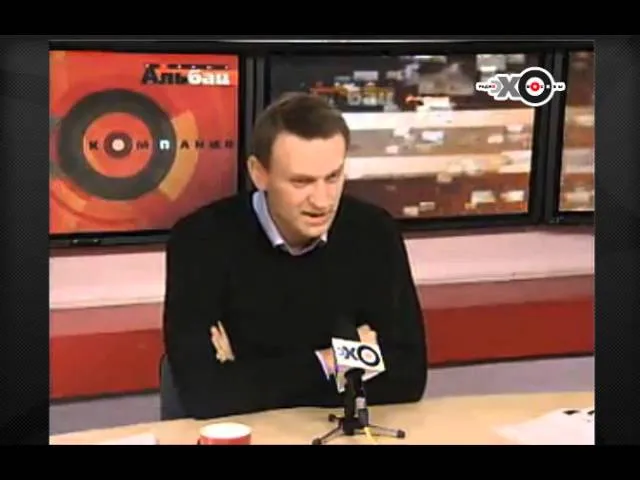
Alexei Navalny on the program “Full Albats” dated October 29, 2012
television company
RTVi and Echo of Moscow radio present
the program Full
Albats. Good evening, 20:07 on the air.
on Echo of Moscow radio and the television company
RTVi. I am Yevgenia Albats, and as always on
Mondays I begin the program
devoted to the key events of the week, the
events that will have an impact on
politics in the coming weeks and months. And at the
end of last week, on Saturday, there was the
first meeting of the Coordination Council
of the opposition. Let me remind you that the elections
took place on the 20th through the 22nd. A total of 45
people were elected: 30 people from the general
federal list
and 15 people from the liberal,
nationalist, and left curias, in order
to ensure representation
of different interest groups in the Coordination
Council of the opposition. The highest number of votes
43,790 votes, was received by Alexei Navalny. This
was something few people really doubted. Although
it should be noted that there was not such a sharp lead
over the others after all. For example,
Dmitry Bykov lost to Navalny by
about 5,000 votes. Be that as it may,
the first Coordination Council meeting took place under
the chairmanship of Alexei Navalny. There
a whole range of issues was discussed, including
the question of temporary rules of procedure, which
is of course very interesting. And on Saturday there was already
the first action held under the auspices of the
Coordination Council
of the opposition: one-person pickets that
stretched from Lubyanka (the square associated with the former KGB headquarters) to the Investigative
Committee
— a protest picket against political
repression, against torture, and above all
of course this is connected with the arrests
that took place last week, of Leonid
Razvozzhayev
and
and what happened last week. Yes, and
finally, Alexei Navalny was also detained
already in the status of chairman
of the Coordination Council, again on Saturday.
Four people were detained. If you
watch the video online,
it is quite difficult to understand what they were detained for
and a few hours later
they were released. But Alexei will tell us
how all this will end. Alexei,
hello, thank you for joining us. Good
evening. Yes, and my first question to you right away:
are you in fact now the permanent
chair of the Coordination Council, or how will
all of this be organized for you?
At the last meeting, a presiding officer was chosen.
That is, this is the person
who conducted the first meeting. The rules of procedure
have not yet been written, as you correctly said,
so it is unclear how this will be determined. But
as far as I can judge, the general
position of the members of the Coordination Council, and
mine as well, is that it should not have
a permanent chairman; rather, there should be a
presiding chair
for each meeting. There should be rotation. For example, one
person should not chair twice in a row.
That is, it should not be possible to form a majority of
28 people and keep choosing someone all the time,
me, or Yashin, or Vinokurov, or
whoever else. There must be rotation. I think this
would be the right approach, and most likely
such a decision will be adopted. Is it already clear how
the Coordination Council will be structured internally?
Will there be factions there, or will there be
committees? What kind of structure is becoming clearer?
Well, 45 is no small number indeed. Forty-five
people is quite a lot, considering that the
structure itself already includes
factions, yes, because there are nationalists,
liberals, and leftists. I do not think a decision will
be made that factions will have
any kind of advantage compared with
other groups or associations. But nevertheless,
from the outset people have already grouped themselves somehow.
These issues must be approved in the
rules of procedure. At the first meeting we
devoted some time to this. But the greater
part of the time we discussed the
action program on political
prisoners, which is generally quite
understandable. People who are more experienced when it comes to
conducting meetings, of course,
understand that the rules of procedure come first, but
a large number of our voters
were simply demanding from us some kind of
immediate action, perhaps even
symbolic actions in defense of political
prisoners. Therefore this was the priority
at the first meeting. Right now we have
several people in the Coordination Council
who love thinking about rules of procedure
and understand this very well, and now
there is a discussion underway. We are using a system of absentee
voting, but nonetheless public
voting. These 45 people do not necessarily
have to vote and decide things only
at a Council meeting. Some provisions
of the rules of procedure can be voted on
remotely, and then finally
approved at an in-person meeting. I think
that the structure of the Council will be as
democratic as possible. There definitely will not be
any domination by a faction or
to govern the entire council on behalf of
some council of factions or something
like that. We will try to avoid all those
formats in which some people,
having formed a majority, will impose
their will on others, because we understand
perfectly well that in a public body like this
by its very nature, it will simply quickly come to
a split: some faction will break away if it
is ignored, if they simply
steamroll it with a majority. They will simply say,
"Why are we sitting here? We were elected exactly
the same way as you were. Maybe you have
a majority, but if you keep pushing us aside, we
will simply leave." And of course this must
be avoided. We need to avoid everyone pulling
the blanket over themselves
and suppressing the minority.
But nevertheless, we need to look for
some kind of compromise solutions, we will have to
look for them. But some kind of, well, I don't
know, coordinating council, some kind of
politburo, are you going to form a politburo?
There is an opinion that
it is necessary to form some kind of bureau. In
any case, 45 people need to have
governing bodies at least in order to
conduct meetings properly so that there
is no chaos. After all, there has to be some
procedure for decision-making, voting, and
so on. There are various forms; one can
form a bureau. The question is how to
form it there: ten people, the first nine
by vote, or simply elect them?
Is it necessary to give some representation
to these very factions and curiae
which, in a vote of 45 people, most likely
will not get their representative through if we
directly elect ten
people? I believe that at this stage we
quite sufficiently need a responsible
secretary, or two responsible
secretaries. The fact that one has now been elected from
among the council members and one from outside the council
who will handle technical issues,
where we meet, how we meet, taking into account that
I hope we will be able to resolve
most issues, including through
an electronic voting system.
Democracy 2, after all—the council
was formed on such innovative
principles: people voted directly,
elected these people. These people can, on
most issues, vote directly
We do not need a permanent body,
this very bureau, because it is simply like this:
you know that an issue is on the agenda,
it is urgent, you take out your computer
or mobile phone, review it, vote, and
within half a day we have a decision. First of all,
everyone else can see how
they voted. Do you mean, well, this
Democracy platform? Well, any, any
electronic voting platform
that is verified here by only 45
people. It would be right if
the 86,000 voters could see how
their
representatives vote. In a democracy, yes, yes, I
think that is right, except for personnel
matters, where of course a secret
ballot is required. You mentioned that you had
two responsible secretaries elected: Nekrasov, not a member
of the Coordinating Council, and Vinokurov, a member
of the Coordinating Council. You probably
know that on social media there is already
a discussion on this topic: why at
the first meeting of the Coordinating
Council did a person appear who is not
a member of the CC (Coordinating Council), namely Dmitry
Nekrasov, who is part of the Committee
for Alexei Navalny's Civil Initiatives
and who worked in the expert directorate
of the presidential administration, and because of this
there is a great deal of confusion around the matter. So
please explain what happened and how.
In any case, we need one person or
several people who will prepare
the next meeting of the Coordinating
Council, so it was clear that the question of
appointing a responsible secretary would
come up. A number of colleagues—Ilya Yashin, Kasparov,
and Gudkov, who was absent from the meeting—they
proposed Nekrasov, whom I
do not know well, but he generally makes
a quite decent impression. Yes, he has
some experience working in that
presidential administration,
but he gives the impression of being a sincere,
reasonable person, capable of dealing with all
these bureaucratic matters. They put him forward,
they proposed him to the council. I think that
as a result of the fact that there were no
preliminary consultations with a large
number of council members, they
felt, well, a little bit
left out—as if a piano had been dragged out of the bushes here (a Russian idiom meaning a conveniently staged surprise),
and Nekrasov did not get through alone. That is,
he was not elected sole
responsible secretary; added alongside
him was Alexander Vinokurov, who
is a member of the Council. The two of them now
are these responsible secretaries
on a temporary basis, until the rules of procedure are adopted. That is,
this is for one or two meetings, I think.
It seems they are already quite sufficient as they are now.
They have been working successfully already, and Nekrasov
prepared the transcript of the meeting
a high-quality one, the very next day, that is,
the process is underway, it’s all working, and does it not
bother you that this is a person who was not elected by anyone?
Unelected. But what do you mean? Well, people did, uh,
vote for him, since he was
a candidate, but nevertheless he was not
elected, and suddenly he appears in your structure.
It is inevitable that, one way or another,
the Coordination Council will
interact with people; it will
form a so-called executive committee, or
maybe it won’t. In any case, there will be people who
will do things, implement one or another
projects. Obviously, these people are not
members of the Coordination Council,
but they can work for it for free
or for pay; that is simply
an executive committee. And if for pay, where will you get the money?
If money appears, if, if
let’s suppose something is being implemented, we, we
we definitely will not pay salaries
to anyone at all. If
one project or another is being implemented and
we need to hire for that project
an expert, for example a lawyer,
the Coordination Council is already now
planning to pay for lawyers
there.
Razvozzhayev needs such services, I think.
As for Lebedev, it’s unclear what is happening there with
the lawyers, so certain
people in particular areas of work
the Coordination Council will definitely
pay, and of course the council will
need, I don’t know, a press secretary;
it needs someone who will work on the website,
do something with it. For the most part,
90% of them will be volunteers, but one way or
another we will have to bring in some
professionals. And now,
you know, in his work “The Powerless” (likely referring to Václav Havel’s essay “The Power of the Powerless”),
excerpts from it were published in the magazine in
the previous issue. He believed precisely that one should not
create bureaucratic structures,
that if, in dissident times,
organizations begin creating
bureaucratic structures, then it all goes
to waste; that in fact there should
be public councils of this kind, and all
questions should be put up for the broadest possible
discussion, and this was under conditions of a fully
totalitarian Czechoslovakia. On the one
hand, that is true; on the other hand, you yourself
said that procedures matter. When people
sit in one room and vote,
make decisions, then either there is
a strict set of rules, as is done in the EU,
with people responsible for drafting those
rules, or it does not happen. Well,
for example, with the meeting transcript, a question may arise:
for a given decision,
did 25 or 24 people vote for it? You need
to pull up the transcript, you need to check;
someone has to prepare all of this.
Naturally, there is no need to create
meaningless bureaucratic bodies,
and I am a strong supporter
of the idea that the Coordination Council should
work, well, according to a project-based
principle. Everyone should understand very clearly
what the Coordination Council is doing. If it
claims to represent those
people who are not represented in
the State Duma (the lower house of Russia’s parliament), and I see it exactly
that way, then it should say: right, here is what I am doing.
I have a track dealing with political
prisoners; here I am forming election
commissions with voting rights; here
we are dealing with local elections;
if necessary, here we will support
or not support this or that mayoral
candidate. Here are the responsible people
who deal with these matters. Here they are,
doing concrete things. So there is no need
to breed paid bureaucracy, but in
any case, procedural rules
must be very strict and must be
understandable to voters. Because if
the Coordination Council, or some of its
members, do something wrong, those people
will bear responsibility, including
in the next elections. They must answer
to their voters, and the voters
must understand very clearly how they
will know and monitor what those
members of the Coordination Council for whom
they voted are doing. Without procedures, without
some minimal executive committee, this
cannot be done. And do you have any
recall procedure? For example, can voters
recall someone? No, that is not provided for.
Again, when we were creating all this, we proceeded from the idea that
there should be as few
restrictions as possible and as little
regulation as possible, and the main
principle of the election commission’s work
was simply reasonableness and an attempt not
to control things that
cannot be controlled. So of course
many things were simply not spelled out;
it never occurred to anyone to specify them.
All of that will be added. As of today,
There is no recall mechanism provided for. And
to wrap this up, when will the
next elections be? Have you already set
some date? And the Coordination Council was elected
for one year, for one year. That is, exactly one year from now
exactly one year from now everyone will lose their
mandates. All right, a great many
questions have come in here—235 of them. I tried to
more or less
systematize them. So, the first one is about
what the
individually.
Coordination Council will be. You have already said
and listed that, and now you are being asked
by Ilya from Yaroslavl: What real
capacity to oppose the authorities does it have,
or plans to have, the Coordination
Council? The Coordination Council was elected
in order to coordinate the actions of
those very people or groups who do not
agree with what is happening. Therefore, we
have exactly the same capabilities
that ordinary
civic activists have.
We simply need to combine
these capabilities properly and do certain things
that, for example, people in the regions cannot
do without help from Moscow. Well, here is
the simplest example for you right now:
as I already said, election commissions are being formed.
They are being formed for five years
under the new law. United Russia wants
to form them in such a way that even
if some changes occur,
or political upheavals, they will still have
commissions packed with their people, and everywhere
they will always, if necessary, be able to
tweak something there. So our task now
is, first of all, to recruit thousands of these
people, prepare all the paperwork for them,
and send them to these election commissions.
Of course, there is no guarantee that these
people will be included in the commissions,
because only
political parties represented in the
State Duma (the lower house of Russia’s parliament) have guarantees. Our task here is to organize
a certain level of political pressure,
of sufficient intensity. For example, in Moscow
an election commission is being formed, and we
will draw up lists, and before Mayor
Sobyanin and the Moscow City Duma we will put
the question directly: we demand that all
our people be included in the election
commissions. We will work on each of these people
individually.
The Coordination Council has hundreds of times more
money and visibility than simply scattered
groups that deal with this, and so
on. Understood. The same Ilya asks you
many people claim that the Coordination
Council was conceived primarily for
you, for your group from RosPil (Navalny’s anti-corruption project). How
are responsibilities distributed among
the elected participants, if
someone
They are distributed in only one way:
everyone writes their name next to whatever
they want to work on. When I
was preparing this action plan related
to political prisoners, well, I
drew it up at my own discretion and
assigned names there at my own
discretion. It was, it was
adopted, but the task of the other members of the Coordination Council is simply
to look through it and choose from the list: I want
to handle fundraising, I want
to handle information and campaigning
work, I want, I don’t know, to write letters to the UN
or to the European Union. Simply, every
member of the council can add or not add
their name and can work or not
work. We do not have any apparatus
of coercion. These people do not receive
a salary. Maybe they will do nothing at all;
then their voters probably
will not vote for them
next time. The degree of activity each person
determines for themselves, and any member of the Coordination Council
can put forward their own project
and carry it out alone or together with someone else.
Will you publish somehow, or otherwise
make public who in the Coordination Council is doing what?
Yes, that is necessary, and I will insist
on it. I believe there must be
an absolutely complete report, first of all on
attendance statistics for Coordination Council meetings, who
is doing what. I believe that for every
action plan there should be regular
published reports. Well, I am simply
used to this, because in the
Anti-Corruption Foundation, in RosPil, in
our projects, that is exactly how we do it:
first we say what we plan to do—
first, second, third, twenty-fifth—
and after some time we publish
a report: this is what we did, this
did not work out. I believe that the Coordination Council
and its members must act exactly
like that, and they must be accountable.
It is not enough just to say, ‘We will organize something
wonderful.’ Two weeks later you must
explain to everyone whether you organized it or not, and if not,
why it did not work out. That is the only way it should be.
That is how everything should be built. Here is another question for you; I’m not
naming everyone—there are so many different
people. Another question for you:
A lot is being said about politics. Will there be
specific economic programs
for development—will you be working on that?
Will programs be drafted
for political reform, which was discussed by
Ilya Yashin during the election campaign? There are
different views on this issue. For example, Ilya
Yashin said during the debates that it is necessary
to write various programs, to develop
what is called a positive agenda, while
interestingly, for example, Andrei Illarionov
from whom, generally speaking, everyone expects
the drafting of some kind of programs, for example, and
so on—he believes that doing this
is completely pointless right now because
the CC (Coordination Council) is not a governing body. It cannot
develop some wonderful
state program and then somehow
implement it. The task of the Coordination Council
is to fight for basic rights, to ensure
that fair elections take place, as a result of which
a government will be formed
that will then be able to write
programs and develop them. Just because we
in the CC now write a detailed pension reform plan
—how can the CC work with that?
Its individual members can do so perfectly well. For example,
Yashin, Gudkov, and
Nekrasov, who is the executive secretary,
are writing something there about pension
reform, but doing this on behalf of the CC? I don’t think so.
It seems to me there will more likely be some kind of
middle-ground option. It is possible that the CC, in
its own name, will submit one or another
legislative proposals. That is, it will be
a practical matter—not writing broad concepts
for reform, but drafting and proposing
bills. Thank God, we have
deputies who can officially submit these bills
on behalf of the CC in one area or another
if someone is willing to write them.
Still, this needs to be understood: it is a very
complex and substantive activity. Everyone
seems to think, “Well then, go ahead and write
a reform of the Ministry of Internal Affairs.” But people spend entire days writing
such a reform of the Ministry of Internal Affairs. All right, for example, I
analyzed how members of the
Constitutional Council answered
various questions—the 25
questions of the political compass. It is an incredibly
interesting thing, I must tell you. The
absolute majority—that is, more than 87,
if memory serves me right,
of the council’s members—spoke in favor of
a parliamentary republic, for example.
So, are you going to discuss these issues
in some way or not? I think this is
simply a political position. You are asked,
right? That is why it is called a compass:
please indicate, in general, which
direction you are looking in. People indicate their
political position, but just because
within the framework of that political
position we now write a draft of a new
constitution—because naturally such
things are regulated by a new constitution—should
the CC be doing that? I don’t think so.
I see. That would just be Manilovism (idle, unrealistic dreaming). And by the way, in
your political compass there is also, interestingly enough,
that same kind of Manilovism:
the same people are in favor of
keeping the flat income tax rate
—that is, 13%—and at the same time they also say
that there should be free
healthcare and education, and you simply
find yourself at a loss, wondering: how do they think
free healthcare is supposed to be paid for
then? I would refer you
to the head of our state, Vladimir
Vladimirovich Putin, who says
exactly the same thing: let’s keep the flat
tax rate, let’s not raise the retirement age,
we’ll make everything free, and
we’ll also build Sochi for 1.4 trillion rubles (about 1,400 billion rubles).
No, no, no, it was just amusing.
And will a shadow cabinet be created
on the basis of the CC? I think not; it is
unlikely. One still has to understand that
there have been many attempts in Russia
to create shadow cabinets.
For the most part, these attempts looked so
naive and a bit ridiculous; after all, they are
led by groups of like-minded people,
ideological allies.
Imagine a shadow cabinet in which
Udaltsov, Illarionov, Nemtsov, and
that same Yashin are all standing together.
That would be a rather dubious shadow cabinet.
So I think that is unlikely. In other words,
you will not be doing that? Well, at
least I will not be coming forward with such an
initiative. I am speaking here only for
myself. I am one of 45 people. It would be
very—oh, come on, what do you mean one of 45? You are
the one everyone wrote about, saying that the CC elections showed
that you are the undisputed leader, at
least of those 86,000 people who
voted. Well, I am very grateful to those
people who consider me a leader
and who voted, but that does not mean
that I can somehow impose
my own [view]. Look at the list—these people
quite independent, like Gelfond and Kasparov
Vinokurov or Nemtsov — they are ready there
to dance to my tune? No. And the degree of my
influence, if I go beyond any
reasonable limits, will, frankly speaking,
decrease proportionally. Therefore, I do not plan
to come forward with such initiatives, and
I do not want to impose them either. Understood. We have
one more minute until
the break. So, Piontkovsky at the beginning
of the meeting proposed organizing a forum
for everyone interested in supporting
the Coordinating Council. By the way, most of those asking
questions watched the broadcast from the first
meeting of the Coordinating Council. Is it possible
to register on such a forum
for citizens living abroad, and
by what means? As I understood Piontkovsky’s idea,
in this sense, I
share it; I think it is shared by
the majority of the Coordinating Council members. We need
to continue this registration. That is,
170,000 people completed the initial registration,
86,000 people completed verification,
and slightly fewer voted. I believe that
a person’s inclusion in this system at all
is an important form of self-identification. You
simply join a certain group
of people and show that you are with them,
that you are like-minded, and we need to continue
to build up this, this thing that
Piontkovsky calls the Forum
of Free Russia; I simply call it
normal active citizens.
Quite simply, we must continue this
work and keep registering them. We
are now going to break for the news and then come back
live in the studio.
Moscow — the network, video, and the internet are working.
Working.
Aha, I wanted to show you — I sometimes
write material for you, but you do not
read it. How so? It happens. Why? Well, I cannot
say that I read every time from
the short ones. Yes. And I did not read the one on Georgia. Show me.
This one.
Hello.
I receive these — today I received again
from...
shows that you
receive... My first reaction was when
first of all, I am interested — I want to tell you
that when Obama
won, every, every one of his voters
received — not voters, but everyone who
was registered received from him an absolutely
standard letter, just saying thank you.
...
You provide them when registering, but
it is still a feeling when you get a letter
for the first time signed
by one of the members of the Coordinating Council. But no,
no one thanked those 86,000 — there is no database, that was
a matter of principle. We cannot
take and send something out to these people, and
the candidates certainly cannot. Maybe the Central Election Committee
can do something else. The database is closed. That is,
I do not know the people who
voted for me, in the sense that
I do not have their addresses, I cannot write anything to them, and
otherwise it would be a database into which anyone could
get access
and spam phone numbers. And ours are not linked
specifically — Volkov can explain this in more detail.
It was done this way precisely because of the ban on
storing personal
data. It was set up there in such
a way that the data, as they are received, somehow
are immediately converted into some kind of
electronic form that can no longer
be reversed. That is, there is no link there
between a given phone number and, say, Yevgenia Albats (Russian journalist) or a given
email — that does not exist. That is, you can do
statistics on phone numbers, for example how many
people are from Moscow and how many from other
regions based on area codes. But there is no
direct link, because we were afraid that
the database would be stolen; we were afraid we would be accused of
storing personal data, and so
on and so forth.
We were also afraid that later someone might
manipulate that database. You know, like
it was before — remember, everyone registered and wrote
letters of support, and then somehow
they started getting spam or something like that. Well,
these are exactly the kinds of unpleasant situations
that, in order to avoid them, we decided from the start not to do any
of that. I insisted on that as well,
because everyone keeps shouting that Volkov
is my friend, and therefore supposedly you and he
would take the whole database for yourselves. I do not have
any database. There really is no database,
none.
If possible, a bit shorter, because there are very many
questions. Please, just a bit shorter.
Because there are very many
questions.
Program.
Good...
About what the Coordinating Council will be doing,
of the opposition, what resources
it has at its disposal, and how they will generally
organize the whole life of the Coordinating Council.
And specifically, Alexei, here a question has come in
that I should have asked you from the very beginning:
what is happening with the criminal cases
that — there was a criminal case
opened indeed when it became
clear that the elections would definitely take place.
The Investigative Committee showed some kind of
enormous interest in the work of the Coordinating Council and
swiftly opened two criminal cases,
one on suspicion of fraud, allegedly
the theft of funds that had been contributed
the candidates—one case over allegedly improper
storage of personal data, and both that and
the other are complete fabrications and nonsense, but they
are making life very difficult for the chairman
of the Central Election Committee, Volkov, who today went
for questioning three times today,
for questioning. We very much hope that
since the elections have already essentially taken place and
they can no longer derail them this way,
these criminal cases will be closed
because, well,
they are ridiculous.
Well, one of the cases there involved
supporters of Mavrodi (Sergei Mavrodi, founder of the MMM pyramid scheme), who transferred
a contribution there of 10 rubles. It's a funny thing when one
of the biggest and most notorious fraudsters in our
country initiates a criminal case under the article for
fraud against Volkov. Well, they
sent their contributions through the Sberbank system
and then claimed that these contributions
were not being returned to them. But the system
is such that Volkov and the election committee simply see
that it can't be done. If you paid by receipt, not
from your own account, those funds cannot be returned to you
automatically. You have to submit an application.
That is why a public offer has been posted: whoever wants
their money returned should submit an application
stating where to send it, and then it will be returned.
But they are not submitting such an application, and to
this day they still have not, and still are not,
while demanding that a criminal case be opened. Their
money is sitting in Volkov's account,
the chairman of the election committee, who has no
way to return it because all
he knows is that from such-and-such
Sberbank branch, a person came and by
receipt made a payment. Where is he supposed to send
that money? And do you think this was an initiative, or
not? Of course. He is a fraudster against whom
criminal cases are being investigated.
You can go to the website
of the bailiff service and see there
multi-million-ruble claims against him
that have been upheld. He is completely bankrupt, and he
is simply selling this human resource of his
to the Presidential Administration
in order to derail the elections. Moreover, as
it turned out, this resource was not nearly as large as
people said it was—they talked about
hundreds of thousands and so on. It's an amusing
thing, by the way, because
one of the main concerns about online
primaries, and primaries in general, that
was always voiced, was that the Nashi activists (pro-Kremlin youth movement) would come and
vote in a coordinated way and win everywhere. But
it turned out there are no such Nashi people at all.
There simply are no actual people who can
show up somewhere and do something on behalf of the authorities.
They don't exist. That is precisely why they turned to
Mavrodi, who was able to get his people
to do something—but even that was under
financial coercion. After all, he
blocked all the members of his
pyramid scheme from accessing their personal accounts until
he effectively annulled their
money there—the virtual money in their accounts—until
they carried out some
hostile actions against
our elections. And how do you know that
someone approached Mavrodi, rather than it being his own
initiative? Do you have some kind of inside information? No,
there is no direct insider information of that kind, but
there is no other explanation. Why would people
united, first of all, by the fact that they are
crazy and joined a financial
pyramid scheme in which they all obviously
lost out, do this? It's absolutely ridiculous.
Mavrodi is a man who could be sent
to prison at any second. They have him there
not just on the hook, but on 120 hooks.
I repeat: go to the website of the
bailiff service, and in the public domain
look at the huge number
of claims against him. He is simply dancing
to the tune of the Investigative Committee,
trying to bargain himself an indulgence, but
all the same, he did manage to make life for the elections
a little worse—undoubtedly he did.
First of all, there was indeed interference by him
with both the candidates and the voters, and of course all this
is being used as a kind of
PR framing. It's very
interesting—I even posted on my blog today
reports from Channel One, Channel Two,
and NTV, and everywhere they keep going on and on about
Mavrodi. In other words, they are simply trying
to link our elections with these kind of
marginal phenomena. Well, among other things,
mmm, the average person doesn't really understand
what sort of elections these are; it all gets mixed into
one big mess—some kind of opposition,
people mumbling and arguing about something. That's what this is
for. Will a party be created
on the basis of the Coordinating Council? That's a question often asked,
and whether there is or isn't any desire
to join Prokhorov's party.
It is obvious that no party
can be created now on the basis of the Coordinating Council. That is precisely
why the Coordinating Council is being created—because a party
is impossible, at least an ideological party is impossible at
least at this
stage. Completely different people, as I already
said—Nemtsov, Udaltsov, and Illarionov—cannot
be members of the same party; never.
will sign on to a single platform, as for
working with Prokhorov's party, with
everyone
parties. If Prokhorov's party
really gets going and operates
independently, that would be excellent. So far
unfortunately, over the year of his
previous political activity
we have not seen any independent actions, unfortunately
at all. Well, maybe everything, everything
is changing. Maybe he will be more
independent, do well, run in local
elections, take part somewhere. All right, you had
uh, an electoral bloc in the Coordinating
Council elections called Civic Platform
Prokhorov's party is called Civic
Platform. At the party congress on Saturday
Sergei Parkhomenko was present, who
was in fact the organizer of the bloc
Civic Platform. Everyone noticed that.
It's just that everyone loves the word "civic".
You see, nobody likes the word "political,"
so everyone likes to pretend
to play dumb and say that we're so
civic. The fact that the bloc was called
Civic Platform and that it was organized by
indeed by Sergei Parkhomenko and Ksyusha
Sobchak seems to me to be just a coincidence.
Again, in order to empha
size
in order to emphasize that they are not
like that, they call themselves civic.
Sergei went to that congress. Well, there were many
people there toward whom I feel very
positively; they went there as
guests to see what kind of congress it was. But are you
not planning to establish any
relations with Prokhorov's party? We are planning to.
The Coordinating Council is 45 people,
each of whom can establish relationships of any
degree of closeness with Prokhorov.
The Coordinating Council as a council
does what it is supposed to do.
So for you it is still an umbrella structure?
Yes, for now at least, yes. Well,
of course Parkhomenko does whatever he
wants on his own. What kind of
discipline can there be? These people were elected, and they
are accountable only to their
voters, so my opinion to them—
just imagine, if I say to Parkhomenko
or Sobchak, "Sobchak, please don't go to
these parties, they discredit
the Coordinating Council"—what do you think she'd say to me?
She would tell me something that on the air
on Echo of Moscow (a Russian radio station) it would be
impossible to repeat. And she'd be right, because these are
45 people who were elected in their own right. All right,
one more question.
From Boris Batalin, about
relations with the systemic, systemic
parties. In particular, he writes that
both the Communist Party of the Russian
Federation, Zyuganov, and A Just Russia
Mironov have sworn loyalty
to the authorities and said they would have nothing
to do with the KS. And do you actually
intend to discuss anything with
the parties that are represented in the
State Duma as needed?
As needed, yes. I already gave an example:
for example, with observers who have
full voting rights. The parties have them,
but in reality they don't have the people. Even if they
don't claim otherwise, still
they have a quota, and under that quota
people are guaranteed to get in. So I
think we will approach them with questions, yes,
so that they give us a quota. Whether they will be allowed to or
not is another
question. I think that in fact, in some ways
they rather sympathize with the Coordinating
Council, and in some ways are jealous of its political
activity, but they are simply forced to make
one statement or another. Those statements
determine the flow of financing
and so on. Uh-huh. As for the rest, I
am skipping the questions here concerning, uh,
Civic Platform. I've already asked those. Here is
another question, which is:
So, how do you plan to mark
the anniversary
of the protests? The author writes that it
seems to him that there is no need for another march. Was this
discussed at the Coalition Council? Could it
be better to organize on
Democratia-2 a signature drive
demanding new State Duma elections? If
100,000 signatures are collected, we remember
that Putin said an initiative could be submitted
if 100,000 signatures were gathered.
Well, that's the initiative. What do you
think about it? As for the 100,000
signatures, that is a wonderful Putin initiative
that has not been implemented, like
other wonderful Putin
initiatives. There is nowhere to submit those 100,000
signatures; it is not set out anywhere. He simply
said it on television, and that is where it all
stayed at that stage. It is impossible to submit them anywhere.
You cannot submit 100,000 signatures anywhere. That's the first point.
Second, some kind of action will be held
to mark the anniversary before the end of this year.
A decision on that has been made. What format it
should take is something to choose carefully; there really should be
an action. Well, people will come, I think, in
fairly large numbers, but
We probably need to be more
inventive, because this kind of
straightforward, head-on rally, our traditional one,
which people do of course attend,
they stand there shifting from foot to foot and
just stand there because they feel they have to
go to rallies. We need something more
interesting. Maybe it will be a concert, maybe
a march, I don’t know. In our group, in the
Coordination Council, there are enough
creative people whom
I personally have high hopes for, that they
will be able to come up with these things. Personally, I
am not capable of coming up with them. Uh-huh, all right.
And Alexei, am I mistaken, or have you really
sat down—I don’t know, maybe the picture
froze, there seems to be no video. Uh-huh. What
is happening with your Kirovles case?
This is the case about the life and work of Alexei
Navalny. They are interrogating various
people who worked for me in 2000–2001
last week. Well, they worked in
one of my companies.
Last week they questioned a guy
who used to go to the gym with me at
college; I last saw him 6
years ago. How they even found his
phone number, and why they questioned him—he
called me in total shock and said,
they summoned me for questioning here. They questioned
him about the gym—well, I don’t know what they could
even have asked him. They also questioned
my assistant, who worked with me at
Yabloko (a Russian political party), that is, several years before
I went to Kirov, they questioned her.
More than that, they questioned some
current boss of hers, whom I have never
seen in my life, I don’t know his name, I don’t even
have any idea what he does. In other words,
this is not even some kind of broad
dragnet—they are simply, in some kind of
chaotic and incomprehensible way, trying
to find at least something. If someone wanted to write a book
about you—well, apparently he would have plenty of
material for that book. Most likely,
they are trying to find some person
with whom, somewhere along the way in life, I don’t know,
I had a falling-out or parted ways, so that this person
would hand over some terrible
dirt on me. I don’t know whom they are trying
to find there. So far, out of this terrible dirt,
there is only the endless claim that
I improperly obtained my lawyer’s
status, and that they are challenging this lawyer’s
status. And this is being stated not by the investigation itself
but by the newspaper Izvestia, to which
the investigators leak information.
Moreover, in order to strip me of
my lawyer’s status, they have been talking about this
and threatening it for many months. They simply need
to apply to the bar association, but they
for some reason are not doing that. Well, they should have
applied already and finally received
what would probably be a rejection from there, and that would be that. So, what about
the case itself? Nothing is being done.
Still, despite the fact that everywhere they
claim that I am accused of stealing 16 million
rubles, they have not even conducted a forensic accounting
examination, which they are obliged to do. That is,
where did this figure come from, other than
someone’s fevered imagination? This is trading turnover
between—well, meanwhile, there should be
an expert examination. In such cases, the amount of damage
must be determined by expert analysis. In the case file
there are two expert reports; both said
that this was not theft but the causing of
damage without signs of theft, first in the amount of
1,200,000 rubles, then in the amount of
530,000 rubles. Now it has grown to 16 million
rubles, and there is no expert report; we keep
waiting and they keep not conducting it. But instead they
are questioning various people who used to
go to the gym with me. 530,000—what,
is that, something you put in your own pocket? No, it is
the amount of damage I allegedly caused without signs of
theft. Without signs of—so no one is accusing you
Am I understanding correctly that no one is accusing you
of having put something into your own
pocket? Earlier they were not; now they are already accusing me
of specifically stealing. No,
of organizing a criminal group
that stole 16 million rubles. And the travel restriction
is still in force? The travel restriction
is still in force, which causes
me inconvenience, but what is really the subject of
my concern is this unfortunate man,
Pyotr Ofitserov, who in their case
is listed as my accomplice. He was
the head of the Vyatka Timber Company, yes.
He earns his living by
traveling and conducting seminars in the regions, and they
until a certain point would let him travel on the basis of a separate
letter, but now they are simply
effectively destroying his business. They are not letting him
go anywhere. He has five children,
he cannot travel anywhere, he cannot
earn money. So apparently
in this way they are trying to squeeze something
out of him, perhaps. But this is already
completely outrageous behavior.
I see. What are the results of the dispute with
Bastrykin
do you mean
the Czech agent Bastrykin? The case is ongoing.
for us, the Basmanny District Court
the Investigative Committee refuses
refuses to check anything, so we file
against it with the Basmanny District Court, and the Basmanny District Court
refuses to consider our complaint
we are pursuing this investigation in different
directions; in particular, an interesting thing is
that
we
those European universities that
Bak(in) said had allegedly invited him
Well, we have already received replies from two
universities saying that
they know of no scholar named Bastrykin; we don't even
in principle know anything about
the existence of any such scholar, Bastrykin
let alone that we invited him. There is
an investigation in the Czech Republic, and we continue
to dig through various notarial
documents. It is a long process; each
letter gets a reply within a month, but we
will keep at it no matter what
Boris, regarding your investigations
into Transneft and VTB and so on, all of this
is still in progress
and the police keep closing these cases
We keep trying to get them
to reopen them. As for VTB, I will
write, and I think we will soon publish
some new interim
results. That is, on the one hand, we
have already strengthened this entire body of evidence
as much as possible; we have basically
exposed everyone there, we have all the facts, but
we cannot force the FSB, the police,
or the Investigative Committee to go after these people. Here they are—go
we have already found everything, just go and
arrest them. Let them write confessions
for real; there is no need to torture anyone there
because we have already nailed them all
but the Investigative Committee is busy
simply protecting them from us
Unfortunately, we still cannot storm VTB or Transneft
just yet. Maybe
the Coordinating Council will make some
decisions on this matter. Will you
run as a candidate for Mayor of Moscow?
First, the election still has to take place; let's wait
until that moment before making a decision. And the beauty of
our Coordinating Council elections is that
I believe we have now
worked out a mechanism by which
lists should be determined and formed
for elections, for mayoral elections and so
on. That is, we should elect
a people's candidate, and that people's
candidate will be supported; he
really needs to be elected, not simply
appointed. All right, one more question. Vladlen
three
six. I voted for you in the Coordinating Council elections
By the way, you, Chirikova, and
Bykov were the only non-left-wing
candidates I chose. So this is
apparently a person with left-wing views. Yes,
I took part in practically all the mass
rallies, but among my comrades, you as a
possible single candidate of the
opposition are not trusted. The main argument is
that there is no guarantee you will not become a new
Yeltsin or Putin—that you are fighting
individuals rather than the system, and in the event of
victory you will act just like the old
liberals, that is, you will sell out
democratic mechanisms for the sake of
holding on to power, as happened in the 1990s
What should I tell them? Well, first of all, I am grateful
to Vladlen for voting for me after all
despite such doubts
and suspicions. It seems to me that I try
to make all my activity
say exactly the opposite. That is, yes, I
fight specific people, but I fight
the system as embodied by those specific people
using concrete people, cases,
and investigations, I show how the
system works, and I show everyone very
clearly. We are also engaged in systemic
work in those areas where something can
be improved. Yes, despite the fact that this whole
entire system of power is arranged in such a way that
nothing can be improved, even our small
efforts matter: we draft amendments
to the law on public procurement, to the federal
contract system. That is, wherever we can
try to improve the system, we improve it
that is, our activity is entirely
systemic and aimed at
fighting these people
comprehensively
but investigations into corruption
must be specifically directed at
specific corrupt officials. That is, you cannot
just shout everywhere that there is
corruption, corruption; you have to say
there is corruption, these people are corrupt, I
accuse them of such-and-such. Here is our
evidence. So it seems to me
that through my activity I have shown many
people that my views are exactly
that: I want to fight the system
and build a better system. If Vladlen's
friends doubt that, then apparently I
need to work better in that direction
and I am trying to do that
And there are a lot of questions. Don't you think
it was a mistake that the opposition did not take part
participation in the Single Voting Day in
elections at the municipal level
and regional elections did take part, and
look, for example, in Saratov we had this situation
everyone united there, from Prokhorov’s side
Prokhorov, Yabloko, PARNAS, and some
smaller satellite groups as well, they
joined forces and said: we will give
a decisive fight in Volodin’s home region, and so on
but they got 1%, maybe 1-and-something percent. It’s clear that
a significant number of votes was stolen from them
of votes. Those were elections to the legislative
assembly, yes; in Barnaul, to the city
assembly. Major resources were invested there
and they got 5%, so they did take part
Yabloko also took part in Krasnodar
and got around 1%. It seems to me—I
don’t claim to have the ultimate
truth—but I’m convinced that this
focus on local campaigns
regional campaigns in the regions is simply
a pointless waste of resources and effort
because it’s impossible to win there anyway. Because
you’re not actually engaged in fighting
for the voter, persuading them; instead, you have to fight with
the police at the polling
station. That is, first you have to
fight for the voter, then you have to
organize monitoring, and then you’re still
thrown out of the polling
stations, and they simply rewrite everything in
the protocols. So in certain
campaigns, you need to participate where there are
strong candidates, where there is an opportunity
to organize at least some kind of oversight
Chirikova’s campaign is a typical example
large cities, legislative assemblies
in large cities. But to spread yourself thin and
say, let’s actively
take part in elections here in Saratov
is pointless; it’s impossible to win them
these are not elections at all, this is simply
these opposition parties, the so-called systemic opposition,
take part merely as backup dancers
and to create the illusion that in
Saratov there really were elections, rather than
simply installing specific people into the legislative assembly
from United Russia. Then how are you
going to come to power if you do not
participate in elections? We must achieve
a situation where elections look more like
actual elections; then, yes, we need to take part in them
I already said that, for example, elections
for mayor of Moscow are fundamentally important, and in
them one absolutely must participate
to form, through primaries, a popular
list, a people’s candidate. Elections to the
Moscow City Duma, the legislative assembly
of St. Petersburg, and so on. Elections, elections in
Yekaterinburg as well, probably—those are elections one should
take part in, elections for city mayors
Yes, but you understand, on October 14—well, in October
there were elections in 4,000 municipal
entities. To say that the opposition
will now go and somehow
participate in all 4,000 of them is impossible
simply because these elections
are organized by the state
by the state machine for the purpose of
reappointing officials; this is not
an election. Therefore, spending effort on this
right now is pointless. Well, Zhenya
Chirikova was here on the air at Echo of Moscow (a Russian radio station), on my program
and she said that the benefit
of participating in election campaigns is that
an opposition candidate actually
gets acquainted not only with their own
supporters, as happens at
protest rallies, yes, but with the broader population
and there is an opportunity simply to hear them and
for people who have never been part of the
protest wave to see opposition
candidates. There is sense in that too, there is
sense in that. Most often, these are mayoral elections
in cities, and where there is a strong candidate
one should participate. But we must acknowledge
the harsh truth that most often these
regional opposition elections are
simply, you see, parties like Yabloko or PARNAS
sell a franchise to local businessmen who
use that franchise in order to
try to get their own local
businessman elected. It has only a very indirect relation to any real struggle, to
the struggle for improvement; it has a very
indirect connection. And here there was also
a question: are you planning to run
when there are elections to the
parliament? That will be, let’s see, in
2016, for the State Duma
of the Russian Federation. Will you go into
parliament? Of course, we must participate
in parliamentary elections. For that, we
must ensure that there are
some parties registered. For that, we
must achieve
the possibility of carrying out
election monitoring. That is what we are working on now
so that we can take part in
elections and come to power through
legal procedures, naturally. But electoral blocs
are not allowed. Ah, yes, right now anyway
PARNAS and the Republican Party are registered
party. Listen, this is a political process
Naturally, if sooner or later there emerges
some genuinely independent
party, there will still be a whole bunch of spoiler parties
Uh-huh, all the same, they’ll still feed and bribe
some people who will also
call themselves the opposition and siphon off
12% of the vote, but there’s no getting around that
that’s part of the political process. So you don’t
believe it will be possible to change the government through
elections
I mean, here in front of me I have an issue of
The New Times, which writes about the latest
report from the Center for Strategic
Research, where
well, apparently right away
they speak of the prospects of a peaceful revolution
they consider the electoral option
unworkable; that is, precisely
through local elections right now
to come to the polls and defeat this government
is impossible, because there are no real elections; they
put themselves there
for example, the Tatars, the Mari,
the Udmurts, the Mordvins, people of the Urals, and the Bashkirs of the Urals
In general, the nationalities issue here raises quite
a lot of questions. First of all, I think very highly
of the Bashkirs of the Urals. And secondly,
why should I have some special attitude toward them
in particular? I treat all
nationalities as citizens of the Russian
Federation, if these citizens of the Russian
Federation
observe the laws and the established
public order, then I treat them
very well, absolutely all of them. And we have
very little time left—one and a half
minutes. So what are the immediate next steps
of the Coordination Council? What will those immediate steps be?
Do you already have a sense of what you’ll be doing?
The immediate next steps of the Coordination Council are
to implement that
multi-point program: defending
political prisoners—that is, not just declarations, but
a concrete program of action
which has already
been announced and will of course be carried out
adopting clear rules of procedure so that
there are no questions about how
the Coordination Council works, who influences whom
so that such questions do not arise, so that it is
absolutely clear. I think that
the Coordination Council should
form working bodies—groups or
commissions by area—that will
develop particular lines of work: a group
for organizing mass rallies, a group for
elections, a group, say, for
investigating corruption. And these people will
work and report back to the public on
what they are doing. Thank you very much. Unfortunately,
we have to leave the air now
and end the broadcast. I’ve already run a little over. Thank you
for coming, and good luck
all the best
I just can never get used to it