Alexei Navalny on the TV Rain (Dozhd) program “Direct Line” in 2013. Part 1
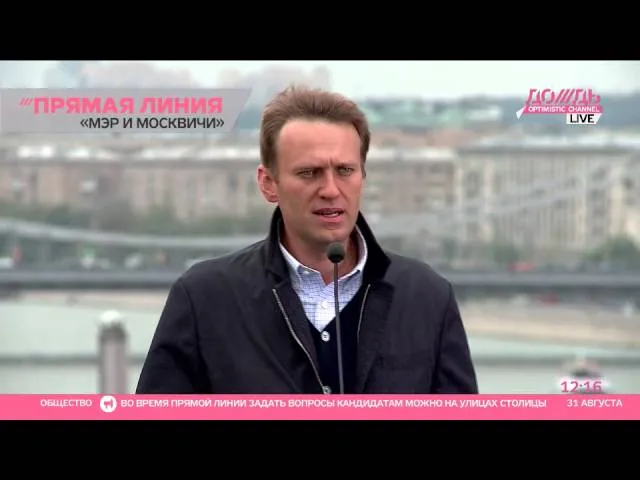
TV Rain and the city newspaper
Cityboom
present: Direct Line — the Mayor and
[music]
Muscovites. Hello, friends. Good evening.
Dear Muscovites, with the Moscow mayoral election
the first election in the past
10 years just a week and one day remain, and
that is why we are here. We are beginning our
telethon, our direct line with
the candidates for mayor of Moscow. We believe that
elections are impossible without discussion,
impossible without dialogue between candidates and
voters, and that is why all of us are here with
you today, and that is why today there will be
candidates for mayor of Moscow here. This is a campaign
event in full compliance with
election law. Invitations were sent to
all registered candidates.
Some responded, and they will
be here today. As for us,
we are now on the roof of TV Rain,
where the audience members are seated, whom you can
see on air right now. And on the fourth
floor, in the main studio, there are also
our viewers who could not fit in here,
and they too will be asking
questions to the candidates. And at three locations
in our beloved city of Moscow — at
Hermitage Garden — our
colleague Yulia Taratuta is there. Pavel Lobkov
is at Triumfalnaya Square near
Chaikhana No. 1, and Lev
Parkhomenko is driving around the city collecting questions for
the candidates. Unfortunately, our website has once again
been hit by a DDoS attack, the TV Rain site. So
it is better to watch us on Avocado or TV Rain
Live. And on YouTube as well — yes, we have a channel on
YouTube with a live stream you can watch. Well then,
let us welcome our first —
not guest, but participant — candidate for mayor of
Moscow, Alexei
[applause]
Navalny. Hello. Thank you very much.
Good afternoon, Alexei. Good afternoon, dear
friends. A brief opening statement. Well,
first of all, I would like to
thank TV Rain for this
opportunity to speak. Very often, when
I complain that television is completely
closed to me, I am always told: but what about
TV Rain? And once again, I have
the opportunity, the chance to appear on
TV Rain, for which many thanks to them.
These elections are very important for
Moscow, important for our city. As you
rightly said, these are probably the first
elections in years with at least some
real competition. And my team and I
are running in these elections because
we truly represent
an alternative to the government that currently
exists. We are running on a platform
that speaks about fighting corruption,
fighting monopolies, dignity, and
a normal judicial system. I am absolutely
certain that we can win. Today I am proudly
ready to answer your
questions, ready to present our
program. Please — any questions, tricky or
not tricky, critical or friendly — I am
entirely at your disposal. Thank you very much, thank you.
Let us determine
the format, determine the rules for
asking questions. Specifically,
the first question will come from Mikhail Fishman
of TV Rain and from our viewers
who sent questions on the website
TV.ru. Here in the studio, in the studio
on the roof of TV Rain, Nikita
Belogolovtsev is here and will help you
ask questions. Raise your hand and we
will point you out, and he
will come over with a microphone. And
today’s live broadcast is hosted by Ksenia Chudinova and
Mikhail Fishman. Alexei, I have the following question:
in your view, what is the main substance of
this election? Is the office of mayor of Moscow
an administrative position, or
a political one? Is there a difference between these
two
concepts? Is Moscow different from
any other city in Russia? Well, obviously
it is. Moscow is a gigantic city;
15% of the country’s population lives here.
Moscow’s population is, on average,
larger than the population of an ordinary country. Just
look at a map of the world — Moscow is a huge city.
Naturally, the office of mayor of Moscow is
a political office. In fact, we
are choosing not just the mayor of Moscow. We
are not only choosing how we will lay
pipes in Moscow, although that too is very important,
because right now pipes are being laid at
twice the cost they should be.
We are choosing a way of life; we
are choosing the political system of the future.
All political changes in the country
will happen or not happen depending on whether
Muscovites want them or do not want them.
Therefore, the most important part of this election is
that we are now coming out to vote
for corruption or against corruption, for
competition or against competition, for
rule by phone call in the courts or for
a normal judicial system, for whether
people should remain imprisoned in the Bolotnaya case (the criminal case against protesters after the 2012 Bolotnaya Square rally), or for
their release. This is a fundamental
choice, a political choice, and everyone
will have to make it on the eighth.
Thank you. Well, raise your hands if you
would like to ask something. Nikita, help us, please.
Your opponents accuse you
of having a fixed match with
Sobyanin. What do you say to that? To that I
would say that any person who
looks at my speeches, looks at our
program, perhaps looks at
today's, this today's speech
He will see that there is no collusion of any kind
there is no fixed match, and frankly I do not want
to say anything bad about your
respected candidate from the LDPR (Liberal Democratic Party of Russia), but when
the LDPR candidate tells me about fixed
matches, all I can do is
treat that ironically. We are running with a
real, tough alternative. We are not
just criticizing; we are proposing
practical solutions, and everything I am
talking about, from corruption in the
construction sector, corruption in
metro construction, corruption in housing and utilities, these are
specific allegations backed
on our side by legal action
that we are pursuing against the mayor's office. This is not
a fixed match; this is truly a choice
of alternatives before Muscovites. By and
large, the choice is
to choose Navalny or Sobyanin, to choose
corruption or the fight against corruption. That is
what these elections are about.
Let's move on, probably. Next, please.
Please stand up so it will be easier. Sergei
Koltovich, thank you very much. Alexei, very
interesting. Still, despite the fact that
you said these are political elections, in
any case the position of mayor of Moscow
implies serious administrative
work, and administrative
work, well, generally cannot be
done by one person. I got the slight impression
that your campaign is
something of a one-man show. So perhaps
tell us a little about your team. If
you suddenly succeed in these
elections, who will be doing what?
After all, with Sobyanin, despite
his somewhat
faceless style, with its pros and cons,
it is clear who does what. And who on
your team will be responsible for what?
Thank you, thank you very much. Of course, I am by
no means some kind of
lone politician. That is absolutely not
the case, and it never has been. Throughout
my entire political career,
perhaps I may be more visible against the
background of some of my colleagues simply
because that is how the media space is structured,
but both in the Anti-Corruption Foundation and in
all the projects I have led—RosZhKH,
RosPil, RosVybory—these projects could not
have happened if a coordinated team had not
been working alongside me.
As for the structure of our campaign and the practical
side of the election campaign, we have already announced
that we will name specific people in
the second round of this election. We
are confident that a second round is inevitable; it
will happen. I am already saying now that for
every area of work there will be a
special personnel committee that
will select the appropriate people. I assure
you that our team's кадровый potential is enormous
and we will be able to assemble not
just an alternative, but a superior,
better alternative to the team of supposedly
technocrats that Sobyanin prides himself on, but
in reality it is simply a team of the very
same old officials who
mostly came from Luzhkov's era, whom
we know to be implicated in corruption,
and to be ineffective. Right now they have simply
been given a light whitewash, you know.
These are not new technocrats; these are the same
people who have sat for 20 years in all those
prefectures and district administrations, whose work
we all know very well. And we are not
thrilled with that work. We have
a question from Dozhd's Twitter: Chichkov Mikhail.
Sorry, we have wind. What mode of transport
will you use after being elected
mayor
of Moscow? When I am elected mayor of Moscow,
I will use the same transport
I use now. I will
use either a car or the metro. I—
when I am elected, I plan
to continue living in the district where I have lived
for the last 17 years, in the Maryino district. The traffic jams
there are enormous, and even when I become
mayor, over the next 2 years it is obvious
that they cannot be solved radically in
such a short time, although I am sure that
there will be some significant improvements.
Therefore I think that for the most part I
will have to use the metro
simply in order not to be late for meetings
at City Hall. I understand that this question
of course implies
a flashing beacon. I am
a principled, principled opponent
of special signals. Whether by car or by metro—in
the metro I will not need a flashing beacon.
You understand, even if it were flashing on my
cap, no one would let me go ahead
in the underground
passage. I see a question from the audience, but
while Nikita is making his way over, let us, as it were,
take a women's question: How
will healthcare be improved?
asks Elena Buyanova, also on
Dozhd's Twitter. What is happening with Moscow
healthcare now? We see that
colossal sums are being allocated to it, but
there are no major improvements. Not
long ago, the Moscow government spent 100
billion rubles (about US$3 billion at the time) on the so-called program
for modernizing Moscow healthcare.
At the Anti-Corruption Foundation, we can
see very clearly why it did not
work: because these gigantic
sums were poured into capital expenditures, into
equipment procurement at prices far
above the market average. And this equipment
is just sitting somewhere covered with sheets.
no one can work on it. My
strategy regarding healthcare
is not crazy and useless
capital expenditures. First and foremost, it is
investment in human potential, in
doctors. We need general practitioners,
we need internists, we need
a sufficient number of doctors so that people
receive medical care on the very day
they seek it. The current strategy, where we
bought a great many CT scanners and ultrasound machines,
but there is no one to operate them,
simply does not work. I have already held, probably,
about 80 meetings now in Moscow districts. At
every meeting I ask: Please tell me,
is it easy at your local clinic
to get an ultrasound exam? And people
just shout in unison: impossible. So we
must make sure that doctors appear,
I will be the mayor who hires
doctors and works on improving their qualifications. They
are simply pointlessly buying
equipment in order to enrich
the purchasers of that equipment. Question. Well,
now we give the floor to the women. Valentina
Mikhailovna, LDPR (Liberal Democratic Party of Russia). Alexei, I have heard a lot about yo
we have many representatives of your
party here today. With pleasure. Thank you. As for me,
as a Russian woman and a mother, I want to ask
a question, assuming that you are already mayor
of Moscow: how will you address the issue
of the spiritual and moral upbringing
of young people? Back in the Soviet
Union, we had an ethics class at school; we
were taught how to behave, we were explained
what is good and what is bad. We
had two shop classes a week, you
understand. Russia will never
break through and move forward if we do not
develop the spiritual and moral
upbringing of our youth, because
that is... Well, I suppose the question is roughly
understandable. We are not talking about Russia, but about
spiritual and moral development. You are asking me
a question, as you said, as a Russian
person and a mother. Well, as a Russian person and
a father, and as someone who studied in the
same Soviet schools as you,
I attended those shop classes and those
ethics classes, which in fact everyone skipped,
and there was absolutely no
spiritual or moral upbringing there,
not even close. I want to say that
I am absolutely convinced that the task of spiritual
and moral upbringing of a person
lies in the family; parents should
be dealing with that. No teachers,
no deputy principal for educational work,
will teach a person any spiritual foundations.
Family, relatives, reading
good literature — that is what people should do.
My task as mayor is not to impose
on people some kind of, you know, myth that
let's spiritually educate everyone.
Now I look at the audience and say,
what kind of guys are you...
My task is to ensure that Moscow's
education system develops, that schools are not
merged thoughtlessly as is happening now,
when we lose teaching staffs,
that there is no corruption in schools, neither at the level
of textbook procurement nor at the level of purchasing
food for these schoolchildren, so that
the money we invest works
for education. If schools teach
properly, if children can
attend extracurricular clubs for free
instead of, as now, already the third club costing
money, then the school will provide the foundation, and
everything else, including spiritual upbringing,
should be left to parents. And now
let's listen to the questions people
asked in different districts of the city.
[music]
of Moscow. So, Alexei, we invite you to
choose, in fact, choose a district. So:
Pechatniki, Perovo,
Petrovsko-Razumovskaya, Shchukinskaya, Prospekt
Vernadskogo, or Butovo. In all of these districts
I have already spoken. Well, let's do Perovo.
Perovo. I would like to know how long
this lawlessness will continue
by people from Central Asia in Moscow, and
when it will stop. This is what
probably worries all
Muscovites most: the issue of immigration.
Indeed, in districts like Perovo, like
my district Maryino, in outlying districts,
this is a colossal issue, and it concerns
all Muscovites. After all, we know that our
city, unfortunately, ranks first
in the world in the number of illegal
migrants, and migrants commit
a significant number of crimes,
including serious ones. My position here
is very simple. First, when I become mayor,
I will push for the introduction of a visa
regime with the countries of Central Asia and
the South Caucasus. Without this, we will get
nowhere. No restrictive measures
will give us anything if we do not
establish tough penalties for city
contractors who hire illegal migrants —
not just fine them, but permanently
bar them from city contracts. And third,
the measure that we will implement
within a year: enterprises working with
municipal money, with our
money, will not have the right
to hire foreigners with that money. They
have enough resources to
hire both Russian citizens and Muscovites.
These are the three measures I will apply. I am sure
that within 2 years the number
of migrants here will decrease by about 70 percent. Mon vo
Yes, according to sociological survey data,
during the time the election
campaign for mayor of Moscow has been underway, the issue of migration
and migrants have begun to worry Muscovites
noticeably more. This is
an indicator, if you like, not so much of the attitude—well, not
toward the problem itself, but of a certain degree
of aggression that exists in Moscow.
The campaign itself seems to be fueling it.
Can you comment on that?
How much do you think there is such a
problem? It is a fairly obvious
phenomenon. The migration issue really
has always concerned Muscovites, and it has been
one of the key problems, of course.
Politicians who run for office
speak about it quite a lot—about the
migration issue. There is a public
discussion, and this
is being stoked; the Moscow city government says very often,
“Well, it’s no longer such a
big problem. The Moscow city government
is now allocating us 110,000 places
as a quota for foreign migrants,” and
they say that in this way they are
solving the problem. But that’s deception. We know that
there are hundreds of thousands, and apparently
millions, of migrants in Moscow, including
undocumented ones. They tell us that a quota of
110,000 people solves some kind of problem.
So despite the fact that we see the
temperature of the public discussion sometimes
going through the roof, these things need to be discussed—not
just discussed, but resolved. I am convinced
that until, for example, a
visa regime is introduced with the countries of Central
Asia and the South Caucasus, nothing at all
will move forward. And for me, frankly speaking,
it is rather sad that I am the only
candidate now for the post of mayor of Moscow
who clearly supports the introduction of a
visa regime. This is a basic measure without
which we will not get anywhere at all.
Look, here’s a young man, yes, and while I’m
making my way to you, young man, I would like
to address our viewers as well and
say that if you have any
questions but for one reason or another
couldn’t come here, write to us on
Twitter, hashtag Direct Line, ask your questions,
and we’ll start asking them right now, including
to Alexei Navalny, in just a moment.
Please introduce yourself and ask your
question. Hello, my name is Timur.
Hello, Alexei Anatolyevich. I would
like to ask a question precisely on this
topic. You talk a lot about it, and I
basically, on the whole, agree with you about
the visa regime, because
after all, I grew up in a more or less Russian,
Russian-speaking culture. Still, I am
an immigrant. I came from Kazakhstan, and I’m
interested in what you think about those
agreements that already exist now—
international ones, yes. That is, we have a
customs union with Belarus and
Kazakhstan, yes. We have a common
economic space, there are
agreements that
allow citizens of these three countries
to work. Will there be any restrictions
on employment, say, for Kazakhs and
Belarusians in Moscow? Thank you. I believe that
some changes definitely
must be made. We see that even in the post-
Soviet space we have very different
relations with different countries. For example,
we have a visa regime with Georgia. We
have a visa regime with Turkmenistan, and
generally speaking, nobody has died from that. And
no major problems arise from it.
Indeed, we have a more
advanced stage of integration with
Belarus and Kazakhstan. We see that
migration from these countries does not create
very serious problems or difficulties for
Muscovites and Russian citizens. Nevertheless,
framework decisions must be
made. I believe that with regard to
Belarus and Ukraine, we should
retain a visa-free regime, while with regard to
the countries of Central Asia and the South Caucasus
a visa regime should be introduced. Even
despite the fact that with some countries
we have customs agreements,
for example Kazakhstan. According to the statistics
I see, a small number
of citizens of Kazakhstan come here—
practically no so-called guest workers,
ethnic Kazakhs, in
Moscow, practically speaking, because
Kazakhstan is a fairly advanced country in terms of
its economic situation. The people who come here are
citizens of Uzbekistan and Tajikistan.
They come not simply because
there are jobs here, but because,
first, it is very easy to treat them
virtually like slaves, and second, because in
Uzbekistan and Tajikistan the states have simply
collapsed—there is neither
health care nor education there. There
it is impossible to find work. I am convinced
that the measures I propose will not
somehow harm or cause major damage
to, for example, Kazakhstan, which is
a fairly advanced country. But they
must be introduced with regard to Uzbekistan,
Tajikistan, Kyrgyzstan, and the countries of the South Caucasus,
because we simply must protect ourselves,
our country, from an influx of people. If
with regard to you, with regard to me, with regard
to everyone present, there is a
visa regime imposed by Germany and
France, that is a normal measure. So
we too must protect our country from an influx of
people from other countries. Dear friends,
because of large-scale, very massive attacks
on TV Rain’s website (Dozhd, an independent Russian TV channel), we cannot connect our
locations around the city where Pavel Lobkov,
Yulia Taratuta, and Lev Parkhomenko are working. We are working on it
for now we cannot do it, but we are working on it.
the solution to this problem if you want to support
the candidate, write on Twitter or simply
come to Red October (a former factory complex in Moscow), you still
have time. As I understand it—sorry, this is
within the framework of the memorandum on fair elections
they organized an attack on the website for us—for you.
Yes, right now we’ll start taking
questions. Let me remind you once again: this is a live line
—ask your question to Alexei Navalny for now.
Well, and here are the questions we have. Let’s
move a little
forward—there’s Alexei. I have a
question about your opening
remarks. Economic issues are of course very
important—healthcare, utilities, education—but
right now it seems to me the most important thing is
to free the Bolotnaya prisoners (those prosecuted over the Bolotnaya Square protest). I didn’t
quite understand how this is connected to the mayoral election.
After all, it wasn’t the mayor who
put them in prison. It is directly connected: it wasn’t
the mayor who jailed them, but the system, of which
the mayor is undoubtedly a part. And when it comes
to the Bolotnaya prisoners, we see that
Sobyanin’s guilt is completely direct: it was he
and his city administration who changed the crowd placement scheme
in the square. He and his Moscow police department did not
warn the organizers. It was they
who organized the provocation, as a result of which
innocent people are sitting in prison.
And it was he who also behaved insultingly
toward Muscovites when he
ostentatiously went to visit the riot police officers
who, you know, had some kind of
bruised finger, and in the hospital he handed out apartments to them
against the backdrop of the fact that those same
riot police officers were beating completely unarmed
people. These people will be released when
the political situation changes. They’re
being held now not according to the law; they’re being held
because they want to
demonstrate to all of us: yes, we are the Kremlin, we are so
powerful, we can do whatever we want with
Muscovites. On the eighth,
Muscovites must come to the polling stations and
demonstrate that we no longer
allow people to do whatever they want to us,
that we support an alternative
path of development. And I am sure that if
millions of Muscovites come and vote,
I am sure that if I become mayor of Moscow,
the federal authorities will never again
allow themselves to do the kinds of things
they are doing today, every single second.
Well, basically, again—a live
line, Twitter, please watch
and send in your questions. Let’s—well, let’s
actually, we’ve just started
receiving questions from Twitter. Alexei,
a user named Pin with the hashtag Live Line
asks you the following: Alexei, I do not
believe any verbal promises from anyone. Do you
have a concrete plan, a schedule of promises with
deadlines and people responsible for carrying them out?
Well, that sounds rather strange when
you don’t believe my verbal promises but
would believe my written promises.
We don’t have a schedule of promises. We have
our program, which can be downloaded from
my website, navalny.ru; it is completely clear
and straightforward. We have the mayor of
Moscow’s first ten steps, we have six draft laws—everything
is clear. Elena Alvarez: housing prices in
Moscow are unjustifiably high. How can
this problem be solved?
And housing prices in Moscow are indeed
unjustifiably high. Right now our average
price per square meter is more than $6,000
per square meter.
Well,
for advanced
Muscovites, this corresponds to nothing at all.
This is the result of
corruption and monopoly in the construction
sector. I am very often reproached for the fact that I
repeat like a parrot, perhaps,
corruption, corruption, corruption—but when
we are talking about the inflated price per square
meter, I am ready to repeat it 100 times:
corruption, corruption, corruption.
The allocation of land plots,
the awarding of contracts, monopoly over
connections to utility networks and electricity,
and so on—as mayor, I will fight this.
This is a specific point in our program,
and I am sure that the measures we
will apply over the next two years will seriously
reduce housing prices in Moscow. Alexei,
one more question from Twitter. Andrei,
username Lermont: Alexei, the government
is raising the issue of abolishing maternity
capital and student stipends. What is your attitude toward
this issue? Well, it seems to me my attitude
cannot differ from the attitude of
millions of people who hear this nonsense.
We cannot abolish maternity
capital now—there are no grounds for abolishing
maternity capital. A huge
amount of money exists in the country and in
the Moscow budget and the federal budget.
We see absolutely colossal
senseless construction projects on which
billions and trillions are being thrown away. And against that backdrop,
they tell us: let’s abolish
maternity capital. But this is one of those
things that really works,
one of those things that
allows mothers to receive these funds,
invest them in their children’s education,
and pay at least part of their mortgage
loans. I am categorically, of course, against it.
Well,
let’s first turn to questions
from Moscow’s districts. Yes, let’s choose
one more district then. Remind us:
Petrovsko-Razumovskaya, Pechatniki, Prospekt
Vernadskogo, Shchukinskaya, Perovo. It would be
the other end of Moscow then—Prospekt Vernadskogo.
Let’s do that. How easy will it be to govern
the future mayor who will be elected by the voters
large
of Moscow, how easy will it be to govern
the territory of Greater Moscow? Well, that is a question
about Greater Moscow.
There is really no significant
problem in governing this territory.
A relatively small
number of people live there; in all of Greater Moscow
the population is about the same as, for example,
in the district where I live, Maryino, although it is
much more compact. Here, rather,
the issue is why Greater Moscow was needed at all.
The decision on Greater Moscow was strange and ill
considered, made in order to move
government bodies to the so-called New Moscow,
the federal government bodies. You
remember all this. Then they decided
that no, they would not move the government
bodies there. Then Sobyanin said that we would move the mayor’s office
there, then they said no, we would not
move the mayor’s office. I see one thing: I see
a lack of any calculations, a lack of
proper plans. I see simply
arbitrary decisions, when two
people woke up—Putin and Medvedev—and
thought, what shall we do today?
Play badminton or expand
New Moscow? Let’s expand New Moscow. Before
investing even a single kopeck there, into these
infrastructure projects—was it calculated
that just for the transport
infrastructure alone, 82 billion
rubles—sorry, dollars—would need to be invested? That is colossal
money. First we calculate, then we spend
money. And that should be the approach to
New Moscow. All right, fine—should Moscow
expand, or perhaps was this
idea wrong from the very beginning?
Moscow absolutely does need to expand.
Moscow is an extremely densely packed city, very
large in population. It seems to me that
first of all, concepts should have been
considered for annexing to
Moscow those towns near Moscow
that are already Moscow in practice. Khimki, for example,
is territorially in Moscow Region,
but in practice, of course, it is Moscow. Reutov,
Krasnogorsk, even Odintsovo—these cities
are effectively part of Moscow, yet for some reason
we annexed territory all the way to Kaluga Region,
where nobody lives, and adopted there
a law on land seizure. Under that law,
land can be taken from the new Muscovites
with no problem at all—even more easily than in Sochi.
This serves only
the interests of certain businesspeople. I
believe that decisions about expanding the city,
which will determine the development of our Moscow
for the coming decades, cannot
be made in such an arbitrary way: the mayor
Navalny comes out here and says, let’s
annex Khimki instead.
This cannot be decided in a week, or in two weeks, or
even in two months. I believe
that hundreds of specialists, including
foreign and international urban planners,
should carry out long, painstaking work,
after which they should present the results of their
work to us for discussion. Everyone interested
should be able to criticize it, and after we
decide that we need it, and that we have the
funds for it, we will make one decision or another
that will determine the fate of the city.
We have an excellent question from
Kirill Zharo, who asked it on the website.
It goes like this: you said that you would not
work with members of United Russia (the ruling political party), because
they live by one set of principles, while you live by
the principle of not lying and not stealing. How then will you
cooperate with Vorobyov,
particularly on transport issues, since
traffic jams in Moscow also depend on the governor
of Moscow Region, who is currently acting governor and
is also running in the September 8
election, because
traffic jams in Moscow also depend
on the road situation in the region? Well, Vorobyov
is not the main thing, not the only
United Russia member in the power system. As for Vorobyov,
I will have to interact with Putin,
with the government, and so on. I will
interact with them. I do not see a
big problem here. I will
interact within the framework of official instructions
and powers. Vorobyov, of course,
is a United Russia member, and as a United Russia politician
I find him unpleasant; I consider him
harmful. But as governor of Moscow
Region, he must act within the framework
of his official instructions and powers.
I assume Muscovites do not want me
to become a mayor who tomorrow unleashes
a holy war and simply starts
boycotting all United Russia members. I will
work within the system in which I can
achieve both political and economic
successes. I will interact with everyone.
Alexei, since we have started the topic of interaction with
United Russia, Andrei Veselov on our
website also asked a question related to
this topic: why did you ultimately decide
to accept the signatures of municipal deputies
from—followed by an epithet directed at the party,
apparently meaning United Russia? How will this affect
your campaign against this party? How
could I not accept these signatures if for
several weeks my team and I
were forcing United Russia and
Sobyanin to let us through the so-called
municipal filter? I had dozens
of people at headquarters working around the clock,
calling, calling back, speaking with them by
phone. United Russia initially
proceeded from the assumption that only
15 to 20 of the most desperate
municipal deputies would sign for me, a couple of
whom I can see right here, standing here among
from Tushino and from Mitino, but we did far
more
signatures than the 12 required, and of course
Sobyanin and the city hall understood that if they
didn’t let me onto the ballot but did let
KTR, Mitrokhin, and Levichev through, there would be
a truly enormous scandal. They understood that we
would then reformat our campaign headquarters into a
boycott headquarters; no one would recognize these elections.
Yes, Sobyanin would get a big
"Chechen-style" percentage — 85% support — but with
15% turnout, we would simply make sure that
no one recognized these elections. Therefore, for
Sobyanin, the only thing to do was
to hold at least relatively decent
elections by allowing me to take part in them. We
deliberately
forced them into a corner through the municipal
filter, effectively making them themselves
admit that this municipal filter is
a stupid idea that exists only
to keep candidates out. They created it, and for us they destroyed it.
They created it, and for us they destroyed it.
So we are very pleased with our work
regarding the municipal filter.
Ladies and gentlemen, let’s do this: right now we’ll
take one more question, one that
was posted on the Dozhd website (TV Rain, independent Russian channel), and then we’ll give the floor to Moscow’s districts.
Again, let them ask their
question, and then we’ll return to our
improvised hall. The question from the website is,
in my view, very interesting. Viktor Guberniev asks:
How do you feel about the idea of dissolving
the Moscow City Duma, and in the future all
legislative bodies of government? Well,
let’s stop at the Moscow City Duma
since we are talking about Moscow, after all, and replacing
it with direct popular democracy through
an internet portal like ROI (Russian Public Initiative platform). How can I
feel about the Moscow City Duma, in which
95% of the deputies are United Russia members? Well,
tell me, those gathered here,
representatives of different parties who are not
only supporting me — does a Moscow City Duma where
95% are United Russia members correspond to your political
preferences? Well, obviously
not. The Moscow City Duma is now
the result of falsification.
Representation in the Moscow City Duma is
a direct legacy of fraud and
manipulation. In any case, in a year it
will be re-elected. I believe the Moscow City Duma
needs early elections, just as
the State Duma, by the way,
which is also a product of
falsification. This absolutely needs
to be done. But to completely replace
it with a mechanism of direct democracy like
ROI would probably be
premature right now. Besides, it would require
significant amendments to the Constitution,
which would take a long time,
years, in perspective. In the future, I
believe that we need to expand
the mechanisms of direct democracy, of course — not
just ROI and electronic voting, but
referendums. Just look, for a moment, at
Moscow, a city of 15 million people: in recent
years, not a single local referendum has been held in
Moscow — not one local, citywide, or district referendum, not
a single one. Here, for example, we have present
deputies from the Mitino district, where recently
an initiative group was created;
several thousand people demanded
that a local referendum be held, and the Moscow mayor’s office
refuses, and always refuses.
Why do I want to become a mayor who will
hold referendums and will allow
citizens to directly exercise their will?
Because citizens want this.
A clear, understandable idea, but here
a question automatically arises
about the division of powers between
the district level and the city level.
You hold a referendum in a district, cancel
the construction of a highway, and that means there will be a gap —
the road will run into a dead end. How do you solve that?
There won’t be any gap. Naturally, I
support giving far
more money, authority, and land to
the local level. I believe this will
work прекрасно just as it works in
other major cities. There are no prosperous
large cities where effective
local self-government does not function, and in
Moscow it will function too. There are issues
of local significance, and there are issues
of citywide significance. There is no need to think that
the residents of Moscow are so, you know,
irresponsible that tomorrow they will ban
all construction altogether. We can see that
conflicts arise where there is
infill development, where there is
the seizure of land from
vital living space — that is where people really
come into conflict. As for projects
that the city actually needs, there is no conflict. If
we look at residents’ protests
regarding major road-construction
projects, we see that most often
there is no justification whatsoever for
these road-construction projects. Simply nothing
at all. Take the Northwestern Chord, for example:
70 billion rubles — there is absolutely not even
the slightest justification for why we are
building it. There are no urban-planning calculations,
no urban development projects, nothing
at all. There is only the desire of Sobyanin’s
mayor’s office to hand out yet another fat contract
to some Rotenbergs, Putin’s friends,
who will build this road interchange at
twice the price. That is why residents
are outraged, and they have every right to be. And
now let’s give the city districts a chance to ask
their question.
[music]
Moscow still has
Pechatniki, Petrovsko-Razumovskaya
Shchukinskaya and
Butovo. Although I might be repeating myself here.
Vernadsky Prospekt caught Butovo's attention.
Let's go with Butovo.
if he becomes mayor, becomes mayor, mayor
what exactly is he promising
to pensioners?
Specifically, will we get an increase in
pensions?
Thank you. A specific question: what exactly is he promising
pensioners? A completely specific answer:
our program includes a provision that
we
will freeze it already for the thirteenth year
until we raise the Moscow
pension supplement twofold. To do that,
138 billion rubles are needed to increase
the Moscow supplement, which is now
about 4,000 rubles, by two times and make
the minimum social pension standard
16,000 rubles. The Moscow budget has
this money. We guarantee that we will do
this in the first year after I become mayor.
Alexei, there are a lot of questions from Twitter.
We're literally being flooded. Unfortunately—sorry—
questions from Twitter. And are you reading them from
a piece of paper, or do you have some kind of magic screen?
I don't know, Alexei—Alexei
Kalinin asks: Will you abolish
residential registration when you become mayor of Moscow?
The old propiska system no longer exists;
there is registration now. That's a federal measure.
It cannot be abolished from the position
of mayor of Moscow. In practice, of course, it
doesn't work. It is fairly
archaic, and we don't need it. If we
want to create some kind of restrictions, then those
should be different restrictions, for example
proper insurance policies and other taxation
mechanisms, and so on. As for this
registration system, it can't be abolished in Moscow.
In principle, it no longer works. Let's return to
pensions. You said that you would
double the Moscow...
well, not quadruple after all—no, that's clear enough.
Kirill writes from Moscow with the hashtag
#DirectLine: Major companies are registered with Moscow's tax authorities.
How do you feel about the fact that Moscow is draining other regions
of the Russian
Federation?
Indeed, in general our whole
system of governing the country is
quite ugly. It is overly
centralized. The issue is not even that
Moscow is siphoning money from other
budgets, but that everyone is moving to
Moscow. As I have said here many, many times,
15% of the country's population lives in this city.
That is simply a colossal
disproportion. Of course, it should not
be this way. But this is already a federal
matter. For this, we must also change policy in the
country so that a person who has earned
a little money in Novosibirsk would want
to stay in Novosibirsk rather than make
their first major investment immediately an apartment in
Moscow. Any person in the regions
earns a bit of money—what do they
do? First they buy themselves a Mercedes, and
then an apartment in Moscow, because in their
hometown it is impossible to live. That is why
we wrote on our campaign
poster: Change Russia, start with Moscow. We
must begin political changes in Moscow now
that will affect the whole country, including in the direction
of other cities beginning to develop and
people beginning to stay and live in their own
cities instead of everyone striving to come to
Moscow. And gradually we must get out
of this
situation
where it pulls in the whole country like a pump.
Yes, you will start with Moscow. But the more actively you
begin, the more comfortable a city we
hope it will become, and the more actively
it will attract people from
other cities.
These will be two
parallel processes: when we begin
changing the system in Moscow, we will begin
changing policy in the country, and people in other
cities will probably also feel one thing
or another. But at the very least they
will feel hope. They will see that
in another city—in Novosibirsk, in
Chelyabinsk, or in Kazan—it may be possible
to elect a normal mayor who relies
on people, not on the election
commission or on television. In any
case, we will have to do this, because
otherwise—well, how can everyone come to
Moscow? Then everything will collapse, turn into a black hole. Alexei, a question
with the hashtag #DirectLine is coming in to us:
Why are there so few modern
sports arenas in Moscow? We have a top-tier hockey
league, a good football championship, but not
a single modern stadium.
The answer here is very simple: just look at how much
money is spent on stadium construction.
For us, every stadium, whether in Moscow
or in St. Petersburg,
costs four times more than it should.
With the money that exists in the Moscow
budget, that is allocated for all these
construction projects—the Zenit stadium in St. Petersburg
and so on—not even just specialists,
builders or designers, but simply
everyone says that all of this is extremely expensive.
Ordinary fans, when they look at
the estimates for stadiums in Russia and stadiums in
Europe, their eyes practically pop out because
everything is three or four times more expensive. Here
one can say simply: corruption at every
step. They want to make $300 million
on the construction of a stadium, which is why there are so few of them.
One more question from Twitter with the
hashtag #DirectLine. You can keep
sending questions. lemi kpur lemi
asking whether you know what Alexei’s
salary is for a Moscow street cleaner right
now, and whether many Muscovites are ready
to work as street cleaners. I know this issue
very well, because at every one of my
meetings with residents I ask the question:
How much does the migrant worker street cleaner in
your courtyard earn? And I constantly hear figures like 8,
9, 12, 15, or at most 18,000 rubles. But I know
the approved minimum standard calculation
says that in Moscow there should not
be any street cleaners earning
less than 30,000 rubles. This is the kind of
secret all of Moscow knows:
they hire and bring in
migrant workers for these jobs specifically, workers who can be kept in a
slave-like position, because you can
take half their wages from them. On paper they
sign for at least 30,000 rubles,
but in practice they get 15; half is simply taken
off to the management company, the district administration, or the housing office.
Questions keep coming in, and readers
of the city newspaper City Boom as well. Misha, let’s
take one of the questions viewers have sent in
right now on the website, please. People
can actually leave specific
instructions for the future mayor. And, for example,
here’s one: Inna Ilchenko suggests
increasing the number of free parking spaces
and solving the problems of traffic jams
and overcrowding in the metro. As for
free parking, that is really an ideological
question. Should people
have to pay for it or not? Look,
when we talk about this, most likely we mean
the city center—increasing the number of free
parking spaces there. But here, unfortunately, I have to
repeat a phrase Muscovites are very fond of:
Moscow isn’t made of rubber; the center can’t
stretch. Historically, that’s just how things
developed: in the morning all of us go to work
in the center, and in the evening all of us go back to the outskirts.
The center of Moscow objectively cannot
accommodate the number of private
cars that arrive every
morning. This is less a matter of
paid parking and more a matter of
parking rights in general. That is,
in principle, we should be banning parking on this
scale. Look at what’s happening.
Look at your Red October (the former confectionery factory complex in Moscow), where we
are right now. You come here at 12:00 noon,
and it looks like hell, just some kind of
nightmare out of a fairy tale. Everything is jammed,
the sidewalks are packed, it’s impossible either to walk
or to drive through. It’s impossible. In principle, over
the next five years we need to
come to terms with the fact that the number of
parking spaces in central Moscow will be
very sharply limited—not even only
through paid parking, but limited in principle,
so that people can walk on the sidewalks,
so that people can move around normally
and live. These measures, of course, should
be accompanied by increased spending and
investment in public transport. So do you
support the measures being taken in
this regard by the current Moscow city government?
I think this strategy has
some sensible features, but I see that
it is being implemented not systematically, but very
chaotically: introduced here, not introduced there. We
believe there should be an overall
strategy for the development of paid parking,
so that Muscovites can see, over the next three years,
where parking will be allowed and where it won’t
be allowed, and so that they can decide for
themselves whether they need a car or not.
This also has to be a long-term
strategy. Right now, once again, we see
an arbitrary decision: let’s say, on
part of Tverskaya Street, for example, near
City Hall up to the monument to Yuri Dolgoruky,
parking is prohibited, but дальше we see
everything parked up again.
That should not happen; there must
be a strategy and
a system. And now, right now, we’d like
to hand over to our colleagues not only
here on the roof of Red October, but also
one floor below, where many viewers have gathered
who want to ask their questions
to Alexei Navalny right now. We hand
over to Lika Kremer.
[music]