Alexei Navalny on the program “Direct Line” on TV Rain in 2016
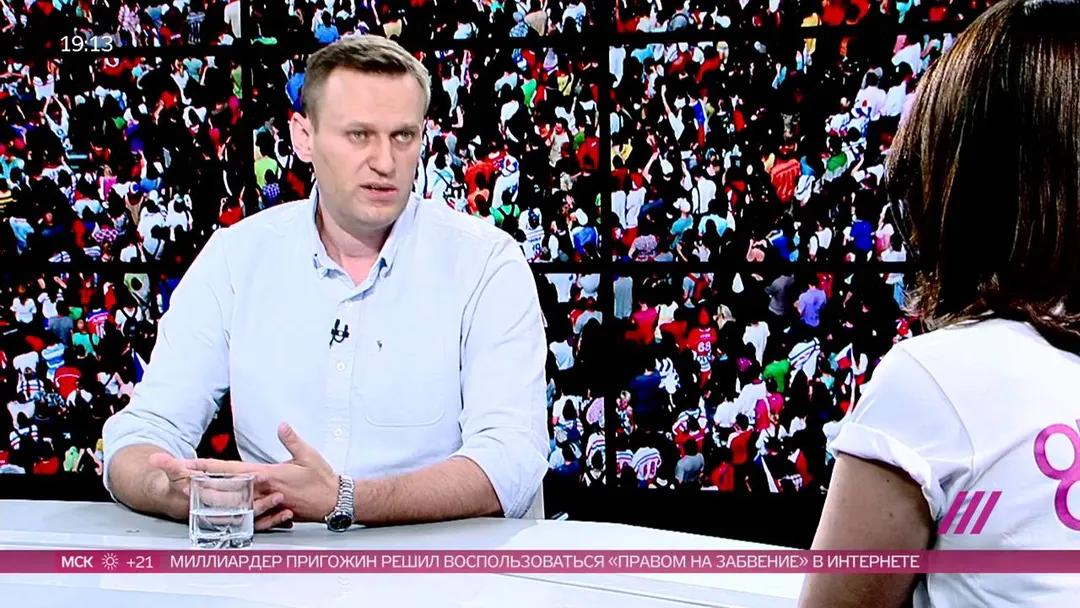
[music]
Direct
[music]
Line. Good evening. It is 7 p.m. in Moscow, and you
are watching TV Rain. My name is Yulia
Taratuta, and next to me is politician
Alexei Navalny. And we are beginning our live
call-in broadcast, during which Alexei will
answer your questions. And those
questions were submitted on social media and
through TV Rain’s platform. We are also taking
your calls at +7 495 744 0101.
Alexei, are you ready? Yes. Good evening.
Thank you very much for inviting me. I am very
glad to take part in this subscription
marathon. I’m a fan of yours, and I urge everyone
to subscribe. I’ll be happy
to answer questions. Thank you. Alexei, we
have very little time, so in our mutual
interest it would be best to keep answers brief. I, for my
part, promise to do that, and
I ask the same of you. First question: what is your
forecast for the libel case brought at the request of
former investigator Pavel Karpov?
As far as we know, you were summoned for questioning
today. What are your overall
expectations for the outcome of this case? Here
the answer is actually very simple.
The forecast is simple: I will be convicted in this
case, and I will receive another criminal
sentence. There is no doubt about that. My forecast
is exactly the same as for all
my other criminal cases. They are
opened not so that I might be
acquitted in court, but so that I can once again
be convicted and my activities can be hindered,
including preventing me
from taking part in elections. So whether there is one
more case or one less case doesn’t really
make much difference anymore. I’ll be convicted for the fourth time. So,
the next question is from Sergei Sushinsky.
Actually, I want to warn Alexei
Navalny that this person had 10
questions, and we selected just one of them.
You have long been fighting corruption. Have you ever
considered taking the post of Prosecutor General of the
Russian
Federation? Have I considered taking the post
of Prosecutor General of the Russian
Federation? Excellent question. Given that
this appointment will be made in the near future,
I think my chances of getting this post are
extremely slim, and of removing Mr. Chaika
from it as well. I think that
of course, in the current system of power
that exists now, my presence
in any position is simply absolutely
unacceptable. This government is built on lies and
corruption, and my mission, both declared and
practical, is to fight lies and corruption.
So of course, for this government I am
absolutely someone who cannot in any way
be used. Obviously, the question was
whether, in a different system of coordinates,
you would become, and would want to become,
a prosecutor. We will all secure the right
for people like me, and specifically for me,
to have the right to participate in elections, to have
the right to compete for certain offices. I
will compete for offices, including
leadership positions in our country.
Which one specifically I will be able to obtain
will depend only on me and on the
support that voters give me.
Well then, Alexei Ponomaryov from Kronstadt
believes that the people about whom
you conducted investigations have only
strengthened their positions, and in this
connection asks: do crooks ever send you
to your black
box compromising material about themselves so that
you will later publish it, and thereby
enter the caste of the
untouchables? This really is an
annoying part of our work. We understand
perfectly well that when we publish compromising material
about some scoundrel, we make his position—
for example, the same
Prosecutor General Chaika already mentioned—he is a disgusting
person, a corrupt person. He should not
be Prosecutor General, and it is awful for us
to realize this, but the truth is, perhaps we
did something that helped him remain
Prosecutor General. As for whether
people send us compromising material, I don’t know. Our
black box is set up quite fairly, and
we do not know who sends things in. It may be
that there are officials who, in this
exotic way, are trying to strengthen
their positions. But there is a popular
joke inside the Anti-Corruption Foundation
that we could take money from officials
for conducting investigations against them—
after that, they definitely won’t be removed from office. And
there is also the opposite version. There is an opinion, and
it came up every time your investigations
coincided with someone’s interests, namely
the interests of certain state bodies or
the rivals of the subjects of your
investigations within the government. That was the case with
Mr. Chaika as well, since against
him
the siloviki (security-service officials) were plotting, and for example in the acute
phase it was the same with Mr. Yakunin,
who in the end was, quite literally, removed from
his post. With Sechin and with everyone else, everything
always coincided. Any of our
investigations naturally coincides with
the interests of some competing
group. Our government is like—well, it is
spiders in a jar, or bulldogs fighting under
the carpet: people who are part of one
mafia-like system, but who at the same time
hate each other and fight over money or
spheres of influence. No matter whom we
investigate, it will always be
to someone’s advantage. We are quite
calm about that. So you are calm about it
how do you feel about the fact that you could become
part of someone else’s campaign
we conduct our own independent work
if that happens to have some kind of
indirect harm or indirect benefit
for someone, there’s nothing to be done about it
naturally, when we conduct an investigation
against Sechin, it benefits Gazprom, and
vice versa. That’s just how power is structured in Russia
for us, the main thing is that we ourselves know
and that the people who support us know
about us that we truly are
independent, and not driven by any
commissioned agendas
that’s not what we do. Well then, Vladimir Kirilyuk from
Perm is also interested in your
investigations. Let’s hear his
question. In your view, Alexei, that is,
what needs to happen? What is the main
change that must take place for
the situation
to change, so that there would actually be
official investigations—not
your investigations that get attention, but at the
official level? So that it would be
shown there on Channel One (Russia’s main state TV channel)
if I understood the question correctly
what needs to change for there to be
a real fight against corruption? There are no
secret, hidden
formulas or unique solutions for this
for there to be a fight against corruption, you need
independent mass media
political competition and a judicial
system people could turn to and at
least appeal certain decisions
until these three things exist, even if
the Anti-Corruption Foundation starts
working 100 times better, even if
tomorrow they appoint a good Prosecutor General
nothing will change without
political competition, without independent
media there can be no fight against corruption. That is
simply an axiom. But unfortunately, our
government is built precisely on the fact that there are
no free media, no political
competition, and no independent courts
therefore, for a real fight against corruption
we need a fundamental transformation of the
political system. And as for showy
arrests—if that’s your creative method, would you
it
want that? Arrests are necessary; there is no such thing as
an abstract fight against corruption—there is no fight against
corruption at all without punishing
specific corrupt officials. They do not
necessarily have to be theatrical. There is no need
for anyone to burst in wearing masks and
drag someone away while he resists, somewhere, while
his children scream, ‘Oh my God, leave us
our daddy and his yacht!’ None of that is necessary, but
nevertheless there must be normal
consistent, calm work
within which there absolutely must be
arrests and there must be bringing
the guilty to justice. Speaking of yachts
children, and, and, and other lyrical details, viewers on
Facebook who are watching our
live call-in are asking you, Alexei
why did you shave off
your beard? Well, I shaved off my beard because I
was preparing for Dozhd’s live call-in, and I thought
that without a beard I would be
more presentable here. Yes, I’d look more transparent, and it was funny
when we traveled
recently to Krasnodar Krai, where there were
various events, including some not very pleasant
ones. I had already shaved off my beard, but even so
I, like other employees of the
Anti-Corruption Foundation
was checked for links to ISIS. So from
that point of view, you see, a beard
doesn’t affect anything at all. I kind of wanted
to joke about it, and then thought it wasn’t worth
joking on this subject, since it is such a
you should have added that it is a banned
organization in Russia. Good that
you added that. Vladimir Kirilyuk—that is,
sorry, Vladimir Ivanov from Moscow
is asking a question about your unfinished
campaigns
up to the point where you are officially removed
and
and banned. Why don’t we take things all the way to court
and to the point where we are removed or
banned? Well, as for the courts,
we’re record-holders here. No
organization has as many court cases as
we do—that’s first. Second, we do see things through to the
end. The Barvikha campaign
reached its logical conclusion
the point of the Barvikha experiment was
that in this small district, but one
that is fundamentally important to the Kremlin, because
the whole Kremlin crowd, that whole gang, lives
precisely there
and we had to force them either to
hold fair elections or
resort to outright falsification. And so
the authorities first resorted to falsification
and then canceled the elections, so we
achieved our goal, and in Barvikha everything
ended very clearly and definitively. And, and
the last part of the question was: why don’t you
go so far that you are
banned from participating in elections? Alas,
unfortunately, we’ve gotten to that point too. I am
officially banned from participating in
elections. The Progress Party, which I
lead, has been officially
liquidated, not merely removed from
the Justice Ministry’s lists. Therefore, we and the
Progress Party are also banned from participating in
elections. We try to go all the way, and in
most cases we do. Well,
the question is about your supporters, not about you personally, because
everyone knows that you do not
have the right to participate in elections, there is
that view, and you probably know it as well—that
skeptics believe you pulled out of the election
Because, because you simply walked away
Because it seemed disadvantageous to you
to run a long campaign, and you understood that
there would be no success in the election
for the State Duma—you mean, you
mean that the Progress Party and I
that we left the democratic coalition
Let’s answer that question too, and
first of all, I think there are not many
opposition politicians, and certainly not many
non-system politicians, who would
have taken part in elections as often as I have. I
took part in the mayoral elections, I took part, we
all took part together in regional
campaigns; we ran in four regions, and in
three of them we were barred from participating. We were also actively
preparing the campaign for the
State Duma in 2011
Although I had no opportunity whatsoever
to take part in the elections, I ran
the campaign “Vote for Any Party Except United
Russia” (the ruling party), so it seems to me rather
unfair to reproach me for
not participating in elections. As for
these specific elections to the State
Duma and the coalition,
we created this coalition, we
promoted and advocated, if
you like, the idea of primaries, a new way
of forming candidate lists so that those
lists would truly receive broad
support. After our ideas were
rejected by PARNAS (an opposition party), the primaries were effectively
shut down, and we considered it impossible and
wrong to take part in that list
Although at the same time I think very highly
and continue to think highly of both PARNAS and
Yabloko (a liberal political party), and I would like to point out that
the party-list campaign for the State Duma is only
one half; the other half will be formed through
single-member districts, and there our
candidates are participating too, including members of the
Progress Party, where registered parties
agreed to support them. So we
are participating. Alexei, those are appealing
explanations—you always have them
an argument for why you leave somewhere
and then come back, but there are some people who
believe that you are to blame for the fact that this
democratic coalition fell apart. At the very
start, you met with Kasyanov and understood
each other’s positions, who each person was
How long can this same thing be repeated, year after year,
literally for decades—that the opposition
simply cannot come to an agreement when it
needs to unite, and instead only publicly
quarrels? As you said at the beginning, there are
people who think that you are to blame for everything
There are always people who
think I’m to blame for everything. Chubais (Anatoly Chubais, a prominent Russian reform-era politician) thinks so
too, perhaps—not exactly the company I
would have wanted to be in, but still
there are people who believe that
there is a significant share of my fault here, and
there really is. It means we
were unable to reach the right agreement with
Kasyanov. It means we were unable
to persuade Kasyanov to go ahead with
primaries; we were unable to persuade
the party
PARNAS. Several regional branches
spoke in our favor; the party’s deputy leader, Ilya
Yashin, supported us. Inside the party there was
a major discussion, but we were unable
to convince our partners, and I publicly
acknowledged this, and I am ready to do so once again
here on TV Rain (Dozhd, an independent Russian TV channel): that the defeat of the
democratic coalition and the abandonment of the idea
of forming the entire list through primaries—
that is my personal defeat. I do not disclaim
responsibility. However, however,
I believe it would be far more harmful
if we were to say, “All right, to hell with it,”
“their ambitions won out, so let’s
now unite around them”
in the name of consolidation. I think it would be wrong
to encourage people who
refuse debate and competition
and it would be more honest toward
the voters, my supporters, and the members
of the Progress Party who
authorized me to take part in the coalition, to withdraw
from it. And the vote that we
held internally showed that
the majority of people support me. Well,
so, and now we have
a phone call. Please introduce yourself, you are
live on TV Rain. Alexei is
listening carefully. Nikolai, Nizhny Novgorod
Alexei, here’s a question. There’s that well-known
story where an elderly woman turns to him and says,
“Son, well, 8,000—that’s my…”
pension.” What did he reply with those famous words?
I read comments on blogs. It says there
that keeping a dog costs much
more. I speak with specialists, yes, and they
tell me that at a canine training center
it costs
What do you think should be done in the long term with
pensions? Yulia, if you repeat the question for me
it’ll be easier, because I can’t
hear very well. The question, obviously,
was about what to do with pensions
since they are small. Did I understand correctly?
Yes, correctly.
Right. It’s a broad question. Pensions—pensions
are small because the economy is small
The economy is small because in Russia
nothing is happening, nothing is being
produced; our entire economy revolves around
oil prices. Sixty percent of our export
revenues come from the sale of hydrocarbons
add primary-processed metals and
timber, and we will see that Russia is, unfortunately,
a raw-materials appendage. There cannot
be—there simply cannot be—large pensions in
in a country that serves as a raw-materials
appendage of developed countries. Therefore,
forgive me, this may be a banal answer,
but high pensions and high wages
will only come to Russia after
the economy starts to resemble the economy
of developing countries, when
It's a real shame that we actually can't
make a transition—or rather, we can make
a transition to the previous question before
the call. Yes, since we were discussing your
associates and ways of uniting, well then
Anton Reznikov from St. Petersburg, he
also asks
a question about your associates. Let's
listen. For example, during the election
campaign in Barvikha, Lyubov Sobol
commenting on the situation on air, with her
manner of speaking, her intonations, her
system of argumentation, practically
copied you. That is, essentially, in front of us
sat, as it were, Alexei Navalny 2, only without
the beard—well, and with some other outward
differences. Tell me, Alexei, do you notice
such a trend in your circle
and do you consider it acceptable for yourself?
If not, what ways do you see to stop this
trend, and perhaps even
turn it
back? We see that Alexei Navalny himself
is also without a beard now. I do notice that,
but that's not Lyubov
Sobol's problem—it's a problem of the fact that in Russia
there is no competitive politics, really.
Lyubov Sobol simply has no one to learn from. And
where are political debates in this country, where
is any kind of discussion? Where is the talk show
that Lyubov Sobol could come to
once—as a hypothetical Lyubov Sobol—and be
routed there, and then come back a second time
and win? This political environment simply
does not exist, where political
activists turn into politicians. Well,
Sobol argues with me at the Anti-Corruption Foundation
on certain issues,
and probably with her voice—or yours, uh, well,
her own, and, and, and, quite possibly she
copies some gestures or
argumentation from me. But come on, Lyubov Sobol—yes,
I suffer from this myself. I too would like
to see some politicians from whom I
could borrow something. But you
speak English. You can
look at American elections.
I do look at American elections, but
you understand, American elections are
an American political agenda. There they
argue about abortion and the minimum
wage; in Russia, that agenda simply
doesn't exist, about current issues. Over the
last few years, I have twice
taken part in debates, both of them, incidentally,
were on TV Rain (an independent Russian TV channel), but on
the federal channels there are no debates.
There is no competition, no discussion, so I
would say now that this is important: neither I nor
other politicians, unfortunately, can
really train our political skills.
And unfortunately this leads
to phenomena like someone copying me.
Tell me, did you study anywhere
stage speech, literally the art
of speaking, political speech? No, never
did
I study.
Am I really so advanced in political
speech that one could assume that?
But no, I never
studied it. I'm not sure political speech
can really be taught; some skills probably
can be picked up, but I'm not
sure that, in the end, form will very
strongly determine content. You can
speak well, but if that were all there was to it,
then actors would be the main
politicians here. What matters, after all,
is substance. And precisely when it comes to
substance, there are no formats for participating in
debates. To be honest, out of sheer
hopelessness, inside the Anti-Corruption Foundation
we hold weekly
closed debates. We just assign roles:
you'll be for Putin today, and you
will be against Putin, or we all gather
together—people debate—in order simply
to train some skills in ourselves.
Do you put on a name tag saying 'Chaika' (likely referring to Yury Chaika, former Prosecutor General), and Alexei on
No, we don't wear name tags, but everyone has
a backstory about whom they represent, and we
record it on video. I very much hope
that these videos never leak online,
because I myself, among others, several times
have played members of United Russia and talked about how
great United Russia is, how we should
rally around Putin—I really got into character.
I tried. A call—let's listen to our
listener. Please introduce yourself.
Please. Yes, hello, Alexei. My name
is—I am involved in public
activity, I'm a civic activist in Pechatniki (a district of Moscow),
and the more I engage in this
activity, the more often I hear
from the mouths of officials and deputies, even
local ones and members of the Moscow City Duma, accusations that
I work for you, receive money from you,
am your friend, and so on. So I have
a question in this connection: what do I
need to do so that they stop
thinking that and accusing me of it? Or
maybe I need to stop doing
something? What do you think? First of all, I would like
to congratulate you, because apparently you
are doing something very right,
something good, because they are fighting you
and trying to discredit you.
And for our authorities, that is still
the first
sign. Second, I really do observe
Such an interesting trend. For example, in my district,
where I live, in Maryino,
there is this candidate running from the Communists,
deputy Rashkin, and he is distributing leaflets
showing me together with this Rashkin under
some American flags. In other words,
it is amusing that the authorities
are trying to discredit certain people by suggesting they may be connected to me.
I am not sure that this works, especially in
Moscow, particularly in the Pechatniki district, where
you
live, if I am not mistaken. In the
Moscow mayoral election, I received about
25%, so if you are planning to run somewhere
for the municipal council
or for some other office, I think this will only
help you. And most importantly, I would
advise you not to pay attention to all these
people and just focus on your work.
The main thing is that the residents of Pechatniki understand
that you are doing something worthwhile.
Well then, now a question from Maxim Katz
from Moscow, your regular interlocutor.
He submitted his question using, yes,
our TV Rain app, Strana Dozhdya, and Maxim
reminds us that he was your deputy—well,
more precisely, deputy campaign manager—
when you took part in the Moscow mayoral
election. After that, your paths
diverged. You have not commented at all on
major public campaigns
run by City Projects, nor have you
said anything about my participation
in the Moscow City Duma elections,
although, of course, I had counted on your
support after my long and successful
volunteering in your campaign. And now
you are also not saying anything about the campaign of
Dmitry Gudkov, where I work
as campaign manager, and many from that
team who worked back then in 2013
are also taking part in Dmitry
Gudkov’s campaign. At the same time, in none of your conversations with
me, whether public or private, have you explained the reasons
why this attitude arose. And in
private conversations with the media, I know, you
say rather unpleasant things about me
that I have no opportunity
to respond to, since it all happens behind my back.
What is behind this attitude of yours toward
me and the team that did quite a lot
for the success of the 2013 election
campaign? Thank you very much to Maxim for this
question. I am glad that I have the opportunity
to answer it. First of all, I would like
to say that I am very grateful to everyone who
worked with me during the Moscow mayoral
election—to the entire huge team of people.
There were hundreds working in the campaign offices alone.
The core of those people are now with me at the
Anti-Corruption Foundation. Of course, we could not
employ all of them there, because
that is simply impossible—it would have become far too
large a structure. But I
continue to work with these people,
and once again I want to thank everyone who
helped me then. That is the first point. The second is that,
as for my support or lack of support for
other projects, of course I, the Anti-Corruption
Foundation, and the Progress Party
support first and foremost those projects
that interest us, the ones we
are engaged in. I have a board in my office;
it has 30 project names written on it.
Ten of them are underway, and 20 more I would like to launch.
But I do not have the time to
carry them out, and our priorities, of course, are
to do what we ourselves came up with, what we
want to work on. As for
interaction specifically with Maxim, I—
well, I am sorry he is not here so that
I could say these unpleasant
things directly to his face. Maybe I will just look into the
camera. I would like to
make this clear:
my experience—and not only mine, but that of the Anti-Corruption
Foundation as well—in interacting with him
shows that he is a person who is
dishonorable and, frankly speaking, simply a
chancer. I completely rule out any
possibility of working with him, and there are
for that, among other things,
political reasons, because, well, we cannot
support a person who
says that when Liksutov
transfers his offshore assets to his wife, that means he
has cleverly tricked the system and is not
corrupt. I cannot support in an election
such a person. Maxim himself ran in an election,
and during that campaign I did not say anything
bad so as not to somehow hinder him, but
nevertheless I cannot support
a person who says, you know, I
hid my income and transferred it to
my parents’ foreign bank accounts; I
cleverly tricked the system. But the
Anti-Corruption Foundation cannot support such
candidates, because that is exactly what
corruption is. We are fighting against it. So,
it is entirely possible that Maxim or the people
working with Maxim are doing some
good things,
but for me and for the majority of the
staff of the Anti-Corruption Foundation,
any interaction with him
is absolutely out of the question. He is simply
a dishonorable person. So, are you now
retelling a conversation you had with Maxim?
His
admission? I actually have not seen him for many years.
In fact, I simply, simply wanted
to say that he quite often follows me around and
asks, why do you not
work with me? I would just like once
again to say that I do not work
with Maxim because he is a chancer, because
he is a dishonorable person, and I try, within the framework of
organizational cooperation,
to work with people who understand what
ethics is, what normal
working relationships in a team are. And
as a matter of fact, Maxim
was the head of my campaign staff and fired him 2
weeks before the Moscow mayoral election for
some such reasons. I supported that decision,
so
he is not someone we can
work with together. Well, that too is
something of an indication of the public
rhetoric and public disagreements within the
very circle I was talking about in
the previous questions. And now a question
from Albert Gurdzhiyan from Nizhny
Novgorod. He reminds us that you, Alexei,
promoted several proposals on
the direct electronic democracy platform on
the ROI website, and his question is
this: you made people believe in
electronic democracy and then abandoned it
halfway. Why didn’t you force the masses
to put the initiatives back to a vote in order
to collect, for example, 2 million votes? After all,
that is exactly how many votes are needed to apply
to hold a federal referendum
on any issue, and since you are not doing that,
tell us: are you more interested in replacing
one government with another, or rather in
replacing government with direct popular rule?
Thank you in advance for
the answer. Thank you for the question. I’m very glad that
the viewer asking it is apparently just as
big a fan of electronic
democracy as I am. We really
devote a lot of time to it, and
indeed we submitted several
bills through the so-called
ROI system, where it was necessary to collect
100,000 signatures in order for
a bill to be submitted to the State Duma. We
were the first to do this, with a bill
banning and limiting the cost of
officials’ cars. Then we collected
100,000 signatures for our bill on combating
illicit enrichment.
But unfortunately we were forced to stop
this activity because all of us were simply
deceived. This is exactly what happened. If you
remember the famous promise
by Vladimir Putin, when he said
before the election that he would submit to
the State Duma bills that gathered
100,000 signatures. In practice, they created
a system under which we collected 100,000
signatures, but our bill did not go
to the State Duma, where deputies could vote for or
against it. Instead, it went to some kind of working
group of the government under the leadership
of Minister Abyzov, where some strange
people, appointed by who knows whom, sat
there discussing it, and in the end our bills were
rejected by the authorities, and not one of them even
made it to the State Duma.
So unfortunately we have to say that
that
the system of
so-called electronic democracy created by our authorities
is completely false. It is a fake, and we
will not use it. Nevertheless, we
continue to use mechanisms such as
petitions and signature collection. I believe in all
these mechanisms; it’s just that what has been created
now is, well, simply deception. It is
a trap. You won’t believe it, Alexei, you are
being asked about by one of our viewers from
the United States, Irina Van Pat
from Seattle. Why wouldn’t I believe it? I
absolutely
do believe it. Do you remember yourself when you were young—when
was the moment that you decided
that you would stand firm to the end, that things were already so
frightening that nothing was frightening anymore? It seems to me
that your advice here would really help
young beginners who are not
indifferent to this country, because fear
now grips the whole country, and it seems to me
that it is not only the fear that they will come after you,
but also the fear that you will not hold up under
pressure and will betray yourself.
You know, I would like to tell
some beautiful story about how
something happened, I saw
an injustice, and at that moment realized
that one must stand firm to the end and fear nothing,
but unfortunately there was no such
story. My political evolution
took place together with the country’s evolution.
When I came into politics with
the Yabloko party in the early 2000s, the country was
completely
different. Basically, the only repressive
mechanisms back then were
election fraud, and even that was not very
large-scale. Back then even Khodorkovsky
was not yet in prison; there were effectively no
political prisoners in the country. When we
wanted to hold a picket or a rally—I handled that in
Yabloko—we held it
right at the entrance to the State
Duma, at what is called the second entrance, and
members of parliament literally walked past our
demonstrators. But gradually the country
changed, and it is impossible
to imagine that we would now do what
we were doing in the early 2000s. But I, just as
I once decided when I entered politics,
that I have my human and civil rights,
that there are inalienable
and non-transferable rights, and I will defend them.
There is nothing extraordinary in that;
I believe there is nothing
heroic about it. There is nothing heroic in
simply remembering that I
have rights. And just as I came into
politics with that awareness, so too have I
now arrived at 2016, when
the country is completely different, but I still
stand up for their rights, and
defending rights that are being violated now is
a much riskier
thing to do than it was in the early 2000s, but I
keep doing it, and I’ll say again: I do not
consider it something heroic. I believe
that every decent person should do it
and must do it. It is simply
an insult to your human
dignity to give up some of your rights
and forget about your rights. Do you consider
yourself a brave person?
I consider myself a brave person because
I
well, I think of myself as someone who, at
a moment when things are frightening, or
a little frightening, or when you think
that you ought to be afraid, I try
simply to make myself understand that
there is no need to be afraid. In other words, I give myself
a little
psychoanalysis session and
convince myself that I need to act
the way I acted yesterday and the day before
and that there is nothing to fear.
It’s not that I have some kind of diminished sense
of danger; I am fully aware of
what is happening. I simply do not think it is necessary
to give way to anyone. Oleg Alefirenko,
an entrepreneur from Italy, asks you
a question about the events in
Anapa: who struck first, and whom, during the attack
by Cossacks on your group in Anapa? Thank you
very much. Well, I was
a participant in those events. It was all
a huge brawl, and it is hard for me
to say who hit whom first there, but
there is one obvious and most important fact: there was
an attack, a group attack,
brazen, in broad daylight, in front of cameras,
with no shame whatsoever. About 40 people attacked us
with hooligan motives, and
simply started beating people.
So I have absolutely no doubt
about who provoked
all of this, who organized it all, and who
is, of course, responsible for the entire incident.
Of course, as I understand it, there was
some version of events according to which a person
who was with you did something first.
All of this went on for about 15 minutes. There are
different video fragments; among them there is
a video in which one of the people who was with
us hits one of the attackers. Well,
yes, he did hit him, and I would have hit him too in his place
if he had come within reach, but
that is of no significance because
if we look at the entire event from
beginning to end, there is no
doubt that this was an attack. These people
must be held criminally
liable, which, by the way, is not
happening now: a criminal case has still not
been opened there. Well then, and now
Vladimir Skvortsov from Moscow
asks about your
family: to what extent does your family understand
and appreciate the importance of the path you have chosen?
How united are you, together with
your family, in this? To what extent is this
a shared mission, or is it simply
your work, something separate, and you just
come home and talk about work there as well?
And to what extent does your wife
understand that tomorrow things may no longer exist in the
form they exist in
today? Thank you very much for the question. This is
important to me. I believe that
it is practically impossible for a politician
to function and carry out his
work if he is not supported by
his family, and I can proudly say that
my family supports me completely,
that this really is, in a certain sense,
well, you cannot call it a joint project—
“project” is a silly word—but everything I do,
I do in part for the sake of my family,
for the sake of families like ours. Because my
family supports me; they are
normal, responsible citizens
of Russia. My children understood less about what
was happening around me before that very
episode in Anapa, and, well, it is impossible
to engage in opposition activity, especially in
Russia, if your family does not support
you. It is impossible to come home
if your wife says—not even
“I love Putin, stop criticizing
Putin”—but simply keeps following you around and
saying, “This is very dangerous, let’s
stop.” We understand that there are some
things that are quite dangerous, there are things
that are unpleasant, but my family supports
me 100%. Does it ever happen that
some decision is made by your
wife—a political decision within the family?
My wife makes a lot of decisions.
As for political decisions,
of course I make them after consulting
with various people within the Anti-Corruption Foundation
and with the people whom I
respect. But some specifically personal influence—
simply because she is my wife and because
she whispered something to me—does not affect
my judgment in that way. But Yulia
is 100% my political ally, and
generally speaking, whatever she advises me to do, I was already
planning
to do anyway. Vera Krichevskaya, our
colleague, recently on TV Rain (an independent Russian TV channel) we launched
a new program called *Evening Hillary*. The first
episode
was devoted to the topic of public politics and
sex. We talked about whether
our president, a single unmarried
president, has the right to sex. Should he hide
his private life while in the status
of a single man? We also
Of course, we were discussing the sex scandal
surrounding Mikhail Kasyanov. I’d like
to ask you a few questions.
First: does a public politician have the right
in Russia to have a sex life? Must he be a
decent, respectable family man?
Should a politician’s private life be
public? Well, my God, we’ve finally gotten to
questions about sex. I assumed they would
be saved for the very end of the show—the most sensational
and scandalous
questions. Should a politician have the right to
sex?
Well, as far as I know, no one has taken away my right to sex.
I’m not going to dispute
the right to sex for him or any other
official, as long as they are not
using public funds
to obtain sex or something like that. I
think that, of course, speaking seriously, every
person has a right to a private
life. I have absolutely no interest in that
side of things unless it concerns
corruption. I can say that our
tip line quite often receives
information about who is sleeping with whom, living with whom,
who has what kind of family, who has children with whom. We’re
not interested in that
unless
some mistress or wife, say,
starts receiving government contracts, for example.
As long as it is not connected to
corruption.
Vladimir Putin hides his family; that
looks a little strange for the president
of a huge country. I think
it is generally wrong, but it is his right.
However, the moment his
daughter starts heading some
academic councils at Moscow State University and receiving enormous
contracts, or supervising multibillion-ruble projects,
that is where his
right to privacy and the right to
keep some secrecy about his family
end, and the public interest begins to apply.
If Vladimir Putin’s son-in-law is simply
an ordinary person, he has the right to keep
his son-in-law private. But if the son-in-law, as in our
case, Vladimir Putin’s son-in-law Kirill
Shamalov became the richest and youngest
Russian billionaire, then, sorry,
there is no right to privacy here
anymore.
So it is a fine line, but we nevertheless
try to draw it, and we have decided for
ourselves that we do not intrude into private
life where it does not involve some
public interest. For us,
public interest matters—we are, after all, the Anti-Corruption Foundation.
Where there are
signs of corruption, we are ready to talk
about it, and we will talk about it. This
was Alexei Navalny, briefly on sex in
politics. And now Yuri Rekin from
Kaliningrad. Please tell us, under
President Alexei Navalny, how will
the issue of relations with
the republics of the North Caucasus be handled? Will we
stop
“feeding” them? Will Lyubov Sobol be sent there
as presidential envoy, or are there
other options? Yes, there are excellent
options—they are all laid out in the Constitution
and in the law. There is no need
to invent anything. The republics of the North
Caucasus
should receive normal, respectful
and equal treatment, just like
all the other republics and simply
the regions—all the constituent entities of the Russian
Federation. When we say “stop
feeding the Caucasus,” what we mean is that we must
stop giving out unexplained
giant transfers that are stolen
by the leaders of the North Caucasus,
the leaders of the Chechen Republic first
and foremost, and that money does not even
reach ordinary residents. You see, in
Chechnya, no matter how much money has been poured in,
the population is still poor; people
go into the forest to gather wild garlic, while at the same
time we see videos of how, at
Kadyrov’s nephew’s wedding, there were
Mercedeses and Rolls-Royces in huge motorcades.
So the approach to
the North Caucasus should be based on the
Constitution and the law. If they lack funds,
they should receive federal transfers
like all the other republics—but
comparable ones. If they have suffered a
natural
disaster, then they should receive a little
more. If there is a
counterterrorism threat
or terrorist threat there, they should also
receive more, for example, than Smolensk Oblast,
but all of this must have a
reasonable explanation, and there must be
a guarantee that this money will not be
stolen or handed over to those same
terrorists. So simply equal and
honest treatment. Well then, we have
2 minutes left in our live
broadcast on TV Rain, and we will
hear from Alexander Khusho from
St. Petersburg. In your opinion, which party should
democratically minded voters
vote for?
Has it discredited itself,
or perhaps it would be better to refuse
to take part in this year’s elections altogether?
Thank you, that’s an excellent question. This year’s strategy
will be fairly complicated, because
well, I’m not prepared to put it in such sweeping terms and
say that PARNAS has completely
discredited itself. Yes, there is much we
do not like, but nevertheless it
continues—PARNAS remains
the independent opposition party Yabloko
possibly less independent, but even so
it is still a party with many decent people
and overall its actions are also fairly
independent; there are decent deputies
who are running in single-member districts from
the Communists and A Just Russia. This is a
complicated
setup. We are not ready right now
to offer voters a specific course of action
because, well, right now
the process is unfolding, and we do not understand
how many and what kind of single-member candidates will be nominated
whether Yabloko will agree to nominate any
decent people, what will happen with the list
of PARNAS. We do not fully understand that. My
view is this: well, these elections, I
took part in the democratic coalition, but I do not
recognize these elections because I am not allowed
to take part in them. I want to participate in the elections
to the State Duma, but I am not allowed into
them. Am I supposed to recognize them? I do not
recognize them. The Progress Party wants
to participate in these elections. The party
would have cleared the threshold; the Progress Party
would definitely have formed a
faction. We are not being allowed into these elections, so
are we supposed to recognize them? No, we also
regard these elections as non-
elections. Nevertheless, well, we should not
simply boycott all of this outright, and
we will try to come up with a smart strategy
and explain it to everyone. Well then, that was
Alexei Navalny, who does not recognize
the upcoming elections. We are not saying goodbye to you
we are simply giving this part of the studio over
to the news. You can continue watching
the news on TV Rain, and we
are moving to another part of TV Rain's studio
and will continue talking with Alexei
Navalny and broadcasting our live
stream on Facebook. Stay with us