Alexei Navalny on the program Bottom Line on Finam FM
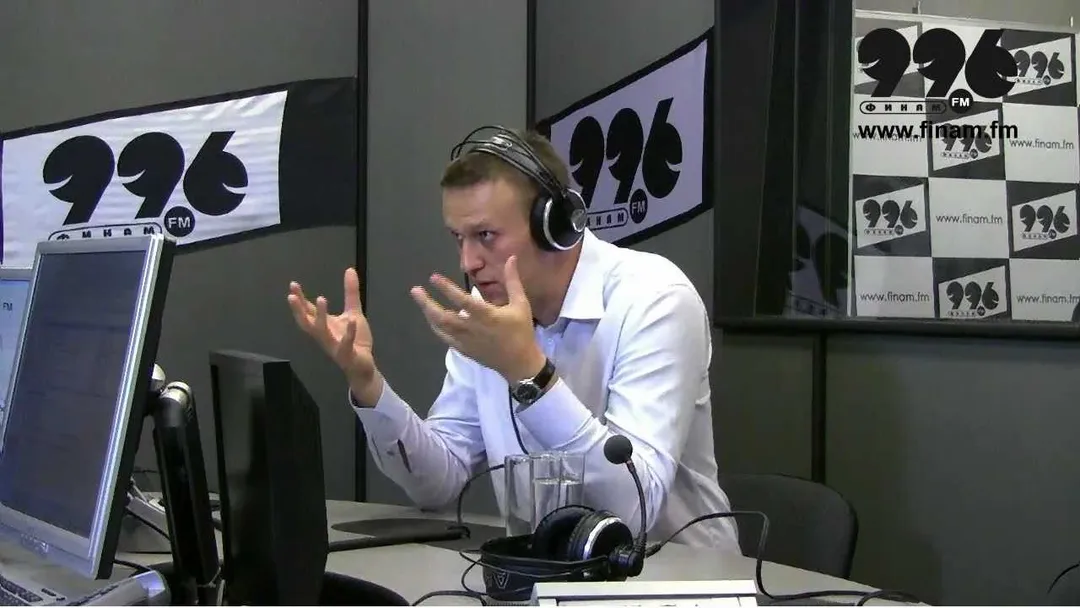
9:06 p.m. in the Russian capital. Good
evening once again, ladies and gentlemen. This is Finam
FM, the daily program Bottom Line, and
today it will air in a somewhat unusual
format. Today, you Finam FM listeners
will be up against a man whom many
of you respect, but I want to emphasize
the key word here: against. I
know many of you are in favor of him. But today you need
to make an effort and speak
against him. Today, Finam FM listeners are against
Alexei Navalny on the program Bottom
Line. Good evening. Good evening. And at the
very beginning, let me remind you of the ways to
get in touch. So, we have received hundreds
of questions; there are a great many of them on the website
www.finam.ru
[music]
for Finam FM listeners. So once again: 65
10-99 and 6, Moscow area code 495, www.finam.ru
Putin today explained the purpose of creating
the All-Russia People’s Front. We have not yet
discussed it. We discussed United Russia with
you, we discussed a united front. We have not yet
Sorry, there it is — a slip of the tongue, as they say.
Yes, a Freudian slip: I called their
front a united front. Yes, but all the same
the All-Russia People’s Front — the prime minister
said that the new organization
should give United Russia a chance
to come back to life, I quote him, and to live thanks to new
ideas and new people. Mr. Navalny, how
do you feel about this new initiative? And I also
liked that he called all the other
fronts copycats — such a
wonderful word. Well, Putin was absolutely right
to say that: to come back to life — because United
Russia is already dead, and now he is trying
to create this kind of
[music]
galvanized version of that entity.
Is it dead, or can it really
reboot United Russia? Well, absolutely
not. We can see that all the people
sitting there in the presidium of this
front are already members of United Russia, or
former members of United Russia, or people like
Shmakov, the head of the trade unions, who
signed a cooperation agreement
with United Russia. In other words, there is not even
a serious attempt to deceive anyone. Mm-hmm.
Excellent, let’s move on. I’m just
bringing the day’s issues up to date here. Yes, this is for
our colleagues in the news service: every fifth
ruble allocated for defense is stolen
from state funds. That statement
was made today by the chief military prosecutor,
Sergei Fridinsky. According to him, year after year
the schemes for illegally siphoning money from the state
are becoming more sophisticated. He
described one case in which
medical equipment for the troops was
purchased at a price three and a half times
higher than its actual value.
Alexei, how would you characterize
the current status quo? Is this an exception
that Mr. Fridinsky happened to uncover,
or is this commonplace? It is commonplace,
absolutely commonplace. This figure — every fifth ruble —
is generally popular with us. Medvedev said that in
public procurement, every fifth ruble is stolen.
And now in the Defense Ministry, every
fifth ruble as well. In our RosPil project
we observe this every day. I disagree with Mr.
Fridinsky on one point: he says
the schemes have become sophisticated. But they steal as crudely
as ever — just as crudely as before. It is simply
inflated construction prices, inflated
prices on any procurement. This is done
completely openly and without any
special tricks, for one simple
reason: because no one is afraid
of the consequences. Everyone keeps droning on
on television about how awful, awful
corruption is, but during Medvedev’s presidency
we have not seen a single
major anti-corruption case. Well,
we are going to have a little mini-debate now
because our listeners are asking for it,
in particular Dmitry Yesyunin
from Moscow, he is 25 years old. He writes: “Yury, as is
well known, supports Medvedev, while
I can explain further: I have already been declared
a Kremlin project. I don’t know, maybe
your address has already
as well.”
On the radio station where Alexei Navalny
said that he has a negative view, quote,
of that part of the intelligentsia
that considers Medvedev separately from
the thieving regime. I don’t know whether you said
this or not, but it is presented as your direct
statement. Yes, I would like
to hear a dialogue between you on this
disagreement. Alexei, I will formulate
my thought, and you can respond, yes? So, I
proceed from the status quo that the current authorities
are real people in a real country, with
very real power, and you cannot simply remove them at
rallies
or even in smoking-room conversations; they cannot be removed that way. With them
you have to negotiate. My main thesis,
why I support President
Medvedev, is that he is
the only person in this vertical power structure
who is vested with constitutional powers
and he can
to reach an agreement that these people leave
but they do not leave empty-handed—they leave with those
capitals and assets that they
earned through backbreaking labor
through backbreaking la- labor. Of course, I
all other ways for these people to leave
are, generally speaking, connected with sad
possible consequences for the country, that is,
what worries me is the fact that then we
may
be overwhelmed by scenarios of a change of power. I
am categorically against that, while at the same time I
perfectly understand that elections in the current
situation are also not an option. That is, behind
tightly closed doors, this issue must be resolved
this issue. Now my question to you, and
your rebuttal: why is it, after all, that you
do not trust President Medvedev?
Listen, they call me naive,
but when I listen to you, I realize
now this is a naive person. That is absolutely
right—you said these are real people with
real deeds, who steal
very real money, and to suppose
that they will give all this up and themselves
throw someone out there—this is completely
would be
uh, that would be completely naive. Again,
President Medvedev is, uh, vested with
constitutional powers, but I wanted
to point out that no lesser
constitutional powers are vested in you, me,
or this radio listener who asked the
question, and we must have the ability
to influence this government no less
than Medvedev, and in practice we
influence it ten times more than
any Medvedev, because Medvedev is
an absolute product of this regime
and we see that despite his loud
statements about fighting corruption, every
single day there are reports of completely
open and unsightly wrongdoing. Look
at what is happening with VTB Bank.
People credit Medvedev with the fact that he
removed Luzhkov, but do we have, with regard to
Luzhkov, even a single criminal
case opened? And that sheer hellish bacchanalia
that they staged around the Bank of Moscow
in which the Moscow mayor, a Medvedev appointee,
is also involved—Medvedev himself gives some kind of
unclear approval, some Yusufov
a former minister, someone buying something from someone
no one understands anything, then a
Chamber of Accounts (state audit office) inspection begins, after which it
is stopped because they say it
will harm, harm some processes
Medvedev sees all this every single day
he runs this VTB Bank, some kind of
and now we are seeing the birth of this kind of
Medvedev-era oligarch, Yusufov. A man
who has not worked a single day anywhere except
in government service, nevertheless
is buying up shipyards worth tens of
millions of dollars, and now he is making
or ready to make some investments of more than
billions of dollars. Well, it is completely
obvious that the origin of his
money should at the very least be investigated, yet
nevertheless Medvedev—personally, Medvedev
gives him the green light to invest his
very dubious and strange money, and
after that, someone is going to tell me
that he really is somehow
trying to change something and really, in
some back rooms, he will be talking with someone about
something? I think that right now, I
am sure, maybe in the back rooms someone is
making some kind of deal, but Medvedev is not present in those
back rooms. So you are not
just not hopeful—you are basically writing off
the current head of state as someone
who could potentially turn
Russia away, by a bloodless route, from that
status quo that was established in the
2000s? No, there is no need to write anyone off
of course, I am not writing him off. I
am simply stating a fact: everything he has done
so far has been just one failure
an endless failure—four years of failure, and
and now we have seen such—well, three so far, yes
and a kind of final point was his
completely meaningless, in some
ways cowardly, this
press conference from which everyone expected
bloodshed, and instead all he did was eat a siskin (a Russian idiom meaning he did something trivial).
And this is the head of state—he could have done
amazingly right things, and he still can
do them. It is just that I very much still think he can
do it, but I very strongly doubt that
after behaving like this for three years, tomorrow morning he will
wake up and say, well then, let us
finally do what I am able to do
today. And once again there was a demonstration
of this kind of powerlessness, which
which he, for some reason, apparently considers
a demonstration of strength. There he was again at
some meeting talking about how, well,
should I perhaps dismiss the Minister of Education,
Fursenko, and glaring threateningly around. Well
what is the problem? Go ahead and fire him—why talk about it?
You pulled out the gun—shoot. Well then, dismiss
Education Minister Fursenko if
all the scientists have complained to you, and for three years now they
They complain, saying, "Take him down," but that never happens.
Well, you see, all this talk about...
how someone is supposedly being cast in granite and...
so on—well, it's all just talk. I'd like...
it not to be that way, but unfortunately... Rea...
to work if President
Medvedev invites you onto his team, in that...
team—the president's team. First of all, you see...
there's some kind of strange bargaining going on here:
am I ready or not ready? First of all, to work for whom?
And what, really, can President
Medvedev's team—who does it even...
consist of? In President
Medvedev's team, as I understand it, there is
Dvorkovich, a normal, excellent
person; there's Timakova. But beyond that, I don't know anyone else.
I don't know who is even on President Med...
who is actually in it at all.
What does President
Medvedev actually want? Judging by the fact that he's grooming for himself
an oligarch, Yusufov, I'm not at all sure that I have
the same goals as President
Medvedev. And I am definitely not ready to work
to help cultivate all these Yusufovs,
Kerimovs, and this whole oligarchic
gang that's close to him. This gang
of oligarchs is just as disgusting to me
as Putin's oligarchic gang—
Abramovich and all the rest. I don't see
any difference at all. How do you feel about
Vladimir Putin? As for Vladimir Putin, I
as follows:
badly. I regard Vladimir Putin
as follows:
and this—this is my wording, I...
my wording, you caught me there. I regard Vladimir Putin
as the man who is now
heading the party of crooks and thieves and
leading it into the elections. Vladimir Putin
is the man who made corruption
the state's main system of governance
and the foundation of the state. Vladimir Putin is
the man who, uh, made the system
of negative selection the country's main personnel policy,
meaning that decent, normal
people only move downward,
while every kind of crook and scum moves
only upward. In your opinion, can the current
prime minister of Russia leave that
Olympus voluntarily, of his own
free will, or will the system he created
in the 2000s not allow him
to leave that bridge—or that little bridge,
the captain's bridge? Yes, because, roughly
speaking, they prop each other up: Putin props up
this system, and the system props up Putin. Well, he would,
as I understand it, be glad to leave.
It's truly an enormous strain; being in
that position for years is difficult. But he himself
made an all-or-nothing bet. He got
everything, and the moment he loses
the real levers of control over the situation,
they'll devour him. His physical safety,
the safety of his money—well, he'll be destroyed.
And it won't be some radical opposition figure—neither
Limonov, nor Kasparov, nor Navalny, nor
Belov, nor Mironov, nor anyone like that—who starts eating him alive.
It will be those same Yusufovs, Kerimovs,
and so on. In other words, the oligarchic gang
that, let's say, didn't get everything
it wanted to get will begin
taking everything away from his businessmen, from all
those Timchenkos, Kovalchuks, Rotenbergs, and
in the course of this war for resources, it
naturally won't leave
Putin himself untouched. And without any doubt,
as I already said, leaving power—leaving
real power—for him is simply
physically dangerous, because he could
lose his freedom, possibly lose his life.
Certainly he and his friends would lose their capital,
and so on. So the stakes are extremely
high. And that's why Putin stays put. Well,
I assume—and he's no fool—he understands
this very well. He sees these people, he
raised these people, and he understands that this
pack—this herd of sharks, hyenas, piranhas,
whatever you want to call them—as soon as it no longer has
access to the nuclear button and the Dzerzhinsky Division (an elite internal security unit)
on the phone, it will devour him. That's the bottom line.
That's the bottom line. This is Finam FM, and today
Finam FM listeners are questioning Alexei
Navalny. Two more short questions.
Alexei, do you see a bloodless scenario
for changing the current government? Yes, I do see such a
scenario. I insist specifically on a bloodless option. I
do see such a possibility. I think that, of course,
such an option is naturally
preferable. I don't necessarily think that a
scenario involving, let's say, some kind of
spontaneous unrest
and what is commonly called the Tunisian
scenario, or any kind of Ukrainian
scenario, must necessarily be bloody. There is no
such direct connection. If people tomorrow
take to the streets and force the authorities
to change and, for example, hold free
elections, that absolutely does not mean
that everything will be drenched in blood. It means
absolutely nothing of the sort. Likewise,
your program will still go on the air: today
a revolution happened, tomorrow we all
still need to go to work. So I think
that such a scenario is entirely possible.
and quite highly likely. Besides, well,
still, theoretically, the probability of what
you, Yuri, are dreaming about does, after all,
exist—that tomorrow you will once again
go after me over President Medvedev. I'm not
going after you. I'm simply having a dialogue with you. Tomorrow
he wakes up and realizes that the day
has come, that he needs to take a risk.
We carefully remove the minister
of internal affairs and appoint a decent
person, bring in... there are such people, I believe.
I believe there are. I think that, well, the task
is this: if tomorrow he needs to find 10,000
... not in this system, as I've already said.
Negative selection makes them hard to find.
For now, Medvedev knows nothing about them; his
task right now is to find 15 decent people, 10
decent ones who are, on the one hand, loyal, and on
the other hand, the kind who on the third
day won't start saying, "Wow, look how much
money there is all around. Why are we bothering
with anything when you can just reach out and take
a billion—just reach out and take it". Such people
can be found.
Moving on now to the listeners' questions, I
will put it, again, the way it was put, you know, 10
years ago in relation
to the current prime minister: who are you,
Mr. Navalny? So, Alexei,
there's a huge, huge amount of information, I'll put it that way, yes,
circulating through various means
of communication. Your opponents here, your main
opponents—I mean, of course, the head
of Transneft, essentially,
... one of the... all right, one of the
people who formulated the idea there about
inflated project costs, payments, and so on.
Most likely you've commented on this, but I
still want you to answer me
and our listeners on the question: who is Alexei
Navalny? Who is he? Listen, for the last four
years I've practically lived as if on a reality show, behind
glass. I described every one of my actions
daily on my blog.
So a little attention and half a day
of time will show any curious
person who Navalny is. I am
a completely ordinary, ordinary guy,
an ordinary person who uses
mechanisms that are entirely accessible to anyone,
including legal ones, in order to
defend his rights. My
activities don't cost any money; they
don't require significant organizational
effort. They require only a little
inner conviction, and anyone can
do this—absolutely anyone can
do this. I don't possess any
unique knowledge, any unique
abilities, telepathic or otherwise.
Or something else—well, confirm that you're an American
project. Say on the air at Finam FM that you are
an American project and that you're acquainted with
... an American spy, something like that.
That's what they accuse me of. Well, you understand, what else
can they accuse me of? The conversation is
the dialogue with this Tokarev is structured in such
a way that I ask him, "Tokarev, who
stole 4 billion rubles, where is it, and when are we going
to look for those responsible?" And he says,
"You're an American spy." That's all. But what else
can they say in response, because the
conversation about who actually stole it—or whether
it was stolen at all, whether we will prosecute
or not—will in any case be
fatal for him. Because then we begin
to get to the heart of it: why does the pipe cost
this much when it was bought for that much? And why
did the design work on the ESPO pipeline cost 20 billion
rubles, when it should have cost 5 billion rubles, and
so on? He doesn't want to answer these questions,
so they start
making up these strange things.
Well, what else were they supposed to
say in their place? So they invent this spy story.
So, to sum up our listeners' questions, yes,
I'll put it this way: are you
a nationalist, a liberal, a communist? And that's
what they're asking you, yes? That is, who
is Alexei Navalny in terms of his political
views? I'm not asking about ideology, yes,
that can vary. But who are you closest to?
Because, again, from the standpoint
of certain information
technologies swirling around you,
yes, there's a lot of it: sometimes you're a nationalist, sometimes you're
outside the system—where are you? Well, all this comes from
people's attempts to force someone's
views into some narrow
ideological niche, to stick labels on everyone,
sort them into jars, put labels on the jars,
arrange everything neatly on shelves. In real
life—especially in today's Russia, with its
strange political system—that
is impossible to do. I am a person from real
life who talks about real
problems. There is the problem of Kondopoga (a town in Karelia associated with ethnic unrest), and I
talk about the nationalities issue.
There is the problem of corruption, and I talk about
corruption. When there is violence in the street
against people of non-Russian
ethnicity, I talk about that too.
So I don't see why I should...
to take and self-objectification
At the same time, there is no doubt that in Russia
there are its own national particularities
which absolutely must be taken into account
there is no doubt that Russia has a national
question; Russians, as a distinct
national community, have their own problems
Russians are the largest divided people in
Europe, and so on. That is why I do not understand
why, based on that, well, you understand,
on the issue of controlling and distributing
weapons, I am far-right on that issue; on the question of
abortion, I am quite liberal. Well,
I am simply a person with a set of
views. Each of these views—I believe in them
firmly, and I am ready to defend them. But
all this applied political science—"let's
place them here on the spectrum"—
it simply does not apply to anyone, really
in fact. I am sure it does not apply to you or to
anyone else. You know, I do not know why,
but I often hear that you
as a project—forgive me, Alexei, for using
that kind of terminology—will be dumped
sometime closer to September. Explain
to me, what does that mean in practice?
What does "dumped" mean? Right now
there is some compromising material. What do you think—
is there compromising material against you, something
serious enough that it could interfere with your
future political—or, I do not know,
legal—career? Well, right now we
can see this compromising material being brought out. It is
the criminal case that was opened over
the RosPil logo. Yes, a criminal case
that is completely fabricated. It seems to me
that this is obvious to many people, almost
everyone—that it was fabricated in Kirov Oblast (a region in Russia), and
so on. But what does compromising material mean?
I mean, without any doubt, I am an ordinary
person, but in my life I have done—I
hope I will never do anything for which
I would be ashamed before all
humanity, before the country, before the people,
and so on. And for which they might possibly
open a criminal case. Well yes, now
when I go to some
hotel and a maid comes into the
room, I will definitely run out of there
So in that sense I will be doubly
careful
Alexei Navalny on Finam FM, Bottom Line
65 1099 W finamfm. Alexei, could it
happen that closer to the parliamentary
elections we will unexpectedly see you—or
perhaps expectedly, I do not know—in
the party list, for example, of one of the three currently
active political parties that
have a license—you understand, yes,
that are already registered
and have the right to participate in
elections—or do you rule out such a possibility?
That is completely out of the question; I
fully rule out that option. At the same time, I will
take an active part in the
election
I hope that all citizens of the Russian
Federation will take an active
part in the election campaign. I have
said many times that as an ordinary
voter, a person endowed with
constitutional rights—returning to the
beginning of our conversation—I can influence a great deal
I have said many times that
the only morally correct
political position at the present time
is contained in a simple maxim:
vote for anyone against United
Russia. This is the message that needs to be pushed. I
will promote it; I will go and I
will vote for any party against
United Russia, and I will urge everyone
to do the same. Can you reveal right now
the secret
which party, potentially, you
might choose? That does not matter. What matters
is depriving United Russia of its monopoly on power
United Russia is—so, are you ready
to vote for the Communists, for example?
I will flip a coin and vote for
the Communists. It does not matter. Yes, for
Prokhorov, I will vote for anyone there
it does not matter. Only one thing matters:
depriving United Russia
of its monopoly on power. United Russia
is what all these thieves and crooks stand on. It has
two legs: Putin's real
approval rating, which is absolutely real, and
Putin does enjoy support; and then there is
this bloated toad, United Russia,
which needs to be destroyed, and we must
destroy it together. In your view, what
is the secret of Putin's popularity, and what
is the secret of the popularity of
Navalny? The secret of Putin's popularity
is very simple. It would be foolish to deny that in
the period up to 2003, Putin did
several useful things, and those
several useful things gave him an
extremely high approval rating, especially in
comparison with the previous president, and
that rating has held up to this day. To that, of course,
one must now add—but only add—
television, administrative resources,
and so on. But Putin simply...
There was demand for that kind of leader, so
you can't say that Putin was just some kind of
accidental figure who was appointed by chance.
But he was shrewd and smart enough
to usurp that power and gain
genuine public support. Now, by 2011,
a significant part of that support
had simply fallen apart, because from 2003
to 2011 he wasn't doing anything
good anymore, and in recent years he only
installed his crooks everywhere, people who
just steal and do nothing else.
As for the secret of my
popularity, first of all, I'm not inclined to
overstate it.
And yes, there are some people
who support me. But it's not like
there are millions of them roaming around
the country with slogans like, 'Navalny for...'
A dictator? Are you aiming
to become a dictator? No, I do not
want to be a dictator. I am against
anyone being a dictator in Russia. And I
think this is less about being for
Navalny and more about being against them.
Besides, people probably like
the way I work, because it's not
just talk, but also
actions, which may not look
like the most effective in the current situation.
Yes, I haven't put anyone in jail. For many years now
I've been trying to put all these people behind bars,
investigating what they do, but I haven't
put anyone in jail—truly, I haven't put
anyone away. But I'm trying, and that's why people want
that. Lock them up. I am absolutely certain that sooner
or later I will put them away. We have something on all of them—on everyone there are
files, black notebooks, everything is written down.
Take VTB, for example. We
have this fraud case where $150 million
was stolen in drilling rig deals.
We found all the documents for the
last three years. Everything is documented.
We know who stole it, how they stole it, and so on.
We have it all laid out—where the
money came from. In other words, we've done all the work
that should have been done by
an FSB (Federal Security Service) investigator and so on. Sooner or
later, these people will go to prison. They
dream of only one thing: that the statute of limitations
will run out. We'll abolish the statute of limitations. You—
Wait. When you say 'we,' who do you mean?
We are the people who, sooner or
later, will gain levers of influence in this country and
who, sooner or later, will restore order
in the country. Do you know them by name? Who are they exactly?
By name? No, absolutely not, by
name probably that's impossible. But I
am sure the day will come when there will be
free elections in this country, and those free
elections will make it easier—they will make it possible
for decent people to take part in elections, and
decent people are not necessarily 100%
ideologically aligned with me, and maybe I
will even lose those free elections. But other
people will come, and they will do what a
normal
government is supposed to do.
Some people say that
you are a Kremlin project, or even a project of the
special services. Yes, and as an argument
against Alexei they say: where does he get
his information? Can you reveal
the sources of your information about the same
business entities you're
talking about? Listen, we started
this program with Yusuf. A lot is now known in detail
about what he's buying there, what he's
planning, his biography, and so on.
Open today's issue of Vedomosti (a Russian business newspaper).
A large part of everything I said
I simply got from the newspaper. I trust
Vedomosti.
Look at Gazprom's corrupt deal
to sell Novatek shares—yes, it
was covered by all the media, it is reflected in
the company's report, and so on. So you don't
have some kind of leaks—you use
publicly available information. It's all so
brazen and obvious that from the business
press and simply from company reports you
can get a sufficient amount of
information. Sometimes in my work,
very rarely, I use some kind of
confidential documentation—like those same
Transneft documents that were
classified. But I've been doing this for more than one
year now, so at this point in any company there are
thousands of people working there, hundreds stealing, but
all the rest are generally unhappy
about it, and they are ready to help me. Let me
put a very, uh, cynical question
to you—my apologies for it. And
aren't you afraid that
physical measures could be used
against you? People are asking this too, including
listeners of Finam FM: isn't
Navalny afraid that—well, Alexei, if we call things
by their proper names—you could be killed because
you are crossing certain lines and getting in the way
of very serious, real
people, as we agreed to put it. You
certainly haven't shocked me with your cynical
I get asked that question once a week, and I’m
not an idiot — of course I’m concerned, and I
try to take precautions.
The thought that I could
be shot, or just, I don’t know,
get hit over the head with a club — that doesn’t
fill me with delight, of course. But it’s
a normal risk, it’s part of my work. I’ve
always seen it that way, and if it
if I were afraid that this would happen, then
I simply wouldn’t be doing this. And aren’t you
afraid for your loved ones, your family? Well,
of course I am. I worry about my loved ones, my family.
My family supports me in what
I do, but any person who
does something — a journalist, I don’t know,
an investigator, a lawyer, an attorney, anyone,
a human rights activist — who in our country
is engaged in genuinely independent
work faces the same risks, and
often much greater risks. Take
any journalist who writes about
what’s happening in the Caucasus — they face risks
every day that are a hundred times greater than mine.
Hand on heart, tell me:
have people close to the authorities ever suggested that you fall in line
with them, stop your activities in exchange for
certain bonuses or privileges, or
has there never been any such conversation? Not once in your life?
I have never spoken with anyone, never
discussed it, and I’m not even acquainted with or have seen the
people you refer to as “the authorities.”
Well, yes, I think that
first of all, they definitely understand — it seems to me,
or at least I very much hope — that over the years
of my work I’ve proven, in that sense,
if you like, that I’m not for sale, and they understand
that such a conversation with me is impossible. That is,
I’m not doing this so that
I can fight corruption for another two
months and 35 hours and then trade it all
away.
[music]
10999 and 6, Moscow area code 495, and www.finam.ru
Yes, I’m very often criticized
for my support of President Medvedev. I
want to ask you — and, Alexei, I’m not going to ask about
whether he wants to run or
doesn’t want to go into big-time politics in
this election. On my program you
said: “Where is there politics in Russia?” Yes,
when there are honest, free elections
— and there are no such elections now — then you’ll agree to take part in them.
But I’m a provocative journalist
who is interested in understanding
public opinion, yes, and in particular
the opinion of Finam FM listeners. If tomorrow
Alexei Navalny announced that he
had finally decided to run in the Russian presidential
election, would you
support him? Yes — send an SMS to 5533 with
the letter A. No — and you have your own truth of life
— why wouldn’t you support Navalny?
5533, letter B. Once again: tomorrow Alexei
announces that he has decided to take part
in the country’s presidential election, and then you
support him — 5533, letter A. To
this short number, send just one
SMS message with a single letter. No
— 5533, letter B. The vote is open, you
will have exactly 10 minutes to vote, then I
will stop it and announce the results, and
I won’t ask Alexei
to comment on them. Whatever we get, that’s
what we get. And now, your letters and calls.
Good evening, you’re on the air. Hello? Hello?
Hello, my name is Ivan. Yes, Ivan,
go ahead. Yes, I’m a supporter, but
I have a question — or rather, a complaint.
You started raising money for RosPil (Navalny’s anti-corruption project exposing fraud in public procurement),
and even boasted on your blog about how
much you’d collected — but where is even one
court case, exactly? And may I add one short
remark, very short? Yes, you know,
Alexei, if the host allows — don’t
take offense — but when a criminal case was
opened against you, someone came up with a joke about you.
A joke, simply.
Go ahead, tell it — it’s not vulgar, I hope? No, no,
let’s not do that, and
he’ll go to jail. Yes, thank you, thank you, no
need for that.
The project does not involve a large number
of court proceedings as such.
Public procurement and violations during
the procurement process are challenged before the Federal
Antimonopoly Service. It’s a kind of
procedure that is, in some ways, similar to
a court process, but it is handled through an administrative
procedure. We have dozens of such cases, such
proceedings; they are ongoing
every day, and the lawyers who work
on this are constantly doing it. You can
go to the website — there is a special
document there, and you can look and see what
each lawyer is working on at the present
moment, which complaint he is reviewing,
and the outcome — whether the decision was made in our favor
or against us. And as of
today, the majority of decisions,
uh, the majority of our complaints are found
to be justified, and decisions are issued in our
favor. Let’s move on. Good evening, you’re
on the air. What’s your name? Please introduce yourself.
Hello, Andrei. My na— please, here’s
I'm from Moscow; I've been working in Kirov for more than 16 years.
Worked there, or rather, was involved in manufacturing.
Building materials, yes, and earlier as well.
Maybe it was possible before, then Mr. Belykh came.
Together with Mr. Navalny, yes, and...
And overall it turned into complete lawlessness. Why
talk about some big forests when you can
just talk about how nicely
the entire forest in Kirov Region is being divided up. How
wonderful it is that funds are allocated to a small town
so that the streets can, well...
as they say, be made to look decent, children's playgrounds where
65% was apparently skimmed off there. After that, there's no need for any
big investigations. Go outside Prague and take a look
at how wonderfully navigators
and ship captains live, the ones who very successfully
caught crabs and the like, for
a million, two, three, four, five million
they stole, and now they live wonderfully there, all outside
Prague. And finally, what frightens me most is
that people like
Navalny and Karaulov, to a lesser extent,
can calmly say things like this,
and they're saying the right things, I
don't dispute that. I'm a communist by conviction, generally speaking. Well,
not a Zyuganov-style one, of course, but a communist, yes, I am.
I understand life perfectly well. So, they say these things
calmly, even though they say they're afraid. They're not
afraid; they say these things, and it became
frightening, because you realize you can say anything,
absolutely anything, and nobody gives a damn.
Nobody cares. Yes, thank you, Alexei, for your answer. But
I didn't quite understand the point about Kirov Region.
If you have any information
about violations in Kirov Region, then please follow
my example. Whether you like him or not,
write to the prosecutor's office. Yes, about
any violations that, if you believe,
were committed by me, by Belykh, by whoever.
Well, file complaints then. If there are
facts, they need to be investigated. If the police don't want
to investigate, then we need to investigate
it ourselves and make all these facts public. But this
passage about how some
captains live outside Prague and so on—
I'd just like to note very briefly
that we have this case, the so-called
case of the Japanese fishermen, which
I am also trying to investigate a little. In
Japan, several fishing companies
also confessed—they were caught, and they admitted
that they
were paying sailors directly at sea,
border guards, and were also paying bribes for
fish catch quotas. So in Japan
the investigation is ongoing; in Russia
there is no investigation at all. Who was it—the person
I don't want to boast too much here,
who sits there writing complaints to
the border service,
the FSB (Federal Security Service), the prosecutor's office, and so on, demanding
that the materials be requested from
Japan, and that a criminal case be opened here as well.
We're working on that. So I, for one,
do not want some crooks
who stole here through the quotas to live
outside Prague. I'm the one actually trying to
get them back.
Now, if you're ready to support
the potential nomination, say,
of Alexei Navalny for President of Russia as
a candidate, then to 5533
please send an SMS message with
the letter A—no, to 5533, the letter B. The SMS
vote is underway. I simply have to remind you:
65-10-996.
wwf FM, this is Bottom Line on Ekho FM. Vitalik
asks why you aren't creating your own
party. Actually, Alexei, let me expand
the question: not just create one—potentially
it might not be registered, yes—but don't you have any
desire to get your own, I don't know,
party and become its leader? Well, let's
first define what we mean by
the word 'party.' Do we mean
some group of people united by a single
idea and defending their
political beliefs, who are fighting
for power? Or is a party just a piece of paper,
a registration certificate from the Ministry of Justice?
If I want to get a certificate
of registration from the Ministry of Justice, I have to
spend a huge amount of time and effort
collecting the names of all these people and
putting together folders by region,
holding a meeting, then taking this
package of documents and running to
the presidential administration and begging them
to register these
supporters of mine. Do I need that? No.
How would that help me and these people in my
struggle? In no way. But there is a certain number of
people who support me. They are
supporters. Maybe they don't support me personally,
but my ideas; maybe they criticize me,
but overall they help me. Well, that is
a party. Why must a party be
something that necessarily has
Excel spreadsheets listing
last names? No—do you have authoritarian traits
in your character? What do you
mean? Well, you see, practically
all political forces in Russia, perhaps
with the possible exception of the communists, have
strong, clearly defined leaders. Yes, starting from
United Russia and ending with, well, those
systemic parties that exist on
the Russian political horizon, as a rule these are
one-man parties. Remove Putin from
United Russia and the whole structure crumbles; yes, remove
Zhirinovsky from the LDPR and the structure
falls apart. Really, I don’t need to tell you
about the Yabloko party, right?
That is, Grigory Alexeyevich stepped aside, and
the party is, generally speaking, facing major
difficulties. This is a colossal problem
in Russian politics: truly, everything
comes down to one person. And I’ve said many
times that this would be
the greatest tragedy of my work if
tomorrow, say, this whole thing just—well, I don’t know—
if aliens abducted me, or if
I got tired of everything, quit, and went off to live in
the countryside, and everything fell apart—then that
would mean that everything you
did was done in vain. That’s why I
believe
that any new parties or movements,
formal or informal, should
be built on a fundamentally different basis, and
all people who hold leadership
positions should come to them through
a process of genuine primaries. And a person
even if he is a leader, a chief figure, and so on, he
must regularly fight for leadership in
his own organization. Of course, leading
an organization probably requires a person with
genuinely strong leadership
inclinations, but even so, that position of his
—of leader, if you like—should every two
years be open to challenge, and he should
have to fight for his leadership.
Alexei, tell me honestly: can you be bought?
There’s a very common saying,
you know: everyone has their price.
Everyone has some threshold. Well,
roughly speaking, if a million isn’t enough for you, then
they’ll offer 10; if 10 isn’t enough, then they’ll offer 100, and
so on. So for yourself, how do you see that?
It’s just that, in fact, there are things more important
than money. I mean, they simply matter more.
Absolutely without pathos. And I’m sure that
any person understands this, even the most
greedy, grasping, disgusting
member of United Russia—he understands that there are things
more important than money. Those are the things I’m fighting for.
Some people fight both for money and for
those things too; there’s nothing wrong with that. But
there are things that simply cannot
be exchanged for money. Mm-hmm. Good evening, you’re on
the air. What’s your name? Hello? Hello? Good
evening, my name is Vladimir, and I have a question.
Alexei, you
keep talking about what’s happening in
the country, but what actions do you propose?
What legislative proposals would stop this?
Yes, thank you. So, briefly and clearly, if
there is an answer—well, first of all, I, I, I
have already said that my activity,
what my work consists of right now,
is putting pressure on the authorities so
that those in power begin to change.
I’m engaged in this; I don’t have answers to some
universal questions. I don’t have a formula
for world peace or universal happiness. Basically, I’m
a lawyer who investigates
corruption in corporations, and now also in
public procurement. That’s what I do.
It’s my work. And I think I do it
quite well. Some think better of it,
some think worse, but that’s what I do.
On specific issues of corruption or
questions of corporate governance,
corporate management, I have
a corporate reform program, and so
on. If you want, I can explain it,
but then we’d be getting into a separate long
conversation.
But to think that every person who
is engaged in political activity
must come out with 50 legislative
proposals for every possible situation—that’s
naive. I’m not the legal department of
the presidential administration, and so on. I
have my political views,
probably on every important issue, but
drafting detailed bills is precisely
a completely pointless kind of
activity right now from the standpoint of
real politics, a real struggle for
power, from the standpoint of actual
politics. What we need to achieve
right now is free elections,
in the sense that everyone will have
the opportunity to take part in elections; they won’t
kick him off, no crooks will deny him
registration, and his signatures won’t be rejected by
some fake handwriting expert from the
Ministry of Internal Affairs. Let’s move on.
65 1099 and 6 www.finam.ru
Dear radio listener, no, it’s not that
society is silent outside the MKAD (Moscow Ring Road). Yes, it
is constantly buzzing. Look at the fishermen:
they came out when paid fishing was introduced for them
and held rallies across the country, and all of this
United Russia, all of Putin and his approval ratings,
instantly, within two days, ran to cancel
everything and publicly scolded that
the unfortunate head of the State Fisheries Committee
Spartak fans got through to Masha Gaidar and
changed the entire policy
part of the agenda, and Putin, with all his
approval ratings and all his power and all
his military men, FSB people, thugs
and thieves like Rotenberg and Timchenko,
meekly got on the bus with them and went
to the cemetery. No one is staying silent. And if
you understand—what does “staying silent” even mean if I can’t
make it so that there are not
a million people running after me right now? But that’s my
problem. I can’t persuade that million
people. But people are absolutely not silent. So
all right, I’ll still ask some questions from other cities
to be objective. Igor
from St. Petersburg asks when there will be
an application filed to initiate
a criminal case over the logos of other
federal agencies, such as Russian Post
the Russian Football Union, and so on
As far as you know—that is, against you
a criminal case has been opened? Yes. The thing is
that if one has been opened, I will be
listed as a witness, so I do not have
the formal right to demand
the order initiating the case
The investigator told me verbally that
the case would be opened, because there is
an expert opinion that the RosPil logo is
desecration
Well, if the case is in fact opened, I do not
rule out that we will conduct such a
wonderful experiment: I’ll collect all
these amazing logos—there are many of them now
people send them to me—where, on the basis of
the Russian coat of arms, there is something completely
outrageous
with sabers, little axes, anything you like, but
for some reason that apparently is not
desecration, even though there is such
forgive me, pornography there—there is definitely some kind of
desecration. I’ll announce it one last time: the SMS
vote is underway. If Alexei Navalny
decides to run—he hasn’t decided yet. This is my
question to you, dear listeners of Finam
FM: if he decides to become a candidate for
president of Russia, will you support him? 5533
letter A for yes, 5533 letter B for no. That’s it, I won’t announce it
again. And Sergei asks
A good question, Alexei, because you
have decided to become a public politician, right? Or
have you already become one? Sergei asks:
A real-life question: how do you
make a living? Does
the RosPil project bring in income? The RosPil project cannot
bring in income because we spend
exclusively on lawyers’ salaries and
the taxes on those salaries. We also have, well, some
minor expenses there, postage and so on
I pay for those myself, personally. I
earn my living, as I’ve said a million times, as
a lawyer. A client, Yuri Pronko, comes to me and says,
“Alexei, I became a shareholder in
LLC Romashka, and the shareholders of LLC Vasilek are
squeezing me out and want to forcibly
buy out my shares.” I’ll say, “Yuri, let’s sign
the contract.”
Cheap? Well, what can you do? Well, I
hope it will be worth it. Yes, if I ever have
such a problem. Good eve—everything
will be fine. Hello? Good evening. Hello.
Hello, please tell me, I
was listening to your program. My name is
Svetlana. I actually got a little bit
scared. I don’t even know now what I’ll decide
whether I’ll go vote next year, but
I just have a question for Navalny: if he
becomes president, won’t there be the same kind of
corruption that exists now? Because after all,
a person comes to power, and he wants things too—
a yacht, a dacha (country house), maybe a second wife, and so on and
so forth. Well, let him answer that.
Thank you. I liked the part about the second wife most of all.
An absolutely astonishing
approach. Svetlana, it’s just that they
come in and—well, there is this public opinion,
you’ve heard it, right? These old ones—
at least they’ve already taken theirs. But the new ones will come, they’ll come
and steal too. Right? And the old ones have already
stolen enough. That is completely untrue.
First, the old ones will keep stealing
forever. Second, there are absolutely, in
our country, people who do not need
a second wife, who do not need a house or
a yacht acquired by criminal means. I am one
of those people. I know many others
like that who tomorrow will not
necessarily have to rob or kill someone
in order to earn money for a yacht
and drive away their old wife and take
a new one. I have a wonderful wife, I have
a decent home, and I am sure that I and
my colleagues absolutely do not have to
trade power for money
Good evening, you’re on
the air. Well, no, I don’t have time to wait.
Good evening, you’re on the air.
Good... Vladimir, trying...
please... and I would like
to ask, well, let’s say, I tuned in somewhere probably
halfway through the program, I’d like to ask
a question, since I myself
ask a question. Do you think that there are people
who are sensible, who understand, who
are ready to work—and enough of them—in Russia?
they can be found, and there will be enough of them. Because the people
who are now, well, in power do exist, but
people match their positions by maybe 15 to 20 percent
of the posts they occupy. Even if we assume
that the other 80% we somehow
hire,
then I’m not sure there will be anyone
to govern—who would they govern? Because people
in our country, by and large, are really not that
numerous. If we take the regions, so to speak,
not just Moscow and St. Petersburg, where there is
overpopulation, but if we look
somewhere farther away, there are basically no people
there, by and large—and no one to govern
there. Yes, thank you very much. I apologize
for cutting you off so abruptly, but we
don’t have much time. People do still
exist, and as I already said, of course, in
a system of negative personnel selection
good people move only downward, while upward
only various crooks move up. But at the
same time, as I already said on the
program, if Medvedev needs 20
decent people right now, he will find 20
decent people. And those 20 decent
people are ready to be among those 20. But I
am not sure Medvedev is doing anything
useful. Looking at what he does, I
am absolutely not convinced that he wants
to genuinely fight corruption. He is not fighting
it. He has far greater opportunities
than I do. Tomorrow, for example,
Medvedev says that, well, there should be
an investigation into the VTB case, and it
is being investigated. He says, as he already
said in the Magnitsky case,
that the case is being investigated, as he already stated. By the way,
regarding Transneft, in my case, he
says it should be investigated and
that it is being investigated. And if it is not being investigated,
then someone should be kicked the hell out. Push them—
sorry for interrupting—the president into
into unlawful actions? The question is: as
head of state, he is obliged to do this. He gets paid
for making sure things are investigated, for
making the interior minister
investigate corruption at VTB, at
Transneft, or at Gazprom. That is his
duty. I should not have to ask him
to do it. Well, for example, I do ask him, and
they still do not do it. So why are you telling
me to support him or join
President Medvedev’s team? There is no
team at all, and President Medvedev
is engaged in some strange,
incomprehensible things. There are people in our country,
but we do not have the ability to replace
all leadership positions tomorrow. But some
number of them we will replace. And these people,
the decent ones, will force everyone else to live
by the law, and I am sure they will make them do so
I promised to give priority specifically to the regions.
via the website www.finam.ru
The presidential administration began
organizing various
political provocations against him. People came there—
which president’s administration? Uh, which
president was it then? It was probably Putin
or during the transition to Medvedev.
Well, let’s say it was roughly the same thing,
the same guy who runs
the administration of the guy who
was running the country at that moment. It
considered the project dangerous, and they began
organizing provocations against us.
In one of those provocations, some
rowdy football fans showed up. A classic move,
the way they hire football fans to
stage provocations. They started a fight
there, and during that fight I, among other things,
used a traumatic pistol (a non-lethal handgun that fires rubber bullets).
There was an investigation, and it was determined that I
had used it entirely lawfully.
There were 200 witnesses there, and so on and
so forth. That was it.
It ended—well, it all ended
quite sadly for the project, because
we had to shut it down. We understood
that we could no longer guarantee
the safety of those attending. There were
quite a lot of people—300 were regularly
present—but specifically in this
episode involving the use of a weapon, I was
absolutely
in the right. Good evening, you’re on the air. What’s your name?
Hello, hello, good evening. This is Alexei.
A question for Alexei as well—from a namesake. Go ahead.
I wrote to the radio station, but even so
they still didn’t say quickly why
for example, Navalny wouldn’t write on
Twitter to Medvedev or to some other
high-ranking official about his
investigations, so that the matter could simply
be brought into the open, into open court?
That’s all, thank you. First of all, I organized
campaigns of formal appeals to Medvedev,
not just something on Twitter where you can
reply if you want or ignore it if you want. Complaints were filed.
In the Damera case, 15,000 complaints were submitted
on paper, which had to—had to—be answered.
As for Transneft, yes, I don’t even know exactly
how many—there were thousands. We also organized Twitter campaigns
and so on. So one thing you definitely should not
be mistaken about is that Medvedev does not
know what is happening or know about my
investigations and so on. He knows all about it.
He knows perfectly well from that same Transneft case.
Medvedev was asked what he thinks about
it. He said there should be
an investigation, but nothing has moved.
He also said there would be an investigation,
but nothing came of it. Your Medvedev knows perfectly well,
your beloved Medvedev, and your beloved Yury,
he knows. He doesn’t want to do anything. It’s not even that
he can’t do anything — that too is
a misconception. He simply doesn’t want to do anything.
I’ll stop there. This is, after all, a program
against Alexei Navalny. Good evening.
Hello? Well, listen, don’t wait until
Hello, good evening.
Alexei is arrested for him to tell you what
kind of story happened there, when
he has already answered that. Go on, stay on the air,
go ahead. Good evening.
Hello? Yes? Hello?
Hello. Hello, good evening. Yes, you’re
on the air. Briefly, clearly, to the point. You
introduce yourself and ask your question
to Navalny. Dmitry from Moscow. Alexei, what
will happen with the Narod movement? Will it still
continue? The Narod movement was created
to promote a national-democratic
ideology, a national-democratic
agenda. As an
ideological movement, it was formed and
it existed, I think, quite
effectively. Organizationally, it did not
really come together, because its leaders, well,
were simply busy with their own affairs, and
now it is in a kind of dormant
state. Wonderful people — Sergei
Gulyaev from St. Petersburg, one of the leaders
of the St. Petersburg opposition, Zakhar Prilepin,
a well-known writer and politician — they were co-
chairs of the movement. They are now engaged in
quite effective
political activity. In that
sense, as the sum of the actions of the movement’s leaders,
the Narod movement exists; as an ideology
it exists. But as for organizational
development, no, because, well, I don’t
see any point in it right now. And the last
question is from Mark. Go ahead then. Alexei,
are you an extremist?
Uh,
the current authorities consider me
an extremist because I demand that they
obey the law. For them, obeying
the law is extremism. But I will
keep demanding compliance. I will demand
criminal prosecution of these people. I
will demand that they end up on the
defendants’ bench. I will demand that
they be in prison. If because of that I
am called an extremist, then yes, I am
an extremist. And on that note, we will conclude
today’s edition of Bottom Line.
Alexei, thank you very much. The only thing
left is for me to announce the voting results. Well,
it would have been strange, of course, if
Alexei Navalny had not received support
among the listeners, but I will note that
your standing dropped by T percentage points
compared with
our last broadcast with Yevgeny
Fyodorov, when you debated. Back then you
received
99%; today you received 96% of listeners’
support from Finam FM listeners. But 4% in
this case withheld their support from you. Thank you
very much to everyone who voted. Thank you to everyone
who listened to us today on Finam
FM. This was Bottom Line, and today you were
against Alexei Navalny.