Alexei Navalny on the program “Bottom Line” on Finam FM
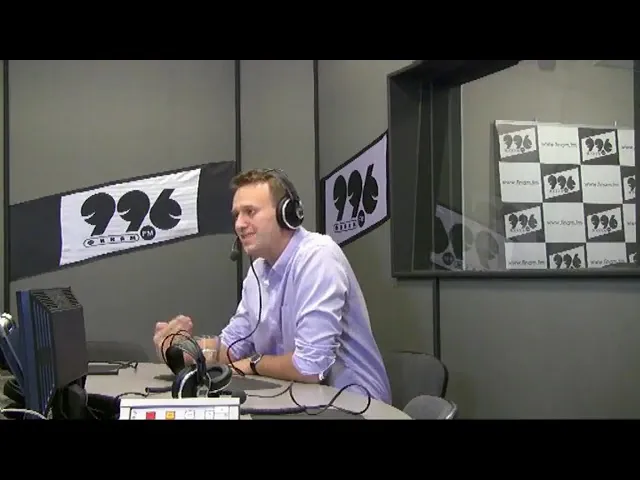
9 p.m. in the Russian capital. Good evening.
Good evening, ladies and gentlemen. This is the program
Bottom Line on the airwaves of
Finam FM. Yury Pronko is at the microphone. I’m glad
that you’ve tuned your radios to
99.6 FM in Moscow or the Moscow
region, or are listening to us on our
online portal, finam.fm.
Today, at your many
requests—just like, remember, in
Soviet times, “at the numerous requests
of our radio listeners”—we have invited to
the program Bottom Line
lawyer, blogger, head of the Union of Minority
Shareholders, and founder of the Rospil portal
Alexei Navalny. Alexei, good evening.
Good evening.
>> Good evening.
>> Let me remind you of the ways to get in touch, which
I think you’ll need. First of all,
there’s our multi-line phone number,
651-0996, Moscow area code 495 for
phone calls, and finam.fm is our
website on the internet, where you can
write messages addressed to Alexei
Navalny, ask him questions, or
simply watch. In other words, you can combine
business with pleasure. A live
web broadcast
is underway online. You can see me, you can see
Alexei. So make use of all these
means of communication. The topic
of today’s program—I’ve titled it this way: Who
Owns Russia? Alexei and I have
spoken about politics in Russia. We talked,
we even met with United Russia (the Kremlin-backed ruling party) here on the grounds of
Finam FM. Then Alexei appeared on
the program “Finam FM Listeners Against,”
yes, Against Navalny. But we have never
spoken with Alexei in concrete terms
about ownership in our country, about the
assets that exist in our country, about
who they belong to.
Look, the program Bottom
Line was originally
conceived for people who, at the very
least, are interested in
ownership in Russia and try to
make money from it by becoming minority
shareholders in one company or another. And,
as a rule, our listeners are given
various
analytical opinions, snapshots from brokers,
traders, and analysts. Mostly,
of course, we talk about blue chips,
that is, our major listed stocks. For many of
you this may come as a surprise
now, but Alexei is the head of the Union
of Minority Shareholders, and I’d ask you
to note that “minority” is not
a dirty word—it’s actually a very good
word. It means an owner, just
a small one, for example in a large company.
I’d like to hear your opinion about
the companies, so to speak, that are
represented on our market. These are the largest
companies, usually affiliated
with the state, while also being
joint-stock companies. So what is your
view—what exactly are they?
Is the Russian state
interested—without any grand rhetoric—in
owners, in small owners,
who hold small stakes? What is your
view of the market? Well, Yury, first of all
I disagree with you
that we have been talking about different
things. We’ve been talking all along about one and
the same thing. And it has all basically been about ownership.
Because to say that in Russia
politics, questions of
ownership, and questions of using
special political instruments
such as United Russia (the Kremlin-backed ruling party) to seize
power, which then leads to ownership,
is all basically a conversation about one and the
same thing. Yes, today’s topic is: who
owns Russia at all? What is
ownership? If we don’t venture
into metaphysics, ownership is
the ability to use,
dispose of, and control. What is
ownership in Russia now? Russian companies.
If we look at the latest
report by Standard & Poor’s, we
will see that companies under
state control account for 53% of
market capitalization. That is by
formal criteria alone. And
if we take informal criteria,
such as the presence of officials on boards
of directors, quasi-officials, former
officials, relatives of officials, then
the figure is much higher. And out of the 90 largest
companies, 73 have in their
share capital an owner
with more than 25%.
So again, that means either the state
or, let’s call them, oligarchs.
>> Uh-huh.
>> What are oligarchs? Are they
real owners? We saw recently
in the example of Prokhorov. That is,
in Russia oligarchs are more like
nominal holders. That is, people,
who formally own these shares.
But in practice, they can be taken away from us at any moment,
and then anything can be done with them,
absolutely anything, again, on the orders of
officials. So
in reality, everything is controlled by a group
of people. I’m not going to say whether it’s Putin or
someone else, but again, this is not some kind of
abstract clique; it is
a very specific group of around 60 to 100
people.
>> So it’s all personalized,
>> it’s all personalized. You can
draw up lists of these people. And now
in the best traditions of feudalism, these
people are embedding themselves into corporate governance
through their relatives,
through friends, through acquaintances. Just
look: our former and current
heads of the FSB (Federal Security Service), take
Patrushev, or the current one
what’s his name, Lord, his surname
>> It slipped my mind too. Ye—yes, yes, yes.
But sometimes it’s useful not to know them either.
>> Ah, yes. Both of them have
children sitting on management boards
or heading companies with
state ownership. Ivanov too,
also a former security official—his children are in place as well.
Remember that wonderful
story with Fradkov, when Putin
introduced Fradkov, everyone was saying:
“People were touched by what a fine fellow Fradkov was for sending his
dear son not to some
cushy post, but to a Suvorov military school
>> to experience the harsh life.” Yes. Well, the harsh
life is over, and now we see Fradkov’s son
where he is.
>> Alexander Bortnikov.
>> Ah, Bortnikov. Exactly.
>> Mm-hmm.
>> And Bortnikov’s son is, uh, sitting there on
the management board of one of the banks.
And Fradkov’s son,
is deputy chairman of the board at
Vnesheconombank, yes—Vnesheconombank is a 100%
state corporation,
and the chairman of its supervisory board
is Putin himself personally. So this is
a specific list of people with specific
relatives who very specifically
indeed, quite specifically
dispose of, use, and manage this
property, manage, I don’t know, these
fruits of it, and can specifically direct
these enormous financial flows. That
is, in the literal sense, it means
a billion here, a billion there, 2 billion
for me, 3 billion for you. And on that
the whole political system is built, because,
obviously, there are a great many people
who would also like to sit on these
streams, on this money. Clearly,
there is not the slightest desire to give it up. And
from this come the political arrangements,
yes—United Russia, through which
the Duma is controlled, the presidential administration
which sets
certain rules, imposes censorship in the media
and so on; the repressive agencies, the FSB and
the police, which right now
in recent months have been doing
absolutely nothing except searching for
political extremism. And
political extremism is anything that is
said against United Russia.
>> That’s how all of this
>> is structured. Ah, but still, does the boundary
between private and, so to speak,
corporate exist? Let me ask
carefully, yes. I assume that
there is a law that must be
observed—the law on joint-stock
companies. But after all, all these
companies are businesses, aren’t they? So
business efficiency, the running of
efficiency.
>> Look, let’s not take everything
to absurdity, right? Let’s not say that
some little company like Vasilek or Romashka is directly
controlled and managed by
Putin. The point is rather that he has
the ability to take that Vasilek away from
any person, despite the courts and
laws on joint-stock companies, from anyone
at all. And it may not even be Putin
who takes it away, but some mini-Putin at
the level of a governor. This happens
every day, on a massive scale. As for
the largest corporations,
Gazprom, Rosneft, Transneft, and
so on—the biggest
>> VTB, exactly right, the state
bank, the largest of the state-owned
banks—I maintain, and given the fact
that for many years now I have been
dealing with the issues surrounding these companies, that
they are, of course, outside the rule of law.
Indeed, both I and my colleagues
do periodically manage to win court cases
against these companies. We do exert
fairly substantial pressure on them, but overall
they remain outside the rule of law.
That is an absolute fact. And despite
the huge number of documents showing direct
corruption, that corruption is completely
obvious and undisguised. Just look at
what happened with Bank of Moscow and VTB.
How many publications there were in
in the business press, there, in the most
serious business press. Analysts
are all talking about it there—foreigners, banking
analysts are going crazy. And nothing happens.
Kostin gives an interview, Kostin,
the chairman of VTB's management board, the president,
says: "And we won't disclose on what
terms how much VTB paid to the shareholders
of Bank of Moscow." What that specifically means is,
yes, if you put it into plain
language: we won't tell you how much money
Kerimov and Yusufov pocketed from this
dubious corrupt deal.
This is happening in full view of the entire country,
in front of the president, the government, and
so on. So the law on
joint-stock companies does not apply
to them. What applies there are
certain informal rules and understandings. Is this your turf
or not your turf? Here, you may
move in and make money here,
but here you may not.
>> Am I understanding correctly that, well, never mind
the law, and never mind its
enforcement? But these people—I still
want to understand, Alexei, who are they
accountable to? If they are not
accountable to shareholders, then to whom
are they accountable?
>> There are no shareholders here. Forget
about shareholders, okay? Again,
>> Well, but those who are, I don't know,
shareholders of Rosneft—you are one yourself,
by the way,
>> I am a shareholder. I am
a shareholder. As a shareholder, I can
claim dividends and benefit from an increase in
the share price. Yes, I do receive some
dividends, from my point of view.
And ask a few questions.
In theory, it's written down on paper that
I can ask questions. More than that,
I can, in theory, receive answers to them
as well. But
the only time I can actually ask questions in any form
is once a year, yes, at the
shareholders' meeting. At the shareholders' meeting
of any of these major
companies, it's basically three hours of shame, and
then we laugh about it for the whole year. It's very
instructive in that sense to attend
a meeting, for example at VTB, where quite
literally, without exaggeration, all the shareholders
stand up one after another and address the presidium,
saying: "You are thieves, you robbed us, your
place is in prison."
>> In the literal sense, in the literal
sense. There is one such
remarkable shareholder who every
year comes up to the microphone and says:
"Kostin, I accuse you of being
a thief, you robbed all of us. Please,
sue me for defamation. The
next year he comes back and says: "At
the last meeting I said this. Here are
new facts: you are a thief, sue me
in court." And he sits there red-faced, staring
at the table. Well, because they know: right now
we'll just put up with it a little longer, another three hours
and that's it. Then he'll go
home empty-handed,
with no dividends and no increase in
share value. And we'll go ride around on our
yachts and merrily lord it over everyone with money. Alexei,
well, in fairness I'll try
to say that Mr. Kostin himself
admitted in an interview with Kommersant (a Russian business daily),
that the so-called people's
IPO had not gone successfully. Yes, he admitted that.
Though some time later, literally
2–3 days later, I saw, um, that he had been
awarded an order (a state decoration). That was
unexpected for me, of course.
>> For me, on the contrary, there is nothing surprising
about it. You have to understand that the
schemes and fraud
that Kostin carries out—it would simply be,
you understand, self-deception and deception of everyone
else to say that he could have done this
without the cover of the chairman
of the supervisory board, Mr.
Kudrin, or that he could have done it without
the cover of that same Mr.
Medvedev, and so on. In other words, don't
think that they don't read these
newspapers and don't know what is happening. They
know perfectly well. Maybe they
are directly involved in the schemes and
personally making money from them, maybe not.
But for some reason they are definitely covering it up.
And when Kostin says that
the so-called people's IPOs—I would remind you,
they took place at Rosneft, Sberbank, and at
VTB—were unsuccessful for him. But why?
For example, at Sberbank no one says
that. There everyone thinks things are perfectly
normal and there are no problems. But
Kostin, of course—they deceived everyone then, if
we remember, the advertising campaign for VTB Bank
featured Kudrin, featured Putin,
the whole state was involved. And
the initial price was set there
very high, at 13 kopecks. After that, everything
collapsed immediately. So what is the question?
You deceived everyone, you looted everything, you
they were obviously unable to manage the bank,
185,000 shareholders are very
unhappy with you. And you say, "This is very
unfortunate." So unfortunate that such
crooks
are sitting in the leadership of VTB Bank. Now that is
extremely unfortunate. So instead of
giving them medals, they should all be thrown out
of the bank. And, as you say, there
are these so-called informal rules there, uh, no point in
looking for the law. And then, basically,
the question becomes rhetorical: is
the Russian state
interested in Russians becoming
owners?
>> Well, what is the state? There is no
office somewhere with some kind of
state sitting in it, you know, doing something.
The state is a collection of
specific people. They are responsible
for specific things. When we talk about the state
in relation to banks, and VTB in particular,
the state means, specifically, the Central
Bank, the Ministry of Finance. And also, uh,
the Ministry of State Property
and the people who sit on
the supervisory board, the officials,
those who were appointed, not only officials there,
but independent directors too — that is the state,
those specific people. In practice, in
Russia, unfortunately, they are interested
in this: officials are interested
in stuffing their own people everywhere — onto
supervisory boards, management boards — and doing there
what Chernomyrdin (former Russian prime minister) brilliantly called
"resolving issues." They sit there,
resolve issues, and siphon off money.
If we are talking about Gazprom and Rosneft,
then it is different people; there, the state means
other people. There you have these
FSB guys (Federal Security Service officers) sitting there who
are interested in getting their children
appointed to cushy positions. Then there is
Sechin, who is interested in making sure that
a significant share of the money from
oil sales would go
not just to Rosneft, but to Gunvor,
would be sent off to Switzerland, to that offshore
company, and so on. In other words, these are
specific people with specific
interests, of course.
Where, in this coordinate system, is Alexei
the minority shareholder? I keep trying to understand.
Well, in this system, in this system
of coordinates — underfoot.
>> In this system of coordinates, everyone
takes the position that he wants and
is able to take,
>> right?
>> If you are an active minority
shareholder, then take the same position that
I do. I have very few opportunities and
powers as it is. And as for
organizational resources, even more so,
administrative resources, any kind of
resources. Well, if you are not afraid
and you think this is wrong, go after
them in court, make a scandal, come to
the shareholders' meeting, write to a newspaper,
file a complaint with the police (militsiya, as it was then called), write
somewhere abroad, I don't know,
a money-laundering complaint. All of this can
be done. I do it myself. Of course I do,
and I have not yet managed to
put them all in prison, punish them, and so on. But sooner
or later I will put them in prison. I am
absolutely certain of that. So if you
want to do this, you will take your place
in this system of coordinates. If you just
sit there, stare out the window, and
just read about it, then you will not. But that kind of
position — sitting by the window — is not for me,
because I feel very personally
about this. I believe that
they are robbing me personally
>> as an owner.
>> As an owner.
>> As an owner in this sy-
>> and as a citizen. Yuri, they are robbing you too.
These are all state-owned companies.
>> Well, I will let you in on a secret: as a shareholder too.
There you go — I will be waiting for you at the next
meeting with impatience. Still, I
am not advertising it, of course, but Sberbank — this
company interests me more and I like it
better. But we have digressed. Look,
you have just said a key
phrase, Alexei, when you said, "I will put them in prison."
That sounds very bold, doesn't it? Very dramatic
indeed.
But if there really is a chain
of facts that allows you
to say this as a lawyer who,
as I understand it, is acting within the law and
demands that the law be observed. And the second
part of this is: I am quickly scanning
the messages coming in right now, and
the recurring theme here — in at least every fifth
question — is: "Alexei, are you not afraid for your
life and your health?" So let me follow up
by connecting these two things, right?
You have just publicly said: "I will
put them in prison." These are specific people, right?
>> People who live by underworld-style notions. They say:
"Well, I suppose something
like Navalny started getting in our way, and
that's that." And then questions arise,
for example, like this one from Yevgeny from
From Magnitogorsk: "Isn't Navalny afraid
for his life?"
>> Well, look, we're practical people too, and
we have our own code of principles, right? Both
informal ones and legal ones. I'm conducting
my own investigation into various
companies. If I see that, in specific
cases, I have gathered all
the evidence, as in the situation with VTB
and several other cases there, the most
well-known being those drilling rigs
that have already become famous, yes, we've gathered all
the evidence. We know who these people are,
we know how they did it. I believe
that these people should end up in the dock
and then go to prison. Yes, right now I
can't make that happen. More likely, they can
put me in prison right now, and all my
statements like, "I'll put you behind bars." And do you
think that they could, uh, somehow, you know,
>> well, let's say, this is what I said at the beginning
of the program, yes: these people, they are
the state. They completely control
the judicial system, the entire
legal system, and law enforcement.
So they can imprison any person,
absolutely anyone. And there should be
no illusions about that. But even so,
I
these are not grandiose statements. Well, I
simply believe that good will triumph over evil.
I believe that sooner or later this
will work out. And I believe that, like all
the rest, this crook will get what he
deserves. At the very least, I will do
everything I can to make it happen.
If it happens in 5 years, in five, in
15, then in 15. As for
whether I'm afraid or not.
There are many dangerous professions. Sitting
across from me is a person who could
be called the author of the famous
meme about the party of crooks and thieves. Yes,
it was thanks to your actions that all this
came together too, among other things. But I would
say that thanks to your provocative,
Yuri, position, all of this spread so widely.
Are you afraid?
>> I'm a journalist, you understand? I ask questions,
yes. I just want to understand, yes.
>> I'm ready to meet with Medvedev, with
Putin, yes, and ask them questions too. You see,
you can deceive everyone in the prosecutor's office,
you understand? Because when someone asks—or doesn't ask—
it's completely obvious. That is,
well,
>> there was this kind of
pressure that crystallized
this whole phrase, "the party of crooks and thieves,"
right? So you're an accomplice,
and that's me speaking to you as a lawyer now,
an accomplice.
Being a journalist is often far more
dangerous than investigating some kind of
corruption in state corporations. Being
a journalist in the Caucasus is
extremely dangerous. We see them being killed there,
yes, and with no one held accountable. Being
some local anti-corruption
activist in some city or somewhere
else, yes, say in Tatarstan. Take
Irек Murtazin, for example. He wrote something
once, wrote something twice, and he was quickly sentenced to 3
years. So there's no need here to
exaggerate the danger that I
am exposed to. And of course, there's no need
to downplay the danger faced by
local activists. Everything is understood by
comparison.
>> Alexei, but maybe, well, you do, yes,
speak very openly,
express yourself frankly, yes, prepare materials.
Let me stress once again: Alexei, as the head of
the Union of Minority Shareholders, as
a lawyer, as an attorney, yes, does all this.
But maybe all of this influence is too
small for them, right? Like, Navalny is just
whispering away somewhere, he has some audience on the
Runet (the Russian-language internet), right? He comes on Finam FM, well,
fine, whatever. Meanwhile we are, basically,
sitting pretty.
>> You see, you have to act,
to use the tools that
exist. If I had the ability
to send signals directly into the nervous systems of all
the country's citizens, I would send those signals.
If I had the opportunity to appear on Channel One
(Russia's main state TV channel), I would appear on Channel One.
I don't have those opportunities. I'm happy that
I can appear on Finam FM. I use
my blog. That's it. And, you understand, the worst
position is to say, "Well, we're
so small, we're such insignificant
ants, so we won't do
anything at all." That is the worst,
most defeatist position. So
>> after September 24, Alexei, a lot of people felt that,
right? So I don't want to—well, now
we've gotten to it. You felt it too, and
now we're going to ask you about it, Yuri,
you understand, about all your pro-Medvedev
propaganda, including on
programs I took part in. I remember very
well—sorry, let me finish—
very well. Piontkovsky attacks
>> as you told me, "But I believe Dmitry
Anatolyevich (Medvedev), and I..." and so on. That's all.
This blah-blah-blah, and you repeated all of it.
that headquarters. Now tell the entire
audience: are you ashamed of it or not? I,
first of all, apologized on my blog after
what happened on September 25.
Second, I am not backing away from my
words that this is what we need.
You see, I can put it this way: I
believe, Alexei, that
a crowd in the street does not solve the issue, that
even calling on people to
gather together, come out, and state
their position does not achieve the goal.
As we agreed at the very beginning,
yes, in your own words, these are also real
specific people, and all of this is
personalized, and these enormous
resources and these enormous forces that
are concentrated in their hands are not
an abstraction, they are reality. I believed
that President Medvedev, as a person
who was in that position, could potentially—this is
the key point, of course—could have, yes,
done it in a softer way, without
chaos, without riots, without revolution, without
street brawls and so on. Yes, I
do not know what President
Medvedev was guided by. I do not believe that they
made an agreement four years ago. Frankly,
I’ll say it plainly: I don’t believe it.
>> I do not believe in the sincerity of your words. I
think it is a distortion to say
that it is either people in the streets and chaos, or else we
play this game about bad Putin
and good Medvedev. That was clear from
the very beginning. And the hypocrisy of this
position, excuse me, was
obvious, but unfortunately a significant
number of people said, "Well, they were
ready to play along with all this." But I am not
calling on you, you know, to
bang your head against the wall and shout
something like: "You absolutely have to go out into the
street and throw at the militsiya officers (police)
rotten tomatoes." I am simply calling for
a certain sincerity, for saying
what you think, for telling the truth.
And the truth is that over
the course of three years, Medvedev consistently
showed that he was not
a president there, and not the person who
would change anything, but rather a
placeholder.
>> It is easy to talk about that now. On October 24,
2011, I said it.
All right, never mind. I just
what happened, happened. Nevertheless, I
stand by my position that he
potentially could have—I say this
with complete sincerity. I apologized to
everyone whom I did not exactly
campaign to persuade—I never campaigned—but
suggested they look in that direction. And
what happened happened in March.
Uh, if nothing extraordinary
happens, then we will have a
change of president, right? So now
now I’m going to go on the offensive against
Navalny, right? So here everyone is asking us
questions
>> about presidential ambitions, about political
views. Every third question here
is connected with the events of this weekend, right?
People are writing: "Disappointed in
Navalny"—Kirill, in particular, writes,
yes,
>> and so on.
>> Listen, the events of this weekend. I
thought the main event of the weekend
was that Medvedev recorded a video about
badminton. People are asking about that. So now
you’re going to turn the whole program into
a session of needling me about it. No,
actually, now I’m the one who will do the needling, yes, by virtue of being the
host, after all. But you
really never hid your
political views connected with
patriotism, nationalism, with, well,
that current, so to speak. Yes, that is
true. You have, by and large, spoken about it
on my program as well, and more than once. But
now
one can increasingly see and hear the opinion
that some kind of synergy is emerging,
a merging of democrats. I am practically quoting
letters to you, yes, that are coming in
with ideas of nationalism. And so some kind of
symbiosis, uh, is supposed to emerge,
yes, which will become an alternative
current. Alexei, look, I can honestly tell you
honestly,
if there were presidential elections,
uh, I don’t know whether you would win—I mean
fair elections, right? Or, well,
relatively fair ones—you would most likely
make it to the second round. I am not
exaggerating your importance or
your capabilities. But right now a situation has arisen
in which there is United Russia
there is
several parties that are within the system,
there are several parties that are outside
the system—well, that are allowed to take part in
elections, yes, I mean the two other
organizations. And there are forces that are
essentially fragmented, and there
leader-centrism is the main thing there, rather than the
idea that potential
opponents or opposition figures. Yes, in
that connection, let me now fully
formulate the question. You will not run in the presidential
election because there is no
choice,
>> because there are no elections at all.
>> There are no elections at all. So you are not creating a political
party because it,
most likely, would not be registered. Am I
understanding your line of thinking correctly?
>> Well, because this method of political
work is irrational right now, it makes no
sense.
>> And look, you really went after me over
Medvedev, right,
>> in the Finam FM studio.
And now let me respond in kind. All right,
can these marches change anything,
can rallies change anything? Fine. I, I,
by the way, I listened to your speech,
right? Fortunately, communications now make it possible
to get everything within five minutes.
And on some points I agree, on others I do not
agree, but that is a topic for discussion, right, in a
country where, as you say, there are absolutely
rightly no elections, no discussions,
none of this, that, or the other. But there are leaders,
yes, though I hope you have not yet caught that disease.
So what is to be done? That eternal
Russian question.
>> Well, listen, the only thing that can change everything is
an active political stance on the part of citizens.
That is the only thing that can
change everything. The specific mechanisms
for action can vary. I also do not
claim to possess some absolute
truth, or to be the kind of person who
knows point by point exactly what must be done
to remove this group of crooks from power
tomorrow. If I
knew those steps, I would carry them out. I do not
know them either. I do what I currently
believe needs to be done. I am engaged in
this investigative work of mine. I
When I am invited to take part in some
events, as I was invited on Saturday
to the rally "Stop Feeding the Caucasus," I
take part in that too and consider it
necessary to support that campaign. There are
different ways of working here. Some people
are involved in organizational
building, like PARNAS and Solidarnost
and so on. I do not, I do not consider it
necessary for me to take part in that, but I do not
see anything problematic about it. And
leaderism? Well, yes, there is leaderism everywhere.
One has to choose something
that unites us. From my point of
view, thanks to you and partly to me, this
campaign against the party of crooks
and thieves has, in a sense, united them
all as well. There is no need here
to create any party, any
structure, and so on. What is needed is a
sound idea, and that idea is shared by
absolutely all people and activists from different
parties. Right now, hundreds of thousands of activists
from all parties except United Russia are
using this campaign. Therefore our task
is to use and seek out more
effective methods of political work.
This is, of course, a complete set of
banalities, but I have nothing
new or extraordinary to say here. Well,
because I simply do not know any of
that, and I think no one does.
If we hypothetically assume
that the United Russia party does not win the upcoming
elections, if
in March something happens that does not
allow that party’s candidate to
win the presidential election. Alexei,
what happens next? Look, you are alone, right?
All right, you have supporters,
yes, but by and large they are fragmented.
Right now, as you say, they have
this idea, yes, about that very
party. Uh, but there are no clearly
formulated ideas—or are there? I do not
know, right? So is there a real alternative?
A real alternative? Of course, yes, there absolutely is
a real alternative for everyone. Well, look,
first of all, if we
hypothetically imagine that tomorrow
Putin is taken back to Mars by Martians,
right, along with all of their United Russia, and something
happens, and free elections are declared in Russia.
Well, listen, there are
political parties now,
such as they are, they do exist. That is,
the country’s population exists, there are
different politicians. I am one of them. These
politicians will take part in the elections.
It would be foolish to expect that tomorrow
they would merge in some kind of shared ecstasy
and
organize something that gets 90%
support. Political struggle will continue,
the debate will continue over
which direction there should be, whether a right-wing
or left-wing path of economic development. But that
would be a normal political process, and
there would be a normal establishment of
the judicial system there, the budget would be normally
formed, and so on. In other words, there would be
a political process—complex, and in some places
scandalous, just as it is in
every country in the world.
>> But these guys won't just give anything up
for nothing. So,
>> Alexei, you know better than I do. What
they possess. Yes,
>> That's right, Yuri. We keep going in circles here,
they won't give up anything. Through struggle you will win
your rights. Our task is to make our
political struggle and political
position so effective that it
would make it possible to remove this group,
which has usurped power, from that very
power. That is the task. It
cannot be solved either in the upcoming
parliamentary or presidential
elections. Elections here do not really
matter at all. Not these ones happening now, anyway. But even so,
without setting any deadlines, without
setting any time frames, we must
continue this struggle. We can see examples
in different countries. In Mexico, a party
similar to United Russia sat there for, what,
60 years in power.
>> There are options. All right. Uh, they may be
hypothetical, but they exist. Then the next
question.
>> I can see you're a little disappointed, but
if you were hoping that I would now give
three simple steps on how to overthrow
Putin and create paradise on earth,
>> and then, after leaving this studio,
you'd say: "Proko became an accomplice in this
overthrow." Nothing of the sort. Well,
I've already done that once, yes. Uh, 65
10-99-6 and finam.fm are the means of communication.
Alexei Navalny, Finam FM, Final Summary.
Alexei, all right then. There is,
let's say, this influential group. There are
people like you, active people, with an
active political stance. Uh, but
there is the broad majority, yes, who
say: "Listen, well, maybe
they're right, this whole setup, you know, that
exists—well, I seem to be earning
my daily bread, right? Bought a car,
bought a little apartment
through a mortgage." Well, if we look,
say, at Moscow, St. Petersburg, and so
on, right? You can't exactly say that people
are living badly, as they say in such
cases, God forbid. Yes, but this
fear that the status quo might collapse—it
exists. You won't be able to
disprove that to me. People with families and children,
after all, unlike our
officials, they look 5 to 10 years ahead,
right, thinking about when one child graduates, where another will go,
to study, and so on. I'm not now
talking about the group that leaves
the country, yes, that's another option, I don't
judge them, it's their right, after all.
But the fear of losing the current status quo,
it exists. And whatever the case, it
is associated with the people who
are currently in power. Yes, there are those little jabs
in smoking rooms, in kitchens, anywhere, yes,
sometimes we even have such discussions on air
too, yes. But this fear,
you have to admit, exists—so how do we
overcome it?
>> Well, look, I'm not arguing with that.
>> It's not even a psychological issue, it's
natural for people to hope
for the best and fear the worst.
Naturally, people will never do
anything, nor will they support anything,
that is guaranteed
to lead to some kind of chaos, a revolution in the
form of chaos, and so on. However, as I
have said several times, it
would be foolish to deny that before 2003
Putin did a great many positive things.
And yes, despite the fact that he
significantly curtailed
political rights, yes, and the process
of usurping power began then and
took shape in 2003, nevertheless there was
a series of positive changes. Of course, this
was connected with rising oil prices, yes, it was
connected, but again it would be
hypocritical to deny that it was also
linked to the establishment of some
basic order in the sphere of
public administration, a more
coherent line. And finally, with
the fact that the president simply stopped being
drunk every day, and so on. Those things
did exist. However, by 2011 all of this
had completely degraded. And this system,
for those very people who
hope for the best and fear the worst,
it became obvious that this system would
lead only to worse outcomes. It is no longer
capable of changing anything, it is not
capable of doing anything well. It cannot
give us affordable housing,
quality healthcare, or
protect us, uh, I don't know, from
crime. It cannot protect us from illegal
immigration, or protect the country from disintegration.
And we all see that the country
is falling apart, and entire republics have in
fact ceased to be part of Russia.
So all of this has also become obvious. And with
with this government and these specific
people, with this list of specific
individuals, no one associates any hope for a better future anymore.
But at the very least, there are more and more such
people. And our task is
to tell a wider circle of people about
what is happening. When everyone knows
about the wonderful Kovalchuk, yes,
who became a billionaire simply
by attaching himself to Gazprom and Bank
Rossiya. About the Rotenberg brothers, who,
Putin's friends, latched onto Gazprom
and became billionaires. And Timchenko,
who, by latching on thanks to Putin
to oil companies, became
a billionaire, renounced his
citizenship, sits in Switzerland, and
doesn't even pay taxes here. About Ramzan
Kadyrov and his cheerful
lifestyle there. By
spreading this information, we
will achieve a situation where more and more people
will realize that this government will bring them nothing
better anymore.
>> And 65199.6
finam.fm is our means
of communication. Alexei Navalny is with us today
on the program Bottom Line on Finam
FM. I'll ask one more question, and then we'll
begin the interactive part. Alexei,
well, um, in your opinion, if in 2012
Vladimir Putin is elected
president of Russia—I still insist,
yes, on observing the law. I hope that
they will observe it too. Well, I'm
a romantic, yes, the last romantic in
Russia who still believes that the law
does exist after all. Mm, what do you think,
he has started comparing himself to
Roosevelt, to de Gaulle. I deliberately
bought the book The Great Roosevelt and, opening it,
after reading just the first 10 pages, found
the first amusing point. Roosevelt
was one of the first politicians to demand
direct elections
to the U.S. Senate, rather than
selection by state legislatures. Yes.
Well, accordingly, applied to
Russia, that would mean direct elections of members of the Federation
Council. And further on, perhaps, I'll find even
more differences between Vladimir
Putin and the U.S. president, but I want to ask you
about something else.
Do you think they really
sincerely believe that they are saving
Russia? You see, I don't believe that
they are somehow so
as young people would say, frozen out, yes,
and that they don't see, don't notice, don't
understand, and are living in some other world.
No, of course they see and
understand everything. And I think they sincerely
believe that they are doing something
good and saving the country from the coming to power
of some other people,
who, well, it's a cliché, you know. They
will also come and steal everything, but
they'll be even worse than us. Yes, they'll come and steal everything,
but it'll be them stealing it, not us
stealing it. And these people have already, you know,
there's an old Soviet joke,
sort of, that stealing has become so
difficult that it already seems to me that I'm
actually earning it.
After all, it's the administration of all these
endless schemes. Well, the same thing with
Gunvor, Rosneft, and
Transneft—managing all of that.
Administering the theft takes
so much money that they genuinely think
that none of this is stolen, that it is
honestly earned.
All those VTB people, Sechin,
Timchenko, the Kovalchuks, that whole gang—they
sincerely believe that they
earned it. They don't sleep at night,
after all. Well yes, I became a billionaire. And
how am I any worse than those rotten
Komsomol types who became billionaires
under Yeltsin? I work harder, I'm
a patriot.
And so they sincerely believe—well, it's
somehow, you know,
many people are inclined to
transform themselves in this way. And any person, in
general, is inclined to justify their
actions. That's normal psychology. And
they sincerely believe that they are doing everything
right. And of course they do not
intend to give up power, and they
will come up with, and convince themselves of,
a huge number of
explanations. They don't live in a vacuum,
they have to explain themselves to us
and to foreigners. They will tell you about
Roosevelt, they'll tell you, I don't know, about
Crocodile Gena and Cheburashka (popular Soviet cartoon characters), they'll find any
arguments to justify
what is happening. Anything can be explained
with the help of some kind of historical
analogies and examples. Then he'll say, "
I'm like Ivan the Terrible, the gatherer of
the Russian lands, or like, what else am I,
I don't know, like Mahatma Gandhi, doing
something there." Well
>> how long this about Let me ask you a direct
question. Are you in favor of revolution?
>> Well, again, what exactly do we mean by
revolution?
Revolutionary sailors running around and hiding everywhere?
Let's put it this way: if by
revolution we mean some kind of
social upheaval that removes
this illegitimate regime from power,
a regime that has usurped power, then yes, I am in favor of
revolution. If by revolution we mean
whether I support crowds going out tomorrow
into the streets and starting to
set everything on fire, then no, I am against revolution. But
we can see that before our very eyes there have been
a huge number of so-called
revolutions that took place entirely
without bloodshed and led to legitimate power,
yes, perhaps to a legitimate government
that we may not like.
For example, take Yanukovych:
the government changed, and Yanukovych came back to
power again, but of course he became far
more legitimate than he would have been before
that, when he became president for a
short time as a result of
electoral fraud. So there is no need to be afraid of
the word revolution. People come out and
demand a change of power. The government falls,
a new one is appointed. There will be no
vacuum. A holy place is never empty
(Russian proverb meaning power vacuums do not last). And there is also a huge
number of legitimate institutions. And
there will be elections, there will be new elections,
people will come to power; some of them will
be to our liking, some of them will not
be. We should not be naive and
think that it will necessarily be us
those people—that I personally will be the one
to take some
position. Maybe I will not take any position at all and will
lose badly. And when you talk
about a second round, well, that is probably
an exaggeration, because polling
shows that, for example, only
6% of the country's population knows me. There is no need
to build fairy tales in your head. And
maybe Zyuganov will come to power, or
Zhirinovsky will come to power, but if he
comes as a legitimate leader, well, then
he comes.
>> People get the rulers they deserve.
Yes. Alexei Navalny. Bottom
line. Finam FM 65 199.6
and finam.fm. Those are our ways to get in touch.
Tell me, do you consider yourself a marginal figure?
>> Well, of course not. By marginal figures I mean
people who, first and foremost,
hold extremely
extremist political positions
that in fact are not supported
by the majority and who are inclined to
break the law. And within
that definition, Putin, Medvedev, and their whole
gang of cronies are obvious
marginals. As for me, I consider myself a perfectly
mainstream politician, because I
say what I think, what I believe
is right. It seems to me that
most people agree with me.
>> What are you closer to? If we use
political science terminology, are you
a liberal, a nationalist,
>> This is not the periodic table. And I am
categorically against that. You hand me
a little box with tiny compartments
and say, "Please put yourself
into one of these little cells." But that is
complete nonsense. We need to proceed
from a real political agenda,
from actual problems. And I have different
views—views on any of these
survey questions that are supposed to define your
political position, from abortion
to gun ownership. Yes,
I have answers to all these questions, but
I do not think in those rigid categories. As for gun ownership—
>> I support simplifying the procedure for
civilian gun ownership, including
handguns. I support
allowing civilians to acquire
them.
>> Are you against abortion
or for it? I am not against abortion. I believe that
abortion should certainly not be
banned, but—so you want to go
straight down the whole list.
>> Well, you just laid it out. I am
going straight down that list.
>> I believe that, of course, abortions should not
be banned, but we should take
measures to make them far
less common. But they must not be banned under any
circumstances.
>> Are you against the Caucasus?
>> And what exactly is meant by the strange
phrase, "Are you against"? Of course I am for
the Caucasus. I believe that my position on
the Caucasus is a hundred times more patriotic and
more focused on preserving the country than
the utterly hypocritical and deceitful position
put forward by those two
clowns of ours, Putin and Medvedev. My position is
that there must be
budgetary equality, budgetary
fairness. My position is
that there is no need to keep feeding these
criminal gangs and groups that
now call themselves the Caucasian
the political elite, because I support
the Caucasus. I believe that if we are
allocating any funds, they should
go to the people and
be redistributed in such a way that
the local population, which is impoverished there, benefits from them.
They’re just crooks who
hand each other gold bars and dance
around there, tossing things to their own
select circle of people.
>> Of course, I despise these people. These people are
murderers, these people are robbers, these people
despise their own population. They have created
these little states which, as I
already said, are not in fact
part of the Russian Federation. They are destroying
their own people. They despise their
people. They have created feudal
structures now, in the twenty-first century,
right next to my country. Of course,
I despise such people.
>> Let’s answer some listeners’ questions.
Alexei Navalny, Bottom Line
on Finam FM. You can call 65
10-99,6,
or send your message to our portal
fin.fm. I can see that you’re writing to me saying
that there is neither an online stream
nor sound, but the channels were today
expanded as much as possible, that is, up to
the limits of our technical capabilities, yes, I don’t
know what exactly is going on there, but at least you
can definitely hear us on 99.6 FM in Moscow and
the surrounding region. Good evening, you’re on the air. Hello.
>> Ah, good morning.
>> Good morning. Where are you calling from?
>> Yes, good afternoon, sorry. Good evening
already. You know, your guest today is saying very
correct things, and things that are painful
for a patriot’s heart to hear, rather,
and I would probably agree with him in about 90%
of cases. But you know, you
won’t believe it, just this morning I
was talking to a person, a friend of mine,
a former classmate, who works in this field, he
makes money from all these
web-related things, that is, he promotes
various websites, various
accounts, and so on. And he just
casually said, "Do you know
how much it costs to set up a LiveJournal
like Navalny’s?"
>> So
>> I don’t know, but he named a figure that
really surprised me.
>> Well, say how much.
>> Well, he said it was around, I think,
1.5 million rubles (about tens of thousands of US dollars at the time), something like that,
and that it also has to be maintained, which also
costs money.
>> And what does it mean to create such a journal? In other words,
will the journal’s readers
come included automatically or what? I mean,
how exactly do you create one? Are there
any examples of journals created that way?
It’s just that, yes, Yuri, I haven’t really looked into
the technical side of it, but as for the substance of the question,
I trust this person because he is
a professional, and he has no reason to lie
to me. You see, Alexei has
a very normal, proper
position on many things, but
the only thing that, let’s say,
doesn’t entirely reflect well on him, perhaps,
right? That is, what raises doubts
among people who generally agree with
his point of view, is the source
of funding, right? Where does he get
the money for all these things?
>> Yes, thank you. I apologize, I’m going to
cut this off rather abruptly, because it’s 21:51,
short answer.
>> Well, it seems to me the last thing anyone could
accuse me of is somehow
having bought my journal or maintaining it with
money. It has existed for many years, and
it gained readers over a fairly
long period of time. It seems to me
it is all quite obvious that
running a LiveJournal for me
costs 0 rubles and 0 kopecks.
>> This is Alexei Navalny on Bottom Line
on Finam FM. I’m launching an SMS poll. Do you
support the activities, the kind of
activities that Alexei
Navalny is engaged in? 5533, right? If yes, you
support Navalny, send to 5533
an SMS with the letter A. If no—and if you think all this talk
about a website costing 1.5 million or whatever else
you may have found about my guest today
is true—then
send to 5533 an SMS with the letter B. Once again.
For Navalny: 5533, text the letter A.
Against Navalny: 5533, an SMS with
the letter B. The voting has been going on for 52
minutes now, 8 minutes until the end of the program.
Good evening, you’re on the air. Hello.
No, I have—good evening. Hello.
>> Hello. Well, what is it? Good
evening. Hello.
>> Hello. Good evening.
>> Igor. A short question. Alexei is now broadcasting,
roughly speaking, through your
radio station to Moscow and the central
region. But how does he plan to get
his thoughts and statements across to
grandmothers and grandfathers who watch
only the main state TV channels? Yes,
Thank you.
>> I get the message across however I can. So,
they invite me onto various
radio stations. Some of these
radio stations are listened to by grandmothers. So
I use that. Wherever I can, well, where I can't do more.
The simplest way to reach people on a larger scale is
television. I don't have television. I do
what I can to get the message out. Right now we've
released videos about our wonderful
United Russia, the party of crooks and thieves.
We're trying to use a new
distribution method through
text messages. A grandson downloads the clip onto
his mobile phone and shows it to his grandmother.
Well, I agree that these are
perhaps not very sophisticated
and not very effective methods, but we
don't have any others. We use whatever we can.
>> Good evening, you're on the air. What's your name?
Hello. Ah,
>> Hello, Roman.
>> Yes, Roman, go ahead.
>> Yes, Alexei, Yuri, good evening. I wanted
to ask, simply, well, I also support
Alexei, yes. I wanted to know his view
simply from the standpoint of an economist and
lawyer, regarding what kind of sums
the assets of our officials abroad are
generally estimated at, acquired from the 2000s
to the present day. And in principle, how
can we count on help, I don't
know, from other countries in recovering these
assets, and how it would be possible
to carry out, among other things, a review of
the results of privatization and your opinion on
that.
>> Yes, thank you.
>> Well, look, obviously it's impossible to estimate this
down to the last kopeck or even to the nearest million
dollars, or even within $10 million,
with any precision. There are fairly well-established
methodologies used by Forbes
and Finans (a Russian business magazine), and other publications, so we
can make estimates. And if we're talking about
the assets specifically of Putin and the Putin
group, then the holders of these assets are
the Rotenbergs, Timchenko,
the Kovalchuks, whose billion-dollar fortunes
have also been broadly described. As for whether
there is or will be an opportunity
later to seize all of this and
return it to Russia, I believe that
it will be possible. It will require
considerable effort. But we do have
precedents where, well,
the bank accounts of African
dictators and Middle Eastern rulers were
frozen and then returned to the new
governments. So of course this is
a matter for the future. Sooner or later this
will have to be done.
>> 65-10-99-6 and finam.fm are our means of
communication. Alexei Navalny is with us today
on Finam FM on In the Bottom Line. The
SMS vote is underway. There are only
2 minutes left to vote. Do you support
Alexei Navalny's activities? Send to 5533
a text message with just the single letter A.
If no, to 5533 send just the single letter B.
The vote is ongoing. They're asking
what Alexei Navalny thinks about
the overthrow of Gaddafi. Briefly.
>> The Libyan people overthrew Gaddafi, so
let them deal with it themselves.
>> All right, answer received. Good evening, you're
on the air. Hello.
>> Hello, good evening.
>> Yes, hello.
>> Yuri, thank you for having this guest. Alexei,
please tell me this: I belong to
the majority Yuri was talking about.
I'm 23, and I want to leave this country.
I've had enough, but I work here, I'm
a specialist in my field, and I want
to work in peace. I don't want to go out
into the streets, vote, stand there with
placards. I want to work peacefully and
earn a living, or else leave. So.
Nemtsov suggests going to the elections, to
the polls, and tearing up the ballot. I want to understand
what I should do. I'm confused. Everyone is shouting
that Putin is bad. Who should I believe? What
should I do?
>> Yes, thank you.
>> Well, first of all, you need to understand very clearly
that this position—"I don't want
to go anywhere or stand anywhere with a placard. I
just want to live normally and work, and for everything
to be handed to me"—will get you
nowhere. Sooner or later it will force you
to emigrate. No one is simply going to
hand you anything, unfortunately.
So, as I already said, in struggle
you will win your rights. Your task and
duty, if you like, as a
citizen, is to take an active stance.
And after that, which politicians you listen to—
whether Nemtsov, Limonov, me, or
Zhirinovsky—that's a matter of choice.
Everyone should, I believe, have at least
a basic understanding of politics. And
analyze things. I say what I think,
and I explain it. I urge people
to follow certain ideas and
advice of mine.
>> The main thing is to think and choose with your own
head.
>> That's the key point. Good
evening, you're on the air. Hello.
>> Good evening.
>> What's your name?
>> Andrei.
>> Yes, Andrei, if possible, briefly.
Sure, I wanted to ask Alexei,
>> whether he is familiar with Yuri Genadyevich Mukhin's idea about
the structure of power in Russia and what he thinks
about it.
>> Thank you.
>> Unfortunately, to be honest, I'm not familiar with it,
so I find it hard to answer.
>> Let's move on. Good evening, you're on the air.
Hello.
>> Hello. Good evening. My name is Timur.
>> I'd like to ask what you think
of Vladimir Solovyov and his
program.
>> Yes, thank you.
>> Well, I regard Vladimir Solovyov with
curiosity. That is, Vladimir Solovyov
holds a certain position.
Vladimir Solovyov earns
his living in a particular way.
Well, that's how he makes his money.
And I regularly get sent links to
his various curious remarks about
me. Well, everyone chooses their own profession,
the one they choose. Vladimir Solovyov
has chosen his path. It seems to me
it's quite a difficult one and not conducive
to mental well-being. Well, let him do what
he does.
>> Good evening. Hello.
>> Hello. Good evening.
>> Good evening. The first woman has called in
to us. What's your name?
>> Hello. My name is Olga.
>> Yes, Olga, go ahead. Briefly, please.
>> I have a question about legal practice.
How can someone become
Alexei's client if, according to
the register and according to his lawyer's account,
if you look at his records, the only
company that appears to be his client is
his parents' company. Maybe that's
not the case? Well then, have you tried to become
my client? First of all, these
statements, which I don't know how
were compiled, seem to cover only
one client. Second, if you are
an individual, then most likely,
of course, it depends on the issue. You
cannot become my client if you are,
because I don't specialize in those kinds of cases.
If you represent some company
or are a shareholder, and you have, uh,
a corporate conflict, and you are able
to pay for my services, then please,
come in, uh, come in.
>> I can certainly take on your case, but,
of course, it will cost
some money.
>> That was an advertisement for Alexei Navalny's law office.
Good evening, you're on
the air. Hello. Right, hello, good evening.
>> Ah, good evening.
>> Please introduce yourself.
>> My name is Alexander. I'm from Moscow. I'd like
to fully support, support
Alexei.
>> Thank you.
>> So. Well, I wanted to comment on the following
topic. Uh, today I was driving near
Komsomolskaya Square, and there were people there
handing out signs—oh, not signs, but
ribbons, like the ones for Victory Day (the holiday marking the Soviet victory in World War II),
something like that. The ribbons had
white crosses marked on them. And they had
posters that said:
"Put a cross on the thieving authorities." And I
want to tell you, I don't know whether
people are happy with life or not, but no one
opened a window or took a single
ribbon. So maybe that's an indicator
of our patriotism, of whether people are satisfied
or dissatisfied with things. I don't know.
>> Yes, thank you, thank you.
>> Well, I don't know to what extent that is
an indicator. To be honest, I myself wouldn't
take such a ribbon, because it
contradicts, it seems to me, the position that
you should come to the elections and spoil
your ballot, yes, put crosses in every box.
That, it seems to me, is not a very rational approach.
Well, in any case, it's a position, and people
have the right to promote it. Ribbons are not
the biggest indicator. Nevertheless,
of course, people's social activity
is quite low, but no one except
us can increase it. Everything
depends on us, on how effective our
work is. So if they're handing out ribbons, well,
good for them. If they're doing it badly, then take
a bunch of those ribbons and hand them out to your
friends. Everything depends on us.
>> But nevertheless, you did put a sticker
on your car.
>> Yes, I drive with a sticker. United Russia
is the party of crooks and thieves. And I would say
that I get quite a lot of
support. People show that they
support it—they honk, they give
a thumbs-up, like, great.
>> Alexei, thank you very much for finding
the time to come.
>> Thank you for the invitation.
>> And I think we had a good conversation
despite all the barbs directed
at each other, right? And what matters
is what was said. And the main
conclusion, uh, is that we are not campaigning to you. I
am addressing the listeners, yes: each of
you is free to take whatever steps
you consider necessary. Just think, at least
sometimes about what is happening in our
country thanks to our programs,
thanks to Alexei Navalny. But I
hope that before New Year's
we will meet again, for example, on December 5, as
>> 31 December 5, well, on December 5 there will also be
the monitoring process, which I
am overseeing, trying to coordinate
to some extent, everyone to the best of their abilities.
So I think that on the fifth there will still be
such an intense period. And because all
the manipulations will in fact be
taking place on the morning of the fifth. Well, of course, I
will be happy to come on your program.
>> All right, agreed. So, the next
meeting with Alexei Navalny. And after
the upcoming, well, let's still call them
elections, yes, to the State Duma
of the Russian Federation, Alexei Navalny,
the bottom line. Finam FM