Alexei Navalny on the program “Week” on REN TV
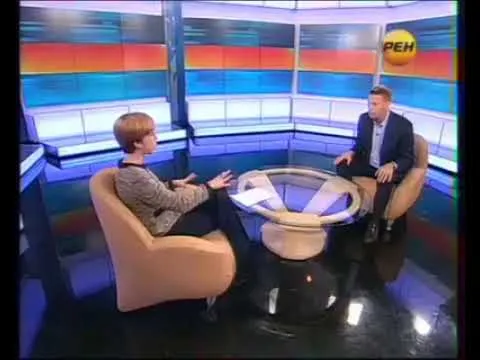
And here is one of the most truly
discussed topics in the blogosphere. Why did
the country’s leading online anti-corruption crusader,
Alexei Navalny, the author of the high-profile
RosPil project, take part in the Russian
March? This event is traditionally
held on National Unity Day by
Russian nationalists. Navalny,
incidentally, has marched there before,
but this time he was announced as one of the
organizers of the procession. The liberal
public took Navalny’s move
painfully. Many
political analysts, however, believe he is acting
absolutely correctly. After all, nationalism in
Russia is becoming fashionable. True, this
fashion is being shaped along very dangerous lines.
Navalny’s demarche. In an interview with our
program, the country’s leading exposer
explained why he stood shoulder to shoulder with
nationalists.
>> Alexei, first of all, let’s clarify
the terms. Are you a nationalist, since you
took part in the Russian March?
>> I’m a person who talks about real
problems. You see, all this
political-science nonsense — nationalists,
liberals, left, right — in our
real world it doesn’t always work
properly. Well,
>> but it does at least set markers for
people, so it’s clear what kind of person
the person addressing them
actually is.
>> Exactly. For me, the markers are
real problems. There is
a real problem of illegal immigration in
Russia. Russia ranks second in the world by the number of
illegal migrants. There is also
the real problem of Russians as
Europe’s largest divided people,
there are problems in the Caucasus, and so on. At the
Russian March, people came to discuss
these issues — different kinds of people. It was not that
you can talk about these problems only at the
Russian March. In the end, I talk about these problems
everywhere. Unfortunately, it turns out that
most of these problems are
taboo. They are discussed neither in the
State Duma (the lower house of Russia’s parliament), nor in the
government, nor on the main
federal TV channels. And it is precisely because
these topics are shut down everywhere and people are not given
the chance to discuss them, that this
leads to radicalization.
>> All right. And television really has not
been very eager, let’s put it mildly, to
show that very Russian March,
for example the one that took place last
weekend. Let’s take a look both at you at the
Russian March and at the Russian
March itself. Please roll the video.
>> So they robbed and stole.
>> Russians, forward! Russians, forward!
>> Moscow is a Russian city.
>> Moscow is a Russian city. Moscow is a Russian
city.
Russia, Russians, forward, Russians, forward
... We are not
forward
forward
jury. And to the end, shoulder to shoulder. And to the
end, shoulder to shoulder.
>> Well, look at what this amounts to. People are used
to seeing at the Russian March
that sort of, you know, frenzied youth,
throwing Nazi salutes, as people now commonly
say. And right there beside them is you, a person
who very nearly became an icon of the
liberal opposition.
>> I’ve been going to the Russian
March for four years in a row. And to all my critics I say
just one thing: if you want the Russian March
not to look like that — if you want it to look better — then
come yourselves. I came to it with my own
personal Russian March, with my own personal
political slogans: Down with the party
of crooks and thieves. I voiced those slogans, and
I conveyed my own position. It seems to me
that I was heard and supported.
That suits me perfectly well. When you enter the United States,
you’ve probably seen that
people give their fingerprints at the
border there, and nothing terrible
happens. Even Democrats, in the Senate and
in Congress, including Barack Obama,
voted for building a wall on the border with
Mexico. Here, it’s simply a question.
>> But not alongside nationalists or,
say, people who put on
Ku Klux Klan hoods and shout
some kind of, essentially, Nazi slogans. You’re absolutely
right, Maryana. And that is precisely because
there it is discussed in the Senate, so there are no
people in hoods running around the
streets. There is, for example, the campaign
called Stop Feeding the Caucasus. Yes,
the Caucasus republics should receive
federal subsidies, like all the
others. But let’s discuss the size of
those subsidies. Let’s discuss what we
get in return. And no one asks you,
as a citizen. Does that offend you?
>> I’m a taxpayer. It doesn’t just
offend me — it outrages me to the depths of
my soul. If you like, it infuriates me. And,
of course, I go — and not just me, but all
sorts of other people go to the Russian March and
say something.
>> Doesn’t it bother you that you are stepping into
Zhirinovsky’s turf, and he has long since
made this nationalist issue his own and, incidentally,
quite successfully.
>> Maryan, are you still concerned about
illegal immigration? Do you acknowledge that
in terms of heroin use
of Tajik and Afghan heroin, Russia
ranks first in the world? I’ll say this:
among drug couriers there are many completely
ethnic Russians, so what concerns me
is drug smuggling,
but I would not tie that to
nationality.
>> You are tying it to that. Problems concern me, and
I don’t care about anyone else’s turf. I’m on
my own ground. I talk about the problems
that exist, that need
to be solved, that are being hushed up. I
retain the right to say what I want, and
the fact is that I have a very broad audience on
the internet as well. And that audience
grows every year.
I’m not afraid of losing anything. I will
continue saying what I
believe is right and what I believe
is necessary. As for online exposés, that is
your main work now.
>> From the start, I was involved in very
specific things. I’m a lawyer, and
my main area of work is
investigating corruption in
state corporations. I was doing that
before, and I’m still doing it. Since
neither television nor newspapers want to show the results of
my investigations,
I publish them online. And that is exactly
why I became a blogger. We created
an entire campaign, the RosPil project, where
lawyers sit and, every day, uh,
challenge such corrupt procurement deals.
Just the day before yesterday, we got canceled
another procurement contract worth 290 million rubles (about 290 million RUB).
In effect, we saved those 290
million rubles for the budget. But it seems we are doing the job
that, in a normal system,
the prosecutor’s office and the Investigative Committee
and so on should be doing, but here all of this
turns into online exposés. And
you are one of the most famous bloggers in
the country. This week there was a meeting between
President Medvedev, incidentally,
internet users and bloggers.
>> You, well, presumably because you were not invited to that
meeting. Does that bother you?
>> No, I’m not upset. It was fairly
obvious to me, and I know they simply have no
answers to the questions I want
to ask. And so on.
>> And what question would you ask Medvedev?
>> There was the so-called Daimler case,
which was fairly well known. It concerned the fact that
the Daimler corporation admitted that it
paid bribes in connection with vehicle purchases
to our officials, officials from the FSB (Federal Security Service), the Interior Ministry,
the Defense Ministry, and so on. And
Mercedes admitted all of this. There are
the numbers and names of the offshore companies,
I even have them myself; I published them,
the ones that received this money. So
the question arises: why is it that, to this day,
despite the fact that I and some of my
supporters online organized
thousands of complaints, appeals, and crime reports,
still nothing has been
investigated.
>> But look at the risk you run. They could
say that you were not invited, well,
for example, to that very meeting of the head of state
with bloggers, because why
invite a person who takes part in
some marginal actions, as people now
say, this kind of
street protest action. There he is, with
nationalists, shouting something, just about
short of throwing up his arm in a Nazi
salute. Why invite such a person
to meet supposedly serious people?
>> If there is no desire to invite me and there is fear of
hearing my question, then a pretext for
not inviting me will always be found.
>> You have become so famous, at least
on the internet, that it is time to ask you about
your future plans.
>> In our country, so much is stolen, and so
openly, in corporations like these
all my favorites—Gazprom, Rosneft,
VTB, and so on—that I have plenty
to keep me busy for the foreseeable future.
That is, investigating
corruption continues to remain my main
focus, and I have a great deal of
work.