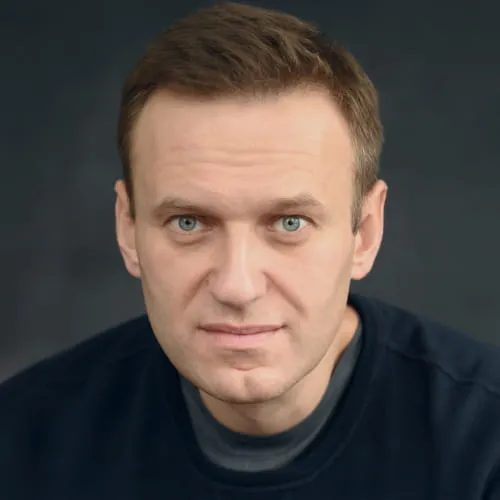
Today, The New York Times published an interview with Alexei — about foreign and domestic policy, his time in prison and prison life, the approval ratings of the authorities and the opposition, and the upcoming elections.
The *NYT* piece included excerpts from Alexei’s remarks. We are publishing the original Russian version of this interview. Below are all the questions asked by the journalists, along with Alexei’s answers exactly as he wrote them.
1. Do you think it was reasonable for Biden to meet with Putin? How should European leaders handle this — agree to meet with Putin or avoid such meetings?
That is President Biden’s job. And the job of European leaders as well. They meet and negotiate with other world leaders. We can, of course, discuss the extent to which such meetings have degenerated into ritual. But one way or another, in the first half of the 21st century, a president’s work largely consists of meeting with other presidents, even if they are deeply unpleasant people who lie with every word they say, as Putin does.
The other question is whether Biden achieved any goals. Obviously, not yet. Putin immediately extracted all the benefit he had planned from the meeting, because he needed nothing beyond the fact of the meeting itself and the television image. That alone is enough for domestic propaganda to launch a mass brainwashing campaign around the message: “No matter how much these ever-changing Western leaders criticize our eternal wise president, they still come to him, sit down at the negotiating table, and ask him for something. After all, no global problem can be solved without him.” Here in the prison camp, I am required to watch state television, and believe me, that line was played very effectively.
Biden, meanwhile, had a far more difficult task: to influence Putin’s behavior both inside Russia and on the international stage. And so far, the consequences have been exactly the opposite of what was intended. After the meeting, Putin effectively criminalized all opposition activity by declaring it “extremist.” Tens of thousands of people have been barred from running for office at any level. In the current State Duma elections, all strong candidates have been removed on the grounds of “supporting Navalny and participating in rallies.” The best media outlets have been crushed and labeled foreign agents. In effect, the infamous Soviet law “On Anti-Soviet Agitation and Propaganda” has been revived in Russia. Hundreds of websites are being blocked even without formal court rulings. The number of political prisoners is growing. So is the level of anti-Western hysteria in the media, though it hardly seemed possible for it to go any higher. So Putin listened to Biden and did the exact opposite. The intensification of repression would have happened even without the Biden meeting, but the meeting did not prevent it or slow it down.
But it is important to understand here that whatever Biden’s real strategy may be, it simply cannot produce instant results. The elements of that strategy that we can see — for example, the truly remarkable, I would even say historic, statement on corruption — suggest that it may prove effective, rather than remain a ritual dance that the Kremlin elites will once again laugh at.
2. In your view, what sanctions should the United States impose on Russia for its repression of the opposition? What do you think of the fact that the U.S. has decided — at least for now — not to sanction the oligarchs on the list you compiled?
There is no need to impose sanctions on Russia. Sanctions — much tougher than the current ones — should be imposed on those who are looting Russia, making its people poorer, and robbing them of their future. That is exactly what they should be called: “A sanctions package in support of the Russian people, against corruption, lies, and tyranny.”
Let’s be clear: so far, all sanctions of this kind have been deliberately designed so that almost none of the significant members of Putin’s gangster clique would actually be affected. Want proof? Then name even one villain who has truly suffered. The planes, the yachts, the billions in Western banks — all still there.
And the fact that sanctions against the oligarchs still have not been imposed is a terrible disappointment. Putin’s regime is a mafia group. Even by formal criteria. Notice that members of this mafia have intermarried, becoming related through their children. It is now a collection of family clans, where the father is the head of the FSB (Russia’s security service) or a former FSB chief, and the son is the head of a state bank, “legally” bringing billions of dollars into the family.
And above them all stands the *capo di tutti capi* — Putin.
The few individual sanctions that have been imposed are almost always aimed at the muscle of this mafia — colonels and generals. Yes, they are villains, and they give orders to kill. But they are still people who decide nothing and can easily be replaced. They have no assets in the West; they do not go to parties in London or New York. Let them remain on the sanctions lists, but the main part of those lists should consist of the people for whose sake the opposition was barred from elections. Those people are the oligarchs — both state ones, the heads of state corporations and state banks, and formally private ones whose wealth directly depends on the further development of authoritarianism. An oligarch who buys a media outlet in order to purge it — fire independent journalists and change editorial policy — is a more important weapon for Putin than some general who arrests people.
I devoted much of my column, published last week in three major newspapers around the world, to exactly this issue. Western leaders — and President Biden above all — must show real resolve in fighting corruption. In particular, they must stop calling Putin’s oligarchs “businessmen.” Any Putin-linked thug or mafioso who calls himself a “businessman” is automatically treated as “almost one of us” — someone you can do business with. The Kremlin is delighted by how easily the American administration can be manipulated with phrases like: “Come on, why sanction the oligarchs? What is this, populism? They’re just businessmen, even if they’re big ones. They haven’t killed anyone.” They have not killed or jailed anyone themselves. But people are killed and jailed every day for their sake.
Interestingly, all of this is understood at the legislative level. The statements made by the leaders and members of the Anti-Corruption Caucus recently created in the U.S. Congress are absolutely correct. Members of the European Parliament are determined to impose sanctions on oligarchs. But the executive branches on both sides of the Atlantic find it hard to stand up to the army of lawyers, lobbyists, and bankers fighting to preserve the impunity of those who own dirty and bloodstained money.
3. Is there a risk that Western support could be counterproductive, since from the point of view of a domestic observer the Russian opposition would appear linked to Russia’s supposed “enemies,” or at least to foreign governments?
There is no such risk — it has already happened. For several years now, this has been one of the foundations of Kremlin rhetoric: all our troubles come from Western sanctions, and the opposition wants more of them. Interestingly, the unpopular “counter-sanctions” introduced by Putin himself, such as the ban on European food products, are also described by propaganda as “Western sanctions.” That is exactly why I call for targeting villains and oligarchs personally. Such actions by the West would be fully supported by Russian society and would even be greeted with jubilation. In the eyes of ordinary people, measures like these would show that the West is not hypocritical, that “they are not all in it together,” and that at last someone is standing up for their interests.
As long as oligarch Usmanov, who paid Dmitry Medvedev bribes worth billions, can live without any problem between Monaco and Italy on his yacht Dilbar, worth more than $470 million, and Roman Abramovich, who financed Putin’s palace, can commission mansions on the Upper East Side, no one will believe that the West truly wants to help Russians save their country from being looted by Putin’s group. You cannot fight corruption without fighting corrupt people.
4. Do you think warnings from Western governments that anything happening to you in prison would lead to tougher sanctions have made your imprisonment safer?
It is hard to say. On the one hand, Putin genuinely fears that new sectoral sanctions could wreck the Russian economy, where real household incomes have already been falling for seven consecutive years. On the other hand, his “I do not yield to pressure” stance has long since turned into a trademark irrational struggle. If someone demands something of me, then I will do the opposite, even if it harms my own interests.
As they say in Russia: “I’ll freeze my ears off just to spite my mother” (a Russian saying meaning harming yourself out of spite). Another Russian saying, which in the context of your question turns into a pun, is: “We’ll live and see.”
We’ll live and see.
5. If you can, please describe a typical day for you in the penal colony.
I should say right away that I am in an atypical unit. Most inmates work in the industrial zones. In our case, there are very few people in a barracks located off to the side. Everything is arranged so that I am under maximum control 24/7, interact with as few prisoners as possible, and anything I say immediately becomes known to the administration.
My daily routine, which is unusual for this kind of prison camp, looks like this.
I usually wake up at 5 a.m., even though reveille is at 6. That hour from 5 to 6 is simply the only chance to read quietly in silence. It is my favorite part of the day, and I am already sad that it will soon disappear as the daylight hours grow shorter.
At 6:00 there is a bell and the duty officer shouts, “Unit, wake up!” We have to get up quickly, get dressed, make our beds perfectly, and go outside. There we listen to the anthem and do morning exercises. Then comes the morning cleaning of the barracks. After that, the duty officer hands out shaving supplies, and we wash up and shave.
At around 7:30 we line up in the local zone — a narrow fenced-off strip of land along the barracks — in order to march in formation to breakfast.
We eat very quickly so that by 8 a.m. we can return for the camp’s main event — roll call. Twice a day we stand outside in formation for 30 minutes while the inmates are counted. An officer flips through a stack of cards and shouts your last name. In response, you shout your first name and patronymic.
Then comes the first round of “re-education.” Until 10 a.m. we have to watch television. Most often it is just some movie. From 10 to 12 we have free time. You can read, write, or sit on a stool if you like. In practice, everyone tries to get in line for the kitchen — here it is called the “meal room” — to drink tea or coffee and have a snack. On top of that, there are always lots of everyday chores: washing clothes, mending, ironing. I make sure to devote at least 15 minutes to the huge sack of letters. Replying is simply impossible, but I read them all carefully.
After noon, some inmates are taken out to work, while the rest are again required either to watch lectures on television or play board games: backgammon, chess. Reading, writing, or doing anything else during the lectures is forbidden. You have to sit in a chair and watch the TV.
Lunch is at 2 p.m. After that, more “educational activities.”
From 4:30 to 5 p.m. there is the evening roll call, followed by another cleaning of the barracks. Then there is a short break — you can have tea or exercise, but only if you have permission and are a member of the “physical culture club.”
At 6 p.m. comes the main part of the program for turning a criminal into a normal citizen: “patriotic education.” We watch films about the Great Patriotic War (the Soviet term for the Eastern Front of World War II). Or about how, once, some 40 years ago, our athletes crushed the Americans or Canadians. Before I got here, I had no idea how many films on this subject had been made with state corporation money. It is precisely at 6 p.m. every day that the essence of Putin’s regime’s ideology becomes especially clear to me: replacing the present and the future with the past. A genuinely heroic past, an embellished past, a completely invented past. All forms of the past must constantly remain in focus in order to crowd out thoughts about the future and questions about the present.
At 7:30 p.m. we line up again and go to dinner. After that there is another mandatory lecture screening, and some of them are actually interesting. I am sure the astrophysicist Neil deGrasse Tyson would be delighted to see bald men in prison uniforms sitting in front of a television watching an episode of a science series in which he explains quantum entanglement of photons. And when one of them falls asleep, he is woken up by shouts of: “No sleeping, watch the lecture!”
It feels as if you do nothing all day, but by evening you are genuinely exhausted and dream of getting into bed.
At 10 p.m. lights-out is announced, and everyone goes to sleep.
At 5 a.m. the next day, *Groundhog Day* begins all over again.
6. How is the food there?
Thanks to the magical power of social media. The food used to be not very good, but I wrote about it on Instagram a couple of times, and it improved substantially. The main item on the menu is porridge. If you receive care packages and can buy food at the prison kiosk, it is quite enough. If, as they say here, you are “living on prison slop alone,” then let’s just say it will help a lot with losing excess weight. But of course you will not starve to death.
7. Have you had any problems with the so-called “activists” — inmates who cooperate with the administration?
In any “red zone” prison camp — one tightly controlled by the administration — everything rests on the “activists.” In my unit, they make up as much as a third of the total number. There were conflicts, especially during the period when I went on hunger strike. The prison authorities really did not like that, and they ordered the “activists” to put pressure on me.
It was a fairly difficult time, and at moments what was happening really did resemble a stupid stereotypical movie about a Russian prison. My prison camp used to be notorious for horrific beatings of inmates. People are not beaten now — at least I have not heard of it — but, as they say, “first you build your reputation, then your reputation works for you.” So those unlucky enough to hear, while being transferred through the prison system, “To Pokrov” arrive noticeably subdued and frightened.
This prison camp specializes in psychological violence. It is far more sophisticated. They will not beat you — on the contrary, through endless provocations they will put you in a situation where you yourself are forced to hit someone, assault someone, threaten someone. And then the job is done: there are cameras everywhere, and the administration will be delighted to open a new criminal case against you for assault, adding a couple of years to your sentence. Not giving in to provocation is the main thing you have to learn here.
For the first few months I managed that well, and now things have simply become calmer. I decided, in fact, that this would be an excellent Christian practicum for me. We are always talking about loving our enemies, but just try understanding and forgiving people you literally could not stand not long ago. Still, I am trying.
8. Is there anything about prison life that you like?
The daily routine! Over the past few months, there has not been a single time when I went to bed later than 10 p.m. or got up later than 5 or 6 a.m. I absolutely love it. At last I am living during the part of the day that suits me. I like going to bed early and waking up early, but politics everywhere — and especially in Russia — is heavily shifted toward the evening. Everyone only wakes up around noon, and evening meetings often end deep into the night. My wife and children are more like night owls too; they were always horrified when I suggested they try living for a while on what I consider the ideal schedule, from 5 a.m. to 9 p.m. So now I have finally found a place where I can realize that long-held dream.
Oddly enough, I also like prison cooking. I never used to cook and had not the slightest interest in it. But here I have been fascinated by the creativity an inmate needs in order to vary his food when often all he has on hand is bread, boiling water, the cheapest noodles, and a can of preserves. And when a care package arrives and there is a microwave in the unit, a culinary festival begins.
When we cook, I always think of the classic scene from *Goodfellas* where the mafia bosses make pasta in a prison cell. Unfortunately, we do not have such a great pot, and pasta is banned too. But it is still fun.
9. Have you come across any interesting tattoos? Have you yourself thought about getting one?
Judging by these questions, you clearly googled my prison camp, discovered that it is described as one of the nastiest prison colonies in Russia, and are now imagining a place where tattooed musclemen with metal teeth stage knife fights for the right to take the best bunk by the window.
What you should imagine instead is something like a Chinese labor camp, where everyone marches in formation and everything is covered with surveillance cameras. Constant control, a cult of informing. This is a “red zone,” indeed one of the harshest, created to combat “thieves’ traditions” and the inmate code that forms the basis of life in “black zones” — prisons where informal prisoner rules dominate.
And in our camp, cruelty is expressed not through beatings and lawlessness, but through the literal enforcement of laws and regulations. Life by the rulebook, elevated to an absolute, is utterly unbearable. That is what the rulebook is designed for. That is why inmates do everything possible not to end up here, in Pokrov. And being transferred to a pretrial detention center for some investigative procedure is seen as a trip to a resort.
Here it is impossible to imagine a mobile phone, even though almost all prison camps have them. And a tattoo machine, even a homemade one, is an object from some other universe. Of course, you could tattoo yourself with a needle and ink from a pen. But the administration would be informed literally within minutes, and both participants in the art happening would end up in the punishment cell.
So the only tattoos I see are the ones people got on the outside. The only thing about them that surprised me is that I did not realize people so often tattoo swastikas on visible parts of their bodies.
Get a tattoo myself? No thanks. I am already bald, thin, and in prison uniform. I have enough prison attributes as it is.
10. Have you recently had access to the medical care you need?
Thanks to the huge number of wonderful people around the world who organized a campaign demanding medical care for me — and I am very, very grateful to all of them — civilian doctors were allowed to see me. Life is much more pleasant when you are no longer at risk of ending up in a wheelchair because your legs are failing. And once they stopped waking me every hour at night to check on me as an escape risk, things became genuinely good. They still check on me now, but every two hours, and they honestly try not to wake me. Everything is relative. You cannot imagine how dramatically quality of life improves when you are simply allowed to sleep. I now understand perfectly why sleep deprivation is one of the intelligence services’ favorite forms of torture. It leaves no marks, but it is unbearable.
11. Does it seem to you that the prison administration enforces the rules more strictly in your case than with other inmates? Have there been attempts by the authorities to punish you in additional ways — to restrict your communication, to prevent you from receiving messages that do not come through your lawyers?
In the seven months I have been imprisoned, I have not once been in a place without surveillance cameras. Every paper and note I take to a meeting with my lawyer and bring back from it is carefully recopied by photograph. I have never spoken to a single staff member without being filmed. For the prison system’s leadership, this is both a guarantee that I will not have a “corrupting” influence on staff or receive favors from those who sympathize with me politically, and a convenient tool for punishing the slightest violation. So the staff are simply forced to treat me more strictly, because otherwise any infraction they overlook becomes their problem. My conversations are later reviewed and listened to again by higher-ups. Amusingly, in our unit, they even installed a huge server in the chief’s office to store these video recordings.
Even more amusing is that when we request those recordings in court to prove violations of my rights, we are invariably told: “Due to a technical malfunction, the recording was destroyed.”
12. In your assessment, how great is the risk that you will be killed in prison? Can you point to any indicators or objective evidence suggesting that this risk has increased or decreased?
Usually, in interviews, this is where it says in parentheses “(laughs).” You cannot see me right now, but believe me, I am laughing.
For many years I had to defend myself against questions like “Why haven’t they killed you yet?” and “Why haven’t they jailed you?” Now that there are check marks in those boxes for me (in the one about being killed, the note says “well, almost”), I am supposed to assess the probability of dying in prison.
Well, obviously, the answer is like in the old joke: 50 percent. Either they kill me or they do not.
Let us not forget that we are dealing with a man who is clearly mentally unwell — Putin. A pathological liar with delusions of grandeur and persecution. Twenty-two years of unchecked power would do this to anyone, and what we are witnessing is the classic situation of a half-mad tsar.
As we now know, FSB assassins began following me around the country literally the day after I announced that I was running for president.
Is that a smart move? Seriously — ordering your security service to kill a political opponent with chemical weapons? Not a great idea. But Putin did it because he is obsessed with his own fears and fixations.
You know that astrologers and shamans officially work at the Kremlin. Putin is obsessed with the occult and wears a red string on his wrist. That is not surprising either — it is a typical sign of decay and degeneration under absolute power.
Here we are trying to construct rational explanations, but one day it may turn out that the president of Russia makes decisions based on the advice of some hermit from the forest. Or a Pokémon.
As for indicators of whether the risk of my being killed has gone up or down, I can say one thing: my observations suggest that it is impossible to predict from outward signs. Russia’s prison system is as chaotic as the rest of state administration. Things are constantly changing here. Strict inspectors arrive and issue firm instructions, only for them soon to be canceled by even stricter inspectors. My life is a roller coaster where yesterday I was the enemy and received 28 reprimands in a month, and today they leave me alone. Then I am the enemy again. It does not even look like the efforts of villains. It is simply the natural life of Leviathan, each element of which can make whatever decisions it likes, but the result comes out unexpected, strange, and satisfying no one.
From prison, it is very easy to see why none of Putin’s “national projects” has succeeded. The chaos and disorder into which the state system has turned are simply incapable of producing any result at all.
Good Lord, with all their capabilities they could not even carry out the project of “let’s kill Navalny.” Still, I would rather not have that become Putin’s first project to be completed successfully.
13. On domestic politics: do you believe you are capable of defeating Putin? Or is your movement aimed at giving people an alternative after Putin dies or resigns? In your view, is it possible to achieve political change through Russia’s electoral system, despite all its flaws? Would it be fair to say that you are urging people to trust Russia’s electoral system and believe in it?
We are getting the answer to the question “Do you believe you are capable of defeating Putin?” right now. The campaign for the State Duma elections is underway, and the only news about it is that candidates are being barred from running.
First they removed, by declaring them extremists, everyone who had worked in our network of headquarters. Then everyone who had supported us in any way. Then even “systemic opposition” figures who could win with our support. And now they are already barring even candidates who were not considered especially likely to win, because they are afraid that our Smart Voting strategy could bring even them victory over Putin’s candidates. So my answer is firm, and I have not the slightest doubt: yes. If we were allowed to participate in elections, then even without money or media resources we would crush Putin’s party, United Russia, right now — in both federal and regional elections. In large cities, it would not even take much effort.
Defeating Putin personally — yes, that too. There is no need to exaggerate his popularity; polling numbers mean little in an authoritarian country. Putin is a politician who has never once taken part in a debate. He is afraid of unscripted questions. Just the other day he appeared before “workers from Bashkiria” (Bashkortostan, a Russian republic), and it turned out that all those workers were local officials dressed in work overalls.
The image of an election with real competition — whether I took part in it or some other genuine opposition figure did — would completely and very quickly change the mood of voters.
That is exactly what happened, for example, in Belarus, where the wife of an arrested opposition figure disrupted President Lukashenko’s campaign within a couple of months, despite his supposedly 80 percent approval ratings guaranteed by every poll.
We are offering people an alternative right now. Our program is better, and we have a vision of Russia’s future that Putin completely lacks.
Putin is not eternal, either physically or politically. He can be removed by protests and revolution, ousted in a coup easily organized by someone like Moscow Mayor Sobyanin, who has concentrated enormous media and financial resources in his hands and controls half of the Kremlin’s personnel. Ministers Shoigu and Lavrov have approval ratings much higher than Putin’s, and they could easily become part of an intra-elite conflict.
But the main point is that Putin’s regime is a historical accident, not an inevitability. It was the choice of the corrupt family around a sick Yeltsin. Sooner or later, that mistake will be corrected, and Russia will move onto a democratic European path of development. Simply because that is what its people want.
14. Are you urging your fellow citizens to vote in the September Duma elections? Is your Smart Voting strategy still in force?
Yes, we are urging people to take part in the elections, even though they are increasingly turning into a mockery. Three-day voting, mass disqualification of candidates, the expulsion of observers. We are calling everyone to the polls for one reason: our Smart Voting strategy works even under these conditions. Not everywhere — in the parts of the country where the protocols are simply rewritten, nothing works — but in large cities, definitely. We have tested the strategy over the past several years. In Moscow and St. Petersburg, in the cities of Siberia — it has been successful everywhere. For the first time in 20 years, we can defeat pro-government candidates in single-member districts. Yes, right now this is not about electing good candidates — all of them have been barred from running — but we can elect people other than those chosen by the Kremlin. The key word is “elect”: it will be the voters, not Putin, who make a candidate a State Duma deputy.
That will reduce the size of Putin’s majority, weaken United Russia’s monopoly, and make the political system more complex.
And most importantly, thanks to Smart Voting, a citizen’s vote regains its value.
15. About a year has passed since your poisoning, which marked the beginning of an intensified offensive against you and your organization. The results of a recent Levada Center poll suggest that the number of your supporters has declined. In light of this: (A) is it fair to say that, in the short term, the repression has been successful from the Kremlin’s point of view? (B) What do you think the long-term consequences of your poisoning and the banning of your organization will be for Russia and its development? Will these events accelerate democratic change or slow it down?
Fluctuations in approval ratings should be taken calmly. It is a natural process. For several months I was constantly on television screens. People got tired of it. A politician in isolation loses effectiveness and after a while falls out of the current political process. In fact, that is exactly why authoritarian leaders now, and throughout human history, have thrown their political opponents in prison.
Putin solved his tactical problem: he prevented us from taking away his majority in the State Duma. In doing so, he gave a very high оценку to our potential and to the capabilities of Smart Voting. But to achieve that, he had to completely change the political system. He had to move to a fundamentally different, much harsher level of authoritarianism. He turned into his furious — if still silent — enemies those among the controlled opposition figures whom he had to throw out of the political system along with us. He deprived his regime of even the ghost of a chance for development and progress. He terrorized and intimidated society, but he also radicalized it.
In the short term, he got what he wanted. In the long term, he struck a blow against the country and its citizens. And they will not forget it.
16. After the forced dissolution of your main organization, how can your regional headquarters survive? What advice could you give them?
We will do what all living things on planet Earth do: survive, evolve, change, and grow stronger. That is exactly what I write in my letters to our regional leaders.
Nothing new is happening in Russia right now: a prolonged period of authoritarian reaction against a backdrop of whipped-up pseudo-patriotic hysteria and military adventures. It is a classic case straight out of a history textbook.
The sharply increased effectiveness of our headquarters and the emergence of a large number of strong leaders could have had only two outcomes: either we secure participation in elections and defeat Putin’s party, or they declare us illegal while they still have the chance.
The risks of political activity have risen sharply. Many people have ended up in prison or in forced exile. But the opposition in Russia exists not because Alexei Navalny or anyone else commands their headquarters. It exists because 30 percent of the country’s citizens — above all educated urban residents — have no political representation at all. And here is what is happening to the other 70%: 25 percent live below the poverty line, and 45 percent live on no more than 25,000 rubles a month (about $340 at the time). Ninety-nine percent have no prospect of a better life under Putin, while the top 1 percent owns more than half of all Russia’s wealth. After 22 years in power, Putin has nothing to offer the country except films about Soviet athletes’ victories in the 1970s.
I have no doubt about our regional networks and leaders — they are astonishingly brave, intelligent, principled people. One way or another, it is they, having emerged and survived under pressure, who will in large part shape Russian politics in the coming decades. For now, we are looking for paths of evolution and new forms of work. We will certainly find them and only grow stronger. History textbooks tell that story too.
17. Has your core political message changed during your imprisonment? What concerns people in Russia most right now? Have any other themes emerged, besides the fight against corruption, that are important to you and your supporters — for example in areas such as the economy, unemployment, or healthcare during the pandemic?
Fighting corruption is our area of specialization. I still consider corruption one of Russia’s main problems — something that is eating away at the country, depriving people of prospects, and obstructing any reform. It is the foundation of the current government.
Nevertheless, I have always tried to make my views on what the Beautiful Russia of the Future should look like clear.
My country is ready right now to become a rich, successful state following a European path of development. We are unique, like any nation, but we are Europe, and we are the West. The foundation of the political system should be parliamentary democracy, and fair elections, judicial independence, and complete freedom of the media must become sacred principles in the new Russia. And by the way, only those three factors can defeat corruption — not investigations and public court proceedings, though those are needed too.
The main goal of the new government must be to raise people’s incomes. Russians are far too poor. They are impoverished citizens of a rich country.
It is poverty that worries Russians most. Since ending up here, I have become convinced of that once again. My prison camp is only 100 kilometers (62 miles) from Moscow, but even here the dominant feeling in the air is poverty, a lack of prospects. Poor prisoners sharing one cigarette between two people. Poor staff on miserable wages. Nurses in the prison hospital whose pay is so low they are embarrassed to say what it is. Staff shortages and turnover. Horribly broken roads. And above all, a bleak and very clear understanding that nothing will change. Unfortunately, that understanding leads not to protests demanding a better life, but to indifferent submission. But experience tells us that submission can easily turn into fury. When I lived in Moscow, the price of vegetable oil did not concern me much. But now, when I have to fit all my monthly purchases from the prison shop within a 9,000-ruble limit (about $120 at the time), I understand very well how something like a 40 percent increase in the price of oil could lead to revolution.
Defeating poverty can only be tied to economic growth, and that growth will be driven above all by two things:
- total deregulation of the economy and the freeing of business - investment in human capital: education and healthcare. The source of that investment should be the insanely bloated military-and-police budget, which currently consumes 35% of the total budget.
Put simply, the government should not be running around the world escalating tensions and wars because its senile leader wants to play on the “great chessboard,” but should instead be working to ensure that the average salary is not $500, as it is now, but $4,500, as it is in neighboring Germany and Finland.
New global challenges tell us that Russia must become one of the leaders in the fight against climate change. Our historical mission is to preserve Siberia’s forests and freshwater resources, which are vital to the survival of the entire planet.
We live in a unique time. There are serious local and regional conflicts, but there are no world wars. There are no enemies seeking to unleash them. We are receiving fantastic revenues from raw-material exports. This opportunity must be used so that the first half of the 21st century goes down in history as a period of progress and prosperity for Russia’s citizens, rather than as years of degradation and stagnation, as it is now.