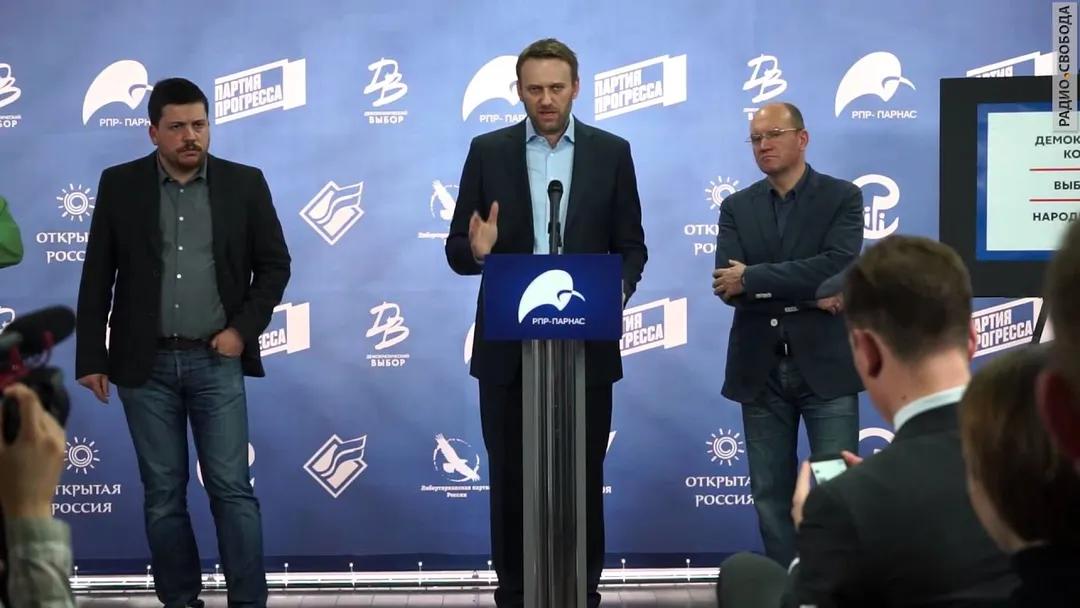
The democratic coalition’s briefing on Nemtsov’s murder
For example, during my election
campaign for mayor of Moscow, we raised 103 million
rubles, with every person providing
their passport details and so on. So
the emphasis, of course, uh, will be on raising money
through, yes, precisely this kind of
grassroots fundraising from ordinary people. As for money
from the coalition members, each coalition member
will make some contribution
to the best of their ability in that respect. As for
money from Open Russia and so
on, it should be understood that Khodorkovsky,
even if he wanted to finance something,
it would be extremely difficult for him
to do so given his legal
situation and in light of current
legislation. The Democratic
Coalition would exist, and Boris Nemtsov was one
of the people who was the main
driving force behind this democratic coalition.
If this tragedy had simply not happened,
Boris would be standing here with us now.
I think this act of terror
pushed everyone toward more active
action. It once again demonstrated
that despite the fact that we are a coalition, not
a single party, and we have
disagreements on various issues, still
against the backdrop of what is happening, those
disagreements cannot be considered
significant. As for the use,
as you put it, by some Nashi activists (members of a pro-Kremlin youth movement) or
someone else, of provocative questions or
topics—well, please, not just Nashi activists, but any
people can ask any questions. Each
of us has substantive
answers that we are not embarrassed to give on
any issue. But, you see, just as
this 86% is a kind of fiction,
existing only in VTsIOM (the Russian Public Opinion Research Center), and not in
real life, so too here, the question
of why the roads in Kostroma resemble
a bombed-out
Luhansk cannot be answered
with: "But Crimea is ours." We are absolutely
convinced that there is a real agenda,
one connected with corruption, one
connected with censorship at the regional
level, one connected simply with
soaring inflation, low living
standards, unaffordable housing, and a broken
housing and utilities system, for which every year
federal targeted programs are adopted; this is
announced over and over, and it is said that
tariffs must be frozen, that the increases must stop
and people must be protected. Nevertheless, the same thing keeps happening
again and again. Therefore, we are sure that
the real agenda will completely
push aside these sort of
Moscow-made chimeras—this endless call to
keep discussing Ukraine. But we are also ready to discuss both Ukraine and the war
and the loss of human life.