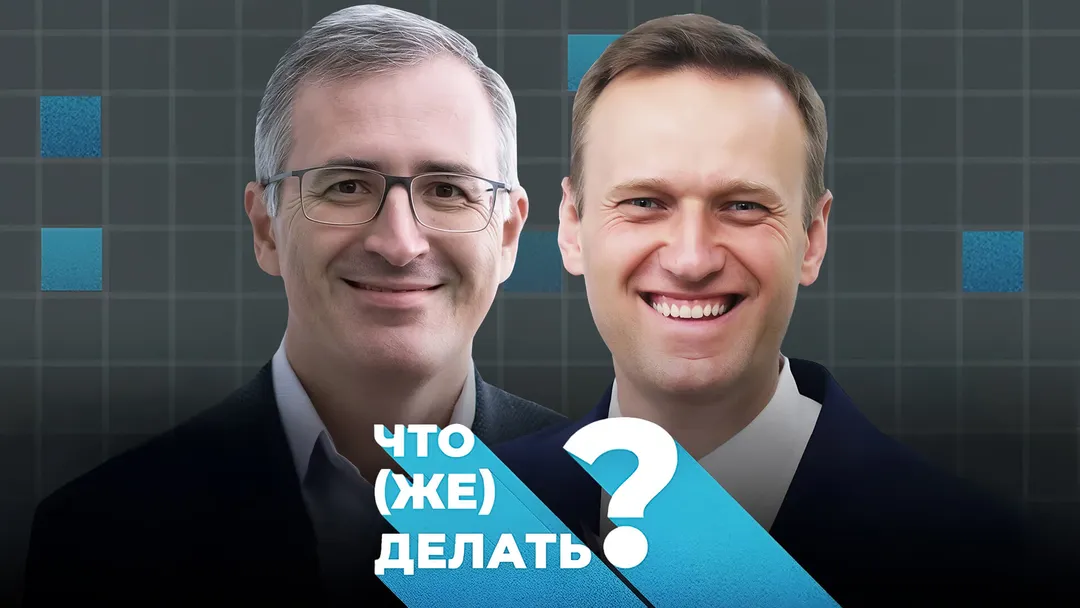
Alexei Navalny’s broadcast with economist Sergei Guriev
Where does one turn to hurriedly sell one’s business before the election that
brings Alexei Navalny to power?
You, Sergei, are beginning to scare everyone again.
You come to power, you arrest those who were in power before you,
and you are fully aware
that, should you step down tomorrow, you will be the one that is put in jail.
So, what is the solution? To stay in power forever.
Are you a politician or a standup comedian?
The good news is that we have a lot of money,
enough to pay the judges a huge salary, like, I don’t know, a million rubles a month.
You are often accused of both sexism and ethnic nationalism. Can you comment on that?
Hello. My name is Sergei Guriev, and this is the last episode
of my show “What is to Be Done?” in 2020, the last episode of the first season.
Since the 30th of September, 13 conversations with experts on economics, politics, law, culture, and energy
have been released on my YouTube channel, as well as that of TV Rain
We talked about what needs to change for Russia to become
a free and prosperous country, and why there is no need to be afraid of those changes.
We talked about what needs to be done in order to usher in the Wonderful Russia of the Future.
As the final conversation of the season,
I have decided to pose the question What is to be done? not to an expert, but rather to a politician,
in fact, the very person who coined the term Wonderful Russia of the Future.
Alexei Navalny created and attempted to register his party, Russia of the Future.
His programme during the 2018 presidential election was called Wonderful Russia of the Future.
He hosts a weekly YouTube show entitled Wonderful Russia of the Future,
which has been airing every Thursday for over two years now
and is watched by over two million people.
Clearly, Alexei is a politician who devotes more time to thinking about what is to be done
in order to build the Wonderful Russia of the Future than many others do.
Sergei Guriev's show What is to be done?
Alexei, good afternoon! Thank you very much for agreeing to this conversation.
I hope that your recovery is on the right track.
What I would like to talk to you about are the crucial issues, the Wonderful Russia of the Future.
You were the one to come up with the term, you have a weekly YouTube show
called The Wonderful Russia of the Future. However, you spend most of
your time talking about the Russia of today.
Therefore, I would like to talk to you about the Russia of tomorrow:
how does it differ from the Russia of today,
what would it look like as a country,
should it be a federation, a presidential republic, a parliamentary republic?
What are your thoughts on this issue?
Thank you very much, Sergei, for inviting me to come on to your show.
I’m always keen to talk about the Wonderful Russia of the Future,
I will explain it all, cross all the t’s and dot all the i’s, so to speak.
Honestly, I am very happy to be on your show, I watch it all the time.
It is also a very welcome distraction from my current routine of
endless running and jumping that I have to maintain as part of my recovery.
To be honest, I'm exhausted, I can’t wait to get back to Moscow.
And I’m very eager to talk to you about the Russia of the future.
Well, I really have just a few fundamental questions, the most important being:
What is the Wonderful Russia of the Future?
If I google Wonderful Russia of the Future,
I will end up on the website for your 2018 presidential campaign,
and I will see a text which describes one of the main tenets of the Wonderful Russia of the Future,
namely investment in education at all levels.
But that's not what I would like to talk to you about.
I fully support your focus on education. Being a professor myself,
I believe that education - both secondary and higher - is crucial.
But I would like to talk about deeper, fundamental issues,
about political and economic institutions.
What is your vision for the Wonderful Russia of the Future, how does it differ from today's Russia?
What is wrong with Russia today?
What would you like to change if given the opportunity?
Well, it is not for nothing that I emphasise education as much as I do
in my programme. Education is of paramount importance,
If we consider the Wonderful Russia of the Future,
looking at it through the lens of present-day Russia, it becomes evident
that education is the root from which everything else will grow.
We understand that it is education - meaning human capital - that makes countries rich.
The better educated our people are, the more competitive their skills will be,
the more money they will earn, the more wonderful the Russia of the future will be.
As for comparing it to the Russia of today,
Russia is an authoritarian state that is situated in Europe,
but, unfortunately, it does not take advantage of its European location at all.
Its citizens have none of the benefits that most Europeans have.
If you just look towards the West from Moscow,
almost all the countries you see will have higher incomes, better healthcare systems.
And they are not doing anything extraordinary, anything that cannot be done in Russia.
So, essentially, it is not impossible for us to make sure that we all live a better life.
Right here and right now.
That we do not receive such beggarly salaries as we do now, such tiny pensions.
Today, there are 25 million people living below the poverty line in Russia.
This really tells you all you need to know about the state of our country
We have to admit that we have achieved little in the last twenty years.
This is especially true if you look at the last ten years.
We live in an enormous country in which all of the power is concentrated in one city - sometimes Moscow,
sometimes Sochi, sometimes Novo-Ogarevo - and resides with one person and one person only.
This system is very clearly not working.
It does not work anywhere else in the world, and it most certainly does not work for us.
Therefore, when we talk about the future of Russia,
it will obviously be a federation. We do not need to reinvent the wheel.
We just need to look at successful examples,
we shouldn’t be ashamed of following the lead of developed countries,
For instance, Canada or Australia.
These are also very large countries, very similar to Russia,
with low population density, with great distances, difficult climatic conditions -
very cold in some places, very hot in others.
We should also look at countries with large populations, like ours.
Brazil, for example - these are all federal states.
First of all, a large country cannot be governed from a single office.
Secondly, let us ask ourselves the obvious question:
are Chechnya and St. Petersburg that similar to each other?
Well, in some ways maybe they are, but in many they definitely aren’t.
And even if, for a second, we imagine a Chechnya without Ramzan Kadyrov,
they will still be quite different regions.
From this very obvious observation, a simple conclusion follows:
Russia is made up of different regions, which means that we need federalism
in order for these different regions to be governed in different ways.
Once again, there are successful examples to follow in abundance:
Take Canada, for instance. Toronto and Quebec are different territories, people there speak different languages,
there are frequent tensions between them, sometimes even mutual dislike.
And there are examples like this all over the world.
You know, this notion of having national, ethnic or cultural differences is not unique to Russia.
This happens absolutely everywhere.
Russia can only function as a federal state,
simply because it is large and heterogeneous.
I would mention one other thing here.
It is important not to repeat the mistakes that were made in the early 1990s.
Remember, there was a famous saying by Yeltsin:
Let the regions take as much independence as they can swallow.
The regions should take more independence,
but I would say that more money and executive authority should be given to cities and municipalities,
so that power gets dispersed to the lower levels, which will save us from regional separatism.
In this case, the regional governor certainly has power,
but the mayors have even more power.
Thus, it is not federal subjects competing with each other, but cities.
That is, in the ideal Russia of the future, Kazan competes with Naberezhnye Chelny,
rather than Tatarstan with Ufa. For historical reasons, the latter is a far
more difficult and dangerous situation.
And again, the example of successful and rich countries shows us:
The city is the place where you live.
And the mayor of this city must have both funding and authority, and then everything will be fine.
That is, you will understand what you are paying taxes for,
you - as a citizen - will be able to influence the police and the local authorities.
It is the local authorities that are responsible
for ninety percent of the issues that we face in everyday life.
Yes, of course, there are issues of peace and war, but honestly,
our everyday thoughts are mostly about housing and communal services,
issues related to public transport, street cleaning, and so on.
These are all issues that are within the purview of local councils,
the city’s mayor, so they need to be empowered.
In fact, the issue of school education is also a local issue.
Thus, I fully agree with what you’re talking about.
In fact, a study of the 1990s in Russia, the federalism of the 1990s,
showed that Russian regions did have independence,
but that the funding at the municipal level was expropriated by the regions.
There is also a study by Ekaterina Zhuravskaia, a well-known Russian economist,
who argues that this was one of the key challenges for Russian federalism in the 90s,
This is what led to the underdevelopment of Russian cities in the 1990s,
while in China, oddly enough, despite China not being a federal country,
in the 1980s and 1990s a large share of funding and authority
was de facto delegated both to the provincial and, most importantly, the municipal level...
This is despite the fact that China was neither a democracy nor a federal state,
and this may have been one of the drivers of China's growth in the 1980s and 1990s.
I have one more question for you. You claim that the country
cannot be governed from a single office and this is not merely a question of federalism,
but also a question of the division of powers between different branches of government.
How do you see the division of authority between the president,
parliament, federal government and judicial system?
Do you think that Russia should be a presidential republic, or a parliamentary one?
Let us start with what we have right now.
Now we have well, a while ago, as a lawyer who has studied constitutional law,
I would have called it a super-presidential republic.
Now, it probably cannot even be called that,
it has become a quasi-monarchy.
The enormous concentration of power in the hands of a single person is simply destroying the country.
For example, look at any of the Q&A’s with Putin. Some people from a freezing village stand there and say:
Vladimir Vladimirovich, please turn on the lights for us.
Putin goes: Turn on the lights for them!
Vladimir Vladimirovich, please dig a trench or a ditch for us, or something.
Putin goes: Oh well. Governor, dig a ditch for them!
You cannot govern a country in this way!
There are millions of decisions that need to be made,
and the over-concentration of power is not merely inefficient, it actively harms our country every single day.
The absence of a functioning parliament is also a huge issue.
We must move towards a parliamentary republic. Again, this is simply a universal rule.
Do we want to live in a prosperous country?
Almost all wealthy countries,
with rare exceptions, are parliamentary republics.
The United States is one of the few rich countries with strong presidential power,
but before using the term Strong presidential power
- let's look at what’s happening right now.
We have a US president who didn't like the election results.
The Supreme Court told him: so what if you don't like it, we have not found any violations.
Some of the laws that Trump introduced when he was first elected
were immediately overturned by the Supreme Court.
And in this sense, the president in the United States is not that
powerful, and his power does not even come close to comparing
to the power that the president has in Russia.
Therefore, I would say that even during Yeltsin’s time, somewhere around 1996,
the president already had too much power, and now he has far more of it.
Therefore, yes, of course, Russia should move towards becoming a parliamentary republic,
in which parties form a governing coalition
and adopt laws, and we live by them.
Let me repeat, this is not some kind of abstract reflection, let us bring back the parliamentary republic.
It is simply the path to prosperity. This is the way to ensure that government is balanced,
predictable and truly represents the interests of the people. Then we will become prosperous.
Thank you. In fact, there are other wealthy presidential republics,
such as South Korea and the semi-presidential Republic of France.
But you are right that, since Russia is a very heterogeneous country,
there will be many different parties in parliament, probably more than two.
And so the president, who got 51 percent or 48 percent of the vote,
as in the case of the United States (with its own electoral college system)...
How do you make sure that the most diverse
groups of the population are represented?
A parliamentary republic probably gives you a greater opportunity
to represent a wide variety of interests.
Let's move on. Let's imagine that you have your own party, which used to be called Russia of the Future.
I still have it, they just refuse to register it.
Let's say it got registered and it takes part in elections.
With what programme, what promises would you go to the polls?
The website 2018.navalny.com still exists and your programme is featured there,
but just to remind people of three or four key propositions,
which you put on the first page of your party's programme.
When we drafted the programme, we thought about it for a long time,
and therefore, fortunately, I can say that my proposals have not changed much.
They are pretty simple, and I think they might work pretty well.
First, of course, and this is an important political step, is the issue of political prisoners.
That is, were we to participate in the elections right now, we would say
that there are many political prisoners in Russia
and, therefore, the starting point would be
the immediate release of all political prisoners.
Second, we propose effective measures to combat corruption,
specifically state corruption. By definition, it is highly corrosive, isn't it?
In Russia, this is something that has been eating away at the country for a while,
it is the foundation of the entire system, and we therefore propose measures to combat corruption
and, first and foremost, the implementation of measures
provided by Article 20 of the UN Convention, that is, the fight against illegal enrichment.
Third, the biggest and the most important measure is judicial reform.
It is generally accepted that judicial reform is very important,
but it is always postponed.
I am absolutely convinced that one of the main reasons why we did not succeed in the 1990s
was that Russia’s judicial system was not reformed.
They said: We will do it later, we have other things to do now, privatisation, for example, or something else.
And judicial reform was not deemed important, everything was supposed to gradually improve.
No, until we have independent courts, we will not succeed.
Until there is a place where a citizen can go and argue against the state...
Imagine: Sergei Guriev is elected president, and I don't like what he does in power.
Until I can go to court and win a case against President Guriev, (should the law be on my side)
nothing else will work as it should. The judicial system is the foundation for everything else.
The next measure is deregulation.
My promise is that it will be easier to register a company
in the Wonderful Russia of the Future than in Singapore or Georgia.
Paperwork will be the easiest thing in the world.
The number of licenses for different types of activities will be minimal,
which means complete freedom of trade, deregulation,
and the abolition of foreign exchange control. Probably, for a wider audience,
foreign exchange control does not seem to be an important issue.
But any entrepreneur who is involved in foreign trade
is driven crazy every single day as a result of it.
Interestingly, in my first job after graduating from university, one of my responsibilities
was dealing with this law on currency control, issuing passports, monitoring transactions,
and I realised that it was an idiotic system, just the worst system imaginable,
invented only to make life difficult for people, which it is still doing today.
It has been changed a little, but is still a gigantic,
gigantic obstacle in general for work, for development.
These are the key things.
Plus, of course, the most important issue for us is still the minimum wage.
During the presidential campaign, we talked about a minimum wage of twenty-five thousand rubles.
I think that this amount should be higher today.
And complete exemption of small businesses from taxes, because at this stage,
when, I repeat, we have 25 million people living below the poverty line,
small business for many is nothing less than the means of surviving.
Let's be honest, some individual entrepreneur Ivanov from Ekaterinburg is
not the person we should be chasing and trying to get to pay his taxes.
This is a person who repairs something with his hands in his car shop
who is simply trying to survive. And therefore we must tell him:
Mr. Ivanov, we love you, you don't even need to register as a self-employed person,
feel free to work. If you earn anything, we love you.
If you manage to pay someone a salary, we will give you a medal for it.
This is what our approach should look like.
But you are still going to collect payroll taxes?
Well, of course, they have to pay taxes from their salaries.
That is, Ivanov may not pay taxes on his profits, but if he hires Petrov to work for him,
then let him pay Petrov a salary and pay salary taxes,
so that Petrov would then have a decent pension.
Alexei, speaking of the specifics of these promises,
it really is better to carry out the judicial reform faster rather than slower,
but there is always the following problem:
you are creating an independent institution.
The very essence of creating an independent judiciary
is that the courts will be willing to say no to the authorities.
How do you see the appointment of new judges and changes in the rules of the game,
including the rules of dismissing judges?
The fact is, if you make the judicial system independent,
then those judges who put you under house arrest and sent you to prison
are the same judges who will tell you, No, you want to make us independent,
so goodbye, Alexei, we will continue doing whatever we want. If you listen to us,
we will tell you the same thing that we told you in Putin's Russia.
How do you solve this issue?
Replacing the judiciary, changing the rules of the game,
creating an independent judicial system.
Well, with those judges who sent me to jail
(and it's not just about me, many people are arrested illegally),
it is quite simple, there is no need to think about it.
They violated the Criminal Code, therefore each and every one of these cases,
especially those that were later contested in the European Court,
will be tried. If you are a judge who has violated the law,
there is a special article in the Criminal Code
Bringing criminal charges against a knowingly innocent individual, it is crystal-clear.
They will be stripped of their status and sent to jail. I don't see an issue here.
This will not actually concern, let's be honest, most of the judiciary.
The first thing we need to do...
Paradoxically, the judges are slaves, they are slaves to the chairperson of the court.
Under the current system of assigning cases, if you are somehow disagreeable
to the chairperson of the court, he or she will turn your life into a living hell.
And if the chairperson of the court likes you, you will get great cases,
both rewarding and easy.
Therefore, the judge must become independent from the chairperson of the court.
The chairperson of the court should be the most respected judge,
he/she should be the best legal scholar,
but he/she should not be an administrative director who assigns cases.
The second most important thing that you mentioned
is, of course, the appointment of judges. Now, most of our judges come from among judicial officials
and court clerks, from the prosecutor's office and the police,
there are almost no defense attorneys, and there are almost no academics.
This, of course, needs to change. Different countries do it differently.
For example, in Germany, the so-called cooling-off period is applied:
you cannot become a judge if you are engaged in civil service.
For example, you worked for the police or the prosecutor’s office,
you can go work somewhere else for two or three years, maybe become a defence attorney,
you can go teach at a university, but it cannot be a civil service job.
You must get experience in a different sector,
so that get a better understanding of real life.
Now, the career of every judge in Russia looks the same: you come in, get a tiny salary,
become a court clerk and a slave to the system.
And then you are simply ready to do whatever it takes,
after working for a tiny salary as a court clerk,
to please the chairperson enough that he/she mercifully makes you a judge.
And no exams or anything like that.
In fact, I watched your discussion with Kirill Titaev, where he quite rightly said
that this is not even the FSB, which throws out those who disagree at the last stage,
it is the judicial system itself...
No one will even consider a judicial career, because you won’t be competing
with other applicants on your knowledge of the law,
but your ability to please the chairperson of the court,
the qualification commission, everyone we call the judicial mafia.
And this notion of a judicial mafia is absolutely relevant and absolutely true.
Therefore, we need to change the way we recruit judges,
to introduce cooling-off periods, to recruit judges from outside the system,
to focus on academic people, on legal scholars, because judges,
especially judges of higher courts, they must be authorities in the field of law.
Read any decision of the US Supreme Court - my God, it is almost poetry,
and it is incredibly difficult to read, because it is written in very complex legal language.
These are titans of thought, they really are the smartest people.
Our judge is a person who was taught: first, we establish the identity of the defendant,
Then comes this stage, then comes that stage...
They are like a bear which was taught to ride a bicycle in a circus.
The bear rides it and only knows three movements.
And all the judges are like that, unfortunately. Therefore, we must move in this direction
in order to relieve specific judges from the oppression of the chairperson.
As for the money The issue of judges taking bribes comes up often.
The good news is that we have a lot of money to pay judges a huge salary,
I don’t know, a million rubles a month. There aren't that many judges,
and we can easily pay them a huge salary, but the goal we should strive for
is for the judge to be the most respected person in the city.
The smartest, most educated and most respected person in the city.
Then it will be completely fine to pay him a million.
You mentioned the term judicial mafia. This really is a crucial issue,
because, in practical terms, when someone comes to power,
- as we saw in Ukraine - they go step by step:
first, replace the judges on the Supreme Court, then city courts,
replace the chairpersons of courts , and so on and so forth.
This process is inevitable because, otherwise,
those people who occupy these top positions will say,
Thank you very much, we will appoint judges ourselves.
And, of course, even if you remove the FSB filter,
you will still need to start by replacing the judges
on the Constitutional and the Supreme Courts, and move further down the food chain.
And how will you recruit judges?
Absolutely true, I agree with that.
For example, the Constitutional Court in its current state
is an absolutely useless court...
even before they were forbidden to publish their dissenting opinions,
there was just one person there who published them.
That is, the judges of the Supreme Court are a nightmare.
As a person who was present at the Presidium's decisions on my cases from the ECHR,
I can say that it is an absolute nightmare.
These are terrible lawyers and shameless people,
Therefore, naturally, the Moscow City Court, the Supreme Court,
the Constitutional Court - they need to be dissolved, end of discussion.
The good news is that it is quite easy to recruit new judges,
a new qualification commissions should do it.
Once again, these are not millions of people, it is absolutely doable.
A large portion of these new judges should come from the academic community, that is,
we must really hire the best lawyers there are.
If we set this as our goal, we will be able to recruit them.
Until now, the goal has been very different - to appoint people you can control,
People you can rely on to help you out. You know how it works?
The people that are taking up the Kremlin, they are claiming: yes, of course,
we want an independent system, but what if some bad people try to sue us?
To act for the good of the country if necessary, we need to be able to pick up the phone and call a judge:
Hello, Olga Egorova? Please do what needs to be done.
And Olga Egorova does it once, then she does it twice, etc.
In her view of the world, this is how the law works.
Judicial reform is the toughest decision that the executive branch can make,
because it can potentially make life difficult in the future.
The courts you create today will be the courts in which you will lose cases tomorrow.
But there is no way of getting around it.
I also think that this is the most important political issue.
If the judiciary is independent, you can afford to step down,
you can afford to lose an election, because you know that after you lose it,
independent courts will protect you from your opponents should they come after you.
What about Sarkozy?
You know, in France, Sarkozy’s entire party,
one way or another, was persecuted according to the law.
Sarkozy - along with Fran?ois Fillon - got embroiled in a scandal, lost the election,
and was convicted, as was Alain Juppe. Thus, the whole party
suffered from the independent status of the French judiciary.
Well, don’t lie or steal while in office.
Coming back to politics, you said Excuse me?
I absolutely agree that an independent judicial system provides balance,
We know how it usually works in Russia:
You come to power and you arrest those who were before you,
knowing that you will be the one being put in jail tomorrow,
should you step down.
So, what's the solution? You never step down.
That's all. And that needs to change.
Returning to politics, you spoke of a coalition,
about your own electoral promises.
Other political parties will probably make other promises.
Which parties would you be willing to form a coalition with?
In the Wonderful Russia of the Future, a multiparty system will exist.
Which parties, which coalitions are acceptable for you, and which are not?
If we imagine a system with transparent elections,
I think it will look completely different from the one we have today, with entirely new parties.
If our party participates in the elections,
it will mean that absolutely everyone has been allowed to participate,
This will no longer be the current four-party system that we have now.
But if we conduct a thought experiment and look only at existing parties,
which are United Russia, the Communists, Just Russia and the Liberal Democratic Party,
then I only see a coalition with United Russia as unacceptable,
because it makes everything pointless. Everything we do is in opposition to United Russia.
The other parties - the Communists, the Liberal Democratic Party and Just Russia -
are actually not ideological parties at all, they are made up of people
who act completely differently in different regions and situations.
Sometimes they are very good, sometimes they are very bad,
sometimes they are in complete agreement with United Russia,
sometimes they are openly critical of it.
Moreover, even if you look only at the Moscow City Council and its Communist deputies.
Some are incredible, while others respond to everything by saying,
Sergei Semenovich [Sobianin, mayor of Moscow], your wish is our command.
Therefore, I see an opportunity to work with any party,
except for United Russia, simply, I repeat, because it makes no sense to do it. That's all.
Got it, thanks. I have a question that is related
to how United Russia runs the country and controls it, namely the issue of mass media.
The media truly is a crucial tool for today's regime.
What would you do with censorship, state or oligarch control of the media?
Yes, this is a very important question indeed. It is quite easy for people of my age,
and even younger, to remember how Putin started out.
Yes, he took over the judiciary and law enforcement agencies, but that happened later,
the first thing that was destroyed was the independent media.
The way it happened was almost elegant:
some were dissolved, but most were simply bought out.
Oligarchs bought up media assets.
Take the case of the newspaper Vedomosti, for instance.
It was an excellent newspaper,
now it's absolutely horrible. And the state claims that
it had nothing to do with it, you know, this was nothing more than a business transaction,
and so there is no censorship.
This should be a lesson for us.
Our notion that someone wonderful will
buy up all the newspapers and give them back their editorial independence
for the sake of market competition, that notion is simply a fantasy.
When the authorities want to tweak things a little, so to speak, it is very
difficult to come to an understanding with the entire editorial board of RBC, for example,
but it's very easy to do so with people like Prokhorov,
who dissolved the board after they published an article on an oyster farm just outside Putin's palace.
We must draw an appropriate conclusion from this.
And this conclusion is that for Russia, which went through a very difficult transition period,
then relapsed into authoritarianism for another 20 years,
the media is not just a business, it is not just
the fourth estate, as it is called, it is in fact one of the fundamental social institutions,
without which we will not be able to bring back political competition or fight corruption.
Therefore, the media should have total freedom of speech
not only over the next fifty years, but in perpetuity.
What is needed is not just a ban on censorship in the Constitution, as is the case now:
Yes, censorship is formally prohibited, but what is the punishment for it?
There is no punishment. Censorship, attempts to introduce it in any way,
attempts to bribe journalists, apply political pressure to the editorial board,
should be criminal offences, and the media
should be able to enjoy greater economic opportunities.
Perhaps exemption from some taxes, again, recognising
that this is not merely a business, but a key part of our social fabric.
And all these wonderful oligarchs need to be told:
If you work for Gazprom or, I don’t know, are the director
of the most important meat-producing plant in some region, well, concern yourself with gas or meat.
You will not be allowed to buy NTV or the local newspaper,
because now we have. yes, Sergei?
Yes, you are right, I understand what you are talking about.
In fact, if we go back 20 years, we can even trace
how Putin came up with the idea of ??creating these links between the media and big business.
Of course, in many ways, the oligarchs came around in the 1990s,
they took over control of the media and played a key part in Russian politics,
but in many respects the current model
is based on what Putin learned from Berlusconi. It was Berlusconi who created a situation
in which you own the media, which helps to protect you from political pressure.
This, in turn, helps you make money in other sectors of the economy.
The money that you earn is used to essentially subsidise the media.
This vicious cycle - money in order to get power,
including ownership of the media, and power in order to protect money -
is something that you can actually trace back to the Medici in Italy.
This is a model that is well-known.
The only way to break this vicious cycle is to really forbid the oligarchs - well, actually
they only become oligarchs after they acquire media - so forbid businessmen to own media assets.
But journalists will tell you that making money is very difficult,
so when an oligarch come and start giving it out,
journalist salaries suddenly rise, life becomes simpler,
and it also becomes much easier to compete with other media.
Besides the ownership itself, there is another important factor - advertising.
For example, today, if you openly criticise
a major telecommunications company, many media outlets
will refuse to place your Op-Ed because mobile telecommunications companies
are important advertisers. This was also the case with Berlusconi’s media empire.
There is research showing that when Berlusconi was prime minister,
access to advertising on his TV channels was a crucial political factor.
Therefore, this is a very difficult question. It is necessary
to not only break the link between money and information,
but also to support the media, to help it survive in this difficult world, a world in which they are not
just competing with each other, but things like your own YouTube channel, for example.
Quite right, I completely agree with that.
That is precisely why I say that there must be a balance:
on the one hand, we prohibit the oligarchs from owning the media,
on the other, we understand that we must make
life easier for the media in terms of economics.
Maybe they need to be exempted from certain taxes.
I don't think that government subsidies are a good idea, but, for example,
funding reserved for each citizen that he can spend on any media of his choice,
that can also be a great solution.
Yes, the state essentially allocates money to the media, but neither the state nor the president,
nor any government official decides which particular outlet ultimately receives it.
You, Sergei Guriev, or you, Alexei Navalny, receive 300 rubles a year,
and you can give these 300 rubles a year to MediaZona or to Channel One.
This can be a great solution. But most importantly, what we need is demonopolisation.
Now there are the Kovalchuks who fully control the advertising market,
they are in charge of everything, and the market
has become absolutely distorted, it is a nightmare.
So, we need demonopolisation, which can easily take place.
In terms of technology, the media is a highly competitive business.
Readers change easily from one outlet to another.
You are quite right about the oligarchs - it is impossible
to compete with oligarchic media, because when the media is acquired
by a Gazprom, a Prokhorov, a Berezkin, with infinite amounts of money.
journalist salaries are set at 10 thousand dollars a month.
This is not market-based in any way, because in this case the media outlet is purposefully losing money.
The oligarch is prepared to do this, because for a newspaper, e.g. Kommersant,
costs a fraction of the cost of his yacht. And he maintains it,
and it outperforms the competitors as a result of large amounts if oil or iron ore money that are being poured into it.
This shouldn't be the case. Small media are withering away
because they cannot compete with the essentially non-profit oligarchic media.
When we prohibit non-core businesses from simply pumping money
and actually paying for political influence, I am sure that the situation will balance out
and the media will begin functioning properly. Especially if, for example,
they also become exempt from paying income tax.
This can be done, we are not talking about unreasonable amounts of money on a national scale.
Let them earn it, let them live, grow and develop.
Thank you, I fully agree with you here.
An oligarch owns a yacht because he has a TV channel.
It is precisely the political influence that he gains from his channel
that allows him to defend himself from his business competitors,
and thereby receive additional profits that he can spend on the media.
Some would argue that oligarchic ownership of the media
is better than state ownership, because the oligarchs have different interests,
different points of view.
But the example of Ukraine shows that the oligarchs are perfectly capable of uniting.
When it comes to fighting corruption, oligarchs, who - on paper - supposedly compete with each other,
are in fact colluding. Thus, as was the case in Ukraine,
progress in the fight against corruption is halted severely.
So, even though oligarchic ownership of the media
is better than state ownership in many ways, it is still far from freedom.
Gentlemen, aren't you tired of wasting money?
First, we spend millions to promote our political candidates,
and then we spend twice as much to destroy our competitors.
I have another oligarch-related question.
Yes, I'm sorry, Alexei, did you want to say something?
I just wanted to add that we do not only see this in Ukraine.
Over the past twenty years in Russia,
and especially during the last ten years, we see that the oligarchs readily agree with the state.
If the president or the head of the presidential administration
needs to resolve an issue with a media outlet’s editorial office - one call to the outlet’s owner suffices.
This is simply quid pro quo - the owner is promised something in return for silencing
his own editorial office.
We know from experience that, unfortunately, this is how it works.
I have a related question for you. You often bring up the idea of
revisiting and maybe repealing the results of privatisation in general or specific privatisation deals.
If you come to power, how will you deal with the results of privatisation?
Let's not scare our viewers. It is always put this way for some reason:
revising the results of privatisation in Russia.
And then everybody shakes their head and goes:
My God, wealth redistribution, take away and divide, but how
And this endless conversation begins, with someone always coming along and saying,
What to do with the privatised apartments? Or something similar.
There is no need to revise all of the results of privatisation.
There are a few simple things you can do. Loans-for-shares auctions, for example,
are a symbol of injustice, when the country’s largest enterprises were...
One can use the word stolen
They were acquired entirely dishonestly. What’s more, it was - and still is - common knowledge.
Well, if Khodorkovsky and Fridman themselves are talking about this,
meaning people who actually participated in these auctions admit that
something needs to be done about this. Loans-for-shares auctions
have led to the fact that private property is neither recognised nor respected in Russia.
It seems to be private, but everyone understands that the manner in which it was acquired was so unfair
that if it were taken away, it would not cause even the slightest public outrage.
You can either take it back or not.
I believe that a simple thing should be done with the results of these loans-for-shares auctions
and, in general, with the largest privatisation deals:
the people who benefited from them must pay a large tax.
And this is quite easy to do, it is an entirely ordinary procedure in Europe -
the same thing, for example, was done in Britain.
following the privatisation deals that took place during Thatcher’s term.
A few years later, a well-organised and civilised state with an exemplary rule-of-law acknowledged
that it may have messed up with the coal industry, so an additional tax was introduced.
It is important to remember, by the way, that when we say
terrible privatisation and terrible privatisation deals,
we are referring to loans-for-shares auctions and Yeltsin’s tenure.
However, the truth is that the largest number of absolutely illegal,
I would even say openly criminal, privatisation deals took place under Putin.
And not only privatisation, but also nationalisation took place.
For instance, the famous buyout of Sibneft from Abramovich,
during which a state company bought back Abramovich's share,
earning him an incredible amount of money.
Of course, these kinds of deals are criminal.
But we must be very clear that this does not concern the vast majority of businesses.
Of course, the privatisation process must be recognised as having been unsuccessful.
We failed to create a broad class of property owners that was needed, it just did not work out that way.
Therefore, our task is to make sure that the people who now occupy the top slots on Forbes’
billionaires list -- not because of their intelligence,
but because of successful privatisations deals -- pay a big tax.
Most likely, they will remain on that Forbes list,
but with a net worth of, say, $9 billion instead of 17.
Thank you. If you look at different estimates of loans-for-shares auction prices
they seem to have been two or three times lower,
for some transactions they could have been up to ten times lower than the fair price.
However, we are not talking about a difference of $8 billion here.
The large proportion of these people’s wealth
was actually created in the 2000s, not the 1990s.
Nevertheless, I am still somewhat perplexed by what you are saying.
You claim that the vast majority of privatisation transactions would not be revisited.
Who will determine which deals are on the list of unfair ones and which ones aren’t?
Is there a statute of limitations? If you come to power,
should an owner of a factory, or a bakery perhaps, think about
whether he will be included on this list or not,
and whether he needs to hurriedly sell his business before Alexei Navalny
wins the election?
You, Sergei, are scaring everyone once again.
Bakers have nothing to do with this, and it seems to me...
It doesn't just seem like it, it is a conclusion I’ve drawn from conversations with numerous people.
Bakery owners are enraged by the privatisation of Norilsk Nickel,
infinitely more so than people who do not own small businesses.
The baker conducts business every day, realising
that he will never earn anywhere near as much as these people earned
by simply grabbing a giant state-owned enterprise.
First, a list of these transactions should be compiled
by a parliamentary or governmental commission after an open, broad and transparent public discussion,
This list should be limited and short.
It would primarily include loans-for-shares auctions and several large Soviet enterprises that were privatised.
It is quite easy to draw a line here: we are talking about the largest Soviet enterprises.
Some behemoths of Soviet industry, such as Uralkali,
formally did not go through an auction,
but from a legal standpoint,
sometimes the process was even shadier.
And for these larges enterprises,
an absolutely transparent parliamentary or governmental commission
examines all the relevant documents and makes them open to the public.
After careful consideration, the commission then proclaims
whether this enterprise should be included on the list,
and whether its beneficiaries (current or former)
should pay a tax, and how large that tax should be.
At the same time, these people can obviously file a lawsuit and get their day in court,
and then the government will have to carefully justify its actions.
Let me give you an example. Prokhorov has not remained the owner of Norilsk Nickel for long,
but we understand where his wealth comes from.
He is now using it to buy all sorts of sports teams all over the globe.
But no one is saying that we need to take everything away from Prokhorov and execute him.
He has to pay a tax. Let him pay a tax, following a reasonable procedure
of calculating the tax, and a reasonable procedure for including him on the list in the first place.
The lines have been drawn already,
recent privatisation should not even be considered.
It's just that when we look at some of the transactions that were made during Putin's time,
they do not even qualify as privatisation, it is simply theft,
and should be considered within the framework of the Criminal Code, that's all.
But the statute of limitations for some of these deals has already expired. Doesn’t that bother you?
Well, you know, the statute of limitations is a tricky issue.
Pretty soon the statute of limitations in criminal cases fabricated against me,
and other defendants in the Bolotnaya case, and many others, will expire.
Well, so what? We need to abolish the statute of limitations.
A statute of limitations is harmful if
it means that justice cannot be achieved.
A simple example. I had been in a coma for 18 days,
but a criminal investigation has never been opened.
Let us suppose that a statute of limitations is introduced that hinders
bringing to justice those people who did not initiate a criminal investigation
and blocked any attempts to look into the details of my poisoning.
Are we then supposed to calmly agree that the statute of limitations has expired?
Of course, these statutes will be prolonged,
but I do not see this as an issue at all.
The primary goal if for the judiciary to be independent.
That is what we started our conversation with.
It should be an entirely unthinkable situation - a judge
receiving phone calls from me, for example - in a hypothetical situation in which I hold political power.
In legal terms, the statute of limitations should be counted from the
moment that independent courts appear in Russia.
In this sense, the statute of limitations clearly needs to be reset
following judicial reform.
It is impossible to consider Olga Yegorova
(or whoever replaced her) as someone administering justice.
It is absolutely impossible to consider Valery Zorkin as administering justice.
This means that, essentially, we now have no judicial system in Russia.
And the people who were arrested for 15 days in 2012, what kind of justice can they get?
They got it in the European Court of Human Rights, but they also want to get some in Russia.
And, if in in 2022, they are told that the statute of limitations has unfortunately expired,
it will be unfair. These people want, and deserve, to have their cases heard in a free court of law.
They should get that opportunity.
Thank you, Alexei. We are having this conversation in 2020, we are both currently in Europe,
so I have to talk to you about one of the most important issues of 2020,
namely that of minority rights and gender equality.
You are frequently accused of both sexism and ethnic nationalism. How do you respond to those criticisms?
In what sense? Nobody accuses me of sexism,
and I have not been accused of ethnic nationalism for a long time.
However, I am happy to answer these questions. When you say that
Please do.
So, no one has accused me of sexism so far, fortunately,
and I am very proud that our organisation and all of its regional offices,
implement gender equality in practice, it is as simple as that.
More leadership positions are currently occupied by women, and we have more women than men overall.
I remember very well that we even published statistics during the last election campaign,
which showed that the majority of regional headquarters, and there were 80 of them, as far as I remember,
were led by women. Moreover, all of the largest headquarters, St. Petersburg, Kazan, Ufa,
all the large cities except Moscow, were all headed by women.
Of course, there is still more to be done regarding gender equality,
Every advanced country, even the likes of Norway or Sweden,
also have unfinished business when it comes to gender equality, and FBK
still has a lot of work left to do. But it is work that we are doing.
I think that what you have in mind when asking that question is something slightly different.
I am certainly one of those people who believe that politicians and political activists
can be made fun of. And I don't see a big problem about mocking
people who take things a bit too seriously.
It is clear that feminists are at the forefront of social change,
especially the more radical ones.
These people truly are moving our society forward.
They are incredibly important,
and I can only admire them.
At the same time they often treat everything
with such utter seriousness...
I think you are referring to something I’ve posted on Instagram, calling my wife a chick.
But, you know, it will be an unalienable right in the Wonderful Russia of the Future
for spouses to come up with funny nicknames for each other.
I don’t think that this is a matter for public discussion.
You need to judge people by their deeds.
Alexei, I don't quite agree with you here. You are a white man,
ethnic Russian or Ukrainian, I’m not sure, anyway
Half and half.
Yes, I am a middle-aged white man. Here in France I am an immigrant,
and in Russia I was not considered a white person, I was someone from the Caucasus.
And so I knew that as soon as people start making fun of minorities,
it will very quickly become dangerous for me to walk down the street.
Therefore, when you speak of jokes, I have to remind you that both
you and I have grown-up daughters.
Ask your daughter, Dasha, what she thinks of you
joking about the issues of objectification, gender equality, and so on and so forth.
What would she tell you?
First of all, I have asked her. And we talk about this quite often,
it really is at the forefront of European politics right now,
and will come to the foreground in Russia soon as well.
Unfortunately, this has not happened yet. I would like to see more discussions
about gender equality emerging in Russia.
This is far from a simple discussion, and it should by no means be limited to people who use Facebook a lot.
It should be much broader, the problem of gender equality in Russia is truly colossal.
It really is huge, men are consistently outearning women doing the same jobs.
Women are consistently in a more vulnerable position. This is a huge issue,
and it is incredibly harmful to our society as a whole.
It harms the economy, it harms the population. Therefore, it must be addressed.
On a more serious note, what you are saying may sound true
I know that if they make jokes today, tomorrow it will be dangerous for me to walk down the streets.
Well, turn on any comedy show - a Russian one, an American one, whatever it is -
half the jokes will be related to ethnicity. I think that it is human nature to joke about this.
You do need to look closely at the way the authorities are treating it.
A politician should not be able to say some of the things that a comedian can.
And when I talk to my daughter about it...
But are you a politician or a standup comedian?
I am a politician, but I never joke about this. You would never hear me say things like
Do you know the difference between Ossetians, ethnic Russians and ethnic Ukrainians?
Thus, I do not think it is fair to say
that I often make jokes on this subject.
You mentioned Dasha. Well, I think her attitude is exactly the same
as that of all other children about the jokes that their dads or grandpas make.
She certainly finds them old-fashioned and weird, which I agree with, they are.
And it is a good thing that she thinks that way.
I think that I am entitled the right to come up with any nicknames,
for instance, for my family members,
but if someone has an issue with it, they are free to criticise me.
Naturally, I think that the feminist cause is of great importance,
and it is a significant part of our political agenda.
Thank you. Thank you, Alexei, I have a piece of advice to you, father to father,
as well as advice to you as a politician. It seems to me that the generation gap is huge,
just as there is a huge generation gap between you and, for instance, Putin and his circle.
And if you want to speak the same language that your voters are speaking,
you should talk to your daughter more often,
ask her for advice on how old-fashioned your jokes may seem
to people who are nineteen or twenty today.
This seems like very sound advice.
I’d like to ask you a question as an Ossetian.
How would you go about making me feel like a proper citizen of my own country?
When you stop using the word Rossiyane (Russian citizens) and switch to Russkie (ethnic Russians) instead,
I start to worry that there is a division, a division into first-class Russian citizens and subpar ones,
people like me - people with a surname that doesn’t sound Russian,
face and hair colour that do not look Russian.
Do I need to fear that someone like you will become a prominent Russian politician?
There is no need to be afraid at all.
And the discussion over these issues will be endless,
and it is important, in fact, that it goes on.
It is essential that the government takes appropriate measures to
guarantee that absolutely everyone has the same rights and access to the same opportunities,
without any exceptions.
I do not see a problem that a huge number of people
do not want to become Rossiyane, that they strive to preserve their ethnic identities.
If they want to be ethnic Russians - this is fine, just like if they want to be ethnic Ukrainians,
or Ossetians, or Chechens. Chechens do not want to be generic Russian citizens,
they are proud of their Chechen heritage.
As are Dagestanis, ethnic Russians, and everyone else -
this is what makes up our society as we know it, what makes our country so diverse.
And there is no need to try to somehow cancel these differences out.
There used to be only Soviet people, and Soviet authorities would claim
that an eternal friendship between different peoples has been achieved,
that ethnicity no longer existed, replaced with a utopia of Soviet citizens.
Well, when this utopia collapsed, a war in Karabakh broke out,
as did conflicts in Baku, Transdnistria and so on.
It turned out that these friendly people were ready to kill each other left and right if given the chance.
There is no need to be hypocritical and lie.
Let everyone call themselves what they want,
let them be publicly and openly proud of their nationality, of their ethnic identity.
For the state, for me as a hypothetical political leader,
supporting various languages and national schools should be a priority...
People want to be proud that they are Ossetians? Fantastic, we need to be funding this.
If you want to send your child to an Ossetian school and learn the language -
great, please, go ahead. Yakut language - please, this is funded as well.
But at the same time, the state needs to keep an eye out
for any cases of possible discrimination.
If there is even a sigh of ethnic discrimination,
a criminal case should be initiated at once, end of discussion.
At the same time, there will always be the ethnical issues in Russia,
one way or another, because the country is huge and extremely heterogenous.
Look at what is happening in Dagestan, where there is a huge number of ethnicities.
In general, I am against the quota system, but in Dagestan,
many are arguing that it is the only way to go.
This is a very difficult question. If we cancel the quota system tomorrow,
some minor ethnicities will be underrepresented.
Essentially, parliamentary democracy will stop working for them.
We want everyone to be represented.
These are very difficult decisions, very difficult compromises to make.
It is difficult to even speak about ethnic quotas, because,
in a sense, they contradict the very idea of ??democracy.
Nevertheless, Boris Yeltsin called the citizens of Russia dear Rossiyane. You do not seem to like this word.
What, in your view, should a Russian citizen be called?
I do not know. It seems fairly obvious that,
unfortunately, the word Russky is not suitable as a general term,
because it contains within it an indication of ethnicity.
You don't want to be listed as an ethnic Russian, as don’t many others.
I am not suggesting that you change your surname...
It is absolutely fair, but the expression Rossiyane is somehow...
I don't mind it, I can say it right now.
You know, I won’t drop dead if I use the word Rossiyane,
it does exist. But I think it's kind of stupid.
Probably, this is one of the tasks. Not probably, it is definitely one of the tasks -
building a unified society, a single civil nation if you will.
And there must exist a unifying term, a concept, which would be clear to all,
that would mean that yes, we are from here, we are from this country, and we are proud of it.
The concept is yet to be invented, and it is crucial to do so.
Thank you very much. I would like to ask you one final question.
How long will it take to build the Wonderful Russia of the Future,
to make the transition from the Russia of today irreversible?
I would say it will happen much faster than many people might think.
People often say that centuries are needed for real change to take place.
You know, there is always this comparison with a lawn, which has been mown for 200 years
and that's why it is so perfect.
I would say that from the moment when
an independent judicial system is established,
electoral rights are guaranteed,
making it impossible to falsify elections,
and to prevent candidates from participating in the elections,
we need to go through two electoral cycles, meaning a total of 10 years.
We will go back to a four-year presidential term,
to the four-year term for Duma deputies.
After 10 years, the government will change completely.
During these 10 years, we will witness how everything suddenly starts to function properly.
I would say we would need to hold on for another 10 years after that, to maintain
an independent judicial system and guaranteed electoral rights.
And if we do, we’ll be all right.
Alexei, this means that a transitional period will still be needed
- several years in order to write these laws, to carry out judicial reform.
But so much of it has already been written!
Take the guests on your show - Pavel Chikov has been drafting judicial reform proposals for many years,
an updated law on the law enforcement system has been drafted as well.
The Saint Petersburg Institute for the Rule of Law
has written about a billion different programmes, and they are all fairly decent. It's just what’s that?
Well, as someone who’s had the opportunity to talk to all of them,
I can tell you that they do not all agree with each other.
There is no single shelf that has all these manuals ready to go, manuals
that you can just pick up and embark on a reform programme...
But the truth is, and this is actually the purpose of my show,
that these issues need to be discussed openly and quickly,
that there is no need to be afraid of these changes. This transition can happen fairly quickly.
Thank you very much, Alexei, for answering all of my questions.
Thank you so much for having me.
Sergei Guriev's show What is to Be Done?
I asked Alexei Navalny what is to be done with political institutions, economics,
property rights, corruption, federalism, the judicial system,
the oligarchs, mass media, gender equality and minority rights.
We reached an agreement on many issues, disagreed on some,
and didn't have time to argue over others, as it is impossible to discuss everything in one hour.
Still, I thank Alexei for his concise and constructive answers, which
confirm that he has a clear vision of how the Wonderful Russia of the Future should work.
This was the last conversation of the first season of What is to Be Done?
Thank you for watching this show!
I wish you all the happiness in this coming year.
I wish for 2021 to not simply be better than 2020 for everyone,
I hope that it becomes a great year for you personally.
See you all next year.