Alexei Navalny’s Interview with Alexei Mazur
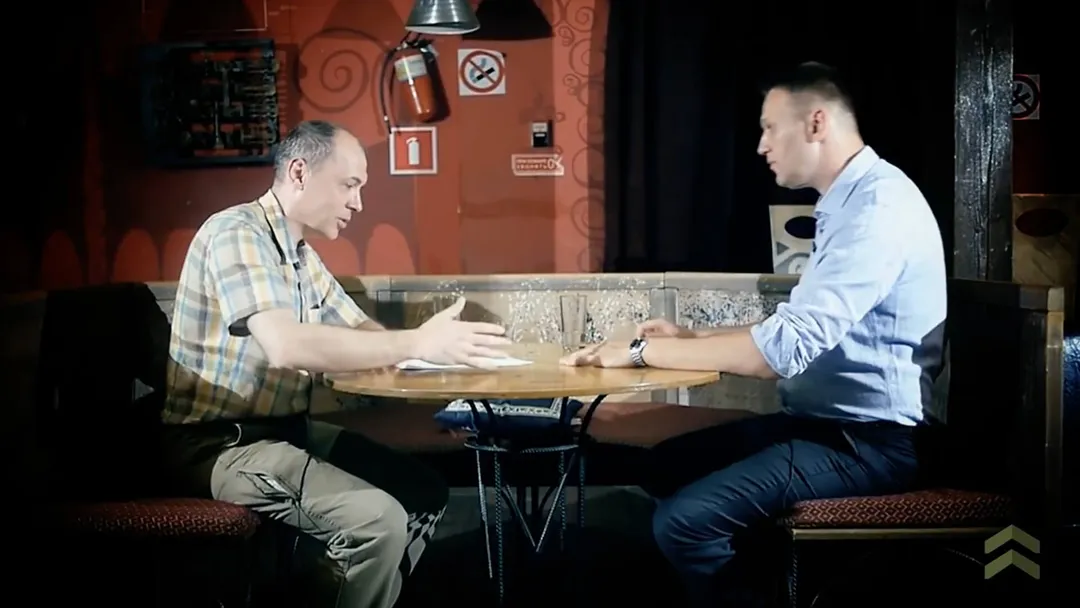
I’m not waiting for a perfect world to arrive.
A perfect world will never come if
we do not fight for it. We need
to fight right here and right now.
Alexei Navalny was born on June 4,
1976, in the military settlement of Butyn
in the Odintsovo district of the Moscow region.
In 1998, he graduated from the law faculty of RUDN University. In
December 2010, he launched the RosPil project. In
September 2011, he founded the Anti-Corruption
Foundation (ACF). In December 2011, he became
one of the leaders of the white-ribbon protest
movement. He took part in the 2013
Moscow mayoral election. He finished second,
winning 27.24%
of the vote. Since the late 2000s, he has appeared
as a defendant, witness, and subject of investigation
in a number of criminal, administrative, and
commercial court cases. Convicted three times.
He received suspended sentences and does not admit guilt. Since
November 17, 2013, he has headed the Central
Council of the liberal political party
Progress Party. He is married and raising
two children.
Today we have an unusual guest on the program,
Alexei Navalny. Hello,
Alexei.
Good afternoon. Usually, when you say “unusual guest,”
you mean some kind of circus
performer or someone like that. I work in a more
traditional genre.
Well, for Novosibirsk, [laughter] how should I put it?
Especially since for three years you had been stuck
in one place.
in Moscow without leaving, for reasons beyond
your control. Thank you for
coming to speak with us. Let’s start with
the past. In 2011, it seemed that in
Russia a renewal had begun, and many
people took to the streets; there were large
opposition rallies, with your
participation—if not to say leadership.
And today, three years later—more than three,
in fact—we see in the opposition camp
confusion and wavering, while reaction is triumphing,
so to speak, and, well, the prospects are
unclear. So here is my question in that regard.
Did this happen because of objective circumstances,
or were there some mistakes by the opposition,
three years ago?
As for 2011, those
protest actions, those protest
rallies, took place in a different country; they
were fighting the regime of a different country. Russia
in 2011 and Russia in 2015 are completely different
countries with completely different political
regimes. That is why the protests of 2011–2012
in some sense achieved their
goals,
because they changed the political
regime. You remember that Medvedev’s constitutional
reform was announced, the procedure for registering
political parties was eased,
and for a short time there were nominally direct
elections of governors introduced,
and so on and so forth.
In other words, many promises were made.
But then, at some point, the authorities
realized that all these democratic
changes would simply lead to
their being removed from power
in fair elections by the very parties
they had allowed
to register. And the political regime
was changed. Russia in 2015 is a country
with many political prisoners.
In 2011, effectively the only well-known
political prisoner was
Khodorkovsky. Russia in 2015 is a country
where almost no opposition is allowed
onto the ballot at all. It is a country where,
for example, I am banned from taking part in
elections altogether, Khodorkovsky is
banned from participating altogether, and so are
many other people. So drawing any
direct analogies here is, well, not very
appropriate. Those protests could not and cannot
stand up to the now fully
authoritarian system that
has taken shape now, in 2015, when the
country is actually, well, waging a war. Could
anyone in 2011 have imagined that,
when in 2011 President
Putin was saying that NATO was our
ally, that Ukraine should remain indivisible,
and that any territorial claims against
neighboring countries were impossible? In
2015, we see different
rhetoric; it is simply a different country.
Of course, back then, in 2011 and
2012, the opposition
made some mistakes. If those
mistakes had not been made, we would probably
not be in the situation
we are in now. But overall I want
to say that we need to stop dwelling on that.
We need to stop living by
romantic notions. Ah, if only
in 2011 we had done
something differently, gone to
a different place for a rally, then everything
would have changed. We live here and now, and
the regime is completely different, and now we
must do everything in our power
to steer the country in the right
direction, because right now it is developing
in a completely wrong way. The opposition is not
in disarray and confusion; that is
a mistaken impression. It has simply been
pushed outside the legal framework. A huge
number of opposition politicians,
myself included, have been labeled the so-called
non-systemic opposition. But what is
the non-systemic opposition? It simply means we are
forbidden from taking part in elections. Why
are there 74 parties, 70 of which are some kind of
strange parties with obscure
names are allowed to take part
in elections? But the Party of Progress, which
even according to official polls—Levada
and FOM—is in fourth place
in popularity, is banned from taking part in
elections and has even been officially
dissolved. We are simply operating in a different
political system, but that does not
mean we should give in to
despair, look back nostalgically on
2011, and agonize over it. No,
here and now we can do a great deal.
This country today, which, as you
say, is completely different from what it was in 2015,
is made up of the same people. Well,
roughly speaking. Of course, there are
new people, some have died, and the authorities are made up
of the same individuals personally. I mean,
only two people there have switched
places, but otherwise everything is still the
same. So, well, it turns out,
the agenda is different, a different agenda. We could not
have imagined it, no one could
have imagined that there would be a war with
Ukraine. If back in 2011
someone had told us that Russia would
be waging war against Ukraine, we would have simply
thought they were crazy. Nevertheless,
it is really happening. And we are now living
under sanctions, in conditions of
real confrontation with the European
Union, which until quite recently was our
main partner, and Germany was our
closest friend. Now we have been thrown out of
the G8 and so on, and so
forth. The rhetoric has changed, and our
government—the main difference is that our government
has realized that the only way for it
to survive, to preserve this
power and use it for its own
personal illegal enrichment,
is simply to
mobilize everyone around the war,
around some kind of island that
everyone is attacking. And we can see that the real
political agenda has, well,
been pushed aside. For example, it is even
interesting to trace this in our
interview. In Novosibirsk there are a lot of issues
concerning Novosibirsk Oblast, the real
political agenda. But everyone asks me
about the war, about the West, about
relations, because the authorities are deliberately
pushing aside the real issues that
should concern the public, issues to which
they have no answers, replacing them with
questions for which they simply
invent some tales about how
the whole world is supposedly preparing to
attack us.
Well, it would be strange to expect you to have
deep immersion in the Novosibirsk
agenda. That is, I do not have a deep
grasp of the Novosibirsk agenda either, but
our democratic coalition,
which is running in the elections on the basis of the party
RPR-PARNAS, has a very clear and
direct proposal that concerns
the regional agenda as a whole. The main thing
we are taking into this election is the slogan
of decentralization: that money and
powers should remain where
people live. For Novosibirsk Oblast
this means very specific things.
We demand, and we want
Novosibirsk Oblast and Novosibirsk
deputies to demand this officially:
that 40% of the VAT collected here,
in Novosibirsk Oblast—which is now
sent 100% to Moscow—should remain
here; that 60% of the excise taxes
collected here, in Novosibirsk
Oblast, should stay here as well; and that 15% of the mineral extraction tax
should remain here. This would bring
several billion additional
rubles, which Novosibirsk badly needs.
This is the Novosibirsk agenda; it is also
the Kostroma agenda, the Kaluga agenda. It is
a regional agenda in general. This is
the main thing we are taking into the election. We
are saying: enough of Moscow—I mean
Moscow as the federal center—acting like a
vacuum cleaner sucking everything out of the regions,
because it is absurd that
Novosibirsk Oblast is considered a
subsidized region. Why is it
subsidized? Who made it subsidized?
By every objective measure—industrial development,
education, population size—
Novosibirsk Oblast is a
self-sufficient region. It is a
donor region that earns money. And we
want that money to stay here
without much damage, incidentally,
to the federal center. That is why we are confident
that this agenda will resonate in the minds and
hearts of the residents of Novosibirsk Oblast.
Do you have a plan? I mean, the situation is
as you have described it, well,
let us assume the agenda has changed completely,
the public has been mobilized around the
situation with Ukraine. By the way, there is also
a disputed view as to whether Russia is
waging a war or not. Officially
it is not at war. There is, so to speak,
an obvious trend on the part of the authorities to clamp down on everything,
to let nothing through, and so on. So what,
strictly speaking, is the positive plan
for a way out?
The plan is very simple. We talked about this
2 years ago, 3 years ago. We have
specific, positive, very specific
proposals that
every region of Russia needs, and that
Novosibirsk Oblast, as a
self-sufficient region, may need
above all. We have set out specific
draft laws on this issue. In these
elections in Novosibirsk Region
we are trying to reinvent the opposition so
that the opposition—the democratic
opposition—goes into the elections not simply with
some list approved in
Moscow, but with one that will be chosen through
primaries in which
the region’s residents themselves will take part. The faces of the opposition
will be determined by the residents of Novosibirsk
Region, not appointed by Navalny,
Kasyanov, or anyone else. That is the first point.
Second. We believe that our deputies
will undoubtedly win seats in the Legislative
Assembly and in the city council in
Novosibirsk. They will be the main
driving force in persuading
your fairly strong opposition—
the Communists and A Just Russia—
and forcing United Russia to adopt these
measures that are supported by all
the region’s residents. Because according to our
polling, and any other public opinion surveys,
we know for certain that the residents of
Novosibirsk Region, first of all,
demand that more money and more
powers remain here rather than
being siphoned off to Moscow. We simply know this
is a real public demand.
Second, we know that they demand
a fight against corruption. This is one of our
main priorities. And we can
guarantee that the people who
become deputies from our side will truly
become guardians of the budget, who will
either prevent or seriously
hamper corruption. We know
for certain that in Novosibirsk Region
and in the city of Novosibirsk there are strong
democratic traditions. And here
the population is unquestionably in favor of
direct elections of city mayors,
the free right to take part in peaceful
demonstrations, and the independence of the mass
media. This is the agenda on which
85% of the population is with us. Our plan is
to talk about these real problems,
mobilize our voters, hold
primaries, and make sure that in the
Legislative Assembly there is a very powerful
opposition that will force the authorities
to change for the better.
Alexei, everything you’re saying sounds great,
but there are some small problems,
nuances.
Nuances, yes. And one of them is that
you said, for example, that you do not
know the candidates from the
democratic coalition who are taking part in the
primaries, except for Artyom Loskutov,
whom you have seen once. And yet here you are
telling us that they will be
guardians of the budget, that they will do
this and that. I wouldn’t vouch for even one
out of ten of my acquaintances, even the very
best ones, being able, as a
deputy, to do this kind of work
well. But you are seeing these people
for the first time and saying they will. So
what, exactly, is that confidence
based on?
On the fact that I believe in democracy. I believe
that out of five people, out of 14 or 13
people who registered for the
primaries, the region’s residents themselves will choose
the very best. And it is wonderful that I
do not know those taking part—I have not
personally known those participating in the
primaries—because that shows
that they are real. You have to admit,
there has never been a case where the leaders
of a party or the leaders of some coalition did not
know their own election lists even though
the election was near. That has never happened. But
we are proud that we do not know. We
are proud of it; I gladly repeat this
over and over, that I am happy
that I do not know who will be on the list. Whatever
the residents of Novosibirsk Region decide, that is how
it will be. Random people off the street do not
take part with us just like that. Everyone participating in these
preliminary elections are people
who share our values, who
sign certain
agreements. We have a set of
draft laws already written, so I
am confident that people of quality will be chosen,
people who are sincere and who will genuinely
work. Most importantly, they will
depend on the voters, not on me. They
will feel constant pressure
from their voters, whom they persuaded
to vote in the primaries. That is the most
important thing. There can be no other guarantee.
It is precisely the guarantee of democratic
elections that is the main thing that
forces a politician to be good,
hardworking, and effective.
There is also the problem that we have already had
honest elections, and there were candidates
who depended on the people.
There were
in that year
there were elections, anyone could run.
A great many got elected. There was no money then,
or not much of it. There was censorship, but it did not
have much influence at that moment. So many people
were newly elected who were supposedly all
from the people, who were supposed to depend
on the voters. They sold out within three years,
and starting in 1995, we
essentially no longer had normal
elections. There were elections bought with
money, and later simply through
administrative leverage. So we went from
a situation where there were competitive,
honest elections, freedom of speech, freedom of
the media, and ended up with the system built under Putin.
not to the vertical power structure, but, so to speak, to the tightening of control over
elections and the monopolization of the information
space. So the question is: what
guarantees are there that now we won’t see the
same thing again, just on a smaller scale?
Well, I have a counter-question: are we really
such bad, hopeless, miserable people
that we don’t deserve anything better? What you
said, essentially, is exactly
the main shocking fact explaining why we
are obliged to do this now. You said that
our last fair elections were in
1990, 25 years ago. We have no
fair elections. That— that tells us
only one thing: that right now we must
do everything possible to bring back
fair elections. Of course, Yeltsin,
and the government of that time, unfortunately,
disappointed all of us in many ways. I
as a former ardent admirer of
Yeltsin—when I was studying, when I was a student,
I was a big fan of his. With great
disappointment, I look at how these
people really changed their colors, broke
everything, and created a system that
reproduces them, re-elects them
endlessly. But that doesn’t mean
that I should say: well, you know, for 25
years there have been no fair elections, so who cares.
Let there never be any. I want them
to exist; I have no other country. I
live here, my children live here. I know
one thing: I must do everything I can
to make fair elections return. I
know there are lots of people here, in
the Novosibirsk Region, in Moscow, in
Kaluga, in Ryazan, in Vladivostok—wherever
you like—who share this
idea too. You want fair
elections too, like any normal person.
So we will do everything we can.
We understand there is a danger that
a deputy gets elected and then changes sides. That is
precisely why we hold primaries,
because a deputy changes sides when
he depends only on his party
leader. We want deputies
to depend not on a party leader, not on
the party structure, not on the presidential
administration, but on the voters. When
everyone knows that democrats go into
elections and form their lists
in only one way—through primaries.
They will behave, or try to behave,
decently, because in the next
election they are guaranteed to lose out,
because there will be primaries again. There is no other,
you see, no other mechanism
exists. I can get any kind of papers
signed by them, but they will still
change sides if they want
to.
Alexei, there are necessary and
sufficient conditions. Yes, fair elections are a
necessary condition, but not a sufficient one.
Back in 1990 there were already fair
elections. What else must there be, besides
fair elections?
We are working here and now. Of course,
fair elections are a necessary condition, but
not enough. We need fair courts.
We need to be allowed to take part in
elections. Do you understand? The paradox
is that if not long ago we were
demanding fair elections, now we are
demanding at least elections. In fact, the main
danger is not that we won’t
clear the threshold—we certainly will—
but that the main danger is
that they simply won’t let us onto the ballot.
So, of course, in an ideal world we would have
free elections, we would have
an honest judicial system, we would have
officials who are more inclined
to allow everyone to participate and to conduct these
elections fairly among all candidates and
parties. But that won’t happen. Nevertheless,
we know that the Novosibirsk
Region, for example, unlike
Tatarstan, does not have a strong tradition of
electoral fraud. In the Novosibirsk Region,
United Russia has traditionally
not exactly lost, but almost
lost in the city; in fact,
it has even regularly lost here, and this is
a place with an extremely low level of voting for
United Russia. The Novosibirsk Region is
one of the most educated regions, and
the city even more so. We know that here
we have our voters, there are people here
with democratic views. They are the people
we will try to rely on. I am not waiting for
the arrival of an ideal world. An ideal
world will never come if we do not
fight for it. We need to fight
right here and right now. [music]
Let’s move on to reality. Again, as you
say, the world is far from ideal,
and we understand that at best you
will get a faction of, say, three deputies in
the Legislative Assembly of Novosibirsk
Region. Well, maybe roughly
a similar faction in Kostroma and in
Kaluga. That’s out of 70 deputies. So
what can such a faction do? Well, basically
nothing. As practice shows,
they are simply ignored and no one
pays attention to such factions. In
electoral terms, you say: "You have
your own voter base in the Novosibirsk
Region; in Novosibirsk it is estimated at
eight to—well, the very, very
most optimistic estimates put it at 15% at the
moment. That’s not enough to change the world.
Yes,
those estimates are wrong. And none of this is
true. When I ran in the Moscow mayoral
election, they told me the same thing: "So what
What do you mean? Your electorate is 8% at most,
even after a successful election campaign
it will be 11% at most. Even so, I received
a third of the vote in the country's largest city
in the country. Here's the fact: polling
measures what existed yesterday, while real
elections show what exists today.
In the city of Novosibirsk
there are up to 40% of people who share our
views, who share the basic
values. Across the region as a whole, at least
30% are such people. They have no one
to vote for. They had no one
to vote for yesterday, the day before, as you yourself
say, since 1995. They have no one
to vote for. That is why we
are aiming for a much larger number of
voters. Simply because, as I
already said, our agenda is supported by
absolutely everyone. At the same time, this is
the paradox. Look,
everyone in the region—just about everyone, I don't
know, 90% of voters—says: "We
demand that more money stay in
the city of Novosibirsk, in Novosibirsk
Region, and not go to Moscow." But where is the
political force that says
that? There isn't one. The official position
of United Russia, which has taken over everything there,
is: "That's it, we'll hand the money over
to Moscow."
We will come in and represent those
voters who want exactly the same
thing. The same goes for, the same applies to
corruption, the same applies to
the election of city mayors, and so on. It is
very important that in our platform we
represent the interests of the majority, not
some marginal group or
some wonderful, progressive, but small 8%.
We are confident that we will create a large
faction if, uh, we manage to ensure that
we are allowed onto the ballot. As for
the saying that one man alone can't fight the battle—well, I can only recall
the late Nemtsov. He was alone in the
Yaroslavl regional legislature. He
brought down a corrupt deputy governor. He
fought for the interests of cancer patients,
turned the entire medical system there upside down,
and made sure that the medications cancer patients were entitled to
receive were provided
free of charge. One person was like a whole faction; the entire
region was talking about him. He was
the main, uh, newsmaker. Despite
the fact that Borya (Boris) was, of course, someone
extremely vulnerable to criticism. The 1990s,
former deputy prime minister, and so on, and
so on. There was a lot one could hold against him,
but we saw that one
truly active, sincere person
can do a great deal. And we
are absolutely certain that we will become
the most influential faction here, in
Novosibirsk Region. Besides, well, you have
a very specific region. After all, it was
you here, not us in Moscow, who elected
an opposition mayor. Never mind what kind of mayor he is,
what he has become now, and so on, but
he is genuinely one of the few mayors not from
United Russia. Here in Novosibirsk Region
United Russia candidates were getting fewer votes than
the Communists, and so on, and so on.
The balance of forces here is completely different. And we
are confident that we will be able to use,
on the one hand, the voters' desire
for real change and, on the other hand,
the existing balance of forces in order
to compel the adoption of
the right laws so as to
truly change the situation for the better.
Well, the agenda you are talking about,
changing budgets in favor of the regions,
greater autonomy for local authorities,
the election of mayors, and so on,
is indeed supported
by the majority of the population. But for
most of the population, for most
voters, these issues have been pushed aside, well,
they have become secondary. And the divide
is over Ukraine, roughly
speaking. Sitting where you are now, for example,
was Zakhar Prilepin, some two or three years
before the events in Ukraine, and he was explaining to me
that the opposition had a wonderful
unified presidential candidate,
Alexei Navalny. Right. And therefore we should
rally together and, so to speak, elect him
president. Now, I think, he doesn't say that
anymore.
Well, ask him—maybe he suddenly will. [laughter]
Another acquaintance of mine, who helped you
in your election campaign in Moscow,
now says: "I won't vote for Navalny
because he is,
well, not 'Crimea is ours.'" How are you going
to build a dialogue with these people? For all the
appeal of the local agenda,
well, proposed by the democratic
coalition, they will not vote because of
this disagreement over the issue of
Ukraine.
I will talk to these people,
I will explain things to them,
you see, just because there is Crimea and Ukraine,
doesn't mean everything else should go up in flames. So
let the whole country collapse, and we will no longer
talk about anything else, we will only
talk about Ukraine. This is the authorities' strategy,
a relatively effective one, which
has changed the entire agenda. They do not want
people talking about corruption, about real
problems, about the cancellation of commuter trains, and so
on. And for that very purpose, they actually
started this war. In order
to change the agenda, in order
to sell the public the idea that
some terrible
legionaries are advancing from the side of
Europe. Any moment now they’ll seize Ukraine,
and then, who knows, they’ll take a bite out of the Smolensk region too.
It’s all a complete myth. And
that myth does not cancel out the real problems.
Of course, there are many people who do not
agree with me on foreign policy issues,
particularly on Ukraine and so
on. But with these people I can find common
ground on corruption. With these
people I can find common ground on housing and public utilities.
These people, just like me, also
believe it is wrong that in the city of
Novosibirsk only 18% of the housing stock is
connected to gas, while Gazprom at the same time
spends colossal sums on buying
football players. That doesn’t, that doesn’t
change anything. Fine then, Crimea is ours.
Fine. But does your home have hot water
or not? In our Novosibirsk region,
85% of households do not have hot water
supply. Therefore
in rural areas,
ah, well, outside the city
of Novosibirsk. Yes, of course, Ukraine, all of that
we can discuss. I have answers to
these questions. Perhaps some people will not
agree with them. However, I am absolutely
certain that when we discuss, well, more
pressing, if you like, bread-and-butter
issues,
many will vote for me. Now,
one second,
for us.
Well, let’s suppose that I am exactly the kind of
opponent who disagrees with you about Ukraine and
Crimea. I have the following
question. You say: "None of this
matters, but how can that be? Civilians are being killed
there under shelling in
Donetsk. And is Russia supposed to, you know,
just watch calmly?"
Russia must stop sponsoring
this war. No one will be dying if
Russia does not finance
these military actions. Putin’s strategy
is aimed simply at
turning Ukraine into a failed
state so that it cannot
carry out reforms. His position
is that Ukraine must
split apart, collapse, and there must be another
15 revolutions there, and so on. My
position is this, and I am ready to
defend it: it is in Russia’s interest, and in our interest as
citizens of Russia, for Ukraine to
be a rich, prosperous state
that could buy our goods.
By all means, let them integrate into
Europe, and we should integrate into
Europe as well. That is the strategy. And I believe
that what is happening now is
simply Putin’s response to the anti-criminal
revolution that happened there. There
really was a revolution. There
people rose up and overthrew their
own Yanukovychs, who were
enriching themselves on a colossal scale
by looting the entire country. The current regime
in Ukraine is far from ideal, but Putin
simply saw an anti-criminal
revolution and fears the same kind of
anti-criminal revolution in Russia.
So telling all sorts of tales about
U.S. influence and so on and so forth,
people in Donbas will stop
dying when Russia stops
doing all this, when we
stop making it so that in
every news broadcast for more than a year now
the first four stories are about Ukraine, and we
even hear about Ukraine in the weather forecast,
if you can believe it. I say: "To hell with
Ukraine, we need to deal with our own
problems, disinfect the Novosibirsk
region."
But there are 3 million Russian people there in
Novorossiya. How can you just ignore them? You
mentioned Zakhar Prilepin here. Back when
I, together with Zakhar Prilepin, in
2011, created the movement
NAROD, which stood for National Russian
Liberation Movement, we declared that
the state’s official position should be
the formal protection of Russians outside
Russia. All those TV hosts
used to say that I was a Nazi and that I
should not be allowed anywhere because I was a
Nazi. Now they say that I am a
sellout liberal. Our position has not
changed. The rights of Russians really were
violated and continue to be violated in the Caucasus,
in Turkmenistan, in Uzbekistan, and so on and
so forth. Those rights must be defended.
They should have been defended everywhere, in all those places.
Putin did not defend the interests of Russians
in Turkmenistan when all those Russians were simply sold out
for gas. They were stripped of their pensions there. He
sold them out for a gas contract. Hundreds of
thousands of our compatriots. He did not
defend the interests of Russians in the Caucasus and
so on and so forth. How many Russians lived in Chechnya?
450,000 people. Now
only a military
contingent of 25,000 remains there. That is where the
interests of Russians are. Those are what must be defended.
And in Ukraine everything was fine until
Putin began instigating
the war. The war will end, there will be
no violence. I very much hope that, in
full accordance, by the way, with the
position of the Russian Foreign Ministry, Ukraine
will remain a single state. Donetsk
and Luhansk regions will receive
some necessary degree of autonomy.
They will settle the issue of Russian-language rights and
will build a difficult but shared
life together. By the way, in every
European—well, not every one, but in many
European countries have the very same
language issues and separatist problems,
but they manage to resolve them somehow. And in
Ukraine, all of this will be resolved too. You just
shouldn't send secret troops there and
instigate military action.
Do you discuss this there with
Prilepin, with Krylov, for example, or
is that it? [laughter]
Well, I do talk to people, I try to talk to
everyone. Those
crazy people from
the so-called NOD (National Liberation Movement), who
follow me all over Novosibirsk. I
am willing to talk to them too. If they
start telling me about terrible foreign agents,
I show them that the current government
is itself made up of foreign agents. I talk to them,
I talk to everyone. Please note
that, despite the fact that I
really do have different views on the
situation in Ukraine, on all other
issues I am in complete agreement with
many political forces. Or rather, they
agree with me—those on the right, those on
the left, liberals, anyone. And so,
let's say you win caucuses in
Novosibirsk, Kostroma, and Kaluga
regions. What then? I mean, these are
just several not very large caucuses in
not a very large number of regions in
Russia.
First of all, to begin with, we did not win
caucuses; we successfully carried out
primaries. These elections and this
experiment with primaries are very
important for us, as I already said:
the rebuilding of the opposition. We want to do
everything from scratch so that
personnel in the opposition are formed differently,
in general. Because, well,
right now, regional figures, who are important—important in
any party and influential in any
party—are most often simply
favorites, or people
with business connections and so on, of the leaders
of the Moscow-based party leadership. That's how it works in
the Communist Party, in A Just Russia, in
Yabloko, as you know, and in any other
party. It has always been this way. We want, in
principle, to change this system so
that the regions, even within
the democratic coalition, within
the democratic movement, are
independent and decide for themselves who
their key people are. This is the main issue
we must resolve. And then we must apply this
system in the elections
of 2016. And I am sure that if
in the 2016 elections we, the
united democratic opposition,
form our candidate list in the same honest, transparent, and open
way for everyone,
it will receive broad
support. And then a serious opposition
caucus will be sitting in the Russian
parliament, which, as you
yourself know, has not happened since 2003. And a truly
genuinely oppositional
caucus has not existed since
1993.
Fine, you win a caucus—then what? I mean,
if that caucus is in the
minority, it changes nothing. I mean,
the majority can always
It changes everything. But who is the opposition
in parliament now? Right now, in
a parliament of 450 people, there are only
two or three decent deputies.
All right. And what is the fundamental
difference between the capabilities of a caucus and
the capabilities of two or three people?
The difference is fundamental. First, what we
must achieve, what we are striving for,
is for people who share our views, people who
stand for fighting corruption, for
direct mayoral elections, for freedom of
assembly, to gain political
representation. We do not have it. That
is task number one right now: to gain
political representation; in the
next electoral cycle, to deprive
United Russia of its majority in parliament and
force the formation of a coalition
government. And then, in the following
political cycle, we will simply win.
That will happen.
So: 2016, 2021, 2025.
That's all very conditional arithmetic. You
can see that not a single election here has
been held under the same rules as the
previous one. Even now, they are
planning to shorten, by six months or a year,
the terms of office of State Duma
deputies.
Well, incidentally, they're carrying out the demand
of the opposition rallies to dissolve
the State Duma.
In a sense, yes, they just should have done
it earlier. That demand still stands for us.
We demand the dissolution of
the State Duma. We demand fair
elections, but this is, you understand,
an evolutionary political process. We
still believe—I personally still believe—
that Putin is leading the country toward
catastrophe. And sooner or later, the
things he is doing now,
the endless squeezing of everyone, the endless
installation of his own thieves in every
post—or even his relatives and friends
in every post—will lead to a situation where in
Russia, well, some kind of
revolutionary scenarios become quite possible. Such
revolutionary scenarios are undesirable
for anyone. That is why we support the idea that
the transition—the transfer of power—must be
peaceful.
So you are against a Russian Maidan?
Is that right?
Well, Maidan is, in principle,
the wrong word, because nothing that
happened in Ukraine could happen in
Russia. What happened in Ukraine was
an anti-criminal and anti-imperial
revolution. It was a national
revolution there, a typical revolution of a colony
against the metropole. Russia itself is
the metropole. Against whom would we
rise up? Well, only against, against,
against those American
masters to whose tune
Putin and his camarilla dance. All those
Rotenbergs and Timchenkos with Finnish
citizenship, Swiss citizenship, and
so on. So what happened in
Ukraine is not relevant to Russia at all.
We will never have that kind of scenario.
It may simply be much worse. Much,
much worse could happen: the breakup of the
country. Look at what we are seeing in the
Caucasus right now. There, effectively, with
the connivance of Putin and his friends, with
federal funding, there has been created
a Sharia-based Wahhabi army that
prays there four times a day, and
somehow gathers in a stadium
20,000 armed men. That is, in principle,
already a criminal offense. Under
Russian law, you simply cannot
have some thugs with
machine guns gathering in a stadium and shouting things. That, that
means they are already criminals.
So the processes now underway
could lead to something
far worse than what happened in Ukraine. And,
of course, as a responsible politician, I
call for a scenario that is
evolutionary. That means that we,
by taking part in elections, must first
gain political representation,
then, having an influential
faction, force this government to carry out
the reforms that society wants,
that society demands. And we know for certain
absolutely that, as I already said,
decentralization—money and powers to the
regions—and the fight against corruption are the two
things that everyone is simply demanding. One
of the reasons, it seems to me, for those
problems that occurred was that
the opposition's agenda was completely
at odds with the Kremlin's agenda. That is, there
was no room for bargaining. That
is, the opposition's demands were, roughly
speaking: you all must leave, run away,
or disappear.
Not exactly.
Well, you can round it off to that with a high
degree of accuracy. This is not, not a reproach to
anyone, because people were out there for the first time,
they had no political
experience, and naturally the radicalism
was off the charts. Now you are saying that there
must be an evolutionary path.
An evolutionary path implies, uh, well,
some kind of bargaining. But an evolutionary path
implies
pressure. And if that pressure is justified
and the authorities see that some points of the
opposition's program enjoy real
support, then they are obliged to yield, which
if, if it is not mortally dangerous.
When you say that the authorities have
one agenda and the opposition another,
there is a key mistake in that line of reasoning.
The authorities have no agenda at all. What agenda is there in
just staying in place? And
that is not an agenda; they do not say it outright.
They make up whatever they like. As
I already said, Putin once said:
"NATO are our friends. Russia should
join NATO." Long live indivisible
Ukraine. Now he says: "NATO are the
main enemies." First they said that
we needed to cancel commuter trains, then
they brought them back, then started canceling them again. They
said, they guaranteed that
citizens' pension savings would not be stolen,
and then they steal them. He declares that
the retirement age must not be raised,
and now he raises the retirement age, and so
on. This government has no
agenda whatsoever. Its agenda and real
desire are one and the same: to keep their places in
power and use them for
endless self-enrichment.
Let's talk about the real agenda.
But that is the real agenda; they just cannot
say it out loud. Putin cannot
go on his live call-in show and say:
"Guys, I am going to lie endlessly and
keep inventing all sorts of new
things for only one purpose: to remain
emperor, to put my Sechins, Kovalchuks,
and Rotenbergs into all the cushy
positions, to place my children and their children
at the head of state companies so that I can
be a billionaire while you serve me." He
cannot say that directly. So
he makes up different things. We do not
That is why we do not want to and cannot constantly
follow the authorities' agenda. We have
real demands. They existed yesterday,
they exist today, and they will exist tomorrow. These
demands are reinforced by the fact that this is what
the entire population is demanding along with us. So
we will keep demanding it. [music]
Alexei Anatolyevich, one of your
main areas of activity is
the fight against corruption. In particular, one
of the important points in the program is
the ratification of Article 20 of the Convention,
which requires an official
to explain where his palaces,
steamships, and airplanes came from, if he suddenly has them
appear. If the value of these
steamships, palaces, and airplanes
significantly exceeds his income, then he
is automatically found guilty, without
any inquiry into, so to speak, whether it was
corruption or whether all of it simply fell
from the sky. But in our current reality, with
the kind of justice system we have, with
the law enforcement agencies we have,
what would the adoption of
this article lead to? To less corruption,
or to higher incomes for employees of
the oversight
agencies? Again, we are not talking about
the ideal world, but about the here and now.
Indeed, one of our most important
demands is the ratification of Article 20
of the UN Convention and the adoption of the law
that we drafted on combating
illicit enrichment. It contains a completely
specific mechanism. You are right
that if an official earned 2 million rubles, but
bought himself a house for 10 million or a yacht for 15
million, that automatically means that
there are grounds for a criminal
offense here. And not without evidence,
as you said. Then a criminal case is opened
against him, he is taken to
court. It is proven that the yacht costs 15, while your
official income is seven. And sorry,
but you go to prison for five years for that. This
needs to be done in Russia. We believe that
despite the fact that, of course, the judicial
system and the corrupt
law enforcement system cannot
effectively fight corruption. And
the main thing needed to fight
corruption is political
competition and free mass
media. Even a declaration of fighting
corruption is impossible
without ratifying Article 20.
In principle, you see, in our country,
if society, the state, and the authorities
allow a completely
common situation in which some
CEO of Russian Railways, Vladimir Yakunin,
earns
quite a lot of money, but in reality
his lifestyle is like that of some kind of
Persian sheikh—well, that is absolutely
unacceptable. We want to make sure
that this at least becomes a formal
crime, because right now we
simply keep documenting it. There is
former Deputy Prime Minister Golikova, who
was responsible for Russia’s social sector. She
had a salary; she has spent her whole life
in public office. Then, bang,
she buys herself a luxurious cottage in an elite part of Moscow.
Where did that money come from?
Right now I cannot even formally
bring a complaint, because
they say: "Well, it’s not a crime, so
she bought it, she bought it." Why do you care
where they got the money? If our
FSB director buys a dacha in Serebryany Bor
—or rather, for his wife, who
has no income at all—for 155 billion rubles. This
is not even considered something
reprehensible now. That is, you cannot even
say that they are criminals. I can say it,
and I do say it. To which they
reply: "Then we’ll sue you for
defamation." You have no right
to call us criminals, because
it’s none of your business. Where did we get the billion?
That is why adopting a law on combating
illicit enrichment means making sure
that it is our business. Where do
officials with modest salaries—or even with
high salaries—get a billion from? Without that,
any further fight
against corruption is simply impossible.
This is the foundation; everything else follows from it. And we
believe that when we criminalize
illicit enrichment, even under
current conditions, with our current
law enforcement agencies and current
judicial system, first, we will ensure
that a significant number of
officials are brought to criminal
liability, and second, we will ensure
that society begins to
take an interest, journalists begin to
take an interest, and we will simply bring more
claims—well, including
as part of our political struggle.
We will raise this as a banner and say
very specific things. Well,
look, these people are criminals. Here
is his salary, and here is his house,
which costs 100 times more. They are
criminals, so vote for us
and fight them.
All right. Well, suppose the situation in
Russia becomes more ideal than
it is now. In what sense? Better, let’s say,
better, yes. How acceptable or
unacceptable would the participation of those officials
whom you consider
corrupt
be in governing, well, a future Russia?
That is, should they be completely
lustrated, or is there some
chance that someone will reform and, uh,
continue working?
That’s an interesting question. Thank you very much.
We simply need to distinguish between two things. What
is lustration? Lustration is when
we take people based on some criterion,
for example, officials up to the level of
vice governor, and simply forbid them
from holding certain positions,
from working for the state. That is one thing; it is
a more complicated issue. And the other thing is
simply to bring to criminal
liability those who violate
the current laws, or is involved in the same thing
— namely, illicit enrichment. Well,
for example, when a criminal case is fabricated,
against such people there is no need, they do not
need to be lustrated. Under the current
law, under the existing
legislation, they should all go to prison
for eight years. All these judges, all
these investigators who fabricate cases, they
must be brought to criminal
liability. This is not a thousand people, and
not hundreds of thousands of people, and so on, but it is
hundreds of people — hundreds of judges, hundreds of
officials. Take, for example, Yakunin,
the head of Russian Railways, or Sechin, the head of Rosneft, or
Kostin, the head of VTB, and all these
state company executives — they do not need to be
lustrated. They have repeatedly violated
the current criminal code. Therefore,
the number one issue is this: everyone who violates
the law must, through a fair court with a jury
of honest prosecutors, honest defense lawyers, and
honest judges, be brought to criminal
responsibility and sent to the defendants' bench
themselves. Second, there is the matter of some kind of
lustration and purging of officials. This is
a more complicated issue, and there are different
views on it. I believe that some
elements of lustration should be introduced,
for example, against those people who
work in bodies that have no
other purpose except repression.
For example, all these so-called centers for combating
extremism are simply
gangster structures created
to suppress the opposition. In its current form,
the presidential administration and its
subdivisions, which were created in order
to falsify elections, and so
on. But in any case, the crucial
point is that all such lustration
measures must be carried out by decision
of a court. In other words, this is not an administrative
decision. You cannot allow me,
Navalny, to lustrate everyone, because
with a personal grievance, including
personal motives, I would ban everyone
altogether. That cannot be done. This must be
done by an independent judicial body.
And where will you find so many independent and
honest judges?
There are 145 million people living in this country. There are
enough decent people here. What is a
judge? A judge is a person who
must first and foremost possess
life experience, along with a basic knowledge
of the law, and so on. We have a sufficient
number of lawyers, attorneys, and people in the
academic community to
recruit people who will judge according to
justice. Even in the current judicial
corps — the current bench, that is. Well,
why do these people rule by "telephone justice"
(decisions dictated by phone from above)? Is it because they like it? No,
it is because they are forced to. If tomorrow
the judicial system is truly
independent, and judges are not appointed
by the president, as they are now, then there will be
courts judging properly, when they know
that any judge who engages in corruption
goes to prison, that any judge who follows "telephone justice"
goes to prison, and that if they judge properly,
they remain there with society's support,
then the courts will judge properly. I believe in
Russia's future. I believe that the Russian
people are not lost. We have people from whom
we can draw honest judges,
honest prosecutors, an honest police force, and
honest traffic police officers. What you are saying
implies that there will be someone who
determines whether a person is honest — whether they can
be appointed or not. Well,
Parliament — an elected parliament. Well,
look, such a body is elected from private
citizens?
Ah, it will be elected from different kinds of people. It is
a balance. They were elected, they formed
a coalition government, and they
formed special bodies
that can, among other things, deal with
certain lustration measures and so on. They
can also form special courts or
special commissions that will investigate
criminal offenses that were
committed — purely criminal ones, such as
corruption, or political ones. And
there is no other method. Well, you can
appoint special prosecutors, as
is done in the United States, or use
the existing prosecutor's office. All this can
be done by parliament; parliamentary
commissions can be created, and different
people will sit on them, people
with different political views. And that
is a guarantee that whatever
joint decision they reach will be balanced.
It will be neither Democratic, nor
liberal, nor conservative, nor
United Russia-style. It will be something shared, and
that is the most important thing that must happen.
We must consolidate around those
points that are acceptable to everyone.
There are philosophical views of people,
and one of them is that people are divided into
good and bad. Here are the good people, here are the
bad ones. And the whole world then appears,
accordingly, as a struggle of good
people against bad people. So, roughly
speaking, right now the people in power are bad
people, and the good ones must replace them, and
after that things will become good. Another
view is that every person is
bad in some ways and good in others. And it may
happen that, well, their bad
side gained the upper hand, that they
gave in to temptation and began doing
bad things. Which of these theories
do you subscribe to?
Of course, there is no such thing as a black-and-white world.
I simply subscribe to the idea
that in a bad system, any
person is forced to play by the rules
of a bad system and becomes a bad
person. The current system is
a system of negative selection, in which
the worst rise to the top. That
is, in order to move up
the career ladder in Russia today, you
have to become venal, deceitful,
corrupt, and so on. That is why,
well, you can see that even those who are
in power now—many of them,
for example, come from liberal, including
parties. Take Yarovaya, that
odious deputy—she used to be our
colleague in the Yabloko party. And we
both remember very well how at Yabloko
congresses she shouted: "Terrible Putin, terrible
United Russia, they are all scoundrels, we must
fight them." And now she has simply
changed colors precisely because a bad
system is exactly what lifts up
the most disgusting, hypocritical people.
If the responsible class,
those at the very top,
demonstrate to the entire system below
that they themselves live by
honest rules, that they themselves are
not corrupt, and that they have the moral
right to hold people accountable for
corruption because they themselves do not
steal, the system will begin to rebuild itself,
because, well, I believe that people are
more inclined toward good, so
they are not good or bad; they are more
informed or less informed.
Rather, what we are talking about now is this: I do not
judge people who say,
"Navalny is a foreign agent"—how could
they know anything about my activities
except from television?
They simply do not know anything. But I
meet with these people and do
explanatory work. And very often
it happens that our conversation
ends with them saying:
"All right, we will think about it; perhaps we will
vote for you or for your party
vote." The world is multifaceted and complex.
I believe that the leading class should
demonstrate the best moral
qualities. And then those best moral
qualities will be followed by the entire system, which will
turn bad people into good ones or,
at the very least, not open the way
for bad people.
Well, we also see the opposite example. You
gave the example of someone who moved from Yabloko
to United Russia and, so to speak,
sharply changed her views. We see
examples such as Kasyanov or
Khodorkovsky. One of them was
prime minister, and moreover he was
prime minister in the system,
that brought Putin to power.
Frankly speaking, I do not think that
the rules of the game in that system have changed much.
That is, perhaps the scale
of corruption has grown, perhaps the scale
of arbitrariness has grown, but it is clear
that Putin's system is a direct
continuation of Yeltsin's system, no matter what
people from NOD (the National Liberation Movement) may think. We see the example
of Khodorkovsky, who was, uh, the
largest oligarch, made a lot of
money, and there are, of course, questions
about how honestly he earned it, and
he ended up in prison and served 10 years. Now you
are now cooperating, well, with
Kasyanov you are simply in a coalition. With
Khodorkovsky, I do not know to what extent. [laughter]
Open Russia supports our
coalition.
If a person looks at this
from the outside, they might say: "So it is all, all
the same after all—there are the same people there,
well, the same people in United Russia and the same people in
the United Democratic Coalition,
it turns out they just lost access to the trough
and now want to get back to it.
So where is the criterion by which you
determine that these people are ones you can
deal with, while those are not?
Suppose tomorrow a person comes, I do not
know, from VEB, VTB, and so on, and says:
"I have changed my mind, I understand everything now, everything under Putin is
bad, you are right. So let us
form a coalition with you." What would you say?
It is actually very simple.
A person is defined by their deeds and actions. So
they say certain things. Then we look
at what these people do. If they say and
do the right things, well,
then I regard these people as
allies. Take Khodorkovsky, for example.
He could have been a typical
Putin-era oligarch. He would not
have gone to prison at all. He would have spent
his money not on educational
projects or, now, on various
projects run by Open Russia,
but on buying yachts or mansions in London or
football clubs. But he does not do that.
Kasyanov, unquestionably, could easily
have fit into Putin's system. He
would have remained somebody important, headed some
state bank or something else. He would have been
what Russians call "sitting pretty,"
he could have done that, but he did not.
People do right, good
things. Not everyone is some kind of
scoundrel. And even in this system, in
this bad system, for many people there is, well, some
ultimate limit to how bad they are willing to go.
Take Kudrin, for example, who
was one of the fathers of that ugly system.
the tax policy, which I also oppose,
am speaking out against now. And Kudrin made it so
that money was effectively sucked out of all the regions.
But they believed, by the way, sorry for interrupting, that
people steal more in the regions
than in the center. They take everything to the center
and then absolutely everything gets stolen there. That’s what they
believed. So. In any case, we can see
that these calculations of theirs led to a situation where
all the money goes to the federal center,
and the regions lose any incentive, and so on.
But we can see that Kudrin nevertheless
left the government, and that he, well, although he
does so very carefully, very delicately, without
wanting to argue with them, he condemns
political repression, he condemns
the lack of judicial reform, he condemns
the political system in general, he
criticizes the government. And there are many people like that.
Of course, there are far more people
whom this regime draws in with
opportunities to enrich themselves. Well,
few people can resist that. I
judge by actions. Kasyanov was part of
Putin’s government—the best,
incidentally, of Putin’s governments
from the first through the fourth year. But now he
has left it behind. For many years now, he has been
an opposition politician. I follow his
activities. Everything he does
looks more or less
right to me. With RPR-PARNAS, we have
some ideological differences, but
they are undoubtedly an independent
political party with which we can
be in a close coalition, and, well, and so
on, and so forth. If people come
even from that side, and we see that their
words and their actions are honest and
sincere, then of course they are all
allies for us.
To wrap up, say a few words to our
viewers. What do you think they
can, well, do today?
It is very important for me, during this
trip of mine, to get across the idea that this really is
the case. It really is
true. The opposition list will be
formed honestly and openly. You—the
people who register and
vote for one person or another—
will be the people who
create this list. And the face of the opposition
will be determined by the opinion of Novosibirsk residents. And
then, I am sure, the election will be more
interesting for you to vote in. You will feel more
motivation to go to the polls
if you know that when you come to
the polling station, you will find there
a party that truly
represents your interests, and people
whom you yourselves put on that
ballot. Come to the primaries,
take part in them, support your
candidates, come to the election,
vote for the united list
of the opposition based on RPR-PARNAS. [music]
Yeah.