Alexei Navalny’s interview with the blogger Stalingulag
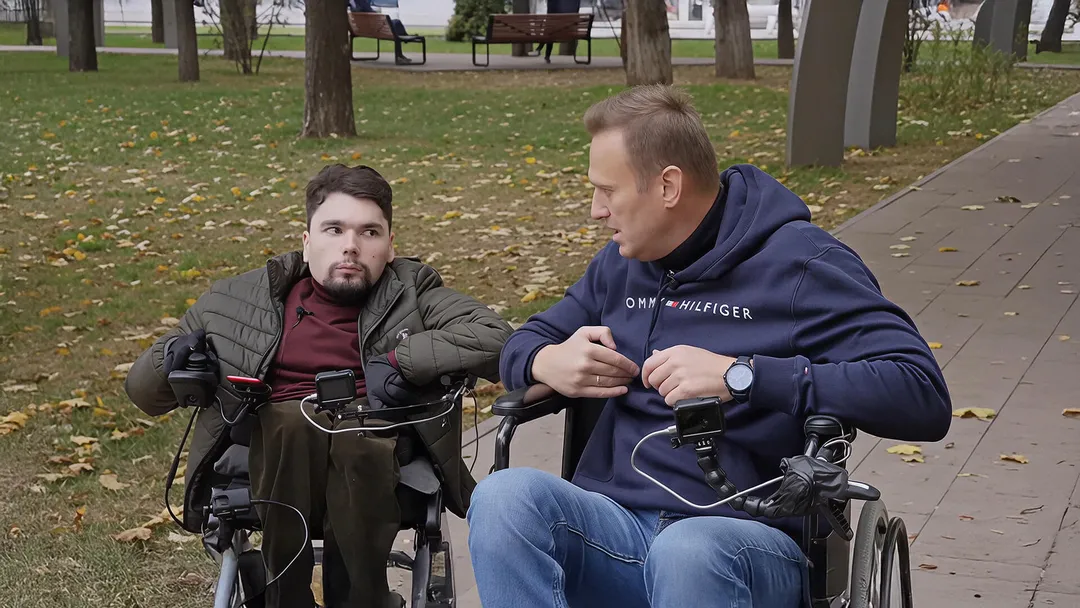
Hi everyone. I'm Alexander Gorbunov,
StalinGulag. And today I invited
someone to talk and ride around the streets of Moscow with me,
a person who can compete with me
in a championship of sitting still
in one place, because he spends time in
all kinds of special detention centers
more often than you probably spend time on
the internet.
Okay, I'm stuck. Just don't drop
me.
If I break the state-issued wheelchair,
the one they give out.
Okay, right now I feel like I'm about to fall
backward.
Careful, don't rush, don't rush.
Oh,
okay, yeah, not that high. Come on,
just a little more.
Comrade Senior Lieutenant,
h-how are you going to get back down?
Please welcome Alexei Navalny.
Hi. There are some very suspicious people around
our office. Great.
So. Well, introduce yourself—they've brought up a vehicle
for you, yes, a car. Well, as you've already
understood from the broken door, we're in
the FBK office. Tell us about these famous
searches you had here.
Yes, indeed, as you can see,
we basically have, instead of a door handle,
just this huge hole now.
Ah, and
this is a new development by Skolkovo
scientists.
Exactly. It's a kind of nano-handle—you can't
see it, but you can open the door. The thing is,
searches are happening constantly right now,
and this office has been subjected several times
to this kind of raider-style
attack, so we decided to wait.
The door is expensive, so let them calm down
first, let things quiet down a bit,
and then we'll replace the door. It always
looks very funny. This whole
space gets filled with these people in
black, wearing black caps. And over there
the office staff are standing around shifting
from foot to foot because the restroom
is on this side, and these guys
block everything here and won't let anyone through, including
to the restroom.
So, we can give some advice to young
people. If for some reason you suddenly
decide to go into politics in Russia,
don't install entrance doors at all,
because that's just an expense. You need to be
open people and expect that at any moment
people in masks will come
to see you. You'll save money that way.
Yes, absolutely. Okay, now let's see whether
the two of us can fit into the elevator or not.
Well, let's see how this
works—call it.
One second. Okay, wait.
Yeah. Yeah. So,
listen, this is kind of our traditional first question already.
I ask: where is it more comfortable to sit—
in this chair here,
which the caring state gives to people
who need it, or on the bunk beds
that the state, with no less care,
[laughter] provides for you?
There you go. You know, I'll tell you honestly:
once the jokes started going in that direction, I—
when I was preparing, I wanted to... Hold on,
one second, let me turn around.
Mm-hmm.
Okay,
and that's it. Done.
Didn't make it
back to the button.
I was wondering whether or not to google
jokes about wheelchair users. I decided
not to.
We wholeheartedly welcome any kind of
jokes at all, and we believe that
if I'd known you were going to start with that joke,
I would have googled them after all. And we
believe that people shouldn't be punished,
persecuted, or taken offense at for words,
because words are not actions.
So, are you getting the hang of it yet?
Well, I still keep mixing up which wheel I need to turn
to go right or
left, but apparently the main thing is fitting through
the door.
Thanks. We just barge right in.
So you do fit.
If I turn sideways, maybe.
Let me get situated.
Wait.
No, stop. That was a mistake. There, I think
I'm in the corner.
No, here, like this. Wait.
No,
no,
no, no, we don't fit. So, no.
So I'll wait for you downstairs then.
Yeah, let's meet at the bottom.
[snorts]
Well, go ahead, somebody, sure.
People are genuinely afraid of me. There were people standing
by the elevator just now, and in horror they simply
parted when they thought you were going
to ask them for some favor or
donations.
No, I think they were genuinely
scared. Really scared.
Thank you.
Okay.
See, we're going along and it turns out there are no
barriers, no obstacles at all. Turns out
Moscow really has improved.
Yeah,
it's fantastic. But now we're about to leave this
beautiful business center and end up on a
beautiful Moscow street. And one that,
By the way, literally this year, in
last year it underwent a major renovation,
they spent 100 million billion rubles on it. And
now we're going to test it. Here's a revolving
door, which, by the way, is also not exactly an obvious
thing to figure out what to do with.
Well, let's take a risk. I'll go
first after all.
Go on, go on.
As they say,
come on, risk is a noble thing.
Yeah, especially since they say you're the future of Russia.
If anything happens, I'll remember you as a hero.
You'll get some kind of posthumous award or something.
Okay, I'm stuck.
That's it,
Navalny is stuck.
See, you're an experienced guy, and I
got stuck.
Well, you see, you have to know how
to adapt. So, basically, we've
arrived already. You see what an accessible
environment this is. Before us is a whole variety of staircases.
[music] The rules on our show are as follows:
you can, of course, stand up,
walk down calmly, but for that we'll
fine you. Or you can make use of
the help of our kind people, who
you can ask
I can't ask the film crew.
Yes, of course. Just look how many
wonderful people are around. I think
someone will help you,
if you turn around. Look there,
see that guy standing there in white headphones.
That very Prigozhin troll (a supporter or operative linked to Yevgeny Prigozhin),
the one who's following me around and filming. Now
we'll test his humanity. Yeah.
Maybe you'll help him get down,
Alexei?
Help me get down
the stairs.
Help me get down
the stairs.
No, well, if you'd tossed your cigarette butt... No, well, you
need one more person. Guys,
can someone help?
Okay, just don't drop me. Careful.
Yes, yes, yes. Don't drop him.
Use both hands, please. No,
guys, stay seated, stay seated, stay seated. Take him.
Wait. Here, Sasha, grab it.
This is pretty scary.
Something's breaking, I think. No.
That's it. Thank you so much. And just like that,
you see, we even made a Prigozhin guy
work for us.
See, they're good for something after all.
So, look, here's the plan. You and I
are now going to go and see how
Moscow has been beautified.
Yeah,
we'll go there on the MCC (Moscow Central Circle), where they poured
a huge amount of money. And it's
considered super innovative.
It's the very latest public
transport system built in Moscow.
Yeah, let's see whether it's suitable for people
who get around in wheel
chairs. So, how does it feel?
So far, it's actually fine.
I just really don't understand: if I
had come out here at 9:00 p.m. and there
simply weren't any people around.
Well, I'll tell you how it was for me. When I
came to Moscow, I stayed with
my relatives on the outskirts
of Moscow, and of course there was no
accessible environment there at all. And we came
home in the evening. It wasn't late,
it was around 8:00 p.m. And I
probably waited an hour and a half or two,
until, uh, someone came out and helped me
get upstairs. Yes, exactly. In
fact, you need, just like I do
right now, at least two strong guys
at a minimum.
Absolutely, absolutely, yes. I'm saying,
you spend a lot of time in
detention centers, right?
Yes. And in general, how would you assess
prison culture—within public consciousness, in
society—it holds such a serious and
important place. And how does it find
reflection in politics, and not...
Oh, whoa, whoa, whoa.
Okay,
okay. A little
slope there. Well, I'd say that it
still has an absolutely decisive
influence. And all these various
prison-code notions,
they're absolutely everywhere. Well, they are,
first of all, very clearly articulated in
attitudes toward any minorities. I mean,
what is there to say about homosexuals,
right? But more broadly, this whole
idea that we mustn't
give way, mustn't bend, must dominate others—that's
exactly what's repeated endlessly on
television.
Some of you probably know that I'm a
trader. When I was just starting out
with cryptocurrencies, after
a small rise in Bitcoin, I decided to withdraw
a little money. I couldn't wait to quickly
test how it all worked. So
on some forum I found the first
exchange service I came across, contacted
support, got a wallet address,
sent a small amount to it, and
settled in to wait.
The money is in your account. Something somehow
didn't work out there—they vanished. Poof. Gone.
Needless to say, I'm still waiting and
haven't lost hope. If only I'd known then
about BestChange, this unpleasant
situation could have been avoided. Best
Change is an aggregator of exchange
services that work with cryptocurrency and
various payment systems. All
the exchangers on its list are checked against
a dozen different criteria, ranging from
financial ratings to
website design. And of course, a lot
of attention is paid to user
reviews. If any of the
exchangers receives three negative
reviews, it is immediately removed from the list,
so the chance of running into scammers
is minimal. Other than that, all you need to do
is choose the type of transfer you need and
find the exchanger with the most favorable
terms and rates. Doing that
is easy if you click through the different filters.
For example, if you need to exchange
a large amount, you can filter
the list by reserve volume and avoid wasting
time on exchangers that
do not have enough currency in reserve. If you
use e-currencies or
often transfer money between different
payment systems, I recommend
using BestChange. The link to the site
will be in the video description.
And how did your time in
special detention centers personally affect you? Did it somehow
change the way you look at life?
First of all, it is always very interesting
to watch how these nerdy kids from
respectable families instantly absorb
prison culture. People are detained
at rallies and brought in. Uh-huh.
Just yesterday they were first-year students at
some institute, studying French,
all cultured and
bespectacled. And after three days it is already "cell,"
"bunk," all that slang and the whole
culture — it all gets absorbed
very quickly. But in fact, that is also
because you need it there.
All those prison rules are there.
One second. Wait,
let us try to get a run-up now.
Got it.
So why did you not get me one of those cool wheelchairs with
a motor?
No, listen, because that exact
wheelchair you are in [music]
is the one the state provides to
people who need it. So it is
the basic model that everyone
gets. And we want you specifically
to experience — and our guests to experience — what
the average
disabled person in Russia experiences.
I actually looked up how many
wheelchair users there are [music]
in Russia. According to the Ministry of Health,
the latest figure is 320,000 people.
That is basically a city the size of Kaluga (a Russian regional city).
Ah, and each of them gets a wheelchair like this, right?
Yes. Yes, this is the basic model. And
an important detail is that a wheelchair like this, uh,
at least this is how it used to be, and I
do not think much has changed. [music]
you can only get once every seven
years. So, seven years, right? You get it,
and if it breaks, then of course
it is pretty obvious that after two years
it will fall apart.
Listen, it will fall apart even sooner. It
You said there are a lot of disabled people,
but do you see them on the street,
run into them [music]
somewhere around the city?
In Russia, no. In Russia, no. And actually
I have thought about this, but it is impossible
to get out onto the street. It is simply impossible
to get outside at all. Even if
your building has an elevator, you might
make it to the ground floor if you can get into
the elevator. But it is not even clear how you would
get outside the entrance.
Exactly, [music] exactly. The main thing is
how to get down from the first floor.
Uh-huh. Thank you.
If you open [music] your Instagram, it
creates the impression of
an absolutely perfect person. I mean,
you have a beautiful wife, smart children, you
eat healthy, [music] you exercise and
you read books, and when you
see such a perfect person, you
think, well, there must be some
flaw. Maybe he strangles cats at
night.
To continue your story: he is a perfect
person. He has a wife, children. On Instagram
everything looks great. He has one
drawback: he lies a lot on Instagram.
Well, actually, Instagram is there
so that we can post
photos where we look beautiful,
smart, or somehow special.
No, but, roughly speaking, you do not have any
photos there of yourself, uh, drunk [music]
singing Leps (Grigory Leps, a popular Russian singer), or, well, relaxing
in some other way.
And I think, well, maybe not very
drunk, but photos of me singing Leps definitely
exist somewhere, because at
our FBK (Anti-Corruption Foundation) we do have parties. And when was the
last time you were really drunk — not
just had a drink, but completely wasted,
like really
No, well, probably only back in
my student days was the last time I was
that drunk. I mean, like
all young people, naturally, I somehow
got access to alcohol [music] and got drunk.
But
then later, well, after a certain age,
first of all, being very drunk
stops being interesting. You drink in order
to feel a certain lift, to
Everybody drinks alcohol. And that's fine. Well,
and then, once again, you and I are being
filmed. There goes some bum filming
me. And you know, in my situation,
these guys don't exactly force me
to be a perfect person, but
they do keep me very disciplined.
How do you deal with that? I mean,
you're constantly under
scrutiny, and it's constantly
psychologically weighing on you. Obviously, no matter how
hard you try to fully relax,
you just can't. And what do you think,
for example, about light
drugs, about weed? Let's put it this way: in
the Beautiful Russia of the Future (a slogan meaning an ideal future Russia), will there be
legalization?
In the Beautiful Russia of the Future (a slogan meaning an ideal future Russia), there will be
decriminalization. That's what we need most of all,
you see, because weed is actually only fully
legalized in relatively few places.
The main problem with weed in Russia
right now is that—and let me say right away
that I am, of course, against
drugs and against drug use—
drugs are drugs, they're evil. But
when some 19-year-old guy
gets caught with three grams of marijuana
and is sent to prison for five years, that's just insane
that's madness. And what we need to do now
is create a new drug policy under which
we won't destroy huge numbers of
people's lives over some
single small mistake. In that sense, three
grams of marijuana are, of course,
a lesser social evil than five years in prison for
those three grams of marijuana. But this is, this is
an international trend. I mean, for
personal use, you can
grow a plant at home and, if you like, use it.
Medical marijuana exists too.
And we should simply follow
modern European and global
trends.
And where is that line? I mean, should we
fully integrate into Europe
and the Western world, or, as people here like
to say,
right?
Yes.
Thank you very much, everyone. Hi, Switzerland.
I can't quite make out what to do, what can be
done.
All right. Thanks so much.
Thank you. Thank you, man.
Thanksies.
Thank you.
There it is.
Just to be clear, we didn't bring this person here.
We really did just run into him.
Yes, absolutely. Yes. Well, he'll get 500 rubles later, of course
(about $5 / €4.5). Per diem.
Uh, should we fully integrate into
Europe, or preserve some kind of
distinct identity?
Well, listen, let me ask you this. Has
Switzerland fully integrated into
Europe? What about the UK? And France—
what exactly has France lost by
being part of Europe?
One of our viewers from
the Urals, for example, will answer you: "But in France,
uh, same-sex couples can marry, and they can adopt
children." So is that what Russia needs?
Our answer to the viewer from the Urals is that
this question should be decided in the Urals.
If he's in Perm Krai or in
Sverdlovsk Oblast, we'll hold a
referendum there. He can come to that referendum
and vote against same-sex
marriage. And whatever the Urals decide, that's how it
should be. Oh, now there are two of them already.
Did reinforcements arrive or what? Perfect,
you can carry me back and forth now.
Or three? Is he with them too?
Are you on your own?
Just by chance. I'm actually from Rostov
Region. A deputy.
A deputy from Rostov Region.
So, on September 8, the Communist Party of the Russian Federation won there. I
ran.
Congratulations.
So there's no ramp, which means you'll
have to hop forward or ask
for help. I can't really get through here either.
We'll put that Rostov deputy
to work now. Hang on.
There we go,
all right, managed it. Though I might
need some help over there.
Hang on a second.
And what about here?
Okay, we need to do something so I don't get
crushed while I'm making my move.
Maybe, maybe help from
the regions will arrive.
Wait, let me try to do it myself after all.
Try backing up. It might be easier
that way. Yes,
yes, exactly. I saw Lebedev do it
backward. Okay,
there we go,
they're honking over there—they want to run us over.
Ah, damn it.
Yeah, it's spinning.
Deputy, help out.
This is help from the regions.
Help from the regions.
Yes, the regions.
Thanks, brother.
Right.
Uh-huh. Thank you.
Okay, one more second. What's that?
What is it? What's that, an Audi?
No, thank you very much. Thank you very much.
That's a donation. That's a donation,
I get it. Thanks a lot, man. No,
seriously, thank you. Thanks a lot.
Let me shake your hand. Thank you. Thanks.
Sure. Well, listen, actually this
speaks to people's responsiveness, but it also
speaks, of course, to the monstrous
way disabled people are perceived in general.
Yes, because disabled people in Russia are
absolutely poor. They're not just
poor, they are not—
Sorry. And does that happen often?
Yes, very often. Of course,
you can. I mean,
we understand that a disability pension
is something like 12,000, 13,000, 14,000, 15,000 rubles a month (roughly $130–$165), right? So
what exactly am I supposed to do with that money?
I have to rent an apartment, I have to
pay assistants, I have to pay for,
I have to buy a car if I want
to get anywhere, because
public transportation is completely not
adapted. So everything has to fit into
those 16,000 rubles (about $175). By the way, how much
does your life in Moscow cost? In general,
how much does it cost to live in Moscow?
Renting an apartment is a big part of my
budget. Actually, this is the life
of a typical Muscovite, it seems to me, and
definitely of a very typical employee of the
Anti-Corruption Foundation.
Once I did an experiment, just went around and
asked: "Do you live in your own apartment or
do you rent?" And everyone rents an apartment or
a room, I think, except for one
person.
So this, by the way, speaks to the claim
that Moscow has it too good. Well, there is
this view in the regions that
Muscovites are swimming in money. When I
came to Moscow, I was struck by the
fact that in Moscow, well, most
people, if they're not somehow connected
to the authorities or benefiting in some other way,
simply live paycheck to paycheck.
Well, look, let's be honest about it.
For an ordinary Muscovite, there is no such thing as
"having it too good," because
the cost of living is just enormous. But at the
same time, of course, even if you compare
a Muscovite who lives paycheck to
paycheck and spends most of their money
on an apartment or a room, with
residents of, I don't know, Altai,
they're still simply incomparable things.
But why is protest activity so low in the regions?
I mean, shouldn't it be
the opposite? Things are worse there, and people
should be trying to change things somehow,
to have an impact. And Shiyes, and Novosibirsk, and
Yekaterinburg with that church, with St. Catherine's
Cathedral—when I was doing, right now I'm
just getting carried away and going off on a tangent,
when we were organizing those rallies, the "He's Not Dimon to You"
protest—there was a rally in Makhachkala,
organized by some people I don't even
know at all, and about
200 people came out. Despite the fact that in
Dagestan, it seems to me, it's genuinely
dangerous to take part in things like that.
Of course, just like in any other
region.
But overall, I definitely
agree with you: protest activity, with the
exception of some regions, is lower.
People simply don't believe that it's possible to live
better. They've never seen anything
resembling a normal life, and they're already
just in despair. It's like,
you know, we've never lived well, so there's no point
starting now. Right.
Whoa. Oh, wait. I shouldn't have
done that.
Okay, got it.
What, are we supposed to drive through the grass? I mean,
there's definitely no way we're getting through here, that's
out of the question.
Moscow is getting nicer, sure,
getting nicer. This little park here has really
been improved,
right before our eyes. Yeah,
let's go back.
And I looked into the repairs. Not repairs, actually—
the renovation, the reconstruction of this
park. They spent several hundred
million rubles on this whole
section.
Well, I'm sure someone ended up with
a wonderful little park somewhere out on
Rublyovka (an ultra-wealthy area outside Moscow),
yeah. Someone got a park built at their dacha.
A really nice and actually very convenient one.
Very convenient.
Tell me, where did you start? I mean, it feels
especially for the younger
generation as if Alexei Navalny has
always been there. But was there ever a moment
when you woke up and realized you didn't like
what was happening in the country?
How did it happen?
There wasn't one single moment. I'm a lawyer, after all. And
actually, what brought me into, uh, into this, into what
I do, into all this activity, was
the Russian courts. When you
go to court once and you've thought through
all your arguments, you understand the law
of your country, and now you're going to
win brilliantly. And like in
American movies, you've found some
key point, and now you're going to say it all to the judge
and he'll bang the gavel. A bumbling judge, right?
But instead there's this bumbling judge sitting there, and he
couldn't care less. He doesn't even
listen to you. He didn't take a single one of your
documents, he doesn't give a damn about anything, and
he just says, basically, denied. And you
think, well okay, a glitch, and the judge
is an idiot. [music] But then you go
to appeal, and then another judge—
not bumbling this time, or some other one—the second,
third, twenty-[music]-fifth judge, and
you understand that this system is built in such a way
that justice cannot be achieved within it.
Justice. [music] And you came up against
this system and realized that it cannot
be, you know, partially improved.
It has to be completely changed,
specifically through political means. And so
that is why I decided to go into politics.
I...
Don't you want to buy yourself a little cake,
or
something like that? Let's take a look.
It seems to me that buying company shares is
much easier than buying things here.
I mean, I know how to buy shares, but I still
haven't figured out how you can
shop in a universal way in
Russian stores.
So please move back, because
I can only do it with a running start.
Well, if it's like this
right now,
listen, you've got it good—you have a lot of
supporters, that is, people
who recognize you on the street, come up to you, and
help. But what should people do if
no one knows them?
So it came out as,
what should people do whom no one
knows? Well, should they all just ask around?
Guys, please help—give me a push
please.
Whoa, careful. Thank you very much. So, here
I'll probably still need your
help here.
Whoa, whoa, whoa.
Got it,
got it. Thank you very much.
Listen, I won't be able to get in there, so
you'll have to manage there somehow
without me.
What should I buy you?
Whatever you think is best.
We could buy a cake and throw it at the
Prigozhin people (supporters or employees linked to Yevgeny Prigozhin),
as an option. Though that would be a waste. Better to feed them. You
Russians are kind people after all.
No, really, we can buy pastries and actually
give them to these Pri—oh, there they are, those
goons.
Could you help me? Could you give me a hand,
please?
Let's get some *kartoshka* pastries (a Russian chocolate cake shaped like a potato).
So this is how we'll do
everything. And here, of course,
we've arrived.
Okay, I need—come on.
And the Prigozhin guy
where is he, by the way?
There. He's coming over to me. I have personal...
Just carefully
tilt it. No, no, no. Tilt it from the back,
so that my front wheels can go up there.
Come on.
Okay,
listen, you broke the whee—
you broke the state-issued
wheelchair they give out.
All right.
There they are, Prigozhin's trolls, damn it. And
they went and broke the wheelchair.
You eat too much.
It's not that I eat too much—it's that you,
Prigozhin, feed people too poorly.
Come on, help your comrade.
Careful,
come on.
Well, you see, they are of some use
after all.
Yeah, absolutely. Come on, now we need to
lift it up a bit. Like that. There.
Come on.
Careful, careful.
Well, give them a little shove.
Thank you very much. I bought you some pastries.
Take them, take them.
Thank you.
Listen, look how nicely you've
got yourself set up. I have to pay salaries
to my assistants so that people help me,
but these ones do everything for Prigozhin for free. See,
they walk around filming. If we end up with some
missing footage, we'll just take their
video.
And they still say you're not an FSB (Russian security service) agent. So
turns out everything has been exposed.
So the Prigozhin connection has been exposed, it turns out. You
too,
Alexei, may I shake your hand?
Thank you very much.
For you...
Thank you very much. Thank you.
[shouting]
Okay, going downhill here, we should be able to
get down just fine. Okay,
yes.
Okay, wait a second. This wheel is somehow
designed in a tricky way. For some reason it
keeps turning
almost all the way around.
Oh,
there we go.
Okay, now I'll...
Okay, that's it, I think. Okay.
You've got a cool wheelchair. How much did yours
cost?
More than 100,000 rubles (about over $1,000, depending on the exchange rate).
And how much does mine cost? If, as you say,
they give it to you for seven years,
right?
If mine has already broken—these guys were carrying me
and now it's already cracking all over.
Obviously, it will break in
half a year at most.
We bought it on Avito (a Russian classifieds site) for 3,800 rubles
on Avito. So that's why
And when I bought shares, as a lawyer I read the law
on joint-stock companies. It says there,
If you're a shareholder, you can go to
Gazprom and get any
documentation about the company, or you can
go to Transneft. I bought a share in
Transneft, came to Transneft,
and said, "Guys, in your report
you showed that you spent
hundreds of millions of dollars on
charity."
I'd like to see the documents showing what
you spent it on, because there is no trace of this
charity." Not a damn thing.
Explain it to me—maybe you bought
wheelchairs or did something else.
What did Transneft do? Did they show me
the documents? Not a damn thing. They told me to get lost
and then declared me a foreign
agent and a spy. But I went to court and
once again I was absolutely, 100% right. They are
all 100% crooks and thieves. And
public opinion is on my side. And
everything is obvious to everyone, but somehow I
lost. They won. I got angry and
kept hammering away at them and started
working, working, working.
Yeah.
Whoa.
That's it. You okay? Fine.
Okay, I'm kind of stuck here, but I think
I'm starting to get the hang of it now
in this sort of thing.
Then I'll cover for you here. For now.
Alright.
Ah, got it.
Okay, I think I'm about to fall
backward.
Okay. And
whoa, whoa. Okay. Wait, [music] hold on.
No, no, don't touch me. I'm not
going to lose to this sport. Let me try
to do it myself somehow.
Okay, Alexei, he's stuck, stuck.
Don't help me, I probably can't do it alone. Actually,
I do need help.
How many points are you taking off for that?
No, none. You did fall, after all,
so that doesn't count. For that, we'll
take a point away from Moscow City Hall.
Do you ever have moments of
apathy, in the sense that, well, you do everything
and it feels like you're just
finally getting to some kind of
result, and then they change the laws?
I don't feel apathy—anger, yes.
I mean, do I really get
that furious? Yes. But as for
apathy—no. I'm a person from the real world,
from real life. I understand that the
people we're at war with are
some of the richest people on Earth.
Not only are they rich, they also have
enormous power. They can
control
people's fates and lives. They are not going to give up that
power just like that. And they are
dangerous. I understand that this is a kind of
war and resistance
that may go on for quite a long time.
The main problem in our country—one of
them, of course, because there are many—is that we
lack something like an institution of
reputation. A person can do whatever
they want and know that no one will
hold them accountable for this or that action.
The institution of reputation will never
work until those who
disregard their reputation and
the very idea of reputation start getting
questions from everyone else. As for me,
people constantly call me out over things
that I said
10 or 15 years ago, because
all of my work has been connected to
the internet. I wrote a blog, I made
videos. Everything I said and did
was recorded and documented. And that
is very important. It disciplines
politicians. It makes them
answer for their words. And we should,
of course, call on the broader public
to hold politicians accountable.
By the way, Sobchak—why did she get
only 2%, given her level of
media visibility? Practically everyone in
our country knows who she is. So what? Everyone knows Chikatilo (a notorious Soviet serial killer),
too. So what? Did you vote for
her?
No, I didn't go to the election.
Okay, so now if I start
falling backward with my arms again, then now
I should do it into a puddle.
That'll get more views. Yeah,
it'll get more views. Yeah,
I'll lean into it. I'm experienced in this
Whoa. Okay.
There.
Nobody voted for her because
that was the Presidential Administration's
plan. They understood that here was a
politician no one would ever
vote for, except maybe
some crazy people or people doing it
as a joke. That's why she was in the
election.
So that means Putin hadn't become so
unbearable that people were ready to replace him
with Sobchak. At that moment, no.
I don't know what Putin would have to do.
Even if he ate a few children, people still
wouldn't replace him with
Sobchak, because, uh, I don't know, Sobchak
probably eats children for breakfast,
figuratively speaking. Ah, so here we are
standing in what is supposedly the most modern, in terms of
transport infrastructure,
place
there is. All the technology is here, here, uh,
Sergei Semyonovich (Sergei Sobyanin, Moscow's mayor), in essence, this is his whole
the Department of Transport, Public Utilities, and everything
else.
I want to address Sergei Semyonovich (a respectful way of addressing Sergey Sobyanin, the Moscow mayor),
if not you personally, then I invite you to come for a ride and
try getting through these
ramps yourself. Or send one of your
deputy mayor or, well,
some other deputy, and we'll try with
him to get onto these ramps or
come down them. Maybe you should try? I
will,
because I’m not even going to try
to push ahead, because this will never
end.
Okay, well, obviously here you just have to hold on to these
things.
Hop.
Okay. Okay.
Got it. Woohoo.
Checkpoint one passed.
On to the next one now.
Well, that was the first one.
Okay, there’s
a second one.
Okay, okay, okay. Easy. The main thing is not to
fall.
[snorts]
Listen, to manage this and get up
like this, you have to run every day and
work out, like you do.
Without that,
honestly. Or have an absolute
need to. I mean, this is just
simply
not possible. No matter how badly I
needed to, I wouldn’t be able to do this.
Absolutely. No, honestly, I
really doubt it. I looked it up: in our country, among people under 30,
the number of disabled people is over
a million, but I think that
maybe some of them could do
this, but definitely not most.
Okay, whew,
there’s more up there? Damn, this is really
an intense workout—CrossFit, I’d even
say. I hope this is the last flight.
Or is there more? There is.
Two more.
Two more.
Let’s keep going.
Yeah, damn. Okay, I still need to get up here.
Okay, somehow...
whoa.
Whoa.
Oh, Semyonych.
Oh, Semyonych.
I’d really like to say a few things to whoever
designed
and built this.
You can pass along a couple of choice words
right now. We don’t have censorship here.
You can say whatever
Well, we were just discussing issues of
reputation and the fact that on the internet everything
gets recorded.
Yeah. If I say everything I think right now
about Sobyanin, then that profanity-filled tirade
will be the main thing that
Google shows about me
for many years to come. My hands...
But now at least I’ll be able to
roll down here. Nice.
There. See, this is a good ramp here.
That’s a nice little bonus.
It’s like a little relaxation zone.
Yeah,
that’s the reward.
And from here it all goes downhill. I’ll
probably make it straight through. No, I didn’t.
No, don’t open it for me. Let me try,
I’ll do it myself.
He wants to do it himself.
I want to do it myself.
Uh-huh. Thank you very much. No, no, thank you.
It’s all fine. Thank you.
[shouts]
Alright then, shall we head to the metro?
Let’s go to the metro, but there is an elevator here already.
Yes, there is an elevator here, but only at one
of the stations.
Take care.
See you.
The irony is incredible. I came out of
this elevator and immediately ended up at the police station.
Hey, man, where have you lured me?
Brought me, I mean.
Well, that’s how these elevators work. That’s it. Bye.
What do you think about these Moscow, uh,
changes that are turning Moscow into
this kind of pedestrian city? I mean, a city where
for nine months of the year it’s basically winter, uh,
and where
being out on the streets is encouraged in every possible way.
Well, all of this comes from a mistaken
understanding—a wrong,
strange, warped version of Moscow
urbanism that has made it its
main idea that we have to crush
drivers. And when drivers
have it bad enough, they’ll all switch to
the metro or bicycles. Moscow is not
an average European city.
Moscow is a monster. It has 15 million
people living in it, drawn in from all
over the country. For nine months of the year it has
terrible weather. It’s too big,
too dense, so, uh,
it’s not Brussels. Trying to turn
Moscow into a small European city
is simply impossible. Besides, there is
for example a very strongly developed
dacha culture here. All pensioners have a
dacha (a country house or garden plot). And forgive me, but you can’t get to your dacha by
bicycle.
And what would you say to people who
say, “Sure, they steal, they skim money off
all this ‘beautification’ of Moscow, but at least
they’re still getting something done.” In the regions, they don’t even have that.
No. Those are the most clueless people of all.
In my experience, the very worst are those
people because of whom we live badly—they
say two things. “Yes, they steal, but”
“they give something to others too, they get some things done.” And
their second phrase goes like this: “Well,”
“these ones have already stolen enough, but if new people come,”
“they’ll steal too.” Those are the two most awful and
harmful phrases for our country. Because
again, our country’s experience
shows that, first of all, they never
steal “enough,”
and second, they don’t do a damn thing.
Moscow has a budget of 2 trillion rubles.
Moscow could simply live the life
of a magnificent, ultra-rich city with
excellent healthcare,
education, infrastructure, and everything
else. But instead, they shove things like
Gorky Park and a few
spruced-up public spaces in our faces. “Look,”
“we planted trees on Tverskaya Street,” and
they say, “Be happy, rejoice,”
“what is it you don’t like?” It’s really like in
the film *Kin-dza-dza!* (a famous Soviet sci-fi satire). “Rejoice.” And that is
absolutely outrageous, because we
shouldn’t be grateful just because we were given
a handout. We should be proud of a city
that actually matches its
2-trillion-ruble budget.
Well, you yourself said that people
are afraid that those who come next
will steal too. How do we make it so that
people stop stealing?
So that one day people come to power who
won’t steal. That’s all. In fact,
what Russia really needs is for
there finally to be a government, people in
power, a president, a prime minister—
someone, anyone, who won’t steal themselves and
will fight corruption.
But you can’t know that until they’ve actually
taken office, can you?
That’s why they have to be changed, that’s why
we have to replace those about whom we already
know that they steal. That’s all.
There’s no other solution here.
Only political competition,
freedom of the media, and independent courts can
make it possible to defeat corruption. Nothing
else will. Okay, attention.
Attention.
We need to somehow force our way in there.
We won’t be able to get in here, look.
Yeah, then let’s try the next one.
Let’s go. And here’s the next one—for disabled people.
What the hell? How is this for
disabled people? I can’t get in here.
Why is this for disabled people? It’s absolutely
unclear.
All right then, carry me in, my friends.
Just a second, just a second.
Come on, come on, come on.
Get the second one.
Listen, I think you’re going to finish off this wheelchair
today.
Well, this is what they call doors for
disabled people, right? But it’s completely
impossible to get through them.
These are called doors for disabled people.
It’s just impossible to get in, and if
you try— Hello.
Excuse me, are you kind of the
person in charge here,
right?
This is a door for disabled people, isn’t it?
That’s right.
But you can neither get into it nor
out through it. You can see for yourself.
At that moment I was following procedure; we had
a train departure, and it turned out that
Uh-huh. No, I’m not blaming you personally.
You’re supposed to help a disabled person if they
come up. Look, now we’ll
arrive, and you’ll be able to roll me out
by yourself.
Yes, I’ll unfold the ramp.
Oh, so your ramp folds out? Got
it.
Right, they’ve sent security to chase us away.
Hello.
We’re advertising
the Moscow Ring Road. Convenient
exits.
Yes.
So look, on foot this route takes you
about seven minutes
or so, right?
And we spent at least half an hour getting here,
right? Well, exactly.
So if this were, say, in
January, we would’ve frozen. We’d
have just turned to ice somewhere. I think
that actually in January, in
most of the places where I managed, with difficulty,
to get through, I definitely would not have
been able to pass at all.
And where are your Prigozhin trolls
helpers?
They’re around here somewhere. Where are they? Over there,
standing there, holding onto the handle.
And their fare is paid for.
What expenses do they reimburse for you? Do they
feed you?
Exactly. And the metro fare too. Well,
you see, Prigozhin (Yevgeny Prigozhin, a Russian businessman tied to state contracts) only on
school contracts, on contracts for
school meals, I think, steals no less
than 20 billion rubles there. So he can definitely
afford to keep not just two people
next to me, but 22.
We should ask them to
I understand that yours is the second-oldest profession,
but you really are making people’s lives harder.
The people’s eye.
The people’s eye. Yes. The second-oldest profession.
All right, let me help you— Which way are we going out?
Which side are we exiting? Yes.
Uh-huh. Let me move aside.
There’s practically a whole special operation going on here.
They shooed people away so they wouldn’t come
over here.
Mind the
gap. Next station:
platform on the right. Okay, let’s head to
the passage to Sportivnaya metro station.
Great. Thank you.
Hello.
So, well, you see how complicated all this is.
Fantastic,
right?
But actually, you’re absolutely right
about how inefficient it is, of course.
They could make an electric ramp that
slides out,
that you can open with a button [music]
and then board. Instead,
they use special staff, and they’re
involved in all this, creating so much
inconvenience for other passengers.
They actually also
delay the train. I mean,
if
And also, look, notice this:
[music] you and I were waiting,
and when our train came, the staff member wasn’t
there. So next time,
if we want to get somewhere,
and there’s no staff at that moment, we
miss our station and do another
loop. And that way we could keep traveling
forever. And by the way, this is a
historic moment. This is only my second time
ever in the metro, because the first time I
went down into the metro was when I first
came to Moscow. And I almost fell off
that escalator. They grabbed me from here,
and that was my first
and last time. This is my second time in
the Moscow metro. A historic moment.
Alexander is in the metro for the second time thanks to
Alexei Navalny. Vote. Smart
Voting (Navalny’s tactical voting campaign). Register on our
website.
Let’s imagine this hypothetical situation:
tomorrow you get a call from the Presidential Administration
and some official
invites you to a meeting with Putin, where he
says to you: “Uh, Alexei Anatolyevich,
I’ve made a decision:
I want to appoint you as my successor, but on
one condition.”
You give the same guarantees that I gave
Yeltsin: that all the assets
of the people close to me remain in
their hands. What would you say to that?”
Uh,
I’d say: read out the whole list. If he
wants guarantees for
himself and his family, I’d say, “Yes.” But
if he wants guarantees for Medvedev,
the Rotenbergs, Timchenko, Sechin, and everyone
else, then that simply makes no
sense. I become president. The next day Sechin
ends up under
investigation, and fairly soon after that
he ends up on the [music]
defendant’s bench.
Rosneft starts paying normal
taxes. And with those normal tax revenues,
we build ramps everywhere. That’s the only way this
works. And it does work, and it will
work perfectly.
Alright, let’s do it.
It does seem kind of narrow.
Okay, I’ll go along the
Go ahead.
Like this. No,
if you don’t hold it, it won’t work. Okay,
can they get through? Yes.
Yes. Well, I made it through. But this wheelchair
definitely won’t have anything left of it
in a few months. You said once every
7 years.
7 years. Yes. Yes, once every 7 years. Uh, and how are you
going to get down? Let’s ask your
assistants
from Prigozhin. It’ll probably break now
if I go like this.
Alexei Navalny is about to break the wheelchair
for us,
so to speak. Before Navalny showed up,
everything was fine. There was a wheelchair.
Navalny stole the fastener. There’s a
screw missing here, and before me Navalny was sitting
there. Navalny—something’s been wrong for me with
this wheel from the very beginning. And it
just keeps veering off here. See, look,
see how it keeps pulling that way all the time?
Yes, there are roads being made, Navalny,
there’s a smooth road—maybe this is your plan
actually, to make me turn here
and break my neck here and that’s it. Guys, help me with
this—can you carry me? It’s gone off somewhere.
I need a few people here,
just
guys,
yeah, better take it and hand it to someone.
Careful, careful.
Got it?
Got it. There.
If you feel it’s too heavy,
set it down.
Careful, don’t rush, don’t rush.
Maybe take a break? Oh, thank you.
Alright. Okay,
stop, stop, stop, stop. Stop, stop.
Let’s take a break. Are you sure you can do it alone?
Yes.
Just a little more.
Let’s go.
Thank you so much. Come on, come on, man.
Thank you.
So, how does weightlessness feel?
No, weightlessness is great. I mean,
if there are helpful people around, they will
carry it. But
it’s a bit wider here, so I
think I can do it.
Sorry.
Oh,
that happens too.
Want to give me a push? Go ahead. What?
[music]
Push me along. All right, go ahead
just not too fast.
Listen, turns out you’re a cheater.
What?
You’re a cheater. [clears throat]
I’m not a cheater, I just use the opportunities
that are there, you know? You’re
basically running on the people’s love.
I’m running on the people’s love. Yes. What’s your
name?
Thank you so much, Irina.
All right, I think you’re about to
take advantage of the kindness of Russian people once again.
Listen, I think we’ll have to
call once again on the help of our friends,
Prigozhin’s trolls (a sarcastic reference to pro-Kremlin online agitators). Where are they?
Come on.
And where’s your friend?
He left.
He left.
You won’t be able to carry me by yourself.
Young man.
Young man, can you help?
You take one side, he takes the other.
Just carefully
you need to support it from underneath, because these parts here,
if you lift by the handles, they’ll just
come off.
No, lower, grab lower. Low—
lower, lower, lower. Grab it.
If you feel tired, let go. Don’t
drop it. That’s important. Let go slowly,
or there won’t be anyone left to take pictures with afterward.
All right, no need to lift it that high.
What? Okay, wait, don’t rush.
Lift it a little.
Come on, just a little bit.
Sorry, can I hold onto you?
If you feel like you can’t manage it,
say so.
It’s not you. I’m just not so sure about him.
A little more
set it down. [music] That’s it, no way. Come on,
there’s just a little left.
What, did you abandon me on the last
steps?
Alexei, are you alive?
Thank you so much. They seem to have
broken my wheel. Ali, that’s the brake,
probably. That is the brake, right? Or did they
bend it? They bent it.
They bent it.
Exactly. Yes. All right, all right, I fixed it.
Now Prigozhin owes... [inaudible/profane fragment]
[laughter]
No way in hell. You’re not getting through here. Guys,
please help me.
All right, I need one more person. Who’s
the second one?
Thank you. Much appreciated. Thank you very much.
Come on, come on, come on.
Hold on, hold on. Okay. Looks like
we made it up, right?
We made it up, right?
Thank you very much.
[music]
All right, pose.
All right, sorry, buddy, I need you to
help me one more time. Okay, okay, okay, okay.
all right, that’s it,
thank you,
thank you.
And by the way, the police are saying, we, we
came out and [music] they’re meeting us. Well,
looks like they’re here for you,
Comrade Senior Lieutenant,
Lieutenant,
hello. What’s going on here?
No, what’s going on with you?
That’s what I want to ask you. Why is something not
right at the station?
And what exactly isn’t right here?
We’re inspecting what’s going on here.
Then tell me what exactly is not
in order at the station.
Listen, are they asking you for documents?
I’m asking for documents. Hello. What,
documents for the wheelchair? Do you think it’s sto—
that it’s stolen?
Why are you stopping her? I’m simply asking you,
what’s going on here?
Nothing’s going on. I’m just riding along and
that’s it.
Are you filming a report or what?
Can you explain something to me? Here you have
a camera bigger than the one on my
These are just curious people filming how
Alexander and I are moving through the metro station.
If you could escort us to the elevator so we can
get out of here.
There’s no elevator, we have an escalator. We’ll escort you.
We’ll take you there.
Let’s go.
Maybe you could help?
Will you help?
I expected the officers from the Interior Ministry unit for
the metro to provide this kind of
heartfelt help—maybe give me a push,
roll me along a bit. Well, there is this thing here.
Sure, of course, just not, not
fast, not fast, [music] not fast, don’t
rush. He won’t be able to keep up with us
afterward. I don’t even know where you’re roll—roll
me off to. [music]
Right now, straight to the
station office. You’ve got quite the escort. There’s nobody
to help you.
Cold-hearted people.
Harsh people, for sure.
All our hope is in the police.
You can only find kindness in the police. In
the Russian police. Just please don't send me flying onto
the escalator at full speed, please.
What? Some beggars I get,
you know, come rushing in so fast I can't even
keep up.
Thanks for the comparison. Very flattering for
people who are disabled just like you, so
to speak.
Well, great. I asked her [music]
to give me a hand. That's what it's
called,
right? Arrive at the platform like
a boss. You made quite an epic entrance. Such an
empty escalator. An empty escalator.
So, listen, why did the police leave you
on the escalator and not help
you? Ah,
well, you see, they said, "I'm like
a beggar, not a real disabled person."
Mm-hmm.
Mm-hmm.
Right. Uh-huh. Thank you.
[music]
So, we have a question from one of our viewers
from Moscow named Mikhail. He
asks: "Will there be lustration too?"
There will be lustration. Without lustration, nothing
will work. We've simply seen it from
experience.
Right now we can't even debate
whether lustration is good or bad, because
we have historical experience
that tells us lustration is necessary,
and until we see at least some
form of lustration—that is,
the removal from power of people
who are implicated in crimes,
who are implicated in all this crap—we
will never live normally. The main thing
is not to let those carrying out lustration be
the ones who have come to power. I mean,
politicians must not be allowed, the president
must not be allowed to run the lustration
commission, because, well, today he's
a good guy—for example, me.
[snorts] And then he decides to
lustrate those he doesn't like,
and then even his own
viewer Mikhail from Moscow, saying:
"I don't much like Mikhail. He's got
some kind of haircut, glasses. I'll
lustrate him too."
Whoa, damn, there's also such a
step here that I could've gone crashing down.
Careful.
Okay, I've got my back here. Yeah,
let's
make sure you've got support. Come on. Disabled
mutual aid.
Come on, come on.
Push,
come on, come on.
Now that's solidarity. Yeah. Not just among
journalists. Well
did you see that woman come up and
say, "They beat him up so badly they did this to him".
Yeah. I mean, it's funny, but she's a good
woman. And actually, people really do
think that in Russia
the cops can beat someone so badly
that they'll end up in a wheelchair. And
that's because it really does happen.
Listen, with this kind of militant
stance of yours—you said, answering my
question, that once you come in, everyone will end up
behind bars right away.
No, no, no, no, not everyone. You said,
what, Sechin? No, I was saying that
they would be under investigation, and then on
the defendants' bench. Well, then probably
behind bars
is what you mean, right? So they understand
that they have nothing left to lose, and then there's
no point in trying to negotiate, and
the situation reaches a dead end.
Well, what is there to negotiate with him about?
Well, at least everything would stay as
it is, but at the same time they would no longer
interfere in affairs any further.
And do you believe that's possible? Well, that's
the thing—it's [music]
simply impossible. There's nothing
to negotiate there. They seized
political power, their children seized
economic power, they are all
state bankers.
Above them there is a man who, with a snap
of his fingers, can take everything from them. So
they too are living in some kind of
constant fear, or is that not the case?
Well, first of all, I don't think they are in
constant fear. Second, they
understand that this man is the boss. Well,
it's like the head of the mafia. You can be
unhappy with the mafia boss, the chief
thief there, but you understand that your
wealth and your position are
provided by him. He provides them, he
appoints you as the local enforcer, and what they fear is not
the Beautiful Russia of the Future, where there is
law and justice, where simply, well,
you can't steal, you can't seize
newspapers, you can't break up rallies, you can't
rig elections. That's what
they're afraid of. Sooner or later,
the pressure of normal, honest people
will lead to them being
removed. This will happen as a result of
elections, it will happen as a result of
[music] mass protests in the streets
or as a result of strikes. Right now
doctors across the country are beginning
to quit their jobs. And they have made
an entire country poor and, most importantly,
devoid of any future.
Thank you for coming, riding around with
us, and seeing Moscow. Tell me, so
Now you're a tall man, and you...
have now seen Moscow, uh, from probably about
a meter and a half—yeah, about 1.5 meters (roughly 5 feet), no more than a meter from
that kind of distance. So, what can you
say about Moscow now? Moscow is
a difficult city for a huge number of
people. Uh, I understood that, of course,
intellectually. I knew how hard it is for people
with disabilities, but I didn't
expect Moscow to be quite this
difficult a city. [music] Here, you have to
not only have some kind of physical
strength. Second, you have to
have, uh, well, a certain kind of
assertiveness. You constantly have to
ask someone: "Hey, carry me over
there, and you carry me over here, and here
help me out." And [music] besides that,
you simply need nerves of
steel, because, of course,
this is
Moscow [music]—a city for the patient,
if they don't have legs.
Well, let's wish our viewers
to take care of their legs, and those who can't, [music]
not to lose heart, but to hang in there a little. As
they say, Alexei found out for himself—everything
will be fine, you just need to be patient and
rehabilitate.
In the Beautiful Russia of the Future (a political slogan about a better future Russia), we'll rig you up with
some awesome bionic legs, and you'll
be running.
We have a tradition. Every guest on
our show signs the backrest
or any other spot that you
like, on the [music] wheelchair—leaves
some kind of personal mark. And after
the season is over, we'll sell this wheelchair at
a charity auction and [music]
do something useful. Either
we'll give someone a good wheelchair, or
we'll build a ramp somewhere. Anyway,
our viewers will decide that. [music]
What should we give you now? A marker.
A marker.
But you've got a marker in your pocket.
How do you
... [laughter]
call that, anyway?
Who on your film crew works
for the FSB (Russia's security service)? This is a search.
It says here, "Tyoma was here," and basically my
plan was to cross out "Tyoma" and write
"Navalny"
but I won't cross it out, I'll just
add my signature: "And Navalny."
What's today's date?
Today is the second.
Zero two—the second. The tenth month. Yes,
as we can see, Tyoma's handwriting is better.
[laughter]
Same design, though.
Thank you.
Alright. Okay, I'm giving the marker back.
Our contest has come to an end. The winners
are announced in the description of this video. Thanks
to everyone for participating.