Alexei Navalny’s interview with Echo of Moscow in Orenburg
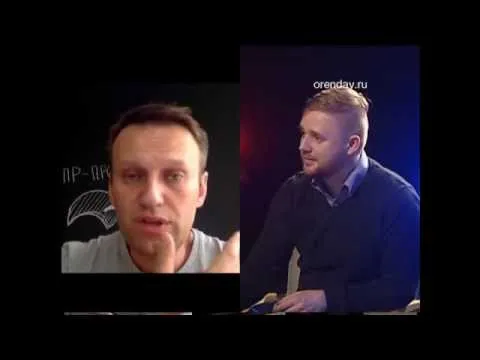
[music]
Good evening, you are watching ONT TV.
This is the program *Echo of the Week*, and today on Skype we will
speak with Alexei Navalny.
Hello.
Alexei, good afternoon. Alexei, basically,
everyone is now starting to talk about the elections.
Some parties are already holding primaries, and
I want to understand how what is commonly called the
"non-systemic opposition" plans to
go into these elections.
Well, first of all, we do not agree with the label
"non-systemic opposition" — we are the real opposition.
There is an opposition that says what
needs to be said, what it believes should be said,
and there are people who conceal the truth
or lie. That is why we are the most genuine
opposition.
And within our coalition, which
was recently created, there are several parties
that are officially registered, and after various
negotiations, we came to the decision that we
will run with a united list on the basis of
the RPR-PARNAS party. Alexei, if
you had your own party — if the Party of
Progress now existed as a
normal legal party — would there still be this
alliance or not? The Party of Progress
does exist; it is just not being granted registration.
Because a party is people, not
a piece of paper. But now they even want to ban you
from calling yourselves a
party. Exactly. Apparently,
that is because they are afraid of our party.
Quite simply, I am the leader of the Party of Progress,
and of course, if it had been
registered, if we had been given that
registration, I would have raised the issue
of us going into the elections specifically on the basis
of the Party of Progress. But I live in
the real world. I am not trying to
pull the blanket over myself, but to act in the interests
of the coalition and in the interests of voters in the
elections that will take place now in
September 2015, and which will also be held
in your region. We
will run on the basis of RPR-PARNAS, and we
have agreed that in the
2016 elections — the State Duma elections — we
will run on the basis of the RPR-PARNAS party. There is
one very important, key thing that I
would like to convey to your viewers.
The main difference of this new
opposition — and I consider it precisely a new opposition —
that is going into the elections is that we form all
our candidate lists through a competitive
procedure. United Russia also holds
primaries — ours took place last week —
United Russia holds them too,
but it is no wonder everyone starts laughing when
United Russia's primaries are mentioned, because
those primaries are structured around a predetermined result.
Those are primaries for people about whom
it is already clear that they are supposed to win. We
are holding real primaries. Alexei, well,
when there were elections to the Opposition Coordination Council, you
won, and that too was
expected. I won because I ran
an election campaign, and I hope that
the candidates who want to become real
candidates for deputy seats will also
run an election campaign, first
among activists,
among those who genuinely support
the activists, and prove that they deserve
to make the list. Then they will get onto
the list, and then we will vote for them
in the actual elections. We
really want — just a second — we simply really
want to move away from the old system where everyone
was appointed from Moscow, and we believe that
the residents of the regions themselves should form
these lists. Alexei, how do you
see the differences in election campaigning
in the regions — and in very different regions,
for example, places like Yekaterinburg on the one hand,
or Orenburg, or
some even more agricultural
region where you may not be as
well known at all?
We are going — we deliberately chose
three completely different regions:
Kaluga Region, which is an industrial
region where in recent years many
have been built —
car plants, because of that; then there is
Kostroma Region, which is absolutely
depressed economically; and Novosibirsk Region,
which serves as a kind of scientific
hub for Russia. The campaigns will be completely
different. And how did you choose them? Why not
Orenburg, for example?
There are no elections to the legislative assembly there, and for us
that is of fundamental importance. The extremely
important elections taking place in your area are
the elections for the Orenburg City Council. We
see that in Orenburg Region — and I am
very glad to be able to say this — United
Russia traditionally gets a low percentage of the vote.
That shows that the voters of
Orenburg Region understand everything about
that party. And I very much hope there will be
real competition in your elections.
I hope that some forces for good, whether in
parties or among independent deputies,
will be able to push back against United Russia. But we
will not be participating in an organized way in
Orenburg Region, unfortunately. Well, at least
RPR-PARNAS will
nominate candidates — RPR-PARNAS candidates
from RPR-PARNAS will run in single-member districts,
certainly. I do not know whether you are aware of this or not,
but here, you know, perhaps it would be
too much of an exaggeration to say that here
RPR-PARNAS has some kind of negative result,
that it has a negative
rating. Well, let us put it this way: it is close
to zero. How much...
Do you think this brand complicates your
campaign going forward, because no matter how you look at it,
these, yes, democrats of the 1990s
— broadly speaking, those associated with RPR
PARNAS — generally provoke in many
people, even those whose views are close to yours,
a certain
allergic reaction. I understand; in fact, that is
one of the reasons why I created my own
party, because I represent
perhaps several people with somewhat different
views, but we created a coalition, and we have
what we have.
An independent party. What you said about
the negative attitude — yes, it existed
yesterday. That is exactly why we all want
to change it. We want
to make the party list, for example in Orenburg,
so that if it appears, it will not be
a list invented by Alexei
Navalny or Mikhail Kasyanov; it will be
a list formed by the people themselves.
There is, after all, a central headquarters that
organizes primaries. If it becomes necessary
to organize such primaries in your region, they
will be organized centrally from
Moscow, but at the same time they will be absolutely
fair, and those taking part in them will be precisely
the residents of the region. And what is the guarantee that
these people will actually make it onto the ballot? Why do you
think they will be registered?
Excellent question. There is no such guarantee. And we
understand that the authorities, of course, will be
inclined to make sure that the strongest
candidates, the ones identified in the course of
the process, are precisely the ones removed from
registration. But nevertheless, we are doing
everything possible. We will appeal to
the voters, we will demand
registration, we will collect signatures honestly and well,
and do everything within our power.
Alexei, does that mean that if
in Orenburg, representatives of RPR-PARNAS
together with this democratic coalition
are registered without any problems, that means
the authorities simply do not see them
as
competitors? I think that
they certainly do see them as competitors, and
every time there were some myths
that they did not view this opposition as
competitors, we successfully
disproved those myths, including in elections in
Moscow. The same thing happened in elections in
Yekaterinburg, Novosibirsk, and so on.
This is not only about me, but about other
politicians as well. And
if they register our list, that
will be a signal that they are afraid not to
register it; if they do not register it,
that too will be a signal that they are afraid.
Register it? Fine. To what extent
do you understand? I know one thing: in the city of
Orenburg there are a great many people
who support electing the mayor, who support
an end to corruption, who support having
a transparent system for housing and utilities management, who support
tax revenues remaining in
the region. Alexei, that is exactly the question:
there are many such people, and they will vote. How much do these
municipal elections in the country, in principle,
matter now? How important is it
to take part in them or not?
Because, by and large, this is the election of
people who will sit on this
city council and will not influence anything,
even more so now in our
region they will not have much influence on the election
of the city head, because he will be
appointed by the governor through a commission. Unfortunately,
you are right in many ways. Indeed,
especially in recent years, the system
of governance has been reduced to the point where
the regions and cities have been stripped of all
powers, all the money has been taken away, and everyone is ordered around by
some men from Moscow or federal
inspectors.
I believe elections must be participated in.
We are going into these elections, in effect, with a
federal political agenda. We
want
to use the mechanisms of legislative
initiative that regional
parliaments have, in order to achieve
the adoption at the federal level of
decisions that would change the system
of taxation, so that money remains in
the regions. We need to make sure that
the regions say this openly. Right now,
paradoxically, the regions are silent. That is,
not officially — behind the scenes they all
complain, “Why is Moscow robbing us?” but
the official position of any region is:
“Please, keep robbing us. Rob us more,”
“we like it.” But what do you mean by “robbing”?
Well, when it comes to taxes, we are one country, after all.
I do not know — say, the same
Kostroma Region is not to blame for the fact that it has no
oil while we do. That is why
Moscow distributes it rationally, doesn’t it?
Moscow distributes it irrationally. Regions
really can never be
completely equal to one another, and
indeed, we are a federal country, and
if somewhere people are extremely poor and
nothing is working out for them, we must
help them. Nevertheless,
there is one absolutely clear fact,
which is that powers
and money should be where those
powers are, where that money is needed. And
if money is earned in a region, it
should remain there. Of course, if you
earn money from oil, then naturally
the share of the mineral extraction tax is high.
We are not saying that in
Orenburg Region all
the money from oil should stay there, but the fact that you are left with only
Or is this...
Are we talking about VAT, which is completely
taken away from the regions? This is an absolutely
wrong and ugly system.
We understand that there are regions that will not
support your position—some provinces
that are, again, not far from
Moscow, the North Caucasus—they will not support it.
Most likely. But you know, this
will be supported by everyone, because it is an incentive
to earn money. Well, please explain
why, right now, in
Orenburg, any mayor or governor
or anyone else, there is any reason to create business. Why
does any of this need to be done? So that
businesses pay VAT, and that VAT goes to
Moscow? No—right now everything is set up
in such a way that Moscow—even though I am a Muscovite,
you understand, I ran for mayor of Moscow,
and I wish this city well—Moscow as a
city, as a federal subject, also—listen, I
remember that at one point you ran with the slogan, 'Stop'
'Stop feeding the Caucasus' (a Russian nationalist political slogan). Now it's 'Stop
feeding Moscow'—am I understanding correctly that you
are going into regional elections with Moscow as
the federal center? Certainly, stop
feeding it. Moscow as a city would benefit greatly
from reform. And you see, right now in our country
right now in the country
there are only seven donor regions. Well, this is
an ugly system. Through an artificial
process, through the plundering of the regions,
things have been arranged so that all the regions are poor. You in
Orenburg Region earn
money, but formally you too are considered
a subsidized region, you understand. Yes, absolutely.
We’re breaking for commercials now, and right after
the break we’ll continue.
[music]
We continue our program. Let me remind you that
we are joined by Alexei Navalny. Alexei,
in the first part you said that you were
pleased that in our most recent
elections, United Russia did not get as
many votes as in other regions. In some
elections—for example, the State Duma elections—it in the
city actually came in second after the Communist Party, but
again, I would point out: after the Communist Party. And those are not
people, so to speak, with liberal views, right?
Or rather, not people, but views close to yours.
Why do you think that some part of that
will come your way?
Listen, this is not something unique to
Orenburg. In Moscow, for example, in those districts
where the technical intelligentsia
is concentrated, people also vote for the Communist Party.
Akademgorodok in Novosibirsk (a major Soviet-era scientific and research district) also
votes for the Communist Party. Why? Because it is
a protest vote, and these people have no one
to vote for. That is exactly why we are now
building a new kind of opposition,
so that you yourselves first decide who this
opposition is, and then support these people
in elections, except...
If they are allowed to run. Still, let’s always say
'if they are allowed to run,' because
frankly, on that score there are
serious
doubts. We must do what we believe
is right. Oh, we seem to be having some connection issues.
Alexei, I hope that now our
internet connection will stabilize. Let’s
try reconnecting. Alexei, can you
hear me now? Yes, good. Yes, excellent.
I hope that now everything will
work properly. So, please repeat once more regarding
your view that there is no need
to be afraid that you will not be allowed to run, that there is no need
to be afraid that we will not be registered.
We understand perfectly well
that this is some decision by Putin or
by some other people, but we must
do what we believe is right. We cannot
make our lives, our
political activity, dependent
on their whims. We have the right to run in
elections, and we will run in these elections. As for
the high level of support for the Communists,
that is protest voting, because there is no
alternative. You correctly said that
the opposition liberal parties,
the democratic parties, performed weakly.
We
need to regroup: vote for any other
party except United Russia. Look at the
current State Duma and look at the laws
that the deputies are passing, many of whom got there
thanks to this
tactic. I knew you would ask that. Well,
indeed, you are absolutely right.
The high results of A Just Russia in
large cities especially are to a great extent
the result of this very strategy, which I
actively promoted and of which I may have been
one of the main drivers.
I believe that at that moment we
were completely right. There was no other strategy
at the time, and there was no party
that was genuinely going to the State Duma on
democratic principles. Unfortunately,
both the Communists and A Just Russia,
and the LDPR, turned out to be far
more timid and compliant than we had hoped.
But surely they are sincerely applauding
Crimea? Surely they are sincerely voting
on Crimea and applauding every decision on it?
Maybe they are voting sincerely, but I
very much doubt that they sincerely
vote for repressive laws
concerning election rules,
rules for holding rallies, the persecution
of non-profit organizations, and so on.
That is, they vote for these things, spout
some nonsense about foreign agents, but
we know they do not believe it themselves. Unfortunately,
well, sadly, I do cooperate with
the Communists too, including, for example, on
issues involving the fight against illicit enrichment.
and so on, but on many political
issues they turned out to be cowards, and we
are confident that, because of this, voters will turn away from them
and give us their votes.
Alexei, let me ask you this, just so we can
understand: you have a sociological
center, right? Well, a center that conducts
relevant research. So when
you started getting results from it, did they
not
discourage you — on the contrary, were they more positive
than what is being published
by the state polling centers? Oh, come on — those results made us happy, on the
one hand. We found nothing new:
Putin's ratings, his formal approval ratings,
really are high. We
are recording the same 84% that FOM (Public Opinion Foundation, a Russian pollster) records.
But this is a rating of loneliness, a rating
that reflects a situation where there is no one else,
where there are no other politicians in the country. But
what interests us much more is not measuring
politicians' ratings. What interests us is
people's attitude toward
corruption. Have you measured any regions
on issues related to
elections? We constantly measure regions; we are
less interested in nationwide figures. We
measure regions. Right now, of course, first and foremost
we are measuring those three regions I
mentioned: Kaluga, Kostroma,
and Novosibirsk. We measure different parts of the
country, and we know — you see, this is why
after creating our sociological service, I
believed even more strongly in the success of our cause,
which is by no means hopeless, because
we know that people are against corruption,
that people are against illicit enrichment,
that people want
elections to be fair.
In one region and in
another, to what extent does the country still
live with the same problems, or
does every place
have its own? Of course, everywhere the top issues are rising
prices, and everywhere housing and utilities services are among the main problems,
and so on. Sometimes there are differences: in some places
the road situation is especially bad,
in others there is some obvious
corrupt official, an openly demonstrative
corrupt mayor or governor — those become
more important issues. Of course, the Urals and Siberia, on
some questions, differ a little from
some other regions,
and so on. But in any regions, both
depressed and
prosperous, basic democratic
ideas — fair elections, direct elections of mayors
and governors, the fight against corruption,
an independent judicial system —
are supported by everyone. So I can say
that regardless of whatever percentages
Putin may have, Putin is in the minority on these
issues against us. He appoints
governors, while we want to elect them, and everyone
is with us on that. I don't know whether you agree
with me or not, but what you listed
— those are basically the main
principles, and in fact the Popular Front
has now adopted them too, in its own way. But still,
they keep talking, talking about corruption and so on.
They say some governors are crooks — well then
excuse me, I have a very simple question
for the Popular Front: your Popular Front
is headed by Putin himself. The anti-corruption front is
headed by me, and I have no
powers. If you are talking
about corruption in public procurement, then
change the public procurement law. I, for example,
have written anti-corruption
amendments to the law, but we cannot get them
adopted. But the Popular Front,
if you'll excuse me, has the majority in the State
Duma (Russia's lower house of parliament), so I appeal to the Popular
Front. I can tell you one thing: don't mess
with our heads. If you declare something, then
do it, because you have the majority, you have
the president, you have
84 percent.
In those regions, Prokhorov either took part then
through his party or personally, and overall, do you
use that result as a benchmark, or
does that result mean nothing to
you? I mean, do you think that
the protest vote was going to A Just Russia, the Communist Party, or
that Prokhorov was also accumulating
what was, in general, potentially
your vote in the presidential election? Prokhorov
Of course.
He did accumulate it, of course. That too is
some kind of benchmark. But for us, Prokhorov's percentages
are still, well,
a somewhat narrow segment. As I already
said, it is a liberal-democratic
electorate, really. Still,
I don't have any major complaints about
Prokhorov, but he is still a rather specific
person: an oligarch who became rich during
the loans-for-shares privatization auctions. Well,
his position on many political issues
was, frankly speaking, not very clear and
quite ambiguous. And now he has
left politics altogether. The reason I brought up
Prokhorov, actually, is because
the alliance you have now
— well, the more links there are, the
less reliable the system is. I hope you
agree with me on that. And we remember
that the fate of Prokhorov's party was
pitiful once, and the second time it was so bad
that we won't even bring it up. Aren't you afraid
that as the election gets closer, there will begin
to be some kind of internal
conflicts within the coalition parties? Their interest is,
naturally, to make their own party
dominate, and so on. So internally
there is always a fairly complicated dialogue going on.
However, I am confident that within our
coalition nothing will fall apart, because
Unlike Prokhorov, we are genuinely
independent parties, that is, independent politicians
who
really are not taking part on Putin's orders
in elections. We are taking part in these
elections because that is what needs to be done, and we
are participating with the platform we
believe in, and that is the most important thing. Of course, this is
the essence of politics: eternal competition between
leaders. No one will ever unite
in such a way that everyone is
friends with everyone else. But within our coalition
of independent politicians, I am sure that we
will act effectively together and
achieve results. Alexei, just so we understand,
you have surely done some analysis
for yourselves already, both on regional legislative assemblies
and on city councils — they are called different things
in different cities — where are you confident that
you have a chance of winning seats on city councils?
And where is the goal simply to take part?
What category of regions does Orenburg fall into?
Orenburg, based simply on your analysis of what is happening there...
As for Orenburg, I won't lie to you, I won't
say that we are working on the elections in
Orenburg — in fact, that is not the case.
And as for the elections there, both for RPR-PARNAS
and for the Progress Party, and for RPR-PARNAS, we
feel... So you are not involved there, we can see that.
That is because, you understand, you cannot embrace
the immeasurable. This single voting day
was invented so that the opposition would have
less room to maneuver. In theory, though, this should come from the grassroots, shouldn't it?
Tell me, why, if you say that there are
your supporters, is there no
mass grassroots movement in cities
like Orenburg, which after all has more than 500,000
people? A mass grassroots movement is absent because
there are no formats for mass political activity.
What kind of mass movement can there be
for the Progress Party if the Progress Party
was not merely barred from the election? It was
officially stripped of its registration. A mass
movement is expressed in the fact that
United Russia is effectively suffering
defeat. Yes, you said that in the city it came in
second place.
Cities like Orenburg are
of course quite promising for
elections.
And it would be worth working on them actively. The fact
that you do not have elections specifically for the
legislative assembly somewhat, well,
frankly speaking, reduces our
country's interest in these elections. But I am sure that in
the city of Orenburg there are interesting
politicians who will run in these elections and
will fight. Alexei, we literally have only
a couple of minutes left, and I have to ask
about the investigations that the Anti-Corruption Foundation
regularly publishes. And
it has to be said that lately
Yakunin has been getting the most attention — well,
except perhaps for Putin's dacha, probably, yes. But
why Yakunin? Why him and not, say, Sechin?
Why him in particular?
We deal with everyone; it's just that Yakunin's corruption,
frankly speaking, is the easiest
to investigate. This man
steals so much and so openly that, well,
we are not the special services, and even for us it is easy
to find these things — his estate, where there is
a gatekeeper's house,
the schemes, his children directly
involved in corruption — all of this
is so obvious that it is easy to show.
That is the first point. Second, Russian Railways (RZD) is
a specific kind of monopoly. These are the people
who cancel commuter trains across the
country, the people who constantly
raise fares and beg for additional
state money. Yakunin himself
is someone who presents
himself not just as some state manager, but as
a politician who is constantly, so to speak,
denouncing consumer society, constantly
denouncing so-called foreign agents,
a label they apply to people like us. We have 30
seconds — yes, we have 30 seconds until the end
of the program. Just so we understand: knowing
how the investigative authorities deal with your cases,
how many court cases have you had
recently? And how many of
your recent investigations
are already being investigated by the Investigative Committee
or by some other bodies? Is there
even one case where you can say
that yes, they took it up? Well, you are asking
a question that sounds like this: is Putin investigating
his own corruption? The answer
is no. He does not want to investigate his
own corruption. That is why we
publish these facts. On every single fact, we
know that sooner or later a criminal case will be opened.
But we cannot
boast of
many formal investigations. Thank you.
Alexei, thank you for joining us. Goodbye.
Thank you.