Alexei Navalny’s Interview with Yevgeny Kiselyov
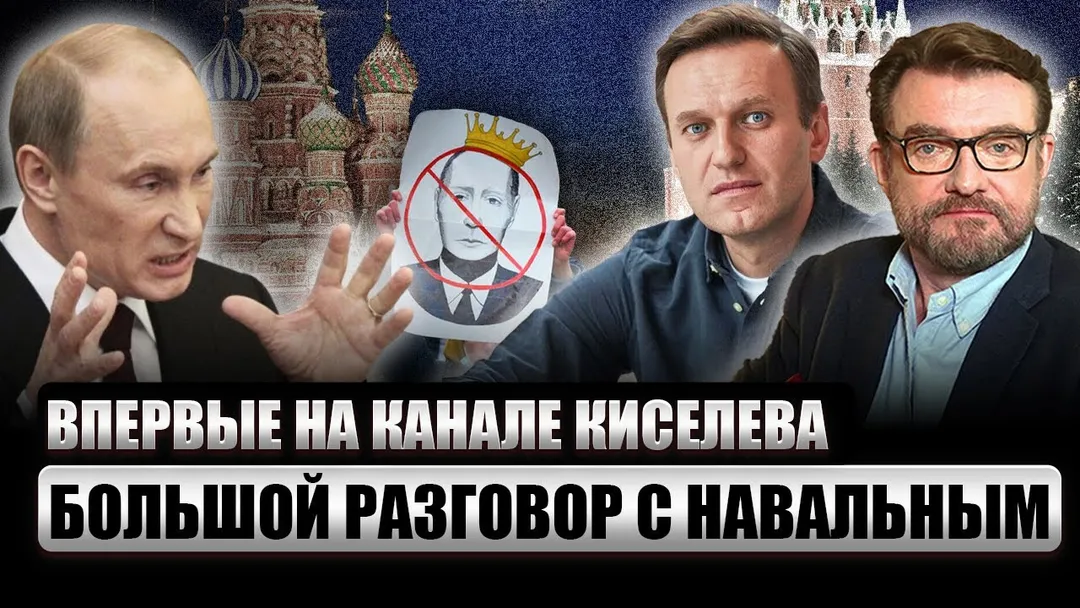
Hello everyone, my name is Yevgeny Kiselyov, and
you are watching my YouTube channel. And now I
want to show you a video recorded back in
the now distant year 2012, which, in my view,
is still very interesting today, and not
only because it includes my
interview—a long interview—with Alexei
Navalny, I think one of the very few, if not
the only such extensive interview
that ever appeared in
the Ukrainian media, and which I do not think was
republished in the Russian mass media.
Well, the thing is that 12
years ago—slightly more than that—in February
2012, a significant part of the Ukrainian
public was, in fact, not very
interested in Russia, and even many
Ukrainian politicians, deeply immersed in
their own country’s domestic problems,
would sometimes, with a certain
irritation—or let us say with
irritated incomprehension—say to me:
“Why is it, Yevgeny, that you keep talking about
Russia?”
is nostalgic
for life outside Russia.
And then, in late 2011 and early 2012,
when mass protests suddenly flared up in Moscow
against
election rigging, which soon
grew into rallies and demonstrations
against Putin’s regime, against
the then already announced return
of Putin to the post of President
of Russia—and it must be said that the Putin
regime at that time was still very different; by
today’s standards, it was almost mild.
What really worried me then, in fact,
was something else: what would happen to Russia if
the opposition forces suffered
defeat. It was clear to me, and I considered it
my duty to convey to the Ukrainian
audience as well that if the protests fizzled out
and a period of reaction set in, this would
inevitably lead, in both Putin’s domestic and
foreign policy, to repression
against the opposition in Russia and to aggression
against Ukraine—an even worse aggression than what had already
happened in 2008 with regard to
Georgia, Russia’s neighboring country. And it was
obvious to me that Putin viewed Ukraine
as a threat, as a source of democratic and pro-Western
sentiments that were dangerous to him,
as a dangerous example of how
a country can live under conditions of
political competition, rotation of power,
genuine electoral struggle,
a strong opposition represented in
parliament, relative freedom of the press,
and an active civil
society. Alas, my fears and concerns at the time
came true: in Russia, the opposition was
crushed, Navalny
ended up
in 2022 turned into a bloody
full-scale war. But back then, in 2012,
political life in Russia seemed
bright and full of hope, and this
is, by the way, very clearly felt in
the detailed report from Moscow that
appeared then in an episode of my program,
which I hosted on the Ukrainian TV channel
Inter, called Big Politics. And in
this report, which precedes the
interview with Navalny, then a bright
rising star of the Russian opposition,
those moods, it seems to me, are very
clearly conveyed. By the way, I am deliberately
not translating the voice-over text
of the correspondent from Ukrainian into Russian
in order to preserve that sense
of a journalist’s outside perspective on
the events in Moscow at the time. I am sure that
my audie
will understand everything even without
translation. Before showing you this
video, which includes, I repeat, a long
interview with the late Alexei Navalny, I
would ask you, please, to give this
video a like so that as many people as possible
can see all of this.
Ask questions, leave
comments, and of course
subscribe to my channel and keep watching.
It all happened, seemingly, only quite
[music]
recently. We are back on the air, live
on the Inter TV channel. This is
the program Big Politics, and I am its
host, Yevgeny Kiselyov. Now let us talk,
as promised, about events in neighboring
Russia, where the day of the
presidential election on March 4 is drawing ever closer. Last
Saturday, everyone was waiting for an answer to the question
of whether the opposition would once again manage to hold
a mass rally of its supporters
despite the bitter cold. We now
know the answer: it did. And not only
the opposition—this time, a mass rally
was also held by supporters of Prime Minister Putin,
the leading favorite in the upcoming election.
All the details are in the report by our
special
[music]
correspondent.
A clip on this subject is now being actively
discussed online: a video from a Krasnoyarsk
TV channel in which, in a single slip of the tongue,
the presenter, speaking about Vladimir
Putin, apparently meant Vladimir
Lenin. The mistake was not cut out, and the video of the blunder
became a hit across the global web. Users
began seriously joking about the prime minister’s funeral.
The political season had only just recently begun with an appeal.
With “Putin, go away” on a banner, Russians came out of
the internet and into the streets. They climbed onto a roof and hung up
such a banner, decorating a building opposite
the Kremlin. The less time remained until the presidential
election, the stronger the protests became. Russians began
to speak not only about fair upcoming elections
but also about a radical change to Russia’s
political system. “I’m sick of it, honestly. I
used to support this, this government, but now
I’m against it. I’ve had enough.” Russians began protesting
first on the internet, on social media
at first simply sharing their thoughts.
Then they started discussing things and organizing themselves.
Until recently, politically active Russians
included many ярких personalities, some of whom
became leaders of the new movement. For example,
Tikhon Dzyadko, a young and popular TV
and radio host, is also a moderator
of one of the protest groups. “I am one
of the moderators of a Facebook group called
‘We Were at Bolotnaya, We Will Come Again’
and another group that was created to inform people
through which
people about
where rallies would take place, how these rallies would
be held, whether they were authorized or not authorized.
That is very important. It seems to me
that in this whole current Russian story
this movement is absolutely
independent and non-political, but at
the same time, despite those first
two points, it is also
political in the sense that the demands
these people are making and what they
want are absolutely concrete things.”
The main demand remains fair elections.
Political analysts, however, are skeptical about the chances of preventing
Vladimir Putin’s victory on March 4. There is no
real alternative to him, which will help him in particular.
There is no alternative on the ballot. People are used to going
to elections and choosing someone, and therefore
we need to explain that this is a puppet and this is
a puppet theater, and in order to be
confident about the future, we need to say clearly
to ourselves, to the electorate, to the people at polling stations: this is all
nonsense.” The main political sparring
partner for now
is Mikhail Prokhorov, though not everyone takes him seriously enough.
Be that as it may, political analysts do not
rule out that Prokhorov could
end up facing Putin in a second round.
Although his rating in current polls
is not always higher than Zyuganov’s or
Zhirinovsky’s, later the businessman
may still find himself in the second
round.
“By means of falsification on any scale,
to secure a mandate for Putin,
a presidential mandate in the very first round,
the greater these falsifications are, the
greater the political damage that will be done
to Putin. In this case, he is working directly
against himself and directly against his own
political future.” The League of Voters, which includes
Parkhomenko along with
other well-known figures such as Parfyonov
and Akunin, decided to push for the upcoming
elections to be fair. The League appealed to all
candidates with a request to grant permission for
monitoring the voting. Under Russian
law, an observer at a polling station may be
a media representative or a citizen who
has received such a right, that is, a mandate from
a candidate or the party that nominated him. Putin’s campaign headquarters
have not yet given such consent. “These are
not elections on March 4, especially if they are held in
just one round. They will only further intensify
citizens’ protest activity, and that is very
important. This means that
the regime will, so to speak, lose not so much
its legitimacy—it will lose that already on March 4—but rather
the speed at which this model’s degradation
of the Putin system, as I call it,
‘capitalism for friends,’ the speed
of that degradation will increase with every
day.” The first action organized through
social networks this year, the White Circle, also
became a preview of the future
protest at Bolotnaya Square. It was a spontaneous
car flash mob, when cars with white
ribbons or simply
white symbols of the Russian protest movement completely
formed a white circle around the Garden Ring (a major circular avenue in Moscow).
Law enforcement reported hundreds of cars, although it was not
hard to calculate that in fact there were
more. To fill the Garden Ring in
two lanes, taking into account the average length
of a car and the distance between them, about 4,000
cars would be needed. “When I was standing on the Garden
Ring, my car was all dressed up
with white ribbons, and all around there were also
many, many decorated cars with white
symbols, and from someone’s window there was playing
a remix of a speech by Alexei Navalny
from a rally, and then I remembered Kyiv, and there was
the same feeling of joy and euphoria as
during the Orange Revolution,” said journalist
Anastasia Karimova, who not only took part
in
the car rally. “To throw yourself at the embrasure there
or stand for several hours
out in the freezing cold—of course people are unhappy
with the situation in the country, but they are still
hesitating. Still, it is worth showing that it is not
too cold, that it is not scary, that one needs
to endure a little and stand up for one’s rights.”
And as it turned out, there was a rally in freezing Moscow.
At the same time, a rally for
fair elections was planned for tomorrow on
Sakharov Avenue. Those calling people to Sakharov Avenue were the so-called
"real democrats," as they call themselves.
Supporters of Valeria Novodvorskaya and
Konstantin Borovoy were marching separately because
they explained that they did not want to protest alongside
nationalists and representatives of left-wing forces.
Vladimir Zhirinovsky also decided to hold his own protest rally.
Zhirinovsky's supporters began gathering there.
The only thing that could have affected turnout, the authorities said, was
the weather. So on Saturday morning,
as they prepared for the February 4 protests, Muscovites
were figuring out as best they could
how to dress. The rally on Poklonnaya Hill (a memorial park in Moscow) resembled
a public festival. The main thought seemed to be:
if not Putin—"If there is no Putin, there is no Russia."
"Putin is a strong leader." Those who came said
they were not so much for him as against the "orange plague" (a reference to pro-Western "color revolutions").
It seemed strange that among the rally's speakers
there were no leaders of the right-wing parties. From the stage they spoke about
a secret
conspiracy, moving on
to those who want to say yes to fair elections.
Nera
On the eve of the event, unpleasant details surfaced.
Reports said that some of the people at Poklonnaya were being
bused in. The editorial offices of several
newspapers and TV channels received phone calls from employees of state
institutions saying they were being forced to protest in support of the authorities
so as not to lose their jobs. And on the main
website where extras were being recruited, one could even
find ads offering payment to those who came.
People I cannot help but trust have already told me about it.
These were private conversations—about how
they were forced to go there, what
they were threatened with if they refused, as at
Rosneft and elsewhere, from various
sources. I already know this. And later
messages started pouring in about dissatisfied participants
from Poklonnaya who had not been paid for taking part in
the rally. The ruling party believes that after Poklonnaya
the protest movement will fade away, especially since its
organizers are also facing a fine because
they filed an application for 15,000 participants, but
nearly ten times as many showed up.
According to Interior Ministry data, that many people came. I think
no one expected it. It is absolutely obvious
that people simply came to express their
position. For me, it is very important. As for
the matter of
fines, let the organizers not worry.
I am ready
to do my part and partially
share responsibility with them before
the law. When the rally on Poklonnaya was already
drawing to a close, Bolotnaya 2 was gathering
momentum. They had been at Chistye Prudy, Bolotnaya
Square, and Sakharov Avenue, and promised
to return a month before the presidential
election. Despite the frost, Russia was once again
protesting.
We're not sitting at home. — And how will you keep warm
today for several
hours?
[music]
And the hearts are demanding the same as before: fair
presidential elections and a rerun of the State Duma elections,
the dismissal and prosecution of Central Election Commission head
Vladimir Churov. One hundred people is one thing; when 200,000 come out,
it becomes rather difficult not to
hear them. We cannot say that we are complaining about
anything in particular. Overall, we live fairly well,
but we are angered by the fact that no one listens to us, that we
vote and yet no one takes it into account. So, basically,
we are going to express our
dissatisfaction. The only presidential candidate
who took part in the march was Mikhail
Prokhorov. He marched in a separate column with his
supporters. I will make sure that the authorities
finally turn to our citizens
with their face, not some other part of the body. I will make sure that
our country becomes the best place
to live, a place where people want to tie the future
of their children. At Bolotnaya, they
would come for a while and then leave
the square, saying: but people are not going around in circles for nothing.
No ideology can draw people out for several hours in
subzero temperatures, when for the third time, even in
the frost, when steam is coming from their mouths, people
come, gather, and are ready to defend
their rights, and above all the right to
free elections. I think the authorities
must hear this, otherwise such a government
will simply be overthrown. Unfortunately, there is no other
option. In terms of reason and
justice, of course, it would have been necessary
to postpone the March 4 election.
Right now, I am not sure that
it will be possible to do that, because the momentum
was lost after December, unfortunately.
So the election will most likely go ahead. But
even if Putin wins, it will
be what is called a Pyrrhic victory.
Another feature of the Russian elections was the split
among public figures into two camps: supporters
of Vladimir Putin and his opponents. Among the latter
were even
I will vote for the person who
specifically helped not only me, but
many people, helped culture, to which
I myself belong. And it is easy for me to do this.
I have seen for myself that this is
a person who keeps
his word.
Our task is to break this system,
to dismantle the system that does not allow
people to exercise their
constitutional rights. The system,
political analysts continue, was created
for one specific person. That was the case in the days of
Peter, Alexander, Alexander I, therefore one of the
possible paths for the Russian opposition
is to demand changes to the constitution, for example such as
depriving the president of the right to partisan
political play, limiting him exclusively to the role of guarantor of state law
to form the government, with the right to send the Cabinet into resignation in
the event of a vote of no confidence from parliament. Vladimir Pun-
feels what is being demanded of him and sees what
is happening in the streets.
Political analyst Andrei Okara shared his impressions in
a meeting with the mayor, to which he and his
colleagues were invited. It personally seems to me that he is precisely
lately in a very serious search
and, well, I have a feeling that he
really wants what is best for Russia and very
sincerely
wants it. Well, maybe not in the same way as the people
who come out to Bolotnaya Square (a major protest site in Moscow) or
to Akademik Sakharov Avenue, what Putin himself
has become accustomed to.
But it seems to me this is a very
small, domesticated bird in the hand, and probably this is
still better than if it did not exist at all.
And so, for now, in the near-term prospects
in the immediate future, the positions are as follows:
citizens can try to influence
the fairness of the elections, though, political analysts remind us, it is worth remembering
that the authorities' trump card is
the administrative resource. A signal of that
was the rally on Poklonnaya Hill (a large memorial park in Moscow), though not fully. How this
will affect those who were against it—and it cannot be ruled out
that they will not want to
vote. One of the strategies identified is
not to give a single vote to Putin and to sign up as
an observer. Besides signing up as an observer, I
am calling on people at 8 p.m. on March 4
to come to every territorial polling station in their
district, to come there and organize themselves
through the internet, through social networks, and
wait until they bring out to you, for observers,
a copy of the protocol so that it is possible
to record and conduct a parallel vote count.
The strength of ordinary citizens is simply very
important, very important.
They stress the need to be ready for popular
[music]
mobilization. I was there on December 10, I was there on the 24th of
December. Here I am today, and I will go on until
the very end. Come out.
threat
Well, in principle, Khimki Forest (a forest near Moscow that became a symbol of civic protest) was
also a reason to talk about
freedom, about
the rule of law, about some kind of equality for everyone
before the law, both ordinary citizens and not-so-ordinary ones.
Right now, 100,000 have already come.
Tomorrow—we'll live and see. But the main thing is that
people have started thinking about their sense of
dignity.
This is
[music]
As for the 'orange plague,' as they called the possible
revolution, on Poklonnaya most likely
it will not happen, because, as political analysts say, today
psychologically people are not ready to live in the streets.
At the same time, they remind us: even 100,000
people at a rally in freezing weather is no small thing.
Kira Tolstyakova, Andrei Onoprienko
Big Politics, Russia
[music]
Moscow. And now joining us live as our guest
from a television studio in Moscow is one of
the most prominent Russian politicians
of today, Alexei Navalny
Alexei Anatolyevich, I
greet you.
Good
evening. Today, without exaggeration, you are the idol of
hundreds of
thousands
Russian visitors to your blog on
the internet and other
online platforms; crowds greet you
at Moscow opposition rallies.
Tell me,
please, will you ever
run for president
of Russia? Alexei: I think that, first of all, I am
being praised far too much. Of course, that kind of
level of flattery can only be heard at
a United Russia congress in relation to
Vladimir Putin. Our task now
is to achieve free elections so that all those
who want to, and those who have the
opportunity, can compete for the post of president,
can compete for seats in the State Duma (the lower house of Russia's parliament).
Once we achieve real elections, I will definitely take
part in those elections and will fight
for a leading position. Well, I don't want to flatter you
either, but in fact I was at
Akademik Sakharov Avenue and I remember very
well that when you came out on stage,
the square roared in a way it had not roared
in greeting for any of the other
speakers. That is a fact of your popularity.
I think that in my person they were not so much
supporting me as protesting
against some of those figures
whom I investigate in my
anti-corruption investigations. Rather,
they were greeting not me, but expressing their
outrage at corruption. Still, who do you
consider yourself more now:
a politician, or still, well,
an internet anti-corruption fighter?
Well, corruption is the real
power vertical; it is the mechanism by
which Vladimir Putin and his
inner circle have simply built
the political system in Russia. Therefore,
naturally, there is no need to be coy, and we
all understand that a person who
is engaged in fighting corruption is engaged in
political struggle in Russia. Therefore
these concepts are inseparable now. And to what
extent are you involved in organizing
protest actions no longer on
the internet, but in the streets and squares?
Moscow. Well, the thing is that
we really do have various
organizing committees and working groups that are supposedly
engaged in organizing
the protest movement, but it seems to me
the truth is that
no one is organizing the protest movement
at all — it exists on its own
prote
It was organized by Vladimir Putin. Vladimir
Putin, by rigging
the elections, brought hundreds of thousands of people into the streets
of Russian cities. So this is simply
a wave of protest. Some people have
been lucky enough to find themselves on the crest of this
wave, myself included, but this protest
is controlled by no one, no one
is organizing it, no one
is directing it. Sometimes I have to read online
comments from ordinary
participants
in rallies in Moscow and other cities
across Russia saying, essentially, that they do not like politicians
and do not want to deal with politics at all
they are coming out to protest violations
in the elections, against
the ignoring of their opinion, against the fact
that the people in power take us for fools. And
then there are people trying to use our
shoulders to break into power, fighting for
their own place in the sun. Don’t you think
they mean you as well?
Well, perhaps. To our great
regret, the period of the 1990s and
the politicians of the 1990s, whom you also
had the chance to observe,
produced a general kind of idiosyncratic aversion to
politics, to political figures
— people do not trust them. And for many years in
Russia, politics was replaced by
political technology (media and campaign manipulation). Everything was built on
bribery, deception, paid-for
news reports, and so on. People are deeply
tired. They are tired of seeing the same
people be communists and Komsomol members (Soviet Communist youth league) today,
democrats tomorrow, and Putin loyalists the day after
today they are embracing the American
ambassador, tomorrow they are shouting about
an American conspiracy, and so on. People
are genuinely sick of it. So
it is a paradoxical situation. Yes, people here
support free elections and come out
to political rallies, but they do not
support any particular
politicians. Right now there are no such
political idols. That trust can
be earned, regained, only in one
way: do not lie and do not steal. You need
simply to prove to people, to explain that
that time, the 1990s, is gone. Those people are gone.
A new time has come — a time, if you like,
perhaps this sounds naive, of a new
sincerity. But there is nothing else, no
other real proof besides
our words and our actual deeds that we
can offer. Now look, Alee
Anatolyevich, you
said, or
rather, what do you mean? For example,
let me ask about democratic
politicians, opposition democratic
politicians
who were very well known, famous
whose stars rose precisely in
the 1990s. Today they are standing beside you
on the stage at these opposition
rallies
of protest. But many say that these people
such as Boris Nemtsov, Vladimir Ryzhkov, Mikhail
Kasyanov
have been compromised forever. So
how do you view that?
Well, I do not think that Boris Nemtsov,
Vladimir Ryzhkov, or Mikhail Kasyanov
need any protection from me
or any legal-defense
services. First of all, people change, and
the mistakes that all of us have made need to be
acknowledged, they need to be
and I am sure that democratic leaders
who did something wrong or, well,
perhaps did not behave entirely properly
some years ago, can now
quite effectively and normally
participate sincerely and honestly in the new
political situation. This is a normal
political process: some people lose
trust, some gain it. Right now I
enjoy a certain degree of political
trust. It is entirely possible that I may
lose it if I am not honest with the
people I am addressing, and
if I descend into some kind of petty politicking
instead of doing concrete work
That is normal. One should
take it philosophically. There are always
politicians who are loved and politicians who are not
ratings rise, fall, and change. I
am absolutely certain that any person,
even if they have been on the
political stage for quite a long time, and even if people
have grown somewhat tired of them, can
win back sincere trust and affection
We know such examples from history. We
remember how Churchill returned to politics,
how de Gaulle returned to politics. Well,
let us talk, after all, about
Russia. Tell me, how does the situation
that existed in December differ from the situation
that is taking shape now? Do you not
feel that the slogans are changing, that
if in December people were demanding a recount
of the votes in Reutov (a town near Moscow)
and fair elections, then today, after all, what
is coming to the forefront is the demand that
Putin
step down. Absolutely right, that seems to me
a fairly natural development of
what is happening, of what came out of
December. On December 5, we took to the streets
in order to say the obvious: these were not
elections, and we do not recognize them as elections.
There was an enormous amount of
fraud; it is simply obvious. The internet
is full of videos showing how
chairs of election commissions
simply put check marks down themselves. Neither
procedurally nor in substance was this
an election, and we came out to say that we
demand new elections. These were not
anti-Putin rallies; they were rallies and
protests for fair elections. There were
mass demonstrations, the largest
mass demonstrations that we had not
seen for many, many years in
Russia; in Moscow in particular there was
a resolution—the biggest in 20 years. Absolutely right, there was
a resolution. It seems to me it was quite clear,
quite simple, with specific
demands. They were:
first, a review of the election results; the resignation of the head
of the Central Election Commission; bringing to
justice those who took part in
the falsification; and holding new elections.
Political reform as well—fairly clear and
straightforward demands. They were addressed to
the authorities, and the authorities are ignoring them. On the one
hand, we can see that they are very afraid.
They are making various chaotic
moves now, setting up their own
counter-initiatives, various support groups.
They are trying at times to curry favor with
the protesters, and at other times accuse them of
being hirelings of foreign intelligence services, and so
on. In other words, the authorities are deeply
concerned about this, but they are not
going to fulfill a single
demand. And the authorities are not some
abstract thing; we understand that
the organizer of the falsification was
a specific person. His name is Vladimir
Putin. He is doing this in order to
preserve autocratic rule in the country.
And this autocratic power in the country he
uses for one simple thing:
corruption. That is, he is simply looting
Russia's wealth. That is precisely why the rhetoric
of the moment is becoming the slogan: down with
autocracy, as in 1917.
Exactly right: the slogan of the moment is
the slogan 'Down with autocracy.' We want
a president, a lawfully elected president,
not an autocrat, not a tsar, or some
person who wants to be a lifelong
national leader, and so on. We
want a government that we may not
love, but do respect and recognize. Vladimir
Putin is not a person who can be
recognized as the president of the Russian
Federation simply because he makes himself
president by means of
falsification. All right, nevertheless he
is running in this election, and judging by
everything, he will not withdraw his candidacy. On March 4
he will be on the ballot
alongside four other
candidates: Zyuganov, Zhirinovsky,
Mironov, and billionaire Mikhail
Prokhorov. There were major arguments before
the parliamentary elections on December 4 about how
opposition supporters should vote. You
remember, yes? Some proposed spoiling
the ballots, since there was no 'against
all' option; some proposed boycotting
the election; some proposed listening to
your point of view and voting for
any candidate
against the United Russia party. Sorry,
for any party, but not for the United
Russia party. What now, what
advice are you now giving your supporters?
How should they conduct themselves on March 4?
Indeed, our official
slogan and the main strategy that
prevailed, it seems to me, in the end,
was: vote for any party against
the party of crooks and thieves, United
Russia. I think that this time the concept
will be similar. Of course, the slogan 'I vote for
anyone against Putin' sounds a little
less energetic than
'I vote for anyone against United Russia,'
because here, after all, we are talking about
four specific people rather than entire
parties, which are still some kind of
conglomerates and communities. Nevertheless,
we must understand a very simple
thing—indeed, several very simple things. First, that
what is taking place
is not an election; it is a procedure,
an event as a result of which Putin will re-
appoint himself president and Russian
autocrat. Second, we must
use this event to
put maximum pressure on the authorities and
create maximum stress, because in the end we
must create such a level of pressure
that the authorities will finally announce
honest, free elections. And third,
the most effective strategy
pressure on the authorities during the elections, the main point
for a candidate running against Vladimir Putin, because
this would be a vote specifically
against Vladimir Putin, and not for
Zhirinovsky, not for Zyuganov, and not for
Prokhorov. But as for the idea of putting check marks
in all four
boxes at once and thereby making the ballot
invalid, a great many people are suggesting
doing that.
I categorically do not like that approach
because there is no
unifying idea in it.
You see, the call to vote for anyone
against Putin quite obviously
unites the supporters and activists of
Zyuganov, Prokhorov, Mironov, and
Zhirinovsky. A call to vote
to effectively spoil the ballot is
divisive. Spending a lot of time in
debates with Zyuganov’s supporters—I do not
see the point. Right now I have no
disagreements with Zyuganov. Zyuganov is a man
who is running against Putin. He
should receive as many votes as
people cast for him. I have no problem with Zyuganov
and no dispute with him. Our dispute is with Putin
over the fact that we want fair
elections. That means we need to vote against
Putin in order to achieve fair elections.
Alexei Anatolyevich is here in the studio of our
program Big Politics. Present here are
my colleagues, well-known Ukrainian
journalists. I would like to give them
the opportunity to ask you the questions
that interest them. Please, the first question
from the political commentator of the popular
Ukrainian weekly Kommersant
Irina
Solomko. Correspondent—I just wanted
to clarify: weekly magazine Correspondent. But I actually have
two questions for you. And
the first one is, let’s say, tactical.
Right now, you were saying that
elections are coming, and we all know perfectly well that
it has already become known that Mr. Yavlinsky
was indeed not registered. What interests me is
why you are not protesting against this
now, because essentially, well, I
heard what you said—that you
hope that through pressure you can somehow
force Putin to do something,
but I personally do not believe that. Putin
is definitely not such a simple man that
some rallies or something else could
make him do anything, yes, at all.
So why is it that at this stage you are somehow
losing this tactical struggle,
in my opinion? And the second question, after all:
Yevgeny Alexeyevich has already asked you
about your ambitions and plans. But
certainly, I think, especially after
the cover of Time—well, the article in Time, you
have certainly seen it—where you are
called Russia’s hope, that is, a great deal
of expectation is being placed on you, in
particular by the international community.
Everyone understands that your ambitions are
presidential, at the very least, and
at least in the wider world you are seen
as someone who could lead
Russia, probably, in some other
direction now, set it on a different course.
In that connection, I would still like
you to state your broader plans clearly
—your long-term plans—and in that context,
I understand, I value very much, and I think that you
have done a great deal as a blogger, yes,
who fights corruption, but that is
not enough to go on to lead a country.
You need, at a minimum, a team; you need
to have a program. In that context, are you
doing any groundwork, because
as the Orange Revolution showed,
the main problem of the Orange camp was that
they came to power unprepared for that
power. Are you now preparing
to take that power and do something
for the country? Thank you.
Thank you very much. So, first,
regarding Yavlinsky, you are completely wrong,
because the organizing committee for the
rallies adopted a special resolution
in which we demanded that
Yavlinsky be reinstated in the election. When the decision was made
that all
presidential candidates would be invited to speak at
the rally that took place
quite recently, on February 4,
we considered Yavlinsky a candidate and
invited him, even though by that point he had already
been removed. More than that, there was a special
separate resolution and a vote at
the rally regarding Yavlinsky, and everyone
gathered there unanimously stated
that they categorically protested against
his removal and demanded his
reinstatement. So in that sense,
our task, our position, is absolutely
consistent.
Second, as for plans, ambitions, and so
on—well, you understand, it is not articles in
Time magazine that make a person a more
or less significant politician;
that is a matter of PR and publicity.
Today someone gets 15 minutes of fame, yes.
I’m probably going through that right now, including in the sense that
way. So when you ask me these
questions, the situation is such that I have
become relatively popular among other
Russian opposition politicians. This
should be taken philosophically. So,
I’m being completely sincere, and when you
ask me about our strategic
plans, and specifically my strategic
plans, I say quite plainly that our
main strategic plan is
to achieve free elections, because we can
talk about this endlessly here
and discuss how we need to create
a program, a team, and so on. As you rightly
noted, Putin is not a simple man, and we
are still very far from
even being able to take part
in elections. Right now, perhaps some magazine is writing something about me,
but the opportunity
to appear on television exists for me
only on Ukrainian television. On
Russian television, I am still
completely banned
as a person.
SBO
the Orange Revolution, and opposition
politicians, at least foreign ones, can you
show them? You know, we can show
Ukrainian opposition politicians.
I’m sorry, we’ll now
take a break and continue our conversation in
the next part of our program. In it, we
will also touch on one more
topic: the ban on imports of Ukrainian cheese into
Russia. After talks by the minister of
agricultural policy, Mykola Prysyazhnyuk, in Moscow,
the fate of one of the important items of
Ukrainian exports still remains to be
fought for. We’ll discuss this with the
minister himself in the final hour of our
[music]
program. This is an edition of the program Big
Politics on the Inter TV channel. Let me remind you
that today our guest is the well-known
Russian opposition politician Alexei
Navalny. Alexei Anatolyevich is currently
in a television studio in
the Russian capital, live on air with
us, let me remind you.
At the moment, my colleagues, Ukrainian journalists
present in our studio, are asking him
their questions. Next question, please.
Dmytro Lytvyn, columnist for the website
Revisor. I would like to clarify something regarding
the level of pressure on the authorities and the Orange
Revolution, which was mentioned here in
different parts of this conversation with Mr.
Navalny. Will there be, in Moscow, as in
proper revolutionary cities,
any tent camps or
anything similar, which I think would more effectively
convince Vladimir Putin that he is
wrong, rather than just Muscovites coming out
to the square on a day off with slogans?
Well, I can’t speak about any
specific plans, because first of all,
they are, after all,
worked out by a group of people, not
just by me. Second, as I already said,
the protest is organizing itself; it is a wave.
And the people who are part of the organizing committee are, in
a certain sense, simply riding the crest
of that wave. But indeed, we are seeing
a situation in which
the protest is growing and
the confrontation is intensifying. Fortunately, it
is not turning into any violent forms,
but we do see that the number of people
is increasing, the rhetoric is becoming ever more
aggressive, and the actions are changing shape,
becoming more and more inventive,
taking on various sophisticated forms. I
do not rule out that a moment may come
when those gathered will go out into the streets and
refuse to disperse. At the same time, I should immediately
add that the model
of the Orange Revolution and Maidan (the protest movement centered on Kyiv’s Independence Square) in the
sense in which it existed in Kyiv is not very
applicable in Russia now for a number of entirely objective
reasons. Nevertheless,
some such incidents, when
people gathered refuse to disperse,
are possible. And what are those reasons, Alexei
Anatolyevich? Because when I was
recently in Moscow, just this past
Wednesday, I was invited to speak
in a discussion on the possibility of an
Orange Revolution in Russia on
the popular radio station Echo of Moscow, and
there one of my opponents, a deputy of the
State Duma, the new
State Duma elected as a result of
those very elections against
whose conduct, with so many violations,
the opposition is protesting—Sergei Zheleznyak—
said: we know everything, we know that
tents are already being purchased in large
quantities in order to stage in
Moscow a Maidan similar to Kyiv’s. Why
do you think a Maidan is impossible? What
kind of
reasons are these? Well, there are some
obvious political differences here. Maidan
happened—correct me if I’m wrong, I’m
not the greatest expert and I can’t
say that I know Ukrainian
politics and how all of this was organized
but some differences are obvious
first of all, the Maidan and the Orange
Revolution took place after the presidential
election, when there was, after all, a leader, there was
an opposition leader, and this opposition leader, in
the eyes of the protesters, had won the elec-
tion. The victory was stolen, and it was clear that
they were protesting in order to reclaim
their victory—namely, so that their leader would become
president of Ukraine. Right now, in
Russia, the protesters have no obvious leader
No, there was no presidential election; all
the opposition leaders were simply not allowed
to take part in the election, so there is neither
a unifying force nor
[applause]
a presidential candidate; they are fighting for fair
elections. That is a fundamental difference. There are
fundamental differences, and there, in
Ukraine’s political system at the time,
there was at least one independent
TV studio, and there was a substantial number of
opposition deputies who stood shoulder to shoulder
around the Maidan (Kyiv’s central protest square); there was
as I understand it, a fairly
loyal attitude from the Kyiv city administration
which, let’s say, issued
permits and, so to speak, made it easier to build
all of that infrastructure. In Moscow, we
have a completely different situation.
Permission for even the simplest rally has to be
literally clawed out, and
obtained only through pressure and threats; we get
permission to hold marches
and rallies only because everyone knows that
people will come out anyway, even without any permission,
and then it really could very
quickly turn violent. So that is
the only reason why we
get these permits. So it seems to me
that the situation is very
different, and no direct analogies,
especially no tactical analogies, between
Moscow and Kyiv, can be drawn.
Alexei Anatolyevich, here is my question. I
have one here. All right, first of all,
you said
that it may happen that one day
people will come out into the square and will not want
to disperse. In that case, is it possible
that force would be used? If events follow
that scenario, then against people who
do not want to leave, would
force be used? That cannot be ruled out entirely,
but nevertheless I think the likelihood of
that is not very high, primarily
because, as I said at the beginning of our
conversation, the main purpose of these
people being in power is that
they are simply enriching themselves. They have
bank accounts in Switzerland, they live
luxurious lives, and they understand that
an escalation of the political situation in
Moscow and in Russia, and the use of violence
against protesters, would simply
drastically devalue their assets in the West.
And when our crooks, our Russian
homegrown ones, are lounging somewhere in
Belgravia in London and living there
a life of luxury, riding on yachts and moving
in high society, that is one
situation. But when those same people have
blood on their hands, and everyone knows that they
were involved in suppressing the opposition and in
violence, I think it is unlikely that they will be
guaranteed such a chic, luxurious, and
carefree life in Britain or on the
southern coast
of France. And tell me,
please, let us imagine that your
slogan, “vote for any candidate except
Putin,” is heard, and one of these
candidates receives a very serious
percentage of the vote. For example, the very same
Communist leader Gennady Zyuganov, and
a runoff situation arises, and it is entirely
possible that in the second round Gennady
Zyuganov could count on victory
because he could consolidate the entire
protest electorate. What
then? There is no problem with that. He will become
president. The person who should become president is the one whom
the people choose. Nothing terrible would
happen. You saw this in your own
country: Yushchenko was elected, and after
some time the voters became disappointed,
and brought Yanukovych back. Nothing
so terrible happens. Yes, there are
certain political excesses, but
this is a normal process: they choose one person,
become disappointed in him, and choose another.
I believe it is Russia’s tragedy that in
1996
Yeltsin was elected through obvious falsifications.
We should have gone through
what all
Eastern European countries went through, when
after the romantic
revolutions of the late 1980s and early
1990s, there was a reaction, and
socialists and communists came to power; then they
were voted out again after some time, and
that political
pendulum began to swing. There is nothing страшного in
the fact that Zyuganov, for example, or anyone else
someone else will become president, president
No. If this person is actually
elected, he will form a coalition
government, because obviously he
will not have enough support
to control the entire Duma (the lower house of Russia’s parliament); he will
work under conditions of significant
pressure from the mass media,
from liberal
democratic forces, and so on.
That is normal: there will be a president who
fends off the opposition and carries out
some of his duties. Uh-huh, good.
Please, I would like once again to give the floor
to my Ukrainian colleagues. Vadim Denysenko,
editor-in-chief of the weekly
Komentarii, your
question. Alexei Anatolyevich, you know,
both here in Ukraine and there in Russia, there is one
and the same question, really, before
the elections: uh, no matter what we say, no matter what
we do, nothing will change — that is what
many people say. I think that here
about 70 percent, and in your country about 70 percent
say that in reality, whether you speak or not,
nothing will come of it. Well, I would like
to ask you to explain why
it is necessary to do something different from what
people say. I do not accept that position, and
the whole history of humanity shows that
when people do something, when even 1%
of active people believe in what they say
and do what they believe in, those people
achieve astonishing success. I am
absolutely certain that in the next
year and a half there will be substantial
changes in the political situation for the
better. And you understand, six months ago we had
just as many skeptics
who said that nothing would happen
and that it was impossible for the streets of Moscow to see
hundreds of thousands of people until
the economy collapsed. We saw that
the economy did not collapse, and there was no
any significant deterioration in
the economic situation. Nevertheless,
suddenly we saw on the streets of Moscow
as many people as we had not seen since
the beginning of the 1990s
It was impossible to imagine six months
ago that the changes in
the political situation, in the political
system, that have already
been declared. Some time ago, President Medvedev
said that for another hundred years in Russia
governors would be appointed. Nevertheless,
amendments have now been introduced, and
governors will once again be elected.
Of course, we understand that the proposed
political reform is, for the most part,
deceptive and aimed simply at
relieving political tension, but this is already
a significant success: with one rally
it was possible to achieve what the opposition in
the State Duma had been trying to achieve
for eight years. Therefore, simply our practice, our experience,
both ours and that of neighboring countries, and simply
human stories, tell us that
everything will work out and evil will be
defeated. Please, a question from the editor-in-chief
of Expert Ukraine magazine, Andrei
Blinov.
Uh, good evening, Alexei. Uh, you know, it is very
pleasant that in Russia, as in Ukraine,
young politicians are appearing. I have always
tried to compare young politicians with
certain characters from literature,
classical literature, so that, well, in
general, the comparison is understandable. Probably
it is worth taking Russian literature, which we love very much.
And you know, I have been listening to you
carefully, and still one has to
admit that for now, the main
character with whom I associate you is
still Bazarov — yes, remember his theory
of nihilism. That is, the main thing, really,
is still... well, not Ivan the Fool, no, by no means.
Not at all. And therefore, in fact,
I simply — as we understand things here
from Ukraine, looking at the political situation —
it is perfectly clear that there is, of course,
a national leader. He has major
problems, quite clearly, with corruption.
I can say that despite the Orange
Revolution, there is indeed a broader scope of
democracy in Ukraine, but here too there are the things
you are talking about — believe me, the same
yachts, perhaps. Well, there is not as much oil,
so of course it is poorer, but I want to tell you
that still, let us
speak honestly. If we compare it with
the Orange Revolution, the number two candidate
in our country, in the third round, after, well, a major
political defeat, got 44
Today Gennady Zyuganov in Russia has
as the second-highest-rated candidate in Russia
a rating of 15, at most
20 percent, and that is all.
So in this connection I have one question for you
on domestic policy, and a second one, after all,
on foreign policy, because let us, after all,
speak about
constructiveness. In reality, we can
destroy the world, but why do that?
The first question, by and large: if not
Putin, then who? I think this question is asked
A great many thoughtful Russians and thoughtful
Ukrainians, we are undoubtedly in
the Russian information space and
we follow events very closely, and
the second ques- how will it then be necessary
to build relations with
Ukraine? Thank you very much for your question.
Well, first of all, when we talk about protest,
it is absolutely not destruction, it is
a positive agenda.
Protest happens because we demand
free elections—what could be
more positive and more right than
honest, free elections? As for
the slogan “If not Putin, then who?”, which
is now effectively the slogan of Putin’s
election campaign—that is, they
go around saying, “If not Putin, then who? Look,”
“the whole country will collapse, Russia will be thrown
to America, and, I don’t know, there will be
cars burning in the streets and
zoos destroyed and elephants running through the streets of Moscow.”
Well, that is absolute nonsense, deception, and
besides, it is even insulting to
a gigantic country where
140 million people live. I want to remind you that we
have somehow suddenly forgotten the name of President
Medvedev, who was perfectly well
president and who assumed that he
would remain president, and everyone was talking about it
quite, quite recently. In our Putin-era
government, even if we are
talking about the current groups
of the establishment within Putin’s
government, there are some relatively
decent people, each of whom could
run the country certainly no worse than
Putin. So, the first point is this:
even among pro-Putin or
people in power, there are plenty of people who
could do exactly the same things that
Putin does—that is, at a minimum, mostly not
do anything, but simply drift along
on the waves of history. A lot of people can do
that.
And
there is an invention of humanity called
representative democracy. And I believe
that representative democracy,
and political competition in general,
bring the best people to the surface;
the worst gradually sink down,
the better ones rise. Therefore, as a result of
free elections, the person will come to power
whom the people support, and even without Putin
remarkable politicians will emerge. It
may well be quite likely that in fair
elections, if he takes part in them,
Vladimir Putin—if Vladimir Putin is
the person who wins them. But
that would already be, excuse me, a different Vladimir
Putin—one who wins with difficulty in the second
round, who would again be forced
to form a coalition government,
who would be forced to fight
corruption because he would be pressured by
deputies and the mass
media, who would be forced not
just to talk, but to actually do something.
So, for some reason, we always have
this kind of situation. Back in 1996,
it was “If not Yeltsin, then who?” If
not Yeltsin, everything would collapse. Back then, Putin
was completely unknown. Putin appeared like
a jack-in-the-box and was appointed
by Abramovich in 1999. And
now we are practically being told that Putin is
something the Lord God sent us.
If not Brezhnev, then who? If not
Stalin, then who? If not Lenin, then who?
Every dictator creates a myth about himself—that
he is irreplaceable. But in reality, that is
absolute nonsense. If tomorrow
a grand piano fell on Putin, nothing in the country would
change for the worse—absolutely nothing.
Water would still run from the taps, and
commuter trains would still run. We would elect a new president
who would certainly be no worse than Putin.
As for your
second—as for your second
question, about relations with
Ukraine—
I am deeply and absolutely convinced that
Ukraine and Belarus are Russia’s main
geopolitical—indeed, in every sense—
allies, and our foreign
policy should be directed as much as possible
toward integration with Ukraine and
Belarus. This is because it happens
in an organic way; these are
the main foreign-policy tasks. And I
understand, of course, all the difficulties that
exist now in Ukraine. There are huge
numbers of people who play
some kind of anti-Russian card; a large
number of people in Russia, uh, play
some kind of anti-Ukrainian card, and so on.
But historically, it simply turned out this way:
in essence, we are one and the same people, and we
must strengthen this integration. We
must resolve all these issues with
Gazprom and gas cutoffs and so
on. But all of that is absolutely just
dust on the enormous pedestal of
Russian-Ukrainian unity. Well, you
know, Alexei Anatolyevich, I think that
Right now, many of our viewers who were listening to you
sympathetically
immediately tensed up when you said
that Russia and Ukraine are practically, and Russians and
Ukrainians are practically one people.
And that is because many people think that
this is not actually the case. Yevgeny Alievich, I,
for example—what people do I belong to?
I am half Ukrainian, half Russian. I
have
most of my relatives living in
Ukraine. Until the Chernobyl nuclear power plant
exploded, literally all my
relatives lived there. I spent every summer
there. I honestly don’t know—absolutely
maybe I’m more Ukrainian in terms of some of my
roots and genetics. I am absolutely not
trying to venture now into areas
where I am not very competent. And I am not
going to argue that there is no such thing as
a Ukrainian nation. By all means,
let it exist, that is perfectly fine, and
Ukrainian culture exists, and
there are a great many people
who want to say: we are not
Russians, we are Ukrainians, we are our own people.
Wonderful, excellent—but that
does not in the least contradict
processes of integration, nor does it
contradict the idea that we can live in
some very, very
uh, very, very close arrangement. And
it is completely obvious to me that there is no country
more closely related to Russia than
Ukraine. Mm-hmm, but at the same time
many people perceive today’s Russian foreign
policy not simply as a policy
aimed at
integrating Russia and Ukraine in one
sphere or another, but as an effort to make that
integration proceed in such a way that
Ukraine would end up dependent
economically and
politically on the Russian Federation, and
perhaps even, in the future,
would delegate part of its state
sovereignty to supranational bodies.
And a great many people absolutely do not
like that. Well, listen, this is
a natural political process. We see the same
thing in the European Union
and in any space where
integration processes are underway: there is a larger
country, there is a smaller country; somewhere there is a larger
population, somewhere a smaller one. And
naturally, the elites and establishments of the two
countries—one tries to dominate the other,
the other tries to push back and keep
a whole lot of powers for itself. Naturally, the same
thing happens at the everyday level.
Every time I come to Ukraine
to visit my relatives, we argue
about what matters more: Russian gas
or Ukrainian salo (cured pork fat). It is an endless
process, and it is an objective process. Well,
everything can be calculated, and one can come up with
an acceptable arrangement which, of course,
will be criticized every time, but
that is political life—everything flows, everything changes.
Ukraine is becoming an ever more developed
country. Ukraine is not experiencing some of the
problems that perhaps
Russia is experiencing—objective ones,
migration, and so on. Therefore every
country tries every day, every second,
every hour, to bargain for better
terms for itself. But that applies not only to
countries, but also to regions, capitals, and cities. This is
a normal process. The main thing is that we
understand that it must keep moving
forward all the same. And still, I must note that
according to all sociological surveys, a larger
number of Ukrainian citizens support not
integration with Russia in politics
and economics, but integration with the European Union,
although the prospects for that integration are quite
distant and vague—that must also be acknowledged.
Well, you understand, it would be strange if it were
the other way around. It is perfectly obvious that
citizens of Ukraine who have
the opportunity to visit Europe and
the opportunity to visit Russia proceed
from a very simple consideration: that the standard of living
in the European Union is better, and integration into the
European Union would give them more
benefits, privileges, and so on. But it seems to me
that these things do not, on the whole, contradict each other.
Russia—I believe that Russia is part
of Europe, and in Russia as well there are processes
of integration into the European Union, naturally
at incomparably, much slower
rates than is happening in Ukraine, in
Ukraine.
And that is absolutely normal—there is
Euroscepticism.
[applause]
I think my colleague will now say that
in fact it is clear that your
voters are in Russia, and this rhetoric
resonates with them. But from a geopolitical point of view,
I mean, in Ukraine, certainly, right now
because of what Yevgeny Alexeyevich said, half of
your sympathizers there have definitely
turned away from you after hearing this,
because in reality, probably,
a modern Russian politician should
understand that he must be a democrat.
not only in its own state, but also in a broader
geopolitical sense. And that Ukraine there
It, just like Belarus, also has, well,
the right to be a sovereign state, and without
that understanding, it seems to me that we
won’t get very far — or rather, you won’t get very far.
get very far. Thank you.
Thank you very much. This is a kind of inherited
trauma of Ukrainian democracy: you always
seem to think that somewhere, someone is
plotting to seize Ukraine
and annex it to Russia. No one is
challenging Ukraine’s sovereignty
and
or the need for the Ukrainian
people to determine their own future themselves — whom they
want to align with and whom they do not want
to align with. I don’t think there is any need
to look for grand geopolitical
meanings in this, because
“geopolitical meanings” suggests that
there are always four people sitting in the Kremlin
thinking about how to annex Ukraine. No one
thinks that way; nobody needs that. And in
fact, it’s not as if — it may seem to you that
this is of utmost importance, of course, but I can
assure you that on the Russian political
agenda, the issue of integration with
Ukraine, unfortunately, ranks
about twenty-fifth, and no
Russian democrats, or whoever else,
imperialists, communists — they are not constantly discussing
how to seize Ukraine
or anything like that. This is not a question of geopolitics
but a question for people like me, who
go to Ukraine every May holiday
and want there to be
completely, uh, unhindered travel.
A huge number of people travel to Russia.
We want to live in some kind of
shared state-like space. What you
have now is that you can absolutely
calmly come to Ukraine. You are, as it were,
here there — every year I spend
6 hours at the Russian-Ukrainian border
sitting in a car just to cross this
border, whereas to Belarus I simply
drive through without even stopping.
You must admit, that is a substantial difference. We are
simply a state, yes, a sovereign
state that has its own border
that must be protected. That is absolutely
normal. When you travel to Europe,
how long do you stand there? Explain that to me, please.
When I say that I
want integration processes
to take place, I want to travel to Ukraine and
for Ukrainian citizens, my relatives,
to come to me in Moscow without spending
many hours at the border — does that mean
that I’m now going to climb onto your Verkhovna Rada (Ukraine’s parliament)
and start tearing down the flag or ripping off
the state coat of arms? No.
No one wants to encroach on
Ukraine’s sovereignty; there is no
point in that. We do not actually want to solve
your problems either, including the ones you
have in enormous numbers, and we have no
slightest desire to interfere there with you
and do some kind of work in your place. So,
if I understood you correctly,
Alexei Anatolyevich, you simply want
to cross the border between Russia and
Ukraine by car in roughly the same way
as citizens of sovereign Germany
today cross the border with sovereign
France, for example, without even slowing
down at the place where there once
really were border posts,
barriers, customs, and so
on. Exactly right. And in Spain,
for example, there are a great many
people who are Eurosceptic
and say, “stop feeding Greece” — a normal
process. But nevertheless, from Spain one can
easily get to Greece, passing through all sorts of
other countries without
stopping at all. That is normal.
The existence of politicians who
strive for greater political,
ethnic, or any other kind of national
identity does not mean that we must
shut ourselves off with barriers and wage trade
wars, and so on. Alexei Anatolyevich, our
satellite time is running out, as they say. I
will still try to ask — to manage to ask —
you one final question after all: what will happen
after the elections take place on March 4?
Your scenario, your
forecast? To a large extent, this political
picture will be determined by Vladimir Putin himself
by the degree of falsification. If they
stage something more decent and
Putin goes ahead with his self-appointment
through the kind of falsification he carried out quite
recently, then I think street protest will
grow substantially.
His presidency will be definitively
illegitimate, and within a few
months we will see, well, a kind of substantial
political confrontation which I
hope nevertheless will not take the form of any
violent scenarios. Thank you, Alexei
Anatolyevich, for your answers. Let me remind viewers
that today on our program, from the television studio
in Moscow, one of the most prominent figures took part.
of opposition politicians in today’s
Russia, Alexei Navalny. And we will continue
our
program. Well, I will probably refrain from
a lengthy analysis of this interview. In a brief
comment by way of an afterword, I will say only
one thing: watch once again the report that
preceded the conversation with Alexei Navalny.
Think about what Russia has turned into
over the past 12 years, what has happened—not
only to Navalny, but also to many
other figures in this report. Think about it:
back then, no one could have believed that in
2024, it would already be two years
into Russia’s bloody full-scale aggression
against Ukraine; that
many Ukrainian cities would be reduced to rubble;
that thousands upon thousands of peaceful
Ukrainian civilians would die; that Navalny would be
killed in prison; that Nemtsov would long since be
lying in his grave; and that almost all the other
leaders and activists of the opposition would be either
in exile or behind bars.
Some would pass away. And then think: Putin
intends to remain in power for another 12 years
and is not especially trying to hide it. Can you
imagine what else might happen to Russia,
how much further it might change?
It seems to me that this is what, first and foremost,
the West needs to think about, because there
are still many people there
who
even after what has happened in Ukraine still remain in
blissful ignorance of the fact that
Putin’s Russia in fact
poses an extremely serious threat to their
security, their
very existence, and they need to do something
about it. Appeasing an aggressor, as we
know from history, leads to nothing good.
That is all from me. Please,
once again I ask you: like this
video, ask questions, leave
comments, and subscribe to my
channel. All the best to you, until
next
[music]
time. Y