Alexei Navalny’s interview with Finam FM
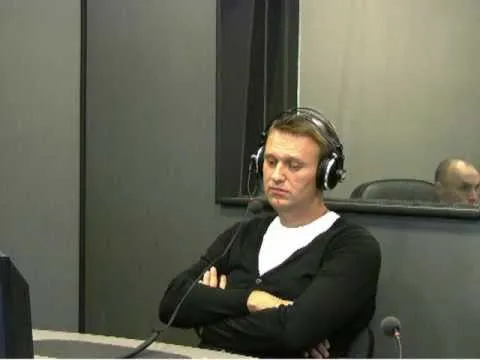
Good evening once again, ladies and gentlemen. At the
microphone is Yury Pronko, on the airwaves of
the radio station Finam FM, with the daily
evening interactive program Dry Residue
and the topic of today’s program is embezzlement,
kickbacks, the looting of the state, criminal
business—how will it all end? And my guest
today is Alexei Navalny, a lawyer and
a well-known Russian blogger. Alexei,
good evening. Good evening. And right at the
start, let me remind our listeners of the ways to get in touch:
there is a multi-line
phone number: 65-10-99 and 6, 65-10-99 and 6,
and the website is www.finam.ru.
the real situation in the country, and what this
will actually end in, in the final analysis.
Alexei, well, it would be unforgivable on my part
not to ask for, well, not to hear from you
some sensational
statements. You understand, journalists
they, well, they’re thirsty, eager
for statements. So let’s start
with politics. You’ve already been all but drafted
into it, both on Finam FM and in other
media outlets, with people saying that
it’s about time Navalny ran in the
presidential election—just like that, casually.
Yes, and various polls
conducted by different media outlets, I should stress, including ours,
gave you 97% after Stas
Belkovsky’s provocation, yes—you got that if you
were to run. In other words, 97% of Finam’s listeners
are ready to support you as a candidate
for president. Yes, so the question was not
whether they would vote for you, but rather
can you honestly, hand on heart, say
how deeply you are tied to, connected with
politics, and whether you have any far-reaching
pla-
I’m very grateful. Thank you very much to everyone
who would support me. That is a great
responsibility for me as well,
because people ask questions and they need
answers. Second, I would still like
to ask, including those who
voted for me: this thing
called a presidential election—what is it,
do we even really have that in this country?
This strange procedure in which
Churov (then head of Russia’s Central Election Commission) sits there shaking his beard and
filling in the boxes out of his own head
or from Surkov’s or Putin’s,
assigning everyone their results—is that an election? I mean, if
even one person really
believes that the result of a presidential
election reflects how people actually voted,
what is called the expression
of the people’s will—I think there are very
few such people. So the question here is whether
one should participate in elections or not, whether one should
take part in this strange procedure
which in
Russia is called elections—that’s
the first point. And second, everyone should
mind their own business. What I am doing now
is something I like, and apparently
not only I like it. It is fairly
effective, useful, and so on. Therefore
I would prefer to keep doing that and work in the
direction where I am actually useful, rather than
switching now to dancing around and playing
this game of hamsters running through
a maze, while above them again stands
Churov, laughing merrily as he watches these
hamsters. Mm-hmm. Well, that was a graceful dodge of the question.
So, you have no presidential ambitions?
My activity is, without any
political pretense—I’m not going to
put on airs here.
The corruption cases I deal with,
and the problem of corruption in general, are
the biggest political issue in the country.
Are you carrying out an assignment from President
Medvedev? I am carrying out an assignment from the
multinational people of the Russian
Federation, who have long since had enough of all this.
So my political
activity, which I am engaged in now,
I believe is important, and it is far
more important than, again, this running
through the maze built by the Central
Election Commission and the crooks who run
the Central Election Commission. Still, then,
a more practical question: do you have your own
political sympathies? I don’t know how you
feel about the United Russia party,
I feel very
badly about the United Russia party, and United Russia is
the party of corruption, the party of crooks and
thieves, and the task of every patriot and
citizen of our country is to do everything possible
to ensure that absolutely—I mea-
to do everything possible so that this party
is destroyed. Not in the physical sense—I
am not calling for any extremism, in the
sense that after today’s
program there will be a headline: Alexei
Navalny proposes destroying United
Russia. By legal means, I propose
making sure that United Russia and
all similar formations—before it there was
Our Home Is Russia, and so on—simply do not
exist, because they are the main
support of the corruption and lawlessness
that is happening now.
What is your attitude toward the leader, not the
official one there, the informal leader
of United Russia, Mr. Putin, a man
who, over the past 10 years, essentially
created a certain system? Yes, in
fact, our listeners know how I feel about
it. But what interests them most right now
will be your opinion, especially
in light of the Rospil portal (an anti-corruption website exposing suspicious public procurement). There and so
on, yes. As I understand it, this is
a kind of culmination of the system that
existed.
The informal and formal head,
the leader, Vladimir Putin, the leader of United Russia,
he created this system. He
deliberately created a system of corruption
which he called the vertical of
power, a system for delegating
corrupt powers, a system
for delegating political powers with the
help of which, in fact,
the country is now governed. Yes, to Ramzan
Kadyrov, roughly speaking, they can say whatever they like,
something like: you there, as the head,
give us 99 percent. And approximately the same thing
is said to any other governor:
give us 60 percent, and for that buy CT scanners
at three times the market price. There you have it.
Look, once again, without any prior arrangement,
I had a clash with
the chairman of Russia's Federation Council
Mr. Mironov. I would
ask: does a minister, any minister, not
specifically Tatyana Golikova, well, in
this case, of course, we are talking about her ministry,
right? Is she responsible for her subordinates? She is.
Then why is she still running
the ministry? I was told that she had been
set up, that most likely she had been given
125 supporting
documents showing that these deals were legitimate. Yes.
Then I had a completely cynical question.
I said: well, excuse me, was the minister
taken for a fool? Well, if that's the case, not
personally, without naming names, yes, without
offense. No, no, that can't be, but you
understand—and after that, essentially, the answer drifted away.
Why, in your opinion, are officials
who hold senior positions not
removed from office? I'm saying this without pathos.
When, essentially, they
fail at the job for which they were
appointed—for example, the minister
of social development. Yes, that's a concrete
example. Or everyone acknowledges that the terrorist attack in the metro
was a failure of the special services and law enforcement agencies.
I speak with various politicians and generals, and I say:
a failure is a failure. I ask: why is no one
held accountable? Well, you understand, the main answer is:
you don't change horses midstream,
raised to the fourth power,
not even cubed. What is the reason, in your
opinion? Well, first of all, this is of course a
traditional excuse. What
Mironov said implies this kind of naivety: we were
set up, those people were set up, these people
were set up. It gives the impression that
there exists some kind of group, a very
shadowy group of such
evil officials who are constantly
setting up the naive ones. That is, of course,
complete nonsense. Yes, Golikova knew perfectly well
what she was doing. The whole country knows what
is happening with the procurement of medical
equipment and medicines. This is known
to absolutely everyone. The Interior Ministry, the FSB (Federal Security Service),
Golikova herself, Putin, Medvedev—they all know it.
Absolutely everyone. I repeat: this is a deliberately
created system for delegating
corruption, and this whole business of kickbacks and payoffs.
That is why everyone is tied to everyone else, everyone
pays everyone else. That is precisely why they are not
removed, among other things. Wait, Alexei—
stop, let me—You know, guests very often
get offended with me because I
stop them mid-sentence and latch onto
specific phrases. What does that mean? Today I will be
a naive journalist, yes, one who
believes that the law is above all else, and as for
living by criminal rules—guys, take that somewhere else.
So how
you speak and argue elsewhere, while
defending the country's budget. So, I want
to understand: what does it mean to bring money in? What does it mean
to pay up? Well, look, here's a concrete
example, and not from my own experience at all.
Quite recently, there was published in
The New York Times, and then all across
the country, a letter from Russian citizen
Kolesnikov, who said directly
regarding medical equipment that
we supplied medical equipment
and, by Putin's order, a standard kickback rate was set
at 35 percent. With that 35 percent, we were building Putin a
dacha (country house). This is not something I made up; it is the direct
testimony of a person who took part in it.
That is exactly what is meant by bringing money in. There was
in effect an offshore
slush fund created, into which
money was skimmed off—clearly by more than one person. That is what
is meant by bringing money in, that is,
quite plainly, among other things. And what, Golikova didn't
know that this company existed, the one that
was supplying equipment at prices at least 35 percent higher
than normal, along with mobile
hospitals? Of course they knew. Everyone knew. That is exactly
why Golikova cannot be removed from
The authorities cannot be driven out; that is what
they call it. I knew too much, and at
all levels, yes, at all levels exactly
so. That is precisely why the leadership is not removed
of the FSB (Federal Security Service), because the leadership
of the FSB is not engaged in protecting you,
me, radio listeners, and everyone else from
terrorist attacks. The leadership of the FSB is engaged in
standing there with a rifle at the ready and
guarding Putin,
Rotenberg, Timchenko, and all the other
shadow and not-so-shadowy oligarchs, people
who
have latched onto this system. Vladimir Putin is
its organizer, its direct organizer,
and judging by
the testimony, for example the direct testimony
of the same Kolesnikov, who
says that Putin personally owns
bearer shares that belong personally to Putin
in this offshore slush fund. Judging by
everything, there really are grounds
to believe that Putin personally receives, among
other things, this money. But perhaps that is not
the case, and that should be established
through an investigation and a fair trial. Now I
have a big question: if
Kolesnikov states this directly in
an interview, wrote a letter, why
is the Prosecutor General's Office not
investigating it? Well, this is what is called
a crime report. It is from the same
series as when they could not find a translator
from English when the Americans, in the
Daimler case, sent documents to
them. Actually, uh, I was ready to offer my
services at that moment, but somehow I was not
asked. After all, I also worked on
the Daimler case. How much time has passed already? A week
ago, Medvedev said in Davos,
regarding Daimler, that the Americans had not
given us the documents. But that is a lie. We all know
all these documents have been published; there is
a specific list of offshore companies to which
the bribes were paid. All the Russian side
has to do is question
the people at Daimler in Russia, which
among other things admitted that they paid bribes,
and identify the ultimate beneficiaries,
the ultimate owners of these offshore companies, which
actually is not an especially
difficult task in our time, when finance is
fairly transparent, because everyone there
is fighting terrorism, money laundering, and so
on. Within the framework of criminal cases, identifying
these people is a two-week job.
The only question is what they will do
when they identify them and find out that it is
they themselves. Alexei Navalny
The Bottom Line program, Finam FM radio station
Finam FM www.finam.ru
[music]
You and I understand perfectly well—you even better than I do
the system that was
created. Yes, appealing to it now already
sounds rather unserious. Yes, I say this openly
to the guys from
United Russia as well. I say:
Enough already—you have been at the helm for 10 years
and in charge of all this. But a system has been
created; it is real, it is
a personalized system, that is,
it is specific people. And for the system to simply
say, all right, we are leaving,
or to suppose that Mr. Prime Minister
will say, yes, I was mistaken, I built the wrong model—
that is, at the very least, naive.
These are serious people who are seriously
engaged in serious business—yes, in
“developing” things. I prefer not
to call it embezzlement but “development”; it is somehow a
softer word. And it is naive to think that they
will just up and leave, just like that. I will give
a specific example. At the beginning of the year,
Yegor Gaidar, who unfortunately passed away too early,
said
that there existed, albeit a
crumbling,
system. In today's Russia, apart from
President Medvedev, who at least
says something, at least in words,
about fighting corruption, who
today talks about the police law, which says nothing
about fighting corruption,
and has been saying it for 10 years already—then tell me,
is President Medvedev
such a naive person, one who says
one thing, yes, but in fact knows
that everything is different and is not going to change
anything at all? He is not naive at all.
Naturally, there are no
naive people there, and no stupid people there either. Everyone
understands everything perfectly well. And I do not believe in
this myth at all, the one in which, judging by
everything, you also believe: the bad Putin and
the good Medvedev. They are more or less the same thing.
Medvedev understands everything perfectly well; he
understands perfectly how all this is arranged and
understands perfectly well that preserving such a
system is his only chance
to remain in power and stay
in power. Because these people, in a
competitive political environment,
cannot survive. It would be naive
to suppose that tomorrow they would say: that's it.
with a snap of the fingers, and we start holding free
elections. But since they are not stupid people,
they understand just as well as we do that sooner or
later this will end, and most likely
it will end soon. How it ends, we
are watching right now live from
Egypt, Tunisia, and many other countries.
That is why this all ends sadly.
Therefore,
Putin and Medvedev must
find the political courage and
gradually give up part of their powers; they
must share power, in the broad
sense of the word, with municipalities, with
local self-government, with anyone at all.
But for now, exactly the opposite is happening.
They are already getting rid of direct popular elections of mayors.
Exactly right. Right now, in our country,
excuse me, in not a single major city,
not in a single city of over a million people, is the mayor
elected. But, excuse me, that is absurd.
So they have usurped all this power,
they grabbed it, but they cannot swallow it.
Let me make one more naive argument
and say this: any system, no matter how
corrupt it may be—not pure and
innocent, of course—must have a
self-preservation mechanism. If that
mechanism does not exist, then the system spins out of control in the
literal sense. At the initial stage,
they took, grabbed, appropriated, moved everything out—
that is clear. But as you already noted,
the live broadcast from Egypt is, in general,
a sign of the final stage for any
such system. But wait—
then the system should develop immunity.
That means the system should be willing to
let off steam. I do not know, perhaps make
parliament a place for
discussion. Exactly right. The question is
whether they have the courage to admit,
including perhaps partly in public,
to admit that all this will end in a kind of
"Egypt scenario." If they do not now
voluntarily give up part of their power, if they do not
delegate authority, then after a certain
amount of time, that power will be taken from them. And
they will all be hit over the head with a log. Mm-hmm.
How far, generally speaking, has corruption gone in
Russian society? I mean, look,
they all say
Yes, it amuses me when I see, you know,
live broadcasts—there are channels like that in
Russia—and for some reason they are
called news channels. Well, I would
call them propaganda channels. And when Mr.
President delivers another speech about
fighting corruption, they write something like,
Honestly, Alexei, I want to take a look
and see what exactly they are
writing there. I will go now—there was a photo on the
internet.
But what I want to understand is this: if
this has already gone very deep, if it has become
well, like a kind of lubricating oil
for keeping all the gears and everything else turning,
then what is the scale of it? Mr.
President once said that out of 5 trillion
rubles in state procurement, 1 trillion
was stolen. There should immediately have been, I do not
know, decrees signed right away
and instructions to the Investigative Committee. Well,
perhaps there are, you see. I
continue to naively assume—I want
everything to be done according to the law. Can you
estimate the real scale? Putin
once said that up to
30% of budget funds are somehow
used for purposes other than those intended.
That is right—Putin said it himself, he admitted it.
One trillion is 20% of state procurement. It is clear
that you cannot steal 100%, otherwise we would be living
in some kind of void. But
it has completely swallowed the state
mechanism; it is the main and
only driver of activity for any
official. That is, I say with full
responsibility that right now any
official will do anything at all
only if at the core of his actions
there is the motivation of getting money, either for
himself or for some of his
business associates. Nothing else. That is exactly
why nothing happens here.
That is exactly why they failed at
that is exactly why there is no fight against corruption.
Because nobody needs anything else—there is plenty of money.
There is a sea of money. Just look at how much
money is spent on state procurement. Therefore,
any officials who are involved in
decision-making—what is he going to do,
fight some corruption, or
work on healthcare, when he can
buy tomography scanners instead? Especially since, again,
everyone understands very clearly that this
system cannot live forever and apparently cannot
remain stable for very long,
because all of this will collapse. So before it
collapses, what must be done? You have to steal
$5 million and move it to Spain,
buy yourself a house there so that
when everything here falls apart
and crowds start running around... And do you
think it will fall apart? Without any
doubt. I am absolutely certain. I already
said that this system, it, it
is unstable, absolutely everything, starting with, well,
I don't know, ordinary people on the streets
and ending with those most vicious
corrupt billionaire officials—everyone understands
that the system is wrong, rotten, and it
will collapse, and it will collapse, naturally, and
how much time do you think is left, and
how long would you give it? Well, you understand,
to predict that would be rather
naive on my part, because, well,
remember, two years ago everyone was also in
that same apocalyptic state of mind
back then, in May, everyone was talking about how the crisis
would force a rethink of the whole model, yes
so to say that all this
will happen in a year, or in two years,
or in a month—I can't make that kind of
prediction. But again, the example of Tunisia, yes,
banal as it may be, shows that this
can all happen completely suddenly, and within
a week. So, well, nothing good will come of
this, Alexei, for ordinary
citizens. Any revolution, yes—chaos,
mob rule—that's why I'm saying
that Putin, not being a stupid man, and
Medvedev—they should understand that in order
to prevent a Russian version of Egypt
or Tunisia, and in order, among other things,
to preserve their own safety, the safety
of their families, and possibly safely keep some
part of their money, they need to share
power. They need to properly
transform things. And besides that,
naturally, they must take some
measures to restore order, to restore
basic order, because right now in our country
real, basic order
is being replaced simply by a huge number of
militsiya officers (the old Russian police force). Well, and we're inflating our cheeks—starting in March it will become
the police.
By the way, will the substance of it change? No. People here are also asking
listeners what they think of Navalny's
remarks about these so-called gentlemen police officers. Well, look,
when a police officer is shaking down a Tajik migrant in the
metro,
then before midnight he's a bad militsiya officer, but
after 12:00 a.m. he's suddenly Mr.
Police Officer, even though all of this happened in the course of
extorting 500 rubles (about $16 at the time). The question is:
has anything improved or not? Your favorite
topic: state companies, state corporations,
companies affiliated with the state.
Yes, the well-known
segment on state-controlled TV channels, yes, where you were, in
essence,
well, accused—yes, accused of various things,
of harassment and of working for some kind of
shadowy Western interests. It's even simpler: they called me
a village idiot, if you
remember. So, Alexei, answer these people
live on Finam FM—what would you say
to everything that was said about you? Well, in
any case, I'm very glad that with the help of
my people—of the people who helped, the people who
support me, and so on—we
really forced them to say something.
Their excuses, of course, look
completely pathetic. I mean, I've already
spoken on this topic: you can call me
a village idiot, a city idiot,
I'm even ready to call myself a village
idiot—just let them return the money. During
the construction of this pipeline,
billions of dollars were stolen. I want
that money returned—as much as
can be recovered—and that the people who stole
it right in front of everyone, with absolutely no
shame, be punished. Yes, when one of the
largest—when
a state company gives billion-ruble contracts to a firm
that is registered using a stolen
passport—that shows a kind of
final stage of degradation. This is already
something they don't even do in Nigeria.
Alexei Navalny, Bottom Line, Finam FM.
Your questions, comments, and remarks at 65
10 99 6, or at www.finam.ru
So, in this interactive format,
let's work through the rest of the program.
Please answer briefly, yes—I mean, I will
ask both the listeners to be concise and you
to answer questions concisely; there are very
many of them. And by the way, before we get into all that,
let me ask you something:
since there is absolutely no way that we
will get through all the questions—not only that, I won't even
have time to read them all out before the end of the program—and
would you answer them after the broadcast, and we'll
post them on the Finam FM website? Well, I'll try.
Okay then, well, let's get started.
Alexei, with the fundraising campaign you announced
today, you're knocking away the chair many officials
are sitting on. They don't need to raise money
for the rest of their lives—they already have it.
So be careful, because they will stop at
nothing in order to remain
at the trough. Be sure to think about a security system
for those who will be helping
you. Good luck. What do you say? We'll hand out
laser swords, pistols, and so on to everyone.
They should be afraid of us, not the other way around. Mm-hmm, yes.
Let's do it this way: one phone call, one email. 65
10 996, Finam FM. Good evening, hello, good
evening. My name is Dmitry. Dmitry, you know
Because of my work, I travel a lot
around the country and interact with a very
broad social cross-section of people
yes, from the very poor to the fairly
wealthy, and I want to say that over the
past year the situation has changed radically.
That is my observation, yes — in other words,
there has been a very sharp rise in distrust toward our
government and a very sharp rise in
social protest. And this is
changing the situation precisely in an
exponential way. That is
one point. The second point I wanted to
make is this: in one of the towns in
the Moscow region (Podmoskovye), there are some guys who
play paintball, and they gather —
you won't believe it — in groups of
2,500 people. This happens there
regularly, and they are led by
professional former military men who
teach them how to seize... Dmitry, where are you
going with this? In short, what is all this
leading to? Well, in short, yes, yes — just imagine,
these guys — and this is in one town, in one
district of the Moscow region. And how many such districts do we have?
Twenty? I am more than sure that in
other districts it is the same. And these
people — most importantly, after these games they
drink beer, drink vodka, and
talk about politics.
And all of this takes place under a
nationalist banner, with a nationalist
flavor. A question for Mr. Navalny: what
is the question? The question is: just imagine giving these
people, instead of paintball guns, Kalashnikov
assault rifles and bringing them to Moscow at one
fine moment, all at once. Thank you.
No need for provocations on the air at Finam FM. Why
did you say all that? And Alexei?
Sooner or later, they will take everything themselves.
Sooner or later, they will come on their own, because
I completely agree with the listener:
over the last year — over the last two years, I
would say — the situation has changed
dramatically. If in the early 2000s
this corruption could be justified by the fact
that Putin had, well, pushed out organized
crime — well, the gangster cops
were simply replaced... his achievement was that he removed
the oligarchs from power, the oligarchs, Chechnya — that is,
in the early 2000s Putin undoubtedly
had certain
successes, some positive accomplishments, yes — that is,
but that is not happening now. Over the last two years
nothing — corruption has been growing, and it has become
obvious even to any grandmother who has
neither internet nor radio nor anything else.
Therefore, without any
doubt, sooner or later this will end with
the guys putting aside their paintball guns
and running off already... God forbid, any further than that.
Right, next question. Mr.
Navalny advocates income declarations for
officials. Is he ready to publish his own
income for the period when he served as
an adviser to the governor of Kirov Region?
Alexei, what is the story there? You were an adviser
to the governor of Kirov Region on a
voluntary basis. I was never a state official,
never, and in that sense I never
received a single kopeck of budget money,
so, well, there is nothing
to report on, really.
Next. Good evening, you're on the air. What is your
name? Good evening. Yes, please introduce yourself.
Vladimir. Alexei, I have this
question: people may have different attitudes toward Zhirinovsky,
but we know that
sometimes he seems to have a kind of gift
for foresight. And as I understand it, everyone
probably realizes that he is better
informed. And on some recent talk show,
I don't remember which one, regarding the
terrorist attack, he strongly attacked
United Russia and ended his
speech by saying that a coalition
government was needed — a coalition
government. Do you think there is
any sense in that? And how should we understand it in general?
Thank you. However we may
feel about him, he is a politician by God-given talent and a man
who very keenly senses the mood
of different groups. Yes, as I said, this government
must share its power; it
must delegate authority, and a
coalition government would become
one of the real mechanisms for soft,
positive change in the country without any
harsh upheavals. At the same time, you understand that this
will not happen, am I right? Because all of this
is happening now and will happen in the near
future. But I hope these guys
will come to their senses. Well, at least, once again,
let me stress: parliament is a place for discussion.
At the very least, let's start with that. Yes, we need to start
with elections; we need to start by
allowing parties to be properly registered
and by not fabricating the results, but
using the real election results.
I like the fact that Muscovites have been divided
into the reds and the others — United Russia, yes?
And it turned out that in our capital...
There are no opinions, so let's move on.
Hello. Thank you. Good luck. Would you happen to have any
desire to add a forum section to the Rospil website
so that people can communicate more easily and
discuss and look for ways to solve
pressing problems? We will do this; there are a great
many suggestions for improving the Rospil website.
Rospil—well, you have to understand that right now this is
simply all being done by one person who, for
free, out of sheer enthusiasm, created
this website. He can't do everything very
quickly, but we will gradually do everything and
everything will work wonderfully. I just want to emphasize once again
that for now we will proceed at the pace
of a Viennese waltz. Whoever knows the Viennese waltz
knows that it gradually builds up
speed. Yes, we have 21:39. Yes, we'll have to
right now, yes, 65 1099 and 6.
www.fmm.ru from their taxes? And I
think it is unlikely that we will be able
to do this with the help of international
institutions, but with the help of international
institutions we can, of course, perhaps quite
effectively put pressure on our authorities, because
all the money stolen from Russia is
of course invested abroad. Mm-hmm.
Good evening. Hello, what's your name? Hello.
Hello. Hi. Hello, Sergey.
My name is—yes, go ahead, Sergey. Alexei,
Well, in general, I wish you success. God grant you
health and good luck in your
struggle. But my question is this: well, I
actually agree that, well, the authorities
themselves—and I doubt, of course, that they
will voluntarily share their powers.
As for the opposition, I have a question.
Well, of course, I also understand that it is
all fake, and that, well, basically the point
is this: in light of the
upcoming elections, why not
hold something like—well, we do have, sort of,
smart people around you—anti-elections, anti-these elections.
You understand, something has to be done.
Thank you. I was an absolute supporter
of the idea of a boycott in the previous elections, but
unfortunately, we have to admit that the idea
of a boycott—well, it is not supported by
the masses. That is, it does not work. To my great
regret, I repeat, I was a supporter of it.
Therefore, I think that in the upcoming elections
the more correct political
strategy is to come and vote for anyone
except United Russia,
that is, to come and vote against United Russia.
Let's move on. Dear Alexei, Konstantin
from Kemerovo Region—so, in fact,
we have questions from different regions of Russia.
Dear Alexei, in one of the towns
in the coal-mining Kuzbass region, a mayor has been removed from office
who, in Governor
Tuleyev's opinion, shamelessly abused
his official position. Not long ago,
Moscow Mayor Yuri Luzhkov was also removed from office
on the grounds of loss of trust. But in my
opinion, also for immoderate greed,
writes Konstantin from Kemerovo Region.
And the actual question is: have the federal
and regional authorities begun fighting corruption?
You see, Alexei, you accused me of
being naive, yes, but people
well, this trend exists, there is a demand for it, yes.
It's just that some people are even more naive than
you, you understand. So if Luzhkov was removed
from office because of corruption, then
the question arises: why aren't we putting him
in jail? Why aren't we opening a criminal
case? Why aren't we trying to recover those $4
billion that Luzhkov
corruptly earned together with his
wife? That's what a fight against
corruption would be. When, excuse me, people
who stole $4 billion—Yelena Baturina earned it
through corrupt schemes—I believe that we
have every reason to believe that
the real reason for Yelena
Baturina's business success is her husband's
official position. I think there are very few
people who do not share this
view.
And in fact, that money was earned
through fraud, through abuse
of official position. Criminal cases should
be opened against them. Our
federal TV channels, when they were taking down Luzhkov,
were showing outright
evidence of his crimes. Well then,
if it's a crime, let's investigate it.
Well then why, Mr. Navalny,
let me ask you a question in return: what is the reason?
The reason is that Mr.
Luzhkov, if his activities are
investigated, is no fool. And I think
somewhere in Switzerland or Luxembourg
there are some very interesting documents that he
would make public, and they would tell us a lot
new and interesting things about the business
activities of Vladimir Putin, his
inner circle, his relatives,
friends, acquaintances, and so on. Therefore,
the Kremlin understands very well that by delivering
such a blow—by investigating Luzhkov—it
would mean that Luzhkov would reveal everything.
the information that exists about him. Okay.
So, I'm launching an SMS poll. Take out
your mobile phones, and here's what I'm
asking you: do you agree with Alexei
Navalny's position? Everything Alexei is saying
right now, in essence—if yes, if you agree with it,
send 5533, letter A. If no—Alexei
Navalny, and moving on. Ellipsis. Is it true
of your life? Yes, he's promoting himself there, well, I'm just
judging even by the messages that are coming in
there.
it's being monetized.
using anti-corruption issues for his own purposes. That is, I
it's being monetized.
means, that is—
honestly, it means gaining something from it.
If that's what you mean, then yes, without any doubt. Let's
call it this: I profit from it.
Political points, political capital—
call it whatever you like. Let everyone
benefit from it. Let's all together
come and fight crooks, and on that
a lot of political points can be scored. So,
do you agree with Alexei Navalny's position?
5533, letter A. If not, you don't agree, and next:
the truth of your life—5533, letter B. Once again,
5533, letter A if you agree with Alexei
Navalny's position. If not, then 5533, SMS
message with the letter B. No need to send anything else.
No need to send anything else. 65 10996 www.finam.ru
My name is Sergei. I wish Alexei every possible
success and objectivity in his
judgments. In principle, I...
Do you doubt him? That's the phrase. I don't
presume to doubt. I always find people
who are categorical in their judgments
a little worrying sometimes, well, that's
probably due to a lack of information.
Still, nevertheless, I would like to ask him
a political question, so to speak.
For example, it's absolutely clear that the entire
spectrum of political parties that we have
in the State Duma (the lower house of Russia's parliament), and elsewhere too, they have all
in one way or another discredited themselves
with ideologies, or with ideologies that are completely unclear.
Yes, and what I'd like to know is this:
say, in new elections or in those
discussions where people talk about the need
to create coalition governments and
so on—what spectrum of ideology could
replace the current one? Not parties specifically, but what spectrum
of ideologies could replace the one currently in power,
this vague ruling ideology? Yes, thank you.
Thank you. Without any doubt, we have
an entire ideological spectrum that is completely unrepresented in
politics—a spectrum of ideology that,
roughly speaking, is usually called
nationalist. I would call it
more right-conservative, yes.
"Nationalist" is a term with
a certain...
connotation, and I think that without any
doubt these people should be much
more broadly represented. Mm-hmm. And there is also
another completely unrepresented group—not as
large as people usually say it is. It is
liberal-democratic, and it too
should be represented. And, well, let's say
that what, what
United Russia is now trying to play with—
well, that's a crude Soviet-style thing, yes.
But nevertheless, such people do exist. There are
quite a lot of them, probably, and they
naturally should also be
represented in such a government. We cannot
ignore them. So, here's my...
great question, from Facebook:
Alexei, there is a thought that in the
near future you may be offered
some kind of position in the state apparatus, and
many people have had similar thoughts
because the impression is that you
and your activities are causing
a certain discomfort for some
corrupt people. I like that
wording—so, a certain dis...
a certain discomfort, yes. As for
if they suddenly call—if, if, well...
it seems to me there would be even more discomfort.
No. Well, in any case, in this
system you cannot work effectively if
you are not part of that system,
part of the corrupt system. We have
seen many examples, quite
recently, when a mayor, for example, who does not
agree with United Russia immediately loses
his high popularity rating because
in that city they simply shut off
the hot water, and people immediately stop
liking the mayor. Therefore, a normal person in this
system cannot exist, and cannot
perform his duties effectively and honestly.
Therefore, being part of a
corrupt, rotten system
is pointless. Right now there's this idea that
let's find three
good people and insert them into a bad
system, and they'll change something—but that doesn't
work. It's naive, and it won't succeed. Well,
so answer clearly: if they tempt you, you won't
go? No. At least not into this
system, yes. And, Alexei Navalny, in summary—
Finam FM. Good evening, what is your
name? Hello? Hello? Yes, good evening.
Please introduce yourself. Yes, my name is Maxim. And
a short question, a simple question: for an ordinary
average citizen, what should they do? That's all.
Thank you. What can an ordinary—thank you, Maxim—
any ordinary, average citizen do?
There are a huge number of things they can do. As I
already said: during elections, go and vote against
United Russia (the ruling political party), always.
Campaign, perhaps to a narrow segment,
in the fight against corruption. I constantly
propose formats in which any
person can take part: write complaints
and send them together with me, and so on.
They can fund some kind of opposition
activity. For example, we launched
a project to fund the Rospil website (an anti-corruption project); people
send 100–200 rubles each, and we will hire
lawyers. I hope we will act
quite effectively. Any person, in
fact, has no fewer
tools to work with than
any opposition politician. And when all
the fuss erupted around the publication
about Transneft, I happened to have, uh, in
the studio, Sergei Aleksashenko, and you were in
America, yes, and I remember everyone online
was saying, yes, Navalny is in
America, yes, yes, he’s there already, and from there
he’s doing all this from across the ocean. I asked Sergei then
a direct question. I said, how
do you think—will he come back? Aleksashenko said
he will definitely come back, without a doubt. But Alexei,
here’s a question from Agafon in Skovorodino—that’s all the way in Amur Oblast (a region in Russia’s Far East),
yes—he sent you the following
question. Skovorodino, by the way, is where the first section
of the ESPO pipeline ends, understood.
So, he asks you—I’m quoting
the letter exactly as it came: “Aren’t you afraid of the authorities?”
Question mark. “The current elite”—that’s
how he put it, yes, “the current elite.”
By the way, that’s the first time I’ve heard that phrasing. They can
maim you, kill you, and
imprison you. I am not afraid of this government. I understand perfectly well
that, yes, with any individual person
they can do
absolutely anything. And yet, taken as a whole, this is
a completely helpless and pathetic formation.
And I think it is simply
disrespectful—to yourself,
to those around you, and to your country—to be afraid of
these crooks. Yes, I’m a rational person, but
my understanding that anything can
happen to anyone, that they can do
whatever they want, is not an obstacle
that would make me stop what I’m doing.
But you do have a sense of danger, like
any person? Well, like any person,
I’m
reasonable. I’m not going to, I don’t know, jump at
police officers or lunge at someone, and so
on. I try to behave cautiously
as much as possible. But some kind of
feeling of fear—I don’t have it. If you
share Alexei Navalny’s position,
please send an SMS to 5533 with the
letter A. If not, 5533, letter B. Moving on,
what should Russian young people do
if they want to live in a lawful, just,
democratic, safe state
but constantly, every day, run into
situations where they can achieve nothing unless they
show loyalty to corrupt
officials or their relatives? What
is the way out? I do not agree in the slightest
that nothing can be done. Listen,
how am I any different from—well, I’m not exactly
Russian youth anymore, yes,
but Russian youth, the Russian
middle-aged, Russian old-timers—we
all have the same opportunities.
We can all do something. I am doing
something, after all. Thousands of people with me send
these complaints; in the regions, people
independently conduct anti-corruption
investigations a hundred times more dangerous
than mine. They do it, they do it—we all can do it.
At the very least, you can go to
the polls and vote against United
Russia, persuade your
neighbors. You can, I don’t know,
fight your petty tyrant of a boss—
you can do all sorts of things.
Uh, no, yes, let’s move on then. Just so that
no one later tells me the promo
didn’t air: 65-10-99 and 6
3 FM. Alina writes: “Alexei, you were investigating
the embezzlement at VTB Bank, including
the drilling rigs case, where the fact of
the theft is obvious. Many
people I know have acquaintances—many
people’s acquaintances, yes—who are on the
management board of VTB Bank. To my sarcastic
questions, they reply that you are no longer
working on this case.”
“According to them, all issues with you, Alexei Navalny, have been settled.”
I don’t know who supposedly settled what with me.
We are continuing this case, and we will
keep going. In the near future we
will publish new and very interesting documents.
There really is, in the VTB case,
completely obvious evidence that
the bank’s management stole $150 million
from the bank, which is comparable to
the bank’s annual profit and the dividends
that they
pay out. We will pursue these
crooks by every possible means.
The crime is obvious; we know who
Stole it, sure—but where did they move the money?
All of this will be published. We will, of course,
continue bombarding our police (militsiya, the former Russian police force)
which, unfortunately, takes bribes from VTB
and refuses to investigate, but we will not
stop. We have already been investigating this case
for almost two years now, and we will keep investigating it for another
22 years—is that what I understand? So, regarding
every word you've just said—do you have
an evidentiary basis? That is already a question
for a lawyer, absolutely. As a lawyer—please.
We told VTB a hundred times when we
named them directly. At the general meeting
of shareholders in Rami, they were told: come on,
guys, sue us—for defamation and
protection of honor and dignity. But what do they do? Because
we have all the documents that
show that these people stole $150 million
from the shareholders and, in the course of
a corrupt deal, also squandered
assets in Yamal (a region in northern Russia), now covered in snow there,
already dismantled, and they can hardly be
used. The total damage to the bank
will amount to more than
We will continue—under this government and under
another one. Let the crooks who are listening
to this program right now know that
sooner or later, we will get them. This is Finam
FM, "Bottom Line." Alexei Navalny
is answering my and your questions. For the last
time, then—so we have another half-minute to
vote. Do you support Alexei
Navalny's position? Then text the letter A to 5533
from your mobile
phone in an SMS message. If not,
5533, letter B. Once again, I ask that in the remaining
minutes, please be brief and concise.
Good eve—you're on the air. Ah, good evening.
Ruslan. Well, to begin with, I honestly sent
letters, though I still haven't received a reply from you.
Well, let's hope that Alexei will respond afterward.
Yes. So, my question is this:
this is my opinion, and I would like to hear yours.
As I see the situation regarding
Russia right now from the countries of
America and Europe, with current oil prices,
when this government feels perfectly
comfortable, nothing will really change. I
think that if oil were at $30
a barrel, then something in this country
would change. So to what extent does your view
on this topic coincide with mine, or not?
Thank you. I would disagree here, again.
The already overused example of Tunisia shows that
it was one of the richest Arab
countries, one of the most stable. However,
that stability collapsed, again,
despite high oil prices, with oil prices rising.
Over the past two years, we have seen
a clear growth in discontent, and we see
that all this oil, these high prices,
all of this is just
being squandered, which is absolutely obvious to the entire
population, and I do not think that high
oil prices are a guarantee of the survival
of the regime. Good evening, you're on the air. What is your name?
Ah, hello. Good evening. My name is
Ruslan, from the North Caucasus, and I
have been following closely and listening to what you
are saying. Of course, I am completely in solidarity with
Alexei and support him in every respect.
In fact, without any problem...
from the Caucasus said—well, I understand how
well,
corrupt it is. Alexei, that is absolutely
all true, really. And there was
one radio listener who asked what
an ordinary person should do. Yes, I have
the same question. For example, take me:
I have two children. Here I am,
currently living here in Moscow.
My wife is a Muscovite, and the children are too, in a way.
Well, I'm not officially registered here, but that's not important. It's just that I
send my child to kindergarten. Yes, for that I
pay 770 rubles
plus 30 rubles in, let's say, bank
service fees—well, a commission—and
I receive 750 rubles for him. It's just—this
is where we need to start, solving problems
in real life, right? Start with this.
Start there. As for ordinary people, Mr.
Putin and Mr. Medvedev have no concern for them at all.
They are simply engaged in business,
plain and simple business.
You mean the ratio between child benefits and
That is completely obvious. But here we should not
deceive ourselves: no social
problems will be solved until
the basic political problems are solved.
Therefore, dear radio listener, I will not
say anything new. I am calling—I am not
calling on anyone to grab a grenade and run off
to storm the barricades. But each of us
can make a contribution to the struggle against this
regime—our own small daily struggle.
We must force them to change. If
these people do not feel pressure and
constant pressure, they will not care how much
has to be paid for kindergarten. And even
if it is twice lower than the benefit. And Raman
asks how you feel about the separation
of the Caucasian republics from Russia.
Since we've started talking about the North Caucasus,
well, it must be acknowledged that at present
for the time being, the Caucasian republics are de facto
separated; they are not part
of the Russian Federation. There is no
authority there
— there are just some gangs there
roaming around, and you can no longer tell who these
gangs are for — whether they are Islamists or
simply some bandits, and so on.
So we need to start by acknowledging
that right now the Caucasus is not part
of Russia, and build
our strategy on that basis. And first of all, this should of course
mean the decriminalization of the Caucasus
and a fight against all these phenomena
that over the past few years have become
fashionable. Look at any Caucasian
politician boasting: we have blood feuds, we
kidnap brides, here everyone
has to wear some kind of headscarves, and so
on. This is an absolutely dead-end path.
This belonged in the past, yes, and
this imposition of tribalism in the Caucasus and
a clan-based social order, which is being carried out
by the federal authorities, by the way, is
an absolutely dead-end path. This is what
we need to fight. Good evening, you're on the air.
Good evening, namesake. Good evening.
Alexei, to keep it brief, my name is
Sergei. I support you, Alexei, completely
and fully — not just me, but, generally speaking,
the aviation intelligentsia from the city of
Zhukovsky. So I wanted to ask: how do you
feel about this proposal? What if
we had a president, so to speak,
similar to, let's say, Lukashenko?
Well then, all witnesses can confirm I didn't cut off
the caller — something happened. Briefly, I
think that's unlikely, unfortunately.
From Lukashenko, Putin borrowed only
the harshness and totalitarian tendencies, but he did not
borrow Lukashenko's kind of fight against
corruption. I think that in Russia, the time for such a
president of the Lukashenko type is simply
impossible. And in conclusion, a question
from Andrei: Alexei, in your view, what is the main thing
in life? The main thing, guys, is not to grow old
at heart — that is Alexei Navalny's answer. Thank you
very much. This was the first meeting in this
year, 2011. I hope it won't be the last, because
as
99% of Finam FM listeners support you.
Those are the voting results. An
absolutely astronomical
number of people took part — 1,212 over
this period of time.
Well, Alexei, 1% do not support you — that was
apparently Tokarev and Vainshtok who voted.
Thank you very much. Alexei Navalny was
today's guest on "In the Dry Residue" on Finam FM.