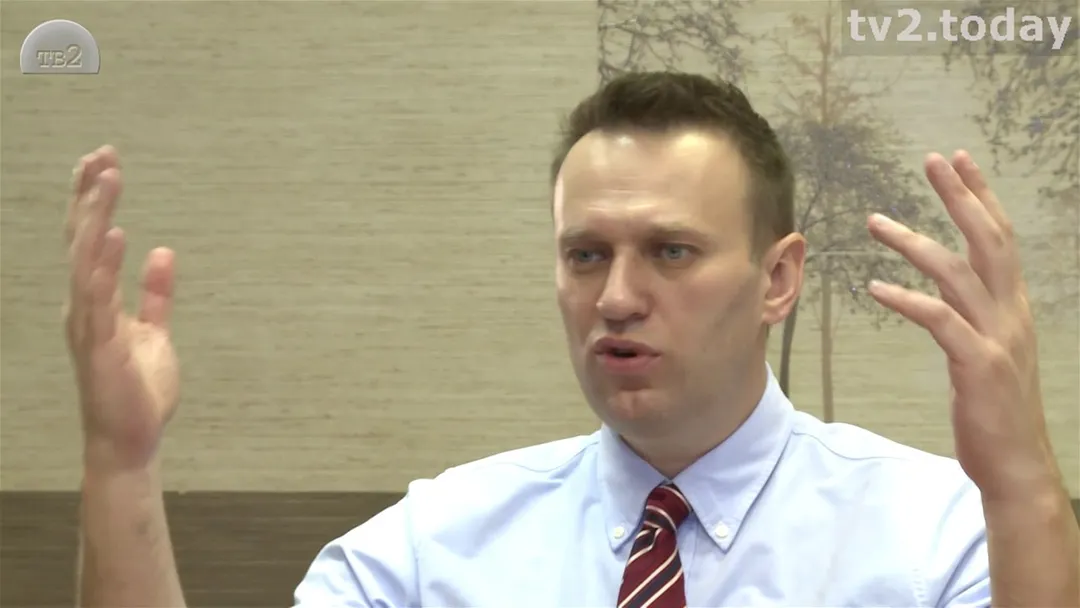
Alexei Navalny’s interview with the TV2 channel
The Kirovles case, and this whole
legal side of it, doesn’t interest us
at all. I mean, we understood perfectly well,
and I understood perfectly well, that
the Kirovles case was really only needed
to convict me and prevent me
from taking part in political
activity and, in particular, from taking part
in elections at any level. I couldn’t
run for the State Duma. Now they’re
saying that I can’t
take part in the presidential election. And
that’s complete nonsense, because the Constitution
explicitly states that only people
who are prohibited from participating are those
who are in prison.
So, from a legal standpoint, I
will take part in the election—I have the right
to take part in elections. The European Court
of Human Rights overturned the first
verdict and will overturn the second one as well. But overall,
if it hadn’t been the Kirovles case,
it would have been some other case. We realize
that this government is afraid of my
participation in politics in general, because
it’s afraid of losing the billions
of dollars it has stolen.
So there will always be some kind of case,
but that should not affect
our determination to take our country back.
Well, if they find some formal legal
grounds to bar you
from running,
what else do you think they might
come up with—what else can the authorities devise
to stop this from happening?
The authorities can come up with anything.
You see? On the one hand, we have
a Constitution that prohibits a third
presidential term, but Putin has been in power for 17
years and plans to stay for, what, 23
or 24 years. Under this same Constitution,
governors were supposed to be elected for two terms, and
now some of them have also been sitting there for 24 years.
Under this Constitution, people are jailed for
one-person pickets. So the issue
is not what kind of legal
tricks they come up with; the issue is that
there is simply a political confrontation,
there is a group of people who have seized power,
and they do not want to let it go. They
want to be lifelong
rulers of Russia. We
cannot agree to that. And we will
oppose it. As for the formula
the authorities use, it was
invented long ago: everything for friends, the law
for enemies. That’s why they rewrite the law
and try to apply any kind of nonsense
to us, while they themselves
don’t care about any laws at all. Just recently,
United Russia MP Maksakova literally fled abroad to Ukraine
(United Russia is the ruling political party in Russia). And
at the same time, she gave an interview saying
that for the entire period when she sat in the
State Duma (the lower house of Russia’s parliament), she had
German citizenship. And everyone
knew about it, even though that is, in principle, absolutely
prohibited. That perfectly shows
the authorities’ attitude toward the law. They don’t care
about any law. They interpret every law
against us and in their own
favor. That is exactly why I am running in
the election, because I do not agree with this.
As for your presidential campaign, I
very often come across the opinion online
that Navalny is running for president
in order to lend legitimacy
to these elections, that he’s a Kremlin project. How do you
feel about that? Well, it’s funny, in
my situation,
to argue with the claim that I’m a
Kremlin project. It always leads to a lot of
jokes in our office at the Anti-Corruption Foundation,
like, is there really not a single person left
who hasn’t had
a criminal case opened against them, or a search,
or computers seized, or something else like that?
People just have this conspiratorial
way of thinking. For my part, I will
try to persuade them, I will work with them. I
completely understand those people who
say that elections, since in
Russia they cannot be free,
should be boycotted altogether. And any
participation in elections is legitimization. Those
people, well,
have a right to that point of view. And I
even acknowledge that there is
a certain logic to it, because free
elections really will not exist in Russia
in the foreseeable future. And what
we are fighting for right now is simply
to be allowed, in principle, to take part at least in
unfree elections. So yes,
there are maximalists who say, ‘Well,
until there are free elections, we will not
take part in this.’
I have a slightly different approach here. We
live here and now. Here and now, I
am running in the election in order to
represent those people who do not
like what is happening, who do not
agree with the fact that power has been
usurped, who do not agree that
all of Russia’s national wealth
serves only one purpose: enriching
Putin himself, his relatives, and his
closest friends. So I will engage in
dialogue with everyone. I will try to persuade people
who are skeptical about
participating in elections to
support me. That is what elections are for.
You just mentioned the foundation again,
the anti-corruption
yes, the Anti-Corruption Foundation. Tell me,
why is it that your investigation,
impressive as it is, speaking as a journalist, did not
cause that much of a major stir
in political circles? It creates
the impression that some people read you
and say: "Ah, well, they steal." Well, and in
Russia, they’ve always stolen—throughout Rus' (historical Russia), they’ve always stolen. And
and
that’s exactly why I’m running in the election, because
I do not agree with the idea that
the investigations we publish do not
provoke a strong reaction and do not lead to,
most importantly, any consequences in a country with
a normal political system.
matured.
Most of our investigations would have led
to a political crisis, would have led
to major resignations, when we
tell a story and prove it
all about how the Deputy Prime Minister
of the Russian government, Shuvalov, has already
become so rich that he flies dogs on a
private jet to dog shows—well, in
any country, even the richest country,
that would simply have led to resignations at
the very highest level. But in Russia,
nothing happens, because, well, on the
one hand, there is censorship, and simply
most of the population knows nothing
about it. On the other hand, there is, uh,
rule by phone call (informal political pressure overriding the law), and there is a completely
controlled judicial
and law-enforcement system, and everyone knows
that, well, it is impenetrable, and
corrupt officials are never punished.
And so there is simply this level of
tolerance for corruption. Well, they stole
a billion there, a billion here, there are
thieves everywhere, but nothing can be done. I do not
agree with that. I am not going to tolerate
this situation in which, uh, Vasilyeva
and Serdyukov
are let off. Serdyukov did not spend a single day
in the defendant’s dock, and yet we
see reports about how they imprison
some people who, in order not to
starve to death, stole from a store
a loaf of bread and some sausage worth 500 rubles.
These people are prosecuted with prosecutors,
courts, and everything else. But people
who embezzle billions are completely
ignored. Not ignored—encouraged, I
would even say. I really do not
like this. That is why I feel great
frustration, to say the least,
about the fact that our
investigations do not lead to resignations. And
I want to be president so that,
among other things, so that
investigations into officials, facts about
official corruption, would lead to the point
where they resign or
end up in the dock. And
then the system will start working. Then, among
other things, people will live better, because
all this corrupt rent-seeking income will
go to everyone.
Now a few questions about
your presi—presidential campaign, about
your reforms, your platform. So
a very sensitive issue for us is taxes.
So you support the idea that part of
taxes should remain in the regions, rather than
going to Moscow. How exactly do you
envision that? And which taxes exactly
should stay there?
What should the proportion of tax revenue split between
Moscow and the regions be?
In any case, it should shift in favor
of the regions. And the regions need
to be left with both money and authority, because
without that there will be no
development. But right now not a single
governor is really interested in anything
except stealing federal
money. Because even if we
suppose, imagine an ideal
governor—he develops business,
opens factories, develops small
businesses, barely sleeps, meets with
entrepreneurs and helps them, and he is not
corrupt at all. So what
does he gain in the end? Nothing. All
the money the region earns is still
taken by Moscow, and he gets back
pathetic crumbs. So this makes
any genuine, worthwhile initiative at the
regional level meaningless. One of my
favorite examples on this subject is this. And the system
in which Moscow sucks money out of
the regions has already reached, well,
threatening and absurd proportions. Here we are
in Novosibirsk, the country’s third-largest
city. The budget of the city of
Novosibirsk is 36 billion rubles a year. At the same
time, Moscow spends on New Year’s
decorations 7 billion rubles. Just on
light bulbs hanging in the streets for
three weeks. And what’s more,
the investigation shows that these
light bulbs
were bought at five times the proper price. That
means most of the money was simply stolen.
And this is an example of how absurd the system is.
So, uh, more personal income tax should
remain there, more natural resource tax,
excise taxes—these are comprehensive
measures, but their main purpose should
be that the regions should have
more money and, and more
authority both at the regional level and,
even more importantly, at the city
level, because cities are where
people live. And in fact, 95%
of the problems and issues that arise for
people in their everyday lives
are connected with city administration, connected
with the city mayor. So let the money
stay there too, because that’s where the school is, where your
hospital is, where your kindergarten is, where you
You walk down the street, and that’s where they should be,
the money should stay there, where you pay taxes and where you
earn your income. We want to change that. In
fact, this system hasn’t always existed.
It was essentially a Putin-Kudrin project
when they consolidated all the money in Moscow,
including in order
to strip governors of political
power. Now a governor’s job has basically
been reduced to traveling to Moscow and
begging for money instead of
developing their own region.
And what specific
examples do you have of which taxes should stay locally?
Well, as I already said, excise taxes and personal income tax
should remain there to a greater extent and be distributed to cities;
they shouldn’t be taken away from
the cities. For example, in Novosibirsk
a significant share of personal income tax was simply taken
up to the regional level, taking it away from the city
level. In other words,
most of the corporate profit tax should
should
while the mineral extraction tax and some other taxes remain federal. I understand that
for regions like Tomsk Oblast,
this is a complicated issue, but we
obviously can’t leave the entire mineral extraction tax in
the regions, because then we’d end up with
a super-rich Tyumen and a super-rich
Tomsk Oblast. But of course,
a larger share of the mineral extraction tax—well, not a large
share, but somewhat more of it—should
remain in the regions. But again,
otherwise, what’s the point of developing at all? And with this
program, incidentally, we went into
the regional elections in 2015.
That’s why we were removed from the ballot everywhere,
because, uh, people in the regions understand
why this is needed. Because, among other things,
the mineral extraction tax and this shared resource rent
should be distributed evenly. But those
regions where, of course,
oil workers are employed and where these plants are located, should
receive a little more. That’s how it
works all over the world—for example, Texas
gets more in the United States from
oil sales than other regions do. Well,
because that’s where the oil workers live, because
that’s where they work. That is fair and
right. United Russia (the ruling political party) keeps telling us
that this is impossible
to do. They say privatization happened in
1996, in 1995, in 1997, and so
therefore
now it’s supposedly impossible to tax, uh,
those oligarchs who bought all that property for next to nothing.
That is absolutely not
true. And here we are referring first and foremost
to the positive example of leading
developed countries. A similar tax on the results of
privatization was successfully
applied in the early 2000s
in the United Kingdom.
They first privatized, during
the Thatcher era, coal mines and raw-materials
enterprises. Then, several years later,
a completely different government
decided that they had been privatized too
cheaply. And those
privatization results were taxed. Those
tax revenues went toward infrastructure
development, and the money was spent
wisely. And in Russia, we can do
the same thing, because this also
leads to a situation where no one
recognizes this property as legitimate. Well,
no one will ever agree that
Norilsk Nickel somehow legitimately belongs
to whoever it is now—not Prokhorov anymore,
but Potanin—because he once bought it
for $100 million when it was worth several
billion dollars. And those $100
million came from the state budget. Everyone
understands perfectly well that the loans-for-shares
auctions were fraud,
which led, among other things, to
an ugly
monopolistic
form of large-scale ownership in Russia.
It produced oligarchs, and in Russia
despite the country’s overall poverty,
it increasingly led to this
abnormal number of
billionaires. That is wrong. And we
must introduce these compensatory
taxes, as they did in the United Kingdom. We will
introduce them, and it will benefit
the economy.
Mm-hmm. And is there a list of them?
The loans-for-shares auctions—how many were there
in total? Thirteen, I think, or
twelve. So it’s not that many, but it
concerns the largest enterprises. In other words,
in that sense, of course, those people who
created colossal fortunes for themselves in five minutes,
became
some of the richest people in the world—they
simply have to pay tax on that,
because, well, just as people everywhere pay
taxes. People who own oil
companies and raw-materials enterprises
all over the world pay substantial
taxes. In Russia, they got these enterprises for free.
They pay a very small
tax—13%, and dividend tax is 9%. Those are
simply laughable tax rates.
On top of that, they pay very low
wages—14,000 to 15,000 rubles (about $150–$165) at
enterprises with hazardous working conditions.
That is the source of this wealth. And
it is both unjust and economically
wrong. So they will pay. Nothing
terrible will happen because of it. This is
not a revolution, not a redistribution, not
“take and divide.” It is a perfectly sound
economic measure. I repeat, it has already been used in
the United Kingdom.
And roughly how much, would you say—
Have you estimated roughly how much money that would be?
How much would it bring in?
I think it could bring in between 50
and 70 billion dollars.
And you are proposing to cut part of
Moscow's tax revenues and redirect them to
healthcare. Well,
not Moscow's, federal ones. I am proposing
simply to cut them. I myself am a Muscovite, and
of course I cannot speak out. I do not want
to speak against my own city. I am simply
saying that, generally speaking, this does
not bring Muscovites any happiness either,
because all that money that
comes in leads to the fact that in
Moscow everything becomes terribly expensive, and all that
money is mostly stolen there anyway.
Yes, I believe that since the burden of
social spending has now been shifted onto
the regions for all
healthcare and education—after all, all of that
comes out of regional budgets, and there is no money there,
let's leave the money in the regions so that
they can improve their hospitals and schools, yes,
that is what I think.
And as for modernizing the road network, on
what basis are you planning to improve its quality? With
what money, exactly?
With the money that already exists in
Russia. Look, in Russia GDP per
capita is 16,000 dollars. That is
quite a lot. There is plenty of money in Russia,
enough, including for
reconstruction—well, at least
of the main highways, and certainly roads
of federal importance and major regional
roads. There is enough money for that in both
the federal budget and regional
budgets. Enough. Just look at the
structure. We simply have monstrously
bloated
military and police spending,
and some insane expenditures on the so-
called law-enforcement apparatus.
Moreover, right now a third of the federal budget is
completely classified.
It would be one thing if we spent that
money and got a high level of
security in return, but we do not
get that. In terms of murders per
capita, we surpass every country. In
terms of serious crimes per
capita, we are ahead; in terms of the number of
terrorist attacks, we look simply awful. So
then why are we throwing almost
40% of the budget at this?
Let's take at least a little from this
military-police part of the budget and
spend it on roads, hospitals, and schools.
Then we will definitely have enough money for that.
You said that the annexation of Crimea was
illegal, that the referendum was illegal, and
that somehow it needs to be returned, with
international negotiations involved. How do you
see this working in practical terms? Suppose you became
president.
Then what?
I would call a new referendum. Right
now
the Crimea issue is insoluble, and I
believe that, broadly speaking, it is insoluble
for any president. This is a kind of Putin legacy
under which Crimea will for
many, many years—decades—
remain this strange territory
that is de facto part of Russia.
No one around it recognizes that. And
what happens is the same thing we see
with Northern Cyprus, or what is happening
in Israel or in the Palestinian
territories, or the Falkland Islands, and
so on and so forth. There are quite a few such territories
around the world. Crimea
will become one of them. In order to
at least begin normalizing the situation,
we must hold a proper
referendum. I mean a real
referendum. What took place
was not a referendum. There must be
observers, there must be a long period of
campaigning,
so that at the end of that referendum, at
the very least, we know the true
will of the people of Crimea, because
their opinion, their right to
self-determination, is fundamental here
and is the basic point from which
we can start building something further
and begin conducting
any dialogue with the international
community, with Ukraine itself, and
so on. So that is the first thing. But
I repeat, there are no
simple solutions that could be applied by
President Navalny, President Putin, or
President Whoever, or anyone else,
that would normalize the situation with Crimea.
That is no longer possible. When one
state takes from another
state a piece of its territory,
Uh-huh.
it automatically creates a conflict for
decades. This conflict for
decades is now with us, and unfortunately it will remain
with us.
Suppose you became president. Your first
three actions.
First: the release of all
political prisoners. Second: introducing a law
to combat illicit enrichment.
When an official cannot explain
where that wealth came from. When he
earns a million and at the same time builds himself
a country house worth 100 million or buys a yacht,
criminal proceedings are automatically initiated
against him. And third: the
start of judicial reform, without which
all other reforms are impossible.
economic development is impossible.
And lustration?
I support lustration. At the same time,
when people talk about lustration, they
often confuse lustration with the need
to punish those who are, right now,
committing crimes. Those judges and
police officers who jail people for
nothing—they do not need any lustration, they
need ordinary law. Because, uh,
criminal prosecution of someone known to be
innocent is already an offense on the books
right now. No
lustration is needed. To put
these judges in prison, to put
corrupt officials in prison. I do not need any
lustration for that. I take the current
criminal code and send
half the government to the
defendants’ bench, remove a significant
number of judges, and so on, and so
forth. What is needed here is political will, not
lustration. As for lustration,
it is a kind of punishment without guilt, when
under lustration people are stripped of some
of their rights simply because, for example, they
held senior positions in United
Russia (the ruling political party). Yes, they may not have been
guilty of anything, but society punishes them.
For example, we can see that
similar lustration measures that
were applied in Eastern European
countries were beneficial for those
societies and led to positive
changes, including economic ones.
That is why I support it, this
lustration, and I will work to ensure
that a majority is formed in
parliament that would pass one
lustration law or another, because
well, among other things, in the Soviet Union, in
Russia, in young democratic Russia,
nothing worked out because, well,
for example, all those lying crooks,
those journalists who sat there at the
Telegraph Agency of the Soviet Union (TASS) and
lied to the Soviet people for years, they
were all left in place. They simply changed colors,
became great democrats, and then they
changed colors again and became great
Putinists. Well, these—pardon the
expression—these sellouts. They need to
be driven out at last. And,
of course, we will never build any beautiful Russia
of the future if we leave
people like Vladimir Solovyov and
Dmitry Kiselyov, all these lying
propagandists, and allow them once again
to change colors. And they will say, like
those deputies who have fled to Ukraine
now, from United Russia and the Communists,
are saying: "But we were always
in the opposition, we were forced
to vote for terrible laws." No, they
do not need to be imprisoned or have their hands
or legs cut off. Lustration. You simply do not have
the right to work in the media. You do not have
the right to hold public office.
That is all. It is the right measure. I
support it, but it is a matter of national
consensus. A majority of political forces
must vote for it.
All right. Federal TV channels, yes? But
what about NTV, supposedly private, which is funded by
Gazprom?
I do not consider NTV a private channel, just as I do not
consider Gazprom a private company. And
people need—I urge everyone—to stop believing
this lie when they, you see, tell us:
"Oh, Rosneft is a private
company," or "Gazprom is a
private company." What private
company? Its chief drives around with a
flashing official light, and 80% of it belongs
to the state; Rosneft is 75%. These are
state companies, and their
managers are state officials
who have simply arranged things in such a cunning way that they are both
officials with flashing lights and people who pay themselves
salaries of 3 million rubles a day (about $33,000/day) and
then tell us: "Oh, but we are a private company,
we pay whatever we want." This is
a lie, it is deception, and this should not
be allowed. It is a state company,
Gazprom is a state company, and NTV
is state television.
Gazprombank is also de facto
state-owned, despite the fact that on paper
it is private; Gazprom Media is
state-controlled. All of this is controlled
by the state. And that is exactly how it should
be treated.
All right. And lately, even our
creative intelligentsia has been speaking out,
not being judged.
The creative intelligentsia has always
spoken mostly in favor of those in power,
unfortunately. There are, well,
wonderful, excellent,
fearless people who say what
they believe is right, what they believe
needs to be said. But most of these people,
tomorrow, whoever becomes president,
they will go around bowing at his feet.
Alas, unfortunately, that is a characteristic of, well,
a large part of the creative intelligentsia.
So I do not see much point in paying
too much attention to them. They fawned over the General Secretaries
of the CPSU, then they fawned over Yeltsin,
and now they fawn over Putin.
Look at Nikita Mikhalkov, the kind of
toasts he sang to Yeltsin, the pompous
speeches he delivered, how he spoke at congresses,
saying: "Thank you, Boris
Nikolayevich." And now he is supposedly the
main fighter against Yeltsinism, speaking out
against the Yeltsin Center and as a major Putin supporter.
These people keep changing colors. They do not even
They keep changing colors; they’re essentially chameleons.
Whatever color the environment is, that’s what they become.
That’s what they turn into. Now, are you familiar with the reform
that Kudrin is supposedly proposing to Putin? You—
Well, that’s ridiculous. You see, even you yourself
are laughing as you ask that
question. What Kudrin reform? It’s all the same
thing. They were running around with it back in 2000, with
Gref’s program. Then, in
2003, they had Strategy 2020 again,
and now it’s 2030.
Every year they come out with some kind of reform.
For all 17 years, they’ve been going around
talking about reform. Medvedev,
speaking publicly—when he spoke
a month ago, he said: “We need
administrative reform.” At the same time, he himself
also said: “True, we’ve been talking about this for 15 years.”
Well then why are you still talking about
it? You hold power in the Kremlin. You
completely control the State Duma
(the lower house of Russia’s parliament). You can pass any laws you want.
You have no opposition at all. All
the governors are with you, all the city mayors are with
you. So carry out this reform. Why do you keep
coming to me with Kudrin, with Putin, with
Gref, telling these fairy tales? You
have the ability to carry out any
reform as early as tomorrow. You just don’t
want to. Because any reform, in
essence, if it is aimed at
making life better for people, ultimately
comes down to this:
take a little money away from Putin’s
billionaires and give it to the people. One way
or another, it means redistributing that
wealth, and they will never
agree to that. Because Putin has
a son-in-law, the youngest billionaire in Russia. And
that’s why no reform that would make
his son-in-law a little poorer and you a little
richer is acceptable to him. And they will never
adopt a single such reform. That is exactly
why I believe that the current
government—the Putin regime—after its
seventeenth year in power,
it
can no longer bring any benefit
to anyone. It has completely degraded. It
is incapable of changing, and it is harmful
to the country’s residents in general. In other words,
the main enemy of this government is the people
of the country. Your brother is currently in prison.
If you withdraw, that would be a major
way to pressure you. Will you withdraw
from the election? Everyone will say that your brother’s fate
is in your hands.
My brother’s fate is in the hands
of all the people of this country, because this
government will go on imprisoning
innocent people and will continue
taking people like
my brother hostage. They put him in prison because
they thought it would be leverage over
me. And my brother understands that perfectly well. And
that’s why the first thing he said to me when
he was imprisoned was: you have no right
to bend or give in to this
pressure by even 1 millimeter. And I myself will be
the first,” he told me, “to
criticize you
if you
ever stray from your principles
for my sake.” So both my brother and my
family support me. And despite
the fact that this is
a huge problem for our family, a tragedy, and
all our thoughts are always with Oleg, who
has been held for almost two years in solitary
confinement, essentially in
near-torturous conditions, nevertheless,
his being taken hostage is not
something that will stop me.
In your view, what is the secret of Putin as
a politician? Because sometimes
you talk to people, and they live in terrible
conditions. And still they say, we’ll go and
vote for Putin. Putin is nothing special.
There is no unique Putin
secret. What’s Lukashenko’s secret? And
what’s the secret of the leader of Turkmenistan? And what
is the secret of the leader of Uzbekistan,
Tajikistan, and all the other former Soviet
republics? They’ve all been there longer than
Putin. And all of them have approval ratings—what
they call approval ratings—higher than Putin’s. Well,
they all have 99%.
And what was the secret of President Mugabe in
Zimbabwe, who stayed in power for 30, 32 years
and, despite having completely
ruined his country, still claimed
to have a 99% approval rating? There is no secret.
He is a typical authoritarian leader
who stays in power because
he holds power by
controlling the mass media,
imposing censorship, controlling
the judicial system after putting it in the service
of himself, and falsifying elections. And all of this
is the mark of a typical, completely authoritarian
ruler. No secret at all, none. The whole
history of humanity has shown us that
this is how they all govern. And they all
have their ratings—85% right up
until the day they are overthrown.
There is nothing new here, nothing
frightening, nothing original,
and there is nothing here that we could not
overcome as we fight for a better
future for our country. Thank you very much.