Alexei Navalny’s interview with Leonid Parfyonov on Kommersant FM
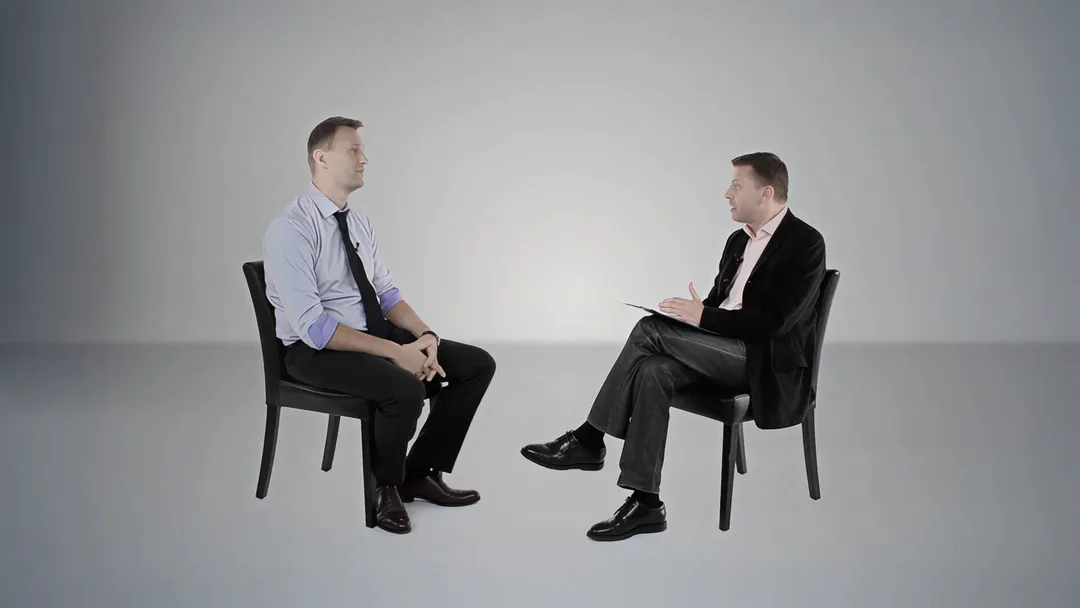
Hello, I’m Leonid Parfyonov,
co-founder of the League of Voters. In the midst
of yet another election campaign, Kommersant
is running a series of dialogues with
public and political figures,
new ones, or perhaps not entirely new, but
certainly people who have revealed themselves in a new way in this
undeniably new social and political
situation. Our guest today is Alexei
Navalny, politician Alexei Navalny.
Is that the right introduction?
Hello. Politician Alexei Navalny.
I think that’s correct.
Tell me, I have a very specific first
question for you. Why do you shout so much
at rallies?
Because I believe in what I’m saying. And
in fact, when speaking publicly at a
rally—I wouldn’t say I often
speak, but when I do, it seems to me
that this is one of the main keys
to success. You simply have to shout
so that a large crowd can hear you.
You have to shout. If you believe in what
you’re saying, shout louder. And I
really do believe. When I say that
I hate these people, I can’t
just say, “I hate these people.”
I hate them, so I yell about it. Yes,
but you also make other people shout
along with you. I understand it on the fifth,
when there was universal outrage, because
the votes had just been counted and then suddenly these
implausible numbers were announced. But on December 24,
to me, for example, it felt like overkill.
Well, why were we going to rallies if not
to rallies in support of something or
in solidarity with someone? We were going to
rallies because we had been robbed
and cheated. We went there and shouted:
“Help!” Because I believe that this
power has been taken away from us. I believe that
power has been taken from me, from these people,
they are taking away our money, our children’s future,
and so on. And we understand perfectly well
that I’m not going anywhere, I’m not leaving
this country. I want to stay here. I
will make sure that power returns to
the people. And I am part of those people. And I
am saying that if our demands
are not met, then
we will take it all back. So
you yourself have identified as a politician. I,
to be honest, have never been able to understand it.
Why is it that some people simply cannot help but write? I
understand that—“I can’t stay silent,” and all that.
But why do they go into politics?
Is it that they can’t help but lead
others, can’t help but propose a program
of action? You see, when you simply observe
some kind of injustice,
everyone reacts differently: some write
an angry article about it, some simply
turn away and sheepishly pretend
that nothing at all is happening, while
others think something must be done, that
something has to be fixed. I can’t just watch
all this. I believe that everyone should
take an active stance.
I actually wanted to ask you about your legal
practice. Somehow I couldn’t find
anything about it. In a few words, can you
say what you do as a lawyer?
As a lawyer, this is what I do. Let’s say you became
a co-founder of LLC Romashka. Your partners
are diluting your stake, want to push you out,
or are looting your company. So you
come to me and say, “Alexei,
they won’t give me the documents—go demand
them.” I’m the number one lawyer in Russia when it comes
to obtaining documentation, and in fact the entire
body of commercial court practice on
document retrieval
Is there a law office called Alexei
Navalny? It’s not a law office. I
am myself a lawyer, Alexei Navalny. Under
the law on the legal profession, I
must belong to a bar association.
I do belong to one, and
I practice independently.
Roughly how many cases do you handle?
Well, I
in my main specialty.
I take on exactly as many clients as
I need in order to earn enough money
to support my office and my family. That’s
three or four clients. You need to earn enough
to be able, in your spare time, as I understand it,
to engage in
work on
the budget. My annual budget right now
is, I think, somewhere around $300,000,
but part of that money
is financed through the RosPil project,
where the money is raised simply
from ordinary people. That isn’t my money. And their salaries
are paid by 20,000 people who
finance RosPil. You emerged under conditions
in which becoming this kind of
public figure—even if
you were kept off television, still
you managed to become a recognizable public figure
at a time when it seemed to everyone that no such public rise
was possible without the approval of
Vladislav Surkov. And, uh,
the first theory was that you had been given the go-ahead
because, supposedly, these two Kremlin “towers”
—rival factions within the Kremlin—were competing with each other, and
Surkov, they say, was at Transneft.
He was chairman of the board of directors there, and one of your
most high-profile exposés was
about the extra billions at Transneft.
No matter how many investigations I did,
there was always a theory that
the whole thing had been commissioned by the opposing side.
Our system is set up in such a way that
no one ever believes there can be
a person who goes around
catching crooks or exposing them
simply because he likes doing it and believes in it.
No one believes you can do things
without being commissioned, that you can write articles without
being commissioned, go to the prosecutor's office without being commissioned,
and so on. I wasn't counting on getting
what I couldn't get. I didn't care
about television. I mean, I wasn't trying to get onto
TV, and I didn't need to go around
asking someone, "Listen, put me on
television so I can make a name for myself." I
was doing my investigations,
posting my boring documents on my blog.
People gradually started finding them interesting.
And it all spread. When I
asked, "File complaints together with
me," at first there were
30 people filing them with me, then 300,
then 3,000. And fighting
corruption, fighting crooks—that's
exciting. It's basically like
an internet series, really.
And then, on the air at one of the radio stations,
you casually let slip the phrase, "the party of crooks
and thieves." And that caught on too. It
caught on. Well, it caught on because
it's true. I was trying to make the fight
against United Russia into something almost fun. I mean,
I sincerely, with all my heart and soul,
hate it, can't stand it. And I
believe it has to be fought, but at the same time
there shouldn't be any special strain or melodrama in it.
There shouldn't be.
Tell me, there's another version of events: there was a movement,
right, in which alongside you were
Yevgenia Albats and Masha Gaidar. And according to another
conspiracy theory,
that was where you were sent off into
nationalist movements. Let our good
our good
culturological theories have their say,
you know, if you search for Navalny, you get
7 million results. You just have to
dig around and find something. But you were
in a movement, right, that looked nothing like
that at all.
Well, Zhenya Albats, a close friend of mine,
was of course never a member of the movement,
never. As for all this—there's some kind of
stereotype that Navalny somehow turned to
nationalism,
right. But simply between that movement and
nationalists—well, I was in the Yabloko party
for many years, in Yabloko, a liberal party,
which I joined out of conviction.
I joined it on principle.
It seems to me that the Navalny of that
past, who more or less fits with
that movement, and then the Navalny of
the present,
the Navalny of the past and the Navalny of
the present—and, I hope, the Navalny of
the future—are all one and the same
Navalny. I mean, I believe I am
absolutely honest with people and with
myself. When I joined the
Yabloko party, I believed there should be no
illegal immigration, and that we should not
be making those kinds of budget transfers
to the Caucasus. I still believe that now. It's just that in
traditional Russian political discourse,
it's customary to label
people who say, "We are against
illegal immigration," as nationalists. And
so, well, some people call it
patriotism. In America, liberals and
Democrats vote for building
a wall on the Mexican border. They're not
nationalists. Not nationalists. But here
for some reason they say, "Well, look at him, he doesn't like
Ramzan Kadyrov. So probably
he doesn't like him because he doesn't like Chechens.
That's all nationalism."
And were you expelled from Yabloko specifically with
that wording—for nationalism?
"Propaganda of nationalist ideas"
was the official wording.
And what was the precedent? What specific case of
propaganda did they mean? Ah—I wrote
an article
in which I said that
turning the agenda of so-called
nationalist issues—migration, ethnic
crime, the situation of Russians outside
Russia—into a taboo was a major mistake. And
liberals and democrats should discuss these
problems instead of ceding that agenda
to some right-wing fringe figures, because
if normal people don't discuss it,
then it will be discussed by
outright neo-Nazis and fascists, while
the problems are real, and liberals and democrats
are obliged to respond to these
problems and offer their own answers.
Well, there was a series of articles,
and naturally the question arose that under no
circumstances should the word "nationalism"
forbidden. And then came the usual set
of clichés and stereotypes, and so on. I
will definitely ask Grigory about this
Yavlinsky, who, we hope, will also
end up in this chair. And, as I
understand it, this is also your answer to the most
common question after shouting at a rally
question: "Why do you go to the Russian
March?"
Exactly the same: you have to go, because
there are voters there too.
Well, because that's exactly how it is.
It's not because there are voters there,
but because it's a problem. And if we do not
want the Russian March to consist of
some Sieg-heiling youth, then
normal people who are
concerned about the problem of illegal migration should come.
It concerns me. I live in the Marina
district, and there are markets all around me
everywhere. I see Tajiks who
live in my basement, in some kind of
poverty. And because of that poverty they constantly
commit crimes. This
problem worries me. I want to discuss it
properly. I do not want the absence
of discussion to lead to violence in the
streets. I
And why did you need to go with Vladimir Tor
to see Father Vsevolod Chaplin?
I simply didn't know Chaplin personally.
So Tor suggested that I meet with him.
I was very happy to
meet him. We discussed all these issues.
I gave my own view. Chaplin
gave his view of these problems. That is
completely normal. And I don't see
anything wrong here. I asked him: "Why do you
want to send all
protesters into the army?"
Well, he smiled and said: "Well, you know,
I stand by..." He stood by his
opinion on some issues. Why would he want
to send protesters into the army?
It seems to me that it was more of a
rhetorical device. I don't know what was
going on in his head. I would say that
on most issues we
agreed more than we disagreed.
That's why I asked about Vladimir Tor. I
watched his speech at Sakharov Avenue (site of Moscow protest rallies) again
and it began, well, in my
view, rather creepily. Forgive me, Russian people,
for standing on the same stage. Here
I am, as a Russian, well, on the same stage with
a minister from Putin's government,
Kudrin — we should really finish
that quote. When someone addresses me as a Russian with
something like, "Goy esi, good
fellow" (an archaic, folkloric Russian greeting), I feel I don't need
such defenders. Why once again
shout oneself hoarse that only Russian
nationalists, somehow, want Russian freedom more than anyone else?
I don't think that
Tor or anyone else there — Tor, Chaplin,
or whoever — needs any of my
services in defending or whitewashing them. I
for a combination of reasons, I go and
stand on stage with various people, among
whom Tor is not the most exotic
character. And I think you can see that
perfectly well, since right now you too are
taking part in this civic movement in exactly the same way.
And what do you think — nationalism in general,
you apparently distinguish between healthy and
unhealthy forms — is it an indispensable component
of any political activity? For example,
Vladimir
Putin also flirts with it from time to time.
sometimes by meeting with football fans, sometimes, quite
recently,
Look, there are healthy people and
unhealthy people. The unhealthy ones need to be treated
or persuaded. The point is not nationalism.
And we need to stop making some kind of
fetish out of the term. I am talking about the real
agenda, about real problems. If we are
discussing illegal migration, then that
is somehow considered nationalism. But I
discuss illegal migration today, and
tomorrow I discuss corporate governance
in companies. For me, basically,
these are simply issues. I
list them separated by commas, and to pull
one out from among these issues, from the whole set
of problems I discuss, and
say, "Here you're a nationalist, and here
you're a bit of a liberal" — that's some kind of,
well, it seems to me completely
irrelevant discussion, especially in the
context of Russian politics, particularly the
non-systemic opposition, where everything is simply mixed together
in a heap and no one understands what is right-wing
and what is left-wing. This whole discussion of whether to allow
nationalism in or keep it out is all, uh,
well, it's just wrong and
strange. What matters are the issues. Putin
is periodically forced to address
certain problems that really strike a nerve.
Yes. When they feel that
Kondopoga happened (the 2006 ethnic riot in Karelia), that there really was
a major ethnic conflict there,
because the police, the local authorities, and
so on had let it all slide, they
are forced to react. Then they
First he says that the only Russian
nationalist is someone who alone
how did he put it, that only a fool can
call himself a Russian nationalist.
In the next interview he says that
he and Medvedev are also Russian
nationalists, and so on. So in that
sense, he jumps around. I don’t. I simply
discuss certain problems. I have
a view on these problems. It doesn’t
change.
There was once a play by Konstantin
Simonov called The Russian Question. Yes,
that was during Stalin’s campaign against
cosmopolitanism and the assertion, so to speak, of
Russian priorities in everything. Do you
think there is such a thing as the Russian
question? When I listened to Tor, I
realized that this is being said all over again.
It’s what I was reading 30 years ago in
the magazine Our Contemporary, that we are
the majority, the great Russians, and we are being
pushed aside; some non-Russian власть is
oppressing us, but our hour will come and we will, well,
show everyone.
Well, the Russian question does exist; there’s no need to
refer to it, as you put it, with a three-letter
word starting with “R.” And there’s no melodrama here. And
the point is not that Russians somehow have nothing—
Russians do have a problem which,
for example, consists in the fact that the Russian people
are the largest divided people in
Europe. A fact is a fact. That
problem exists, it does. But that does not mean
anything in itself. It does not mean that tomorrow
we must unite, put on red
shirts, and set samovars everywhere.
All right. What else makes up the Russian
question? Well,
the fact that Russians are deteriorating,
dying out, drinking themselves to death, and that the
population is shrinking. It’s not the small ethnic groups who are
to blame for that.
And who says, who says that some
Russian question is caused by
It is implied, implied, that
the Russians will still show them, because we are
the majority, but some power that is not ours, not
Russian. Bingo. So everything
you just mentioned, listing
a set of clichés and stereotypes, shows
that this question, all these things, need to be
discussed without hysteria and without
dragging any peoples into it. I don’t see any
clichés or stereotypes except in Russian Marches (nationalist demonstrations in Russia),
not in what I say. Yes, when I go to a
Russian March, I am my own
independent little Russian March.
And in my Russian March there is no
conspiracy against Russians, no
little peoples, no blood-drinkers or
anything of the sort. If we are drinking ourselves away
and degrading, we ourselves are to blame.
The authorities we elected are to blame.
So my point is that this is a
Russian authority. Still, let’s then
emphasize this:
Russian, Russian-state authority existing in the
state called the Russian Federation. This
authority must be changed, and we must
strive, including by political
means, to make people stop drinking so much,
smoking so much, and stop
degrading. And at last we must
come up with some kind of unified strategy
for what we are going to do about Russians who
remain outside Russia. Obviously,
it is one thing in the Baltics, somewhat different in Turkmenistan,
and so on. There is nothing in these problems
that requires any kind of
emotional strain or some special app- app-
approach, or again, tearing open on oneself
a loose red shirt.
Especially since neither yours nor mine is
red. All right. And with your rather
acute sense of the national question,
what did you make of Putin’s remark
about Akunin being an ethnic Georgian?
I have no desire whatsoever to defend
citizen Putin, but specifically
to pick on him over this
rather unfortunate phrase, I think, is not
worth it. We all say unfortunate things
from time to time. I am absolutely convinced
that Putin has decided for himself that
he will be president of Russia for as long as
he exists. In other words, he is
either president, or he is nothing.
He has driven himself into this trap. But
I believe he still does have a way
out.
What is it?
Well,
not to be afraid and to gradually begin
delegating this power, loosening
the system. He has grabbed so much power for himself
that he can’t do anything with it. And
now he sits over this
boiling pot that is about to explode.
And he understands that it is about to explode
and scald him with boiling water, but he still
keeps holding it in his hands. So
you mean it would have been better if
Medvedev had gone for a second term?
It would be better if the president were elected by
the people of the Russian Federation. I think that
in a fair election they would hardly have elected
Medvedev.
I strongly doubt it. But I am
sure that, uh,
it would have been possible to create such a system in which
in which a normally elected
President of the Russian Federation would give
Putin security guarantees, specifically for
him and his family. Not even just as
a backroom deal between two people,
it should be an element of
public consensus. But, in the end,
all of us want this, uh,
transfer of power to happen not in the form of
an Orange Revolution or a green,
golden, Arab Spring, and so on.
We want there to be no
burning cars in the streets. This is what
not just two people who are supposed to
reach an agreement between themselves want. This is what
140 million people want. The newly elected
president will explain it to all 140 million people,
put it all in writing, and it will be supported by
the new parliament.
And do your political ambitions go as far as
the presidency?
First, we need to make sure there are
free elections. If there are free
elections, including presidential ones, then I
will fight for a leading position. I
assume, and I am sure, yes, that if there are
truly free
presidential elections, all sorts of people will come out
to take part in them. And we
will see politicians who are new and old,
different, brave, and not so brave. I
will fight for a leading position in
this system. But there’s no time left,
March 14. Who cares that, well,
forget it, just like this constant talk about nationalism
all the time. You’re being weighed down by certain words and
unnecessary symbols. There is no
calendar. There is a country, and in it live
140 million people. They want lawfully
elected authorities whom they will
respect. Just because some Churov (Vladimir Churov, former head of Russia’s Central Election Commission)
wrote in a calendar that certain
procedures would take place on March 4, that
means absolutely nothing.
And we will make sure that
proper elections are announced for the State
Duma, for the presidency, and for all
the rest as well—mayoral and any other
elections. And what is happening now,
is irrelevant. You know, over the last
10 years, from the sale of oil and gas alone,
Russia received 2 trillion dollars. We
could have bought ourselves any reform. But here we are:
12 years have passed, and all these, uh, grandmothers,
grandfathers, young and elderly people who
loved Putin—we are now sitting here in
an old Russian melancholy and realizing that what have we
bought or received? Military reform? No.
Interior Ministry reform? No. Judicial reform? No.
Pension reform? No. There is nothing. Did we
build any roads? In all of Putin’s time,
we have not built a single major
highway. I mean, it’s pointless even to compare it with China.
Not
a single railway line. Well, we keep knocking together some
pipelines at a cost three times
higher than what they cost to build in other countries.
That’s all. We got nothing. Yes,
a huge amount of real estate in
Spain and in London belongs to various
Russian officials, but that is hardly something for us
to be proud of. And
there just isn’t that feeling of, uh,
pride in our country. Our satellites
are increasingly entering the dense layers of water
rather than whatever necessary layers of the
atmosphere. I wanted to ask about a goal, about
a national ideal, about a dream.
I came across a phrase in one of your interviews
saying that Russia could
become, what was it, a metaphysical,
irrational Canada. What does
that mean?
Russians are people who, despite the fact that
this is a European civilization, well,
we are a little special; we like being
special, a bit odd, perhaps,
right?
So Canada seems to you like
a country that is, generally speaking, prosperous,
boring, and although it resembles Russia, it is still
not Russia. But we would add our quirks
to that prosperity, those maples and lakes,
and all that. I simply think that our
distinctiveness, our irrationality and
metaphysical nature, do not consist in the fact that
we are doomed to have crooks in Mercedeses,
that a car will always be parked on the
sidewalk, and there will always be some kind of mess,
and pipes will keep bursting. I am absolutely sure
that we can, in general, become
a country with a European level of coziness and
comfort, but there will still be, there will be
something wonderful about us,
something special, while at the same time it will be an ordinary
routine European life. You walk out of
your house, and there is no car parked on your
sidewalk, the traffic cop does not take bribes from you, and
you elect and re-elect the president,
and there are none of these feudal estates,
racing off into the distance
in Mercedeses with various eagles,
coats of arms, and so on. That is not where our
distinctiveness and metaphysical nature lie.
Well, so large and still more
Canada. Thank you, Alexei Navalny. In
the series of dialogues with
public and political figures on
Kommersant, the conversation was conducted by Leonid
Parfyonov, co-founder of the League of Voters.
Goodbye. Thank you.
At