An interview with Mikhail Zygar about motivation, fears, and protests
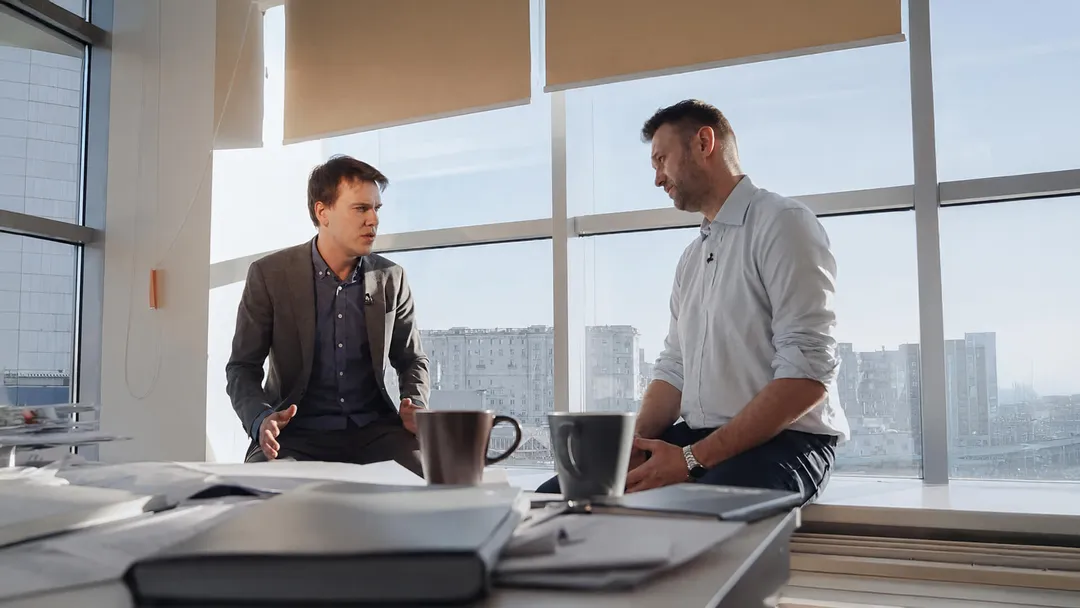
Hello everyone. Usually at this time we
say, “Good evening,” because at this
time TV Rain (Dozhd, an independent Russian TV channel) usually airs
the program “R Knows.” But it’s clearly not evening now,
it’s only daytime, and we’re not in our
studio. Well, many people know that the place
where TV Rain’s studio is located
has had some problems lately,
so we’re in the middle of moving.
And on the way, we stopped by the Anti-Corruption Foundation
where we’re sitting on a windowsill
next to Alexei Navalny. Hi. I’m
very glad—well, I wanted to say that I’m
very glad to be back in your studio again,
but I’m also very glad you dropped by to see me. I
have the opportunity to say that today our
studio is located on this windowsill, yes.
Well.
Alexei, I’d like to talk about something that
people probably discuss with you least often—
that is, not to talk about you at all,
but simply to talk about what
concerns us, the people who are not
involved in
politics, generally speaking.
What concerns us is this: have you had a chance to watch
the film *Leviathan* yet? No, I haven’t seen it, and
I don’t want to watch it at home. I want to see it on
the big screen. After all, in 10 months
of house arrest, I’ll say—perhaps
this is a somewhat illegal thing—I learned
how to use torrents,
because I had no other
way to watch
new films. But I still wanted to watch it
on a big screen, so I’m
putting off the pleasure. And what did I manage
to watch during that time? I watched—
I simply had the opportunity to take
rankings and watch them from number one to
one hundred: the top 100 films that won
Oscars, the top 100 films with supporting
actors, the top 100 films by
companies like Columbia Pictures, and so on. I had a lot
of time. I mean, the life of a person
who for 10 years—10
years, please—10 months is under
house arrest looks like
a computer and torrents.
And
that’s prohibited, and computers are prohibited too,
but in any case, there are people in your home
who
can do it, and you can always peek over someone’s shoulder. I
still worked a great deal, and during
the second part of my house arrest, in
the second half, employees of the Anti-Corruption Foundation
were already allowed to come visit me,
we held planning meetings, and part of the office
effectively moved to my home. But even so,
you still have a lot of free time
because you don’t go anywhere,
you don’t spend time
sitting in traffic, you don’t need to shave, iron shirts,
and so on. Those are the little perks of house arrest.
Although by the second month it becomes very
wearisome. A great deal of the Foundation’s effort,
if you follow the publications on the
website, goes specifically into
explaining what Article 20 is and,
more broadly, into this kind of verbal struggle against
illicit enrichment.
And where does the confidence come from that this is
really what concerns people? From
our experience, quite simply. The point isn’t even
that it already concerns people; we need
to explain to people what ought to concern them,
because, again, we have extensive experience—
a lot of experience hearing the response
when we publish particular cases of
corruption. We publish someone’s dacha (country house) on
screen, and people say: yes, terrible corruption—but what do you
propose? And for quite a while now we’ve
moved beyond the format in
which we simply talked about
corruption, pointed at a person,
and said, “He’s a crook—look, here’s the scheme by
which he stole a billion.” We propose
systemic solutions for somehow fighting corruption,
and from my point of view, and from the point
of view of the Foundation’s staff,
a legislative framework that would
prevent it is the key thing here.
That’s why we want, through concrete
examples, to show what illicit
enrichment is, but also to lobby and call on
all of us to push forward
a specific law that would prevent illicit
enrichment. There are
several questions here, yes. First: concrete
examples—there are a great many concrete examples,
detailed, very high-quality journalistic
work,
presented to the public. But who said that
this will impress the public?
There is simply a counter-
assumption that in our country everyone
has long known that
everyone steals, everyone has long had an idea of
the scale on which this can happen,
and that it’s not this fact—not a detailed, thorough
description of how
it happens. It may be a bit more sophisticated there, a bit
more crude here, but really, who could this
surprise? The main question is: why? Why devote
your life to repeating the same
story over and over, when basically everyone
already knows about it? One’s life
is worth devoting to things that
seem important. This seems important to me,
and therefore, despite the fact that I
of course closely follow the public’s reaction,
and closely watch how
I can prove it better, more simply, more persuasively,
nevertheless, I do what I believe is
necessary. And even if tomorrow it turns out
suddenly that this
will lose all appeal for everyone, will completely lose...
interest in this, and the TV Rain channel
whether they stop interviewing me or not
or stop talking about some of the things that
we uncover, I will still keep
doing it, because I consider it
important. I understand. Exactly.
what you're saying, and we've noticed for a long time that if, three
years ago, every investigation of ours
would cause an explosion online, now
people say, well yes, the Anti-Corruption Foundation
there they go again, they've found some
guy who stole a billion. So what?
That's not interesting. Let's watch
the latest Oscar gifs instead, but even so
we still think this is important, and I
am absolutely convinced that corruption is
that a corrupt system is
the main obstacle to the country's
development. My efforts are aimed at
removing this obstacle so that
Russia can
develop. Well, to take corruption as a
phenomenon—well, that's of course a fantastical
yes, there is corruption in Norway too, and in
Denmark as well, but the scale is
different. So at the moment
the main task is to explain as much as possible
well, and
as long as anyone still cares about it, let's say.
The second part, as for Article 20,
of the convention/article.
how serious is it, or is it just
really an answer to the question people ask
when they say: all right, you've
just explained all this, but what exactly
are you proposing? Well, we are proposing this.
This is an appeal to some very
strange mechanism that
could work if the rest of the
machine were working, but you keep writing
that the whole machine doesn't work, so
let's just, say, repaint this machine's
fender yellow, and then everything will become
much better. If the whole machine isn't
working, what's the point? Well, not exactly. We
aren't proposing to paint it yellow after all;
or add an extra air conditioner, but
it still won't run. What we're trying to propose is
installing an engine from a fundamentally new
system, because officials—
state power, how is
state power structured? It is the foundation
of the state, and at present
corruption and the corrupt system—this
system of delegation, where Putin
says: you may steal, but do what
I tell you to do—
Well, he doesn't say it like that. But it's a kind of
informal consensus. He doesn't say it
out loud, but it's completely obvious from
what is happening in the country. You only have to
remember Serdyukov, for example.
There was a lot of shouting that he would be jailed
because he stole billions, but nevertheless
for his latest court hearing
just the day before yesterday he arrived in a car with
a flashing official light. You see, that is exactly
what shows this kind of
social contract—not a social contract,
but a pact between Putin and the entire
Russian bureaucracy: that you can do
whatever you want, you can steal
billions, but the main thing is to preserve
political loyalty on fundamentally
important issues. That's it.
We propose changing this entire system.
We propose creating a system in which
this arrangement of theirs
will stop working. But at the same time, of course,
I am not going to be disingenuous. I am not
going to deceive anyone: for
our country to begin developing
normally, some basic things must be changed.
Judicial reform, first and foremost.
No anti-corruption effort in our country
will seriously begin to work until there is
judicial reform, until judges
become independent. Reform of
public administration, reform of
federalism and federal relations,
interbudgetary relations. Power must
be transferred from Moscow to the regions, to
the cities first of all. Until these three
things happen—these are already political
slogans now, yes, but they simply
follow quite naturally nevertheless.
These things are connected. But now, right now,
sitting in front of me is one of the leaders
of the Progress Party, who has already gone down this road, and I
am trying to show, and have always maintained,
that we have never approached the problem of
corruption narrowly. It was never the case
that I, you know, wrote: well, there are some
crooks, and maybe Putin will notice
them and drive them out. That is,
I have always criticized this
state mechanism. It seems to me, well,
I tried to do it without any
hypocrisy, speaking about how I know it
works, and I think I have never
ignored those broader socio-political
questions—important, fundamentally important ones.
It's just that people focus only on corruption because
there is more attention on my work now, and
if once people only asked me for my
opinion on corruption, now
they ask for my opinion on
they increasingly ask for my views
on broader
issues. So what are you aiming for, Alexei?
I aim to be useful.
Personally, I personally—well, personally, I think all
people strive to be useful.
I don't think I can say anything
original in that respect. I won't say anything
that any normal
person wouldn't say: I strive to be a normal
family man, a good father, a good husband, and
in my public work, in
some broader human
mission, I try to be useful
to society and the state. I try
in the short time allotted to me
to do as many right
things as possible. As for being a normal family man—where
is the line you cannot
cross? What do you mean?
And in your, in your political
activity, any politician has to
sacrifice something. Mm-hmm. In particular, sometimes
the interests of their family. What happened
over the past month obviously
shows
that the safety of Alexei
Navalny’s family is under threat because of his
professional activity. Does that mean
that thoughts about this kind of
harm to yourself and your family must have
crossed your mind? Well, you’re proceeding from a certain
premise or assumption that there are
some family interests that are separate from, or even at odds with,
my public interests. But the truth is
that my family
supports what I do, and in that
sense, my
family is prepared to put up with all the inconveniences
it experiences and, quite frankly,
rightly tolerates them for the sake of
all of us doing something right together, because
I’m not the only one doing all these
right things—my wife, together with
me, who sits through those searches
or gets dragged in for questioning—this is
her part of the contribution to the right things
that I do. It seems to me that this is
the right way for a family to be organized. Yes, but that
sounds a little unconvincing, because
everyone lives in roughly similar
conditions, everyone assesses those risks, everyone—
every person, when choosing a job,
thinks about what good it will bring them
and what they are risking. And many of your
colleagues, understanding that perhaps it was not
best for them to keep working in Russia,
left. Mm-hmm. Leonid Volkov left to work
abroad, another left to study, Vladimir Ashurkov
left because—what do you mean, “left”?
Volkov was here yesterday. He works there
but comes here. Ashurkov was forced
to flee, and so on. What did you say to them
when they came to share
their decision: “I think I’ll go work
in Luxembourg”? I said nothing. It’s a personal
choice. I can’t force people
to do
something in a situation where, for example,
specifically, Volkov doesn’t receive a salary from
us at the foundation, but he does quite a lot
of work. He has to earn a living somewhere. He
worked in Yekaterinburg, then he
worked in Moscow for a while,
then he found a job in Luxembourg,
works in Luxembourg, comes here regularly,
and works here. In fact, he has always been a volunteer
for us. Actually, not that many people work at the foundation
as staff; far more people work with us
who don’t receive a single
kopeck from us, who somewhere—I don’t
know—in Moscow or anywhere else, in
Luxembourg, in Africa, or on the moon—somewhere
they work, and then they come here to put in
their few hours honestly. That’s basically
how everything is set up, because we can’t
pay everyone
a salary. I don’t doubt that there are
people who are ready for volunteer
work. I
I’m trying to imagine the mindset
of a person who is watching us
and says, “I still don’t believe it,”
I still
just—it’s like in the film *Beware of the Car* (a famous Soviet comedy),
where Papanov says to Mironov,
“They’ll put you in prison, and you…”
Well, when choosing what I do, I
understand what could happen to me because of it
and every time I’m forced
to weigh the pros and cons. It actually seems strange to me
that I’m being asked these questions, excuse me,
by TV Rain (an independent Russian TV channel), which is filming me
here right now, because you were thrown out of
your studio, because you were taken off the air, and yet
none of you ran away. So
you also assess your own
risks. Because everyone assesses them in the same way:
first, everyone has an idea and
the right motivation to do the right
things in life. So some people choose
money, go to Channel One, and lie
on that Channel One all day long, and maybe
they’re happy with that, or maybe they
suffer over it in the evening. And someone else goes
to practice the profession they love—
whether as a lawyer at the Anti-Corruption Foundation
or a camera operator at TV Rain—
and does it despite the fact that they
earn less money, because they get
thrown out of the studio, because they have to
live in some strange, makeshift, almost underground
conditions with an uncertain future, because, well,
who knows for how long. I hope you will continue
to exist and develop. But after all,
you could be shut down tomorrow too, just like us. But
for you, I think, and not for me, that
doesn’t mean there’s no point—it just means something different.
Right. So everyone, everyone pays their own
price. Yours is a little lower, mine is
a little higher—but tomorrow everything could
change. It’s everyone’s choice. I make
my choice. The people who come to
work for us at the Anti-Corruption
Foundation—I explain all of this to them
at the very first interview: that you will be
searched—everyone has been searched; they will
take away your personal phones and computers;
there will be surveillance, there will be pressure, covert
email, illegal criminal
prosecutions, but nevertheless a huge
number of people come to do it, well,
because it’s the right thing to do, because they
don’t want to live in a country where, for no reason,
people are searched, their computers are confiscated, and
some crooks run the country. Is there a
final goal to this? Yes, we want to change
Russia. For you personally and for me personally, I
want to do—I want, over the course of my
life, as I already said, to do the right
things. I want to—I want to make my contribution
to making Russia a normal
country where people can work in peace
and live in peace. Well, I, you know,
I started smirking because I
recognized myself. If I, if I give, well,
comments—if I give comments
to foreign journalists who
ask, like, you’re TV Rain (an independent Russian TV channel),
I usually say very similar things.
Misha, then please tell the truth
to your audience right now. But I
just remembered that I say similar things
to foreign journalists. We want
foreign journalists
usually take such remarks with tears in their eyes
because the foreign
press is structured a little more
idealistically, and they themselves, as in
your case, I’m sure, sincerely
say these words quite sincerely. You
consider them a little bit
like, why say these grand
banalities? But the truth is
that life works like this: either you
do something good, or you simply
stare at your desk, trying not to notice what
is happening around you, and keep quiet
just in case. Or you do
bad things. In fact, bad things are done by
a relatively small number of people
who are greatly helped by those who simply
stare at their desks. Our responsibility,
those of us who understand what is happening,
is to do the right things and try
to genuinely make our small contribution
to the country’s development. But what is wrong with that?
It may sound lofty, but only for that is it
worth living, isn’t it?
No? There are different ways to do good things.
Your path is exposing those people
who
who steal, among other things. That’s one path, but
we do many things. We are building a party
now in order to win
elections. I ran in the Moscow mayoral election. I
wasn’t only exposing things—I was proposing options
for development
and
and for the external situation as well, likewise. But
before, they didn’t let us into elections. The party
wasn’t registered—then it was registered,
but it still isn’t allowed to take part in elections, let’s put it that way.
Now they’re not letting me myself take part in
elections either. Well then, that means among the things left to us are
holding rallies and going out into the
streets, as happens all over the world,
as it happens in Europe, in the United States, as
it happened hundreds and thousands of years before
us, and apparently will keep happening after
us. So if we are unhappy with what
is happening, if we are not allowed into elections, if we
are not allowed to submit our bills, and so
on—well then, we will gather people,
go out into the streets, and demand our rights.
That is the only way, because there is no
such
system or scenario in which we
can keep sitting at home, somewhere
being indignant, posting on Facebook, and then
some other people will come and, on our behalf, put pressure
on this government so that it
changes. The government will not change
if the country’s residents do not put pressure on it. That is
our task: to organize that pressure
through elections, through elections,
through going out into the street and handing out leaflets. I
understand that many
people—office workers and those whom
it is customary to call the middle class—also
view the idea a bit ironically. Like,
what, we’re going to go and
stand in the street like lunatics, or
hand out some little newspapers? Without that,
nothing will work, unfortunately. There are no
formats in which
simply with likes on
Facebook political regimes are moved.
When people are standing in the street—and I’m not even
saying they have to stand there
endlessly, or seize buildings,
or set something on fire—but simply
the presence of a large number of people in the
street puts pressure on the authorities.
Moreover, I want to tell you that the authorities themselves—
you see—when they want
to demonstrate that they have popular
support, what do they do? What does
Ramzan Kadyrov do today? He takes some of
his men—his *basmachi* (a derogatory term for armed followers)—out into the street, and they
walk around with slogans. The same thing
happened in Ingushetia, and Putin does the same
when he needs to show that he has
support somewhere beyond television,
that beyond the virtual, he drags
state employees out into the street. And by doing so they
acknowledge that people must physically
stand somewhere, and other people, seeing this,
will change
the system. You mentioned Chechnya. Is Chechnya, for you,
part of the Russian Federation? Chechnya
is, of course, part of Russia, but at the
same time, what is happening in Chechnya
is completely unacceptable to me, and I see that
it is part of the Russian Federation in a
formal sense: we send money there, there
are all sorts of attributes of state power there.
Portraits of Putin hang there as symbols of Russia, but in essence
it is a separate region where
a Sharia state is being created,
a Sharia army is being formed, where the actual
laws of the Russian Federation do not apply,
where even
the principle enshrined in
the Constitution—that ours is a secular
state—is being denied. Some people walk around saying
there is no problem with them having religious
feelings and loving their prophet, but
when the entire republic is driven out on a
workday to demonstrate, that is something
wrong. Moreover, when the head
of a constituent entity of the Russian Federation
declares as his personal enemies those who
support the publication of cartoons there,
that says that we have created
a little state within the country
that denies the principles of the Russian
Federation, and this is absolutely unacceptable, and
it will lead to major problems in
the future. What do you think about these cartoons?
Should they be published? I
believe that, in general, should they
be published in the Russian media? We have
a Constitution, laws, customs
of coexistence, and so on. Within that
framework, anyone has the right to publish
any cartoons. Moreover, I want
to say that in
Russia in 2015, such questions should not
even arise in principle, because
most of the people who are in
power—or simply living here—we all lived in
the Soviet Union. All those people who
now walk around with crosses or with
placards saying “we love the Prophet” took courses in
scientific atheism at university, you understand. We
did not just have some kind of
ideology; one of the foundations of the Soviet
state was the complete denial of religion,
not merely mocking it, but
destroying it—churches were blown up there, and
so against that background—churches
were blown up, admittedly in a somewhat different
historical period, all right, but
you understand—in the 1970s and
1980s, in those churches that had not been
blown up, there were warehouses; they were turned into
barracks, and so on. And films,
cartoons—everything from that
time was simply
child’s play compared with what
French cartoonists publish, and
everyone knows it. You see, all those people back then
were shouting, “There is no God, religion is the opium
of the people,” and now they have become such
religious fundamentalists.
Should the Russian media urgently print
the cartoons? Do you join
that call, do you share the view that
they absolutely should? I absolutely believe
they should. As a sign of solidarity, the media
should of course support those
cartoonists, because those killed were not
just some cartoonists, but
victims of religious fanatics.
Terrorists attacked a media newsroom and killed people
for publishing certain
materials. Once again, these
cartoons—it is ridiculous even to say that they are
more offensive than what
existed in Russia, in the USSR, in Chechnya,
in Azerbaijan, in Armenia—everywhere—just
a few years ago. The leaders of
our country—Putin studied at law school,
and in his official curriculum
there was scientific atheism. All party members
could not even enter a church,
and if they had their children baptized, they could
be expelled. For example, when
my grandmother had my father baptized, she did it secretly
because he was a party member, and
they were afraid he would be expelled for it. And
now those very same people who in
the 1970s and 1980s
jailed people for distributing the Bible
are now posing before us as
guardians of “spiritual bonds”; they are religious
fundamentalists. This is simply
an utterly outrageous hypocrisy, and in
our country of all places,
all those guys in uniform ought to keep quiet,
the ones who would not let people attend
religious processions (Orthodox cross processions) just 20 years ago. Processions—
that is, in our country
officials
who display religious
beliefs, religious feelings—they
are not the problem. Those who display
religious feelings—let them display
them. But those who try to impose their
religiosity on us, their pretended
religiosity on us, and those who try
to turn Russia into a fundamentalist
state, whether Orthodox or
Islamic—those are the ones who should keep quiet and
stay out of it. Because my favorite example
in this regard is that our head of the Supreme
Court, Lebedev, when he was a judge in the 1970s,
sent to prison the father of the well-known
journalist Zoya Svetova, with a sentence for
what? For distributing the Bible. And later
this same Lebedev upholds the verdict
saying that they offended the feelings of believers
by dancing in a church. In what church?
One that did not exist in Soviet
times—the Cathedral of Christ the Saviour was blown up, as
we know. And back then, for some reason, he in
the 1970s did not remember his
great religiosity or think about the rights
of believers. So all of this is
a grand fiction, this whole
business of official believers—crooks who can
put on anything, you understand. Right now
they have put on crosses; if necessary, they will
walk around with some kind of...
Satanic ones—I think right now you are speaking
more or less the way
many of your critics do, who
say that he has no faith at all because
he is a nationalist. He took part in the Russian March (an annual Russian nationalist rally),
and at that moment he had already told everyone
everything about himself. Since then—since then,
well, the thesis is that people do not change.
If he did that—I spoke at the Russian
March, and I can repeat it now. I
took part in the Russian March and said that
I am against illegal migration. I still say
that now. I was asking now not about the Russian March
but about the thesis that no one can
change their views, that people over time
do not develop. So if the chairman
of the Supreme Court once made such a
decision, does that mean he must
keep churning them out? I am simply saying
that in that case the chairman of the Supreme
Court should not have made such a
decision. And if he once made
such decisions, he is not just a private person—he is
a judge. That means that now he should not
remain chairman of the Supreme Court,
and he should not be the person
who makes 100 percent
opposite decisions and then supplies
them with some ideological basis, saying
that they are all violating and insulting
the rights of believers. And at this demonstration in
Grozny, half the people marching are former Komsomol members (the Soviet Communist youth organization),
you understand, and former Party officials
who used to shout, “Religion is the opium of the people,”
and now they are shouting, “Let’s kill
those who publish cartoons.” In this
there is nothing but hypocrisy, and nothing
but an attempt to fit absolutely anything
under the theme of, “Let’s make sure power
stays in our hands forever.” Was lustration needed?
Of course it was.
It was a colossal mistake
—a major mistake that did not
allow the country to develop. It was
a mistake made by Yeltsin, and yes,
the political elite, the leadership, of course,
there should have been lustration: the top
all those Party—all the top Party
officials should have been excluded
from political work. They should not have been—
the Central Committee of the CPSU (Communist Party of the Soviet Union), local Party leaders—
all of them. I believe that this whole
Komsomol gang—despite the fact that
most of them went into business
and became oligarchs—
should have been removed
from these spheres of activity in political matters.
And of course employees of the MVD (Ministry of Internal Affairs) and the KGB
who were specifically responsible for political
repression, the special departments, should
also have been prohibited from
holding public office,
engaging in teaching,
and so on. That is, according to the principle
used in the Czech Republic and in
Poland, they would have had the opportunity to go into
business, to do some kind of
political consulting outside the state,
and everything would have been fine, and then the country
would, I think, have developed more
stably. So in general, in your view, for
the future, lustration is a positive
step that helps society
develop? Of course. Lustration does not
mean that these people will be hanged from lampposts tomorrow.
On the contrary, it means that these
people will, in some way, bear some
punishment and will have the opportunity
to start a new life in other fields,
to apply whatever talents they have,
which they undoubtedly do have. These people would not have seized
power in the country if they did not possess
some talents. It is simply that in certain
specific spheres we say: we do not
trust you, guys, to run
the state. We do not trust you, for example,
to teach our children. Everything else—
please, do as you like: go into business if you want,
travel, entertain yourselves,
go into show business, create something,
whatever. But in some areas you are forbidden to work.
That would have been a completely normal
transition. This system of lustration
is precisely what allows countries to get through
moments of political crisis more or less gently,
without creating additional polarization.
I think no—well,
polarization is arising now, when
people say, “We are allowed everything, but those
others are some kind of outcasts.” Some kind of—well, we
see some dressed-up clowns
walking around in, I don’t know, leather
jackets and looking generally rather strange,
who shout that they are supposed to
kill everyone, starting with liberals
and ending with homosexuals. And to quote roughly:
“Only the fear of death
can intimidate the opposition, and then it will not
come out into the streets.” I think this was said by
that very “Surgeon” (nickname of Alexander Zaldostanov, leader of the Night Wolves biker club), some guy with
some kind of fox tails, a leather jacket,
and hats, who himself, frankly speaking,
looks like some kind of—this whole
crowd of theirs looks like a bunch of
caricatured gay characters from
American comedies. And they are the ones
making these statements—that is polarization,
when devils for hire say that we
are going to kill some other
people. Well, polarization is when one
part of society hates another part
of society. That is exactly what is happening. They do not merely
hate—they always, quite directly, this is
literally a part of society. Do you think that behind
these people stands a large part
of society? There is always some part
of society that supports the most
radical views in the most
In a wonderful society, there will be ultra-
conservatives who may want
to kill liberals, and conversely there are
some liberals or pseudo-liberals
who despise their
opponents so much that they want to
deprive them of all rights, impose
voting restrictions, and so on. What matters is that
the mainstream, the majority overall,
balances these points of view and does not
allow radicals to kill
each other. Is there a danger that in
Russia there could begin
a war? Russia is already taking part in a war,
moreover, a war we could not have
imagined—a war with Ukraine. This is a war in which
Russia is participating. That's a different matter.
You asked whether it is likely that in Russia
a civil war could begin. I think that
there still are no such direct
preconditions for that. At least right now I
do not see them. In principle, those
who went to fight in Donbas (a region in eastern Ukraine)—many of them are
people who were either carried away by a false
romanticism or fell for this
sort of imperial propaganda. But generally speaking,
inside the country, if, if
you set aside this part of their nonsense about how
we are supposedly meant to rule the whole
world and seize all neighboring countries,
I do not see that even someone like
Strelkov says that in Russia
there should be created some kind of
corrupt state and that there should
stand a monarch who has stolen all
the national wealth. No, they do not seem
to be saying that. So despite the fact
that there are radicals there—in America there are
radicals, in America even more than in
Russia. There are fanatics who believe
that America should be in charge of everyone
and drop nuclear
bombs on everyone. There are such people there too; they just are not
in power. There are such people in Europe too.
They exist everywhere, and in Russia they will exist too.
It is just that
if they are not given
direct state support, then their
role will be extremely
insignificant. The idea that Russia
should rule the whole world is nonsense.
You said that. But why should we rule the whole
world? And does Russia need at all
to strive to become
a superpower? Russia right now can
aspire to become
a regional superpower. We should aim
in the foreseeable future to become
a leading European
power. In general, for Russia the only possible path in the world
lies through economic
development. Our budget must be
comparable to the budgets of the United States and China. Our
military spending must be comparable
to that of the United States. Right now these are simply figures
of entirely different orders of magnitude. Therefore the task, and it seems to me the path
to becoming a superpower,
does not lie in seizing the countries
of the former Soviet Union, but rather in ensuring that
people become wealthier, GDP per capita grows,
the budget grows, tax revenues grow, and the population increases.
In the United States, the population is more than 350 million people,
and GDP per capita is enormous. Here, by contrast,
the population is shrinking, and GDP per capita
after inflation is frankly laughable.
The population is not shrinking? The population
is shrinking, ours certainly is. Yes, yes—through
the annexation of Crimea, we added about 2
million people, but the population trend is very
bad. And despite the fact that there were certain
spikes connected with the fact that the generation
of the Soviet baby boom had its second
child—the first and second child—we
can see that a demographic pit (a sharp demographic decline) awaits us, and
we will fall into it in the near future. This
will happen in about five years. We will talk about that decline
a little later. But as for superpower status and
national pride, last year
you may have seen that there were several very
interesting opinion polls, and moreover they
were even tracked over time.
It was published how the ratio changed
of those people who would choose
national pride rather than personal
well-being, and vice versa.
Accordingly, the number of those people—those
who would prefer to see the country as a super-
power rather than see themselves as prosperous
individuals—the number of such people
rose sharply. More than 50%
of respondents would rather feel pride
than personally have a lot of money. It seems to me
that all these questions are just so
obviously manipulative. It is like asking
something along the lines of: would you like someone to spit in your
face for 100 rubles? Everyone says no, of course
they do not. There are other polls that
show that when people are asked:
was annexing Crimea a good thing? Good, yes.
Are you personally willing to pay anything at all
for the annexation of Crimea? Everyone says they are not
willing. These simply are not two real alternatives.
So you do not believe that such a
dilemma exists? I believe that this is
an absolutely false dilemma, and no one
should have to pay for becoming
a superpower or for development. On the contrary,
these things are directly connected: we will
become a superpower only if
people become wealthier. If people are paying for it,
if people are paying for the fact that we are supposedly
becoming a superpower, then that is not any kind of
superpower—that is the robbery of the population.
Only through a wealthy, prosperous
population—when families have
four people and there are no problems with
housing, cars, or
healthcare or education.
Only that can be called a superpower in
Denmark, in Norway, in Austria, and even in
Luxembourg—wealthy, prosperous
populations. Not one of these countries has ever
in its life—none of the wealthy, prosperous
residents of these countries would ever think that they
live in superpowers. The countries are small; this is
far from it. Some of them were once superpowers,
but that time has passed. The countries are small,
the population is small. Germany is
certainly a regional superpower.
The United Kingdom, despite its small
size, certainly is one; the United States is.
Why is this needed? Why does any country
—any country with a large population,
a large territory, and great
wealth—inevitably influence
the countries around it? One way or another, others
consult with it. It interacts with them somehow,
and the scale of that interaction is directly
proportional to its money, its population, and
its size. In that sense, small
Japan, which has a relatively small army—though
it is increasing it, by the way—
is, in Asia, a very
important partner and a very significant
country. And in that sense, Russia
will in any case remain influential, even in total poverty.
But if we want that influence
to grow, we must become wealthier.
That is the only path. We can see
that China’s role has grown not because
it bought more submarines, but because
whereas before, some 100 million
people there were going hungry, now no one
is starving; pensions have started being paid there,
the country is developing, the country has become richer,
and the country’s role has increased. If the country becomes
poorer, its role will decline. Right now Russia,
despite the flood of petrodollars,
is a poor country with a relatively small population,
and a shrinking one. We must break this
trend, develop, and let our people
grow wealthier—then Russia’s role in the world will
increase. What emotions did you
feel at the end of last year, when
the ruble’s exchange rate quite obviously began to fall very quickly,
and economic problems that had not been visible for
a long time began to become
apparent?
Well, in that way there also appeared
some new arguments for saying,
“You see? We told you so.”
Besides, speaking as someone who—
all my accounts have been frozen, and the money,
my savings, were in rubles in
those accounts. And when I saw that my
savings were losing value, I didn’t even have
the option of converting them into foreign currency, unlike
many others. So my emotions in
that respect may even have been a little
stronger than the national average. But
as for the economic situation overall,
yes, of course one can say—and
should say—that everyone had been talking about this,
because we were being fed nonsense that
the country was supposedly developing, that some kind of
prestige was rising. But all of it was
because of the price of oil. When the price of
oil was high, there was swagger; when the price of oil
fell, everything immediately collapsed. So, in other words,
was there some feeling of schadenfreude? No, not schadenfreude.
No—why schadenfreude? It’s just that everyone
had been talking about it for years. I was one of
the people saying it. It was
basically quite obvious that
all of this would collapse as soon as the price of
oil fell. The price of oil fell, everything collapsed, but
there was no schadenfreude, because yes, it collapsed,
but I’m the same person
who goes to the store and buys milk
that has gone up by 40%, and food and so
on. In that sense, the consequences of
this crisis will have to be dealt with by all of us, and
the current government, which is built on the
principle of “after us, the flood” (meaning: let disaster come after we’re gone)—for them,
it really is all the same; they
have grabbed what they could, and they want to preserve their
power. Is that just a propaganda line? No,
not at all—I
am absolutely convinced that, since
they want to keep power for a long time, they do not, in general,
not care what happens next. They do
care what happens next, but they
are prepared to make decisions that harm
the entire country in order to strengthen their
power. In that sense, they have
an absolute priority, which is
that Putin should be president for life,
and everything else is of
secondary or tertiary importance. That is
the whole point. Because with this
war against Ukraine, they have dealt
a colossal blow to Russia’s geopolitical
interests in the long term,
turning Russia into a raw-material appendage
of the West once and for all. They have dealt
a colossal blow to the country’s economic
development. But they did it
deliberately, because they think like this:
“After us, the flood. The main thing is that I
die peacefully in my bed as President
of the Russian Federation, and what happens
tomorrow—I couldn’t care less.” I see no other
logic in them. That is, the goal of making
Russia a great power, and making themselves
great historical figures—none of
the
leadership, ideally, would mind that,
but the priority is to remain the country’s leader,
to remain a kind of emperor. Therefore,
for them it is better even to remain an emperor over
a poor, torn-apart country than to become a person,
a lawful president who shared
power with everyone, even of a great country.
That alternative is much worse for them.
Their unconditional priority is precisely the preservation of
power at any cost.
with the rest, yes, to share power.
Please explain how this could happen very
simply. The current president and the Kremlin, they
have taken all the power and all the money for themselves, and
sharing power means electing
governors, which the majority of the country demands,
electing city leaders, which the majority of the country demands.
The majority of the country wants this. How should it
happen? Elections. First of all, elections
for governors, elections for mayors. Second,
an increase in powers and funding
for mayors. The entire financial system is now
set up so that Moscow siphons off, like
a giant pump, money from the entire country. This
has to stop. People on the ground, first and foremost
city mayors, must have
both the authority and the money. And lastly,
the most important thing in this system is
elections to representative bodies of government.
Our Progress Party is not being allowed onto
the ballot. Yes, it would seem that I
ran in the Moscow mayoral election and got almost
30%. My colleagues and I have the right
to run in
elections and represent some part of
the population. It seems obvious that we do, but
I am not being allowed, and the Progress Party is not being
registered. This
must stop, and there must be free
access for everyone who wants to take part in
elections. Because, for example, in the last
Moscow City Duma elections, not one of my
associates was even remotely allowed
to get in. This has to change. And I am not
saying that tomorrow United Russia
will get 0% and we will get 99%, but there will be a more
balanced Duma where there truly
will be more political forces
represented. And let Putin keep
some kind of majority in the Duma, but it will be
a majority of, say, 35%. And there will also be
more communists, perhaps,
perhaps nationalists, perhaps there will be
more liberals, and so on. But it
will be a Duma that represents the interests
of Russian citizens. Can one conclude from
this that Alexei Navalny is a politician who
a few years ago publicly used the slogan
"Putin behind bars," and has now revised
his views and now says that Putin
should allow the Progress Party to enter
the Duma?
...the rules for regional elections. The slogan
I used at rallies was:
"Putin is a thief," and I still say that
Putin is a thief, and his friends are thieves and
corrupt officials, and we demand that we be
given the opportunity to take part in elections to
the State Duma and to regional legislative
assemblies, where we will either win or
take the number of seats that properly belongs to us.
That is all. Nothing has
changed compared with what I
said then. I demanded it then, and
I demand it now. It is just that back then I
didn't have a party. Now I do, and it is not being
allowed in precisely because they are afraid, because
they understand that we will take
a significant number of seats.
The economic difficulties at the end of last
year — are they an opportunity?
No, not an opportunity for anyone. It is a blow to
this system of power, a blow to the entire
population, and through that a blow to the whole
power structure. But it is entirely possible, and we
are seeing it now, that they will choose
the option under which they will tighten
the political situation, screw the screws tighter,
and put even more pressure on everyone in order
to compensate for their problems
in the economy. This is exactly where all those
costumed clowns come from, the ones who
shout that they are going to kill the opposition.
That comes from exactly the same place. Because there is
an economic...
Have you managed to speak with any of
the major political figures — opponents,
allies? In this short time I have only managed
to meet with the leadership there,
of PARNAS (a Russian opposition party), for example, with Kasyanov and Nemtsov,
in order to, well, among other things,
talk through certain matters connected with
regional elections and so on.
Because there are plans; life does not
stop anyway, regardless of whether I am under arrest
or not under arrest. There will be some
election campaigns, and in order for
people not to get in each other's way in
the regional elections...
to reach agreements, in the sense that, as you know, I said that
I believe we should hold a large
mass street demonstration at the end of
February or the beginning of March, and of course
our colleagues in the December 5 coalition and PARNAS, and
many others — they matter, and I am discussing this with them.
Now, among the well-known
political figures, with the leadership
of PARNAS so far... Have you spoken with
Kudrin? No. There has been some exchange recently,
from time to time, but that was quite a while ago. With
Khodorkovsky — with Khodorkovsky I do not have
the ability to leave Russia, and he does not have
the ability to... We have not yet spoken on Skype.
We have corresponded. Well, we will talk, yes.
We correspond quite actively, and
even when I was under house arrest, well,
we corresponded through third parties.
So in that sense, you know that I
even launched a joint project with him, and
the contacts are there, of course. Do you consider him
an ally, a partner? I consider everyone
allies — I consider allies all those
who tell the truth about this political
regime. There may be some differences in views,
personal sensitivities, criticism, and so on,
but that is normal. They are politicians; otherwise
we would all be one person. Then just
a couple more questions about the distant past: what...
What do you think about privatization? Is it necessary
to come up with some kind of mechanism, like
the one, for example, that was once proposed by
Khodorkovsky for legalizing
the final results of privatization
in the 1990s, or should there be some kind of review
of it? It needs to be divided up, yes. Yes, there is
the privatization that took place with
difficulties—legal in some places,
illegal in others, right in some cases, wrong in others.
Then there were the so-called loans-for-shares auctions
when the largest enterprises were simply
handed out to some dubious people who
claimed that they would manage them
efficiently. They did not do that, and instead
they simply became billionaires. I
am convinced that in order to overcome
the problem of those loans-for-shares auctions and the
property that no one considers
legitimate—not even the owners themselves, because
they are really just quasi-holders—
why can Putin so easily crush all
these oligarchs, jail them without regard for the law, and
so on? Because, yes, nobody believes
that Norilsk Nickel should
belong to Potanin or Prokhorov,
nobody believes that Uralkali should
for some reason belong to some
Suleiman Kerimov, or whoever it was—
Rybolovlev. No one accepts this,
including those very oligarchs. That is why I
am convinced that we need a mechanism, something
like a compensatory
tax—the kind that was used in Britain,
for example, after privatization, when
the difference would simply be paid between
the acquisition price and the market
value today, and we would all begin
to regard it as a kind of
fair act. Then property
would be legitimized, and then no one would
be outraged that some
district party committee (Soviet local Communist Party office) guys came along again,
from the Komsomol (Soviet Communist youth organization), and declared Norilsk Nickel—
a gigantic enterprise on which
the entire Soviet Union had labored—
to be simply their own, and then
made billions from it without doing
anything. They took those billions abroad and bought
some, I don’t know, football
clubs or God knows what. No one
recognizes or accepts this, and no one ever
will. So in order to overcome
this, we must of course introduce
a proper, normal mechanism—not
nationalization, but compensatory taxes.
Who should sort out these enterprises,
draw up a list?
A normal government would review it.
A government of public trust could do all this.
It can all be done; it is not
a problem. The Finance Ministry calculates more
complex things, the Economic Development Ministry calculates
more complex things, so a set of
enterprises whose privatization
took place in such an obviously
unfair way during those loans-for-shares
auctions is, first and foremost, well known.
All the largest enterprises, all
the largest enterprises. And moreover, I
would say there were reverse deals as well. For
example, the well-known deal involving the buyback of
Abramovich’s Sibneft: Abramovich bought Sib
neft for $100 million, and then Gazprom bought it back from him
for several billion.
That was a kind of de-privatization, but it was
a monstrous corrupt scheme. That
money—the difference, that unlawfully
obtained gain received by Abramovich—should also
be taxed. A significant
portion of that money should be returned, because
no one will ever recognize this, no one
will ever admit that this was
right, because it was obviously
wrong, unjust, and
corrupt. Returning to the previous
topic about partners and allies, am I
right in understanding that these people
who were clearly
involved in the unfair loans-for-shares
auctions and who now, or in the recent
past, owned these enterprises—
it is hard to regard them as partners and allies?
Whom do you mean? Well, Nemtsov, for example,
always spoke out against the loans-for-shares
auctions. Kasyanov did not take part in them. In
that sense, in the RPR
PARNAS party, I am not talking about
the people you listed conditionally—for example, Prokhorov,
for example, Khodorkovsky, and so on.
There, he was
the owner of such an enterprise, and
as far as I know, Khodorkovsky is actually
one of the people who
quite actively promote the idea of a
compensatory tax—one of the schemes in
that regard. In 2003, a couple of
months before—Khodorkovsky, in that sense, there are no
problems. Here they support it with
the RPR-PARNAS party. I do not see any
problems in that sense there. With December 5,
with Yabloko, which put forward this idea,
there are no problems either. With Prokhorov, well,
okay, then Prokhorov should, should
fall under this compensatory tax
and should pay.
Figures like Fridman, Potanin, Abramovich
and others, who could
be—or who in one way or another are
perhaps passive, but still some kind of
political players in Russia. Which
of them are political players?
They could be, but they are not. That means
they are sitting under the bed and rejoicing
that they have managed to drag under the bed
their billions, and they work
for this regime, as long as the regime does not take
those billions away from them. When the regime does take them away
When it comes to billions, as in Yevtushenkov’s case, they
start squeaking pitifully about something. Well,
fine, fine. I’m very glad that you’re taking all of it
away. In that sense, even just from the example of
this whole picture, we can see
the utter pointlessness of this entire oligarchic
gang. They are unnecessary; in fact, they are harmful.
They do not manage anything effectively, they do nothing,
they play no positive
political role. More than that,
they are so cowardly and worldly that
when things are taken from them, they hand it all over with
an ingratiating little smile. So I do not, for even a
second, see in these people any
political allies of mine or
anything of the sort. Even though perhaps
somewhere, over tea, they curse Putin
in the strongest terms—in that sense,
well, so what if they do? They are part
of this regime, not its foundation. In that
respect, the Yevtushenkov case is
—if not lawful—then at
least entirely logical and proper
from Putin’s point of view. Of course,
it is perfectly logical.
[music]
From a procedural and legal
standpoint, it is completely senseless and disgusting.
And if anyone should have been jailed there, then
all those Bashkir officials (from Bashkortostan, a republic of Russia)
who allowed the privatization should have been jailed,
and those ministers too—Medvedev in particular,
the then president, or
prime minister, who approved all of this,
because Yevtushenkov could not have
stolen
Bashneft; that was done by officials. So
the officials should be jailed instead.
But that is precisely why this case was carried out in such
a way—exactly because
no one in Russia really recognizes large-scale private property
as legitimate at all. It is so
illegitimate that, by default,
everyone
supports any move by the state,
because it is easy to say: he has a lot of money,
let’s take it all back. That is the problem. Now I want
to quote something.
Yes: “A drunken obkom boss (regional Communist Party chief in the Soviet era),”
“who traded Russia for security guarantees
for his family.”
Mm-hmm. Who is that about? About Yeltsin. Moreover, I
can say this as a former
great admirer of Yeltsin, as someone
who, foolishly, once supported
—like many of us did—various
of his strange actions, from
the loans-for-shares auctions
to the shelling of the Supreme Soviet. And in that
sense, when I look at what
is happening around me and to me, well, I
understand that this is, in some sense,
a kind of metaphysical price for the fact that I once
supported all that. I was a huge
Yeltsin fan. So what did we get in the
end? We got exactly this: he had the
hopes of millions of people like me,
who wanted change, and he traded all of that
away so that some little bunch of
crooks could now own—well, *Vedomosti* writes that they have
some $300 million worth of
real estate in Moscow—but for the sake of
guarantees for these pathetic
crooks of his, he traded away the hopes, aspirations, and
future of an entire vast country. And the fact that
well,
they may be nice people—I gather that perhaps
you, Mikhail, are friends with that whole riffraff
company, Chenko and the rest—I will not take back
a single word. I believe that this really
was the case: at the end of the regime there was
simply a deranged alcoholic there, controlled by
his corrupt family,
which made sure that we sold
the country’s future in exchange for their miserable
$100 million. Yes, that is exactly
how it is. Interesting how suddenly you shifted
to
to personalities—who I am friends with or not. I know
what you’re getting at there; I simply ignore all of that.
I ignore it.
So that means you are not very concerned
about
about us starting with insulting
the feelings of believers, and now insulting
the feelings of
people who are ideologically
finely tuned—you are not afraid of offending those people for
whom, broadly speaking, Yeltsin is a kind of
ideal?
He was once an ideal for me too.
That is precisely why I feel it is my
responsibility to say this so plainly.
Many people are outraged by this. What I am saying
now contains rather offensive words.
Offensive words were spoken about—about
a deceased person, a deceased
statesman. That deceased
statesman was an outstanding
man, but what he did at the end
cannot be called anything else, because
forgive me, once again I am forced
to repeat myself: what is happening now to the TV Rain channel (*Dozhd*, an independent Russian TV channel)
—it is being driven out from everywhere; everywhere there is
censorship, some incomprehensible people,
random figures who came to power
for no good reason. Aren’t you afraid? I am afraid,
on the contrary, I believe that my
responsibility is
to say this absolutely plainly.
Maybe that will also push you
to finally acknowledge it and move
on. And there are things one must not
say—things I may think, but I
would never say, because it is
dangerous, because it would offend someone.
Well, of course, any person can
say different things, as long as he does not cross
there, beyond the bounds of the Criminal Code, for
politicians and public figures in general
Well, there is an added responsibility.
There are some things you shouldn’t say or
do, because for some people you are
a role model. And of course, you shouldn’t
pass on bad examples to others.
What topics would you avoid
talking about? Well, it’s not even really about topics, but about
specific questions. Unfortunately, I
swear a lot. So when I’m in a public
setting, when I might be
filmed or there’s a journalist around, I try
not to do that, because that too is
a bad example. Everyone has
bad habits, and there’s no need to
put them on display—you should work on
getting rid of them yourself. I think politicians,
for example, shouldn’t... I like shooting, I
do practical shooting, but I’m not
going to... I don’t know, there was a period in
my life when I promoted it. I still
support civilian gun ownership now,
but I think politicians should not
pose for photos with
assault rifles or pistols, or go shooting at a
range for the cameras, and so on. Because, well,
that’s a bad example. If you want
to go shooting, then go shooting—but there’s no need to
turn it into a public theme.
And so on. Do you picture
your hypothetical voter
when you make such vivid
appeals? Yes—any person, really. Here, I once had
a search that lasted 75 hours, and for 4.5 of those hours I was
giving lectures to bored militiamen (police officers).
A bored militiaman is, is, is one of
my favorite audiences, actually,
because I have to deal with them a lot.
They detain me, take me somewhere,
and I discuss things with them with great pleasure,
from Sechin’s salary (Igor Sechin, head of Rosneft) to
the salaries of police officers,
comparing them in Russia and the United States,
the housing situation in general, corruption,
and so on. I’m ready to talk to anyone.
In that sense, for me there isn’t really
a preferred audience that I
most enjoy speaking to. Though, for example,
those same police officers and
pensioners—talking with them
is the most interesting, because they argue
with you, and that makes for an interesting conversation. But
in general, I’m happy to talk with
anyone, and that’s a politician’s job. It’s always more interesting
to speak to a more aggressive audience.
To what extent
do you have to make your views
sharper, or on the contrary, less
sharp, depending on how you think
the audience will react? Let me give
you an example.
Take Crimea, for instance, which
“is ours” (a reference to the slogan “Crimea is ours”)—to what extent
is that the position of a politician who should
of course speak that way? Well, I
try, on every issue, to express
my actual thoughts and not
be dishonest. Okay, there’s this idea that
for a politician, saying
“Crimea is not ours” is political suicide. So in any case, I
will say this: my politics, my approach—well, many people
repeat this now, but I’m not
convinced it brings any
political dividends. Everyone said,
“Crimea is ours.” I said what I believe. I say
that the annexation of Crimea was
illegal, and in the long-term strategic perspective
it will do no one any good. Crimea
will not develop; it will turn into
a territory like Northern Cyprus,
and that will only create problems for us. But now—and
this is the second part that
for example Ukrainians and many liberals don’t like—I
say that there is neither a political
nor a legal way to return Crimea
back, and this Crimea problem that has been
created will be like
the issue of a united Jerusalem—it will be
something we’ll be discussing with
Ukraine for 200 years, and by then our grandchildren and
great-grandchildren will be around, and no one will agree on anything.
That is, Crimea will become one of those
disputed territories in the world that will
poison life for both Russia and Europe for many, many
years.
That’s my answer to the question of what I think
about Crimea, not an answer to
whether I take into account the hypothetical opinion of
the audience. I try to discard all those
political consulting tricks,
sociological calculations—I’ve even concluded that nobody
really knows anything.
I say what I think
needs to be said, and in that sense I’m not trying
to come up with some formula that
will please everyone. Because any such
formula that pleases everyone
ends up pleasing no one. In that case,
I might as well just say what they say on
television—everyone already hears that. What’s the point? Who needs
that? I represent the part of society
that wants positive change, and for me it’s
more important not simply what they think, but
to persuade them with my arguments. Okay, and
when the cancellation of commuter trains in
Vologda Region was called
“the genocide of the Russian people,” what exactly was behind
that? It was a metaphor, of course, it was
a metaphor, because these days we all
love talking about “genocide” and
so on. “Genocide” here, “genocide” there—the Investigative Committee
opens something like 15
genocide cases a month. So, well,
that’s what I was playing off in a
polemical
way—this whole idea. They’re all shouting about
some kind of genocide, that genocide is happening against
They say there is genocide going on in Donbas—but let’s
look at what is happening in Vologda here, and
where the real genocide of the Russian
people is actually taking place, in my view. If we’re
going to talk and shout about genocide, then let’s
talk about Vologda or the Pskov
region, where the population is simply being drunk into submission
Where—well, there is some kind of complete
lawlessness going on there.
In many regions, local commuter trains are being canceled, and
that is often the only way
for people to get around at all. So that’s what I’m saying:
let’s compare where
the real genocide is. That was the point of the post, that is,
it was a kind of
joke. What is genocide? Genocide is
the destruction of a particular group because
I even repeated that several times in the post
specifically so people would understand that throwing around the word
“genocide” is stupid. In Russian
political tradition now, it has become customary to call
just about anything genocide.
And so that is exactly the point
I was playing on. Of course, genocide is
a truly colossal, monstrous
tragedy, and that word should be used
extremely rarely. What are you afraid of?
I’m afraid of many things, like any other
person. I worry about all sorts of things.
Well, I can’t say I’m afraid exactly, but I don’t
like heights, for example. I really don’t like
it when someone sits on a balcony with their back
to the edge. We’re sitting low right now—well,
not that low, it’s the fifth floor. So I’m an ordinary
normal person with ordinary reflexes
and so on. So if, Mikhail, right now
you were to pull out a gun and leave it here, I would clearly
feel
discomfort and anxiety, let’s put it that way, like
everyone else when it comes to physical
objects.
Well then, is there no fear of becoming disappointed in
what you are
doing? No, there isn’t. I believe in it now.
That is, if such a moment comes,
I think—I wouldn’t want it
to come—but I may become disappointed in something.
But right now I believe in it, so why would I
be disappointed? On the contrary,
I believe in what we—I believe in what I
am saying. I believe that the things I
propose for the country’s development are useful.
I believe in Russia’s future in general. I’m
an optimist by nature.
And that helps me. And what will happen to you
in
a year? It’s hard for me to say.
Usually in interviews
I answer something like this: on January 20, 2016,
I will still be a person who
tries to draw other people into this work—
that was a bad start—who will
try to bring other people in
to change Russia for the better. That is
what I am doing now, and I would like
to keep doing it next year too, only better, more
effectively, and more successfully than now. I would like
to be a better Alexei Navalny
than the one I am right now.
Right now, I am one Alexei Navalny. And
in a year, I would like to be
a better Alexei.
Navalny: it’s a constant battle with yourself, yes.
I wanted to say that the sun is already
high, but in fact the sun has already gone behind the clouds.
So I think we will take that
as a good sign. We can—yes, it has
stopped shining in my eyes, and I think
that means we can wrap up our
conversation and wait for next year—or
maybe even meet before then.
See you. All the best.
Should we have shaken hands at the end
or not? What do you mean? I just
thought we should do something, you know.