Alexei Navalny’s interview with Radio Svoboda (Radio Liberty)
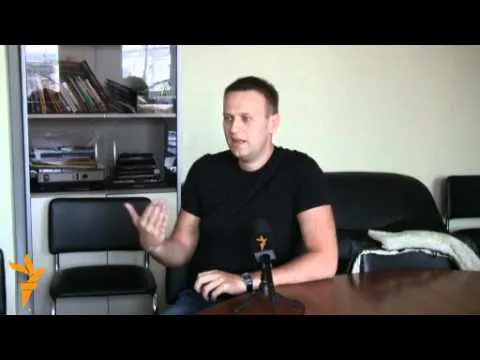
We are recording an interview with the well-known
blogger Alexei Navalny
and thank you very much for your time and for
agreeing
to speak with us. I think this conversation
will certainly be both interesting and useful for
a great many people who are now
following your work, including
on
the internet. In a certain sense, a defender
of minority shareholders.
In Russia, we have a small number
of huge corporations that are, on the whole,
under state
control, with the state as the dominant
shareholder, and all the affairs of these
corporations are decided accordingly. Every one of us sees this, whether it is
a manager of one of these corporations or even
some grandmother living in Ryazan (a city southeast of Moscow).
It would seem she is quite far removed from
all of this, but everyone sees that
these corporations—and the Russian economy in general—
which is built around these
corporations, are structured in such a way that
a fairly small number of people
grow rich and live lives of utterly
staggering luxury. Meanwhile,
the shareholders of these corporations, and ordinary
Russian citizens, who are
indirect shareholders in these corporations
through the state, receive
essentially nothing. Every day in
the newspapers we read about scandals and
multi-billion-ruble embezzlement schemes that
are described completely openly and directly.
Yet nothing happens. So I decided
to do something very simple. I decided:
if a crime is being committed so brazenly,
openly, and obviously, why not simply
try filing a lawsuit
in court? Why not try writing
complaints to the prosecutor's office, and so on? It is a fairly
simple thing, lying right
on the surface. It is just that before me, this was
mostly something no one
was doing. And my activity rather
quickly attracted attention, simply because
it was a kind of formalization of what
everyone talks about. Everyone says: they stole
a billion dollars. I say: they stole
a billion dollars—here is my police report.
And without any doubt, there was also
a personal motivation here. It all started with money—
money that was stolen
directly from me. I invested
my personal funds in the so-called
blue chips, these largest corporations,
mostly commodity companies, mostly oil companies.
And when I invested my money and
received neither dividends nor any increase in
share value, while again, every
single day I read in the newspapers how these
people were buying football clubs, flying
on private
jets, enjoying fabulous
parties in Courchevel (a luxury French ski resort), I understood
that the money stolen from me
was exactly the money with which they
were living their glamorous, luxurious lives. And I
do not understand how
oil companies can pay me
such tiny dividends, while a small
offshore company, which exports the products of these
companies, earns billions, and its
head, Putin's friend Gennady
Timchenko, makes the Forbes list. That is what
became, in a certain sense,
a matter of my own personal money, and I
considered it a personal
insult to me as a shareholder, since
everything was so obvious.
It would be hypocritical to think—and on my part it would be hypocritical
to claim
that my activity is not
political. Corruption is the most important
issue on the country's political agenda,
the question of how
oil is exported, how
the proceeds from the sale of oil
and gas are distributed—these are political questions. The fact that I
investigate specific cases means these are
absolutely political investigations, and
politically motivated as well.
So yes, this activity is
political, 100 percent. That is the first point. The second is
regarding some kind of
supposed popularity of mine—why has the format
of my work received such
support? I am not inclined to overestimate
my popularity, but I
think that the support I do receive
is connected with the fact that I was one of the first people
to move to a new format of work. That is,
before that, the opposition movement
consisted of various
dissidents from Soviet times and from the early
perestroika period, who were
absolutely wonderful people, and they are
absolutely wonderful people, but in
the current situation they are completely
irrelevant, outdated morally,
physically, in every sense—their activity now
looks completely archaic. Then there
were
and still are those kinds of
liberals and democrats associated with the romantic
Yeltsin period, who now, in
retrospect, looking back, turned out not to be
such great liberals, not such great
democrats. And very many of them changed their colors
or even now, while still proclaiming
themselves liberals and democrats, they are quite
openly supportive of Putin and even say
that we do not need any free elections
because in free elections
the terrible
fascists would mostly win. So that is the kind of
opinion of the people from the 1990s; by now
it has finally degenerated into
simply some kind of
empty talk. My own approach is based on the idea that
you can, of course,
rhetorically denounce the bloody Putin regime, but
you have to do something practical in
that direction. That is why I
have focused on practical
investigations, practical work,
practical lawsuits, and everything I
say is backed up by certain
concrete actions. If someone
says that these people stole and that
crooks and thieves have gathered around Putin, I
say roughly the same thing, but I
back it up by trying to prosecute them
through criminal proceedings. Whether it works or not,
whether it succeeds or not, whether it works or does not work,
is a separate question, but I do cause them
problems, and people now seem to me ready
to support politicians who
create problems for this
government. It seems to me that I have received
some support in part because I do not
play obviously meaningless games. If there
were elections, I would without any doubt
take part in them. But there are no elections
now. That strange procedure
that is called elections is not really an election
at all; in it, you control
nothing. And that is exactly why opposition
politicians who are completely focused
on getting a piece of paper from the Ministry of Justice
and then running with that paper from the Ministry of Justice to
the election commission and asking it
to draw something for you there, or
conversely, not to take away the votes
that you rightfully received—that is not
politics. It is more like running in
some kind of race of laboratory rats through
a maze built for them by those very
Kremlin crooks. I do not want to be in that
maze, and what I do, what I try to do, is
create my own agenda rather than
follow the Kremlin's timetable and its
parties and so on. There are specific cases,
and I deal with those specific cases.
Taking part in this fake procedure from
beginning to end is meaningless, and I will not
be involved in
it.
I understand perfectly well what situation I am in.
I can clearly see examples, including
sad and even tragic ones, such as
the case of Sergei Magnitsky
and what could happen, and
did happen, to people who were involved in
investigating corruption. Therefore I
assess the reasonable risk that
exists; I am aware of it, but again, it
is not an obstacle to my
work. From the outset I understood these
risks. I am doing all this consciously, in
conditions where that risk exists, and I
accept it. Well, you see, there is the moon,
there is the sky, there is the sun, and there are risks. I
live in this country and in this
system, so for me this is not
some major problem. I have never
been threatened. It is hard to say whether there is
danger or no danger; I take a philosophical view of
it. I believe that any
person in Russia who is engaged in
something right and useful bears
a certain risk. That includes journalists,
politicians, public figures—anyone,
really. There is even a certain irony in the fact
that you, Radio Liberty (the Russian service of Radio Free Europe/Radio Liberty), are asking this question,
because the closest analogy to what
is happening now—these DDoS attacks on
LiveJournal—is what they used to do in
the Soviet Union, when the so-called
jammers were operating, and they jammed what
they called enemy voices. That led
only to the fact that any person in the Soviet Union
as soon as they bought a radio receiver would immediately
rush to try to tune in to that very Radio
Liberty, regardless of whether
they were actually interested in what was being said or not.
It was something forbidden. Many years have passed now,
but the authorities are acting
just as stupidly. They are simply trying to obstruct,
trying
to jam, to temporarily stop these
attacks on servers and so on, and
to prevent information from spreading
through LiveJournal and other social
networks, not to let people coordinate there.
But all this only leads to the fact that people
who are, well, becoming politicized
spread information, and these attacks in
modern information society have
extremely low effectiveness. And those people who before that
had not thought about politics and
viewed LiveJournal as a place where
you could look at cats, dogs, or
some pictures—they are irritated, and
their irritation is growing precisely because
they understand that some crooks in
the Kremlin, using taxpayers’ money,
are obstructing them, preventing them from looking at
their cats, and I am sure that these
utterly foolish attacks and attempts
to interfere will only lead to
a rise in protest sentiment