Alexei Navalny’s interview with Radio Liberty, May 29, 2015
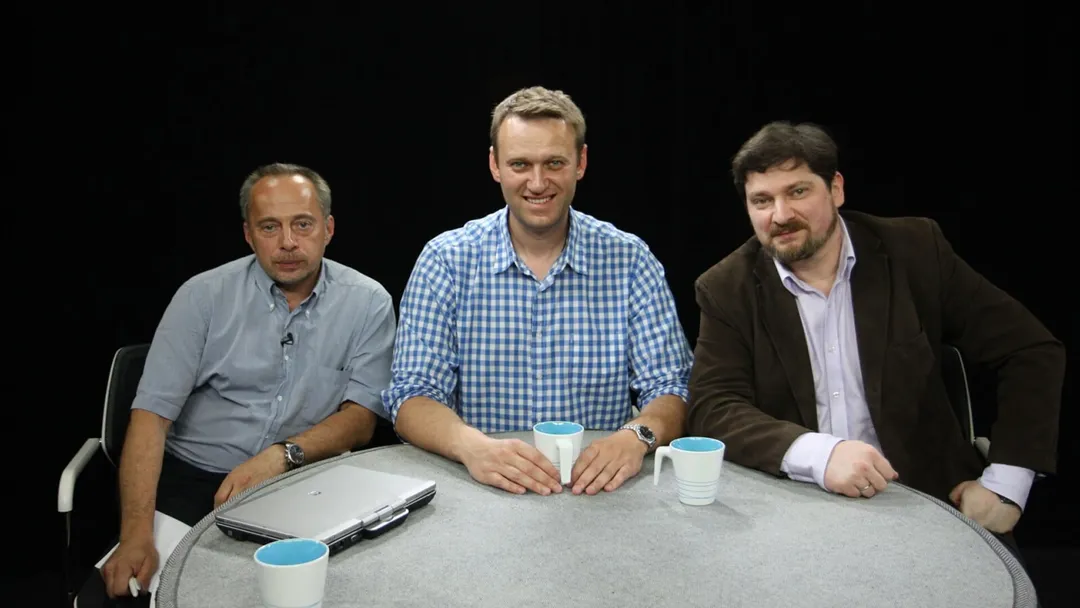
This is Radio Svoboda (Radio Liberty), and on the air is the program
Face to the Event. Today, this is a joint
broadcast by Radio Svoboda and Voice of America.
The program is hosted by Mikhail Sokolov, and together
with me it will also be hosted by Danila Perovich, uh,
my colleague, a special correspondent
for Voice of America in Moscow. Today, you will ask your
questions live on the air
to Alexei Navalny, well-known, I would
say the best-known today and
the most popular opposition politician,
the founder of the Anti-Corruption Foundation and
the leader
of the unregistered Progress Party.
Incidentally, it is not merely unregistered,
but recently the Justice Ministry stripped
it even of that status. He is fighting for the right
for it to become a party. In short, yet another
legal absurdity, another obstacle
for Alexei Navalny in his political
activity, in his human rights
work, and in his anti-
corruption efforts. That is exactly what I wanted
to mention: Alexei Navalny is also,
besides being a leader fighting for
party registration, also the head
of the Anti-Corruption Foundation, and in general we
know him above all
for those things more
than anything else, because quite a long
time ago now, probably about five years
ago, Alexei Navalny gave his first major video interviews
specifically about fighting
corruption, both from the headquarters
of his foundation and in
the Radio Svoboda studio, so this is
in a sense a bit of a return to
familiar ground, but with
what I hope is a welcome addition:
the Russian service of Voice of America, which
may
lend this
conversation a broader international angle.
There is Lyosha (diminutive of Alexei), he has arrived, thank
goodness. I apologize for the slight
delay. Moscow is a difficult city, especially a city
where you did not become mayor. Well, let us
talk right away about current events. Yes, by car and on
the metro, yes, I was running. So, about current events:
the Democratic Coalition, which you do not exactly
quite
lead, is these days opening its
campaign headquarters for the September elections.
The Novosibirsk mayor's office has approved a rally there.
As I understand it, you are going there on June 7.
How do you explain to your supporters
why they should go into these legislative
assemblies and city councils under conditions when
the election campaign is, let us say, not
quite really an election? Yes, there is fraud,
it is unfree, unequal, and so on. First,
and this is very important for our Democratic
Coalition, we use precisely this in
our explanations: it has no leader and
cannot have a leader precisely because
the most important principle of the Democratic
Coalition is competitive procedures.
That is, whoever wins the primaries
becomes the leader, whether regional,
federal, whatever you like. We are not trying
to deceive anyone; we are not saying
that electoral struggle right now is
the most important thing, and we are not trying
to convince anyone that if someone
gets into a legislative assembly in Novosibirsk, in
Kaluga, or in
Kostroma, or in Magadan, exactly,
that will change the entire politics of the country.
But we believed, and still believe, and I have never
backed away from this, that elections are
an important avenue. In 2016
there will be elections to the
Federal Duma; that will be an important
political moment, and it will be a chance for
the opposition to gain political
representation, which it has not had
for the last 13 years at the federal level.
In order to prepare for that, in order
to work through precisely these
primary procedures, in order
to impose them, including on the entire opposition
and on ourselves, we are conducting, if you like, a kind of
test in three regions. We are doing something
completely new. No one has ever
done this before. It is very difficult; very few people agreed
to it,
but so far everyone has agreed that
we really will try to create
an honest, competitive, understandable procedure
under which the candidate lists will be determined
in a new way. All right, but you have already
played with the authorities, or against the authorities, in
the Moscow mayoral election, yes, and after
that it turned out
that, well, at least the opposition said
so,
while on the other side the pro-government candidates
said—more precisely, there was only one of them—
essentially: well, you see, we did allow it,
and yes, we even competed. Do you not think that
under the conditions Misha
mentioned, you are playing ping-pong with the authorities
from a position that is doomed to lose?
Well, Danil, I am not some naive
little boy. I understood all of this perfectly well,
I understood about the marked cards,
I understood about the falsifications; we had seen
this for many years. Nevertheless, looking back
now at 2013, when I
ran, I would still make
exactly the same decision, because that
election campaign was extremely important
in order to show, once again, simply
to ourselves, that people
of liberal-democratic views,
of democratic views, do not
have to remain in the 5 percent ghetto, because
this is, well, the history of Russia, probably, I do not know, since
since 1996, people who
talk about elections, about the need to
fight corruption, about honesty there,
transparency—whoever talks about ideas always
ends up hovering somewhere around the five-percent
threshold. For them, success or failure is
5%. And the Kremlin was pushing that idea very actively
at the time. They were saying, well,
there are some internet heroes out there,
some obscure opposition figures—their ceiling is
five, well maybe 9.9%. In Moscow, we went in
and I officially got 27%, in reality 30%. And
if not for the falsification carried out by the authorities,
there would have been a second round. I am sure that I
would have won it. That is—well, there is one
small detail. Our mutual acquaintance,
the very important journalist Lena Milashina, recently
quite recently
cited a very interesting text that
was sent by a very interesting person. What matters
is not how you played—what matters is not your
it is not how you played, but the score on the
scoreboard. But you understand, this is not
ping-pong or football, and all these analogies
are not entirely appropriate; the metaphors are misplaced
because politics is
a process. During the election campaign, we had
one political reality in
which it was taken as an axiom that democrats in
Russia are people on the edge of
the five-percent threshold. When
the election campaign ended, we
already had a different axiom: that democrats in
Russia, without access to the media, without money, without
favorable conditions and under pressure, can run
a major election campaign and
receive a third of the vote in the largest
city in Russia, where 10% of the country's population lives.
Alexei, tell me: in your project,
there was talk of uniting
the democratic forces. But now we see
the two Gudkovs, Vladimir
Ryzhkov off to the side somewhere, yes, on the basis of
Nechaev's Civic Initiative—it is unclear
whether they are with you or against you. And is
Mikhail Khodorkovsky involved in your
democratic coalition project?
I'll start with the second part. Mikhail
Khodorkovsky is involved, and from the very
beginning he declared
his support. From the outset, we
understood that we could not unite everyone.
What matters is uniting those who are, first of all, ready—right now—
to stop any arguments about
which party vehicle to use, and who are ready to say immediately that in
2016 we are running on the PARNAS platform.
That was not an easy decision. At that point,
the Progress Party had not yet been liquidated.
For example, Vladimir Milov and
Democratic Choice—that is a
registered party—and for them this
decision also came very hard. Nevertheless,
we decided to put an end to this
discussion because it is harmful, and to run
on the basis of RPR-PARNAS. That is the first point. The second
thing that was important—fundamentally important—for
me was those very primaries, so that the lists
would be formed only on a competitive
basis; so that it would not be Navalny, Kasyanov,
or Khodorkovsky drawing up the lists, but rather
the candidates themselves coming forward and proving to people
that they are worthy, and the people forming the lists.
As I already said, not everyone agrees with our
approach, with our concept, so not everyone
joined. But excuse me, I—I
have great respect for the colleagues you mentioned, but I
am not interested in political engineering; I want
to do politics. The formation of
lists, when thousands of people take part in it,
tens of thousands of people—for me, that is what politics
is, and that is interesting. But simply
sitting down, dividing things up, drawing district lines, and
deciding, well, Alexei, since you cannot
run, then Kolya will take first
place, and Petya will take third place—
that does not interest me. That is how they have always done it,
and that is how they end up getting 4%. Absolutely, yes.
But nevertheless, all sorts of critics here
say that, well, this is still a kind of
ping-pong among your own circle, because we
know that you have a popular, well-known
agenda. Much of it, a large part of it,
is based on criticism of the existing
order, and it is
topical, widely discussed, and we know about
the street protests. And at the same time, as it were,
next to you are many politicians about whom
people say, oh, them again. And you too can be accused
of, in a sense, playing an honest
game—meaning, whichever of you is more popular will in the end
ultimately
take this prize for himself, so to speak.
That is an excellent question, because one of the
problems we have encountered is that
even people with democratic convictions
do not actually believe in democracy.
They really do think that any
primaries are just a kind of game in which
Navalny and some other people want
to legitimize a result that is predictable in advance.
That is absolutely not the case. If we
look at the candidates who
are registering—you can go online
and see who has put themselves forward in
Kaluga, Novosibirsk, and Kostroma. I personally know
maybe two people. That is all.
These are all completely new people. Here is one who
organizes demonstrations—you know, I have
seen him there twice.
The only person I know well personally
is Zayakin from Dissernet; he has put himself forward in
Kaluga. All the others are
wonderful entrepreneurs, academics,
or simply local activists
and politicians. I do not know them. And that is
what is truly wonderful about our primaries:
I do not care who becomes a deputy. I
want the strongest people to become deputies, and
so that the strongest candidates would head the list on this issue
we’re changing things here, though actually we’re hardly changing anything, Mish
by the way, because he is talking about something very
important. He says that
experience is gradually being accumulated
without television, without, essentially,
through door-to-door work, experience is being gained
in political campaigning, but you understand
that you are operating in
completely new conditions over the past
year. We understand. That is exactly what I want to ask you about
over the past year in Russia
there has been, in my personal view, perhaps
a fundamental change, a view that may be shared by others
in society. Somehow it happened that into
this ideological split, which
at one time went unnoticed—perhaps
perhaps SPSR, perhaps something else—a whole
society has fallen into it, and now it is “Crimea is ours” (a Russian nationalist slogan after the annexation of Crimea), now it is
a mood that is, generally speaking, effectively normalizing
attitudes toward war. There were Levada Center polls
on this. Once again, how do you feel about the fact
that Crimea has been declared part of Russia
and in this case, is it necessary to persuade
Russians to return to complying with
international agreements? After all, the question
is how we are going to act in this
new political reality, or—and Crimea. Let’s
take it one at a time. So, as for
the new political reality,
we are certainly aware of it, we understand
that those issues, that agenda
which just two years ago turned out to be
marginal—and in fact did not exist even
among nationalists; no one was discussing
Crimea, and nationalists with an imperial agenda
were marginal even within nationalist
circles. Now all of this has blossomed, Putin has
taken the lead, and once again we hear some
meaningless, utterly stupid tales about
how we are supposedly reviving some kind of empire
and conquering Europe, and in that sense it is
even more ridiculous now to hear about
how we are going to conquer the whole world when I
am sitting here writing documents about how in
the Kostroma region, half the people do not have
hot running water
or centralized water supply; in some places there are no proper toilets
That is precisely why, despite the fact that
there really are disagreements on certain issues,
all of this has come back, and
people living without water supply
are dreaming about somehow conquering America. Nevertheless,
an important thing that we
certainly note and know is that all these
issues are not delegated downward. Putin managed
to impose the agenda that we are living in
a besieged fortress: love me and no one else
—but this does not filter down. That is exactly
why mayoral elections are now being canceled en masse,
city mayoral elections have been rolled back,
gubernatorial elections as well, and so on. Because
no matter how much they may talk
about Crimea and boast of 86% support, at the grassroots level United Russia
still can only win a majority
through falsification. And the successes—I
will even leave aside the Moscow campaign,
Yekaterinburg or Novosibirsk, where
the opposition won—even if it was the Communists, still
it was the opposition. Take Baltiysk, for example, where
United Russia got nothing. All right,
so do you still believe that
you hope the refrigerator will defeat
the television? It is not about the refrigerator. I
believe that the basic ideas still
—democratic elections and so on—
are supported by people despite this
split in society. As for Crimea,
my position here is absolutely clear:
the seizure of Crimea was a violation
of international agreements, a harmful
violation of international agreements,
because the Budapest Memorandum,
nuclear non-proliferation, and those
fundamental agreements in which
Russia participated at the time—they were
more important; there was also, of course, the major treaty
between Russia and Ukraine. The point is that
strategically, what was done with
Crimea—and not even to mention Ukraine—
will cause great harm to Russia, and it has even
dealt a colossal blow to that very
“Russian world” that Putin supposedly protects,
because in effect we have gained
nothing except a huge country of forty million people
whose population now simply
hates us. But the problem—the Crimea problem—
is a problem that cannot be solved
quickly.
It cannot be dealt with like a sandwich.
Exactly right, it cannot simply
be returned immediately. There is this—well, your
partner Kasyanov says, of course,
that annexed Crimea should be returned to Ukraine, and
then we will sort things out there. But I think
Mikhail Mikhailovich said that this is
in fact more complicated; someone oversimplified
his words. I asked him about it, by the way. And
so the Crimea problem should be resolved
first and foremost by holding a referendum
which did not take place there; what happened there I
do not consider a referendum. But at the present
moment there are 3 million Russian citizens there. They
have passports, and you cannot simply
snap your fingers and say it is a simple trick.
All right, suppose you hold, you hold there
a referendum in which the majority expresses
itself in the same way as in what you called
illegitimate—I will tell you the same thing that
I say to some of my partners in
the democratic movement: you do not believe in
democracy. But I know that, well, there are 3
million people there, and I cannot simply
—let us say not me, but you, some ideal
president of Russia who wants to do
what is best and wants to resolve
the Crimea problem in the best possible way—the first and
in fact the only thing that can really be done is this
to start doing this directly: to hold a fair
referendum with a long
preparation period, in which both Ukraine, I don't
know, the Crimean Tatars, and all
interested parties would, over an extended
period of time, be able to campaign, and then we
hold a referendum. Based on the results of that
referendum, a decision could be made. I do not
understand. With Japan, things are much better than
they are now with Ukraine. After the war, a
hell of a lot of years have passed, there is the declaration
of 1956, two islands and peace,
and still they cannot do anything
and there is not even any referendum. And you
say that such a conflict could be
resolved by a referendum, exactly. That is why I
said from the start that the problem of Crimea is
a long-term problem, and Crimea will be a territory
like Northern Cyprus for decades. Well,
the Arab-Israeli conflict—for how many
years? The Japanese islands—for how many years? This
will poison life for decades
for all Crimeans, for us, for Ukrainians.
This will be the
main issue on the agenda of international
relations for many years, and it is unsolvable, first
and foremost because there are now
3 million Russian residents living there. You want a referendum—
under whose control? International
control, Ukrainian, Russian, some kind of joint
arrangement? That already depends on whether there is political
will. Under the current regime, this is of course
impossible. What we are discussing is fantasy
unless people come to power in Russia
who genuinely want to
resolve this amicably and democratically.
There should be a referendum which, well,
naturally, is under Russia's jurisdiction
under Russian law. But it
must be an absolutely fair referendum
whose rules are recognized by everyone—Ukraine,
the international community, and so on. And
then those 3 million people will show
which direction to move in. We have
probably only one—no, actually two
good international examples. They are
the Saar region, which, as you
remember, came under French control, but
nevertheless people voted and it
returned to Germany completely without bloodshed.
And more recently we had Scotland—the same
thing, well, similar questions were put
on
the agenda, and they prepared for the
referendum for a long time. Fine, in short, I
am not trying to draw direct
analogies. I am simply saying: should
any future Russian government, before
implementing the scheme you
mentioned, publicly declare that it
condemns the violation of international
agreements that unquestionably occurred?
It was a violation of international
agreements, absolutely, in every respect. Of course it
must say so, yes. And if I
am ever part of that government, I
will not change my position. What I have said
now will always stay with me: it
was the wrong action, it was
a violation. But it happened, and now we need
to think about what to do next. There is no simple
solution. You cannot simply
sign a piece of paper and just somehow
return something somewhere. Alexei, tell us this:
Russia not only annexed Crimea, but also
got involved in the war in Donbas. About 6,000
people have been killed, more than 10,000
wounded, and 1 million refugees. What now
should be done about this war? This is already
an event of an entirely different order. This is
the real thing—this is no longer just some kind of
political mistake. It is a crime, and
a crime against the Russian Federation, against
the Russian people, a crime
of an international nature. And what needs
to be done? This war must be stopped. It is necessary
to stop sponsoring this regime. It is necessary
to stop—what regime? In Donbas, well, in
Donbas, in Luhansk—these strange
field commanders who, as we can see,
are already beginning to eliminate one
another. What happened with the so-called
Batman long ago—well, Mozgovoy (Aleksei Mozgovoy, a separatist commander), Mozgovoy, and
so on—happened quite recently.
So we can see that
without Russia's sponsorship there—financial
and organizational support, and sheltering these
people—all of this collapses fairly quickly.
Probably, in order to stop all of this,
some painful
things will have to be done. Well, apparently
it will be necessary to grant immunity and allow
those people to enter Russian territory
whom the Ukrainian authorities will never
forgive. But I believe that what Russia
must do is immediately withdraw all
troops and stop all operations,
stop all sponsorship. In fact, they should
ritually, as Lavrov and
Putin do, declare that all of this is part of Ukraine.
All of this must stop as soon
as possible. It is all dragging us into some kind of
abyss, and it brings happiness to
no one. And what should be done, specifically,
in the situation where two Russian
servicemen have been captured, and Russia is now
publicly disowning them? In fact, this is yet
another example of the abyss into which
all this is leading us, because, well, this is
already a situation that is not merely
politically difficult for the Russian
leadership—it is immoral from the point of view
of the entire nation. These really are our
soldiers, obviously servicemen who were sent
for a special operation, and now they are simply
being publicly betrayed. It is clear that they
were engaged in illegal activi-
ties. But even spies of some kind...
Intelligence operatives engage in illegal
activity, but they are nevertheless recognized,
brought back, and these people need to be exchanged. I
believe they should be exchanged,
for example, for Savchenko. Well, there is this
problem. Probably the last question on
this
topic: on the one hand, you say that they
should be, but on the other hand, you yourself
say that this is a crime. They
are, they are part of this
crime committed on the territory
of another country.
That is correct. Responsibility for this
crime lies first and foremost with those
people who give criminal
orders. This is yet another
example of how they are trying to classify
not just living people anymore, but even
certain graves, which is doubly offensive.
Well, you understand, a man's son has died, and he
cannot even say how his son
died. That person was a serviceman; he
was following orders. This is an absolutely
immoral situation; it is unacceptable. It once again
shows that this needs to stop. Who
needs this? No one needs it.
Alexei Navalny in the Radio Svoboda (Radio Liberty) studio
answers questions from Voice of America
from Danila Golts and Mikhail Sokolov of Radio
Svoboda. Well, the topic remains the same:
sanctions.
About
You have spoken in favor of personal sanctions. Your
colleague Mikhail Kasyanov is asking to bar
entry to the United States and Europe for a group of Russian
Kremlin propagandists. Should
a Russian politician turn to
other countries in order to punish
figures of an authoritarian regime? I remember
the Federal Penitentiary Service
when I was under house arrest
demanded that I be put in actual
detention because of my op-ed in *The New York Times*
when, appealing to foreign
public opinion, I said that, well,
with regard to specific crooks who
are robbing the Russian people, sanctions should be imposed. And
I believe that is a normal activity,
and it is carried out entirely in the interests
of the citizens of the Russian Federation. These
people are no allies of ours. None of
these Solovyovs, Kiselyovs, and other
propagandists, nor the Russian Putin-linked
oligarchs who are among the
sponsors of the war, are close to me in
the slightest. It is in the interests of the Russian people
to impose sanctions against them; it is in the interests
of Western states to make sure that
they stop laundering money,
corruption money, on their territory, and
this is the right lever of pressure on this
regime. Because these people wage war
in order to be able to continue
enriching themselves and staying in power.
A short question: are the sanctions already in place
working, especially the sectoral ones?
Well, of course they are. As I understand it,
right now the main focus, after all, is not just
of Russia's foreign policy, but of all
Russian policy, on getting sanctions lifted.
Sectoral sanctions have hit very hard
the economy; of course they have also hit
Russian citizens. That is precisely why I,
as a Russian citizen, still
support sanctions against
individuals. I am against
broad economic, sectoral sanctions, but they
have worked, unquestionably. What do you think:
why was Boris Nemtsov killed? For this kind of
position? For a combination of reasons, Boris
Nemtsov was killed because he was an
independent politician, because he said
what he thought needed to be said, because
he spoke boldly about Chechnya,
about Kadyrov, about Chechens fighting in
Ukraine, about Putin, about sanctions, and so
on. He was one of the symbols
that united many people. Besides that,
he was a politician, not just some—many
people see me as some upstart who
came out of nowhere. But he, after all,
was a man who had been deputy prime minister; at one point, as you
well remember, for some time he
was seen as a possible successor; he almost
became president of Russia, he was a governor,
and so on. Therefore, I think that, given
all of that, such a target was chosen
precisely to terrify—not just
society, but the elites as well. Of course, it is very
hard for us. In fact, I think that even now
it is still difficult to speak about Boris Yefimovich
in the past tense, and I remember very well
how you spoke about him when only a very short
time had passed.
One of the main feelings is that
Nemtsov feels so alive,
free, yes, with this
open-collared ease against the thickening atmosphere around you,
and what would have to
happen, well, for you to leave
the country? Both I and my family have been being pushed toward
that for quite a long time. If you remember,
when I was doing my fellowship at Yale University,
the first public
statements began—essentially, that they were against Navalny,
that they were conducting some investigations. They were
made right before my return,
obviously with the aim that I would simply
get scared and not come back. I
well, I do not play that kind of game with myself—
as in, what would have to happen for
that? They imprisoned my brother for
nothing. So what else would have to happen
for me to leave? I do not consider such a
possibility at all. I simply do not—
you know, I do not think about it. Such a
possibility is not something I consider.
My family supports me — this is my
conscious choice, what I do. I believe
that I am doing the right thing. I am
supported by a great many people. And
especially after Nemtsov (Boris Nemtsov, Russian opposition politician), to leave and abandon
all of this — that would be a betrayal. The question
of personal safety has somehow been dealt with.
How can it be dealt with? Well, Boris
refused security. Well, that turned out
badly. If you guard me, my
dear... I came by the metro, probably
already... what can I say, it’s simply
meaningless — this kind of race, an arms race
in this sense. Whatever resources
I may have, even if I had
10 samurai walking with me, and each had not two but
three guns, it would still be far too little compared
with the resources of the state.
So yes, I do take certain security measures,
like any person would, but I
understand that this is no panacea. Alexei,
tell me: Chechnya under Kadyrov — well,
in Nemtsov’s murder everyone sees a
Chechen connection. What is this? Is this the future
of Russia — a totalitarian regime,
a theocratic one? A year ago, well, I would have
completely disagreed with you and even
laughed at such an assumption.
Now we are seeing things that, well,
simply do not fit in the mind at all.
This kind of fundamentalism — not even
just religious, but somehow simply
wild.
And something pagan about it, yet at the same time
these fundamentalists seriously
are conducting discussions with us about
polygamy and things like that. This is a kind of
postmodern fundamentalism, where on the one hand
you have these Night Wolves (a pro-Kremlin Russian biker group) in
some kind of leather pants and strange
outfits, and on the other hand Islamic
fanatics. And unfortunately, we see that this
is becoming the political mainstream, and
laws are being passed in the same kind of
fanatical spirit.
And this has nothing at all to do with
religion — it is paganism, paganism in its pure
form, unfortunately. And I am very upset
that representatives of the Russian Orthodox Church (ROC) are also taking part
in this
mad, specifically pagan kind of game
and imposing these sorts of values on us.
All right, we can talk about this as
something even amusing if we shift
the discussion to the pagan nature of all this. But besides
that, as far as we know from various
sources, there are between 20,000 and 80,000 very well
armed men who periodically — and
just now, literally, I was watching
Grozny television — show off their
special training. They sweep forests, they
are armed like genuinely very serious
high-level
special forces
units, and so on. So my
question is: would it be correct to say
— as several people in the
Russian opposition have already said — that in fact
this is Vladimir Putin’s combat reserve
for some contingency, though it is unclear what kind? I do not
think that is directly the case. I think
rather that his
men are there not as a combat reserve but for
carrying out certain functions
that even our special services are not prepared to
perform. For example, direct
contract killings and so on. So this is
less a reserve than a destabilizing
factor. It is Kadyrov’s trump card, his
lever for blackmailing Putin,
because Kadyrov has built a very simple system:
he receives billions, he
has created a sharia army, genuinely
an excellently trained fighting force.
And his dialogue lately — the public dialogue
he is conducting both with Putin and with
all of us — boils down to this:
fine, stop. Stop giving us money.
Well then, what do you think
these 40,000 men with assault rifles will do? Ask
yourself that question, and then you will start
giving us money again.
And I think that Putin, in a certain
sense, has become hostage to his own game,
to this whole arrangement. And what can he do, even if
this contradicts the message of the recent
film organized by Open Russia
because there it is said that they are
practically family, that this is in fact
a relationship of mutual dependence, and
at first they were killing certain Chechens,
their enemies, in Moscow. There were scandals, as
you remember — near the White House (the Russian government building) they killed
one of Kadyrov’s enemies there. The authorities
swallowed it. Now they have organized the murder
of a very prominent politician. Do you think
Kadyrov knows who killed Nemtsov? I very much
hope that Putin and other state leaders
did not take part in organizing
these plans, and that this was still
Kadyrov acting on his own initiative. But the direct
link between Geremeyev, Delimkhanov,
Kadyrov, and the specific murder — there is
a very short chain there. We are familiar with
the case materials; the press writes about them.
It is a very short and very
obvious chain. And the fact that our
special services,
for all their vaunted reputation, are not even capable of questioning
people — Geremeyev in particular — and that they
leave through the international airport
in Grozny, where border guards
subordinate to the FSB are stationed, and freely
fly off to the United Arab Emirates or
somewhere else — well, this shows that
the situation is simply very grim. Therefore,
yes, they do carry out certain assignments, but in
exchange for colossal financial resources.
if there are no resources, they will stop carrying them out.
Have you seen Mikhail's proposal
by Mikhail Khodorkovsky on normalizing the situation in
Chechnya? Well then, when you win... I
read his article in *Vedomosti*—excellent.
I watched that film, of course. I
think this is the right approach. Chechnya—
Chechnya as part of Russia—Chechnya needs
the same thing that Russia as a whole needs,
only more of it, and fairer
institutions, and faster ones—still more transparency, still
more choice. Of course, it has its own
specifics—*teips* (Chechen clan-based kinship groups), and so on. But it is precisely
the introduction of some democratic
normal mechanisms of transparency that
is very important. In Chechnya,
dozens, hundreds of people are enriching themselves, but
the majority of the population is still
destitute; people go out and gather wild garlic
just to survive, and in that
sense, the colossal sums of money
that flow there do not reach those people.
And the introduction of democratic mechanisms
that Khodorkovsky is talking about
would be right, good—but here
there is one detail that operates in
Chechnya and, as it turns out, has worked in
Russia as well, at least judging by
the past year: the authorities—when you say
that we should oppose them with a clear
democratic procedure, one for which
the people supposedly long—we
[music]
and so on. They simply raise the stakes;
they start saying: you are enemies because
we want this—for example, 'Crimea is ours,'
and you accuse us—and instantly, right there,
they bring down the house with applause, of course,
amplified by state propaganda,
of course, under the daily influence on
people through television. But it nevertheless
creates this kind of mood in
society. So how do you turn that around? Well, that's exactly
how it is. I agree with you. More than that, I—yes, I
would put it even more clearly: they started the war
so that there would be a different
political agenda, so that they would not have to
answer questions about corruption. They
started the war. Nevertheless, there is no need
to turn anything around there—it turns around
on its own. You come to
Kostroma Oblast (a region of Russia)—all right, I will come and
answer. I meet with voters a lot;
I answer questions about Crimea, about
Ukraine, patiently—but all the same, the moment comes
fairly quickly when you
say: now let's discuss why
in Russia, so rich as it is, you don't have
hot water, why you don't have
sewerage. They sit down in front of the
television, you see—but the fact that they don't have
hot water, they remember even while sitting in front of
the television. That's very important. All right.
Alexei, your opponents often call
you a Russian nationalist. Do you personally
consider yourself
one? I believe that at the present moment
all these
ideological labels and clichés—they
do not carry much significance in Russia.
In general, all of this is... well, are our
communists left-wing? No, obviously not.
And so on and so forth. Many
many liberals are not liberals.
So the labels themselves
are insignificant. Of course, many issues
on the political agenda that are considered
traditionally nationalist, I
raise constantly. First and foremost, this
of course concerns migration issues. I
support introducing a visa regime with
the countries of Central Asia. I believe that this
is absolutely normal, and it is a European
practice that I am calling for in Russia. Well,
has your view of nationalism changed, I mean,
after Donbas, where under this kind of
banner of Russian nationalism there were
all sorts of monstrous atrocities committed? Yes,
there were all kinds of torture basements, NKVD, SMERSH
—all of that Stalinism has been revived. I very
What you are saying is absolutely right: Stalinism,
this whole imperial frenzy, is something
that harms the development of Russian
nationalism. You know very well that I
devoted many years, among other things, to
building certain bridges between
nationalists and liberal democrats,
and the political agenda of the nationalists
was—they themselves said that they were
creating a national-democratic
movement. Unfortunately,
we see that Putin has turned
the trend, and what was previously a marginal imperial
mindset among nationalists has gained the upper hand.
The national-democratic part
of the nationalists has either completely
fallen apart on its own, as is happening now with
Belov, whom, as we know, today they did not even
allow lawyers to see in court; he is being held in a psychiatric institution,
and so on. That is, we see that
those nationalists who speak out against
the war in Ukraine—and there are many of them—at the last
Russian March, there was a separate column
which, incidentally, was larger in size
than the column of those who
supported the war. And they are being pressured; they
are being subjected to repression, unfortunately.
You know what the thing is? Years ago, I
was talking about roughly the same thing with Mikhail
Borisovich Khodorkovsky, and there is this
feeling, yes, that very many
democrats, very many people who
think about how Russia should be organized, say:
there is this kind of nationalism, and there is
that kind of nationalism. The thing is that
very often people, for example in the West, they
do not distinguish at all between these two
forms of nationalism, believing that for Russian
Russian nationalism is characterized by
an imperial mindset, the idea that all of this together is
not any kind of republic at all, but repression,
the holding of a vast territory through
imperial consciousness, and through that
the realization of a Russian nationalism that
is not nationalism
of citizenship, but nationalism in the sense
of ethnicity. Wouldn’t you want to give up
the word “nationalism”
altogether? After all, it’s not about the words. I mean,
whatever people in the West may say, and people in Russia
may think that republicans are
some single, unified thing. But we know that’s not
the case, and people in the West—at least those who
are interested, those involved in politics—
they understand that these really are two
different nationalisms. This imperial
nationalism I would actually call Soviet
patriotism, or some kind of pseudo-Soviet
patriotism, or Stalinism, which lately
has taken the form of post-Stalinism, neo-Stalinism,
whatever
you want to call it. That’s exactly why I said, when
we began this topic, that I try
to avoid these kinds of
ideological clichés, which for many carry the idea that
migrants are in fact your
allies, not your opponents, because I
know the objections, I know the objections—for example,
those of a very worthy person, Svetlana
Gannushkina (a Russian human rights activist), toward your election campaign.
Please tell Svetlana Gannushkina
that in this respect my position on
migrants is far more honest and
correct than hers, and in that sense I am
much more of a defender of migrants than
she is, because I am demanding simple things. I
demand that they enter here on visas,
with work permits, and then every
migrant will have insurance, and then
if, God forbid, something crushes
his leg at a construction site, he won’t be thrown into a ditch
to die; he’ll go to a hospital. What
is it that he is trying to do?
Let’s move precisely to this
point: what it costs the state. We
know that right now your demands
are impossible to fulfill precisely because of the issue
we’re now turning to: the fight against
corruption. That’s not true at all. So,
a visa regime can be introduced; it’s a simple
measure. Sure, bribes will be taken in
embassies and consulates; right now bribes
are taken by every branch of the Federal Migration Service, and controlling an embassy
and consulate
is an order of magnitude easier than
administering anti-corruption efforts for
every police officer who is currently
collecting money from migrants. You have
a certain volume of already existing slave-like
labor. What are you going to do with these people?
How will you protect their rights? Because
they also have rights. I’m not
trying to say that migration is
bad in general. Naturally, Russia’s
population is declining; Russia needs
a certain inflow of labor, and
the authorities and businesses should provide
normal, honest quotas. At the same time, they
must increase labor productivity.
If a machine can do the work somewhere instead of
10 migrants, then let the machine do it.
And some portion of migrants
should remain; they should
work here on visas; they need to be legalized.
But this bacchanalia, where anyone
can simply up and come here—I
mean, you understand, I can’t just go to Germany
by simply getting on a plane and going. So
why can every resident of Uzbekistan
do the same with this country? Germany
was not in the same state with me,
and Uzbekistan has long not been in the same
state with me. That’s fine—I’m ready
to introduce a visa regime. I have a question
from one of our listeners on Facebook.
He wrote: liberals promise
democracy, fair elections, and all the rest, but
how exactly are they going to fight
poverty and injustice? What should be done about
education and healthcare? Well,
briefly, in bullet points: that’s an excellent question,
because the most important policy
position with which we are going into these
elections—the Democratic Coalition—is
the redistribution involved in changing the tax
system. We support, to a large extent,
leaving part of the taxes and a significant share of
powers—VAT, and part of the mineral extraction tax—
in the regions.
That way, approximately 1.7 trillion
rubles in additional funds will go to
the regions. But of course the most important thing we
need to do to fight poverty is
to redistribute national wealth more fairly,
because we can see that
Russia has sold $3 trillion worth of oil and gas
over the last
15 years, but the only ranking in which it has risen
is the ranking for the number of
billionaires in Russia. It hosted the Olympics,
and there will be football too. Well, as for football,
right now, as you know, there are major problems.
What should be done about FIFA? Putin is defending Blatter
Putin is defending Blatter, and it’s clear why.
Because unfortunately, in this respect,
I actually feel ashamed for my
country if we took part in corruption and
bought this thing—the World Cup.
Notice that the Americans started this
case because the Americans too, at
some point, bought one of the
tournaments for themselves. But the FBI now—they admit
that yes, we Americans
have corruption too, but it must be honestly
acknowledged. So it will also be necessary
to go after someone else as well.
FIFA is facing a major, major reorganization, and
the position of FIFA’s sponsors, who said
from Coca-Cola to
McDonald’s, was: we demand
changes and different ethical standards.
That will, of course, push everyone in that direction.
And here we smoothly move on to the topic
of corruption—an eternal one, yes. Well, and also
after all, that’s where we started some years ago.
So, do you still have sources in
the Russian government structures who
tell you what things are really like
behind the scenes? They aren’t needed. It’s all so
open now. This is happening so openly. I was saying roughly
the same thing back in 2011,
in 2010, in 2008—that corruption
was so open that I was getting most of it
from open sources.
Now it’s happening—well, I don’t even
know what comes after “open,” something more
open than open. No, no, there’s no word in Russian
that would capture all
this cynicism and lawlessness
surrounding corruption. It’s shameless,
utterly depraved corruption that is happening now.
No sources are needed.
Open a newspaper and just read: they’re
handing out contracts left and right. As I’ve
already said, that’s why they started the war in the first place,
because they changed the agenda. If earlier
I published an anti-corruption
investigation, it became a news event.
Everyone was upset: how could this be? Just look,
that’s right, they stole a billion here,
they stole over there too—what scoundrels. But now, against the backdrop of
thousands of people killed, against the backdrop of questions
of life and death, war, sanctions, and so on,
it seems like no one is interested in this anymore.
So they drowned you out with their own agenda?
That’s exactly what it was done for. Well, absolutely, listen—
how can one discuss it? Corruption is
important; people do discuss it and will continue
to discuss it. I will keep working on it. But against the backdrop of
the fact that they are literally tearing down
the gravestones from the graves of our soldiers so that
no one can see where they were killed,
all these things become somewhat
secondary. They believe that all “color
revolutions” begin under the slogan of fighting
corruption. So that means you’re preparing a Maidan (the Ukrainian protest movement/square),
is that it? Well, I think that
the deputy interior minister said something funny,
but in fact, color
revolutions do happen because of
corruption, because this lot sits there,
sits there stealing by the billions, and then
there comes a moment when people come out and
say, “Enough,” and revolutions happen, unfortunately.
So if Mr. Zubov were doing
what... well, if they didn’t want a color revolution, I
would, of course, want a normal transfer
of power. But a change of power in Russia
right now—a transition from this
authoritarianism to democracy—is in some
sense a revolution, because it is
a change of the political system. Well,
of course I wouldn’t want any
upheaval or people with weapons
running through the streets. I would want
a soft, normal transition. And what would you
offer Putin as part of that transition?
Putin should be offered
security—for himself, his money, his
assets, his family, and some
limited number of close associates.
I think there will now be a huge number of people on Facebook
who
will write that you’re a Putin project.
Yes, “the Kremlin’s golden lure,”
the Kremlin’s golden lure—but all the same, I
really do think that despite the fact
that, well, in some sense, my
relationship with Putin already has
a personal dimension to it—he put my
brother in prison for nothing. But I
still think—And would you go after his friends?
“Go after” them? What does that even mean? All my
so-called “harassment” consists of is that I write and speak
about them. These are events of somewhat
different orders. They’re not sitting in prison anywhere; they
feel perfectly fine and
fly around on private jets. Well, to
Europe many of them no longer travel. So you are not
a Kremlin project? Honestly, I don’t know
what this is here—touch wood or press the red button?
There are dozens of questions here, Alexei,
dozens of questions—ask him
the tough one: is he a Kremlin project or not?
A tough one, then? I’ll answer you toughly:
no. And all of my activity, it seems to me,
proves that this is not the case. But nevertheless,
I understand why
people think
in conspiratorial terms: they haven’t seen
normal, sincere politics in a very long time, so it’s hard for them
to believe that there are people who
say what they think. Well, I am such a
person, and the people who work with
me are such people too. And it seems to me
that what matters is that we are constantly
trying to build up and increase
the number of such people. So I am ready
to explain it to everyone consistently and patiently,
although, to be honest, I am very
tired of it—yes, that I am not a Kremlin project and
I do what I believe needs to be done. And now they’re
asking again: what about the systemic liberals?
How do you feel about them? Take Chubais, for example—
you went after him rather indecently
in the company of *Komsomolskaya Pravda*.
It probably would have been better not together with
*Komsomolskaya Pravda*. But in that, um, in
that line of reasoning there are two very important
mistakes, and it is a major mistake to call Chubais
a systemic liberal. He is not
any kind of liberal, and attempts within the system of
“us versus them” to assign Chubais to our side—this is
a big mistake. Chubais is a man
who four years ago declared, "What do you mean—
we in Russia don't need free elections,
because in free elections, people like
Rogozin would come to power." Now he sits
in the same government with Rogozin and feels
perfectly fine. So he hasn't been any kind of
liberal for a long time. That's the first point. Second, as for
my attitude toward Rusnano and
my recent statements about Rusnano—
some people think they
are synchronized with *Komsomolskaya Pravda* (a Russian tabloid newspaper).
But that's simply ridiculous. There was just
an obvious news hook: there was an audit
by the Accounts Chamber, and Chubais went to
United Russia, to his new—to his
new bosses, where he told them—and I
quoted this Interfax report almost
verbatim—"You know, guys, sorry, yes, in seven years
we failed to build a control system, failed
to calculate the risks, calculated everything
incorrectly, and because of that, in many ways
we failed." So I simply wrote
what I think. I think that's exactly how it is.
Guys, in seven years you created nothing.
A lot of people say that as soon as
you start talking about the fur storage
facility, Yakunin's chair immediately starts wobbling—and
from different sides at that.
No, that's a major problem with my
work. Unfortunately, I suffer from it. But when I
realize that everyone I, as you put it,
go after—
whether it's Shuvalov,
Sechin, or Yakunin—holds on to their position, then with Chubais
everything will be fine too. He will go on saying
that Russia doesn't need free elections
because supposedly some worse people would come to power, even though
those worse people came a long time ago,
and everything will be fine for him. He'll get yet
another tranche of state money for
his Rusnano, announce yet another
tablet—and there will be no tablet. And then,
the losses will be covered.
Exactly. Well then, to put it bluntly:
why weren't you imprisoned on those
fabricated cases? Me—they did imprison me at first.
They sentenced me to five years.
Then they released me the next day. I have
no other explanation except
that I talked about this a lot, and the people
who came out onto the streets of Moscow—they
pulled me out of there. Maybe there is
some secret—I don't know—arrangement
or something, but I know nothing about it. So I
don't believe at all that in politics there are
complicated schemes or some kind of
multi-move master plan.
In their ping-pong game, I take what I see with my own
eyes to be what it is. I know
that I'm not unique in this. Of course, every time
I run a campaign against someone, it
benefits someone else too. Well, there's nothing I can do about that.
An important question now, and no jokes:
Andrei Dmitrievich Sakharov said of the USSR,
"My country needs support and pressure."
What do you think: can the West now
achieve anything from Russia besides sanctions,
perhaps by somehow helping
democratic institutions, the opposition,
civil society—whatever form that takes? And should
it do that at all? And more broadly, the
role of the West in the current Russian
situation—I don't think
the West can help
anyone in Russia in any meaningful way, because first of all,
the institutions the West has are not
designed for that.
And I don't believe such assistance can be
effective. But what the West can do
really effectively is what it is
doing now, for example with the
FIFA case, when they start catching the crooks
whom
Russia... I've said this many times: I meet
with Western politicians, and they all ask
the same question: what should we do? I tell them
something simple: follow your own laws.
Make sure that money stolen from
us cannot be laundered in your countries. That's
what you should do.
Swiss bank accounts will be exposed,
personal details will be disclosed—yes, Russian politicians
will be forced to reveal their accounts,
to disclose their real estate holdings,
or it will be done for them by force.
That's what needs to be done: expose
the hypocrisy of all these crooks who
lecture us here about native traditions and about
how everything must conform to some
supposed roots going back to Yarilo (a Slavic pagan deity), while they themselves
make films and send their children to
Switzerland. That's what the West should do.
A deputy speaker of the State Duma can do that.
As for cooperation between
Western institutions and Russian
organizations—fine, whoever wants to do that,
let them do it. I don't see
anything shameful in it. There is nothing more
stupid than all these laws on
"foreign agents," but I don't believe
that there is really any
effect in it. Well, you recently wrote that
classifying Dmitry Zimin and his foundation as
foreign agents proves that those in power today are
enemies of Russia and occupiers.
Meanwhile, according to
Levada Center data, Putin's work as
president is currently approved by 86% of Russians. So how
can you win if your thesis that
those in power are enemies and occupiers is
supported now by, at most, at most
14%? First of all, 14% is an enormous
number of people. Fourteen percent is an unimaginable
number of people. Just think about it.
The last time liberals and democrats were
represented in parliament was in
1999, when they got 5.5% and 5%. Fourteen percent
today is a lot. That's the first point.
Second, that 86% is simply the rating of a void.
They have eliminated everyone.
In that sense, it’s amusing for me to watch
polls in which Putin has 86%, while everyone
else has two percent each—Medvedev has two, and
I have two, Prokhorov has two, everyone does—because
there is no one.
But it would be exactly the same if we
had conducted a poll, say, in nineteen
eighty-five, or in nineteen
eighty-three: Konstantin Ustinovich
Chernenko would have shown a 99% approval rating. Would that
have meant anything? It would have meant
nothing.
If tomorrow there were three TV reports about
Putin’s shady dealings at St. Petersburg City Hall
and Putin’s palace in Gelendzhik, that 86% would
shrink to not even six. All that remains is
to take control of television. How
can the opposition look for new media opportunities?
Well, at present I’m afraid
they are, of course, connected only with
the internet, and we can see that the authorities
understand this perfectly well, and that is why they are launching
an offensive against
the internet. Well, we will do everything
possible. If I knew
some miracle formula, I would have implemented it
long ago. There is no such formula. We are doing
everything we can, from handing out leaflets and holding meetings
with voters to
internet campaigning. How much are you counting
on middle-aged people in Russia—not
just on young people sitting on the internet,
not only on those who may be
impressed by your activities, but on the sensible
middle-aged group that could
perhaps become your base of support—the generation
known as the Soviet baby
boom, those born from the mid-1950s to the late 1960s. It is very important;
it carries great weight.
It is precisely this generation that Putin’s media offensive is aimed at, among
other things.
All this imperial frenzy—this idea that, well,
we’re going to seize all these places now,
these stupid jokes about how we’ll ride in on
tanks and therefore don’t need visas—well,
all this nonsense is aimed there too.
But as far as I—I’m
not much of an expert in demography, but among
Russian generations, this generation
is the largest in number, and now
these are already middle-aged people. I
think that working with
them offers the greatest prospects.
Well, if we take this political technology approach rather crudely:
the people want to live poorly,
hard lives, and not for long, in the name of state greatness.
Is that incurable by your therapy? Are you Don Quixote?
Arkady says to you. I don’t think so.
Don Quixote, you see, defeated one
windmill, two windmills, three windmills. But I
ran in an election and got a third of the vote
in Russia’s largest city. As I already
said, I simply know that this is not the case. I
am ready to talk to everyone—workers,
collective farmers, and the creative
intelligentsia—and everywhere I get some
support. I do not claim that tomorrow I will have
86%, but I am not alone. I’ll now
turn to listeners’ questions, actually
we should give them their due. Here’s one, rather grimly phrased:
they write: it seems your struggle is not only
hopeless, but needed by no one except you.
I’m reading this straight through: the country is hooked on the drug
of great-power chauvinism; people are willing to be
openly robbed; they don’t care about
corruption. Is it worth punching concrete with your fist,
enduring the pain, getting tired, and looking ridiculous?
Serzh, Moscow. Once again, none of that is true.
I am not some lone voice crying in the wilderness—well, that person
may think so. Today my colleague Leonid
Volkov wrote an excellent text on this subject:
there are a great many of us. But
because there is very little
horizontal communication established
within the opposition, each person thinks,
sitting somewhere in Kaluga, that he is
the last democrat in Kaluga, while someone
sits in Kostroma and thinks he is
the last liberal in Kostroma. But such
people make up as much as 30% in any large
city—up to 30% of people
more or less share our
views. That’s the first point. And secondly, both our
polls that we conduct and, indeed, mostly official polls
show
that up to 70% of people still believe that
there should be honest elections for mayors, elections
for governors, and as for corruption, 87%
of people in my country think it is a serious problem. What
is stopping these people from leaving their kitchens,
from ceasing to be the last democrats in
their neighborhood, from seeing a kindred spirit across the block and
realizing that together they are many? There are many reasons. I am not trying
to
to avoid responsibility myself, including for
the opposition’s ineffective work.
There is fear of repression. What Putin has done over
the past few years—he has
of course sent many signals to this
part of society: if you go out
to protest, we will jail you. And we
still see random people being seized
in connection with the Bolotnaya case (the prosecutions following the 2012 Bolotnaya Square protests in Moscow) and imprisoned. And of course we
encounter this: people used to say,
and still say, that before they went to every
rally, but now, honestly, they are
a little afraid. They understand that most likely
nothing will happen, but they are still a little
afraid, and so
they probably no longer even say
they understand that nothing will happen. In general, there are other factors too, and we see that on this issue
as well.
There is even some amusing math
that says the probability that
you will be arrested at a rally or after
a rally is much lower than the probability
that you’ll get hit by a car while
you’re on your way to a rally. Or even just walking
down the street. So this is an absolutely
safe thing to do, especially when we’re talking
about authorized rallies. But
still, there is this general sense of anxiety.
We can see that even on the internet
lately we’ve lost all the major
platforms: Lenta.ru has been taken over, Gazeta.ru
has been taken over,
destroyed, and the TV channel
Dozhd (an independent Russian TV channel) was driven off all broadcast frequencies, and so
on. In that sense, of course, we somewhat
underestimated the authorities’ capabilities, because
in 2011 it seemed that we
had completely defeated them on the internet. But then
they simply started, in a very crude way,
taking over platforms and blocking them.
May I nitpick the historical
record a bit? Back in 2011, you
put forward the slogan “vote for any party
except the party of crooks and thieves,” and
as a result, the votes mostly went
to A Just Russia, according to experts,
which now zealously defends Putin’s
regime, even more fervently than United Russia. Do you
admit that was a mistake? Maybe you should
have said not “for any democratic party,”
but for the party you came from —
Yabloko. The Yabloko party would still have gotten
2% or 3%, or however much it got, but
it might have gotten 5%. Well, it would have, it would have
gotten into the Duma and voted
against Crimea. First of all, the Yabloko party
even under the conditions of that campaign — I don’t
remember exactly how much it got, but
in the mayoral race it got 3%, represented by Trokhi...
Our campaign, “vote for anyone against
United Russia,” the main beneficiary of that campaign,
as you correctly said, was
A Just Russia. But it could have been
Yabloko, if Yabloko hadn’t spent its time
fighting me and playing into
the Kremlin’s hands. I have great respect for
many of my former colleagues from the
Yabloko party, but they did not want to
make that happen. It’s pointless now
to invest any effort there. Unfortunately, they will never
achieve anything. And in the
Moscow City Duma election, you, so to speak, got back at them
when you effectively called for a boycott. But
what did they have to do with it? The boycott — we
announced it because all of our col...
our favorite topic, elections. No, this is, this is
wonderful — excellent questions. This is very
important, and this discussion is important now, when
there are new elections. We announced a bo... we
announced a boycott because all our
candidates were removed from the ballot, and some
candidates — for example, Konstantin
Yankauskas — were simply placed under house
arrest so that they could not take part.
That’s the first point. The “vote for anyone
against United Russia” campaign was the right one,
because the result of that campaign
was the entire protest movement, everything that we
see now. In 2011, any
rally with a thousand people was
a huge, magnificent rally, and
we had never seen anything like that. Now, any
rally with fewer than 30,000 or
50,000 people is considered a failure. All of that is
a consequence of that campaign. It turned out to be
not effective enough in the sense that
United Russia did not lose its majority.
If United Russia had lost 50%, then
right now we would not be seeing cowardly
A Just Russia members and
Communists, but bold and active people who
would be twisting United Russia’s arm. But
Putin, in that sense, also puts in
some effort. Yes, he has bribed some of them,
some of them
he has intimidated, so
we did not achieve it 100%, but I believe it
was the right strategy. As for the New Year’s pause
in 2011 between
the rallies, when everyone ran off somewhere
on vacation and so on — that probably
was a glaring mistake. We should have
put forward some kind of single candidate for
president, kept acting, kept
holding rallies. But instead everyone scattered. Well,
a lot of people say that now, looking back on
those events. But I was inside all of it,
and I don’t think so. That’s just another myth.
Many people
experience it in their own way,
through some perhaps not very well
sounding heroism that never actually existed. They say,
“If only back then, on December...
if we had gone to Revolution Square, we would have...
wow...” Limonov (Eduard Limonov, Russian writer and political activist) says — well, Limonov is talking
complete nonsense. He was not part
of those events, and so on. He later became a Putin supporter.
Exactly. But many people, even now,
including my colleagues, worry that they
went the wrong way. But that’s all nonsense.
If they had stood on Revolution Square,
it would not have changed anything. I know — I
was there, I spoke on all the stages. It would not
have changed absolutely anything. It’s just that
you see, that protest movement
that existed did, in a certain sense,
win. But that was in the old Russia — that
Russia no longer exists. The protest movement
led to the authorities becoming frightened and
announcing political reform: elections
for governors, a notification-based procedure
for party registration, and so on. It’s just that
the Russia in which the protest movement temporarily
prevailed — not fully won, but
did achieve some success — ceased
to exist in 2012, after
they started jailing everyone and Putin
completely changed.
That is actually what I wanted to ask, because
this is already, in a way, a third country.
Yes, and now let's talk seriously. You
say—this is what I mean, this is what you're
saying: that you believe in this
deep-seated need people have for certain
basic things: elected governors,
fair distribution of resources, and so
on and so forth. So you
imagine that as a result of
some kind of
I don't even know what kind of brainwashing,
a person who genuinely
enjoys this newly rediscovered, if
you like, grandeur—however dubious it may smell—of
their
country, will trade in this rather powerfully
uplifting
deception—which, incidentally, also switches him off from this
rather foul-smelling life with all its
problems—and turn him back toward those
very problems where he'd have to make a lot of
unpleasant efforts, instead of just
sticking a sticker on the rear window. Could you
repeat that?
Yes, let me ask you right away:
you've been to the U.S. many times. Have you
ever been anywhere in Texas? Do you
have any idea what the average
American is like—what people call a hillbilly or
something like that? I've never been to the United
States. I've spent a lot of time in the West, but in
the U.S., never. —You have been to the U.S.? —I have. Have you
seen—have you seen the average American, the kind
they call a redneck? And all those
hellish American
propaganda films—they're the same. A great film,
for example, *American Sniper*, which
Clint Eastwood made not long ago—a superb film. But
it's really just propaganda,
no different in that sense. It's part of any
country: people want this, they want something to
be proud of. Americans—a significant
number of Americans who live in
New York—it may be Manhattan or
somewhere out there in Connecticut,
but a significant part of the U.S. is all about:
we've put on plaid shirts, rolled up our sleeves,
pulled on our boots, and now we're going to show the whole world
a thing or two. And someone living, I don't
know, in Colorado—they're still promoting democracy.
After all, they are, they are in favor of
what they see as right. They promote
democracy. In Russia, everyone talks about
showing 'Kuzka's mother' (a Russian idiom meaning to teach someone a harsh lesson), and how our
tanks will roll all the way to somewhere.
There is a big difference in meaning there.
A big difference. I'm not trying to draw a direct
analogy. I'm saying that people
who try to command the whole
world, or who like the idea of grabbing
the whole world—they exist in every country, and
they exist in Russia too. But at the same time, I believe in
progress. I believe in social progress. I
believe that Russia is, on the whole,
a democratic country. Look,
I go out into the street, and I don't see
everyone dressed like the Night Wolves (a pro-Kremlin Russian biker group) or
like some sinister, terrifying Chechens. These are
ordinary people. I see exactly the same kind in
Berlin, in Paris, or in London—ordinary
normal people. I know that these people
share the same cultural code as I do; they have
the same attention, the same
understanding of what is good and what is
bad. Freedom is good, democracy is good,
fair elections are good. If
everyone walked around like, I repeat, those
strange bikers, then yes—but
I don't see that. I see normal people, and
once again, I
don't want to brag too much, but I think
there is no politician in Russia who
has had more real, practical meetings with
voters, because I met
tens of thousands of people during the mayoral
campaign. They were completely different kinds of people,
and most of my meetings were specifically in
the outskirts of Moscow, in all sorts of
places like Biryulyovo. You were there with those people,
weren't you? You saw that they were not planted
people. They were normal people. That's the plain, homespun
Russia for you. Go get acquainted with the Russian
provinces—if they don't lock you up again
before you can go. Here's the question: why
do they jail me if I have so little
support? That suggests the opposite, because
I can find common ground with everyone—at
Uralvagonzavod (a major Russian tank and railcar manufacturer) and in Kostroma—because
in general, in a military
garrison as well. Of course. In that
sense, I'm a completely ordinary person.
What will you say to them? Because when you
come in, and they say, 'Oh, come on,'
'to hell with you'—so you don't talk to them
about Crimea? I do talk to them about Crimea. If they
ask me, I'll talk about Crimea. So what's
the problem? —All right, they say,
'tell us without being asked.' If they ask, I'll tell them. Well,
of course I'll tell them. But people write to you that your
proposal will provoke nothing but the fury of the crowd.
Eighty-five percent of the people are against you. Well, once again,
that's simply not true—that Kadyrov's men (followers of Chechen leader Ramzan Kadyrov) will kill
you and the people will say, 'A dog gets a dog's death.'
Sooner or later, we all die, so why
worry about it? It's the natural
course of things. Sooner or later, all of us will either—
as they said in a famous film—sooner or
later they'll finish us all off; we'll all die.
There's nothing frightening about that. But I simply
know that's not how it is. Once again, I urge
your listeners and everyone around to stop
thinking that we're some kind of 1 percent surrounded by
99 percent standing there with burning torches and
pitchforks, about to kill us. That's not true.
Most of our proposals
are supported by the public. Of course, on
the issues of Crimea and Ukraine, we are in the minority,
but that is not 100 percent of the agenda. If it seems to us
that everyone sitting in any
in the city, in Kostroma, in Novosibirsk, they
are not literally thinking about Ukraine every second.
That’s simply not true. But they put on these
St. George ribbons,
to show support for Putin? No, that’s not it. They put on
St. George ribbons because they were
told to wear St. George ribbons.
Everyone who wants to remember the Second World War,
the Great Patriotic War (the Soviet term for the Eastern Front of World War II), and
to honor those who fought—so they wore them not
for any other reason. A small number of them
may have worn them because they wanted
to express solidarity with Putin, but no, this is
simply solidarity with their grandfather or
great-grandmother, that’s all. By the way, speaking of
Putin after all—who is Vladimir Putin
to you? Many compare him to
authoritarian leaders of the 20th century. I’ll
start gently: Salazar, Franco, Mussolini.
And some, after
Ukraine—well, you know. I’m not a political scientist or
a historian; I’m not really into those kinds of comparisons.
For me, Putin—I may see him in a more
basic way, without
drawing analogies. He is a cunning man,
undoubtedly talented, who
usurped power in a huge country.
He came to power by chance: Yeltsin appointed him
as someone who seemed to have no ambitions. Nevertheless,
well, who knows—before that he had
headed the country’s security services, and before that
he had done other things too. And now, simply
by reading memoirs, we can see
that Yeltsin made, for him and for his
family, what seemed like the right personnel choice.
Unfortunately, it was catastrophic for Russia. But
Putin was not the most influential
political figure when he was
appointed. Nevertheless, he became such a figure,
usurped power, seized it, and
has held onto it for many years. That
of course means that you cannot
treat him lightly,
or think that he is some kind of complete
fool or just a crook. He is
certainly corrupt; he is a man
who is greedy, who breaks the law
every day. He is absolutely cynical, but he is
also, unquestionably, an extraordinary person in
And what is he afraid of, in your view? He
is afraid that he will end
his days not as the emperor
of the Russian Federation. He is afraid that
if he loses power in Russia, he will be
persecuted. And I think, it seems to me, that
of course he is not afraid of me or
of certain individuals; rather, he is afraid that
if he leaves power, those people
around him, the ones who jailed
Serdyukov, grabbing him while he was still in his slippers,
might do something to him. Or perhaps he
remembers
Libya, by the way. In your opinion, how much has Libya
already shaped him? In your view, how far is Putin
prepared to go in his confrontation with the West—
a confrontation that is already obvious, already involving
references to nuclear weapons and so on?
Is he ready to go all the way? Because there are
those who believe that the Russian leadership, that he personally,
does in fact have
a
sense—well, an instinct
for self-preservation that still functions. And there are
others who say that, well,
‘death is beautiful in its own measure,’ and that this was underestimated,
while he simply went straight ahead, head-on, and keeps going.
Well, it seems to me that those who think he
has some kind of
because we have seen that our ideas about
the limits of what was permissible before Putin did not even
come close to matching how far he
could actually go. Who, two years
ago, could have imagined a real
war with Ukraine?
It’s the apartment bombings; it’s, as they say,
‘it’s not all so clear-cut,’ ‘it’s unknown who'
blew up the buildings, who started the war in Ukraine.
What is known for certain is that Putin and his
inner circle did it, and he did it in order to
preserve his monopoly on power,
including in order to retain
the exclusive right to enrich himself
and his people. It’s even simpler than that: is there a red
line? There is no red line. No. I—I
very much hope that he simply, I don’t
know, before dying, will not press the
nuclear button and decide to take
the rest of humanity with him to the grave.
But beyond that, I do not see
any obstacles, constraints, or
actions he would not take in order
to preserve his position
as the head of Russia, who holds all power
in the country. That is now his only
goal, as I understand it. He is obsessed
with this one idea alone: to die peacefully
in bed while remaining the emperor
of Russia—something like Joseph Stalin.
For the sake of that idea, for example, could he go
so far as to back down on the question of
Donbas? Some sources are now
leaking that within the elite, even in
Putin’s inner circle, there is a strong desire
to stop this.
I don’t think so. They have a strong
desire to get sanctions lifted, certainly,
yes. But the destabilization of Ukraine and
turning Ukraine into what is called
a failed state—this is
a fundamentally important objective. That is,
to allow success in Ukraine, where
a genuine anti-criminal revolution took place—
preventing that success is his most important
task.
In principle, of course. That is why I think here
they—well, lately, fortunately, it seems that
aggressive military actions,
combat operations in eastern Ukraine
If that stops, it will be a slight step backward.
A little forward. But of course, Ukraine will
destabilize everything so that
Ukraine would not be able to focus on
reforms and would discuss only Crimea, the war, and
that is how the political agenda in Ukraine
was built entirely around the war.
Yes, but what about the idea of a Maidan, in your view?
A Maidan in Russia, yes, a popular one like that,
a mass uprising of the kind Boris Nemtsov spoke about,
when, as in
some year like 1990, there will be
half a million people in the streets. Has it been discredited?
By Maidan? Why do we call it Maidan
instead of calling it Manezhnaya Square
of 1989, or Bolotnaya? Well, not
Bolotnaya—they beat and jail people there, so in
Russia we have seen mass, non-
violent
protest. When Ukraine was still part of
the Soviet Union and there were
no demonstrations at all in Russia, into the streets
of Moscow came 800,000 people who
forced the repeal of Article 6 of the Constitution (the clause on the Communist Party’s leading role). That
was the most successful protest action. Well,
maybe not of all time, but at
least in Russian history. And where are those
800,000 people now? Those 800,000
people—the People’s Movement of Ukraine (Rukh, a major Ukrainian pro-independence movement)—did
that.
Less excitement—let’s study history.
Ukraine’s history, let’s study the history of Ukraine.
Agreed, maybe I
am oversimplifying, and drawing analogies and examples from
Ukraine too directly, perhaps. Under what
conditions, then, could a non-violent
mass protest, which does not seem to be
discredited,
lead to practical action? I am try-
I am trying to bring that moment closer.
You should have a specialist for that—well, no. Still,
all right. Will you be creating
the conditions for the emergence of a mass
non-violent protest? That is what I
do; it is part of my job, because
such events, similar events,
happen, well, as a result of—how should I put it—I
have already said that I believe politics is
endless chaos, the result of certain
random events—a black swan arrives,
and people go out into the streets; a taxi driver sets himself
on fire, and the Arab Spring begins. Something
similar, I think, sooner or later
will happen in Russia. Our task,
my practical task, is to bring that
moment closer and try to ensure that
the transfer of power does, after all, take place
more or less smoothly, and that we do not see
revolutionary sailors in the streets of Moscow.
I have several questions from
listeners; once again, we should
address them. Tens of thousands of deputies and other
petty officials—for all their corruption, murders,
abuse, and so on. Ukraine’s experience
shows that the process goes very
difficultly. Yes, of course there are such judges. Yes, and
I would perhaps say something unpleasant:
the judges who are judging badly now
are ready to judge honestly; it is just that
the rules of the game must
change. When—if a judge, say,
a judge of the Basmanny Court (a Moscow court often associated with politically motivated cases) who puts you
behind bars—then he will be able to parti-
cipate, because a judge
of the Basmanny Court can be held criminally
liable. These people are criminals. At the same
time, right now all judges are dependent. You are
right. What do we call lustration if
this person committed a criminal
offense under current
law—and they did commit such offenses? This is
not lustration at all; it is simply
justice. So no lustration is needed here.
Lustration is when we
discriminate against Radio Svoboda (Radio Liberty) journalists; we do not
know, reward them or do something to them—
that is some kind of class-based action.
When a person is prosecuted,
a judge who handed down prison sentences,
investigators who fabricated criminal
cases—the Bolotnaya case, judges who jailed people,
who violated procedural norms—they can
be imprisoned under current law. That is what
should happen. I do not keep such lists,
but your news outlet does have such lists.
You see, the main thing is not to
forget all this. Returning to the same question,
are there, in what one might call the core of the judicial
system, or perhaps, I do not know, on the periphery
of the judicial system—in the judicial system, are there
people at all in the legal community,
lawyers, the academic community—are there
people who can judge according to the law and
who will judge according to the law if they understand that
the authorities want them to judge according to the law? Jury
trials—please. All these crooks,
the Rotenbergs and Yakunins—I am not demanding that
revolutionary tribunals shoot them.
Jury trials. If, with the help of
some clever lawyers or
the mobilization of public opinion,
Rotenberg wins against an honest government
in a jury trial, then we will throw up our hands
and disappoint the finest prosecutors. Tell me, what
should be done with the political police that
has now been created in Russia? It is not
just the FSB; there is also the special
Center E unit in the Interior Ministry, yes, and
the Investigative Committee is, broadly speaking, also part
of this system. How do you think it should be
dealt with? Well, Center E is simply unnecessary.
It should be disbanded. In principle, they are not
needed. These guys will go off to fight
somewhere in Donba— No, they will not go anywhere
to fight in Donbas. Come on, what are you talking about?
What happens to police officers who—
They need to be laid off. By law, they are entitled
to be paid two months’ salary, after which they
They’ll find jobs, go to work—I don’t know.
Some will work at a car repair shop, some...
Some will become lawyers, as always happens.
That’s what happens to people. But the system in general...
the FSB itself, for example,
Yes. In what
form?
They themselves...
started receiving the right
political signals, because when in the state apparatus...
the order came to falsify elections—well, that was it.
That’s when it all happened—when people
inside the system received from the authorities
illegal orders. They understood: that’s it, we now...
Now—do you believe in Zyuganov’s victory in
1996? I do believe in Zyuganov’s victory
in 1996, and I very deeply regret that I
was one of those people who demanded
the shooting of the Supreme Soviet (Russia’s parliament at the time). There were
fans of Chubais and Yeltsin and so on. I, I...
maybe I look at everything that happened
more philosophically. I think that...
You understand that if Zyuganov had won,
you wouldn’t be sitting here. Right, right—that’s exactly where we’ve
gotten to the heart of it. I believe that if back then
Zyuganov had won, the same thing would have happened as
happened in all the Eastern European
countries. Zyuganov would have won, and he would have been
a weak president facing a strong opposition.
The media would have attacked him, and then he would have
lost at the next stage—the same thing
that happened throughout Eastern Europe, and
the pendulum would have started swinging. But everything was broken,
the Supreme Soviet was shelled, there were
all those judges from Soviet times still sitting there,
FSB officers,
KGB people, journalists, and so on—they understood
that the rules of the game were in fact exactly the same,
that nothing had changed since eighty-
three. Back then we should have
lost. In 1996, we
should have lost, because before
1996, things had been done
that were in many ways wrong. The system would have...
Zyuganov would have done the same thing as
Putin.
With the Constitution, he would have wrapped everything up in exactly
the same way, you understand.
That’s all. You want me to tell you
the banal phrase that history does not know
the subjunctive mood. But I lived through that time too,
you understand.
Everyone lived through it. I remember the media
that attacked him constantly, people
who ideologically hated Zyuganov, and so on.
If he had come to power then, he would have been
a president—a president facing a very
strong opposition. He would have been a weak
president, and...
he would have been a weak president facing a strong
opposition—until Putin appeared and
the Chechen war, Yeltsin...
to falsify—now with me, with the entire
opposition movement, with all of us,
this is, among other things, the price we are paying, so to
speak.
put it metaphysically, we demanded that they shoot
the Supreme Soviet. Still, it seems to me that
the most important thing, Alexei, is institutions, not
individual personalities. But many of your supporters
personally place their hopes on...
on institutions...
in general. And people write to me asking,
what are we supposed to do about Navalny’s fans? They don’t
treat him critically. There are those
what do you call them—‘Witnesses of Navalny,’ really
like some kind of sect. But maybe that’s your enemies
writing that? Of course not—those aren’t my enemies writing it.
Those are people who are mistaken. I
am in dialogue with them. It’s simply connected with the fact
that in our politics...
not even Western, but specifically American-style—that is,
if we have an election, then everyone stands there
with signs. If it weren’t Navalny but
Ivanov, everyone would be standing with
signs saying ‘Ivanov.’ When everyone stands with
signs for Kerry, Obama, or McCain in
America, no one is afraid that Obama is
some terrible person who will seize
power. For Russian politics, this is
something unfamiliar, so many people think
these are some kind of authoritarian tendencies.
Once again, I am the kind of
person who is, I think, the main supporter and
the main popularizer of the idea
that the opposition should be led by those people
who win in intra-
opposition competition through honest, open
and universal voting. If you win, good; if you don’t,
you try again in the next cycle.
If you won, but then in the next cycle
you lose, then you leave. That’s how it should
work. Politics, deals, agreements,
coalitions—those are all part of it. Someone
runs for office—it’s all just like in the TV series
*House of Cards*: someone runs in order
to secure the support
of certain people and win the primary. I
have to go around on foot to various politicians,
make arrangements with all of them. That is what
makes the whole structure more complicated, but it also
makes it more stable in the end.
And do you agree with Leonid Gozman,
who wrote that, in the end, the fate
of the regime, the fate of Russia, will be decided not
in elections, but with the help of elections? Yes, that’s
a rather strange... By the way, did you
read that article in *Vedomosti*? I did read
that article. That comparison with Lenin was such
apologetics that I was even uncomfortable
posting it anywhere on social media.
Leonid Yakovlevich Gozman has this kind of
cunning political theory, which I, of course, am not
going to try to comment on right now. However,
the thesis that power will change not as a
result of elections—I myself, in Russia, I myself
have repeatedly said that power will not change
as a result of elections; the electoral...
The struggle is not the main and
only thing. But it is one of the most important
elements. That is precisely why I myself
took part in elections and am now helping
others take part in elections. Tell me,
are you ready to run in the presidential election in
20... what year, if by some miracle you
manage to get rid of these
criminal convictions that are blocking your path
to
to running against all the politicians from
the current government for all the leading
positions? Of course, I am absolutely ready
to take part in elections. I do not believe
that I am the only person on whom
the whole world depends. I am ready
to compete with other opposition
politicians in order to determine who
right now, at this moment, should run,
and if I become the person who
wins that competition, then of course I will run.
So you are ready to run in the presidential
election, absolutely, in 2024
or 2018? I am ready to run in the
presidential election that takes place.
As you rightly said yourself, right now
I am barred from running in it. Khodorkovsky
is barred from running in it. Our task
is to secure the opportunity to participate in elections,
to secure fair elections, and then I would
take part in them. Thank you, Alexei.
Alexei Navalny answered questions today
from Voice of America, Danila Perovich, and Radio
Svoboda (Radio Liberty), Mikhail Sokolov. Thank you very much.
Our video broadcast has come to an end.
All the best, goodbye, and read the Radio
Svoboda website. And of course, the websites
that Alexei Navalny runs as well. All the best.
Thank you.
Places