Alexei Navalny’s Interview with Radio Svoboda (Radio Liberty), Part 2
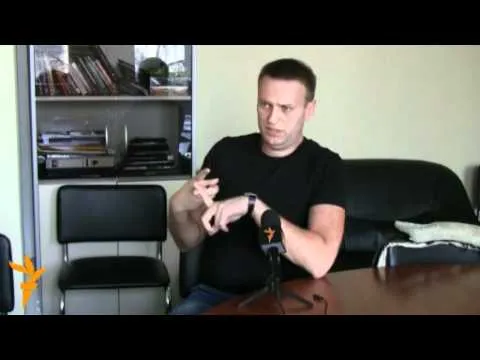
The main task is to find a mechanism
for coordinating supporters. A huge
number of people—thousands of people—reach out
asking, “How can I help you? How can I do
the same thing you’re doing?”
Coordinating and managing
the efforts of these people is extremely difficult. They
are experts in—well, either they’re not experts at all
or they’re experts in completely different
fields. Everyone can make some kind of
contribution, but when it comes to the question, “How can I
help you right now?” the answer is:
That is, if you’re not a lawyer, not a specialist in
the securities market, then it seems like
there’s really nothing you can do for me except
spread information. But we need
to build a system like this. I see my
task as creating a system in which
everyone, first, would be able to
make their own contribution; second, the system would be
decentralized and would not depend on
any particular
person—including me.
Because I, like any
person, can be intimidated or bribed, and so on.
That must not lead to the entire
activity
coming to a halt. It is, without any doubt,
obviously not independent; however,
it would be a mistake to view the system
as some kind of monolith. There is no monolith,
of power. There is no so-called
criminal Putin regime in the form of
people all carrying out one
single task. In reality,
it’s not one big criminal
gang, but rather a community
of various crooks who are constantly
fighting among themselves, defending different
interests and promoting different interests.
The same thing happens in
the courts: different corporations bribe
these judges and influence judges in their
own favor. So despite the fact that, yes,
if Putin personally orders
a judge to make sure Navalny does not win this
case, I will never win it. And any
Gazprom or Rosneft has enough
administrative leverage to exert influence.
But since everyone in the system is busy
trying to make money,
the signal from above does not always get through, and
the system is a gigantic criminal
mess and absurdity. There is no real system at all.
There is this kind of corrupt chaos, and in that
corrupt chaos, this so-called system
is chaotic—it simply makes mistakes.
That is precisely why we win regularly.
The Presidium of the Arbitration Court
ruled in our favor regarding, broadly speaking,
a shareholder’s right to receive
information. The Constitutional Court also issued
a ruling in our favor, and so on and so
forth. Besides, many cases are
obviously political, and when courts
hand down unjust decisions against us,
it generally leads to a major
scandal that the authorities do not
want. Every year, in the public procurement system,
public procurement
totals 3 trillion rubles (about tens of billions of U.S. dollars), of which, according to Medvedev,
1 trillion is stolen. That is an enormous
number of cases—thousands and tens of
thousands, a colossal number
of auctions, tenders, and so on. The people
involved in this—not even the people who steal, but the people
who are involved in the system that enables
the theft—
the theft itself—
those people do not get any money from this
corruption, so they are inclined
to complain. Besides, corruption has become
such an obvious and familiar
phenomenon that people are hardly embarrassed by it, and
holding auctions with a predetermined
outcome is absolutely not uncommon.
So the facts that are available now—
anyone can sit down and, by spending one
hour in the public procurement system, find enough of these facts
to sustain our
work for a month. At the same time, you need to understand
that, given the scale of the problem, our
activity is still very small,
very limited. So the obvious
facts of corruption that any person can find
are already enough for our work. If
we go deeper and start looking for
insiders, we certainly won’t have trouble finding them,
and they come to us in large
numbers. But even insiders are not necessary
in a system where all the corruption happens
simply on
the surface. The authorities cannot avoid talking about it;
at the level of rhetoric, they cannot avoid condemning
it. There is too much of it; it is too obvious.
That is the first point. Second, they cannot actually
fight it, and corruption is so
resilient because it is the foundation
of power. Medvedev and Putin exist
because corruption exists, because
corruption is precisely the basic
idea and the basic point of elite
consensus, which consists in the fact that
all the bosses below delegate their
political rights upward, and all
the bosses above delegate
economic rights downward. That is how it works.
This is what any governor looks like in practice.
A district chief, and so on—he has
two
responsibilities: to make sure that in his territory
there are no protest rallies, and
that in his territory United Russia
gets 65% of the vote, and that Putin gets
some set percentage there. In exchange, he can
enrich himself as much as he likes, as long as he
does it not too blatantly and
does it cleverly, he need not fear
any criminal prosecution. That
is the basic consensus. Why would
the mayor of some small town in
Ryazan Region falsify
elections and risk anything if in return he
gets nothing for himself?
Now he does get something: he
gets the opportunity, when he is allocated
money for some housing and utilities project—10 million rubles—he
gets the chance to steal 1 million from it.
That is exactly why he falsifies
elections: to preserve this system.
That is why corruption is—this is exactly
the vertical of power, and it is resilient because
if corruption disappeared tomorrow,
there would be no Putin or Medvedev.
That is, they would still exist, but there would be no sky-high
approval ratings, no constitutional majority in
the Duma, and no people with
portraits of them hanging everywhere. None of that would exist, because
what would be the point?
I can give an example. When I
worked for the Yabloko party
in 2003, when everything about
Putin—who he was and how he governed—was already clear,
we were collecting signatures for the liberal
Yabloko party, and the people collecting
signatures went door to door. If, in
some apartment, you started criticizing
Putin, the door would be slammed
in your face. Since 2007,
people listen carefully to criticism,
hear it out, and are ready to take it in. Why?
Because there are absolutely
real
grounds for it. Before 2003, Putin,
for all his faults, without any
doubt did some useful things,
implemented part of that famous
Gref program, and so on. It would be
stupid to deny that. But from 2003 to
the present day, the authorities have completely
degenerated; they have done nothing useful for
anyone.
The stories once told about how
order had been restored in the Caucasus, that there would be
police reform, army reform, and
so on—none of that happened, and from
2003 to 2011 we see only
growing corruption, nothing but theft,
against the backdrop of Russia receiving
colossal, unimaginable sums from
oil exports.
So there are entirely objective reasons
why discontent is growing, and here
there is also an indirect reason. First and foremost,
it is the spread of the internet,
the internet's penetration. Right now,
30% may not seem like that many people
who get their news every day from
the internet. Maybe it is 20%, but that 20% is
the politically active class; these are
residents of big cities, the people
who, broadly speaking,
serve as the driving force for
political change. And these
people can now get information
quite independently of television. So, on the one hand,
there is the government's incapacity,
confirmed over years; on the other hand, there are
alternative sources
of information. This leads to the fact
that the authorities will face very serious
problems, and those problems will keep growing.