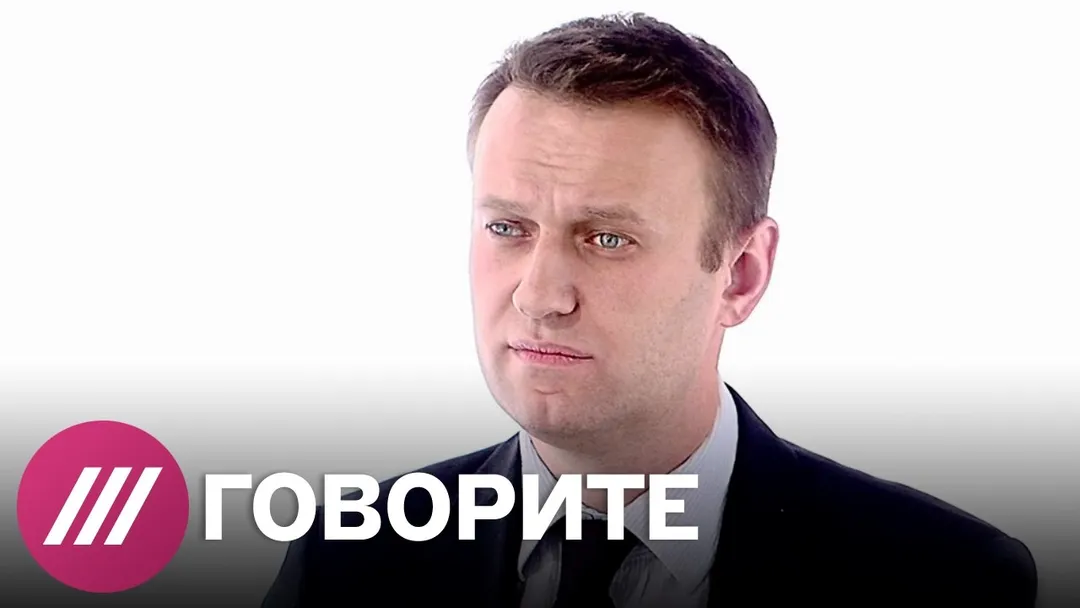
Alexei Navalny’s interview on the program “Speak Up” on TV Rain (an independent Russian TV channel)
[music]
Speak.
[music]
Good evening. This is the program
Speak. I'm your host, Yulia Taratuta. Today
my guest is Alexei Navalny, a politician,
founder of the Anti-Corruption Foundation, and
a man who is now receiving special
attention because he has announced
his intention to run as a candidate for
president of the Russian Federation. Good
evening. Good evening, Alexei. Thank you
for coming. Thank you
for inviting me. You've already said quite a lot
since making that announcement
to various media outlets. I'll start with today's
news.
Today Bloomberg reported, uh, that
there is a discussion underway in the Kremlin about
your candidacy. And so far,
as far as I know, there have only been
a few comments, and they were
identical. Mm, the Kremlin and the government
responded by saying, mm, that they
were not responding at all. That's what Dmitry
Medvedev said, and that's what Dmitry Peskov said.
But in fact, a source in the Kremlin, to whom
we put a question
about Bloomberg, said he had been misunderstood
and that the Kremlin—and that there is no discussion.
Tell me, please, how do you view
the comments about your campaign
coming from the Kremlin and the government? This is
what interests me most. Why are you all—we're all
discussing this so much? I'm not at all
interested in discussions inside the Kremlin. I'm
not interested in what is happening in that
respect inside the Kremlin. I'm interested in what
is happening on the streets, what is happening in
people's homes. I know that real incomes
have been falling for the third year in a row. I
see monstrous corruption in the country. I
see a great many political
reasons why I should take part
in these elections. And I made the
decision to participate in them on that basis,
because I am bringing forward a platform
with which I want to change the country. And in that
sense, of course, the Kremlin has some kind of
attitude—positive, neutral,
or negative—but I don't care. Well,
you may be allowed or not allowed to take part in
the election. And that depends only on me.
It depends only on me and on those
people who support me. If
we can persuade a sufficient number of
people to support me, my candidacy—and
that is what we are doing now, this is the first
stage of our campaign—then those people
will force the Kremlin to register me for
the election. I like your idea that
you shouldn't ask those in power for
permission when you're planning to enter
politics. You just have to go. And you have also
just now, and before, said that the Kremlin
must be unable not to register you.
And what are you going to do to make that happen?
To do that, I am going to talk to
people. That's why I came on this
program. I want Dozhd viewers right now
to watch this broadcast and, among other things,
say: "Yes, actually, we want
Navalny to take part in this election.
We'll think about whether to vote for him or
not, but we will definitely sign in support
of his nomination. I want
millions of people across the country to say at
this first stage: "In any case, we
want there to be real elections,
want there to be an alternative."
We want to have a choice, we
want to see debates, we want to see
discussion, we want to see and hear
the platforms being debated." And when those
people support me, if I can persuade them,
the Kremlin will have no other choice
left.
And in your platform, which you
published in fairly brief form, and which in that
sense contains the main points, yes,
there is quite a lot to discuss and
quite a lot to criticize. But is there
a guarantee spelled out there, or stated in informal
conversations, of personal safety for
Putin and members of his family in a situation where
he agrees to a so-called
transfer of power. Well, in the event
that he has to hand over power. And what is
the logic behind that? Do you have respect for
the institution of the presidency itself?
First of all, I am very glad that my
platform is being discussed, and glad in general that
any platform at all is being discussed in this country.
Second, this is of course not
a point in my platform. I said it on the air of
Echo of Moscow (a Russian radio station). Many journalists
found it interesting, and that is why it is being
discussed. Third, uh, I would actually like
people to have respect for
the institution of the presidency, because
right now it does not exist at all. This is not an institution
of the presidency; it's something else entirely. It's
one man who has been in power for 17 years.
And he wants to stay for 24 years, because there are still
7 years ahead. And he intends
to be elected again in 2018 for
another 6 years.
My attitude toward Putin, personally, including
in connection with my family, with the
pressure being put on the people
I work with, and with the fact that my brother
is in prison on a criminal case, on a fabricated
case, is of course negative, but
every normal politician, it seems to me,
must nevertheless rid himself of
personal animosity in matters like this. And
if, in reality, for the country, for a peaceful
transfer of power, guarantees need to be given
security and honor those guarantees
security, declare them in advance
these security guarantees are quite
to unpleasant people, to him and his family alone, then
that, of course, must be done. Meanwhile
you want to leave the president’s family alone,
but are ready, in fact, with the full force
of the law, to go after all the people
around him. You even named
names like Sechin and Rotenberg—that is, people
who belong to Putin’s inner circle
Putin. Do you think they are carrying out
someone else’s will? Otherwise, why
take part in elections if—why then
change anything if all these people
are simply to be let go, amnestied, and even
allowed to keep all the property
they took? After all, in our country
80% of the property in the country, by various
estimates from 75% to 88%, belongs to 0.1%
of the population. And that 0.1%—that’s all of them
right there. It’s basically a somewhat expanded
Ozero dacha cooperative (a well-known group tied to Putin’s inner circle).
If all of them are let go, it simply makes no
sense whatsoever. And guarantees
should be given to a political figure,
specifically Putin. He is a political
figure. But the Rotenbergs, Sechin, and all
the rest are just clients. It could have been
not Sechin but some Vasyachkin, not Rotenberg but
some Pechkin. None of that matters. They are
simply people he uses as
his wallets. Well, in a sense
you are ready to imprison them, the people who are
being used, but are prepared not to touch
the president, against whom you have many
complaints, but for the transition he is to you— I am not
going to imprison anyone; no one is untouchable. I
am not personally going to imprison anyone. And I
am taking part in the elections so that
the leader of the country, or even the prosecutor general,
or anyone else in the country, cannot
throw anyone in jail. Only a fair court can
send people to prison. I believe that all these
Sechins, Rotenbergs, Yakunins, and all
the rest should end up on the
defendants’ bench before a fair
court. But I repeat, Putin is a
political figure, and we want a peaceful
transfer of power. But we understand that
if tomorrow this particular person feels
that he either remains
a ruler for life, as he is now, or else
he will be killed—well, what choice will he have?
So naturally, he will want
to remain a ruler for life. I
think, in fact, this is one of the
reasons why he stays in power. But
my assumption is that
he is afraid not of the opposition, not of me or
some more radical opposition, but of
his own entourage. He can see what kind of
people they are. That the moment he loses this
chair from which he can
hand out billions, they, in the course of their
conflicts, will devour him first.
In that sense, you do not believe that Putin
can decide to leave
power? I think that is possible, but
I think he is very strongly held back by
his knowledge of his friends’ habits.
Let us imagine that in 2018
the person from the ruling camp,
the one who will run, is not
Putin, but someone to whom he hands over the
mandate.
I am ready to compete in an election against any
proxy they put forward, whether
Medvedev or someone else. It does not
make much difference, but I believe
that it is extremely unlikely. And I am sure
that at this point Putin’s strategy
is to remain a ruler for life
of Russia. Not a president, but
specifically a ruler with unlimited
powers. That is precisely why he is constantly
uh, recognized all the time
as the most influential person in the world. But in
fact, that is true. He seized power in a
huge country and is, in essence,
an absolute monarch. And what is your
main complaint about the authorities and the
president? Well, I can tell you,
share my main complaint. It
does not change. It seems to me that, uh, politics
in Russia is built on the principle of a
special operation. Someone is always being pushed somewhere,
money is being passed around, people are being put in
certain conditions, vulnerable
spots are found. And what is your complaint? Well,
I think everyone has roughly the same
complaint. Everyone would phrase it
in their own way. I would put it this way:
from my point of view, this government
despises people and does not respect them, nor
does it respect law and order. They do not care
about anything. They really do things behind the scenes,
ranging from some kind of
transfer of billions to the privatization of
Russia’s largest
oil company. They sold 19%
of Rosneft shares, and to this day the business
press is still discussing it—no one can understand
what happened. It feels as though, I
do not know, they gave each other a gift
for New Year’s, rather than selling the largest
Russian state-owned oil
company. These people consider Russia their
property, and Russian citizens they regard
simply as serfs
or peasants. That is all. That is the
complaint. You always emphasize, and in
a sense your political identity
is built, your political posture is built
on the fact that you are anti-elite. And for that
people now even like to compare you to Trump,
when they look for, uh, well, they look for some kind of—people compare you to everyone,
But with Trump in this
in a sense, well, you can be compared to him. He
built his company on the principle of
being anti-establishment, and you are saying that
the establishment, uh, should learn on its own,
uh, entirely, as I understand it. Uh,
actually, mm, I want to understand: you
say that you don’t know anyone, that you
don’t really engage with anyone.
I mean, I’m still talking about what is
called the elites, about the Kremlin, about
the government. You are saying that you
do not want to enter into contact with these
people. And in a certain sense, if
we are to believe that you have no ties to
these people whatsoever, they should be afraid of you. That
is, for them you are not some kind of compromise, not
a figure they can deal with. Take Kudrin, for example,
if he came into power or declared
political ambitions, that would be normal, but
you are, in a way, frightening. Well, Kudrin is
the власти. He was a minister for many years and still
remains a member of this very
group. As for me, they are not afraid
of me, of course. I think they additionally
dislike me precisely because
they cannot control me,
manipulate me, and because I am,
probably one of the few politicians—and
I am proud of that fact. I do not go around
asking them for anything. That whole system is
set up so that everyone who appears on the
political scene has to come and ask for
something—say, to be given
a single-member district or permission to
create a party. I have never asked them
for anything, because I believe that
Russian citizens have the right to
it. So I am not going to ask
some obscure, strange people,
who happened by chance to occupy
offices in the Kremlin, for something that
rightfully belongs to me. And there is one thing they fear:
they fear a change of power in general—
a real transfer of power. When someone comes along who
truly wants
to become president, serve his
presidential terms, and leave, and then
a new president will be elected. That
rotation itself, the idea that power
will change, that in any parliament there
will be an opposition sitting there—this is what
terrifies them. Because if it happens
that there is an opposition in parliament,
there will be parliamentary investigations, there will be
an independent press, there will be
government crises because
for example, the press uncovers some
corruption in the government, that means
they will no longer be able to make
billions of dollars. That is what they fear
and nothing else. And still, if you are completely
disinclined to compromise, to enter into
any kind of negotiations, but with
a fairly serious part that influences
That is not true. Let me answer right away: that
is not true. I negotiate with a large number of people
constantly, and in fact
in the course of my political
activity I make various
compromises, quite difficult ones, including
political ones, including
programmatic ones. I need
to unite many people. Politics is
in general an endless compromise, but
one must distinguish between compromise and submission
to unlawful rules. That is all. In other words,
going there and asking, “Guys,
may I run in the presidential election, and
will you let me appear on these
TV shows?” They will say, “No, well, okay, you
can run, but we will let you onto other
TV shows, and also we will put forward those
ones instead.” That’s what they like, like to
bring up—the Moscow election campaign,
when you were effectively allowed to run.
However you look at it, that is, you did not
ask for permission, but you were allowed
to take part.
I do not ask anyone for permission
I ask no one for permission
I formed a campaign headquarters; I ask no one
for permission, I started collecting signatures, and
I created a situation—well, not alone, of course, but together with
a large number of people; Muscovites
created a situation in which the authorities had
no choice but to—they themselves
came to me and said themselves: we
will give you the signatures of United
Russia deputies so that you can be registered. That
is how it worked. Maybe we
do not know something. I keep coming back to the elite and the
establishment. Perhaps you still,
as you say, are in contact with the elite
or feel that some part
of business, or some part of the people
who are influential and are now
close to power, might, in a situation of
uncertainty or a shift in the agenda, somehow
take your side or take the side
of change? Perhaps you are already
talking to someone about this? There is a lot
we do not know, including whether there is
life on Mars. However, we know fairly
well that within the authorities there are
groups that, of course, want change,
they are just terribly afraid. And in business
there are such groups too; these groups are everywhere.
And among city hall employees, I assure you,
the majority voted for me in the
mayoral election. Yes, we even looked at
the results in those precincts where
the residential buildings where officials live are clustered
together. I beat
Sobyanin there everywhere. Inside the system there is a huge
demand for change. I know for certain that
these people exist, but that does not mean that I
have to go around building
relationships with them. Besides, this is also
Impossible. They are afraid. As soon as this
government weakens because of me or because of
someone else, they will all come running out themselves and
they themselves will, to Vladimir Vladimirovich Putin,
I don’t know, cling to his calves. And he
knows that perfectly well.
If
you are not allowed to run in the election, and if
no compromises with the elite are
reached, then you are essentially saying that
you are not entering into any kind of
negotiation process at all. What
is the second scenario?
We have a revolutionary change of power. And that
depends on various things. There are
1 year and 3 months left until the election. If
the election is competitive, then one must take part in it.
If we once again see
a procedure—I do not even want to use
the word “election” right now—in which the same
same people appear again, just in profile, and not even
in profile anymore, but still full-face:
Putin, Zyuganov, Mironov,
Zhirinovsky, Yavlinsky—they have all, by the way,
already announced, except, I think,
for Mironov, that they are participating—then we cannot treat such a
procedure as
an election at all. I think that simply
quite few people would come to such an election
even without any boycott. One last
question about the establishment. You position yourself
in opposition both to the current authorities and to
people who could potentially
form your, uh, let’s say,
platform, your base. But with various
statements you alienate different groups of
people. For example, you speak rather harshly
about Yeltsin and that era.
Why are you cutting off such a significant
part of the electorate, so to speak—a part of
the creative class that remembers that
period with sympathy? Moreover,
if you remember, a large number of
successful and
well-off people came out to Bolotnaya (Bolotnaya Square protests in Moscow). And in your
program, in your words, there are a great many
rather unappealing words with regard
to business, big or otherwise. Well, I
do not think I am cutting anyone off that way.
On the contrary, it seems to me that I am trying
to build a new social consensus
about that period as well. Back in those
days I was a fervent Yeltsin supporter and even,
embarrassing as it is to say now, a supporter of Chubais. But we
saw that those very people
betrayed everyone who had supported them. They
betrayed those who, in 19
98, came out into the streets by the hundreds of thousands.
This entire democratic
movement turned into the enrichment
of certain people in the government,
enrichment on a colossal scale, and
simply became a transfer of power from
Yeltsin to Putin in order simply
to guarantee money and safety for
Yeltsin’s family. Therefore, we must
assess the Yeltsin era soberly and objectively.
And the people who made their way in
that period, the people who earned
money then, I assure you, they
feel exactly the same way about it. Yes, it
was a wonderful, romantic time, but
did we get democracy as a result
of it? The answer is obvious. Did we receive
authoritarianism as our inheritance? Yes, we did.
Did we get that very same level of wealth
stratification that does not exist, well, not even in
a single Eastern European country.
Does it not seem to you that the freedoms of that time,
simply by the very fact of their existence,
already stand in opposition to the current
government and the current regime? And,
for example, that period itself and those very
freedoms of the Yeltsin era—the freedoms
of speech, movement, and so on—
in fact, right now you sound like
Culture Minister Medinsky, who
criticizes the Yeltsin Museum. And what is going on there
now? I am not criticizing the Yeltsin Museum, and
I even think that, obviously, Russia
should have a Putin museum as well. There should
be a museum for any ruler
who was in power. But one must
make distinctions. I am not criticizing that period, I am not
criticizing those wonderful people
who fought for democracy. I
am criticizing the ending. But I am living now, in 2016,
when Russia has a huge number of
political prisoners, when people are jailed for
likes on the internet, when virtually all
property belongs literally
to a tiny few, when 23 million people are
living below the poverty line. So yes,
of course, it is all very well to say: “My God,
how wonderful it was, how
free, young, and beautiful we were
in 1997
.” But I live now, in 2016, and here
everything is much worse, all hopes have been
trampled, and we are forced to build all of this
again from scratch.” You yourself have already several times
mentioned the word ‘political prisoner’ in your
program and in your remarks that
your first decree would be the release of
political prisoners. You keep bringing
this up. It is an important point. What do you
mean by the term ‘political prisoner’?
Let me clarify my question. For example,
do Ulyukayev or Nikita Belykh belong to this
group? After all, it is perfectly obvious that
this is a political signal, not imprisonment for
corruption. And there is a fairly clear
definition of political prisoners
given by Amnesty International. There are
prisoners of conscience, there are political
prisoners, but the point is that people
are subjected to criminal prosecution not
for a real crime, but for
political motives. a political motive
prevails here. Uh, answer
the second part of my question. The second
part. As for it, I don't know
the circumstances of Belykh's case, I don't know
the circumstances of Ulyukayev's case. I understand
one thing: that in Putin's system there cannot
exist an uncorrupt
minister and an uncorrupt
governor. Any person who
carries out
executive-administrative and
functions in this system can be arrested tomorrow.
Well, look, the case of
Ulyukayev is that he
quite fearlessly went to collect
cash from an oil company, as they now
say, not in order to keep it for himself
but to distribute it among his staff.
That says only one thing: that this is
standard practice. They all go around and
turn each other in in this situation on
the side of the investigators, who present us with
a certain picture, offer us
some version of events. I don't believe in any
investigation. I understand perfectly well that, uh,
with Sechin, in such situations you have
to choose a side, because you know
how—no, you don't need to choose a side. I
I wrote a special post on this topic. I
believe that Ulyukayev is, of course,
corrupt. His property, his lifestyle
and the money that he—that he
has, of course, show that he is
corrupt. Nevertheless,
he was directly arrested as a result of
some kind of, I don't know, provocation
or something else. Procedurally,
I see a large number of violations there
in procedural terms, but of course Ulyukayev
is corrupt, and our Anti-Corruption Foundation, I
as its head—does the selective nature of prosecutions
not interest you very much in that sense?
On the contrary, it does interest me, of course, as I
already said, any person—Nikita Belykh
Ulyukayev, Putin himself, Sechin, and even, I don't know,
some of the most unpleasant people to me,
Shuvalov with his dogs that he flies around
on a plane—they deserve fair
justice, they deserve that in
their case due process be observed, that
when they are arrested for some
reason or placed under house arrest,
it be properly explained what they are
being punished for. And you have a very obvious
energy of something new, a new path,
an alternative agenda. I just want
to say this on air. You are an active and
brave person, and, uh, obviously those who
think this way should a priori be on
your side. Well, simply by virtue of the fact that you are—
you. But your program—you
yourself have noticed, and are glad about it—has quite
a lot of critics, and not insignificant ones. They, uh,
say, for example, that for them you
haven't really made any effort at all, well, in
the sense that you included nothing politically
important for them in your program,
you did not include it. For example, Sergei
Aleksashenko wrote a fairly detailed
text very sympathetic to you, yes. Well,
he says, for example, that he, well, cannot
help but support decentralization and
other such things, but doesn't understand why you
say nothing about, specifically,
the difficulties involved in restoring gubernatorial
elections, well, the nuances, uh, the president's right
to dismiss governors
and appoint acting replacements in their place
from among his own bodyguards. That's from
Aleksashenko. Nothing is said about
abolishing the municipal filter (the rule requiring candidates to secure endorsements from municipal deputies). Well,
nothing that could really attract other
people to you, and not only those
who care about the 25,000-ruble subsistence minimum
(about 25,000 rubles). We'll talk about that later. I,
first of all, am very grateful to everyone
who criticizes my program. Once again I can
say that I am very happy that
this program is being discussed. As I
already said, many people have already announced
that they are taking part in the election. Which of
them has been in your studio, and with whom have you
discussed their program? With no one. They
themselves don't want that. It doesn't
interest them. Zyuganov has already announced, and
Zhirinovsky, Yavlinsky. Their programs are not
being discussed, among other things because they
themselves do not want that. Mine is being discussed. I am
very pleased. Uh, Aleksashenko's criticism
is fair. But I can say that in
those theses—the points that we
published—there is, for example, nothing about
agriculture, nothing about housing and utilities.
Let's be honest, let's honestly not play
with words. There are no—there are almost no
political theses there. And these are
fundamental political issues, because
in my theses I focused
on what I had not spoken about before. As for
the abolition of gubernatorial elections,
political reforms, and everything else,
I have been speaking about that, uh, publicly and to
a fairly large audience for the last
eight years already. So it seemed to me
pointless to repeat that in the program,
because at the first stage we
are addressing our supporters, and they are fairly
well aware of my views on
Russia's political system. I
tried to say something—to bring something new into
the discussion. You yourself
pointed out that people are discussing
the minimum wage, the tax on
oligarchs. You mentioned that, meaning, I
have a poor attitude toward rich people, although not
toward rich people, but specifically toward oligarchs.
These are the things I want to put at the center of
the focus of the discussion, rather than just once again
saying for the millionth time that yes, I support
direct elections for governors. Yes, we’ve
noticed that. Your critics have too. You and everyone
keep saying that what you’re proposing is not—
I won’t use the word populism, I’ll say
simple economic solutions, and in general that you
tend toward social measures that,
well, uh, experts call
populist. I’ll simply call it
an economically left-wing, uh, program. 25,000
as the minimum wage. And by the way,
Aleksashenko is asking you whether
civil servants’ pay should also be raised proportionally?
Well, if you’re raising it for public-sector workers? And
these are not simple economic solutions, and
this is certainly not populism. These are
sound economic decisions
that are made even in the most
thoroughly capitalist
countries. If you look at the same
minimum wage, the issue of it
was the central topic of discussion
throughout the entire election campaign. And
there, the minimum wage is set
at a fairly high level
by state law. Starting in 2018, in
New York State, you will be prohibited from
paying anyone less than $15
an hour. I also believe that in Russia
there should be a minimum wage threshold
below which people genuinely
become destitute, and the state and
society end up spending even more on them,
in fact. That is precisely
the key point. When we
pay a person 8,000 rubles,
they eat poorly, they have poor
health, they can’t get medical treatment, they become
antisocial,
it is hard for them to raise their children properly,
so overall, sooner or later, more money will have
to be spent on them than
if they were simply guaranteed a salary of 25,000
rubles. Still, all your social
innovations—redistribution of money,
doubling spending on education and
healthcare—again, your
critics calculate that you would simply
have to abolish the entire army, because they are using
the consolidated budget rather than
the federal budget. This is just a game
with numbers. Look, Yulia, this is an important
point I want to make right now.
You can’t take one part of a program and
consider it in isolation. It would be
naive to assume that I want to take
this 25,000-ruble minimum wage
and somehow force it onto the current Putin-era
economy. Of course not. What I am proposing
is a comprehensive solution. It sounds as though
you’re planning to, and that the money you’re planning
to take will come from your hated rich. Not
exactly. If you read the program carefully,
you’ll see that its main
idea is the fight against inequality. You don’t
deny that in Russia this is a huge
problem, if 88% of the wealth belongs to
0.1%. Don’t drag me into this. I’m not yet
running on that platform or standing
for president.
But the problem of inequality is enormous, so
it has to be addressed from different angles. From above,
through the super-rich and the oligarchs. These are
literally just a handful of people who should
pay a tax on wealth accumulated from raw materials.
And this needs to be understood: these are not just rich
people. No one is proposing to levy this tax on
the creators of Yandex, on people
who created something new. But if—
And how, exactly, are you going to
determine that? People are already joking about it.
Number five on the Forbes list means
you get taxed, while number eight does not
because he’s a nice, likable
guy. Why is it that in different sectors of the
economy different tax regimes can be
established? After all, people are somehow
classified. For some, VAT can be one rate,
for others there are VAT exemptions. The same
applies here. You’re speaking exclusively about
industries. Oil is included, which means the internet
is not affected.
Participation in the loans-for-shares auctions (a controversial privatization scheme in 1990s Russia) or non-participation
is important in this case. Of course
it is. And I wrote this explicitly in the
program. There were quite a few loans-for-shares auctions
—not many, in fact. I think there were 13. I
may not remember the exact number right now.
The bank is exempt; it did not participate. If you
did not participate in a loans-for-shares auction, then
you are exempt. But if, for example, that part
of Alfa Group’s business that is connected with
TNK, then of course it is subject to the same
tax on raw-materials wealth.
So yes, people who made
enormous fortunes trading in raw materials,
oil, gas, and metals should
pay. And I assure you, after that
they will still remain very wealthy
people, but they simply should not
effectively own all of Russia. So
let me finish the thought. To fight
inequality, we need both to tax the oligarchs
and raise the minimum wage,
and relieve the middle class of taxes. And
most importantly, we need economic
growth. To achieve that, my program provides for,
among other things,
a radical reduction in various
bureaucratic costs that are currently
simply suffocating business.
Among democratically minded people
there are, as I already said, people—and many
people—who could hypothetically
be capable of voting for you as an
alternative. But I have the feeling that,
despite what you say, that you
you take elections seriously, and this is not
a game, but you don’t seem to realize
that among your voters there are also
people who, uh, are guided
not only by political considerations, I mean
they vote for you not just because you are
Alexei Navalny, different, young,
active — they also want to vote for a program
and to vote seriously, not just for show.
They understand that. So how do you assess
this idea that democrats will anyway
think it over, think it over, and agree with
you because they have no other options, and
there’s no need to court them? That is precisely why
I read any criticism very carefully.
That is precisely why I am now
explaining all these points to you, as best I can,
and through you
I am explaining them to all voters and all
viewers. And I started the campaign 1 year and
3 months in advance because I understand how much
enormous work needs to be done
to persuade people. I know very well
that, well, there is no such thing as
bound voters. No one votes simply
because the Yabloko party calls on them to, or because
Yavlinsky or Navalny or
Zhirinovsky tells them to. People choose for themselves.
Today they vote for one person, tomorrow
they vote for someone completely different. So I have to
convince them, including those people
who came out, for example, to Bolotnaya (the anti-government protest rallies in Moscow).
I do not have this idea in my head
that just because they came out to Bolotnaya and
supported that movement, it means they will
automatically vote for me. I
simply know that is not the case. So who, in general,
is your voter? Where is this so-called
“Navalny belt,” if
we use American terminology,
which we have mentioned more than once today? It
will be created during the election. That
is the task of the election, because there is no
such belt yet. Let me explain. These are people
who are dissatisfied with what is happening
and understand that something
is going wrong. These are people who
are unhappy with corruption. These are people
who may even, at an earlier stage,
have viewed Putin
normally. Maybe even now they still
view him normally, but they
say: “Well, 17 years, and he wants
another six ahead of him.” That is too much. We want
a change of power. These people, simply because of the
objective system of
information distribution,
and the spread of the internet, know more about me
if they are residents of large cities, of course.
Therefore, at this first stage, my
voters are residents of large cities.
Simply because they know me. Our polling shows
that even now 55%
of the population — by various estimates,
roughly 55 percent — do not even know
who I am. Even in a negative sense
from all those programs on
NTV, they still know nothing about me. And we
have a huge amount of work ahead of us
just to tell people that such a
program exists, that such a proposal exists,
because, as I said in my
video address, there have been no real elections
since 1996. People have completely lost the habit of
the idea that there could actually be real elections
and that someone could actually take part in them
who is not controlled by
the Kremlin. That is the problem. No one
believes in it. Meanwhile, in
various interviews, in at least one of them you
said that
there is only one thing you are afraid of: that you
will become afraid.
And so you are afraid that you might
become afraid
and you do not want
to reach the point where you do. So
what could make you afraid?
That was in an interview with Venediktov.
You watched it closely. Well,
look, I’m a normal person. I’m
an ordinary person.
And of course, generally speaking, I am afraid of
many things: for my relatives, for
their health, for my children’s happiness — many
things frighten me, as they would any person.
But as I understand it, the question is ultimately
a political one, yes, and from a political
point of view, of course, I would not
want to imagine myself in a situation
where I would have to, where I would
for some reason betray my own views. So far
that situation has not arisen, and I will do everything
to make sure it does not. And I
promise voters now that I will not
let them down. I will truly
represent their interests, rather than
be guided by some hidden motive
or personal motive. Well then, don’t let them down.
Our guest was Alexei Navalny,
founder of the Anti-Corruption Foundation,
a politician and the man who announced
that he intends to run in the
presidential election of the Russian Federation at a
time when he is facing a fairly
serious trial in Kirov Region. We do not
know how it will end. Thank you. With
you was Yulia Taratuta.