Alexei Navalny interviewed on "Parfyonov and Pozner" on TV Rain
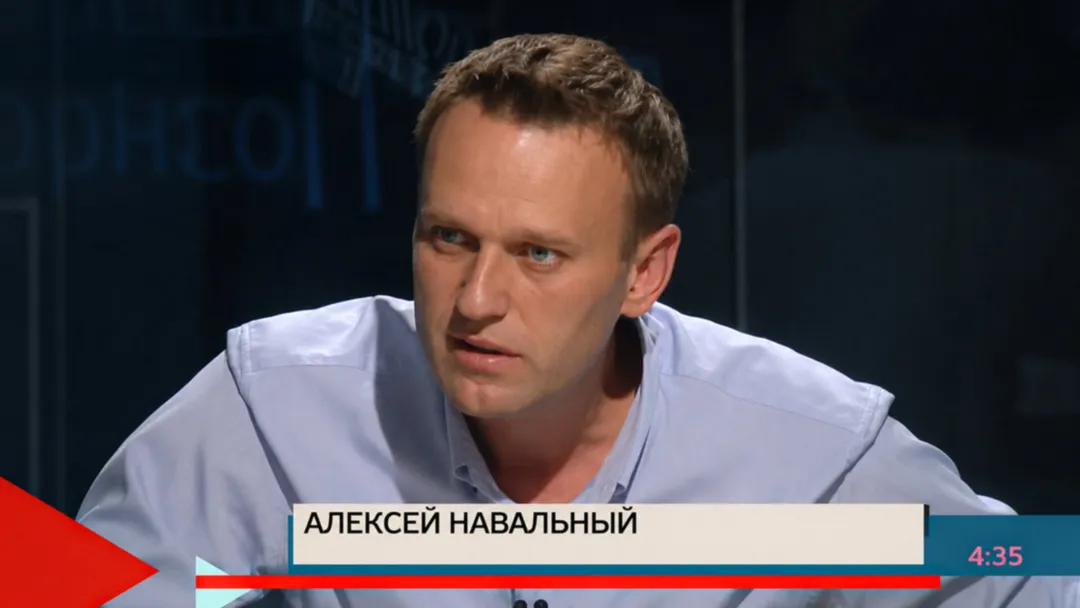
This is the Parfyonov and Pozner program.
We continue with today's broadcast.
And our next topic.
And our next topic concerns my favorite magazine, Time.
This weekly political magazine occasionally allows itself
or rather, once a year, to publish on its cover
its Person of the Year and Person of the Decade.
One year it was Putin, I remember. Right?
And once every 10 years
the Person of the Decade was, incidentally, Gorbachev.
And every year, of course, they also name the 100 most influential people in the world.
I actually tried to find out how they determine that.
It's an internal affair, within Time itself, among various
editors, journalists, and reporters.
They do it themselves; they vote.
And that's how the final list is put together.
But one of those 100 caught our attention, the one placed exactly
in the middle, at number 50, the only Russian on the list.
Really?
Yes—Alexei Navalny, who is presented there in a very striking way.
We have the opportunity to show the portrait that accompanies
the only influential Russian, according to Time.
That's not exactly right.
That's not quite how he's presented—well, yes, here he is, shown against the backdrop
of the Cathedral of Christ the Savior.
Yes, rather demonic.
I would say so, yes. Hair standing on end.
Very Orthodox-looking too, isn't it?
All right then.
So, I think it would be interesting to talk to him about this.
Alexei Navalny is our guest today.
Please, welcome to our studio—open the doors.
Yes, hello.
Hello. Come in.
I'll write your name on the board in the meantime.
Navalny—just now.
Tell me, were you surprised?
Alexei.
I was very surprised.
About two months ago, I got an email.
Yes—congratulations!
It said, “You've made our list.” I wrote back to them.
“Thank you very much.”
“There must have been some mistake.”
Well, they said no.
And you kept quiet about it.
Had you actually seen the list, by the way?
They sent me a link.
I saw the list, but I kept quiet.
Because if I had announced it, people would have started laughing at me, basically,
and even now
most people treat it rather ironically.
But I myself treat it ironically too, because after all it's more
a reflection of journalists' views.
It's Time's idea of influence rather than something real.
If you look at the list carefully—I had the pleasure of doing so—
there are people on it whom absolutely no one has ever heard of.
It's quite astonishing.
I mean, truly no one.
And yet there is a lot of PR in it,
there are people nobody knows—for example, the Anonymous group.
Well, that's understandable, since it's tied to the internet.
But in fact even Mitt Romney
is not really an influential person yet.
If he becomes president—which is unlikely to happen—
then he would be influential.
It's a strange thing.
Listen, even if they do recognize your influence there,
who else does?
How do you yourself assess your own influence?
Vladimir Vladimirovich (Putin), in my view, recognizes it.
That famous Time magazine photo—he showed it during his program
to Ambassador McFaul, saying, “Isn't this your golden boy?”
Well, for example, I am not invited onto Channel One.
That is probably some kind of reflection of my influence.
They don't allow me to invite you; I'm saying that completely frankly.
There are several people,
you among them, whom I still cannot invite onto the program.
To be honest, I'm terribly flattered that these are
people who, for unclear reasons, are on a blacklist.
That is evidence that someone is afraid of him.
Afraid of his considerable influence.
People aren't afraid of someone who has no influence.
If that person is giving you instructions on whom to invite and whom not to invite—well.
They don't let me invite them.
You see, the subtlety is this: no one says “invite them,” but “don't invite them”—that, yes.
Now listen, there's just one thing I don't understand.
Is there some kind of method for turning this sort of influence
say, internet fame, for example,
into real politics?
All right, say you criticize
Shuvalov, for example, over his financial disclosure.
Immodest income, yes?
But how would you then be able to claim Shuvalov's position yourself?
Otherwise, what's the point of criticizing Shuvalov?
Well, the point is not what position to aspire to,
the point is that
in current conditions, any person who wants to be influential, to be strong,
can become influential. And one of the few—or perhaps
the only good thing about a state built on hypocrisy and lies,
is that any person who tells some truth
immediately becomes known—relatively well known, at least.
And no blogger—Navalny or any other blogger—
would have any chance of becoming prominent in the United States or Europe.
Because revelations about Shuvalov as a bribe-taker would interest no one there.
Television would be reporting it, not blogs,
it would be on the front pages of newspapers, and so on.
So all my legal work—and what I mainly do is
investigate corruption in state companies, in Gazprom, Transneft, and so on—
would be unnecessary in a normal society.
So can one say that your influence is connected precisely
with the fact that sources of information,
real sources of information, essentially do not exist?
They don't.
And against that absence, a person like this, as it were,
a blogger, becomes not just a blogger, but a Blogger with a capital B.
Something that exists nowhere else in the world.
No, it's not even that sources of information don't exist.
You have the newspaper Vedomosti lying on your desk.
On every page there is a description of
some corruption case, of how 1,000,000,000 was stolen.
But very few people can take one more step forward,
namely, to say: “Okay, 1,000,000,000 was stolen,”
“so I will bring together a group of people,”
“and we will file complaints with the prosecutor's office, and so on.”
And we will do everything possible
to make sure that the person who stole 1,000,000,000 goes to prison.
Most likely it won't happen right away, but we will make it happen.
And a group of people who are engaged in precisely this transformation of
the online ability to gather information and unite into some kind of offline
actions, simple ones — to go out to a square somewhere,
as pompous as that may sound, to file a complaint, to raise money.
For someone.
These people immediately become influential; they form influential
political groups. This is how it happens all over the world.
Tell me, generally speaking, are you
attracted by this idea of
being influential, and in general, are you
interested in power? For yourself, that is.
I want to change many things.
The instrument of change is, of course, power.
Nothing can be done without political will,
without political power.
Earlier today, you were discussing public television and the election of
governors.
Absolutely nothing can be done, because they do not want to do it.
And we cannot do it from below, because we do not have that very power.
That is why power is needed as an instrument of change.
I want to change a lot in this country.
So yes, of course, that is what I am striving for.
So that, having taken this instrument in hand, I can put on the defendants' bench
Shuvalov, Vekselberg, all these people.
I do not file complaints with the prosecutor's office for no reason,
just because I enjoy it.
I sincerely want these people to be held accountable.
And I am absolutely certain that sooner or later I will do it.
Well, or someone else will do it, and I will help make it happen.
All right.
If we are talking about elections, then with gubernatorial elections, one way or another, there is this filter,
and you, obviously, would not get through it — there is definitely no slipping through that sieve.
And most
importantly — I have found...
well, never mind that; the question is still whether anyone can get through that filter or not.
A filter is a filter.
There will be an election for Moscow mayor — in our system, that is also the head of the region, effectively the governor.
Will you, for example, run?
A simple question.
If there is a mayoral election, that is exactly the kind of election it would make sense to take part in
for someone who has spent a great deal of time dealing with Moscow's problems.
However, judging by these filters, many independent candidates are screened out.
Most likely, if I enter that election,
I simply will not be able to take part, because the municipal filter
requires collecting those 7% of signatures from municipal deputies, who are almost all
United Russia deputies, and it simply does not allow anyone through,
not to mention the presidential filter,
which in reality is the same kind of
blacklist that exists on television.
This one we do not like, he is an extremist, and besides, we do not like his face.
There is another link here as well — public television and the so-called...
In any case, perhaps
I may not run, but these instruments of influence, if they exist,
should be used to support an independent candidate.
I am not the only person everything depends on.
And why would you not run?
If there is an opportunity, when elections are held,
I will fight for leading positions in any election, at any level.
And naturally,
we are now working to ensure that there are free elections
so that we can take part in them.
Naturally, there is no false modesty here.
If there are elections, we will go to them.
Did you have a question for Mr. Navalny
that you had thought of asking if he had come on Channel One?
Yes, of course. An unrelated one.
Wait, wait.
Yes? In general, I am wary of people who seek power,
because, as a rule,
they are driven by one of two things: either power itself strongly attracts them,
and there are many examples of that,
or they have some kind of
sense of mission and think they know how I ought to live.
And once they reach power, they will try to make sure
that I live the way they think I should live.
It is almost always one of those two, in one form or another.
And so I would ask you: when you seek power,
because that, to some extent, determines my attitude toward you,
Aha, I see.
You are more of a
messianic type of person.
It is not power itself that attracts you, but rather the fact that you think you know how I should live.
Absolutely right — I do understand how you should live.
And I believe that under my rules
you will live much better, because under my rules — because I...
You know, as a lawyer, there is nothing dangerous about that.
As a lawyer, when I come
to the police, the prosecutor's office, the courts, and I see those faces,
when in the Magnitsky case, the Transneft case, the Gazprom case,
there are these guys sitting there with those expressions, untouchable, and everyone understands
— the judges, the prosecutors, the police officers — everyone understands that I am right,
everyone understands that all the legal grounds are on my side, everything is on my side.
Common sense, truth, the law — everything
and yet they laugh in your face, and you leave with nothing.
Speaking of that, I completely agree with you.
I want to create rules for you under which you can come to court,
and if you are right, you will win. If you are wrong, you will lose.
That is all. What is wrong with those rules?
All this time, one quotation kept running through my head.
How do you feel about it?
About the well-known song
by Galich (Alexander Galich, Soviet poet and songwriter): "Fear only the man who says: I know how it should be done."
I completely, one hundred percent, agree with that.
But to me, that always seemed strange,
because in that way we deny people the right to lead.
Any leader comes and says, "Friends, I want
to arrange things this way and that way," and then we are supposed to vote for it.
What I can tell you is that in my system,
alongside "I know how it should be done," there is also a system for re-electing me — or removing me, if you like.
That is, if you do not like this person,
or if you think you do not like my system,
you go to the elections, and there will be none of these filters.
If you do not want him, you vote him out.
Sarkozy was wildly popular.
And then suddenly this happens.
The wildly popular Sarkozy
now, quite possibly, will lose — as was mentioned at the beginning of the program.
That is it, that is the system of power.
It is democracy.
If a person deteriorates, if he becomes worse, he goes down.
If someone was worse yesterday and becomes better, he goes up.
It is a normal system; it is the only option.
Unfortunately, we have not invented any other system.
Does that reassure you?
Is that supposed to reassure you?
In principle, I agree with that.
But I disagree with Galich on that point.
When someone tells me that he knows how I should live.
What I’m saying is: right, right, don’t—if possible, don’t say, “I want to limit you,” okay?
Make the courts function.
But don’t tell me what I’m supposed to do.
And it seems that this kind of position is simply a desire not to take
an active civic stance, not to speak about the things
that you are obliged to speak about, including as citizens.
For example, the fact that I’m on ORT’s blacklist (ORT was the former name of Channel One) is a violation
of the law by Channel One—it is prohibited.
And let me correct you. First of all, it’s on RTR.
Channel One.
Excuse me, there is no such list, I assure you.
It doesn’t exist.
You know that yourself.
There is a conversation between two people, when one says: I want to make
this kind of program, but I understand that there are people who, today, cannot—sorry.
Is that censorship or not?
That is censorship.
It’s not Soviet-style censorship; it’s something quite different. But it is censorship.
But if—
It is prohibited.
A program was shut down in America for the same reasons.
Is that censorship?
Well, probably yes, probably yes.
You understand, right? I think that’s wrong.
I’m saying this publicly.
And what I’m saying now will be heard at Channel One. Right?
So along with all the talk about Galich (Alexander Galich, Soviet poet and dissident), I personally expect from you,
gentlemen, a more active civic position.
What is this supposed to mean—are we going to the barricades now or what?
Yes, let’s go to the barricades.
No, that was wonderful.
Let there be censorship, and we’ll be covered in blood.
Tell me, please—what do barricades have to do with it?
Why bring blood into this?
Barricades and blood? They go together.
Peaceful protest.
It’s the only thing we have.
People taking to the streets.
That is what barricades are.
I went to Bolotnaya (the major Moscow protest rallies of 2011–2012), I went. So what?
And nothing. I’m very glad that nothing happened.
You’re discussing your programming grid because at least
some kind of law on gubernatorial elections was introduced.
Political parties are now being allowed to register under an absolutely fake law.
But still, it’s something. Why?
Because twice people created those very barricades in the streets.
That’s all.
Your position too—when it became active, it changed more in one day
than all the opposition parties did in ten years.
My active position as a journalist consists in what I do
on television.
That comes first of all because that’s where I have some influence—I’m not on
Time’s list, but I do personally have some influence nonetheless.
And as for barricades, barricades are still things associated
usually with revolutionary situations.
And the logical continuation of that is Putin.
If not Putin, then who?
You know, it turns out that for us the alternative is barricades, a bloodbath,
and somebody’s guts on tank treads or something of that sort.
Or Putin sees the alternative as: we’re going to storm the Kremlin, right.
And that we need to take the Kremlin.
Those are your words—your words: “need to take it.”
As a result of honest, free elections.
And those honest, free elections have to be won.
I went to Astrakhan and spent a week there.
Those were not barricades of any kind.
But we did organize, among other things, a mass rally.
It was, formally speaking, illegal as well, because Astrakhan’s city administration did not want to allow it.
Excuse me, what was your name—Anatoly Anatolyevich?
We seem to have a lot of Anatolyeviches in this country right now.
And Vladimir Volfovich too. Yes, yes, yes.
So what I want to say is this: some people said that you went there
to gain political capital,
and when Navalny went, it was immediately covered, and so on.
And then others followed you.
This one went, and that one went too.
Look, here we all are—here we are, really.
But what was the point of going? What good did it do?
Some people would put it that way.
But I’m telling you how it really was: I went there to support
people who are standing up for your rights, including your political rights.
And together with my colleagues—and I’m very grateful to the people who responded
to my call and came as well—we supported those people; it mattered to them
because in Astrakhan they were literally being beaten up by thugs.
So any Muscovites, any media outlets that came there,
served in any case as a kind of protection through media attention.
Of course, the media followed certain opinion leaders there.
And the fact that Churov (then head of Russia’s Central Election Commission) even uttered this nonsense about procedural violations at 6 percent
—that they were found at 6 percent of polling stations—he was forced to say it
because there was too much attention on it.
You can’t just cover this up with a newspaper anymore.
This whole situation, I mean.
That’s why people need to go to Astrakhan and shout about it.
Well, not necessarily that everyone has to go there,
but we have to speak out. Shein is the alternative.
The man was elected mayor, and the only way
for him to defend his rights is to threaten to die on hunger strike.
Is that normal?
You know, in some countries people made such threats and did in fact die, though under different circumstances.
Under Margaret Thatcher, those Irish prisoners simply starved to death, that’s all. Yes.
So what does this current governor—or rather,
officially, governor? mayor, mayor?—mean in this case?
You know,
supposedly he had
—supposedly—and Shein had 30.
You know what struck me about those two numbers? Because if you were going to steal an election,
if it was stolen, it would be more sensible to steal it as, say, 52 to 48.
That gap seems completely unreal.
Do you think Shein really got more votes?
That’s a fairly well-established fact, because there are electronic ballot boxes
where we can see that Shein mostly wins with 56 percent.
Sixty. That is a colossal
difference.
At the polling stations where observers were thrown out, Stolyarov had
twice Shein’s result.
That’s all. And that already tells you a lot.
It was precisely because of those polling stations that Shein lost.
So it’s actually very simple.
Those video recordings really do show everything.
And what do you think—will the election be annulled?
I hope so.
What do you think—realistically, will we?
Do you think so?
Before I went to Astrakhan, a million people told me that, basically,
not even 20 people would come out into the street there.
But 4,000 came out in that southern city.
So we have to think in terms of making it our task
to ensure that the election is annulled and a new one is called.
And as for overanalyzing and doubting—don't. There's no need.
You need to act sensibly.
You just need to question which methods of work are the right ones to choose.
But you shouldn't spend too much time reflecting or consulting political analysts.
You just have to do what you must.
Well, there's really nothing
else, except,
perhaps, for that worn-out phrase: do what you must, and let come what may.
Unfortunately, there's nothing else to invent.
As a citizen, you are obliged,
and I, as someone who claims to have influence, again,
at that moment, I was obliged to go to Astrakhan.
So I got in and went.
Since we're talking about today, I still can't help asking you
how you feel about the event that took place today
in Moscow near the Cathedral of Christ the Savior, and more broadly across Russia near churches.
What is your view of it?
Do you also believe that
the Orthodox Church is under attack,
that Orthodoxy, faith, and so on are being attacked, and that they need to be defended?
I should probably clarify.
We're talking about the so-called prayer vigil.
And naturally, it is inseparably connected with this.
With what you might call the hippie-style action by the group Pussy Riot, which took place in the Cathedral of Christ
the Savior. Right?
I am an Orthodox Christian, and as an Orthodox Christian
I strongly disapprove of any actions that may offend Orthodox believers.
But beyond that,
I am also a citizen and a lawyer, and I see that these people committed minor hooliganism.
And it is completely unprecedented that petty troublemakers,
who have young children, have been held in custody for more than a month already.
There is an investigative team there—four investigators.
They are being protected from popular anger.
They are being guarded from popular anger.
Fine—put them under house arrest or into a witness protection program.
What is happening to them is absolutely unjust
and outside any law.
Unfortunately, it seems to me that some
of the Russian Orthodox Church's public reactions to this situation will lead to the fact that
there will be
this enormous negativity toward the Russian Orthodox Church, and it will only keep growing,
and in the end, we will create nothing but a lasting kind of
anti-clerical and aggressive anti-Church lobby.
In other words, anti-church sentiment will grow, because everyone understands
that these unfortunate, foolish young women are being kept locked up
because they shouted there, 'Mother of God, drive Putin away!'
And that's why they were locked up.
It looks as though the Russian Orthodox Church either appears to have, or in fact did, contribute to the fact
that they are being kept in a cage, and naturally, nobody likes that.
No one will agree with that.
And people will keep dragging out all those watches and various other stories.
And church-related hysteria is being whipped up around all of this.
This is a very big mistake.
Well, for some
government officials and officials within the Russian Orthodox Church, this is a major mistake.
So that was a broad discussion of Simon.
Ostrovsky and the prayer vigil.
Thank you.
That was Alexei Navalny, the guest of today's edition of the program Parfenov and Pozner.