Alexei Navalny’s interview on the program “Sobchak Live” on TV Rain (Dozhd). Part 1
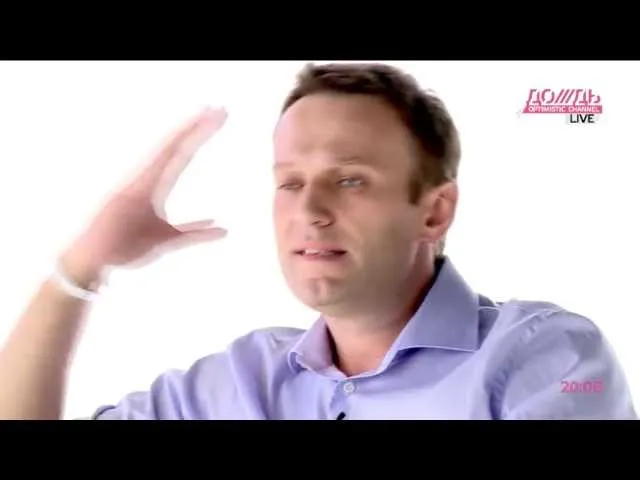
Sobchak Live
Good evening, this is Sobchak Live, and
today my guest is a candidate for mayor
of Moscow, Alexei Anatolyevich Navalny.
Good evening. Good evening, Ksenia.
Anatolyevna.
As I understand it, for many people, Alexei
Anatolyevich, this is now a new reality,
because many people
associate your release at the beginning
of your detention, then your release
before the verdict came into force, with a certain
new milestone for Alexei Navalny. You’ve
been told many times that
you went from being a blogger to becoming a national
politician, but now everyone
seems to agree on that. Do you yourself feel that
this point, through all these events,
has made you a national politician?
Regardless of any further events
connected with the election, I believe that
for a real politician, nothing like that exists;
there is no point through which one
suddenly becomes a national politician. Either you
are engaged in political activity
or you are not. For all these
past years, I have been building my independent
political line, bringing together people
who share my views. I
have been acting and working from the very beginning.
Even back when I wasn’t
invited onto wonderful programs like Sobchak
Live, when no one was
chasing after me many years ago, when no one
was running after me and
no one was interviewing me, I
felt myself to be just as much a politician then
as I do now. Back then I had
a system of views, I had
proposals; it’s just that now my
activity has gained support, perhaps from
a broader circle of people. But as for
me, no one can, you understand,
grant me passage, make me or not make me
a national politician — and no one can do that to anyone.
In reality, it’s only puppets
that get pulled onto television or dragged back off
it. I do what
I think is necessary; around me are my
supporters of these views. I think we’ll
talk more about that today. As for
this decision, it really was
paradoxical and caused a storm of various
opinions and emotions. Which
version do you subscribe to? I think you know all the
versions connected with your release.
Let’s list the main ones for our viewers.
The main ones. Well, the first is that Sobyanin
needed this election, needed a candidate. All these
versions from some foolish political analysts
aren’t even worth listing — it’s all
complete nonsense. I knew for certain
that there would be a long, real prison term.
And my wife said so immediately afterward.
Even three days before that, people from
Kirov wrote to me — it’s a small city, you can’t hide
things like that — that in the pretrial detention center
three cells had been renovated, and special forces had been brought into the detention center.
Special forces were brought in there, and later I
saw them myself when they brought me there. So
you knew about the sentence? I knew that the sentence
would be a real one. I knew there would be
a long term. Of course, all those
wonderful conversations about the possibility
of a suspended sentence certainly frayed the nerves,
but I understood that the decision had been made, and it
was fully carried out. When that
decision was implemented, the interests of everyone had already been taken into account there —
Sobyanin’s and not only
Sobyanin’s; God knows whose else, I don’t know.
Putin made that decision. For me,
there is no other version except that Putin
changed his decision under pressure
from those people who said that they
would come out to Manezhnaya Square (a central square in Moscow), and in the end
they did come out. They understood perfectly well, even by 3:00 p.m.,
that more than
10,000 people would take to the streets of Moscow — it would be the largest
unauthorized mass protest. And those
people, by threatening to come out and
that something might happen, forced
them to take a step back. And that is why I am very
grateful to those people. I truly believe
that it was not some
Sobyanin, Putin, and so on who got me released, but precisely those
people. Whether for long or not for long, the fact that
I am sitting in this studio right now and not in
pretrial detention center No. 1 in the city of Kirov, I owe to them.
But don’t you think that, after a year,
when the squares had seen
larger gatherings of people, it’s still unlikely
the authorities could have been frightened by the fact that
10,000 or even 20,000 people came out? That’s not even
100,000. They acted completely rationally.
What’s more, they acted within the system
in which they always act. It’s just that
those somewhat dim political analysts forgot
how events developed. People came out
to Chistye Prudy (a boulevard area in Moscow), then came the first
Bolotnaya protest (on Bolotnaya Square), and in response to that first
Bolotnaya rally, there was Putin’s response, voiced
by Medvedev, meaning: here, we’ll change everything here.
They let the tension subside,
after which they started tightening the screws on everyone there,
jailing people, and so on and so forth.
And then this is a kind of traditional Putin tactic
— a sort of aikido that he has used many times. You know,
let's take a step back now, and then
when he turns away, we'll hit him
over the head with a hammer. When there was the Manezhnaya unrest (protests/riots near Manezhnaya Square in Moscow),
connected with
the death of one of the football fans, Putin even
went to the grave, yes, surrounded by fans.
So in doing that, it seemed as though he had very seriously
damaged his political image, but then he
got revenge on those people afterward. He jailed
several of them. So they do this
all the time. I see. So you believe
that Vladimir Vladimirovich initially
made one decision and then changed his mind
after learning how many people were planning to come out
and showed flexibility in his political position, yes.
Yes. But why? He sits there and understands that
there could apparently be some
problems. Why would he need that? Better
to step back now and then somehow
catch up with them later. So you think there was no
intrigue here connected with the election, with
the idea that Sobyanin needed a real opponent
And Sobyanin did need a real opponent
up until the 18th, the 17th,
the 16th, and two weeks ago, when
the prosecutor asked for six years for me, all of this
was still in place. Nevertheless, the decision on an actual
five-year prison term had been made, and it had not
been revoked. Well, unless of course you
think that Judge Blinov independently
makes decisions like that. All right, you said
that some group of people could have
told Putin that otherwise,
if the preventive measure was not changed,
they would come out to Manezhnaya Square. What kind of
people are we talking about, roughly? I don't know what
group of people. I think that, first of all, Putin
understands such things himself, and secondly, we
understand quite clearly — or at least it seems to me
that I clearly understand where all this
comes from. You have to realize that Putin and
the people around him get their information
from exactly the same sources as we do. They
read the same Twitter, and on top of that they also look at
some so-called red folders
brought in by FSB officers, where the FSB, based on
that same Twitter and Facebook, writes
that yes, this time there really will be
the largest unauthorized protest yet.
So they monitor this closely. Alexei Anatolyevich,
you've been in politics for years now.
Still, who are these people who could have
influenced Putin in such a way that he
changed that decision? Roughly speaking,
who? Putin made the decision himself. I think he
took into account the information he was given by
certain operational services that
monitor
the possible number of people who
would come out into the streets, the mood of those people,
and their demographic profile. So when they
told him, 'You know, tonight
12,000 people will definitely come out,
people whose demographic profile is
young men under 35 years old,
with a fairly aggressive mood' — well, they came out,
and maybe they would leave, or maybe they would burn down
the State Duma building. So Putin said, well,
why the hell
do I need these problems? Better that we now
put out a statement so that by 8 p.m.
everyone would know that the sentence would be
reviewed. And by 8:00 p.m. everyone
already knew that the preventive measure would be changed.
I didn't know, because I only found out the next
morning. But everyone who came out then knew, and
for now we'll just step slightly aside,
let the raging bison run past us, and then
we'll eat that bison piece by piece. Well,
still, at 8:00 p.m., as far as even I
remember the media atmosphere around those events,
people in the
square — well, they may have been talking about it, but by around 8 p.m.
everyone already knew. I was curious myself, so I
checked later: by 8 p.m. absolutely everyone
absolutely
was reporting it — that is, the Prosecutor General's Office
the General Prosecutor's Office
had linked these two events.
All right, now regarding the election itself.
As I understand it, the appeal procedure
is 40 days, so in any
case, the maximum amount of time this
decision can be delayed is 40 days.
So accordingly,
on the 29th we will file an appeal — a short one for now.
Then, once we receive the transcript from the
hearings, we'll file a detailed one, and this can
be considered very quickly.
And there have been precedents. Remember when
Khodorkovsky was running in the
election in Moscow's University district for the
State Duma, his appeal
was reviewed instantly so that
the verdict would enter into legal force
and he would not be able to run. In any case,
by the 8th, even the longest possible deadline
— no, no, absolutely — this
can be considered over the course of
several months, or it could be
reviewed in 15 days. Your forecast: will they let you
take part in the election, so to speak? I don't have
I never try to make forecasts like that.
I don't try to predict things
that I don't control. Everything depends on
us. If we force them to let us onto the ballot,
they will. People came out and forced them to let me
out—they released me. So I'm not
going to engage in some idiotic
interpretation of who went in there,
who went to Putin, who came out from Sobyanin, and so on. It
makes no sense whatsoever. I have
my team. I have my
election campaign. I have my
political views, so if only
I had the time to
tell Muscovites together with my team
about my political views, I
will use that time. But aren't you
afraid of inadvertently
playing into Sergei Semyonovich Sobyanin's hands
in the game he has chosen? Because if
he really does ensure fair
elections—and as I understand it, some steps are now being taken
to make that happen—we can't
know in advance, but there are certain
signs that the elections
really could go quite
transparently, and if he still beats you, then
he will become, essentially, the only
politician in Russia elected legitimately, without fraud
at the polls. And am I afraid
of playing into Ksenia Sobchak's hands, who, as
is well known, is a Kremlin agent planted in
the opposition, by appearing on her program? Whatever
I do, I can always end up helping someone
or not helping them.
I could be accused of legitimizing things or something else, but I
can't live in a state of some kind of
idiotic
conspiracy theory. There is political struggle,
political struggle for clear goals. I
have a system of views, and I will
use every opportunity that
I have. Of course, the elections
taking place in Moscow right now are already
completely unequal and unfair.
Candidate Prokhorov, for example, has been pushed aside, while
all day long on television they talk about Sobyanin,
what a strong
manager he is. And about me they say
that I horribly stole all the timber, and so on
and so forth. So what now? But you are still
taking part anyway. We will take part
because, as I've said many times, for me
these elections and this campaign are
about interaction not with the election
commission, but with the voters. This is not
the last election campaign, and we
understand perfectly well that this government, which
has dug itself into the Kremlin, will not change as a
result of elections like the ones
taking place now. All right, let's
imagine a situation in which, before
the eighth, the ruling comes into
legal force, and regardless of whether it is
a
suspended sentence or not, you
will not be on the ballot as a candidate. What will
you call on your voters to do? Well, for
you personally, please tell me, if
I am not on the ballot,
will that be an election or not? Well, I did invite
you for an interview, but it seems to me
that for many people, if I am not
on the ballot,
those will not be elections. For me, they will not be
elections, because they removed the main
competitor. They didn't just remove him—they removed him
using the repressive machinery, in a completely
unlawful way. My entire штаб (campaign headquarters) will turn into a
boycott headquarters. We will call on
Muscovites to boycott these elections. They
are already dishonest as it is. But then
they won't even have that sort of
ritual illusion, you know,
of some kind of fairness. All of this, this whole
smokescreen, will be completely obvious, and we will
urge people to boycott the elections, not
to go to them, and to say that
anyone who goes to vote under these conditions
is, well, an accomplice to this
violation of the law. And of course we will call on
all the other candidates to withdraw their
candidacies. Let Sobyanin win with
a turnout of, I don't know, 15%, with some of his
three sham candidates. And why do you
not consider it more advisable to,
for example, call on people to vote for
the Communist Party candidate or for Mitrokhin from
Yabloko, because I am a candidate. I
believe that, as a Muscovite, as a
citizen, I have every right
to take part in these elections. I have
fairly strong support.
Whether it is large or small, we will see.
If, if candidates are removed from the election,
they remove them because they do not want me
to take part in it. We will boycott
any election in which they do not allow
participation. Why am I asking about this?
Because when the elections to the
State Duma took place, there were two, within the opposition there were two
opposing currents. On the one hand,
there was Boris Nemtsov and his so-called
...yes, and your policy, which consisted in
that any candidate except the candidate from the authorities
the authorities. Isn't there a contradiction here? What
maybe in the mayoral election, then, too,
your position should work the same way then?
won compared with Boyko? No,
there is no contradiction. No, it's just that in every
specific situation we have to choose
the best political strategy, the one
the political strategy that will cause
the greatest problems for this government after all.
When we are dealing with parties, these are
parties, meaning a large number of people. We
were fighting United Russia then, and our
campaign, "vote for any party against
United Russia," obviously had an effect.
It did. Vote for any
...the same thing in the presidential election
didn't work anymore. The campaign "vote for
anyone against Putin" did not work
because Putin himself decided: so, with
me there will be these, I don't know, two
"Murzilkas" (token, unserious candidates) or three, or one half-Murzilka
and the rest are Murzilkas, and that no longer
worked. The same thing here: Sobyanin himself
determined the competitors in the election.
He decided which lineup of competitors to place on
the ballot, including me and my
candidacy. Therefore, if they throw it out,
the option "vote for anyone against
Sobyanin" does not work, because this
campaign benefits Sobyanin. It
raises turnout for him. Understood. As for
Mitrokhin, he has publicly more than once
accused you of the fact that part of Yabloko's
program was, let's say, copied into
your program, and in general over
the last few days we have seen a lot of criticism, even
within the Yabloko party, connected with you,
to the point that people who are members
of the Yabloko party are forbidden to somehow
express their... Yes, yesterday there was
this remarkable letter online from
an internal party mailing list, from one of
the major party functionaries. It said something like,
"Love for Navalny
membership... being infatuated with Navalny and
membership in the Yabloko party are incompatible." Well,
first of all,
it's a little strange to see that
Yabloko has now chosen as its main
target of criticism me. It seemed to me
that there are, generally speaking, other people
to criticize. That's first. Second, well, this is
politics. I'm fine with that.
Everyone competes with each other. An alliance with
Mitrokhin? What exactly do you
mean by an alliance? I have
normal relations both with Mitrokhin and with
Melnikov, and as for monitoring
the elections, as for demanding equal
opportunities for all candidates, I
work with both Mitrokhin and Melnikov,
but obviously we
are competing. The fact that I have good
relations with Mitrokhin—I appeal to
all voters, including the voters
of Mitrokhin, with a call to vote for
me. Let's move on to the program itself.
Actually, having familiarized myself with
your program, and Yabloko's, and
Sobyanin's, I still think that ordinary
viewers, ordinary voters, are unlikely
to read every word of
these programs literally, but many points even
to me seemed very similar. Sobyanin
talks about the problem of migrants, and you
also talk about it a lot. Many things
really are similar to Yabloko's program.
Could you, very concretely, so to speak, in
simple terms, explain how your program
differs from the campaign programs
of Yabloko and Sobyanin—well, for example, these
two of your competitors? Look, in simple
terms, point number one: we need to start with
what I have and what they do not have. That is
the most important thing: not the letters and numbers
written in a program, but the ability and
the desire to implement that program. My
program differs from theirs in that I will
implement it. That's first. Second, let's
take the main blocks. What
sociology and everything else show
are the main problems that
concern Muscovites: illegal
migration, transport, and housing and utilities. If we
look at Sobyanin's position on transport,
we will see that Sobyanin's program
is focused on implementing grand
infrastructure solutions that are very expensive:
big interchanges, big highways, and so
on. It is mainly aimed at
building roads, interchanges, major ones.
And yours? My program says that
these major solutions of his,
these major roads, in fact will not
solve any transport problems. There are
calculations showing that these
problems are not solved this way. My
program is about the need to develop more quickly
the capillary connections, the capillary system
of small roads, and so on. And all these
major construction projects look quite
meaningless; they do not have, uh, proper
infrastructure
urban-planning or transport justifications, and in
are mainly beneficial to contractors, that is,
Sobyanin wants to use transport funding to
feed contractors. That’s transport. Second,
when it comes to housing and utilities services, the differences here are very
serious. We are saying that it is necessary to
conduct
an audit of utility service costs. We
are saying that it is necessary to carry out
demonopolization, and so on. Sobyanin’s program
says that everything should be
rolled into enlarged tariffs, which include a
corruption component, and that this will somehow build happiness for us. As for migration,
but this is
simply ridiculous, you understand, because
Sobyanin is a representative of United Russia (the ruling political party), the very
party that has controlled both the State Duma (lower house of parliament) and
the Moscow City Duma for many years. They can pass
any laws they want. So the question arises: why
haven’t they? They have only now started fighting
illegal migration because
opinion polls show that illegal
immigration is unpopular with everyone. Why do they
not want to introduce, for example, a visa regime, and
why have they consistently, all these years,
blocked the introduction of a visa regime with
the countries of Central Asia? Sobyanin’s position
on migration is absolutely hypocritical and false
from the first word to the last. Maybe
he has started listening to the spirit of the times, but
you can look at it this way: he is now mayor, he
now has United Russia sitting in the Mos-
cow City Duma, and right now the contracting
organizations, housing maintenance offices, and so on
are the main employers of
illegal migrants. Well then, go and solve this
problem. But they need migrants because
they bus them to rallies in support of United Russia
because they take part in
election fraud, because money can be collected from these
migrants. Street cleaners
take home 18,000 rubles on paper,
and so on. But how exactly are you planning to deal with what
is connected with the visa regime? Is it really
a realistic measure? The visa regime is one of the things. We
for example, propose in our program that
contracting organizations that are connected to
budget funds, to city money, should
be disqualified if they are involved in
the use of illegal labor.
It is a very simple solution that would
work very well. Sobyanin does not do
this because he knows that if this
law were introduced, tomorrow all these
contracting organizations belonging
to the wives of district heads, and so on, all of them
would have to be disqualified because
they all profit from illegal
labor. We have to break away for literally
a few minutes. Stay with us.
Sobchak Live. We are on the air live and will continue
after the commercial break.