Alexei Navalny’s interview on the program “Sobchak Live” on the TV Rain (Dozhd) channel. Part 2
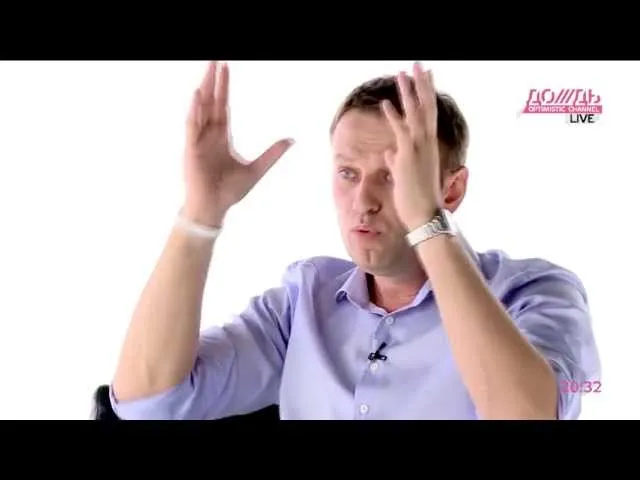
We are live on Sobchak Live, and with me
still in the studio is Alexei Anatolyevich
Navalny, a candidate for mayor of Moscow. It’s just that
once I became a mayoral candidate, you kept
emphasizing all the time that I’m Anatolyevich, which is
of course—I’m already somehow learning to pronounce
the first name and patronymic correctly, as many people
write it. So, you believe in victory? That’s
good. All right, let’s talk about something else.
About your criticism of Sobyanin: in your blog
and in your public appearances, I’ve read and heard a great
deal, but I’d still like to know, in your
view, what good has Sobyanin done during
this time, and which of his initiatives are you
prepared to continue—or is there nothing at all
for which you could praise
Sobyanin? Well, compared with
the Luzhkov era, even if these things
were obvious and clearly needed
to be done, the Luzhkov period
is not especially different from the Sobyanin period.
What good has Sobyanin done? He has done something,
without a doubt, for this “something”
he deserves credit. At least at the level of
rhetoric, he began talking more about
the inadmissibility of infill development
especially at the beginning of his tenure, it really was
connected with the fact that many
things were reconsidered. Now we see
that the construction... well, what I liked was this:
I like any steps toward
transparency, fighting corruption, and so on.
What was being done at the first stage
looked more or less, at least
in terms of the statements, more or less acceptable to me.
For example, I liked that he brought into
the economic bloc Andrei Sharonov—that’s
an excellent professional—and there were
a couple of other people too. I liked
that at the initial stage he consulted people, and
his program was written by many of the same people who
later helped me write my program. But
all these ritual, rhetorical things
came to an end.
After a few months. Well, why?
Advertising banners, park improvements,
some genuinely useful decisions on
bike lanes—you should say,
well, there are pluses here. I try
to look at the whole picture. And I can
explain—I try to look at
the picture from above: here is a city with
a budget of 1.6 trillion rubles
—a gigantic budget for a gigantic city.
Sobyanin is not engaged in improving
the management of the city, but in PR. They’ve
made bike lanes—let’s photograph them,
let’s do
a hundred reports about them and say that this is great.
It is good, but when people tell me what a
wonderful Gorky Park
we now have, I say that in the city of
Moscow there is so much money that with that money
my Maryinsky Park should look
magnificent too, and no worse than Gorky Park. But
when I see this—well, you understand, something is better
than nothing: a park was done up, advertising was removed,
spot development ended. Thank you
very much to Sobyanin for not
having us shot, you know—and why not praise him for that
even if he is your competitor? Well,
I am not going to praise a competitor for the fact that
out of 100 items in his job description
he fulfilled two. The previous one maybe
fulfilled only one, and this one started
fulfilling two—am I supposed to praise him? I
want him to fulfill all 100, or at least
to start fulfilling more and more of them.
I see the trend, and I see that
Resin, the embodiment of corruption
and the construction mafia, was an adviser to
Sobyanin and now sits in the State Duma
representing United Russia, and the same
very influential mafia from Kazan
—the construction mafia that was simply
brought here by Sobyanin and his hometown mafia network—
headed by Kusnirovich... these are the same
con artists who are handed the same
suitcases of money, just through a different entrance.
You wrote about Kusnirovich, and your position on that is
clear. What interests me is something else. All right,
instead of these people, let’s imagine
a situation in which Alexei Navalny
wins the Moscow mayoral election—what kind of
purge will there be at City Hall? Who will be the people
who come in with you, and whom will you remove?
Who will stay? You mention Sharonov; I know
that you have also spoken very
positively about Pechatnikov. I don’t know
whether Kapkov will stay, whether others will stay...
Positively about Pechatnikov—you’re mistaken.
There are people who represent
the political leadership of City Hall—those are
the people who really
determine policy. As for those now sitting
in City Hall, some are better, some are
worse; some fulfill zero
points of their job
descriptions. From the current leadership of the mayor’s office,
of course, no one would stay. But that is inevitable when
a new mayor comes in through an election:
naturally, the political team
running the city has to change.
Otherwise, none of it makes any sense. It’s very important
to understand that the city is not run by these
20 people, but by tens of thousands of people.
The prefectures, district administrations, and so on.
It’s impossible to replace them all in a single day,
and there’s no need to. You simply need
to put in place different political
leadership so that these
people develop the right priorities,
the right messages. Alexei Navalny:
What will this political
leadership look like? At least a few names—and
where will you get these people? How
will you hire them?
There are a great many people around me,
starting with municipal deputies
who have served as municipal deputies for many years
and understand urban problems extremely well
at the grassroots level and at the middle
level of the prefectures, and at the level of city
services. Around me there are people who
have run huge corporations, like
Vladimir Ashurkov. Around me there are people
who are involved in governance in one way or
another, in representative and legislative institutions,
in cities—for example, Volkov,
Leonid, who serves in the city
assembly of Yekaterinburg, a city of over one million people.
But are there any major political
figures? You see, major
political figures—I need people
who—you can smirk sarcastically here if you like,
or not—but who will live by the principle of
not lying and not stealing,
and who will also carry out their official
duties. What to do with city
government in general is fairly clear; it’s been
discussed so much and so much has already been
written into various programs. It’s very good that
so many people have this worked out, which is why you say that
the programs of many candidates are very
similar. The only difference is that some people
will carry them out and implement them,
and some won’t. Someone writes a healthcare
program and allocates
for it, as Sobyanin does, an increase in material
resources of 100 billion rubles (about $1 billion USD), of which
30% will be skimmed off, while someone else won’t
do that. That’s all. Yes, someone writes about
a different structure for choosing outpatient clinics, and
I hope we’ll discuss all of that as well.
Look, still, about the team. I know
this question gets asked often, and it’s asked
rhetorically as well—and directly to you—
about who exactly the people on
Sobyanin’s team and Navalny’s team are.
Look, each
candidate, under the new legislation,
was required to nominate three
candidates for appointment to the Federation
Council (the upper house of Russia’s parliament). From these three candidates,
one will later be chosen. To explain it
to our viewers, it’s roughly like
the vice-presidential choice in American elections—these are
people
who are, roughly speaking, supposed to
strengthen the figure of the elected
president, or in our case, the
candidate. Usually they are chosen according to the principle that, well,
if there are pensioners, you need
to put forward someone who will
represent the interests of pensioners; if
there is, I don’t know,
a Black male candidate, or
conversely a white male candidate, then ideally
a Black woman should be
vice president in that situation. In other words,
you need to appeal to the maximum
number of people from different voter groups.
As far as I know, you put forward three
candidates. They are all familiar to me and
respected people, but one could say they are
technical figures: Mr. Ashurkov, and
Bezkaravainy and Lyaskin are still people
from your team who do not have that kind of
major political weight. Was that a deliberate
and intentional
choice? Please don’t be offended, but this
is what’s called “hearing the bell but not knowing where it is” (a Russian expression meaning to have only a vague idea of the facts).
Nothing of what you’ve just
said is true—from the parallels, the parallels with
America, to the fact that for some reason
you called these wonderful people
technical figures. No. The point is, there are
requirements—requirements of this idiotic
legislation—that when
a candidacy is put forward, at registration,
you have to choose three people, one of whom
will later go to the Federation Council, a useless
body that it’s not even clear what it does.
Those are the legal requirements. Nevertheless, among these three people
I included people
about whom I can say that they are
wonderful people. Technical figures?
Why not people who would strengthen you,
for example? Do you mean taking some kind of
idler who is a political figure
just because of their image? For example, Sobyanin has
Shvetsova. People may feel differently about her,
but she is unquestionably someone who
for a long time
has prepared falsifications and ensured
inequality among candidates, for example in the media.
Who has prepared falsifications? Do you
have something specific in mind? I know that
Moscow elections have never been
honest, and your beloved Shvetsova as well
Shvetsova is not my favorite; I brought her up as
an example. She was always involved
in organizing and facilitating these
falsifications through the social sector
through healthcare institutions and
education. It was she who made it so that
despite the fact that for each Muscovite
healthcare spending is
four times higher than for any other
citizen of Russia, in Moscow it is impossible
to get good healthcare. So
you are suggesting that I simply take
some former idiot and
a corrupt loafer and go around with him
simply because he has some kind of
hairstyle and says, "I spent 100 years
working in government bodies." Well,
as a rule, people want to strengthen
themselves. I have a different rule: I
choose the people I believe in and who
have proven themselves through decent work,
people whom I know will not
deceive anyone, will not steal,
they will not
behave in a corrupt way,
and will strengthen me by making other people, looking at their
work, support me even
more strongly. That is what I need.
Can you name the people who will
work at City Hall if you become mayor
of Moscow? Specific names,
specific positions. Well, I don't know, for example,
the Department of Culture will no longer be
headed by Sergei Kapkov, and instead it will be hea...
Sergei Kapkov definitely will not
head the Department of Culture. He
I think does not head the Department of Culture now,
but he heads it because
Sergei Kapkov is a member of United Russia
and Sergei Kapkov, despite the fact that in
personal communication he is quite a pleasant person,
is a representative of this very government. For
me, he represents Sobyanin, Putin,
Abramovich, and United Russia, just so I can be clear.
So that I understand correctly: any person
regardless of whether he made a good park
or built a bike lane or
did something good in healthcare,
if he is connected with the system of power and was
at some point, or is, a member of United
Russia, will not have the opportunity
to work at the level of the political
leadership of the mayor's office? Of course not. Unfortunately, our
system is structured in such a way
that they forced a huge number of people to join United
Russia—I don't know, there are
teachers, doctors, and so on. In a specific
example, who could be better than—well,
let's say now, if you want me to—
All right, who will head the prefecture
of the Southern District, who will head it, who
will—are there people who will take these
political positions? Ksenia, this is all
we still have many days left before the election.
We will still have our
program—it is a living thing
that will be written down,
reworked. We also still have
presentation meetings planned
at which we will talk about, for now,
the people and say what they will do. All of
this will come—please be patient.
There has to be a certain
dramatic structure to it, so of course we cannot
reveal everything now and spell out
everything down to the district administrations. But it will be
detailed at the level of the political
leadership, at the level of the political
leadership. Well, at least maybe
could you name a couple of people? It feels like
you are demanding that I
appoint you somewhere immediately. With all
my affection for you, I definitely cannot
appoint you anywhere, sorry. Let's
talk also about your recent promise
to include environmental points in your
program. First, were you offended
that she nevertheless brought some
criticism of your program into the public sphere, and
second, which specific environmental
points will be included? Well, of course I was not
offended at all, because this is
a normal political process: people
evaluate programs,
they like some things, they do not like others,
it is in fact an endless
process. First, it is impossible to make
a perfect program that appeals
to everyone; the program has to appeal to me. In
any case, there was no separate section on ecology,
and that was what Zhenya Cheirikova's complaints were connected with,
and we discussed all of this with her. We
will spell it out.
The issue is not about including in the program a point saying
"let's plant a million new
trees." It is really about points concerning
compliance with the law. In Moscow they cut off
pieces of land under the pretext of changing their boundaries
and build housing on them. Not because
the program is somehow bad, but because of
corruption—because a contractor comes
and says, "Cut me off a piece of Losiny Ostrov (Elk Island National Park)
and I'll put up a residential complex there." That is what we have to fight.
In your program, in what
way? Law and order are already spelled out in our program.
There must be a master plan, there must be
development plans, and there must be clear
boundaries. If Losiny Ostrov (Elk Island National Park) has boundaries,
then those boundaries cannot be redrawn.
You can’t, as they call it at City Hall, slice off
little pieces from it. There must be a development plan for Moscow.
Here’s a very recent and very
telling example of what is happening right now
in one of Moscow’s main squares, on
Triumfalnaya Square. Today there stands
an enormous ugly tent that has been put up there,
simply a disgrace and an eyesore on
the face of the city.
so that he couldn’t come out there on the thirty-first.
We will not have this kind of nonsense,
when some kind of business
or corrupt interests, or political
interests, dictate, among other things,
the city’s architecture and outward appearance.
Let’s put up any monstrosity at all, so long as
Limonov (Eduard Limonov, opposition politician and writer) doesn’t come here—that’s all. There is no other way
to fight this except by observing the law.
You simply cannot combat this any other way. We’ll
break for a few minutes. Stay
with us. Sobchak live.