Alexei Navalny’s interview on the program “Sobchak Live” on TV Rain (an independent Russian TV channel). Part 3
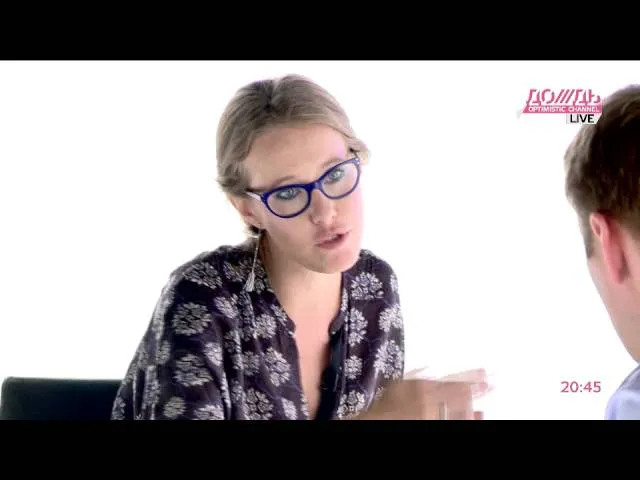
We continue with the program Sobchak Live, and
my guest is still Alexei
Anatolyevich Navalny. Alexei
Anatolyevich, now I have
a number of other questions related to your
federal ambitions, so to speak, and
connected not just with the mayoral election
in the city, but also with the statement you
have repeatedly made regarding
the next presidential election. So,
look, speaking about your program, the
main thing you always say, including
here on TV Rain, is
this:
that you will put Putin in prison. You and your
supporters. I can quote you—don't
roll your eyes. I’m quoting: “The main thing is
that I feel myself to be part of
this process. I will do everything so that he, and
Putin, Rotenberg, and Timchenko, and all of them on
the list, end up behind bars.” But for now, the situation is such
that Vladimir Vladimirovich is the one putting you in prison. So what, essentially, is the substantive difference between your
rhetoric and his?
If you are someone aspiring
to head the executive
branch, how can you, deliberately or not, make
such statements about the judiciary?
How can you make statements like that?
It seems to me that in this sense they are very
similar to the statements
Putin constantly makes. It’s just that he
currently has more power and
therefore more opportunity
to carry out what he wants. But the issue
is not the statements—it is concrete
practice. Putin uses
the law enforcement system and the judicial
system in order
to enable his
corrupt billionaires to protect their billions,
to place them outside the reach of the law. And he uses this same
system in order to
neutralize, imprison, intimidate, kill, and
so on, people who
criticize this corrupt system of his. I
am saying that this is what we demand. My
federal ambitions, regional ambitions,
municipal ambitions, neighborhood-level ambitions—
they are all about the same thing. I demand one very
simple thing: law and order. I demand
that these people—look, under me, Putin
will be in prison. How can a person who
believes in the judicial system speak like that?
You are not saying, “We will investigate
what crimes were committed.” I have been
working on exactly this for many years.
So you want to deal with the judiciary rather than
the executive? I do not want to deal with the judiciary and
the executive separately—I want to deal with power in the country as a whole. I want
to say that I
know for certain that on
the basis of the separation of powers, you cannot exercise both
judicial and executive authority—that is the whole point.
There is
a contradiction there. For the judiciary to gain real
independence, political power in the country must change.
Then honest courts
which, under conditions of
adversarial procedure, will consider
cases, and so on—I am sure they will, without
a doubt, hold all of them
accountable. Because I, as a person
who has devoted years to
investigating all sorts of schemes at Transneft,
Gazprom, Rosneft, and so on, know
with absolute certainty that these people are guilty of
serious crimes. They
stole
billions. Is that your assumption? It is not
my assumption. I am absolutely certain of it.
I am telling you: I publish documents. But only
a judge who
will hand down a verdict on Putin can be certain in that sense, because
otherwise how is he different from the fate—or rather, from
Judge Blinov, who simply signs a sentence on command?
Do you not see
that this is absolutely—how should I put it—
the same thing in substantive terms?
The fact that you are wearing blue
glasses right now—I can see that. I am ready to go to any
court and prove that you are currently wearing
blue glasses. When I see that at
Transneft so much money was stolen, and I have
documents, and I have checked it all, I know it.
I am ready to go to any court and, under conditions of
equality, adversarial procedure, and openness,
prove that these people stole this
money. I am ready to come and prove that
Putin, together with his crooks, built
a residence here in
Gelendzhik using stolen money. Clear?
Once again, a few more questions of federal
importance. There is a major debate
in connection with the new initiatives
of Ms. Yarovaya regarding Stalinism
and fascism, and their interrelation. Do you believe
that Stalinism and fascism should be equated
in legislation? To be honest, lately
I have somewhat lost track; I have not been following
Ms. Yarovaya’s legislative initiatives.
What happened there? Well, an initiative
connected with making it impossible
to criticize the Red Army and its actions during
the Great Patriotic War (the Soviet term for World War II on the Eastern Front).
It triggered some kind of storm of emotions, and all that.
These actions are complete nonsense.
Yarovaya (likely referring to Irina Yarovaya, a Russian politician)—let's not talk about Yarovaya. You
believe that Stalinism and fascism should be
equated at the legislative level. What
does it mean to equate them at the
legislative—what does it mean to equate them at the
legislative level? That too is some kind of
nonsense. Stalinism and fascism are equally
anti-human and criminal
regimes. Do you agree with that or not?
This does not need any kind of approval at
some legislative level. It is
a matter of studying historical documents;
it is a matter of research. Navalny, what do you
think? I think this does not require
legislative regulation. It's nonsense and
a waste
of time. Everyone noticed that just this Friday in
England, same-sex marriage was legalized.
Before that, it had been legalized in
France. Would you
uh, if you became president, allow
same-sex marriage to be legalized? I believe
that the question of legalizing or not legalizing
same-sex marriage—or rather, the question
of formalizing civil relationships—is
a matter for referendums, apparently
regional ones. Russia is a very large country;
attitudes differ across different federal subjects (regions).
I think that a referendum in
Dagestan would never legalize such
relationships. I believe people have the right
to formalize civil
relationships between themselves however they want. An important
question, for example, is the adoption of children. Here
I am categorically opposed. But if someone
lives as a couple and wants to formalize their
inheritance rights, then for God's sake. Who
they are—men, women, a grandmother and
a grandmother, a grandfather and a grandfather—I don't care.
It doesn't interest me at all. If in that
federal subject (region) such
legislation is adopted, if it's a liberal city and
they are allowed to formalize their relationship,
fine by me. I don't object. You know, excuse me
for all the insinuations, but you know that exactly
the same thing, when asked about same-sex marriage,
Vladimir Vladimirovich (Putin) answers in exactly
the same way: he talks about regional referendums and
about allowing them to hold a referendum on this issue.
That's all. It's clear that here
no one can hold a referendum, and
no one ever has, in fact.
In reality.
A referendum—because it is impossible to hold one.
As for gay pride parades in Moscow,
that is no longer a federal issue, but even
more interestingly, the thing is that many people
for some reason try to catch me out
on the question of a gay parade. Once again, my
position here is very simple: everyone has
the right to assemble peacefully and without weapons; this
is guaranteed by the Constitution to all
citizens. So yes, gay pride parades should be allowed,
gay pride parades and
anti-gay demonstrations as well—they have
the right to assemble. There is only one
question to discuss here: how
to ensure everyone's safety. And in that
sense, we should follow, for example, the model of
Jerusalem, which—yes—they allowed
a gay pride parade to be held despite an ultra-
conservative religious majority
in the city's population, by holding it in a stadium so that
no one would kill anyone. Otherwise, let
both sides rally.
What should be done about Chechnya? Previously, you had
some kind of idea about a confederation. Now you
Where did you get that from? Tell me.
What do you think now—how
should this problem be solved? It is obvious that
there is a problem. It is obvious that you talk a lot about it.
What do you consider the problem? Because you
just mentioned some kind of confederation.
I don't know where you got that from. What I mean
is that, of course—and you very
often talk about this—an enormous amount
of budget subsidies goes to this
region. It is obvious that the situation there is not fully
entirely
under control under
the influence of the local leader, Ramzan
Kadyrov. How should this problem be solved? On the one
hand, there are huge subsidies that
ensure peaceful coexistence;
on the other hand, the abnormality
of this situation is obvious, as are the major problems that
could arise at any moment when in
Chechnya either the leader changes or the leader's
attitude toward what is happening changes.
What I consider the problem of Chechnya—when I say
"the problem of Chechnya," I mean that on the
territory of Chechnya, a political,
tax, and legal offshore zone has been created,
effectively, where its own system
of power exists, its own troops—so what
should be done about this? Once again, I have no
other prescription except compliance with the laws
of the Russian Federation, which under the
Constitution must apply everywhere
equally. Chechnya needs exactly what
all of Russia needs, only on a
much larger scale. It needs
honest judges whom no one will call
to pressure. It needs honest
police officers—the very same reforms that
it needs to be carried out on Russian territory
it needs to be carried out in Chechnya. Simply sending there
perhaps twice as much money. But
that twice as much money should not be for
them to build a mosque or some kind of
residential district named after Ramzan Kadyrov, but rather for
changing the judicial system, for
perhaps inviting
police officers from other regions in order
to break up the clan system, in order
to make sure that under no circumstances in Che-
a knife fight—if you bring people there, how do you
imagine others there?
I mean, I said it there briefly
you understand, all of this is necessary. And this is a detailed
program, but what to do about it is completely
clear: those very
institutional reforms need to be carried out, the ones that
all of Russia needs. But when now on the
territory of Chechnya, with our money,
some kind of sharia army has effectively been created
where there are basmachi (a derogatory term for armed Islamist militants) with beards and gold-plated
Stechkin pistols, some kind of religious schools where
people—where children, instead of learning
mathematics, memorize the Quran by heart. This is
absolutely unacceptable. This
will lead to this
bandit enclave turning from
a bandit enclave into something even more like
an ultrareligious one, and we will be dealing with these problems
later, for another
200 years. Today you published your response
to journalist Aidar Zhabayev. He asked you
some questions, and you answered. I’m not going to
talk now about the substance of those questions or
those particular complaints. I think that as a
candidate you will face them often. I’m saying
that it seemed to me and many of my colleagues
that you react rather aggressively
to this kind of criticism directed at you
you react aggressively to journalists
who also ask you about
your nationalism. And in general you conduct your rhetoric
quite harshly. Aren’t you afraid
of scaring off some part of
the liberal electorate precisely because of
the aggressiveness of your rhetoric? And the second
question is related to this:
about “Murzilkas” — even today that term came up, didn’t it?
Don’t you think that this also drives
people away, this kind of division into black
and white? After all, many people really do
sympathize with you but support
Sobyanin. They genuinely think that way
they genuinely do not want any
serious changes because they are afraid for
their money, their salary, and their modest savings
So is the world really black and white? Is it correct
to see it that way, and is that how it looks in your view? Because
that is the impression one gets. But that is
wrong. And I don’t “get impressions” — if
there are things I am sure about, I say
those things absolutely clearly and directly. I am not
going, in order to please
some particular group of the population, or
conversely in order to show that
I want to push away the right, whom the left
doesn’t like, to change something in my
system of views. If I believe in certain
things, I say so. I have been saying so
for many years, and no one can
reproach me for saying one thing yesterday
and something different today. And
well, all right, perhaps sometimes I
don’t know, behave too forcefully. I do understand
that, probably, judging by our conversation
that, well, some of your questions I also
may answer with excessive aggression
all right, it’s just that there is this
feeling. By the way, this is charac- Vladimir, Vladi-
I don’t know what is characteristic of Vladimir
Vladimirovich (Putin). I believe in what I say, I
feel it; for me, I take everything
very personally. When I talk about corruption
it really, personally infuriates me. And
when Vladimir talks about “wiping them out in the outhouse” (Putin’s notorious phrase meaning to kill terrorists wherever they are), he
does he think that too? Your beloved godfather
is an absolute hypocrite; he isn’t “wiping anyone out” in
the outhouse. Vladimir Vladimirovich is busy
enriching himself and his country-house
cooperative Ozero. I dislike that very much
therefore I will speak on this subject
quite aggressively, even
if some sensitive people like you
clutch their hearts and say
“My God, how uncompromisingly he says all this”
If I consider certain people
to be “Murzilkas” (a dismissive term for obedient propaganda mouthpieces), when we say “Murzilka” we mean
simply people
I will call them that because that is how I
see them, that’s all. Now look, even the
case of Zhenya Chirikova showed that a person
who simply voiced a program not on
your behalf, but on behalf of many of your
supporters, was immediately subjected to a large
number of attacks, and she herself wrote about it
and we all saw it on Lenta. This
happens very often: anyone who is not
with us is against you. This is, well, what I would call
a historical hallmark
of Bolshevism. Is that right, and
wouldn’t you admit, perhaps
even now on air, call on your
supporters to be more tolerant of people with
a different position, more gentle toward
those who may not
share it. Would you at least use this broadcast to call on
your supporters to be as they are
— tough and uncompromising, and
to say everything plainly, to call things by their proper names.
I need supporters who are like me. I
believe in these people, and I want them to believe
in
me. The intelligentsia, the real
intelligentsia — the intelligentsia I believe in —
consists of people who have a system of
views. Tough, uncompromising. The intelligentsia is
always doubting — apparently, you and I have observed
different kinds of intelligentsia.
The people — my Russian intelligentsia —
are people who possess a system of views.
For them, the world is not black and white, but at
least they know what they are talking about,
and they have convictions, aspirations,
and inner moral values. Those are the people I look to.
Are you an intellectual?
I consider myself an интеллигентный person.
Of course. Well then, as one intelligent person to another, at the
end of our conversation, yes, I’m giving you
a book. I hope you’ve already read it, but
let it be part of your collection before
these difficult elections. And at the same time,
one last question: which significantly
Ksenia, you’re giving me a book — the wonderful
play by Yevgeny Schwartz, The Dragon. In return,
if I may, I’d like to give you this. You see,
we have these little things
that identify people from
our campaign headquarters. I’m giving it to you as an advance gift.
You still need to spend another four hours standing at the
campaign cube and handing things out. Since I gave you
this book — five books, or maybe three
books that influenced your
worldview — can you
name them? I read an enormous amount. I
don’t have five books that influenced
my... Reading in general. Russian, Russian
literature, Russian letters, Russian words —
they are, well, probably 90% of my personality.
It is reading, and
the first thing — the very first thing — that I
did when I arrived at the pre-trial detention center (SIZO) was say:
Where is your library here? Sign me up
for the library as quickly as possible. Is that more
Dostoevsky, or maybe... I remember
that Dreiser once made an
incredible impression on me. Are there
any books that... I read everything. I
don’t have that. These are journalists’ favorite questions:
name three people who
made an impression on you, name
three books. I don’t have a favorite writer. I
adore Russian classics. I read
contemporary literature with pleasure. In principle, I
love reading. I love the Russian language, and I
cannot live without it. It is a huge, it is
simply a form of self-identification
for a person. So, in principle, I live in
reading all the time. Thank you very much, and good luck
in the election. With us was the candidate for
Mayor of Moscow, Alexei Anatolyevich
Navalny. We’ll see you this Thursday.
Goodbye.