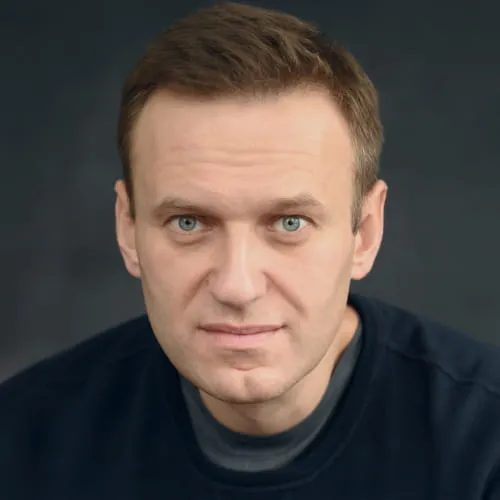
The Russian opposition figure and anti-corruption activist, who was the target of an attempted poisoning on August 20, 2020 and is now imprisoned, sets out five measures to combat the greed of leaders of autocratic regimes in an article for Le Monde, also published in the Frankfurter Allgemeine Zeitung and The Guardian.
Opinion article. Exactly one year ago, I was poisoned with a chemical weapon, and I did not die. Corruption appears to have played a significant role in that fortunate outcome: it had hollowed out the state system from within, and therefore the security services as well. A group of FSB officers [Russia’s domestic security service] applied a nerve agent to my underwear in a highly unprofessional manner. They had been following me for three and a half years with the same lack of professionalism, violating every instruction in the book, which allowed independent investigators to expose the entire group. When the leadership is busy providing mafia-style protection to the business world and extorting money, the quality of covert operations inevitably suffers. However, a regime built on corruption performs simpler tasks very well. Autocrats who want to rob their people first take control of the judicial system, and it works perfectly on a quid pro quo basis. So when I returned to Russia [in January] after treatment, I was sent to prison immediately after stepping off the plane. There is little pleasant about that, but at least I have time to read the memoirs of leaders from around the world. They write about how they tried to solve humanity’s greatest problems: war, poverty, migration, climate change, weapons of mass destruction. These are considered matters of “primary importance.” But these leaders do not often mention the fight against corruption. That is hardly surprising: it is treated as a matter of “secondary importance.” And yet—strikingly—these leaders almost always talk about corruption when they recall failures. Their own, and more often than not, those of their predecessors: “We devoted years, hundreds of billions of dollars, and thousands of human lives to Iraq, Afghanistan, Mali—wherever. But because the country was looted by the corrupt government of Nouri al-Maliki, Hamid Karzai, Ibrahim Boubacar Keïta—whoever—the people turned away from it and allowed radicals armed with slogans about just and honest government to prevail.” Refusing the discussion And here an obvious question arises: if corruption prevents us from solving problems of “primary importance,” is it not time to put it at the top of that list? It is easy to understand why that has not happened so far. Corruption is an extremely delicate subject for discussion at international summits. Suppose you are discussing Syria and cyberattacks with Vladimir Putin, for example. Everyone is satisfied and engaged. Now imagine a meeting with Putin on the subject of corruption. The very fact of such a meeting is a personal affront. Everything becomes awkward from beginning to end. It is like proposing a debate to the richest man in the world, a man who has plundered his country, on the topic of how to fight him. It is deeply uncomfortable. But turn on the television or the radio: one of the main factors behind the Taliban’s victory was that the West “failed to notice” the absolute corruption of the governments of Hamid Karzai and Ashraf Ghani [in Afghanistan] and did not want to raise this unpleasant subject with those two men personally. They did not want to discuss the theft of public funds—and now we are talking about stonings and beheadings. Eliminate the root cause When the USSR collapsed, the ideological confrontation ended, and corruption in its classic sense—the use of public office for private gain—became the universal foundation on which, beyond any ideology, the prosperity of the authoritarian international is built across the world. From Russia to Eritrea and from Burma (Myanmar) to Venezuela. Corruption long ago ceased to be merely an internal problem of those countries, yet it almost always becomes one of the main causes of the global challenges the West faces as well. A new real war in Europe, with aircraft and artillery? That is Putin taking revenge on Ukraine for carrying out an anti-corruption revolution and overthrowing Viktor Yanukovych, Putin’s protégé, from his throne. Religious extremists of every kind can spread their propaganda far more easily when their opponents drive Rolls-Royces through the streets of their impoverished countries. Migration crises are caused by poverty, and poverty is almost always caused by corruption. You may be saying sarcastically right now: “At least climate change has nothing to do with corruption.” I suggest you say that in front of the millions of hectares of Siberian forests that burn every year because of insane clear-cutting carried out in violation of fire safety regulations. I hope I am wrong, but I fear that the next major terrorist attack could be caused, for example, by chemical weapons getting into the water supply of a major city, or by a devastating attack on the computer infrastructure of an entire country. That attack will be commissioned by one of those who own golden palaces, in order to divert international attention and redirect it toward questions of global security. That is why we must not consider it awkward to ask corrupt autocrats direct questions, addressing them personally. On the contrary, they must know that the business they conduct in the shadows will always be the main topic of discussion at international summits. Such an approach will be crucial to eliminating the causes of many problems. Resolve and political will So what should we do? Can people in Washington and Berlin really fight corruption among officials in Minsk or Caracas effectively? Of course not. But the specific nature of corruption in authoritarian countries is that it relies on Western financial infrastructure. In 90% of cases, stolen assets are moved to and kept in the West. Because an official working for an autocrat knows better than anyone how important it is to keep his capital far from his colleagues and his own boss. Two things are needed to solve this problem: resolve and political will on the part of Western leaders. At the first stage, corruption must cease to be a source of fantastic opportunities and become a heavy burden that at least part of the elites surrounding autocrats will have to bear. Then those elites will split, and the camp of those who favor modernization, progress, and lower levels of corruption will grow and gain new arguments in domestic political disputes among elites. Five measures The following measures are realistic, easy to implement, and could become a highly effective way to begin fighting corruption globally. 1. The West should establish and track a special category: “countries that encourage corruption.” This would make it possible to apply the same measures to groups of countries instead of imposing sanctions on individual states. 2. A “duty of transparency” should become the main sanction—a kind of tax on corruption for this group of countries. All elements of contracts concluded between Western companies and their partners from countries with a high corruption risk should be made public if those contracts are in any way connected to the state, officials, or officials’ families. Someone works at a state-owned company in a highly corrupt country and wants to buy a villa on the French Riviera? Let him buy it, but all information about the transaction must be available to the public. Do you want to do business with officials from Minsk or with a Russian governor’s aunt? No problem. But you will have to publish all the documents at every stage of your agreements, and it will no longer be possible to hide the bribe you paid through a “regional representative” or a “local partner.” 3. Fighting corruption without fighting corrupt individuals is hypocrisy, and it undermines voters’ trust in any action taken in this sphere. Until personal sanctions are imposed on oligarchs—and above all on people from Putin’s inner circle, the moral leader of all the world’s corrupt figures—Western rhetoric about fighting corruption will be seen as a game and empty words. Nothing is more depressing than reading yet another “sanctions list” overflowing with the names of colonels and generals from the security services whom no one knows, while carefully avoiding any mention of those whose interests those colonels protect. The West must abandon its semantic blinders: for it, the label “businessman” functions like a religious indulgence. Putin’s oligarchs, who head state companies or formally private companies whose prosperity depends on Putin’s favor, are not businessmen. They are leaders of organized criminal groups. But today, sadly, representatives of the Western establishment display the reflexes of Pavlov’s dog. If they are shown a security-service colonel, they shout: “Sanctions!” But if they are shown the oligarch who bankrolls that colonel, they say: “Invite him to Davos!” 4. The United States, the United Kingdom, and Germany already have tools for fighting foreign corruption: the Foreign Corrupt Practices Act, the Bribery Act, and others. Try to guess how many cases were opened on the basis of complaints submitted by our organization [the Anti-Corruption Foundation, ACF], which has now been declared an extremist organization by Putin’s government. Not a single one. The bitter truth is that even Western law enforcement structures grant privileged treatment to corrupt foreigners. With even a small amount of political will from governments (and pressure from public opinion), the situation would improve. 5. It really would be worthwhile to create an international organization or commission tasked with preventing the export of political corruption. Look at what is already happening. By investing relatively small sums, Putin is buying ultra-right and ultra-left movements across Europe wholesale, so that their politicians become his oligarchs and agents. He buys them by offering them positions as “members of the boards of directors of state-owned companies,” and this entirely legal practice is flourishing. People who once served as chancellor of Germany, prime minister of Italy, or foreign minister of Austria publicly support a dictator, thereby normalizing and concealing corrupt practices. All contracts linking Western politicians—whether still in office or already out of politics—to partners from corrupt authoritarian countries should also be made public. These initial measures would have a significant impact, because they would create groups within the elites of authoritarian countries that would see fighting corruption as a rational choice. To begin acting, no money is needed, no soldiers, no restructuring of global industry and politics. All that is required is political will—an element that is unfortunately often lacking. Public opinion can finally move things forward. And one day, leaders of different countries will write in their memoirs that they managed to solve many problems of “primary importance” by eliminating the root cause of those problems of “primary importance.” Without military forces, without billions, without dozens of wasted and ruined years.
Loading PDF...
1
/
0